Women chefs before the 1970s

In the late 20th century women began to make serious inroads into restaurant kitchens, sometimes taking the top spot as chef. An account of women’s progress is given in Ann Cooper’s “A Woman’s Place Is in the Kitchen: The Evolution of Women Chefs” published in 1998.

But not a lot is known about women’s status in professional kitchens in earlier eras. In an appendix, Cooper lists a “sampling” of women chefs from the past. Though it is not intended to be complete, it includes only 11 women before the 1970s, beginning with Julie Freyes at Antoine’s in New Orleans in the 1840s. Four of the women worked with their husbands or took over after his or another family member’s death, a not-unusual route for many women in the past.

I wanted to see if I could find out more about women chefs in this country before the changes since the 1970s. Were there many women chefs in the past, I wondered, and what kinds of hotel or restaurant kitchens did they work in?

One problem crops up right away: what exactly is the meaning of chef, particularly in the U.S.? Does it refer to a formally trained person who handles procurement, hires staff and supervises them, and can take over any position in the kitchen in a pinch? Or does it simply mean head cook, with someone else with more executive power handling everything else?

What I have learned is that in the 19th and most of the 20th centuries women were actively involved with food production outside the domestic sphere. They were caterers, they taught cooking, and they worked in restaurant and hotel kitchens. Quite a few were not native born and had acquired their skills abroad.

A few notable women of the 19th century are profiled as chefs in The Culinarians (David S. Shields, 2017). Sarah Windust, a trained cook from England, worked with her husband in 1820s New York, running the kitchen of a coffee house that catered to actors and writers. Eliza Seymour Lee was trained by her mother, a freed slave who had been taught by Charleston’s top pastry chef of the 1790s. Eliza and her husband ran a dining room for boarders. When he died she continued in business as a restaurateur and caterer until the Civil War, specializing in pastries. Lucretia Bourquin also catered, supplying the Whig Party’s 4th of July dinner held in the woods outside Philadelphia in 1838. For those with “fastidious taste” her Philadelphia Eating House offered up such favorites as French soups, Beef a la Mode, Canvas Back Ducks, Terrapins, Snipe, and Partridges.

The confusion over who and what was a chef is illustrated in the career of Nellie Murray, a Black cook and caterer in New Orleans in the 19th century. At times she evidently worked as a cook in white households, but she also became known as the caterer to New Orleans society. She catered all sorts of events, parties, and fundraising dinners, providing dishes preferred by the upper class such as trout with oyster sauce. Almost certainly she supervised helpers for some of her clients’ events. This was certainly the case when she was invited to run a Creole kitchen at Chicago’s World’s Columbian Exposition in 1893. She did not have a restaurant nor work in one but she would seem to otherwise have exhibited the characteristics of a chef.

Despite the handful of women named above who are known to have had notable careers, the U.S. Censuses of the 19th century failed to record women in the role of chef. Often leaving out women’s occupations and uncertain of the meaning of occupational titles, the census does not present a reliable source on this subject. But it’s worth noticing that from 1900 through the 1940 the census shows a steady increase of women chefs from approximately 85 to nearly 2,400.
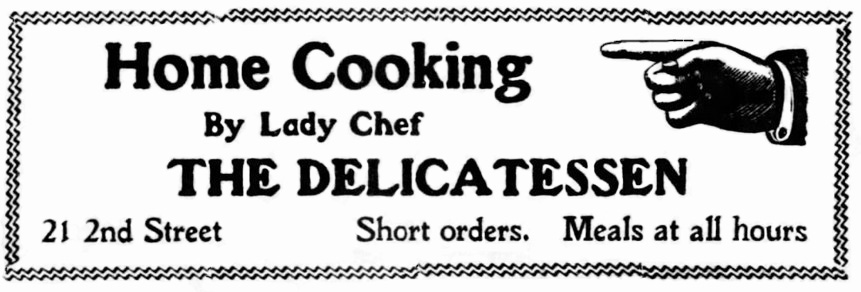
What accounted for the increase of women chefs in the first half of the 20th century? The short answer is war and decreased immigration. American-born men were not terribly interested in working in restaurant kitchens, but there were numbers of women available who had studied home economics, including dietetics. Many of them went into institutional kitchens, but from there some took jobs in restaurants. [Advertisement, Reno NV, 1905]

Two news items of the early century undoubtedly inspired American women to aim for chef positions. One was the widespread story of Rosa Lewis, “chief culinary artist” of London’s Cavendish Hotel, paid the then-enormous annual salary of $15,000. And, in 1907 the newly opened elite woman’s club in New York, The Colony, hired Sophia Nailer as chef. Like so many women cooks she had previously worked for wealthy families.
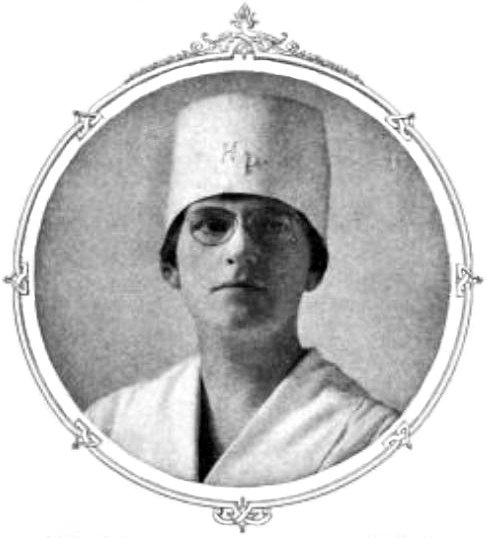
But despite the few women at the top, it seems that most women who held chef positions in hotels were hired mainly because they added homely dishes to the menu for guests, particularly residential guests, who were tired of typically routinized hotel menus. This seemed to account for the hiring of Anna Tackmeyer [pictured, 1919] as chef at New York’s Hotel Pennsylvania in 1919 to run the “home cooking department,” which operated separately from the main kitchen. In the 1920s some restaurants, cafeterias especially, proudly advertised they featured home cooking with only women in the kitchen. White men often refused to take orders from women, so it was common that restaurant kitchens with women chefs would be entirely staffed with women.
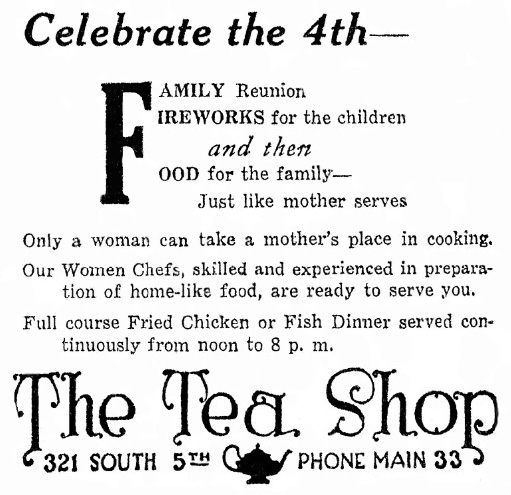
More typically, though, women chefs in the early century would work in the kitchens of small hotels in remote locations, such as in Baxter Springs KS with a population under 2,000. Others worked in urban tea rooms which were often women-owned and where the majority of patrons were women. [Advertisement, 1924, Springfield IL]

It was an established belief that women could not handle meat. Yet, a want ad in the trade journal Hotel World in 1921 defied this conviction. A woman chef sought “full charge” in a high-class place, claiming she could handle it all: “Meat, pastry, carving.”
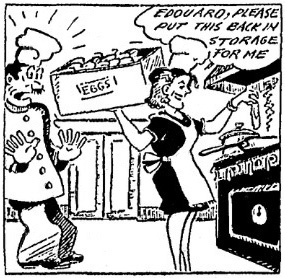
The shortage of men in WWII opened up possibilities for women chefs. The American Hotel Association reported in 1943 that 330 hotels nationwide had women chefs. Working in Miami, one woman hired to replace a male military recruit retained his title as “second chef and broiler man.” She reflected the heady feeling this could give a woman, boasting in a letter to the editor that lifting heavy pots and crates was something she didn’t give a second thought to. [cartoon illustration, 1946]

Sociologist William Foote Whyte observed in 1948 that the French chef had lost control of kitchens and that “many of our modern American kitchens with women cooks and food production managers have completely lost the old distinctions of rank.” Of course this could be seen as the classic situation of women not getting into what had been male-dominated ranks until the positions had lost status. According to a spokesperson for the National Restaurant Association in 1952, the traditional “hat wearing, and artistic male chef” was being replaced by trained women dietitians who had a more modern outlook on how to run a kitchen.

Despite these advances, though, men still controlled most commercial kitchens through the 1960s and beyond, even into the 1970s when the Culinary Institute of America, which had admitted very few women since its creation in 1946 to train returning GIs, began to welcome women students. It would be slow going for women chefs for many years thereafter, but progress would continue.

After the pandemic, who knows what situation women chefs – or restaurants in general — will face?

© Jan Whitaker, 2021
7 Comments

Filed under proprietors & careers, women

Speed eating

Since the early 19th century, observers have commented on how fast Americans eat. Visitors from other countries were especially apt to notice the speed with which people, particularly men, gulped down their food and hurried away from the table as quickly as possible.

In the 1843 book Men and Manners in America, the author observed that “all was hurry, bustle, clamor, and voracity, and the business of repletion went forward with a rapidity altogether unexampled.” He described how at breakfast he had barely arrived at the communal table as others were rushing off, leaving behind a terrific mess of chicken bones, an upset mustard pot, and a tablecloth with egg, coffee, and gravy stains. Dinner was no better: “the same scene of gulping and swallowing, as if for a wager.” Many of his fellow diners left the dining room before the second course and few waited for dessert.

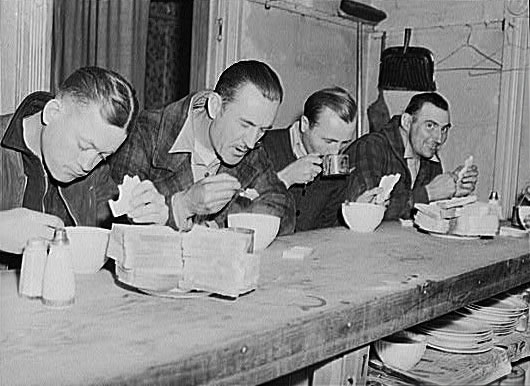
His observations were ratified by many others, continuing throughout the 19th century and into the 20th. New York’s inexpensive “slam-bang” places with counters were especially noted for their customers’ speed of eating. Viewed from the back, wrote an essayist in 1865, a row of 30 men with heads bent down and elbows moving rapidly looked as though they were weaving or fiddling. They finished in about 8 minutes.

A Scribner’s story in 1874 described the typical American restaurant as a place where men “do not eat – they feed,” without even removing their hats. It reported that the average mid-day “dinner” time lasted 6 minutes and 45 seconds. At New York’s Astor House of the 1880s – scarcely a low-class eatery – many of the male customers ate standing up at a counter, a practice that was by no means rare. A visiting French economist attributed the popularity of 5-minute counter lunches in saloons to the wish not to interfere with business — a convenience “that does not cut the day in two.” Or, as another writer put it in 1895, “The ammunition is put in, with a wad of dessert on top, and in ten minutes the man who is going to be a millionaire in less than ten years is back at his desk, loaded and pointed at his work . . .”

By the late 1890s, women had also become speed eaters, “stopping in restaurants when shopping and being in such a hurry that they don’t care what they eat and do not even remove hats and coats.” The so-called “new woman” was ready to sit at lunch counters “like a man and eat her pie and drink her coffee in a hurly-burly.”

The late 19th century also witnessed the development and spread of new restaurant types organized around speed – the cafeteria, the automatic restaurant, and the quick lunch, all of which were based on the abolition of table service. They also did away with the much-hated custom of tipping that was widely viewed as a foreign importation from old and dying Europe.

Through the 20th century speediness was made into a science, increasingly applying not only to how fast customers ate, but how quickly food could be prepared, how quickly customers could be presented with food, and how they could be induced to leave as soon as possible. The hot noontime “dinner” gave way to the sandwich lunch. The number of menu choices was reduced. Chains developed that produced food in central commissaries, doing away with the need for full-scale restaurant kitchens. Cafeterias discovered they could speed up the serving line by wrapping silverware in a napkin. Uncomfortable seating could be designed to stop patrons from lingering.

After the second World War, in which the military had developed rapid methods of feeding troops, speed-up technology advanced in restaurants. A California drive-in had machines that could mold 800 hamburger patties per hour and slice 1,000 buns in the same time. In 1956 an automatic broiler was advertised to drive-ins that broiled approximately 300 burgers an hour. The franchise system began to spread quickly to drive-in eateries across the country, but now without curb service because it was much too slow even if carhops wore roller skates. Even table-service restaurants, catering to the relatively leisurely dinner crowd which was on the increase in the 1960s, improved their speed with frozen foods, boiling bags, and microwave ovens.

By 1965, more than 70% of the more than 378,000 commercial eating places in this country were quick-service restaurants, according to a marketing research study.

No one comments about Americans eating fast anymore. It has become normal.

© Jan Whitaker, 2021

7 Comments

Filed under cafeterias, chain restaurants, patrons

Top posts in 2020

It’s been a year! Bad for restaurants but good for restaurant history. I’m disturbed by the number of restaurants that became history this year and the many that are barely hanging on. It’s great that my blog has fared well but I’d rather see good fortunes shared.

The top post was a controversial one: Aunt Fanny’s Cabin. I focused on its troubled relation to race, which many readers disputed, arguing that the Black staff loved working there. Others ignored the post’s theme and just commented on the restaurant’s fried chicken.

The second most popular post was about Wolfie’s, in Miami. Since I published this post in March of 2011, it has consistently drawn large numbers of readers, becoming the all-time #1 post about an individual restaurant.
Other starring restaurants that drew many readers were (in this order): Schrafft’s, The Bakery, The Bird Cage, Miss Hulling’s Cafeteria, Toddle House, The Pyramid, and The Silver Grille. Note that two were in department stores: the Bird Cage in the newly-closed Lord & Taylor, and the Silver Grille in Higbee’s.

The number three post was Taste of a decade: 1970s restaurants. That was the decade in which many small chef-owned restaurants came along, introducing more adventurous menus and moving away from the post-war favorites, steak and baked (potatoes).

Most surprising to me was the number of clicks on Sawdust on the Floor, a post not focused on an individual restaurant, so not a fan page. This made me happy because I actually prefer researching and writing posts on trends and characteristics of restaurants.

Another surprise in 2020 was the increased number of appreciative comments — and especially emails — that I received from readers who took the time to write. Despite the contentiousness and divisiveness on display this year, I am also struck by how many people have gone out of their way to be kind and thoughtful.

Finally, I’m remembering what a friend said to me when I began this blog in 2008: Won’t you run out of things to write about? No, my list of ideas is longer than ever.

Meanwhile, wishing you all the best for 2021!

23 Comments

Filed under blogging, favorite posts

Your favorite restaurant?

What was your favorite restaurant of the past? One that is no longer around, but that you think of all the time with fond memories. And what was it about it that you especially liked? The food, the atmosphere, the staff – or maybe all of those. Tell us all about it, including where it was and give a rough idea of when you used to patronize it.

One of my favorites was Duff’s in St. Louis’ Central West End. Oddly, I have no memories of what I ate there at all, though I know I was happy with their menu. What I liked about it was that it represented a new trend in eating places in St. Louis, occurring in the 1970s. (It opened in 1972 and closed in 2013.) The new breed – also represented by others in the Central West End and University City — were at least somewhat more adventurous with their cuisine, but the big difference was their laid-back, offbeat “vibe.” At Duff’s this was due in large part to the mismatched tables, chairs, dishware, silverware — just about everything. It was friendly but not in an invasive, scripted way. A great place to meet friends for lunch.

62 Comments

Filed under atmosphere, decor

The Automat goes country

What happened when Horn & Hardart went outside the densely populated city and into the countryside?

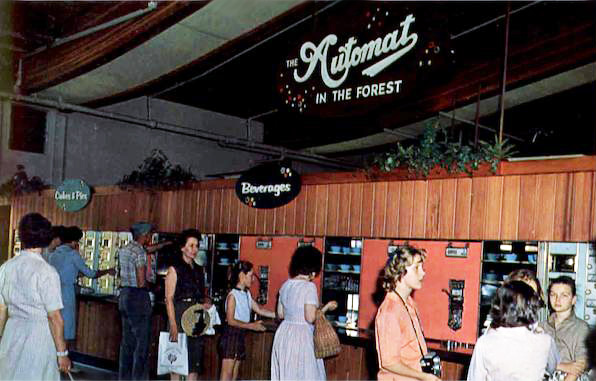
“The Automat in the Forest” was located in Sterling Forest Gardens, a 125-acre private park filled with attractions such as huge floral displays, children’s playgrounds, fountains, and a meditation garden. The enterprise, created by a NYC investment company, was a one-hour drive outside New York City.

The Gardens presented a highly-engineered version of nature achieved with imports such as 1.5M tulip bulbs and 300 robins for the grand opening in spring of 1960. (The robins arrived by plane.) There were swans, peacocks, cranes, and flamingos, while native wildlife was strongly “discouraged” from participating. There were even special “picture-taking spots” where a sample photograph was displayed along with precise instructions on how to get the same results.

At the time of the 1960 opening a wire-service story disclosed a jarring fact: “The setting is so romantic that few visitors would guess that the Union Carbide Corporation’s laboratory is constructing an atomic reactor over the nearest hill.” That did not seem to deter visitors.

Into this surreal wonderland came the Automat in 1962. That summer a promotional photo showed children feeding a deer in front of a wall of vending cubicles – which was odd since deer were forbidden in the gardens. The photo’s caption explained that the Automat was the first to be located outside a city, and described it as having redwood planks and pastel panels rather than the usual marble facing “in keeping with its surroundings.” In the postcard above, the vending wall looks oddly out of place in the high-ceilinged building and has little feel of an urban Horn & Hardart.

At the same time that the Automat moved into the Sterling Forest Gardens, Horn & Hardart’s Food Service and Management Division was advertising that it could furnish In-Plant ‘Automats for Industry’. I suspect the factory installations were very similar to the array in the Gardens.

The Automat was not the first eating place in the Garden’s International Pavilion. A 1961 postcard described the original eating place, a buffet, as “tastefully decorated in international motifs.” Nor was it the last restaurant in the Pavilion. It was there only two years, continuing in business through the 1964 season. By the 1965 Spring Festival the Automat in the Forest had been replaced by the Sterling Farms Restaurant. Later, in 1968, there was a Schrafft’s occupying the Pavilion.

Horn & Hardart also operated a second eating place in the Gardens, Peacock Patio, that had a cafeteria and barbecue. Not far from the park, it ran a Country Store where, ironically, H&H frozen prepared dishes were sold. It’s not clear how long either remained in business under Horn & Hardart’s ownership.

As might be imagined, Sterling Forest Gardens was popular with garden clubs, groups of older adults, and bus tours generally. Without doubt its most unusual guests were Marshall Tito of Yugoslavia and his wife who visited in summer 1963, one day after Tito enemies had infiltrated the Waldorf Towers where the Titos were staying in NYC. Distrustful of the city’s ability to protect him, Marshall Tito cancelled plans to attend a 1,100-person dinner at the United Nations, asking instead to visit a farm. He was taken to Sterling Forest Gardens, where he and his wife lunched at the Automat. Walking through the Automat’s cafeteria line, he chose a hamburger steak, french fries, and macaroni while she accompanied her ground meat with fries, carrots, and spinach.

After several years of slumping attendance, the Gardens closed in 1976. Later, it became a site for medieval jousting.

© Jan Whitaker, 2020

7 Comments

Filed under alternative restaurants, chain restaurants, Offbeat places, patrons

Added attractions: cocktail lounges

Neither cocktail lounges nor cocktails were new in the 1930s when both became quite popular. Far back into the 19th century, men enjoyed lounging at bars and tables in hotels and other places while they imbibed cocktails, along with cobblers, fixes, fizzes, flips, juleps, punches, slings, smashes, sours, and toddies. Cocktails became popular after the Civil War and a regular pre-dinner habit in the 1890s.

In those times drinking in public was a male enterprise. Later, during Prohibition in the 1920s when it became illegal to sell alcoholic beverages, drinking in the home, formerly rare, became common. Women who had generally shunned drinking in public began to indulge. Since bootleggers made more money from concentrated alcohol than wine or beer, cocktails rose in favor with both sexes.

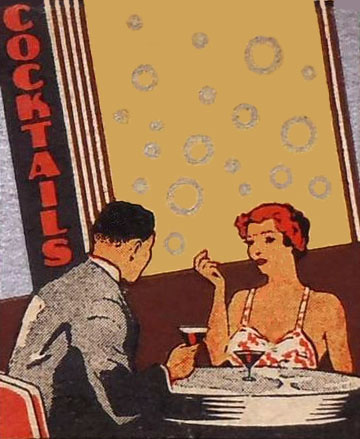
Upon repeal of Prohibition in the early 1930s, hotels and restaurants made plans to capitalize on cocktail drinking, ushering in the era of luxurious cocktail lounges that could attract women as well as men. According to one report in 1934 the new spaces attained a level of respectability by avoiding the old term “bar room,” preferring instead to be called cocktail bars, cocktail lounges, Persian rooms, palm rooms, and tap rooms. Cocktail “hours,” often accompanied by a tinkling piano, were instituted to encourage patronage.

In some senses, though, Prohibition hung around for years, even decades. Some states and towns did not permit cocktail lounges, while others only allowed men to be served at bars. The latter rules favored having a lounge with tables.

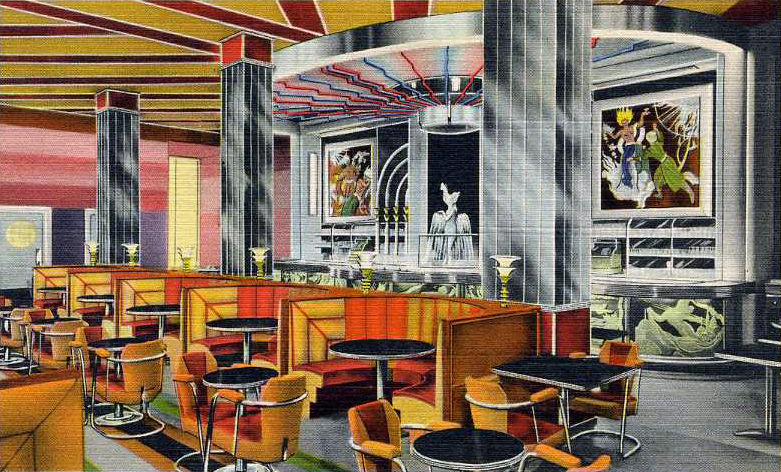
Hotels were prominent among the places where cocktail lounges were installed, and they still remain in many today, providing meeting places for socializing with friends or doing business with associates. Some, such as the new lounge at the Hotel Jermyn in Scranton PA in 1935, were quite glamorous with their bright colors, shiny surfaces, and over-the-top interpretations of art deco motifs.

It isn’t too far fetched to say that in the 1930s New York cocktail lounges were swankier than the restaurants they accompanied. Creative uses of materials such as metals, glass and leather, modern furniture, murals, and clever lighting set a tone quite unlike earlier decades. Color choices were striking, especially on surfaces not usually painted brightly such as tabletops and ceilings.

But women didn’t really love the hard, smooth yet cold, ultra-modern look. According to a 1934 article in Restaurant Management titled “The Ladies Must Be Pleased,” they actually preferred Colonial themes, something that designers would have realized if they had paid attention to the tea rooms of the 1920s.

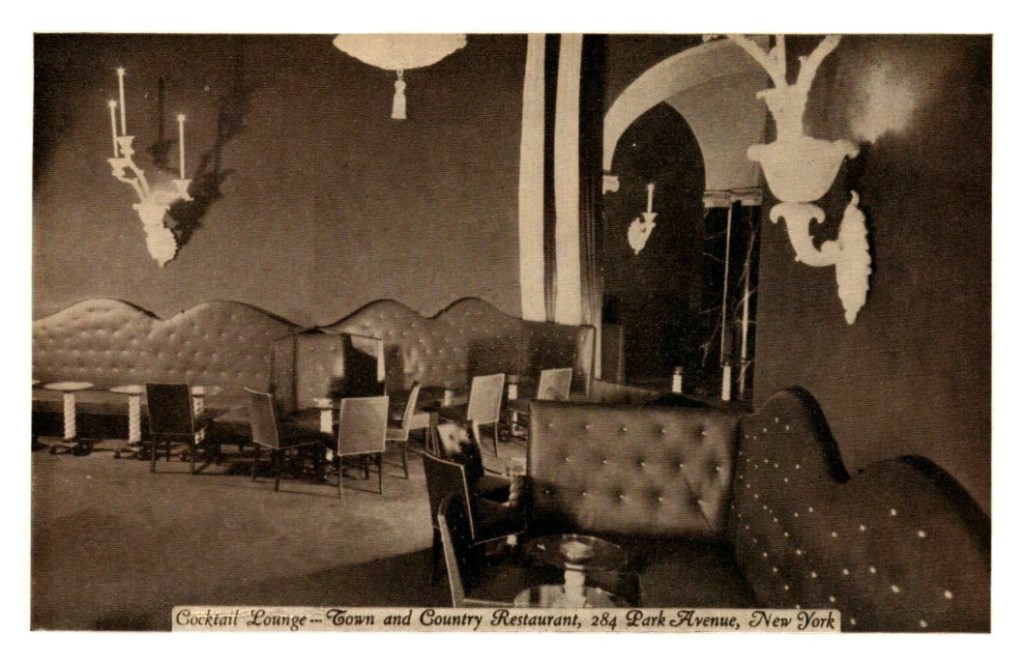
The bold styling of the Jermyn was passé by the 1940s, when the oh-so-glamorous and romantic cocktail lounge at the Town and Country Restaurant in NYC opened on Park Avenue. It seemed to epitomize the very concept of lounging with its high-back tufted banquettes.

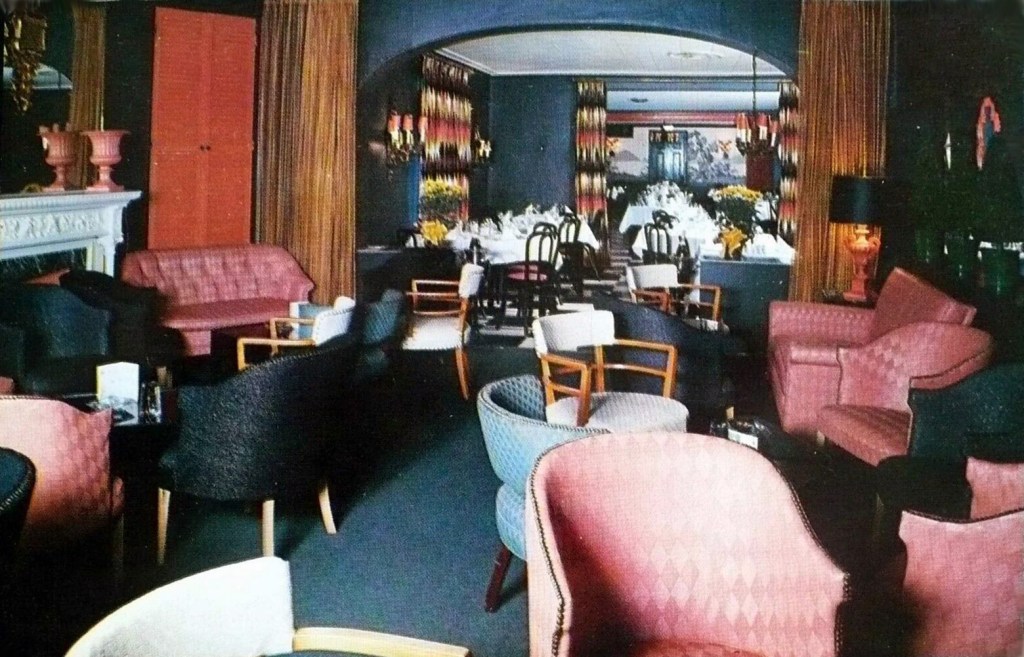
The Keys restaurant, in Indianapolis, had the informal look of a living room in the 1950s.

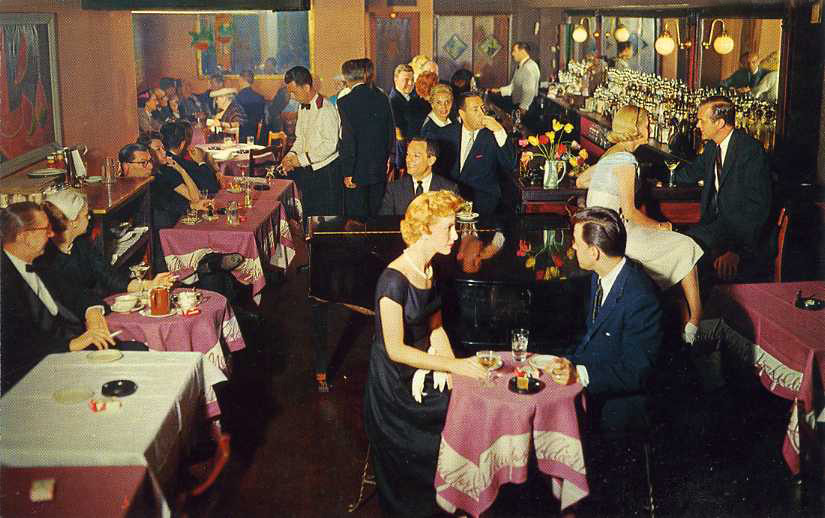
The advantages of setting off a space for a cocktail lounge made good sense for restaurants because it drew people in. And there was always a good chance that some who came in for a drink would decide to stay for dinner. Plus the lounge served as a waiting place for diners. Liquor offered higher profits than food, and having an attractive lounge extended the flow of traffic both before and after the dinner hours. Of course space was at a premium, with high rents in some cities, New York in particular. Anyone attending Goldie’s supper club in New York in 1955 [shown at top] was going to be crammed into a tight space with the club’s owner, pianist Goldie Hawkins. How servers maneuvered around his piano without spilling drinks on the well-dressed patrons is a mystery.

Cocktail lounges were rarely found in small cafes, and pretty much never in commonplace lunch rooms. But they were found in a number of Chinese restaurants that adopted a nightclub style, as well as some California drive-ins, a restaurant type quite different than the standard drive-in, and often referred to as the California coffee shop. The Tiny’s drive-in chain in the San Francisco area had it all: carhops, a dining room, and a cocktail lounge.

Yet, clearly, America was never totally comfortable with cocktail lounges, or bars, and regulated their numbers. Even as the Chicago suburb of Glen Ellyn eased its liquor law, allowing restaurants to serve mixed drinks, it capped cocktail lounge seating to 25% of seating in a restaurant’s dining areas. The 1980s saw the cocktail lounge recede somewhat as a restaurant feature when movements to reduce drunk driving took hold and the cost of liability insurance rose. Consumption of cocktails and hard liquor generally shrank as wine grew in popularity. These trends continued into the 1990s as cities restricted the number of liquor licenses granted.

In recent years cocktails have become popular once again. Many restaurants have bars, but I really haven’t noticed that cocktail lounges have reappeared.

© Jan Whitaker, 2020

2 Comments

Filed under atmosphere, decor, night clubs, women

Lunching at the drug store

I’ve often noticed how the history of some institution or object does not quite mesh with the nostalgic haze that eventually envelops it. To a significant extent this is true of now-vanished drug store soda fountains, many of which became places for lunches as well as for sweet fountain treats before they vanished.

Independent soda fountains date as far back as the 1810s. Decades later some druggists began adding soda fountains to their apothecaries, mainly as a favor to their customers. Soda fountain drinks, whether plain carbonated water or water mixed with syrups, were viewed as healthful and in accord with the temperance movement of the 19th century.

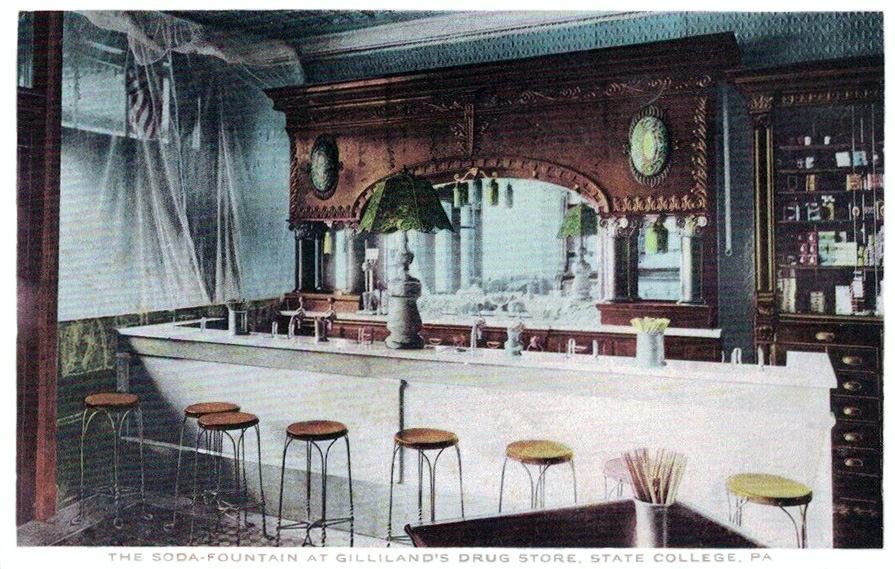
Soda fountains emphasized the elaborate beauty of their fountain apparatus, especially after a marble soda fountain went on display at the 1876 Centennial in Philadelphia. A soda fountain in Boston in 1886 was described as made of “black and chocolate marble, surmounted by a statue of purest marble, representing a dancing girl.” In addition to the artistic features, customers were attracted by the technical aspects of fountains with their tubes and faucets.

Fads in drinks meant that there was a constant search for newness, with Easter punch the first choice in 1890, but surpassed in 1891 by orange phosphates and Creme de Russe. The number of concoctions was endless. The Standard Manual of Soda and Other Beverages, published in 1897, promised more than 1,500 “formulas,” including how to mix “Coloring Agents, Foams, Extracts, Essences, Fruit Juices, Syrups, Meads, Beers, Ales, Phosphates, Lactarts, Egg Drinks, Ades, Milk and Cream Drinks, Medicinal Drinks, Popular Fancy Drinks, Hot Soda Drinks, Ice Creams, Ciders, Fruit Wines, Liqueurs, Cordials, Bitters, [and] Cremes.”

In the 1890s druggists began to feel economic pressure to install soda fountains. Apart from drawing people into the store, soda fountains produced good profits at a time when department stores were taking away some of druggists’ business by selling over-the-counter medicines. Plus, the complex range of possible drinks did call upon mixing skills in a way that was at least somewhat similar to what druggists did in compounding medicines. They could reassure themselves — if need be — that they were using “formulas” rather than “recipes.”

In the 1910s, many druggists took a step further and began offering light lunches along with fountain drinks. According to one account, this was a way of ensuring that soda fountain traffic did not die away during lunchtime as it had been doing.

The added profits from selling sandwiches and a few other edibles were welcome but, having spent many years learning their trade, many druggists were depressed about needing to go into what became known as the luncheonette business. A 1914 survey of pharmacists found that most respondents were not thrilled about selling food. Replies included, “Let the hash houses have the pie business.” Some called the situation degrading and asked, “Can we still claim the right to class our calling as a profession?” and “When a man finds it necessary to make a living selling hot dogs, he had better pull in the sign ‘Druggist.’”

Nevertheless the luncheonette business spread and grew, as did druggists’ dependence on this source of revenue. In the 1920s it was not at all unusual to find a luncheonette in a drug store, some even selling hot dishes such as chop suey and tamales. By 1931 an estimate was that nearly half of the 25,000 drug stores nationwide served fountain lunches, with 2,800 doing so in NYC alone. And it was said that some druggists were taking in more money from food service than from everything else combined.

As popular as they were with customers, soda fountain luncheonettes were deeply disliked by catering employee unions, as well as restaurateurs and lunch room owners who viewed them as illegitimate competitors. A 1926 article in the trade magazine Cafeteria Management argued for higher national standards for restaurants, pointing out drug stores as examples of businesses that should not be in the feeding business. To gourmets who mourned the loss of fine restaurants in the 1920s when the sale of alcohol was banned, drug store food exemplified the worst of the worst. Duncan Hines, who began to rate restaurants across the entire country in the 1930s, pointed to the drug store lunch counter as a “sinister influence” and asked, “How in God’s name can anyone who regularly eats drugstore snacks ever be expected to recognize a good meal when it’s served?” Much of the food sold in drug store luncheonettes in the 1920s, was in fact bought ready-to-eat or nearly so from commercial commissaries.

Given all the criticism of drug store lunches, it’s rather surprising to see a menu attachment from Walgreen’s in 1948 and note how closely it resembles a full-scale restaurant, both because it offers 8 “complete dinners” with soup, potatoes, vegetables, roll and butter, desert, and beverage and because it describes the sauces for two fish dishes à la française! Of course it’s likely that the big drug store chains met a higher standard of cleanliness and food quality than many of the small stores had in earlier decades.

Drug store lunch counters were still sufficiently popular in the early 1960s that they, along with dime store counters, were sites of Black protestors claiming a right to patronize them. Notably, a 1951 report of the Congress for Racial Equality cited Walgreen’s stores as among the very few eating places in St. Louis that served Black customers.

By the 1970s drug stores were beginning to close their lunch counters. As early as 1970 Walgreen’s operated only one in New York City, down from 17. Whelan’s too had closed most of its counters there. The trend swept across the country and by the 1980s, nostalgia attached to the few left, most of which were limited to serving sodas and ice cream concoctions. Bitterness among druggists is long forgotten, along with other complaints. Now the best way to find any still in existence is to search for “old-fashioned soda fountain.”

© Jan Whitaker, 2020

14 Comments

Filed under alternative restaurants, popular restaurants, restaurant issues

Lunch in a bus station, maybe

In November, 1961, new Interstate Commerce Commission (ICC) rules took effect requiring all interstate bus terminals to integrate their lunch and waiting rooms. The new regulations went against Jim Crow laws in the South that required separate “white” and “colored” facilities.

Although travel on interstate buses had been integrated by the ICC in 1955, the regulations had not covered restaurants or restrooms in the terminals.

The new rules were issued just months after the Congress of Racial Equality organized “Freedom Rides” with groups of Black and white members who rode buses to Southern states — Alabama and Mississippi in particular — with the intention of challenging segregated bus station facilities. In May, 1961, the Freedom Riders were attacked by violent white mobs who beat them and firebombed one of their buses while it was stopped with a flat tire outside Anniston AL. [photo above]

Twelve days after the ICC rules took effect a Black journalist, Bettye Rice Hughes, set out on a bus trip through the South to observe firsthand what had changed – and what hadn’t. She was a graduate of Lincoln University in Jefferson City MO where she majored in journalism. She and her husband, Albert Hughes, a photographer for the Associated Negro Press [ANP], lived in Los Angeles. She was a reporter for the ANP, but it is unclear if that was her job at the time of her tour. In 1964 she was editor of the women’s page of the San Francisco Sun-Reporter. That year she took part in a panel at a conference on Black writers sponsored by the University of California, Berkeley. In 1966 she left the Sun-Reporter and may have moved to New York City. I was not able to trace her any further than that. [photo: Bettye Jean Hughes at 1964 conference, talking with LeRoi Jones (Amiri Baraka)]

Her six-week tour took her through Oklahoma, Arkansas, Tennessee, the Carolinas, Florida, Georgia, Alabama, and part of Mississippi. Her story, “A Negro Tourist in Dixie,” was published in April, 1962, and continues to be read today.

The bus she took avoided going through all but a corner of Mississippi – where it made no stops – and her tour did not include Louisiana, the birthplace of segregated railroad travel.

In her report of the bus tour it’s clear that she is a close observer, paying attention not only to the reaction of white people to her, but also to the reaction of other Black people, on the bus and in the stations, including kitchen workers. Clearly she is an object of curiosity, but also hostility. “I felt that the threat of violence was always there – particularly in South Carolina, Georgia, and Alabama – but somehow it never erupted,” she writes. She is served in the lunch rooms, though often grudgingly. On a couple of occasions she has to insist on her right to eat in what were still considered by many to be “white” lunch rooms.

The first direct challenge to her presence in a lunch room came at a Greyhound station in Florence, South Carolina. There, the white cashier as well as a white counterman yelled at her to go to the station’s other lunch room, “the one for you.” She stood her ground, despite her growing fear, and succeeded in getting served, but the episode filled her with dread about the next stops. During the encounter, white patrons, she noted, were silent and “pointedly staring at their food.” In Tallahassee FL, the “problem” of serving her was solved by having a Black cook do it.

Throughout her experiences in lunch rooms she felt the eyes of Black travelers on her as much as those of whites, though evidently few dared to order food. She concluded her essay expressing hope that Black passengers would assert their rights in the future and that white Southerners would become accustomed to eating in lunch rooms with them.

I was curious about how lunch room integration proceeded in other parts of the South that she did not visit, and how things developed after her tour. I found that in quite a few cities officials refused to integrate, insisting that local Jim Crow laws took precedence over ICC rulings. The major of Shreveport LA put it bluntly: “We don’t care about the ICC.”

In Birmingham, the manager of the Greyhound cafeteria was fined and given a suspended sentence for allowing Black and white people to be served together. The manager of the lunch counter in the McComb MS bus station took down the signs indicating separate lunch rooms but refused to serve five Black customers in what had been the white room. When they began banging on the counter for service, a gang of white males ran in and attacked them as well as chasing off a TV cameraman.

In some cities and towns local authorities closed their bus stations’ eating facilities rather than integrate. Federal authorities stepped in and prevented Birmingham from closing its Greyhound restaurant. But in Crossett AR a lunch room closure left a Black woman traveling with a 2-year old stuck on a Continental Trailways bus with little food for two days in a snow storm. White passengers had found rooms in a local hotel, but the hotel told the Black woman they were full. After a radio station ran a story about their plight, Black families offered a room and neighbors brought “enough food for a banquet.”

By the time Bettye Hughes’ essay came out, it was generally possible for Black travelers to get a meal in a Southern bus station, though resistance continued in some places. An Associated Press story declared that Virginia and the Carolinas had accepted bus station integration, but Birmingham had integrated “in name but not in practice.” It also reported that Black people were staying away from bus station restaurants generally. They knew they still were not welcome.

© Jan Whitaker, 2020

14 Comments

Filed under atmosphere, lunch rooms, racism, restaurant issues, waiters/waitresses/servers

Suffrage tea & lunch rooms

In roughly the ten years preceding passage of the 19th amendment giving women the vote in 1920, suffragists ran tea rooms and lunch rooms to raise funds for the cause and to publicize their arguments for why women should have the right to vote.

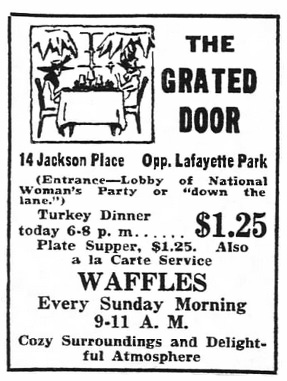
Most major cities – New York, Boston, Baltimore, Hartford, Charleston, Atlanta, D.C. [see above illustration], etc. – had a suffrage tea or lunch room, many located in the local suffrage headquarters. In smaller towns they might be temporary, running only for a week or so in order to get money for something such as sending a delegate to a meeting out of town. There were other related ways to make money: in San Francisco suffragists sold a specially packaged Equality Tea, with a booth in the Emporium department store.

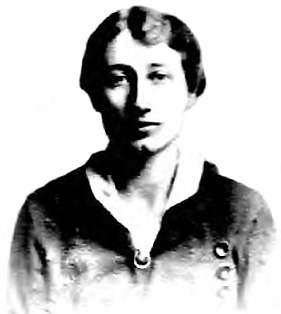
Some groups served only tea but in larger cities tea and lunch rooms also provided food. When a suffrage tea room opened in Chicago in 1914, it offered a variety of salads and sandwiches with a beverage for 35 cents. Desserts could be added for another 15 cents, but evidently pie a la mode was reserved for male guests. Men were warmly invited to patronize suffrage tea and lunch rooms, and treated very well, since they would be the ones deciding whether women would get the vote. Lifelong peace activist Mildred Scott Olmsted [shown here at age 29], interviewed at age 97, said she had been a volunteer waitress at Philadelphia’s suffrage tea room, where they “lured men in for a good cheap business lunch.” “Then,” she said, “you could hand them literature and talk.” No doubt she did a lot of talking. Over and over she heard the argument that women should rely on husbands, fathers, and brothers to vote for them.

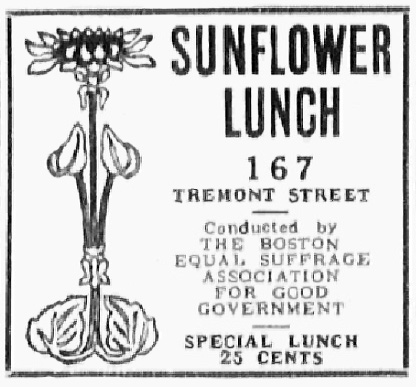
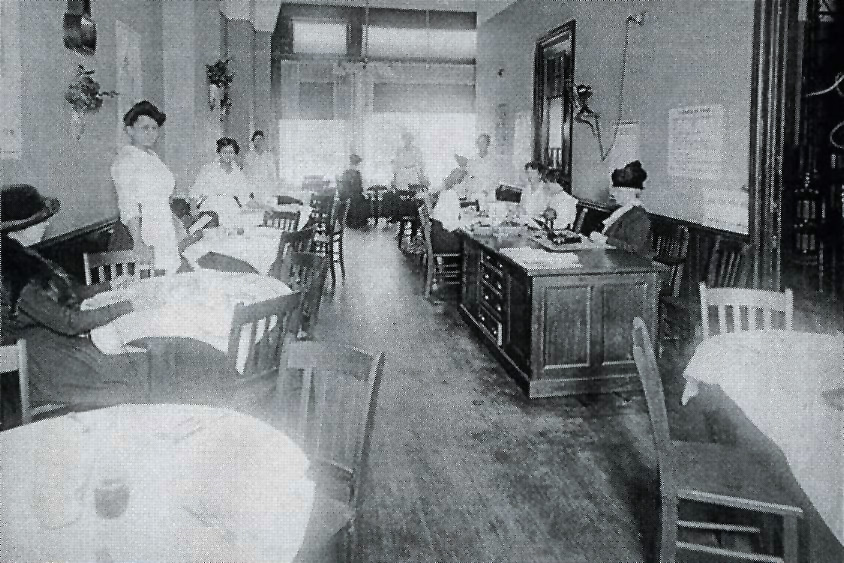
At Boston’s suffrage lunch room on Tremont Street [shown below] substantial meals were available, such as corned beef hash with beets and a muffin or boiled salmon with egg sauce and potatoes, both for about 30 cents. The back of the menu was used to inform diners that if the lunch room succeeded in adding another 40 daily patrons to its usual 160, it would make enough profit to cover its office rent. Yellow was the color most often associated with the suffrage cause, explaining the Sunflower name adopted by the Boston suffragists.

Undoubtedly, the most eye-catching of the pro-suffrage tea and food dispensaries was the yellow and black lunch wagon that showed up in the Bronx near Fordham College in the summer of 1911. Suffrage volunteers worked in it, selling lemonade and sandwiches. The plan was to have one wagon in each of the five boroughs; one showed up in Brooklyn in 1915, though I couldn’t determine if there were others.

The lunch wagon was only one of New York’s suffrage eating places. At 70 Wall Street was the Votes for Women lunch room run by the Empire State Suffrage Campaign Committee, in a space donated by the husband of one of the suffragists. When a promise of homemade food was made on September 16, 1915, the place was mobbed, with men crowding the tables and “against the walls.” A menu published later promised “Real Home Cooking,” featuring Chicken Salad, Corn Bread, Waffles with Real Maple Syrup, and Home-made Ice Cream.

The offer of “homemade” food was politically strategic in that it reinforced the idea that suffragists were feminine women, not pseudo men as argued by the anti-suffragists. Using the same logic a suffrage group in Washington state put out a cookbook with 700 recipes. [1917 ad for Philadelphia’s lunch room show here]

Multi-millionaire Alva Belmont financed another New York City suffrage lunch room on East 41st street, at the headquarters of her Political Equality League. There middle-class women who could afford to spend 50 cents for lunch ate in one room, while working-class women ate inexpensive sandwiches in a second room.

Along with suffrage groups, probably every city also had an organization of women opposed to equal suffrage. They also tried to gain support through teas and lunches, though these tended to be occasional events held at the antis’ headquarters or in someone’s home. In February 1917, the District of Columbia Association Opposed to Woman Suffrage, for instance, created a pink tea room – pink being the antis’ color — at their Pennsylvania Avenue offices for visitors attending the inauguration of Woodrow Wilson. In Des Moines IA, the local anti-suffrage association held a tea reception at Younker’s Department Store to host a prominent anti-suffragist from Pennsylvania.

Just how helpful suffrage eating places were in boosting the cause is impossible to assess, but they surely must have helped build bonds among feminist activists such as Mildred Olmsted.

© Jan Whitaker, 2020

3 Comments

Filed under alternative restaurants, lunch rooms, patrons, tea shops, women

Image gallery: have a seat!

How often do you notice the chair you are sitting on in a restaurant? I’m a fairly observant person but I couldn’t tell you what kind of chairs my favorite restaurants use. Unless a chair is unusually uncomfortable I doubt I’d pay any attention to it at all.

Restaurant owners, managers, and designers, on the other hand, have thought about chairs a lot. There are numerous considerations that go into selecting them, including price, comfort, durability, style, portability, and how much space they occupy.

And let’s not leave out gender, because many of the chairs used in the 20th century were either intended to appeal to men or women, with the understanding that women will adapt to male preferences, but not necessarily vice versa. A 1912 etiquette column counseled women not to wrap their feet around the front legs of chairs in restaurants, but to keep them close together, facing straight ahead and flat on the floor. The author admitted the reason so many wrapped their feet around chair legs was that the chairs were too high for most women!

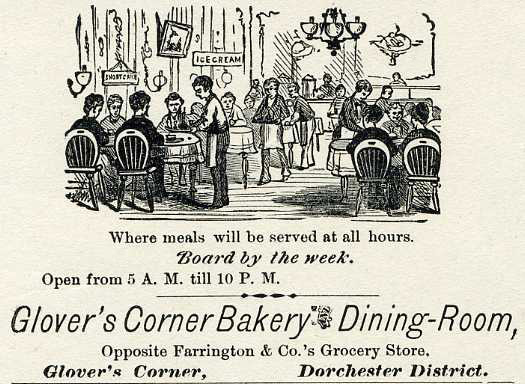
It’s hard to say exactly what chairs were used in the 19th century because of the lack of available images as compared to the 20th. In the early 19th century, public eating places were often furnished with benches, while chairs came later. After hunting up as many drawings of chairs as I could – mostly from Victorian trade cards and circulars of the 1880s [e.g., Glover’s Corner, Boston] — I’d say seating in ordinary, non-deluxe restaurants was fairly simple, with slat or spindle backs.

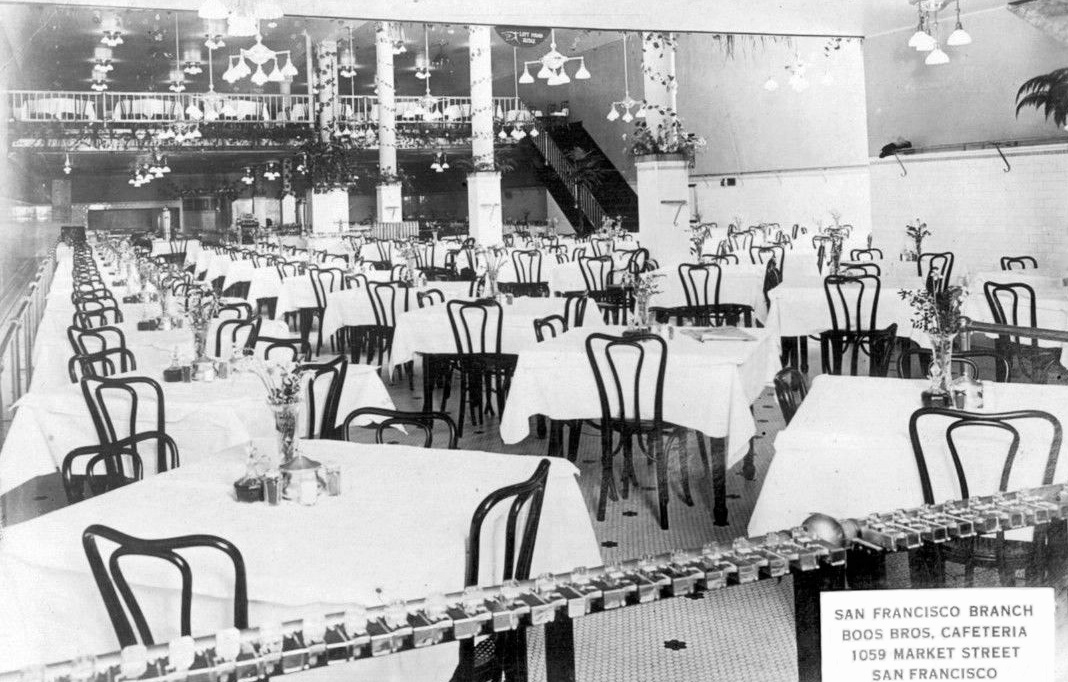
Certain chairs have been dominant in restaurants at various times over the past decades. The most successful beyond a doubt was commonly known as the “Vienna chair.” Used worldwide in the 19th and 20th centuries, it was one of the bentwood chairs developed and produced from Carpathian beech by the Thonet Company of Austria. Its stellar success was because it was graceful, durable, and lightweight. As one of the earliest chairs to be mass produced, it was also inexpensive. [Boos Bros., 1915]

Various versions of the Vienna chair were in use in this country in the 19th century. The C. L. Woodman restaurant of Chicago advertised in 1880 that it had remodeled and added “260 pretty chairs of cane and ebony [that] recall the days of our Viennese rambles.” In 1884 B. Nathan & Co., San Francisco, ran an ad saying “Sole Agents For Thonet Bros. Indestructible Bent-Wood Austrian Furniture and Chairs, for Hotels, Restaurants and Dining-rooms.”

Somewhat reminiscent of the Vienna chair, metal “ice cream parlor chairs” were used in various types of restaurants in the early 20th century.

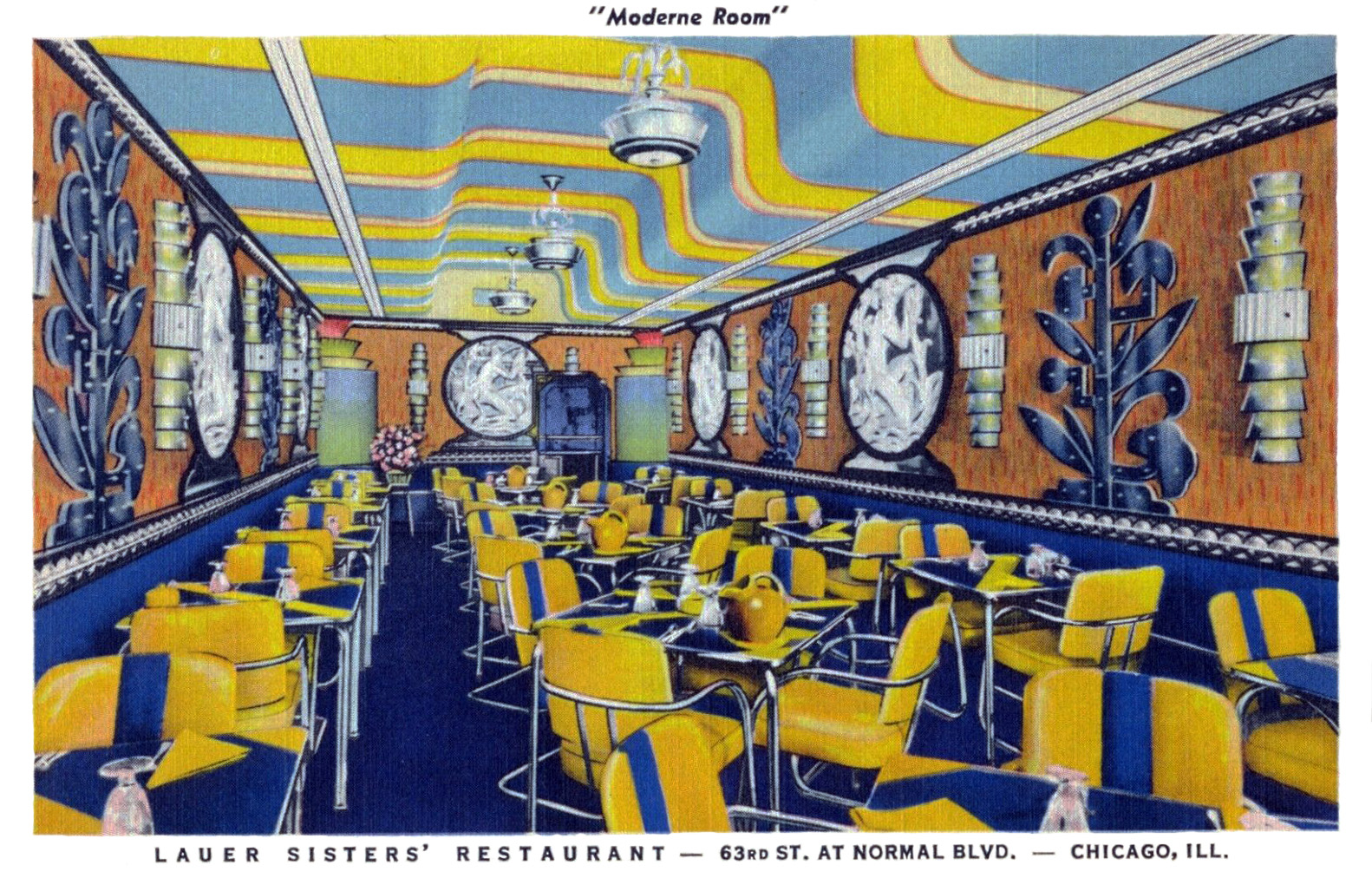
Though it continued in use until WWII and even beyond, becoming collectible in the 1960s, the prototypical Vienna bentwood chair began to look dated in the 1930s, when streamlined aluminum or chrome chairs upholstered in colorful leatherette came into vogue. Some restaurants tried to update their bentwoods with paint or cloth covers that added color. [Lauer Sister’s, 1936]

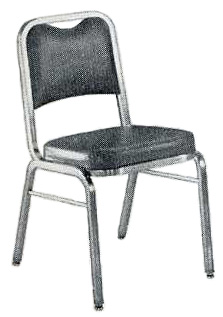
But by the 1960s chairs with metal frames and padded vinyl backs and seats lost their 1930s moderne look, retreating into plainness and, for some, stackability. I have to admit what when I see this type of chair in a restaurant I lose faith that I will encounter good food. They are often used in restaurants that cater to banquets.

Tea rooms and other restaurants that pitched their appeal to women often tried to avoid using typical restaurant chairs. A newspaper in Canton OH in 1906 applauded a new luncheon restaurant for women that had “wicker chairs . . . instead of the conventional stiff restaurant chair.” No two of the wicker chairs were alike, the article said, giving the place a desirable “homelike” look. Many other tea rooms and inns used Windsor side and armchairs evoking a sense of Colonial times.

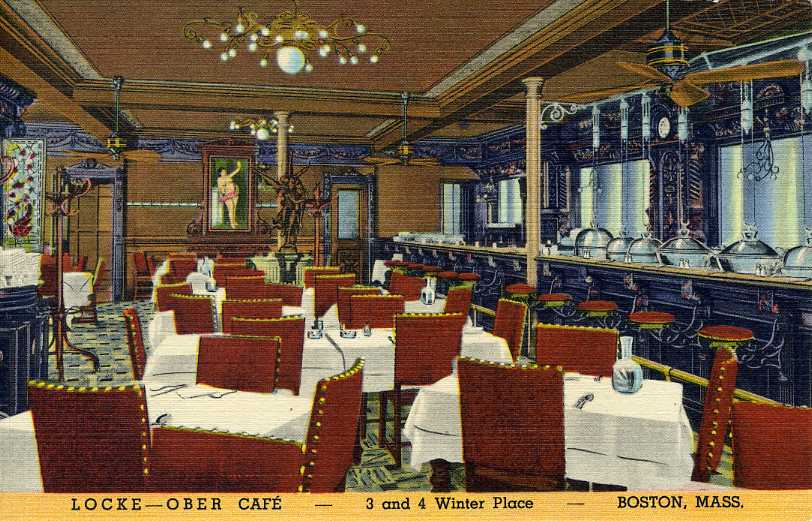
More expensive restaurants, especially those catering to men, were likely to use leather upholstered chairs, as shown in the men-only Locke-Ober restaurant in Boston.

Men evidently favored sturdy arm chairs with a clubby look or, more informally, less pretentious captain’s chairs. As early as 1862, Philadelphia’s Continental Café and Restaurant advertised that the gentlemen’s café was furnished with walnut tables with marble tops and handsome walnut chairs “covered with red morocco.”

More recently a stylish restaurant has demanded a stylish chair, though I’d be hard pressed to say what the typical restaurant chair of the 1980s up to today actually is.

© Jan Whitaker, 2020

8 Comments

Filed under restaurant decor