Category Archives: women

Catering to women’s tastes

In the 19th century and much of the early 20th restaurant owners viewed women’s tastes as quite different than men’s.

Women did not patronize restaurants to a great extent in the 19th century, but it seems when they did they preferred places that furnished ice cream, pastries, and cakes, not only for immediate consumption but also to order for the home. For instance, in 1865 in Milwaukee WI there was Thompson’s Ladies’ Restaurant, Ice Cream Parlor, and Confectionery which provided three meals a day plus Tea, along with Wedding and Party Cakes to order. [Advertisement shown below]

Such places were seemingly rare and I doubt that their customers included women of little means. In 1869, it was reported that poor working women frequented “coffee places” where they ordered simply bread or cake with coffee. But even these may have introduced the long-lasting idea that women were particularly fond of sweet foods.

I wonder if it was often the case that they made do with a simple sweet dish because that was all they could afford.

Of course, sweet dishes were not women’s only preferences if they could pay more. Oysters were also popular choices — as they were with men.

Commentary about women’s food preferences was sometimes insulting. The idea seemed to be firmly planted for decades and well into the 20th century that women were frivolous eaters while men chose real food. That would be repeated time and time again in books and newspaper stories. For instance:
1888, New York Tribune: In ladies restaurants a woman might order salad, ice cream, oyster patty, eclaire, cheese cake, “and perhaps one or two other varieties of whipped froth and baked wind.”
1894, Charles Ranhofer cookbook: “Should the menu be intended for a dinner including ladies, it must be composed of light, fancy dishes with a pretty dessert; if, on the contrary, it is intended for gentlemen alone, then it must be shorter and more substantial.”
1917, Housewives Magazine: a woman “expert” reported that men made “habitual food choices” while women “go by eye-appeal.” Typically, she explained, almost all men ate meat, while women preferred fruit salad, beans or macaroni, and cake and ice cream.

By the mid-1920s women were making up a larger proportion of restaurant goers than ever before, possibly as much as 60%. Pleasing them was becoming essential. The trade magazine Restaurant Management advised: “Many managers have not yet seen the light. If you doubt this watch the places that get the women’s trade. In the majority of cases these restaurants serve light, tasty foods in homelike surroundings and at a reasonable price “

But even as women’s patronage became important, there were still commentaries that were insulting. Eating habits were changing, possibly due in large part to Prohibition, leading the former proprietor of Keen’s Chop House in NYC to comment in 1931: “Formerly when a man took a lady to dinner he not only selected the restaurant, he took great pride in ordering a particularly choisi, well-balanced meal.” But, he said, it had become clear that now women “would rather have had the unholy hodgepodges you see them reveling in to-day.”

Even some women criticized women’s food choices. In 1937 a woman who had worked for major restaurant chains said that to succeed in the Depression tea room operators had to recognize that men wanted “real food” . . . not “Canary bird food.” [Above: Boston tea room’s “canary bird food.”]

Slowly, insults concerning women’s tastes died down, although differences in restaurant orders based on gender were still observed. In 1934 a woman tea room operator said that “The conventional woman’s taste runs to chicken patties, peas, and ice cream; men like steaks, French fried potatoes, and apple pie.”

Had differences largely disappeared by the 1950s? When I wrote an earlier post I thought that numbers of men still wanted what they regarded as he-man meals and that there were restaurants willing to cater to them.

Yes, a chef commented in 1952, there were those who still believed that men preferred “an exclusive diet of thick mutton chops, brawny steaks, large ribs of beef and mountainous apple pies” while women went for “chicken patties, asparagus points and meringue shells.” But he declared this false, saying in his experience women “want their double sirloins as big as those served to their husbands,” while the most popular choice at a NY men’s club was “creamed chicken with sherry,” despite the fact that the chicken was cut up into small chunks.

But there may still have been some resistance on the part of men about eating foods tagged as feminine. Salads are one example, a favorite with women since the 19th century, but not so much with men. That included meat and fish salads, and in more modern times, green salads. And an industry publication reported in 1960 that a large hotel lured men into ordering a sandwich by naming it “The Mountain Climber.” It was made of turkey, ham, and cheese and had been previously ordered only by women.

However, as much as the differences in the restaurant orders of men and women may have declined in the late 20th century, it seems that with a few exceptions women still haven’t achieved equal stature or full recognition as gourmets or culinary pace-setters.

I’d love to hear readers’ thoughts on this topic.

© Jan Whitaker, 2025

13 Comments

Filed under food, women

Ruth Stout, her life and tea rooms

A few days ago I read a fascinating article by Jill Lepore in the New Yorker. It was about Ruth Stout, author of How to Have a Green Thumb, Without an Aching Back, originally published in 1955. It has been reissued and is still quite popular.

There were many engaging aspects to Stout’s life, such as her affair with the radical Scott Nearing, her career as a writer, the fact that her brother was the mystery novelist Rex Stout who created Nero Wolfe, her involvement with ‘no-plow’ gardening, and the fact that lived to be 96. [Below: Ruth in 1923, age 39.]

But what especially interested me was that Stout had been briefly involved in owning and running two tea rooms in Greenwich Village around 1917. They didn’t last long, but that was true — almost typical — of many tea rooms.

The first was the Will o’ the Wisp which she opened with a family friend. It was appropriately named, being short-lived. It was ridiculed by the New-York Tribune in a 1917 story about an imaginary visitor from afar searching NYC for the “real Bohemia.” He and the writer go to “the Wisp” (as it was known), where the “young ladies” (actually about 32 and 50 years old) that operated it invite them to come back the next night and help wash dishes around 1 or 2 a.m. The sardonic piece ends with the trite observation that Bohemia is a fantasy.

If the Tribune writer had known that the two women running the Wisp were both from small towns in Kansas, that would have been another sign of how misplaced his dismissive attitude was. They actually represented the adventurousness and talent of many New York transplants. In this case they were writers, world travelers, and free spirits.

The Greenwich Village tearooms before World War I served mainly as hangouts for local residents, many of whom were artists and who liked to gather with friends in the evening. Alas, they didn’t spend much, so the advent of visitors from outside the Village was a financial boon. The Wisp tagged itself in advertising as a place for writers, “the poets’ favorite,” not a slogan likely to draw the masses.

As the photo at the top shows (by the Village’s photographer Jessie Tarbox Beals), tea rooms were plentiful, with three in the building in this photo. And the building itself is none too impressive, even looks somewhat structurally unsound. The Wisp is on the ground floor.

Not much later, or maybe simultaneously with the Will o’ the Wisp, Ruth opened a second Village tea room called The Klicket, this one with dancing. The Quill, the Village’s magazine, promoted it saying, “Ruth Stout’s ‘Klicket’ has a good floor, and say! Ruth CAN cook!” No doubt she was amused by that since she wasn’t much of a cook.

At the Klicket, Ruth found herself keeping even later hours, but there was little monetary reward.
As she indicated in her advertisement she mainly hoped her customers would end the evening by paying for their tea. It was not a financial success and she kept it going only for about a year.

In a 1917 book about the Village, author Anna Alice Chapin outlined the “phases” which the Village was going through, which included not only “the tea-shop epidemic,” but also psychoanalysis, arts and crafts, masquerade balls, and support for labor activism and anarchy. Ruth took up the call to radicalism. She and Rex were on the editorial board of a leading socialist-communist periodical The New Masses. She also visited Russia as a Quaker volunteer helping alleviate famine there in 1923 and became a helper and romantic partner of Scott Nearing for several years, living with him on his farm.

She published four books in the 1950s and 1960s, including her garden book and Company Coming: Six Decades of Hospitality, Do-it-yourself and Otherwise, in which she mentioned her tea rooms. Until her death in 1980 she spent her elder years in Connecticut where she and her husband Fred Rossiter had acreage.

© Jan Whitaker, 2025

11 Comments

Filed under Offbeat places, proprietors & careers, tea shops, women

Famous in its day: Fanny’s

Lately I’ve been browsing through The Ford Treasury of Favorite Recipes from Famous Eating Places published in 1950. [illustration from Ford Treasury]

Among the 245 restaurants featured in the book, one stood out. Only Fanny’s gave no recipe. Instead, the ingredients of its salad dressing were simply listed. They were oil, tarragon vinegar, chutney, brown sugar, salt & pepper, mustard, fresh tomatoes, tomato paste, orange juice, ground pecans, garlic, onions, celery, and parsley.

The reason given was that the recipe was a valuable asset for which the owner Fanny Lazzar had been offered as much as $10,000. It was a “secret” recipe which, along with the restaurant’s spaghetti sauce, was closely guarded. The trademark had been registered in 1946.

Through the years the amounts said to be offered for the recipe increased mightily. In 1958 it was up to $250,000 according to the book Who’s Who — Dining and Lodging. (Oh, and it just happened that Fanny Lazzar was on the Advisory Board of Directors of the Who’s Who Historical Society that published the book.)

Fanny Lazzar of Fanny’s Restaurant serving her customers, A. Victor Abnee Jr. and Col. Robert Heuck, October 23, 1962 in Evanston, Illinois.

The more I learned about Fanny Lazzar and her restaurant, the more I began to realize how much effort she put into promotion. She admitted that she needed to have a full house regularly since she had no bar. Evanston was a dry town until 1972, although patrons brought alcohol to Fanny’s with no fear of a police raid. [Note wine glasses on the table in the illustration]

Fanny had started the restaurant in an industrial area in Evanston, Illinois, in 1946. She was a divorced mother of two boys facing the challenge of creating an upscale restaurant in a downscale neighborhood. She approached the local newspaper, the Evanston Review, asking if she could start a weekly column. She was told that restaurateurs did not have columns, so she bought a want ad instead. Almost accidentally, that provided a tremendous boost to her business.

Her Evanston Review advertisement was sent on to The New Yorker magazine by a professor at Northwestern University. The magazine included the entire, lengthy classified ad under the heading “Anticlimax Department (Fried Chicken and Violets Division).” It began with a quotation from John Milton (“‘They eat, they drink and in communion sweet, Quaff sweet immortality and joy”) and then told a story about visiting her uncle and aunt in Italy when she was 6. She spent time lying in the grass and smelling violets. Her aunt called her in to eat, and insisted that she do so even though she said she wasn’t hungry. Her uncle intervened and said she could go back and enjoy the violets. Next her classified ad launched into promoting dinner at her restaurant, suggesting that her “fine spaghetti” with its “rich meat and all butter sauce” would restore “SOMETHING that seemed lost.” Then it gave the restaurant’s hours on Sundays and the prices per various pieces of chicken, for example one chicken leg, 75c.

Marshall Field III, grandson of the department store’s founder, saw the New Yorker’s teasing putdown (did he recognize it as such?) and decided to give the restaurant a try. After his visit he introduced wealthy friends to it, including J. L. Kraft, Oscar Mayer, Richard Sears, and the presidents of Montgomery Ward and the First National Bank of Chicago. Fanny’s was well on its way to becoming a society restaurant. Although her first year in business had ended in the red, she was beginning to build a following.

Over the 40 years she ran the restaurant, Fanny invested in many, many advertisements, as well as producing 40 years worth of weekly promotional columns in the Evanston Review and the Chicago Tribune. Her paid advertisements appeared monthly for years in the Rotarian magazine. Despite being on the so-called wrong side of the tracks, Fanny’s location was not entirely a bad one. The Rotarian’s headquarters were only six blocks from the restaurant and it was close to Northwestern University and not so far from Ravinia’s summer music festivals. [above, an enlarged view of the restaurant, possibly in the 1960s]

She endlessly boosted the restaurant, repeating over and over that it had been honored by foreign governments and the Butter Institute of America, visited by famous celebrities, and written about in more than 165 newspapers and magazines. In her first column in the Tribune in 1955, she reiterated her triumphant claims: written up in 15 national magazines in the first two years; recommended by three of Europe’s finest restaurants in her fifth year, including the Tour d’Argent in Paris; and that she personally still prepared a garlic bread so fine that nobody had ever succeeded in copying it.

It’s likely that all her patrons and many others in the Chicago area, the country, maybe even the world knew Fanny’s saga: spending the first year serving industrial workers in the neighborhood, shoveling her own coal, and sleeping fewer than four hours a night. How she spent a full year each developing her salad dressing and her spaghetti sauce. And how she hired chef Bobby Jordan to fry chicken after he told her he had been “sent by the Lord.” And how she met her second husband, Ray Lazzar, while dining at the Pump Room where he was captain of the waitstaff.

Her success enabled her to live well and to become a local philanthropist. But she seemed to reveal her continuing insecurity after a student at Northwestern University gave the restaurant a poor review in the student newspaper in 1980. He wrote that Fanny’s was “overrated,” decorated to “look like it’s a rich man’s garage sale,” and that the spaghetti sauce was “just a tinge above Ragu,” while the salad dressing tasted “just above vinegar and oil with food coloring in it.” [above: a latter day match cover]

She responded by taking out a full-page ad in the student paper in which she reiterated her success, even going so far as to list in capital letters two columns with names of “GREATS” who had patronized her restaurant. She called her critic a “gross ignoramus” and concluded the long letter saying, “your bungling efforts at reporting a WORLD FAMOUS RESTAURANT WERE NOT ONLY WITHOUT TRUTH, BUT ODIOUS AND ABSURD.”

Two years later the school’s new restaurant columnist decided to give the restaurant another test. He was in agreement with the 1980 review and complained about soggy iceberg lettuce, greasy “orange-flavored” salad dressing and chicken that wasn’t “nearly as crisp as the Colonel’s.”

It’s hard to know if the restaurant had declined or if the student critics were poor judges of quality.
Ray Lazzar died in 1984, which was surely a blow, and the restaurant closed as of the end of July in 1987 at which time Fanny was 81 years old.

© Jan Whitaker, 2025

2 Comments

Filed under elite restaurants, proprietors & careers, restaurant advertising, women

Goodbye, Alice

Last week Alice Brock of Alice’s Restaurant made her exit from Earth. I wrote a post about her long ago, but thought I’d add a bit more about her life, including more of her colorful quotations. She didn’t find running restaurants easy and made that clear in interviews and in her 1975 book My Life As a Restaurant. [photos by Jane McWhorter, from Alice’s book]

In addition to opening and running three different restaurants in Western Massachusetts over a number of years, she worked with a franchise that was to create nationwide string of restaurants, not surprisingly named Alice’s Restaurant. In 1969 announcements were made that the first four would be located in Boston, New York, Nashville, and Los Angeles. The goal for the first three years was 500! Just how many of them materialized is difficult to determine, but it’s certain the total fell far short.

Alice derived some income from her association with the enterprise. She was paid to be a menu consultant, promoter, and for “just being Alice.” She fulfilled the third goal when she quit the job less than a year after the launch. Once she sampled the food at the New York pilot location she declared, “The food was no good. It wasn’t honest. It was like the movie – a lot of gravy but no meat.”

She spoke her mind, as her quotations make clear.

About her first restaurant in Stockbridge MA:
“. . . a year after I had opened the restaurant, I dragged my body in through the door and freaked out. I felt that instead of owning it, it owned me. . . . I had a terrible urge to smash everything. I telephoned Eastern Airlines and booked myself on the midnight flight to Puerto Rico. I emptied the cash box, gave away all the food.”

Working in a restaurant kitchen:
“. . . if you open the kitchen door, it’s like the door to Hell – everyone’s screaming and crying and cursing, and pots are being slammed around, sweat is pouring off everyone, and it’s a hundred and thirty degrees.”

Running a restaurant:
“Running a restaurant isn’t really satisfying. In fact, next to running a hospital emergency ward, I think this is the worst thing you can do.”

© Jan Whitaker, 2024

6 Comments

Filed under alternative restaurants, chain restaurants, Offbeat places, proprietors & careers, women

Postscript: Don the Beachcomber

A new book has come out about Don ‘s wife, Sunny Sund, who took over the Beachcomber chain and made it a success. Its author is Sunny’s daughter Karen, working with Cindi Neisinger. It is largely a personal account filled with anecdotes, a view of a mother/daughter relationship, celebrity mentions, and some of the harsh realities that shaped Sunny’s life. A drink recipe ends each chapter.

7 Comments

Filed under Polynesian restaurants, popular restaurants, proprietors & careers, women

Beer & barbecue at the fair

The 19th century was the century of world’s fairs, but the United States did not have a fair to call its own until 1876 when Philadelphia celebrated the 100th anniversary of U.S. independence. After Philadelphia, Chicago’s, in 1893, was the largest in this country. [above, outdoor beer garden at the Tyrolean Alps]

So . . . for St. Louis organizers of the Louisiana Purchase Exposition in 1904, when St. Louis was the fourth largest American city, second-largest Chicago figured as the one to beat. St. Louis fair organizers hoped to surpass the Chicago fair in all ways, particularly attendance.

The St. Louis fairgrounds occupied an immense 1,200 acres, double the area of Chicago’s. Not only was the area very large but so were the buildings. A hotel on the fairgrounds, the Inside Inn, had 2,357 rooms and dining rooms accommodating 2,500 at a time. The Palace of Agriculture building alone covered 23 acres. Big money too: the entire outlay for the city, U.S. government, participating nations and states, exhibitors, and concessionaires came to over $500M in today’s dollars.

Planning the fair’s restaurants, with enough variety in fare and price to please fairgoers, was a formidable task. In St. Louis, those interested in being considered included owners of existing city restaurants, experienced professionals who made a career of running restaurants at fairs, various exhibitors who wanted to include a themed restaurant as an added attraction, some state and foreign nation buildings and exhibits, and food and drink companies and promoters.

The offerings ranged from about 50 stands selling sandwiches to 75 full-scale restaurants, some of them expensive. There were also oddities such as a proposed underground eating spot in the Anthracite Mining exhibit’s coal mine with waiters dressed as miners. Or, the restaurant in Hereafter — a tour through Dante’s Inferno — where diners ate off coffins in the Café of the Dead, probably an imitation of the Café of Death in Paris’ Montmartre.

Without a doubt the most lavish, expensive, huge, and overall outstanding restaurant was the Tyrolean Alps, organized by two prominent restaurateurs, New York’s August Luchow and St. Louis’ Tony Faust, plus three other experienced St. Louis caterers, and with many backers including St. Louis brewer Adolphus Busch. Like several others it could handle an estimated 2,500 diners at a time. Despite all the banquets it catered, the famous people who dined there, its extensive menu, its general popularity, and its gross receipts of nearly $1M, like so many concessions it managed to lose money by fair’s end. It carried on for a time post-fair, into the summer of 1905.

Even before the fair ended some restaurant concessions had failed. The two owners of the Japanese restaurants [shown above], overcome with debt, filed for bankruptcy. The German Wine restaurant that charged $2 for a lunch with wine, proved to be far too expensive for fairgoers. Also, beer, not wine, was the preferred beverage at the fair, costing a nickel for a glass or a dime for a stein. Beer pavilions, such as Falstaff’s and Blatz’s, competed with the almighty Budweiser, widely available and practically the official beer of at least 17 of the restaurants.

I haven’t found reports on how well the food stands did, but I’m guessing they fared better than many of the full-scale restaurants. The Barbecue, with six stands spread around the fairgrounds, was quite popular with the crowds. A reporter from Wichita KS let her readers know that it was a good deal, not requiring much money or time in being served, whether ordering hot beef, pork, mutton or sausage sandwiches. Plus, she reported, they supplied free paper cups and spoons (!).

Another winner was the enormous Inside Inn, the only hotel on the fairgrounds and the biggest financial success of the fair. A ham sandwich was 10 cents, while a complete dinner was 75 cents, and breakfast and lunch each cost 50 cents. At fair’s end, the Inn showed a sizable profit.

There were about a half dozen women operating restaurants. Prominent among them was well-known cookbook author Sarah Tyson Rorer who had also been at the Chicago fair. She ran a large restaurant seating 1,200 prominently located in the East Pavilion building [shown above], and she taught cooking classes. Harriet McMurphy, a food reformer and domestic science lecturer from Omaha, ran an eating place designed for people with digestive difficulties. She had very definite ideas of what was best to eat, rejecting pastry as something that should not be eaten more than once a year. Instead she offered baked apples with almonds and whipped cream. A local woman, Mrs. Reid, operated a breezy tea room called The Bungalow designed for women guests.

A few of the women restaurant operators also did the catering for some of the many banquets given during the fair, possibly including wedding ceremonies held in Ferris wheel gondolas [visible above] accommodating 60 persons.

The St. Louis fair has often been criticized for its disrespectful treatment of Philippine tribal people brought there to demonstrate the U.S.’s beneficial domination of developing nations considered inferior. Evidently they adjusted to modernity very quickly, soon tiring of the rice diet they were fed at the fair and demanding an American diet such as found at the restaurants. They were granted their wish.

A lesser known scandal was how Black fairgoers were treated. In June, a group of Black visitors observed notices posted by restaurants on the Pike that read “No colored people served in this restaurant.” Then complaints were received that white servers were refusing to sell glasses of water to Black visitors, claiming that if they did they would lose their white customers. The fair organizers expressed dismay and there was discussion about hiring a Black woman who would run a stand to greet visitors of color, but that did not materialize and the number of Black visitors declined. The water issue was supposed to be “solved” with separate tanks of water and distinctively marked glasses. Unsurprisingly, the Black press denounced the fair. The Cleveland Gazette, for instance, advised “Our people had better stay away from the St. Louis World’s fair. There is much discrimination on the grounds.”

In the end, the St. Louis World’s Fair drew about 8 million fewer visitors than had Chicago’s exposition. The sideshow amusements lost so much money that the chairman of the Pike Financing Co. reported, “So universal has been the losing on the Pike that not one of the St. Louis shows will be taken to Portland,” the site of the next big fair. Despite all the losses for private investors who naively expected to make money, the fair’s Exposition Company managed to break even after paying back government loans.

© Jan Whitaker, 2024

11 Comments

Filed under food, Offbeat places, racism, women

Finds of the day

Slim pickings for a restaurant ephemera collector at the giant Brimfield flea market recently, but at least I turned up a few finds. Among them were two small menus and a business card, all from eating places run mainly by women. The size of the two menus makes me wonder if male-owned restaurants ever employed any this tiny.

The Henniker Tea Room

The oldest of the three finds was a menu from The Henniker Tea Room in 1932. It took me a while to realize that its location “Midway between Westfield and Brocton” put it in New York state.

I discovered that it is a relic of hard times in a double sense. The front of the menu says “Tenth Season,” so it was begun in 1922. That was the year that the owner’s husband, a superintendent of schools, died of tuberculosis, which probably meant that she had to earn a living for herself and her two daughters.

The second hardship associated with this menu is that it dated from the depths of the Depression. I suspect that is the reason she stopped charging an extra 15 cents for salad with Sunday dinner specials, and reduced the price of potato salad from 30 to 25 cents.

Possibly the tea room failed in the Depression because by 1940 Frances Swain was living in a lodging house and working as a secretary for the YMCA. But her fortunes must have improved after that because in 1950, at age 66, she had become director of the YMCA and headed her own household with additional income from three roomers.

The Salmagundi

The Salmagundi was a seasonal tea room that probably opened in the late 1920s. It was located on Beacon Street in Boston, in a rooming house that the married couple who operated it lived in. I’m guessing the menu shown here is from the early 1950s, an era when tomato juice appetizers were still popular.

The word salmagundi was an old-fashioned but rather artsy word. It could apply to many kinds of mixtures, whether art, collections of short stories or poems, or a multi-ingredient salad.

The Salmagundi was a frequent meeting place for women’s clubs, bridal showers, business and professional groups, and gatherings of college alums.

Duncan Hines, in the 1946 edition of Adventures in Good Eating, declared The Salmagundi “One of the most popular places in Boston,” and praised its “unusual food combinations, delicious hot breads, and good desserts.”

A student at the Massachusetts Institute of Technology took his girlfriend to dinner there in 1950. He said it was a quiet place with three small dining rooms and a limited menu but one he approved of since it included lobster, steak, and chicken. They ordered duck and found it delicious, and liked the “fancy rolls.” But the check totaled a bit over five dollars, so he had to borrow some money from his “chick.”

Around 1960 it passed into new hands, and the owner tried to get a license to serve wines and malt beverages. I found no trace of it after 1962.

Mary Hartigan Restaurant

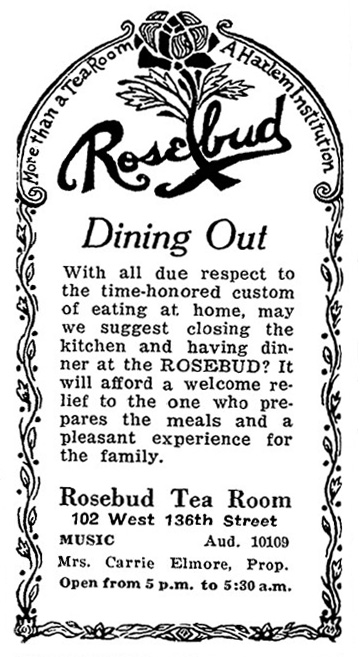
Although Mary Hartigan’s business card is the smallest of the day’s finds, I discovered that hers was the most successful business of the three. She established it in 1933 in what was formerly a Dutchland Farms that she had run. [above, front and back of business card]

The Dutchland Farms chain in New England, beginning as dairy stores, developed into restaurants quite similar to Howard Johnson’s shortly before the chain failed in the Depression. Some were converted to Howard Johnson’s, but Mary Hartigan, who also ran one in Harwich Port MA, decided to run her Dedham place independently under her own name.

Nevertheless Mary Hartigan’s and Howard Johnson’s shared a similar appearance as well as a similar menu. A Hartigan menu from 1952 shows that she kept the strong link to dairy products in her new restaurant, dedicating an entire page to ice cream concoctions such as sodas, sundaes, freezes, frappes, floats, and malted milk. In addition to the standard steak and chicken entrees, the menu also presented a variety of seafood, including seafood plates, baked lobster, Cape scallops, broiled swordfish, and fried clams. Tomato, grapefruit, and pineapple juice served as appetizers.

1952 was also the year that the restaurant acquired a liquor license. In 1959 the building was enlarged and remodeled. [above, business card interior]

When Mary Hartigan died suddenly in 1961 her obituary in the Boston Globe observed that the restaurant was “one of the best known in the state.” She left it to a niece who ran the business until 1970 when it was sold to a new owner who said he planned to keep the staff, some of whom had worked there for three decades.

© Jan Whitaker, 2024

6 Comments

Filed under food, menus, proprietors & careers, restaurant prices, tea shops, women

Status in a restaurant kitchen

The status hierarchy in a restaurant kitchen depends on a variety of factors. Skill is clearly one of them, but, historically — if not currently — there have been others, some of them surprising.

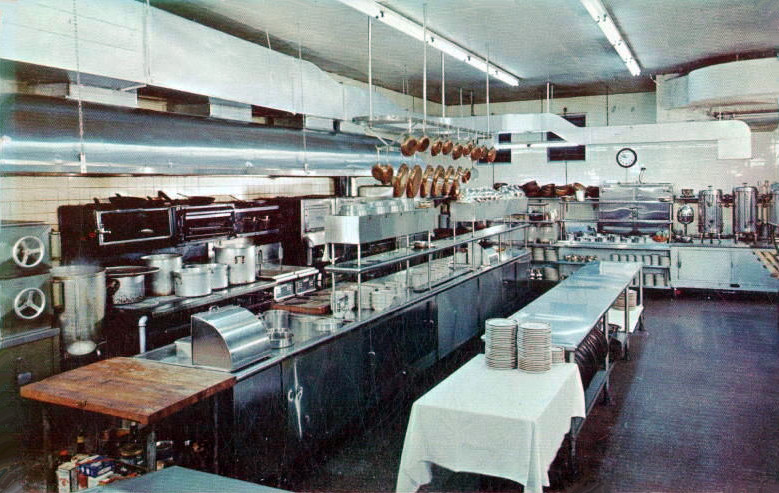
In 1944 and 1945 sociologist William Foote Whyte spent time observing kitchens in a number of Chicago restaurants. To one of them he gave the fictional name “The Mammoth” because of the size of its kitchen which employed 45 persons excluding dishwashers.

Whyte noted in his book Human Relations in the Restaurant Industry that by that time in this country, the French chef had lost influence and “this system has steadily degenerated,” eliminating some of the hallmarks of status.

But there were still distinctions of rank, fainter and sometimes subtle yet real.

In step with that time, gender was still a major factor contributing to status. It was linked to skill and experience as well as the difficulty of tasks. It was also reflected in the use of knives and heat, and the sorts of food handled. Although because it was wartime, more women were assuming these positions, at The Mammoth it was men who did the cooking, and men who both portioned and cooked red meat.

Women handled the lower-status food: chicken, fish, and vegetables. The Mammoth’s food suppliers at that time had not yet taken over much of the food preparation as they have in more recent decades, leaving many tedious tasks to the staff that sliced, chopped, and otherwise prepared fresh food for the cooks and sandwich makers.

Among vegetables, he explained, decorative items such as parsley, chives, and celery ranked highest. (Their elevated status reverberates today in the many photographs of elite chefs bending almost double as they carefully tweeze small decorative touches into place.)

One notch down came green beans, followed by spinach and carrots. Undoubtedly the status of these vegetables derived in part from their popularity with customers. But also, he explained, on the women workers’ opinion of them, based on “lack of odor, crispness, and cleanness of handling.”

Lowest in status were potatoes, then at the bottom onions. Whyte states that the “low standing of potato peeling is too well-known to require comment.” I’m not quite sure what it derived from, although it is well known that military recruits strongly disliked kitchen duties that involved peeling potatoes.

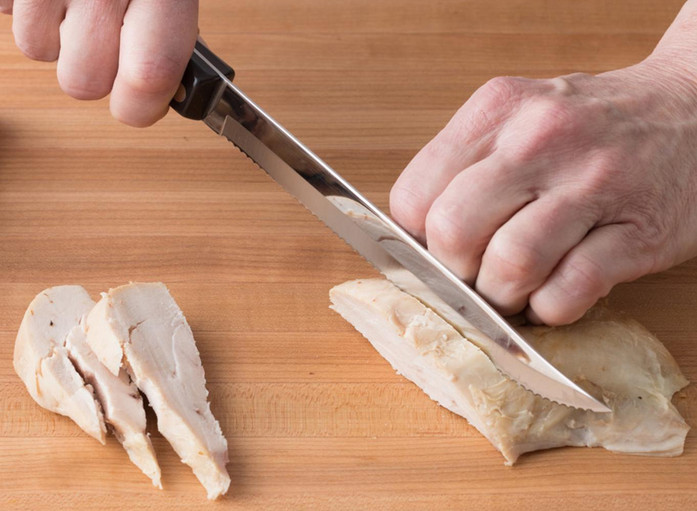
Seven women handled cooked chicken. Those who sliced the chicken were at the head of the line. Slicing white meat was higher in status than dark meat. Next came two women who portioned and wrapped slices for sandwiches. On the bottom rung were three women who picked the remaining meat off carcases, with the one who picked white meat ranking higher. The worst job, that of the seventh woman in line, was picking bits from chicken neckbones. When the worker assigned to that task complained about always getting the necks, she was assigned to another job.

Deep disdain for the chicken picking job was highlighted in the response of one of the workers on the line whose job was wrapping slices. She commented to Whyte that it was tedious. When he asked her if she would prefer picking, she frowned and said emphatically, “Oh, no, I wouldn’t want to do that.”

The woman who handled the fish station, “Gertrude,” was highly regarded by management but not by employees because they held a low opinion of fish, considering it smelly. According to Whyte, this put her station “at the bottom of the status hierarchy,” even though with the wartime meat shortage, fish was assuming a much more important role in restaurants. He attributed the workers’ attitude to ignorance, particularly because The Mammoth had a high standard regarding fish and bought only the freshest. Gertrude strongly disliked being referred to as “the fish lady,” and asked that in the book Whyte refer to her station the “sea-food station.”

© Jan Whitaker, 2023

2 Comments

Filed under food, women

The smörgåsbord saga

Swedes began immigrating from rural Sweden to the United States in significant numbers in the 1870s, but it took a while before Swedish smörgåsbords were introduced to the American public. The earliest ones opened in cities in the 1910s, but even in the 1930s proprietors still found it necessary to explain the concept to Americans who were not of Swedish ancestry.

In 1912 a self-proclaimed high-class Swedish restaurant called Henry’s opened in New York City [advertisement 1918]. There had been earlier Swedish restaurants in the city but they appeared to serve workers and were unlikely to have offered smörgåsbord. In 1915 another first-class restaurant opened in New York, Scandia, headed by Gerda Simonson. It was the first known restaurant of its kind run by a woman.

It is somewhat surprising that these early examples were in New York City since both Chicago and Minneapolis had larger populations of Swedish immigrants. But it’s likely that at that time NYC restaurants were better able to attract travelers from abroad as well as Swedes living there.

Despite the presence of a Swedish restaurant with a smörgåsbord at the 1893 Columbian Exposition in Chicago, there do not seem to have been many such restaurants in Chicago until the 1920s. They were also evident in Rockford IL. As was true of tea rooms, many were run by women. The Bit of Sweden in Chicago, opened in 1925, billed itself as a tea room, but of course Prohibition was in effect, ruling out the smörgåsbord’s classic accompaniment to herring, a shot of Aquavit. The number of smörgåsbord restaurants increased during the 1930s, particularly after Prohibition ended. [pictured:Rococo House, run by the same woman who introduced Bit of Sweden]

At first it seemed that Swedish restaurants in the U.S. relied heavily on patrons of Swedish ancestry who enjoyed them on Sunday evenings. [above Rockford IL, 1928; kropkokn is a cake] Gradually they drew a non-Swedish clientele, many of whom had as much trouble with the concept of smörgåsbord as they did with its pronunciation.

At their finest, smörgåsbord restaurants achieved a high level of artistic beauty in food presentation as is evident in the above photograph of a New York restaurant in 1939.

Newspaper stories had appeared in the late 19th century explaining that Swedish steamships and hotels furnished smörgåsbord as appetizers before a meal. Patrons took a small plate with a slice of bread and then selected a few items to eat while standing, accompanied with a strong drink and beer. They might have seconds but they did not eat so much that they spoiled their appetite for a full meal which they would soon order from their table.

Non-Swedish Americans, however, tended to see the smörgåsbord as a meal in itself, piling their plates high and often returning for more. Soon restaurants adapted by pricing the smörgåsbord separately. For a higher price, patrons could precede a dinner with smörgåsbord if they chose to. In the 1930s the Bit of Sweden restaurant in Los Angeles went to some trouble to explain how it all worked, devoting a page of its menu to this, and instructing patrons that the correct pronunciation was SMIR-GOES-BOORD (rather than SMAR-GUS-BORD). The restaurant charged $1.50 for smörgåsbord with dinner, or $1.00 without, and included a warning on its instructions page that customers had better eat all they took or they would be charged extra.

Other stories also appeared in the 1930s with instructions on how to handle smörgåsbords. In 1948 well known food journalist Clementine Paddleford explained what she learned from the daughter of the manager of NY’s Three Crowns Restaurant — which made its debut at the 1939 NY World’s Fair. She was told there was a system to choosing from its famed 100 items. First, she wrote, take pickled herring and a bit of herring salad along with a boiled potato with sour cream. On the second visit, more fish – maybe shrimp, sardines, smoked salmon, and a marinated mussel. Trip three might be hot dishes, but alternatively could be cold meats, salads, and cheeses if the diner was planning a fourth trip for hot food.

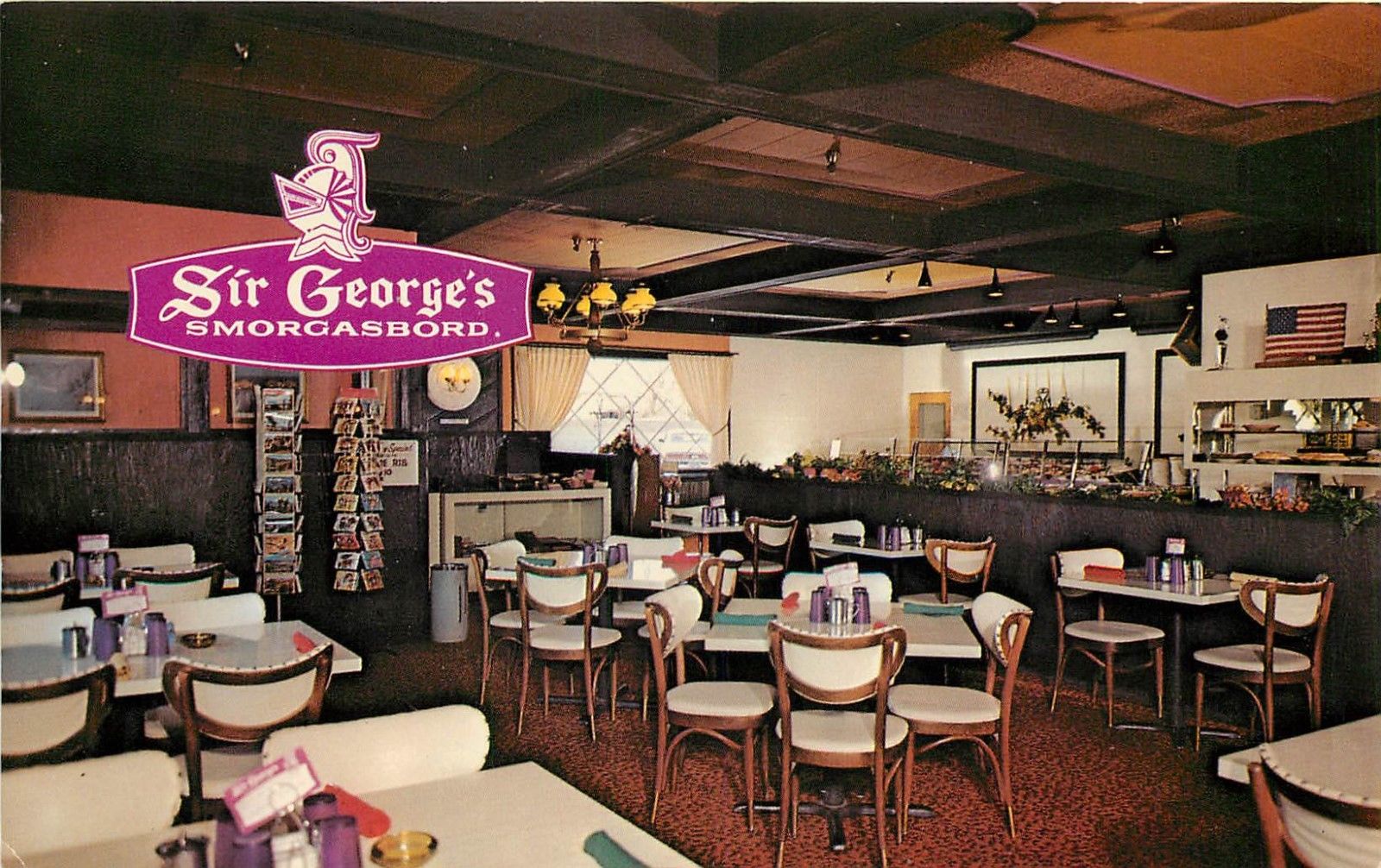
Decades later, smörgåsbord restaurants could still be found, but it seems that the idea of freely choosing food from a spread was being taken over by low-price, no-frills, all-you-can-eat buffets. Some, such as the Sir George’s chain called themselves smörgåsbords, but others named themselves “smorgies.” I doubt many, if any, were owned or operated by Swedish-Americans. [above, Sir George’s in Hemet CA]

As for authenticity, Tracy Nicole Poe explained in her 1999 dissertation that even the early examples of smörgåsbords in the U.S. represented an “invented tradition.” She wrote: “Like other elements of Swedish-American ethnicity . . . the smorgasbord’s origins are more a product of the National Romantic Ideal, and its rituals more concocted from the imagination of community leaders, than they are manifestations of rural immigrant culture. The fact is, most Scandinavian immigrants would probably never have attended an actual smörgåsbord in the classic nineteenth century European sense.”

On the other hand, I think the all-you-can-eat smörgåsbord derivative, though invented, is a genuine representation of American culture.

© Jan Whitaker, 2023

18 Comments

Filed under food, patrons, women

Meals along the way

On Monday, October 6, 1834, Charles Shipman and his two teenage daughters, Joanna and Betsey, left Athens, Ohio, for Philadelphia. Charles went there twice a year to buy goods for his general store. They traveled in their two-horse carriage and would not return until November 15, by which time they had been through the mountains, traveled by steamship, visited Washington and Baltimore, and met with President Andrew Jackson.

Their usual plan was to get up early, travel for a while and then stop for breakfast and dinner at an inn or tavern. Their main meal was mid-day dinner. They ate “supper” wherever they were staying for the night. They stayed at inns, hotels, and for their longest stay, in Philadelphia, at a boarding house where their meals were supplied.

The meals in taverns and inns in small towns were surely humble. Joanna kept a record of their travels, more of a log of times and distances than a diary of subjective impressions and descriptive details. It’s disappointing that she was not inclined to record much about what they ate on their travels, but there are some interesting bits.

On their fourth day of travel they stopped in Morristown OH for breakfast at 9 a.m. Joanna writes: “Found some tomato preserves on the table, at first thought they were very good, but after tasting again concluded to the contrary.” On Joanna’s initial recommendation, Betsey ate some of the preserves but later told her sister that they made her feel sick.

That evening they arrived in Wheeling – now in West Virginia, but then Virginia – and stayed in a “very good country tavern” where Joanna reported she “Ate too much supper, and that with rainy weather and miserable roads makes me feel a little homesick.”

In the journal it becomes clear that the sisters were prone to feeling homesick and anxious – about traveling through the mountains, staying in cities, meeting people, and being on steamboats. Joanna found Smithfield VA, and then Petersburg VA where they stayed overnight, depressing: “Have had the horrors all day.” Seeing a fire from their window in Philadelphia, Joanna recorded that she and Betsey were “frightened out of our wits.”

Did anything thrill the sisters on what was probably their first trip outside Ohio? Joanna certainly shows no excitement about meeting “Old Hickory,” the President, and simply records that after shaking hands, and “looking at him as long as we cared to, we left his August presence and went into the yard.”

Joanna writes with a restrained tone, yet it’s clear she has a sense of humor. The Shipmans met with various people along the way. After one of them, a man who “ogled his eyes” when he looked at the sisters, told them he planned a future visit to Ohio, Joanna writes, “So now look sharp, Miss Betsey.”

On the way to Fredericktown MD, they stayed overnight at an inn. Joanna recorded her simple breakfast the next morning as “a piece of bread, strong [i.e, rancid] butter, peach sauce and a cup of milk.”

At that point they were about to reach that part of their trip that took them to larger cities. But I feel certain that they had no interest in exploring urban dining as itemized on the 1834 bill of fare of the Adelphi Coffee House in Philadelphia [shown above]. It gives a good idea of choice dishes of that time, but since the coffee house was also a drinking place it would have been forbidden territory for this family. Charles Shipman was a dedicated temperance follower who refused to handle alcohol in his store.

Upon reaching Baltimore the next evening, they had trouble finding a hotel that was not full, but on the third try discovered a new place called Page’s that had just opened. Joanna described it as “the most splendid house my little eyes ever beheld.” They had a private parlor and meals brought to their room. But despite these positive aspects, she wrote “It nearly frightens us out of our wits to go all through [the hotel]. Betsey says she never thought she was raised in the woods to be scared at an owl, but she has found tonight that she was.”

Their 11-day stay in Philadelphia included some strange-sounding entertainments. At the Hall of Independence they viewed dogs powering cloth making, and an automaton that wrote. The next day they went to Washington Hall where they saw speaking and dancing puppets and “the exhibition of the burning of Moscow.”

Their father offered Joanna and Betsey a trip to New York City, but they turned it down, preferring to head for home.

Leaving Philadelphia they returned to Washington, beginning their journey homeward. They stayed in a large hotel, Brown’s Indian Queen Inn, but did not record anything about it. Traveling through Virginia they stopped at Warm Springs, where they were weighed so they could see how much they gained at dinner. Charles (119½), Betsey (109), and Joanna, (118½) each added from 1 to 1½ pounds to their slight frames. They stayed overnight in the springs region, eating “a real country breakfast” the next morning. Then, for dinner at White Sulphur Springs, they “were treated to some fresh pork fried, some fresh beef fried, some light bread and some milk, rather tough this, as I look at it,” recorded Joanna.

Only two days from home, they stopped at Wilson’s Hotel in Charleston for dinner. She reported “the way dinner was served was a ‘touch above the vulgar.’” I would not think that was a resounding compliment.

Joanna was more than thrilled to get back home to her mother and brother.

© Jan Whitaker, 2023

17 Comments

Filed under patrons, roadside restaurants, women