Category Archives: patrons

Diet plates

Dieting for weight loss began to attract attention in the 1920s, reversing the preference for somewhat chubby bodies that preceded it. Before World War I, the word “diet” could equally well refer to a plan of eating designed for gaining weight. Then — and now — the notion of dieting contained contradictions.

A 1905 newspaper story described the phenomenon of the “jiu jitsu girl,” a modern being who took a rational attitude toward her food, either for the purpose of adding or losing pounds. If she wanted to lose weight she drank a lot of water, did gymnastics, and ate only fish, poultry, fresh vegetables, and fruit.

But the weight-losing version of the jiu jitsu girl must have been a rarity in 1905 because restaurant menus took no notice of her. Most of their offerings were more likely to add pounds. Which must be why, when she went into a restaurant, JJ girl tossed aside the menu as she gave her order.

In the 1920s and 1930s, when the so-called Hollywood Diet became the rage, restaurants made a few concessions to dieters by providing the regimen’s staple food, grapefruit. But few if any provided diet menus or special low-calorie dishes.

Whether restaurant patrons tried to cut calories with grapefruit, salads, or zwieback in the 1920s and 1930s, European chefs deplored the trend. Critics said dieting was one of the causes of the downfall of restaurant cuisine in those Prohibition years. Alas, they sighed, art had gone out of restaurant cooking and weight-conscious women were largely to blame.

However, those who took a more businesslike attitude toward restaurants, such as industry publisher J. O. Dahl, recommended that restaurants get with the times. Look through popular magazines, he counseled, and see how very often dieting is discussed. He urged progressive restaurateurs to develop diet menus for their women guests – whose numbers were drastically increasing.

Yet, it wasn’t until the 1950s that dieters received widespread recognition with the arrival of the restaurant diet plate. Shown in all its glory at the top of this page, it was stereotypically a hamburger patty – sometimes referred to as chopped steak – accompanied by cottage cheese topped with canned peach and a limp lettuce leaf on which reposed a wan slice of tomato.

Slight variations happened. Gelatin might accompany or replace canned fruit. Steak houses such as Bonanza and Golden Corral added toast to the plate. Woolworth tucked in saltines (see 1971 Woolworth advertisement below).

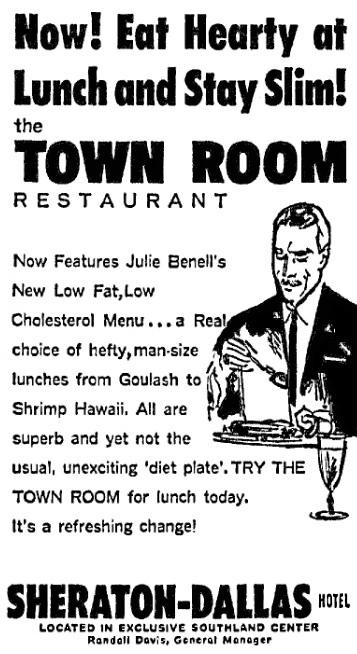
To be absolutely fair, some restaurants were a bit more creative in designing diet plates. The National Restaurant Association, recognizing that about 10% of customers were on diets at any given moment in the 1950s, helped develop menus. Perhaps a menu of consommé, celery hearts, 4 oz. minute steak, green beans, and unsugared fruit was one of their suggestions. In 1962 the Town Room in the Sheraton-Dallas relieved diet boredom with “hefty” slimming lunches of Goulash and Shrimp Hawaii.

Putting everything into perspective, even the dispiriting classic diet plate was superior to the liquid diet products that some restaurants put on menus in the early 1960s. For 50 to 75 cents a glass dieters could sip Metrecal (a product of the same company that made Drano and Windex). “Some drugstores find it is giving the hamburger competition,” reported a 1960 story.

By some bizarre logic, places that seemed as though they were havens for non-dieters also offered diet plates. Such as pancake houses and sweets shops. The DoNut Shop in Edwardsville IL had a Weight Watchers Diet Plate and Farrell’s Ice Cream Parlour in Seattle advertised a Low Calorie Diet Plate. Were these nothing but conscience-soothers for customers prepping for ice cream and doughnut binges?

Although I have no doubt you can still find the occasional classic diet plate on a menu today, the hamburger-cottage cheese-peach lunch fell into deep disfavor in the 1980s. Long regarded as boring, by the mid-1980s they were commonly referred to as “old style,” “so-called,” or “1950s diet plates.” Critics argued that in most cases they were not only insipid, but also contained more calories than other menu items.

But it was not the critics who sunk them as much as it was changes in restaurant culture of the late 20th century. Many restaurants upgraded their menus with fresher and lighter food that (usually) had the virtue of being lower in calories. Restaurants specializing in salads became popular.

A sign of changing times was the Chapman Sisters Calorie Counter on Chicago’s Miracle Mile. With a decor that signified “natural,” the casual restaurant had a brick floor, hanging plants, butcher block tables, and walls painted with large apples. Calories were given for each dish on the menu. Even the highest-calorie item, a Spinach and Mushroom Quiche, topped out at about 200 fewer calories than the classic diet plate, and a Tostada Salad came in at 395.

Another example was the 1980s “Light Balance” menu at Tumbledown Dick’s in Cos Cob CT  where no dish had more than 380 calories, whether it was a Vegetable-Stuffed Pita, Chicken Florentine, or Pasta Primavera. The Light Balance menu gave not only calories but also fat, sugar, and sodium content.

In retrospect, as unappetizing, calorie-rich, and unbalanced as the 1950s diet plate was, the irony is that the average American was slimmer during its time.

© Jan Whitaker, 2017

30 Comments

Filed under food, menus, patrons, restaurant customs, women

Christian restaurant-ing

christianrestaurant1976riversidecajpgThere are a lot of reasons why a restaurant might choose not to sell liquor that have nothing to do with religious beliefs. But restaurants that brand themselves as Christian absolutely never serve alcoholic drinks. This has always been their defining characteristic.

In the U.S. Christian invariably means Protestant. Catholics, though doctrinal Christians, don’t consider drinking alcohol sinful, nor does its avoidance confer holiness.

christianrestaurantin-n-outjpgAlthough their predecessors date back to the 1870s when white Protestant women and men fought saloons by creating inexpensive, alcohol-free lunch rooms for low-income working men, Christian restaurants made their more recent return in the 1960s, 1970s, and 1980s. Some contemporary examples do not make a big display of their orientation. The Western burger chain In-N-Out, for example, prints a small biblical reference on the bottom of its soft drink cups that many customers probably never notice. The Atlanta-based Chick-fil-A chain has a religious mission statement and is closed on Sundays; but its religiosity was not known to all until a few years back when its late founder declared support for conservative family values.

christianrestaurant1980dec19Other common characteristics of Christian restaurants have included banning smoking and, like Chic-fil-A, closing on Sundays. Most have made an effort to offer some kind of ministry, ranging from offering religious pamphlets to preaching or providing live or recorded gospel music. Some have made free meals available for the poor. Typically they have had “biblical” names such as The Fatted Calf, The Ark, or The Living Bread. In some cases, the staff has been asked to assemble for daily prayers. Proprietors tend to be deeply religious, some having been redeemed from a troubled past. And, finally and not surprisingly, many (but not all) have been located in the “bible belt” where evangelistic religion thrives.

Some Christian restaurants went a little bit further. The Praise The Lord Cafeteria in Cleveland TN was unusual for a cafeteria in that it featured gospel singing, preaching, and testifying on weekend evenings. Waitresses at Seattle’s Sternwheeler often greeted customers with “Praise the Lord.” The owner of Heralds Supper Club in 1970s Minneapolis MN grilled prospective singers until he was convinced that they were genuine Christians. The owners of the Fatted Calf Steak House in Valley View TX, whose specialty was a 24-ounce T-bone, were more trusting: they let patrons pay whatever they could and even allowed them to remove money from the payment jar if they were in need. But the honor system was strenuously abused and the restaurant closed in heavy debt after just 1½ years.

christiankozycountrykitchenI became interested in this phenomenon when I noticed that a postcard in my collection – the Kozy Country Kitchen in Kingsville OH — said on the back, “Family dining in A Christian Atmosphere.” As shown on the card, it’s a highway restaurant with a big sign and parking lot looking as though it serves truckers, and was not the kind of place that would be likely to offer beer, wine, or cocktails even if it was run by licentious pagans. So what, I wondered, made its atmosphere Christian?

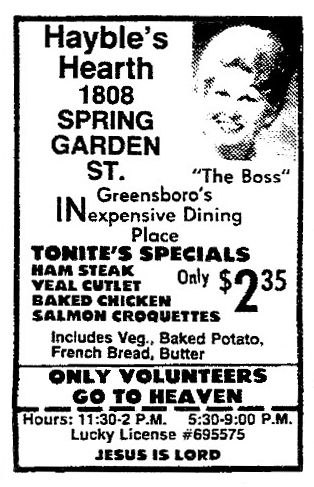
christianrestauranthaybleshearth1980Now that I’ve done some research I think I know the answer. It was probably an overtly friendly place, but one that frowned on swearing or arguing. Maybe it was similar to Hayble’s Hearth Restaurant in Greensboro NC. Hayble’s was very successful compared to most Christian restaurants, staying in business for nearly 20 years. In 1975 its manager said that she found Hayble’s a nice place to work because, “There’s no fightin,’ no fussin,’ no cussin.’” This made me realize that not everyone’s experiences with restaurants are like my own in which the norm is a focus on food and socializing, with moderate drinking in a cordial atmosphere.

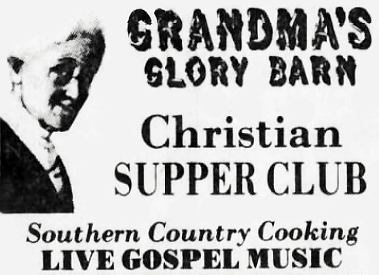
A special type of Christian restaurant developed out of the more-urban Christian coffeehouse movement that had been aimed at a teenaged clientele. It was the Christian supper club which served a buffet-style dinner followed by a show featuring singing groups performing gospel hymns. Some were run under church sponsorship, but many were commercial ventures. The first was the Crossroads Supper Club organized as a non-profit in Detroit in 1962 by an association of churches and businessmen. Its manager, who had formerly worked as an assistant to Billy Graham, said it was called a supper club because “night club” had unsavory connotations. Its initial success inspired a Methodist minister associated with Crossroads to suggest that one day there might be a “Pray-Boy Club” whose members held keys to individual chapels. (He was joking, wasn’t he?) However, like many Christian restaurants and supper clubs, Crossroads soon fell on dark days.

christianrestaurant1977nashvillejpgThe heyday of the Christian supper club was in the late 1970s and 1980s. By the 1990s it was fading. One of the more ambitious-sounding ventures was Gloryland in Hot Springs AR. The project rallied investors to transform a former nightclub called The Vapors — famed for being colorful in a non-Christian way — into a supper club. Slated to open in 1991, the venture never got off the ground.

Undoubtedly the most successful of the Christian supper clubs, the one that served as a model for others, was The Joyful Noise, with two locations in the Atlanta GA metropolitan area. The first was financed with contributions from 500 stockholders who, according to president Bill Flurry, wanted “clean entertainment” in a place without smoking or drinking. The Joyful Noise(s) enjoyed about 20 years in business, from 1974 to 1994.

© Jan Whitaker, 2017

10 Comments

Filed under alternative restaurants, atmosphere, chain restaurants, family restaurants, night clubs, Offbeat places, patrons

Taste of a decade: 1980s restaurants

1980srestaurantsfourseasonshotellosangelesDespite an off-and-on economy, the 1980s was a decade in which Americans ate out more often than ever before. Gone were the days when people indulged in a nice restaurant dinner only when traveling or celebrating a birthday or anniversary. Now no reason was needed at all. Restaurants were for convenience, but also for entertainment, pleasure, new experiences, and sometimes only incidentally for nourishment.

A food elite emerged, composed of frequent restaurant-goers with insatiable hunger for new cuisines and unfamiliar foods. Paralleling the growth of the food elite were chefs who became famous as they gave interviews, dashed off cookbooks, and demonstrated cooking techniques on the dais and the small screen. “Food is now the stuff of status,” said wine and restaurant critic Robert Finigan in 1983, comparing the public’s adoration of chefs to their awe of fine artists.

1980srestaurantfoodA growing interest in healthier diets influenced restaurant menus, which began to feature less red meat and more pasta, fish, and chicken dishes. Concern with smoking and drunk driving brought changes too, as restaurants set aside non-smoking sections and saw their liability insurance premiums rise even as drink orders declined.

The food fashion cycle quickened as diners discovered a taste for arugula, radicchio, goat cheese, sun-dried tomatoes, sushi, crab cakes, Pad Thai, mesquite grilling, and fresh ingredients. Meanwhile old favorites such as steak and baked potato, tossed salad, and cheesecake seemed dull.

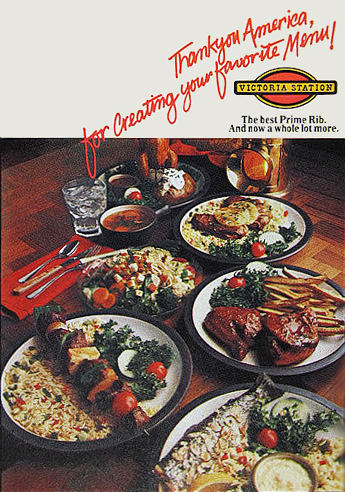
1980svictoriastn1981morechoiceterryakichickensalmonstuffedchickThough shunned by the food elite, corporate chain restaurants continued to grow and thrive. By the middle of the decade 540 chains managed 60,000 fast-food restaurants, employing over half of the nation’s restaurant workforce. Restaurant groups proliferated, ranging from those that owned a dozen or fewer restaurants in one city to groups controlling hundreds of franchises throughout a region. Independent restaurateurs, too, found it increasingly attractive to operate more than one restaurant.

Traditional eating places, from the humblest to the grandest, suffered from intense competition. Losers included coffee shops, Cantonese Chinese and red-checkered Italian restaurants, and even sanctums of haute French cuisine.

Black men, who formed the basic waiter corps of the 19th century, largely disappeared from restaurant dining rooms and kitchens, replaced by immigrants, white college students, and white women. A 1981 study conducted in NYC found that Black workers rejected the low pay and poor conditions typically found in restaurant kitchens, preferring to take better jobs in industry if they could. Racial discrimination also kept them from waiting jobs in some instances and the limited number of Black-owned restaurants prevented widespread training in kitchen skills and entrepreneurship.

Though conditions were improving, women also faced continuing discrimination in restaurant work. Many luxury restaurants rejected them as waitstaff in the belief that patrons attributed higher status to male servers. Other objections were their alleged “boyfriend problems” and lack of “tableside” skills such as meat carving and salad making. An article in the trade journal Restaurant Hospitality noted that while more women had become bartenders, chefs, and managers by end of the decade, “For women, the American foodservice industry is still rife with barriers.” In the kitchen, women tended to be confined to pastry and pantry. Some women chefs said the solution was to open their own restaurants even though they might have to take on a male partner to get financing.

Highlights

1981 Social indicators – small families, working women, projected long-term increases in real income and leisure, and more single-person households — promise growth in restaurant going according to a Bank of America Small Business report.

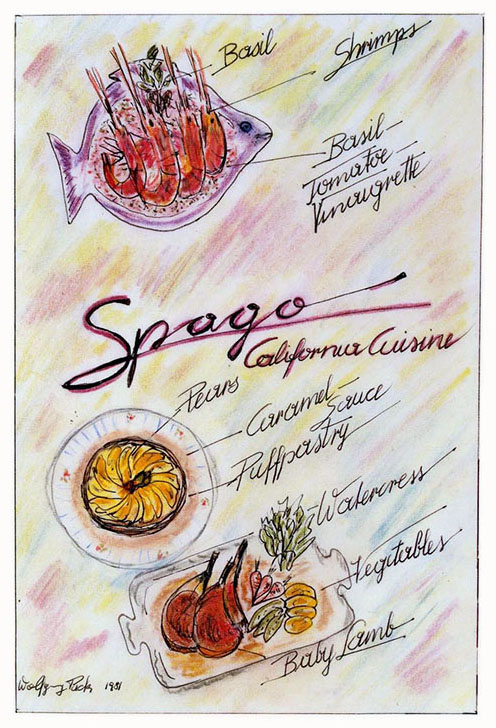
1980srestaurantsspagomenu19811982 Having introduced nouvelle cuisine at Ma Maison in Los Angeles, Chef Wolfgang Puck presents “California cuisine” to patrons of his new chic-casual Sunset Strip restaurant, Spago. Pizza with Duck Sausage wins quick stardom.

1983 The Food Marketing Institute reports that 2/3 of all fish consumed in the U.S. is eaten in restaurants. In Seattle, Colonial-themed 1980srestaurantsmadanthonysMad Anthony’s executes a style and cuisine turnabout, replacing a beefy Steak & Kidney Pye-style menu with seafood. Onto the auction block go pewter plates, crocks, jugs, and replica muskets, along with a Nacho Cheese Dispenser.

1984 With the opening of Spiaggia in Chicago, Chicagoans learn that Italian doesn’t inevitably mean spaghetti and candles in Chianti bottles, as they sample pumpkin-stuffed pasta and goose carpaccio with shaved white truffles. With dinner for two easily totaling $100 [about $228 now], they learn it often means higher prices too.

1985 Even as restaurant patrons in much of the country search out new restaurants and cuisines, Southerners remain loyal to cafeterias, with five major chains operating from 84 to 149 units each. In Milwaukee, taverns continue to do brisk business serving deep fried fish on Friday nights.

1980srestaurantsmariani1986 Most restaurant reviewers contributing to John Mariani’s Coast-to-Coast Dining Guide report that their towns have better restaurants and a wider selection of ethnic cuisines than ten years earlier. A number of cities lag behind, though, including Minneapolis and Chicago where many cling to meat and potatoes, and Columbus OH which has the dubious distinction of serving as a test market for fast food chains.

1987 With new laws holding restaurants responsible for customers who cause drunk driving injuries, rising numbers of liability lawsuits against restaurants, and ballooning insurance premiums, American Express promises protection to restaurants that accept its charge card.

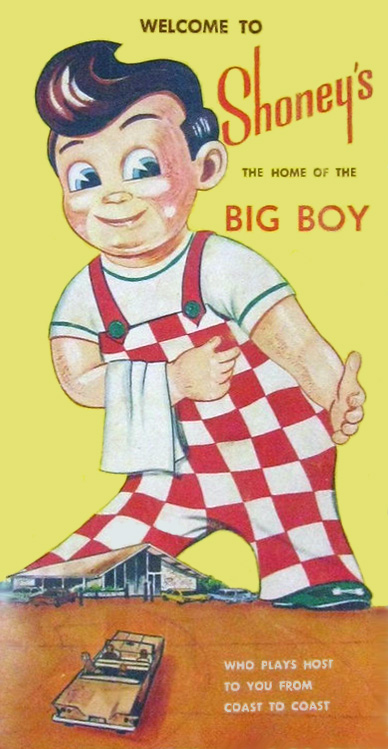
1980sshoneysmenucover1989 The “largest ever” bias lawsuit involving a restaurant chain is filed against the 1,500-unit Shoney’s and its head Ray Danner. The suit by the NAACP’s Legal Defense and Educational Fund charges that Shoney’s sets limits on how many Black workers can be hired in each outlet, keeps them in jobs out of public view, and punishes white supervisors who refuse to go along with the program.

© Jan Whitaker, 2017
13 Comments

Filed under cafeterias, chain restaurants, elite restaurants, ethnic restaurants, food, menus, patrons, racism, women

Bulgarian restaurants

bulgarianrestaurantcafesofiadcIn 1985 an eminent cultural geographer, Wilbur Zelinsky, published an article on American ethnic restaurant cuisines. In it he said that the foods of some places stirred little interest in the U.S., among them Great Britain, Ireland, Scandinavia, Belgium, the Netherlands, and Germany.

And he wrote that he had never found a single Bulgarian restaurant in metropolitan North America.

Actually, though, there were a few Bulgarian restaurants — either in the sense that they served Bulgarian dishes or at least were run by Bulgarian-born proprietors. From 1910 through the 1960s I’ve found at least one Bulgarian restaurant or café in St. Louis MO; Anaconda MT; Indianapolis IN; Midland and Allegheny PA; Niagara Falls and NYC; Portland OR; Los Angeles and San Francisco CA; Seattle WA; Hillsdale & Kalamazoo MI; and in Cincinnati, Youngstown, and Toledo OH.

bulgarianrestaurantboteffscincinnati1956

However, they might not meet Zelinsky’s definition. He considered a restaurant ethnic only if it predominantly served people not belonging to the ethnicity the restaurant represented. It’s true that there have been very few of those, and most of them after 1985. Also, I cannot be certain that restaurants owned by those born in Bulgaria always served Bulgarian cuisine, especially after the 1940s.

It’s likely that the customers of early 20th-century Bulgarian-owned restaurants were fellow countrymen. The majority of the Bulgarians in this country before WWII were men. Many lived in cheap hotels and rooming houses while working as laborers for railroads, steel mills, meat packing houses, and coal and copper mines. I ran across a want ad looking for a woman to cook meals for a group of Bulgarian men, but eating in restaurants was probably the fate of most single Bulgarian men.

Like the Greeks, Bulgarian restaurant and lunch room operators didn’t always get a warm welcome. A case in point was Racho Evanoff who was among those denied a soft drink license by authorities in Portland OR in 1921 on the grounds that they were suspected of using soft drinks as a cover for liquor sales. The newspaper didn’t mince words in a story about bootleggers in the city’s north end who it referred to as “liquor banditti from mid-Europe.” It identified them as “aliens” from Austria, Dalmatia, the Slavic nations, Roumania, Greece, and Bulgaria. However, Evanoff evidently escaped the curse over time. He renamed himself Robert and in 1927 his restaurant was still in business with a rating of “excellent” from the health department.

Saying just what is and what isn’t Bulgarian cuisine is not easy, particularly since Bulgaria is a multi-cultural country, but it resembles the food of other Balkan countries. A 1924 story about a Bulgarian restaurant mentioned lamb stew, eggplant, okra, and chicken soup seasoned with lemon. I haven’t been able to find a restaurant menu but have read about the types of food served in Bulgarian restaurants in restaurant reviews and advertisements. Examples include cured sausages, grilled meats, pierogi, shish kebab, moussaka, stuffed grape leaves, yogurt, chopped lettuce salads with feta cheese, and baklava. In the U.S. the cuisine in Bulgarian restaurants seems to have been similar to that of Greek restaurants that served other than American dishes.

bulgarianrestaurantbbqpeteca

bulgarianrestaurantboteffsadvtext1956After the second World War it looks like the few Bulgarian restaurants and cafés in business then gained a wider range of customers, partly by including on their menus more familiar American dishes such as barbecue, fried chicken, and steaks. A restaurant operator in Los Angeles went from coal miner to lunch wagon operator, and then succeeded in building up a small chain of BBQ Pete’s in the 1940s and 1950s. In 1950s Cincinnati Daniel Boteff, who had formerly run a shoe repair shop, opened a couple of Bulgarian restaurants [pictured above and right, 1956] serving Shish Kebab Dinners for $2.25, along with BBQ Chicken, Fried Chicken and “Boteff’s Cut” Sirloin Steaks. He advertised in 1957 that his restaurant was one of very few restaurants in the US serving “authentic Bulgarian foods.”

It’s my impression that today there may be slightly more Bulgarian restaurants though they still remain rare.

© Jan Whitaker, 2017
7 Comments

Filed under ethnic restaurants, food, patrons, proprietors & careers

Dining with Diamond Jim

diamondjimchurchills

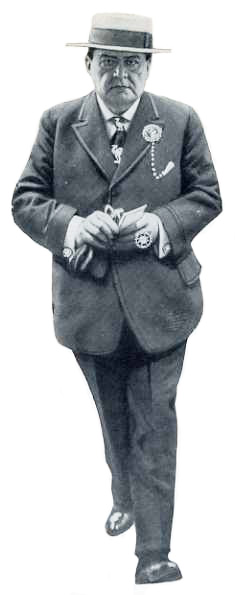
In the early 1900s with the growth of Broadway’s fame as a place for flashy people to see and be seen, no one stood out from the crowd like James Buchanan Brady. Known across America for his large collection of diamonds which he boldly wore in public, he inspired others to display trappings of wealth. In the words of Parker Morell, author of a 1934 book about Brady, “Jim was the diamond studded decoy duck that filled the coffers of New York’s merchants.”

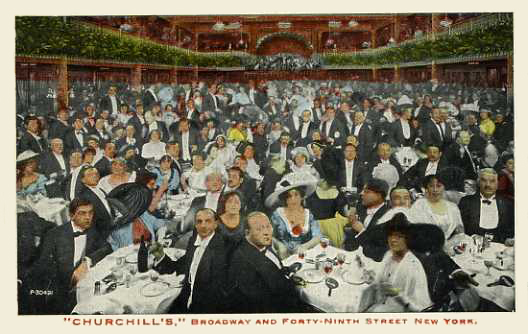
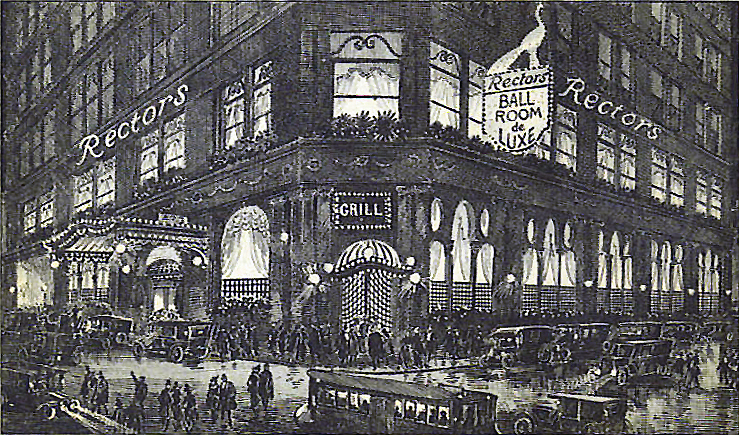
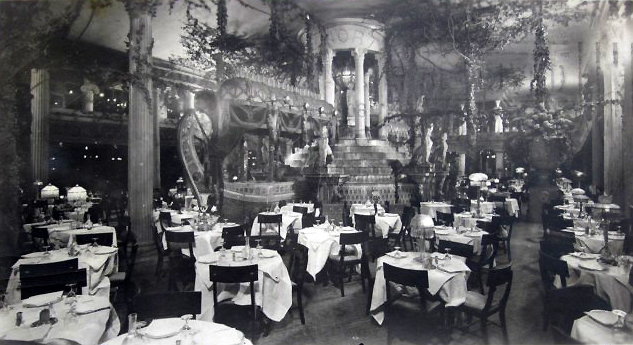
Those merchants included not only the jewelers of Maiden Lane, but also the restaurateurs of Broadway. Among his favorites were Rector’s, Churchill’s, Shanley’s, Healy’s, Murray’s Roman Garden, [see below] and others on and off Broadway. In 1917 he gave a talk at a dinner of the New York Society of Restaurateurs where he contrasted Broadway’s restaurants with the downtown places of his much poorer early days where a plate of corned beef and beans cost 10 cents.

diamondjimrectors

Brady was a highly visible regular in restaurants and so-called “lobster palaces.” The proprietor of Rector’s, the reigning palace of lobsterdom, referred to Jim as “our ten best customers” due to his frequent visits coupled with the vast amount of food he was alleged to consume. And of course his presence in hot dining spots attracted celebrity hunters galore.

diamondjimmurrays1908

But did his celebrity also win him a get-out-of-trouble ticket – or did he simply live in a time when being super rich brought immunity from scandal? As “America’s greatest salesman,” James Brady frequently hosted parties of visiting businessmen whose contracts he was courting as a major player in the railroad equipment business. He could spend up to $3,000 (in 1904, equal to $82,000 now) for an evening’s entertainment which might also include the company of well-paid chorus girls or visits to women on the shady side of town. He freely poured wine for his guests, but he did not drink. Orange juice was his preferred accompaniment to meals – at a time when it was not considered a customary beverage.

diamondjimphotoDespite the expensive dinners he gave, he showed a contradictory attitude toward restaurant spending. According to George Rector, Jim swore he would not come back to Rector’s after it levied a 10-cent cover charge. Of course he did return, but why argue over such a minuscule fee? And when he was charged with extravagance, he countered defensively that extravagance meant spending money you didn’t have or wasting it on worthless things. He, on the other hand, spent his well-earned money on simple dinners such as what he called his “one-two-three”: Lynnhaven oysters, terrapin, and canvasback duck. Expensive, yes, but not extravagant “because you get your money’s worth.”

He could be generous. According to gossip columnist O. O. McIntyre, when Brady died in 1917 he had a number of elderly waiters on pensions.

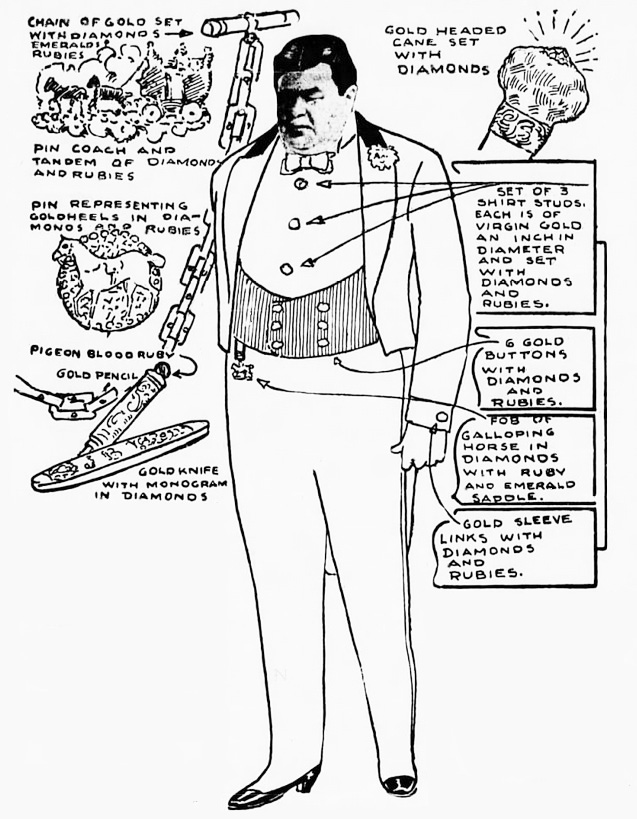
He began acquiring and wearing diamond jewelry in the 1880s when he became a traveling salesman for a railroad equipment company. According to Morell’s book Diamond Jim, it was common then for traveling men to wear diamonds, and to gamble with them too. Brady was able to build a collection by winning at cards and dice. Displaying his collection to business associates and clients proved to be a good way to impress them and make sales. By 1893 he was ordering diamond-crusted pieces and sets that were custom designed exclusively for him. When he attended meetings of railroad directors he often wore his “transportation set” that included cufflinks resembling tank and coal railcars, and shirt studs in the forms of a bicycle, auto, and airplane.

diamondjim1908jpgAccording to some accounts, his jewels may have made him a nationally known celebrity and an effective salesman, but failed to win him acceptance by genteel society. Perhaps he regretted his glittering reputation. Headwaiters bowed down to him but he was sometimes ridiculed in newspapers. The Baltimore Sun ran a story in 1913 titled “Reckless Money Spenders of America in a Delirium of Extravagance Rival Rome’s Profligates” that spotlighted Diamond Jim and implied he bribed railroad purchasing agents.

He faced further unfavorable scrutiny the following year when testimony before the Interstate Commerce Commission revealed that the inexplicably debt-ridden New York, New Haven & Hartford Railroad Co. had, among other transgressions, bought railcars and equipment from Brady totaling $37 million without competitive bidding. In his ICC testimony Jim freely admitted that he had been very generous to the company’s officials – but simply because they were old friends. He also told the commissioners that he kept no books because “I don’t propose that anybody else shall know how I have built my business.”

Well, at least he could eat. Though it was often recounted that he consumed prodigious quantities of oysters, lobsters, and game, I am skeptical about this since the accounts seemed to be part of legend-making after his death. Nonetheless, his diet, which included half a pound of candy daily after he cut down following a diagnosis of diabetes, seemed to have a disastrous effect on his health. In 1912, and later in his will, he donated a large sum of money to Johns Hopkins Hospital for surgery he said gave him a “new stomach.”

When he died, James Brady’s fortune, including his diamond collection – though quite substantial — turned out to be smaller than expected. Obviously “Diamond Jim” was largely a media creation. The man vanished in 1917, most of the restaurants failed with Prohibition, but the fantastic stories have persisted.

© Jan Whitaker, 2017
6 Comments

Filed under elite restaurants, night clubs, patrons, popular restaurants

Restaurant wear

dinnerdresses1912

Although affluent women of the upper classes patronized restaurants in the 19th century, they usually did not do so unless they had a male escort, preferably a brother, father, or husband. Respectable women were not supposed to appear too much in public view, and only in select eating places such as the dining rooms of leading hotels.

But as the century ended the situation began to change. Dining and entertaining in restaurants became fashionable and women appeared in public during the daytime without an escort, whether at lunch or afternoon tea. And they wanted to be seen.

The idea that there was a certain type of clothing right for these occasions began to take hold. Around 1900 the terms restaurant wear, restaurant gown, and restaurant frock proliferated in newspaper stories that reported on what stylish women were seen wearing in Paris restaurants.

dinnerdresses1907philinqnov7gownshatswrapsforrestwear-2

It was a sign that restaurant-going had truly arrived. It no longer inevitably carried the stigma of vice and moral peril. Even though the majority of American women, especially those living in small towns and rural areas, might never see the inside of a swank tea room or café, those reading the society pages could imagine all eyes on them as they entered an elegant restaurant dressed in the latest style.

In 1903 women of Tacoma WA who followed their paper’s “Fashion Hints from the Shops” learned that black silk costumes for restaurant going were “quite the thing.” The prettiest gowns had skirts with flouncy semi-trains and a pleated top with velvet bows in front worn with a long fringed silk scarf.

Top tea rooms and restaurants became stages for virtual fashion shows. Clever dressmakers were said to “haunt” tea rooms to get ideas of the latest styles. In New York, Delmonico’s and Sherry’s were prime spots to see the pleats, flounces, laces, scallops, eyelets, and ribbons of the much be-decked outfits of 1905. The wisdom of the day had it that women went to such places not for the food, but to see what other women were wearing.

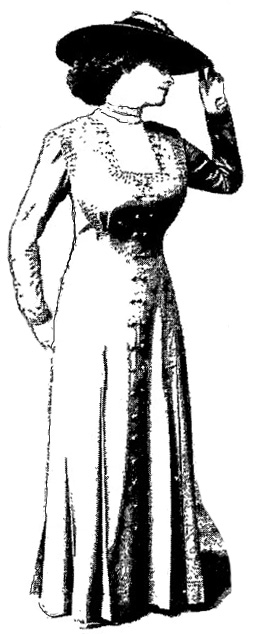
dinnerdresses1909frockThose traveling in the open autos of 1909 wore heavy, unattractive coats to protect them from road dirt and grime. But the bright side, pointed out the Philadelphia Inquirer, was that the coats were loose enough around the shoulders that “really elaborate costumes may be worn beneath them without harm.” The example, hard to appreciate in the black and white drawing here, was a coral pink restaurant frock with braided trim and crocheted buttons topped with a hat sporting what were mysteriously described as “vivid coral wings.”

Enormous attention was paid to women’s necklines with the new interest in restaurant wear. Time and again readers were warned not to confuse restaurant wear with formal wear. The rules were firm. Formal wear meant revealingly plunging necklines, bare arms, and no hat. Restaurant wear, by contrast, meant a frontal coverup, with a moderate neckline or even a high choker-style collar. The dress must have sleeves and the costume was to be topped off with a hat.

But rules are often broken. According to Julian Street’s 1910 magazine article titled “Lobster Palace Society,” gauche gold-trimmed Babylonian restaurants such as the Café de l’Opera in New York’s Times Square made every effort to seat women with low necklines prominently on the ground floor.

dinnerdresses1922franksederphilThe 1920s featured a new silhouette, as shown in this advertisement for glamorous gowns in 1922 as sold in Philadelphia’s Frank & Seder department store. Hats were getting smaller in the 1920s and 1930s, sometimes replaced with hair ornaments.

dinnerdresses1933repealFar from the Depression dampening the wish to get dressed up and go out on the town, the repeal of Prohibition in 1933 introduced a new fashion category, the cocktail dress. Tailored looks prevailed, and in 1938 a fashion columnist chided women who instead chose “luscious, romantic, billowy” frocks to wear to restaurants and nightclubs, sternly telling them that “such fragile, pale bits of formality are not worn!”

dinnerdresses1945cotillionrmhotelpierreThe trend toward simplification and informality continued in the 1940s with a wartime preference for plain, dark dresses as shown here. By the mid-1950s many women reportedly tried to pass off sundresses as appropriate for the cocktail hour (verdict: “Nothing could be more incorrect for after-five-wear.”) while teens couldn’t see why they shouldn’t wear jeans to a restaurant. Not nearly special enough, reasoned the columnist Dorothy Dix. Advice thrown aside, the casual trend continued.

Since the 1970s “restaurant wear” has come to refer mainly to uniforms for restaurant staff.

© Jan Whitaker, 2017
1 Comment

Filed under elite restaurants, night clubs, patrons, restaurant etiquette, women

Holiday banquets for the newsies

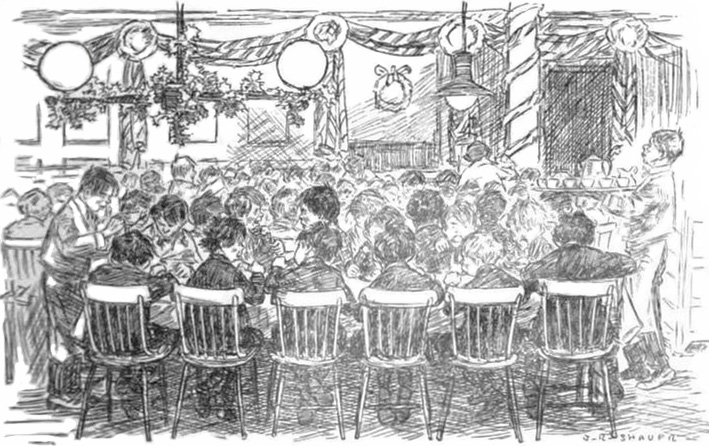
xmasdinnerca-1912nycbowery

In the 19th and early 20th century, newspapers were sold on city streets by young boys, and a few girls. Some of the children – who could be as young as 5 years old — were homeless while others came from poverty-stricken families. Their meals could be few and far between and they were always hungry.

But on Christmas Day, or a day close to it, they ate well thanks to the annual custom of  newspapers, philanthropists, mayors, and others who organized feasts for them. Some of the dinners were held in orphan homes and public buildings, but many took place in restaurants.

xmasdinnernewsboychicago1887Turkey was the typical featured food of the newsboys’ dinners. In 1875 the Telegram gave a dinner at Henri Mouquin’s restaurant on Ann Street in New York for over 1,000 boys and a handful of girls. The menu was roast turkey, mashed potatoes, rolls and butter, finished with cake, pie, coffee, and oranges. Nearly identical meals were given across the country for decades to follow, some accompanied by cranberry sauce and side dishes such as corn, peas, celery, and pickles. After dinner the children sometimes received a box of candy to take with them.

The newsboys of Kansas City MO, guests of the mayor, hailed turkey in a little ditty they shouted in a procession from City Hall to Staley & Dunlap’s restaurant on Main street in 1895.
Who are we? Who are we?
We are the newsboys of K. C.
We are the stuff; that’s no bluff;
We eat turkey and never get enough.

A dinner held in a Dallas restaurant in 1899 had a menu that departed radically from the customary dishes [see below]. There was no turkey or pie. And not only was the menu organized into the old-fashioned categories of Fish, Boiled, Roasts, and Entrees, they were not presented in the traditional order of appearance. It also contained quite a variety of assorted dishes, some of them unusual. “Boiled Rallet of Beef” might have referred to Rilettes of beef, which was beef cooked to mush and served on toast.

xmasdinner1899dallas

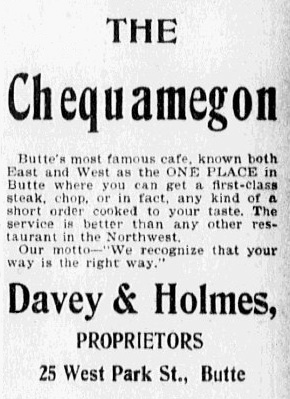
xmasdinner1903Boisterous behavior during dinner was expected. The boys cheered loudly for their hosts and entertainers, producing a noise level often described as deafening. Food fights were typical. At the Chequamegon restaurant in Butte MT in 1902, a report said the children “yell, whistle, throw biscuits at each other and occasionally land on each other’s jawbones with a dislocated leg of the bird.” Dinner sponsors often egged on high spirits by giving the newsies tin horns and firecrackers.

As much as the newsboys and newsgirls enjoyed the holiday dinners, the charitable events had their detractors. Reformer Florence Kelley criticized the dinners as well as the newsboys’ lodging houses found in some cities because they encouraged children to work and live independent of their families. She criticized New York City in particular for making newsboys into heroes. Rather than being seen purely as victims, as would be the case today, the boys were often regarded as spunky survivors with potential to succeed in life despite their rough style of living and lack of schooling.

xmasdinnerbishopcafeteria1930s In the early 20th century, states tried to limit child labor. Girls under 14 were barred from jobs involving selling. Boys under 10 could not sell papers and those aged 10 to 14 had to obtain written parental consent before a badge was issued to permit them to sell papers in the streets. Still, the dinners continued through the 1920s and 1930s. In the 1930s Bishop Cafeterias in seven cities held annual newsboys’ dinners to honor the chain’s late founder Carl Stoddard who had been a newsboy as a child.

Newsboys’ dinners could sometimes be found into the 1960s, but the children were absent, having been replaced with adult news vendors.

© Jan Whitaker, 2016

9 Comments

Filed under food, menus, patrons, restaurant customs

When presidents eat out

presidentskennedyn-joy

By now Americans are used to seeing presidential candidates chomping on corn dogs, pizza, Philly cheese steaks, and other hearty food of the people. For some – but not all — food eaten on the campaign trail has been quite a departure from their usual preferences when eating out.

presidentsjockeyclubdc1964It is certainly hard to imagine that John F. Kennedy normally patronized down-home restaurants such as the N-Joy Restaurant in Cornell WI which he visited on a campaign stop. The N-Joy was known for its homemade salad dressing and chicken dumpling soup, but not for chicken in champagne sauce, a specialty of the elite La Caravelle in New York. La Caravelle also supplied a French chef for the Kennedy White House and edibles for JFK’s airplane trips. He also enjoyed Washington’s Jockey Club, which he made famous through his patronage and later became a favorite of the Reagans.

Like the Kennedys, the Reagans enjoyed dining in the best restaurants, at least before Ronald Reagan was wounded in a 1981 assassination attempt. They liked Le Cirque in NYC and Jean-Louis in Washington, the latter visited by the Reagans just eight days before the shooting. But even apart from security pre-checks, a presidential visit to a restaurant could be a very complicated matter. Before the Reagans dined with friends for an after-theater repast at Le Cirque the restaurant was visited multiple times by the city’s health and fire departments as well as FDA inspectors. Ronald Reagan’s birthday dinner at Jean-Louis required that the restaurant accept no other guests that night.

presidents1903It’s hard to know how often presidents ate in restaurants in the 19th century. Possibly it was easier for them then, before 1902 when the Secret Service was created following President McKinley’s assassination in 1901. Probably many of them made their way to Delmonico’s and many, many hotel dining rooms. Harvey’s in Washington claimed it had been the “Restaurant of the Presidents since 1858” – the administration of James Buchanan – and it became famous in the Civil War when the Lincolns ate there. Presidents Garfield and Grant were said to enjoy Francesco Martinelli’s table d’hôte in New York City. Martinelli’s and Harvey’s were pretty nice restaurants compared to the cheap New York cellar where Chester Arthur ate corned beef and coffee just as he was about to take office in 1881.

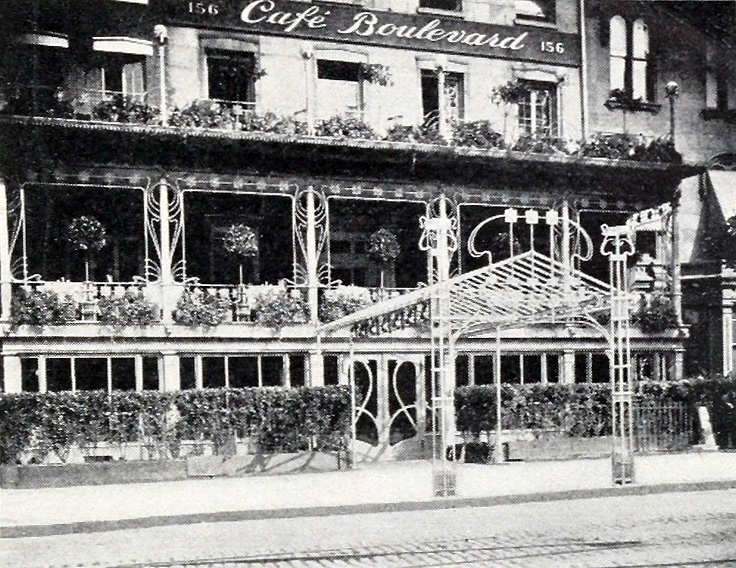
Theodore Roosevelt showed a taste for lively night spots. As Governor of New York, he patronized Shanley’s, a popular NYC resort, and as president was known to frequent the Café Boulevard [pictured above]. He also visited Antoine’s in New Orleans, as did Presidents Taft, Harding, and Coolidge.

Miserable meals on the campaign trail were a hallmark of the failed presidential campaign of William Jennings Bryan in 1908, and of his political career generally. According to a Collier’s magazine article, in over 12-years traveling the country he had earned the dismal honor of being a “Quick Lunch Hero.” He had eaten at over 1,700 railroad lunch counters, gulping down “mummified food” and “historical eggs.”

President Wilson might have applauded Bryan for his no-frills meals. During WWI Wilson called upon the country to embrace “the simple, wholesome, nourishing dishes which mother used to make,” gladdening the managers of the earnest, squeaky-clean Childs restaurant chain which quickly shifted to a wheatless wartime menu by substituting rice and corn meal dishes.

presidentharrytrumandixonschiliWhether by circumstance or taste, Harry Truman was a humble diner. He was a fan of Dixon’s Chili Parlor in Kansas City MO, where the chili was made without onions, garlic, tomatoes, or chili powder. He is shown above visiting Dixon’s on his way home for the holidays, on December 23, 1950. After leaving office he and his wife Bess drove across country, according to a 2009 NY Times story, eating “a lot of fruit plates at roadside diners.” One of their stops was at the Princess Restaurant in Frostburg MD, still in business today complete with a “Truman booth.” In 1958 Truman’s finances improved when Congress passed the Former Presidents Act, ensuring former presidents would get pensions and Secret Service protection, but somehow I doubt that this transformed him into a gourmet diner.

presidentjimmycarterarthurbryants80

Although it’s probably true that Truman genuinely enjoyed Dixon’s chili and JFK really liked La Caravelle’s chicken in champagne sauce, it’s hard to know how much presidential restaurant choices were based on esthetic as opposed to political factors. President Carter had a tendency to eat in popular restaurants – such as KC’s Arthur Bryant’s [pictured above], NYC’s Mama Leone’s, and (surprisingly) Aunt Fanny’s Cabin. Were those strategic choices? If still in business today, it’s certain that Aunt Fanny’s Cabin would not be on the approved list.

According to John Mariani in America Eats Out, Presidents Johnson, Nixon, Ford, and Carter generally weren’t big on restaurant going. Nixon, who came from a restaurant family, would sometimes go for dinner at Trader Vic’s in the Capitol Hilton near the White House. He was also said to be a devotee of NYC’s Colony where he was allowed to bring his dog into the main dining room. But the president who was hardest to keep in the White House was George H. W. Bush who enjoyed Italian (I Ricchi, DC), Chinese (Peking Gourmet Inn, Falls Church VA), seafood (Mabel’s Lobster Claw, Kennebunkport ME), and Tex-Mex (Rio Grande Café in Texas).

Apart from patronizing restaurants, often making them famous overnight, presidents can greatly influence the entire industry. For example, Franklin Roosevelt’s election was responsible for the repeal of prohibition in 1933, so critical to restaurants’ survival, while President Carter’s dislike of the three-martini lunch led him to champion cutting the deduction on business meals as part of a tax reform plan. He failed but eventually the deduction was reduced to 50%. Apparently the reform was not as disastrous to the industry as they had predicted.

© Jan Whitaker, 2016

25 Comments

Filed under patrons

Faces on the wall

caricaturessardis

People love seeing celebrities in a restaurant. Trouble is, celebrities can’t sit around in restaurants all the time. Solution: put a photograph or a cartoon of them on the wall, suggesting that they are regulars, liable to walk in at any moment.

In the United States the custom developed first in urban theater districts, in places visited frequently by publicity-seeking performers after the show.

Sardi’s in New York City [shown above] is still famous for its walls of caricatures of stars of the moment and of the past. Sardi’s tradition began in 1927, reportedly inspired by the custom in Parisian cafes. But Vincent Sardi could have found precedents in the United States too.

An early instance was Chicago’s Chapin & Gore’s of the 1870s. Located in the vicinity of McVicker’s Theatre, it was a place where “exceedingly well dressed, fast-looking men” hung out with women suspected of questionable character (a suspicion that applied to any woman without a male escort). Not only did actors make it onto Chapin & Gore’s wall but also the city’s mayor, newspaper publishers, and leading industrialists. Another room displayed what temperance advocates described as “indecent and obscene” caricatures of European notables, which a court ordered removed in 1878.

Another 19th-century precedent, dating back to at least the early 1890s, was Otto Moser’s café in Cleveland, still in business today but not at its original location. Once within walking distance of seven theaters, its walls were lined with playbills and autographed photos of performers.

caricaturesblueribbonIn New York City, as early as 1910 Joel’s Bohemian Refreshery adorned its walls with cartoons and photographs of entertainers, some drawn by Carlo de Fornaro. The café was not only popular with Broadway performers but also with Mexican rebels and others opposed to the presidency of Porfirio Diaz, aided by de Fornaro’s pen and brush. The Blue Ribbon, opened near Times Square in 1914 and closed in 1975, was also decorated with caricatures and photographs.

caricaturesbrownderbynvineChallenging Sardi’s for nationally-known wall fame was Hollywood’s Brown Derby restaurant, which opened in 1929 and closed in 1985. Lore has it that caricatures of movie star patrons from the nearby studios began to go on the walls after a Polish artist agreed to exchange his artwork for meals. He achieved fame as “Vitch,” later mailing his sketches from London where he had a career as a pantomimist. Like Sardi’s, the Brown Derby employed many a sketch artist over the decades, however few restaurant artists stayed on the job as long as the Detroit London Chop House’s Hy Vogel [“Prince” Mike Romanoff shown below].caricaturesromanoff2

Today, a repro Brown Derby lives on, so to speak, on the grounds of Disney Studios, complete with caricatures (of course). Which reminds me of the inquiring reporter exploring a number of Dallas restaurants adorned with celebrity photos. He asked the manager of a national chain restaurant in 1982 whether it was really true that Cary Grant had eaten there, in Dallas. Not exactly, admitted the restaurant’s publicity director, but the actor had been to one of the chain’s other units. Somewhere.

It’s rather surprising that Cary Grant’s picture was even on a restaurant wall in 1982 since he made his last movie in 1966. Given that fame doesn’t last long, those who manage picture walls tend to rearrange them from time to time. What to do with outdated celebrities, stars no one has heard of? In the 1970s Sardi’s moved old-timers to “memory lane” on the second floor, while the owner of Miller’s Coffee Shop in Little Rock AR admitted at the restaurant’s closing in 1970 that a few years earlier many of its caricatures had been given away or simply papered over.

caricaturespalm4

An equally sad fate has befallen regular patrons of Palm steak houses. The tradition of drawing and painting caricatures of famous and faithful customers directly on the walls began at the original Palm on 45th street in New York City [shown above] during the Depression. Later, it continued at locations around the country, but in recent years many of the images have been destroyed due to remodeling and closures.

When you think about it, restaurants’ fortunes are as shaky as those of celebrities.

© Jan Whitaker, 2016

18 Comments

Filed under atmosphere, patrons, restaurant decor

“Come as you are”

ComeasyouAreFayettevilleNC

Before restaurants adopted the expression, it was used by churches, with a double meaning that referred both to dress and to the shame of past deeds.

However, in restaurants it simply meant that patrons could wear their everyday casual clothes.

In the hospitality field, the slogan took hold first in the West. In the teens and 1920s, it was commonly used by hotels and resorts. It may seem odd that a resort where people swim, golf, and play tennis would require women to wear dresses and men to wear jackets to dinner, but that was not uncommon in the 1920s, especially in the East. In fact, the custom can still be found today, but it stands as a quaint re-enactment of past times as much as anything.

comeasyouareLeaderMC

The western attitude toward casual dress in hotels, resorts, and restaurants spread slowly and was not without some resistance. Oddly, it met the greatest resistance from a business operating in the West: the Fred Harvey company that ran eating houses for the Santa Fe railroad.

The Harvey company required men to wear jackets in its dining rooms – even before electric fans and regardless of hot weather. If a man refused to wear a jacket, he would be served only at an adjoining lunch counter. In the early 1920s the Harvey company fought an Oklahoma Corporation Commission decision that threw out Harvey’s jacket rule. But Oklahoma’s supreme court ruled in favor of Harvey, declaring that the company had the right to require jackets. “Unlike the lower animals, we all demand the maintenance of some style and fashion in the dining-room,” said the decision.

Full-scale formal dress – white tie and tails for men and women wearing long evening gowns – was never common in this country. Nonetheless etiquette advisors who wrote for women’s magazines liked to suggest the opposite, flattering (and confusing) their readers with rules followed only by the upper, upper reaches of high society. However, even if formal wear was rarely necessary, there was an expectation that diners in a nice restaurant or hotel dining room would at least wear what we now refer to as business attire. The St. Regis Hotel in New York City advertised widely in 1908 that it was a comfortable, homey hotel opposed to snobbish dress rules, yet making it clear that “The wearing of a business suit bars no one from admission or service.”

As widely as she was published and read, etiquette maven Emily Post never seemed to be in tune with most Americans. During the depths of the Depression she continued to insist that women should wear suits, hats, and gloves to a restaurant lunch and dinner dresses in the evening. Even at a summer resort, she declared, women should wear cover-up shoes when dining out. “Bare-toed sandals with evening dresses are too revolting to mention,” she wrote.

comeasyouarePortland1952

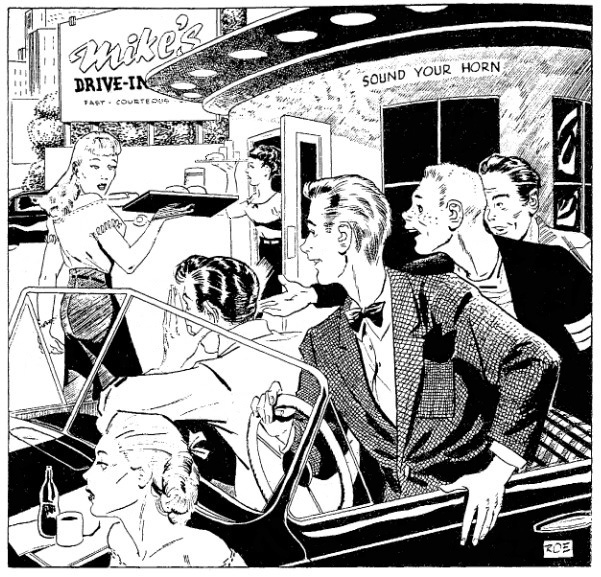
Following World War II as young families were established and the suburbs spread, things began to change radically. The restaurant industry realized that finding a babysitter or dressing up the whole family was a barrier to restaurant going for many. Instead families were turning to informal roadside places. “Drive-ins, with their motto of ‘Come as You Are, Eat in Your Car,’ have a siren call for parents with insoluble sitter problems,” observed the Cleveland Plain Dealer in 1960.

Chains also got the message. A 1963 Bonanza advertisement proclaimed low-priced steak dinners plus “No tipping – Children ½ price – Come as you are – Western atmosphere.”

comeasyouarelittleblackdressMeanwhile, in the late 1960s, in the midst of the hippie upheaval, Gloria Vanderbilt recommended the “little black dress” as always correct for dining in a fine restaurant. But informality was winning as women wearing pants gained acceptance even in luxury New York City restaurants in the early 1970s, a rule change stimulated no doubt by a damaging recession.

By the late 1970s dress codes had been relaxed to the point that many upscale restaurants were minimally satisfied if their customers at least wore “dressy casual,” which usually meant designer jeans, shirts with collars, and no short-shorts, tank tops, or halter tops. Some chains accepted t-shirts as long as they weren’t white, but everyone agreed that patrons had to wear some kind of shirt and shoes.

Today, as Alison Pearlman has written in her fine book Smart Casual, the bond between fancy formal restaurants and gourmet dining has been loosened further by affluent young professionals in the creative industries. If they wear hoodies and jeans to work they expect to do the same as they sample innovative dishes at a hip restaurant.
comeasyouare1899
And yet, along with the relentless trend toward casual dress, the tendency to show off in public persists, possibly as strongly as in the late 1890s when women of New York’s “smart set” took to the cafes to display the latest fashions.

© Jan Whitaker, 2016

5 Comments

Filed under chain restaurants, drive-ins, elite restaurants, family restaurants, patrons, restaurant customs, restaurant etiquette