Category Archives: Offbeat places

The “mysterious” Singing Kettle

singingkettlepcA veil of ominous mystery has spread over the remains of a California roadside tea room once known by the homey name Singing Kettle.

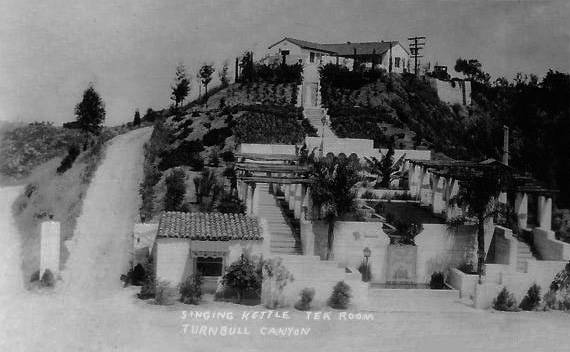
It was located near the summit of Turnbull Canyon, high above the San Gabriel Valley, on a winding road running through the Puente Hills in North Whittier. The road was completed in 1915, opening up a route filled with what many regarded as the most impressive views on the entire Pacific Coast.
singingkettle3781tcrstreetview

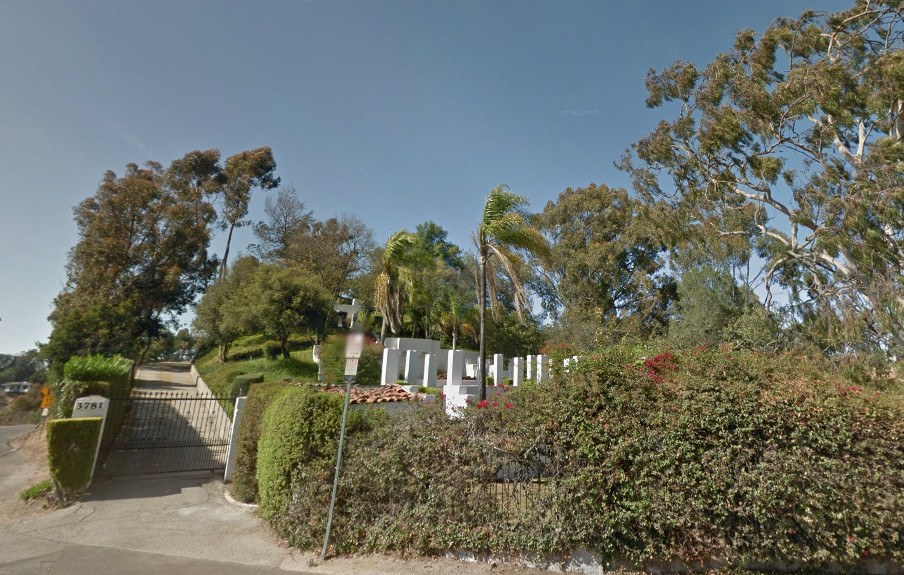
Today young people drive into the “haunted” canyon at night determined to be frightened to death. Gazing out car windows they eagerly tell each other tales they’ve heard of satanic rituals, murders, and human sacrifice, hoping that behind that fence are unspeakable horrors they might be lucky enough to witness. Even the Singing Kettle tea room, perhaps because remnants of its entrance are visible from the road, has become enmeshed in dark fantasies.

Why am I laughing?

Because it strikes me as funny that a tea room from the 1920s and 1930s could be associated with horror and paranormal events. Or even that people would find its existence mysterious, wondering why it was ever there or what it really was.

I suppose that given enough time and imagination mysterious auras can envelop any mundane place, even a deserted mall or a parking garage. But still, finding a tea room scary is like being frightened by a club sandwich.

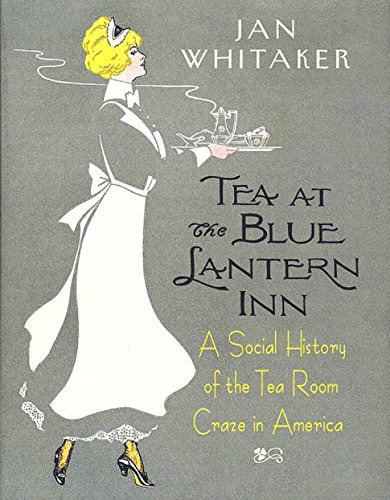
I have experienced a somewhat similar attitude before. I gave a talk on tea rooms of New York City when my book Tea at the Blue Lantern Inn came out in 2002. Afterwards a man in the audience came up and asked me why I didn’t mention the darker aspects of tea rooms. He was fixated on the idea that a lot of them had been speakeasies and houses of prostitution.

Really? If that had indeed been the case, why would I not have mentioned it? It would be a good story. I’ve found little evidence of prostitution in tea rooms. It’s true that some, a minority, of tea room proprietors were found selling liquor during Prohibition. A few places in Greenwich Village were raided in the early 1920s, and here and there the mob would open a joint and call it a tea room, though that was purely a ruse. They were totally fake. I feel certain it was impossible to order a diet plate or a Waldorf salad in a mob tea room.

singingkettleentireproperty

The dining area of the Singing Kettle tea room was up the hill from the pergola entrance shown on the black and white postcard above. As can be seen from a bird’s-eye view of the property, terraced stairs with fountains and shrubbery led up to the main tea room which today appears to be a residence. The view while dining would have been spectacular.

The tea room was frequented by students and staff from Whittier College, the Whittier Chamber of Commerce, and women’s clubs. It was a popular place for business meetings, card parties, wedding receptions, and bridal showers. Weddings were held in the inner courtyard of its entrance pergola.

singingkettlehartwhittierheights1927I have not been able to discover exactly who ran the Singing Kettle. It was said to be owned and operated by a major Southern California agricultural land developer, Edwin G. Hart, but I can’t establish if he was headquartered on the property or was directly involved in the business. He did promote the tea room in a 1927 advertisement for his new residential development, Whittier Heights.

The Singing Kettle was in business from 1926 until at least 1939, but probably not much longer. It surely would not have survived gasoline rationing during WWII.

© Jan Whitaker, 2016

With many thanks to the reader who told me about the Singing Kettle.

21 Comments

Filed under atmosphere, odd buildings, Offbeat places, roadside restaurants, tea shops

Famous in its day: Aunt Fanny’s Cabin

auntfannyscabinouthouse

Famous, but also infamous in its day because of how it portrayed the South before the Civil War and Emancipation as a world of smiling slaves who loved serving the kindly white people who held them captive.

Beyond its costumed mammy servers and the Black children who boisterously recited the menu, sang, danced, and proclaimed the South would rise again, the proprietors of Aunt Fanny’s Cabin restaurant in Smyrna GA created a legend regarding its name and building which appropriated and falsified the life story of a living woman.

According to an oft-told tale, the restaurant’s core building was a relic of the Civil War era and the home of a former slave, Fanny Williams, who spent her last years sitting on the restaurant’s front porch telling of the war and its aftermath. At her death in 1949 legend had it that she was very old, her age ranging from somewhere in the 90s to much older. She was “about 112 years old” when she died, restaurant owner George Poole told a reporter in 1982.

Indeed there was a real Afro-American woman named Fanny Williams. However it was revealed after the restaurant closed in the 1990s that she was born after the Civil War and had never lived in the cabin, which itself dated from the 1890s. Poole’s estimate of her 112 years had been preposterous – only a few dozen people worldwide were known to have attained that age — but newspapers had been much inclined to lax reporting when it came to Aunt Fanny’s Cabin. Far from an ancient rural yokel, she was about 81 when she died, a city dweller in Atlanta, and active in raising funds for her church there. How willingly or why she adopted the ex-slave persona is unknown.

auntfannyscabin1953jpg

Fanny Williams was a servant to a wealthy Atlanta family named Campbell. She was in service to socialite Isoline Campbell McKenna in 1941 when McKenna opened a tea room-style eating place on family property near their summer home. She named it Aunt Fanny’s Cabin, hosting ladies’ luncheons, bridge clubs, and bridal showers. She leased the business in 1947, selling it to lessees Harvey Hester [pictured above instructing his employees] and Marjorie Bowman in 1954. They elaborated the Aunt Fanny legend, enacted in what are known as “Blacks in Blackface” scenes where cheerful servers sang, danced, and even joined patrons in singing “Dixie,” the anthem of the ante-bellum South. According to a newspaper report in 1977 the restaurant’s decor included framed advertisements for slaves.

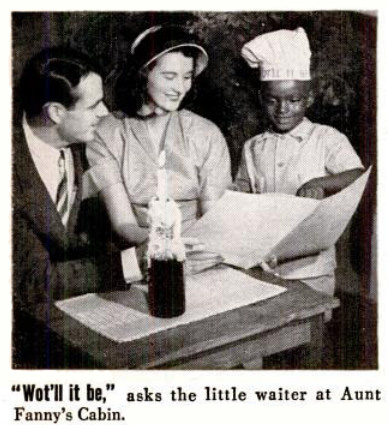
The restaurant’s third owner, George “Pongo” Poole, continued the song and dance tradition into the 1980s, although when a cabaret tax was demanded, dancing by the Black boys stopped. However, they continued to carry yoke-style wooden menu boards around their necks while they shouted out the menu offerings [child waiter shown below in 1949 before the menu boards were used].

The restaurant drew Georgians from Smyrna and Atlanta, as well as visitors from all over the country and the world. It was a tour bus stop, and a favorite of President Jimmy Carter and conventioneers such as members of the American Bar Association. Those who complained about the roles played by Black servers and the implicit celebration of slavery were characterized by proprietors as “Northern liberals,” though there is evidence that some Southerners and Westerners were also critical.

auntfannyscabin1949lifewoodburysoapadvIt became standard procedure when reporting on the restaurant to quote Poole about how his staff loved working there and was part of a big happy family. When interviewed, Black women servers would invariably attest to their love of the job and how they never felt insulted. To what extent this was a genuine expression on their parts is unknown.

What is known is that many of the elements that characterized the restaurant had been subjects of contention for a long time. A 1964 survey by Wayne State University researchers showed that most Black respondents found terms such as Sambo, Aunt Jemima, auntie, mammy, spook, and darkie offensive. Many white people, especially in the South, did not understand this, and thought that calling an elderly Black man or woman Uncle or Aunt/ie was a mark of respect. As for “mammy,” despite the affection many Southerners felt for the Black women who had cared for them when they were children, it had been rejected by many Americans long before the 1960s. In the 1920s the National Organization of Colored Women’s Clubs mobilized massive opposition to a Washington, D.C. memorial to mammies proposed by the United Daughters of the Confederacy. “One generation held the black mammy in abject slavery; the next would erect a monument to her fidelity,” said the club women’s official statement in 1923.

Georgia Senator Julian Bond said in the 1980s that he had little attraction to Aunt Fanny’s Cabin but could imagine that younger Blacks might find it “cute.” A journalist with the Atlanta Constitution who visited the restaurant in 1984 reported that he saw numerous Black patrons.

So, what’s the story? Did the degree of tolerance or even liking that some Black people expressed for Aunt Fanny’s Cabin mean that it held no offense to people of color? Did it mean that those who complained were thin-skinned trouble makers with an elevated sense of their own dignity who couldn’t take a joke? Did it mean, as a 1982 Washington Post story argued, that the years after the Civil Rights Act of 1964 were part of a post-racial age in which slavery, forced segregation, and lynching had largely ended and any remaining blatant prejudice was due simply to a few “obnoxious rednecks”?

mammy1959milwaukeeI think not.

I cannot be absolutely certain that there has never been a Black-owned restaurant that celebrated plantations, “pickaninnies,” and “mammies” of the Old South, but all the mammy restaurants I know of, mostly in business from the 1930s to the Civil Rights era of the 1960s, were white-owned. And dressing Black women servers in mammy get-ups was so commonplace back then that at times I’ve wondered if wearing that costume was a waitressing job requirement for dark-skinned women.

auntfannyscabin1954jpg

After the death of owner George Poole, Aunt Fanny’s Cabin struggled and subsequent owners could not revive it. It closed for the last time in 1994, sometimes recalled as partly a victim of “political correctness.” Based on the understanding that the original portion of the restaurant’s building had been a slave cabin, the city of Smyrna proposed to move it downtown to be used as a visitors’ center. After a historic structures report revealed it dated from the 1890s, the city decided to go ahead with the project on the grounds that the restaurant had itself been a significant part of the city’s history.

© Jan Whitaker, 2016

Update regarding comments: From now on I will approve only thoughtful comments that address the theme of this blog post which is the restaurant’s portrayal of history and how that shaped the roles available to Black staff. I will not approve comments that assert that everyone loved working there or that rave about the fried chicken. I have already held some back for these reasons — along with some hate comments — but now it is my policy. March 5, 2021

December 16, 2021 update: The remaining Aunt Fanny’s Cabin is going to be torn down! Thanks to “MadamC” for sending this link to the Atlanta Journal-Constitution story.

103 Comments

Filed under odd buildings, Offbeat places, popular restaurants, racism, restaurant decor, uniforms & costumes

Dining for a cause

SanitaryFairKnickerbockerHall

During the Civil War, fairs were held in over twenty Northern cities to raise funds for the United States Sanitary Commission, a private organization that supplemented the Union Army Medical Corps’ efforts to care for wounded soldiers.

New York state held five fairs, in Albany, Poughkeepsie, Rochester, Brooklyn, and New York City. The Brooklyn and New York City “Sanitary Fairs” were massive endeavors resulting in donations of enormous amounts — $300,000 and $1,000,000, respectively — to the Sanitary Commission.

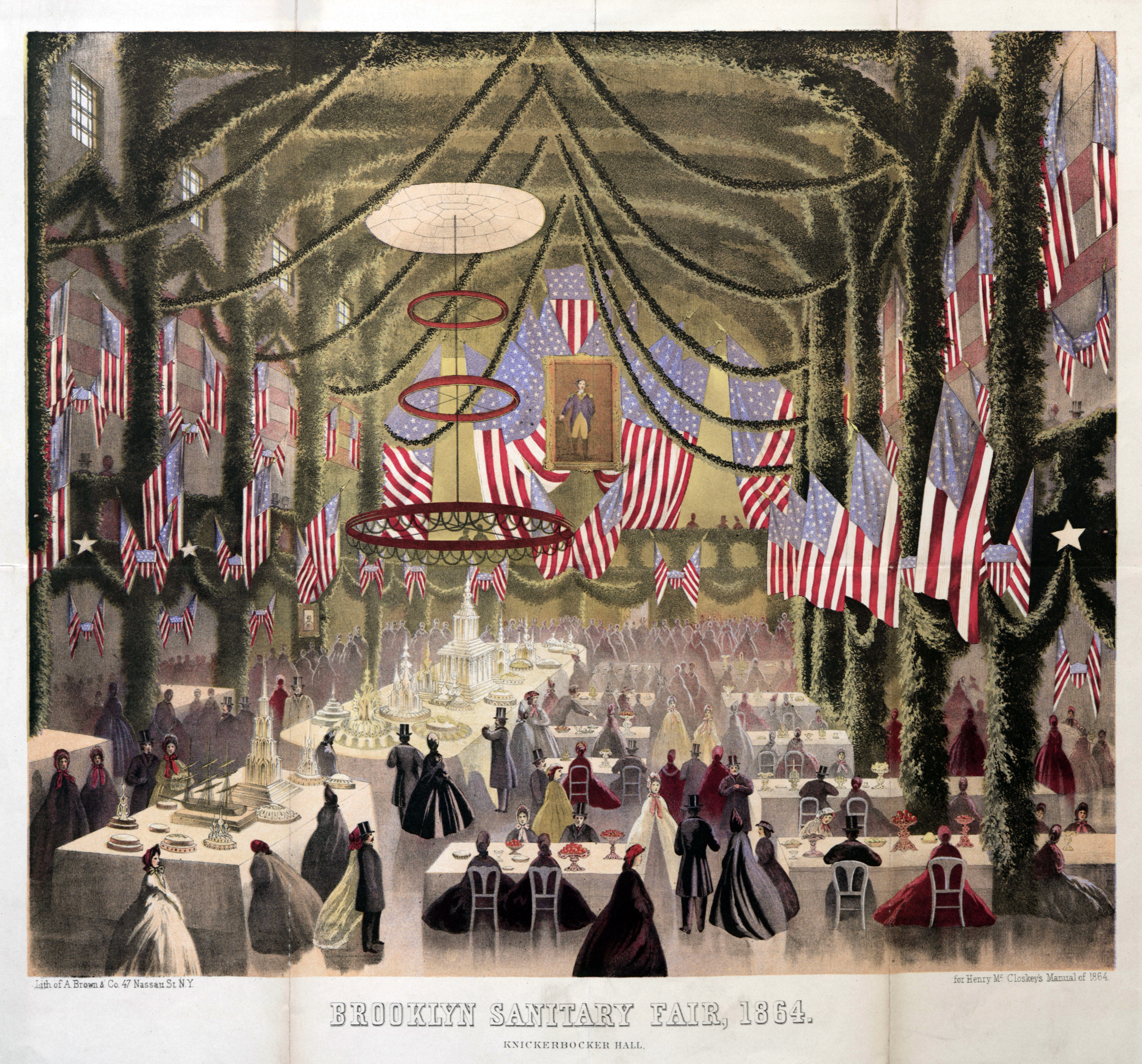
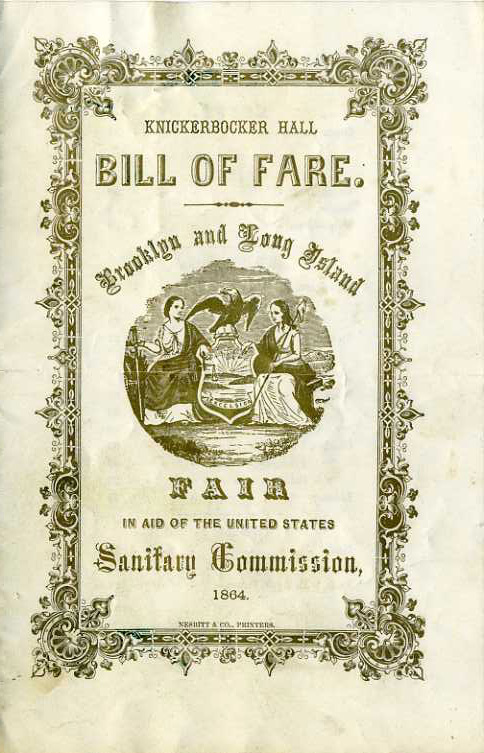
SanitaryFair1The fairs featured music, displays of art and curiosities, tableaux vivants, and other entertainments. Restaurants were an especially popular attraction. This week, a friend whose ancestors were involved with the Brooklyn fair gave me a wonderful printed-in-gold bill of fare from that fair’s Knickerbocker Hall Restaurant.

There were two main eating places at the two-week-long Brooklyn & Long Island fair, the larger one located in the temporary, specially built two-story Knickerbocker Hall located next to the Brooklyn Academy of Music [shown above]. The other restaurant, The New England Kitchen, occupied another temporary building across the street [shown below].

SanitaryFair2The Refreshment Committee in charge of the two restaurants was quite successful in getting donations of food supplies, including almost $20,000 worth of wine. But public opinion nixed serving wine, along with holding raffles, as improper for a fair in the “City of Churches.” So the wine was given instead to the New York Metropolitan Sanitary Fair which was held about a month after Brooklyn’s, in April of 1864.

Despite the absence of wine, the Brooklyn fair outdid the Metropolitan NYC fair in how much money its SanitaryFair3eating places cleared. Compared to the Metropolitan NYC fair, the Brooklyn menu was simplified, with no relishes or fruit, and few soups, cold dishes, or pastries. Brooklyn netted $24,000 for the cause, while the Metropolitan fair cleared only a little over $7,000 because, unlike Brooklyn, they received little donated food (uh, what happened to the wine?). Brooklyn’s New England Kitchen added perhaps as much as another $10,000 for the Sanitary Commission.

SanitaryFair4Brooklyn’s Knickerbocker Hall Restaurant, which could seat 500 at a time and took in about $2,000 a day, was under the direction of the men’s refreshment committee, while the New England Kitchen was run by a committee of women. The Kitchen was tremendously popular, serving 800 to 1,000 persons daily. But it occupied too small a space and, as the commemorative volume issued by the fair noted, would have made a greater profit had it been able to accommodate larger crowds.

sanitaryfairfrankleslie'sillustnewspaper

Unlike the Knickerbocker, the Kitchen’s bill of fare did not replicate that of a fine restaurant. Nor did the Kitchen follow the prevailing custom of hiring Afro-American men as waiters. The Kitchen used (white) women volunteers who served meals dressed in mid-18th-century costumes that visitors found ugly yet fascinating. For a set price of 50 cents, considerably less than a typical dinner composed from the Knickerbocker Hall’s a la carte menu, they served a down-home meal of such things as pork & beans, brown bread, applesauce, baked potatoes in their jackets, hasty pudding, and cider. Food was eaten from old china with a two-tined fork. The Kitchen also hosted events such as spinning wheel demos, apple paring bees, and an actual wedding.

Though it’s hard to draw a straight line from The New England Kitchen to women’s tea rooms of the early 20th century, it is notable how many tea rooms adopted a similar theme, right down to the old-style cooking fireplace and spinning wheel. It was also significant that so many women assumed executive and managerial positions on fair committees, especially in the New England Kitchen, and it’s probable that many of them remained active in public life after it ended.

© Jan Whitaker, 2016

8 Comments

Filed under alternative restaurants, menus, odd buildings, Offbeat places, proprietors & careers, uniforms & costumes, women

Find of the day: Hancock Tavern menu

hancocktaverndoublemenu

When I found this menu from Boston’s Hancock Tavern [shown front & back] at a flea market my first question was how old it was. As soon as I began researching I learned that proprietor Wadsworth & Co. had taken over in 1897 and that the building pictured was torn down in the spring of 1903. That narrowed things down.

At that point I thought I knew enough to consider the question of the tavern’s history, starting with “Built 1634″ as noted on the menu.

Then, everything began to unravel, including the menu’s date.

hancocktavern1867corncourtI discovered that Edward & Lucina Wadsworth had reopened the Hancock Tavern in 1904 at “the identical site of the original historic structure.” Which had been razed. It took a while to figure that one out but I eventually determined that the reborn Hancock Tavern was located in the rear, Corn Court side, of a new office building facing on State Street. [sketch of map fragment shows Corn Court and Hancock Tavern in 1867]

Then I found a story about a menu like mine found in a collection of items related to the Hancock Tavern — similar except that it said “Visit the Historic Tea Room Up Stairs. In this room the ‘Boston Tea Party’ made their plans, and dressed as Mohawk Indians to destroy the tea in Boston harbor, Dec. 16, 1773.” Since mine simply says “Private Supper Rooms Up Stairs for Ladies and Gentlemen,” I decided that it probably dates from the reincarnated Hancock Tavern, which would put it between 1904 and approximately 1910.

Much bigger mysteries surrounded the history of Hancock Tavern. By the late 19th century legends about the tavern abounded, beginning with the notion that it dated from 1634 as the continuation of a tavern begun by Samuel Coles. It was also said to have hosted John Hancock, exiled French king Louis Philippe, George Washington, Benjamin Franklin, and French foreign minister Talleyrand. But the grandest legend concerned the conspirators in the “Boston tea party.” Beginning in the 1880s, the various proprietors of the Hancock Tavern spun historic tales about this.

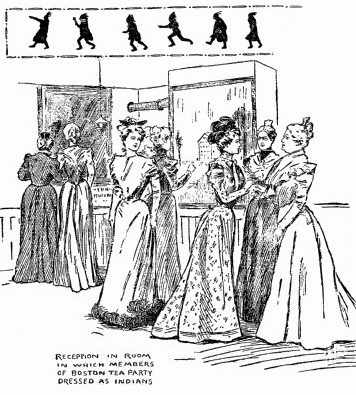
hancocktaverndec1898In December of 1898, the Daughters of the American Revolution, dressed as Colonial maids, met at the Hancock Tavern to celebrate the 125th anniversary of the tea party. On the wall was a somewhat more detailed inscription, likely put there by the Wadsworths: “In this room the Boston tea party made their plans and dressed as Mohawk Indians, and went to Griffin’s (now Liverpool) wharf, where the ships Beaver and Eleanor and Dartmouth lay, and threw overboard 342 chests of tea, Dec. 16, 1773.” Later, the Wadsworths produced a souvenir booklet of historic lore.

But the link between the tavern and the Revolution, as well as its ancient status, were thrown into doubt in 1903 when City Registrar Edward W. McGlenen announced that the just-razed building that had housed the Hancock Tavern had been erected between 1807 and 1812. Furthermore, he said, its predecessor on the same site, a two-story house, had not been granted a tavern license until 1790, ruling out any associations with the Revolution. He also showed that Samuel Coles’ Inn, reputedly built in 1634, was an entirely separate property, thereby demolishing the Hancock Tavern’s claim to be Boston’s oldest tavern. The legends, he said, had developed from a number of fanciful books and articles from the 19th century that were in conflict with town records.

And so my menu, though still more than 100 years old, lost some of its charm.

On the bright side, though, I learned a few things about the operation of 19th-century taverns. I learned that Mary Duggan, widow of the first licensee, ran the tavern for a number of years after her second husband died. In addition to supplying the finest liquors, she advertised in 1825 that she had engaged a “professed COOK” who would have soup ready from 10 to 12 o’clock (then the standard time to eat soup), and would prepare supper parties “at the shortest notice.”

I also realized how much turnover there was in the tavern business. During most of the 19th century the Hancock Tavern was leased out to a succession of proprietors who either handled its alcohol and food service or the entire operation, which included lodging.

It fell on hard days sometime before the Wadsworths took over in 1897. Their energetic attempts to raise its historic value may have sprung in part from the fact that it had spent some years as a gambling den. In a city with many old buildings, most Bostonians did not care about it.

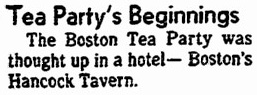
Having the bad luck to be located in what was fast becoming Boston’s financial district, the building was doomed, but the legend of Hancock Tavern’s link to the tea party lived on. The Arkansas Gazette reported in 1976:

hancocktavern1976© Jan Whitaker, 2016

6 Comments

Filed under atmosphere, history, menus, odd buildings, Offbeat places, proprietors & careers

Coppa’s famous walls

coppa'sBlackCat2

The San Francisco restaurant Coppa’s became legendary in the early 20th century as a gathering spot for bohemian artists and writers, especially after they decorated its walls with curious and intriguing murals. Though the murals remained in existence for scarcely a year, because of the devastating fires that followed the earthquake of April 1906, they have been forever tied to the restaurant’s mystique.

coppaincoppa'sBlackCatOver the course of months in 1905 the murals were drawn in chalk crayon by artists who frequented the restaurant on Montgomery Street. Legend has it that proprietor Giuseppe “Joseph” Coppa papered (or painted) his walls a hideous red that offended their esthetic sensibilities, impelling them to mask it with their humorous, nonsensical drawings. An alternative explanation is that Coppa asked the artists to draw on the walls and that he chose red as a good backdrop. I find this more convincing since Coppa himself was a painter.

A row of stenciled black cats at the original location, by Xavier Martinez, was inspired by Le Chat Noir in Paris, the city where Martinez had studied painting. They gave the restaurant its nickname, The Black Cat, which was also used at its new post-fire location.

While I was at the Library of Congress a few weeks ago I had a chance to look at the hard-to-find book The Coppa Murals, by Warren Unna (1952). He interviewed some of the artists involved and also Felix Piantanida, Coppa’s early partner who was responsible for preserving the photographs shown in the book. It’s likely the photos were taken for use in an article by Mabel Croft Deering not published until June 1906 in The Critic, but written before April’s destruction caused Coppa’s closure. The murals themselves were at some point scrubbed off or painted over by the landlord.

coppa'sphoto1906

Though the restaurant was looted by vandals, the building Coppa’s restaurant was in actually somehow escaped destruction [shown above]. With few buildings intact, its value rose and Coppa’s landlord raised the rent, leading Coppa to vacate and open another Black Cat on Pine Street in November. He and Piantanida split up, and for a short time Piantanida conducted a restaurant called La Boheme in the space formerly occupied by Coppa’s.

The artists and illustrators who contributed drawings included some who would become prominent, such as Maynard Dixon, Xavier Martinez, and Gelett Burgess. The artists, along with poets and writers, contributed puzzling sayings and quotations that adorned the walls, fascinating – and insulting – customers (“Philistines”) who came to gawk at the bohemians.

coppa'sbook

The cover of Unna’s book shows a crude rendering of a mural by Xavier Martinez depicting the restaurant’s core group of regulars. Martinez is seated at the far right. Standing behind him is poet Bertha Brubaker, wife of Perry Newberry, smoking a cigarette. Her nickname “Buttsky,” which referred to her habit of saving cigarette butts, appears in the “hall of fame” of names that run beneath the black cats. The names of Coppa’s regulars are interspersed with those of famous writers such as [Johann Wolfgang] Goethe, [François] Villon, and [Guillaume] Apollinaire. The few women named are hard to identify since their last names do not appear, but Maisie was freelance writer Mary Edith Griswold and Isabell was allegedly a newspaper writer.

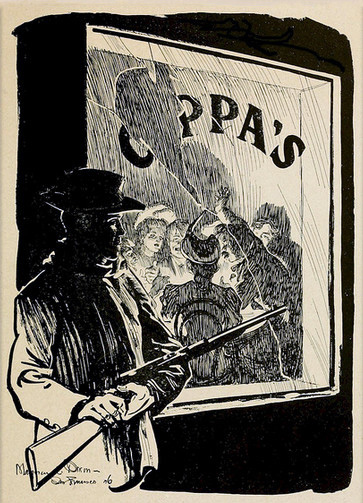
coppa'sMaynardDixonSimpleLifeinBohemiaWhen Coppa moved to Pine Street, a new row of cats appeared, but now marching in the opposite direction. Maynard Dixon also contributed several new images. One of his shows Coppa unfurling a scrolled menu to a crowd that includes regulars who were violinists, writers, poets, and artists. On another wall Dixon commemorated Coppa’s “Last Supper” at his old location, celebrated soon after the fire and necessitating official approval and protection from a marshal who stood guard outside. Another notable feature of the Pine Street murals were two works by a woman, painter and jewelry designer May Mott-Smith.

coppa'sredpaint

Coppa’s second Black Cat closed in 1913, after which Joseph and his son Victor launched Neptune Palace, a more commercial cabaret restaurant. In 1916 Joseph returned to a bohemian theme with The Red Paint, a short-lived restaurant on Washington Street that went out of business at the start of Prohibition, stopping the flow of “red paint,” i.e., wine. It too had murals, never completely finished and lacking the inspiration of those at the earlier Black Cats, despite Maynard Dixon’s participation once again. Many in the old gang had moved to Carmel by the Sea and things were not the same.

coppasaug231933In 1922 Coppa opened yet another restaurant, at 120 Spring Street, offering “old-time dinners,” possibly so-called because they were paired with illicit wine. Joseph was often arrested in raids by prohibition agents, and Victor once escaped by running out the back door. It’s possible the restaurant was officially padlocked for a time because in 1933 it “re-opened,” with the unveiling of a painting by the ever-faithful Maynard Dixon of a nude woman dressed only in shoes, stockings, and a large-brimmed hat with her legs crossed atop the table, toasting an obese man opposite her [see 1933 advertisement]. The same image was used on the cover of the restaurant’s menu at its final location, 241 Pine. That closed in December 1939, marking the end of Joe Coppa’s long culinary career.

Joseph’s wife, Elizabeth, who had been the dining room manager and cashier, died in 1938. After his retirement he took up painting, focusing on portraits of men such as business magnates, Italian dictator Benito Mussolini, and poet George Sterling.

© Jan Whitaker, 2015

12 Comments

Filed under atmosphere, Offbeat places, restaurant decor

Dining sky-side

airportO'Hare

Although a number of superior restaurants have opened in airports in the past several years, their run-of-the-mill food purveyors are often just passable. Customer comments reveal praise for certain restaurants, but opinions overall sound a negative note, rising to weak compliments such as “actually somewhat good” or “standard innocuous restaurant/hotel fare.”

In the beginning, there was no food at all. In the 1920s airports had no restaurant facilities. There were scarcely any commercial flights, facilities consisted mainly of fields and a hangar or two, and the few commercial passengers were lucky if they could get a cup of coffee.

By the mid-1930s more commercial flights were offered and airport conditions improved. The number of passengers multiplied more than 100 times between 1926 and 1935. To win greater traffic, bigger cities vied to create terminal facilities that could match those of their transportation rival, trains. Restaurants figured prominently among the amenities offered.

Most passengers in the 1930s, 1940s, and 1950s were businessmen or wealthy travelers who were unwilling to settle for bad food. Even though all air travel was essentially first-class then, passengers frequently rejected what was served on the plane and tried for something better in the terminal. Their demands, combined with the need to put airports in the black financially, brought about efforts to create first-rate airport eating places.

airportburbankskyroom (2)

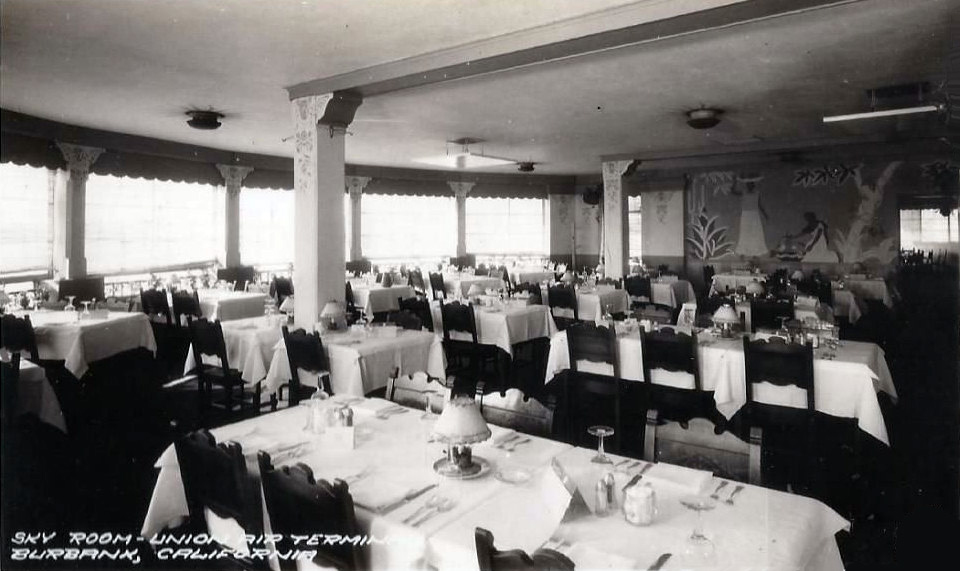
The earliest image of an airport restaurant I’ve found is that of the Sky Room in Burbank CA’s Union Air Terminal (now Bob Hope Airport), in 1940, showing tables with white linens, goblets, and boudoir-style table lamps.

Airports were costly for cities and towns to build and run so income from concessions was needed badly. Managers expected income from non-aviation concessions at New York’s Idlewild airport to make up one third of revenues in 1949. Restaurants and coffee shops were the biggest single contributors of concession revenue in most airports.

But restaurants found it hard to operate profitably when serving only “captive customers,” particularly when their numbers were still relatively small. Beyond pleasing airline passengers, the solution for many airports was to reach out to customers living nearby. In 1947 the airport restaurant in Albuquerque NM went so far as to hire a chef who had studied with Escoffier and cooked for US presidents and royal families in Europe. His mission was to make the terminal restaurant one of the nation’s best known restaurants.

The early 1950s saw the debut of what might have been America’s premier airport restaurant, The Newarker in the Newark NJ terminal. With Joe Baum as manager and Albert Stockli as chef, it soon became famous, launching Restaurant Associates which owned many of NYC’s top dining establishments. Duncan Hines lauded The Newarker for its “flaming sword specialties, authentic East Indian curries, [and] regional Swiss specialties.”

airportCleveland1965Seattle1941

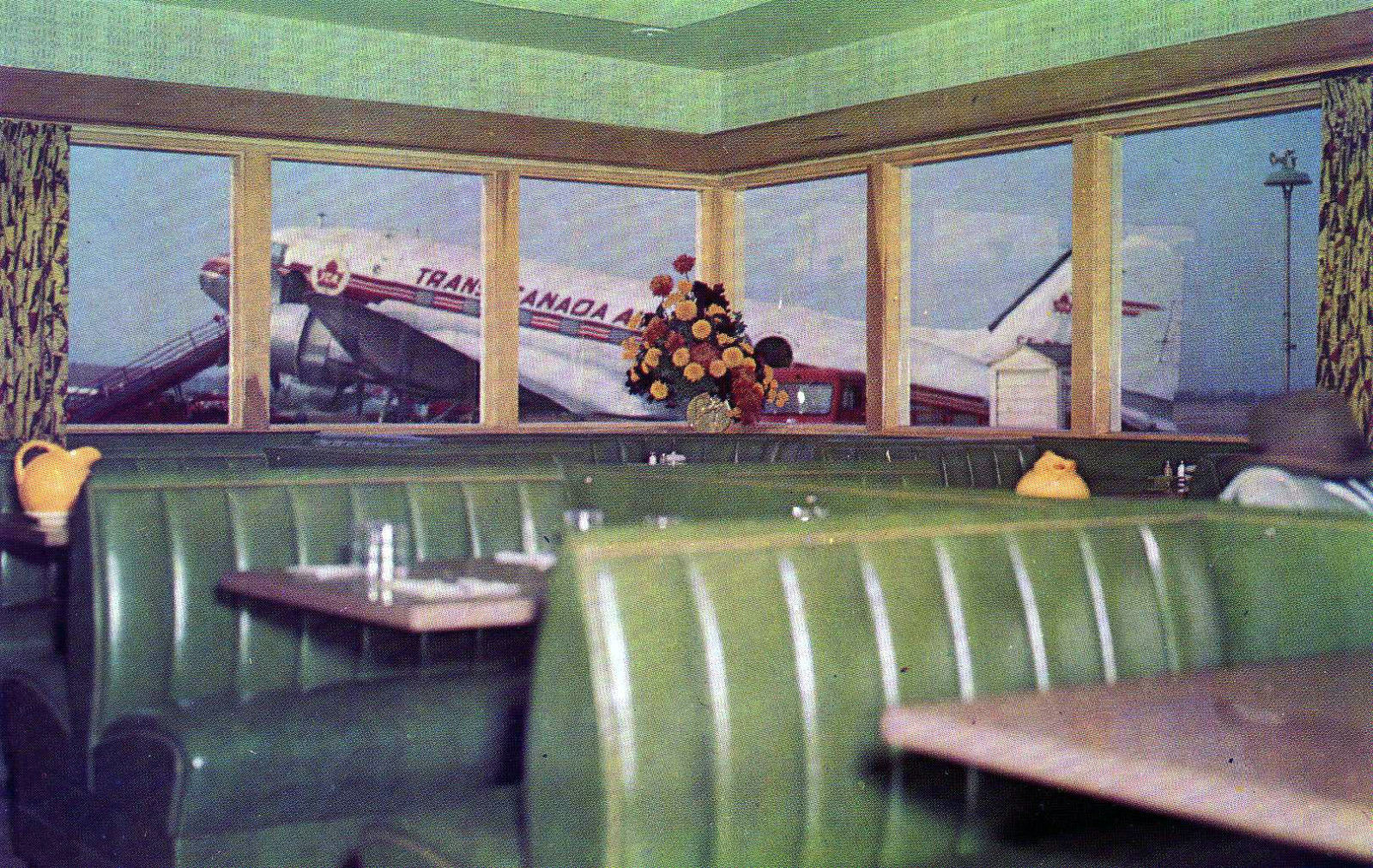
Evidently the tactic of pulling in locals worked, partly because even through the 1960s people were thrilled to see planes take off and land. Dining rooms typically overlooked the airfield. In 1953 Fort Worth’s new terminal at Amon Carter Field was touted as “a wonderful, quiet spot to have a leisurely evening meal and then sit on the observation deck and look at the bright lights of booming Dallas nineteen miles away.” Now it may seem an odd idea to go to an airport restaurant to celebrate a birthday or, even stranger, a holiday such as Thanksgiving or New Year’s Eve, yet these festivities did indeed take place [advertisements: Cleveland, 1965; Seattle, 1941].

airportClevelandshreiberrestaurantSome airport restaurants were operated by local restaurateurs. Among them was Marie Schreiber, who became a restaurant operator for Statler hotels after providing meals in Cleveland’s airport restaurant [pictured] as well as on-board meals for departing United Airlines flights. Food service operations of two Chicago departments stores, Marshall Field and Carson, Pirie & Scott, handled meals at O’Hare for years.

At the same time, chains that ran airport restaurants and prepared meals for service during flights developed rapidly. Some, such as Skychef restaurants, were operated by the airlines (in this case American Airlines), but existing chains such as Dobbs House and railroad caterers Fred Harvey and Interstate Hosts also migrated into airports. Dobbs House units in airports from Wichita to Miami also earned praise from Duncan Hines in 1959 for dishes such as pompano en papillote and Colorado mountain trout.

Southern airports were protest sites because of their discriminatory treatment of Black passengers. Until summer of 1961, Blacks were not served in Interstate Hosts’ main dining room or the coffee shop in New Orleans’ Moisant International airport, but only at the snack bar. After lawsuits, Black customers gained equal patronage at all airport restaurants in recognition that airports, like bus terminal facilities, were fundamental to interstate commerce.

In the 1980s theme restaurants – often flight-themed – began to locate in the vicinity of airports. But that’s a subject for a future post.

© Jan Whitaker, 2014

6 Comments

Filed under family restaurants, Offbeat places

Holiday greetings from Vesuvio Café

XmasVesuvio1956

I wish I could explain the Vesuvio’s holiday cards, but I can’t. Maybe it’s enough to know that the Café was a beatnik gathering spot in San Francisco.

The café was founded in 1949 by Henry Lenoir, who wore a beret and undoubtedly preferred to spell his first name as Henri. I’m guessing he’s the aging cherub on the left on the 1956 postcard above. I couldn’t find much about him other than that he was born in Massachusetts around 1904. The son of a Swiss university professor, he was a college graduate at a time when that was fairly unusual. In 1940, before he opened the café, he worked as a salesman in a San Francisco department store that I like to think was the Emporium. He was an art lover who enjoyed the company of beats and hipsters.

I don’t know if the Vesuvio served much food. It seemed to be more of a drinking than an eating place back in the days when Henry presided behind the bar. A sign in the window advertised “booths for psychiatrists” and a “Gay ‘90s Color Television” flashed old photos of women clad in bloomers. In the late 1950s it was on the North Beach circuit for beatniks who made the rounds from the Vesuvio to the Coexistence Bagel Shop and a nameless bar called “the place.” No doubt they stopped in at the City Lights bookstore too; Henry lived upstairs.

XmasVesuvio1964It was the day of the Hungry I, the Purple Onion, and the Anxious Asp (where the restroom was papered with pages from the Kinsey Report). “The place” and the Coexistence, considered the birthplaces and headquarters of the San Francisco beats, were both gone by early 1961. But, although Henry sold the Vesuvio in 1970, it continues even today. Of course it isn’t the same. Given that Beatnik dens became tourist sites almost overnight, it already wasn’t the same in 1964 when the card with the 5 nude mannequins and one real woman modestly dressed in a long-sleeve leotard was produced.

© Jan Whitaker, 2013

16 Comments

Filed under Offbeat places

Dining by gaslight

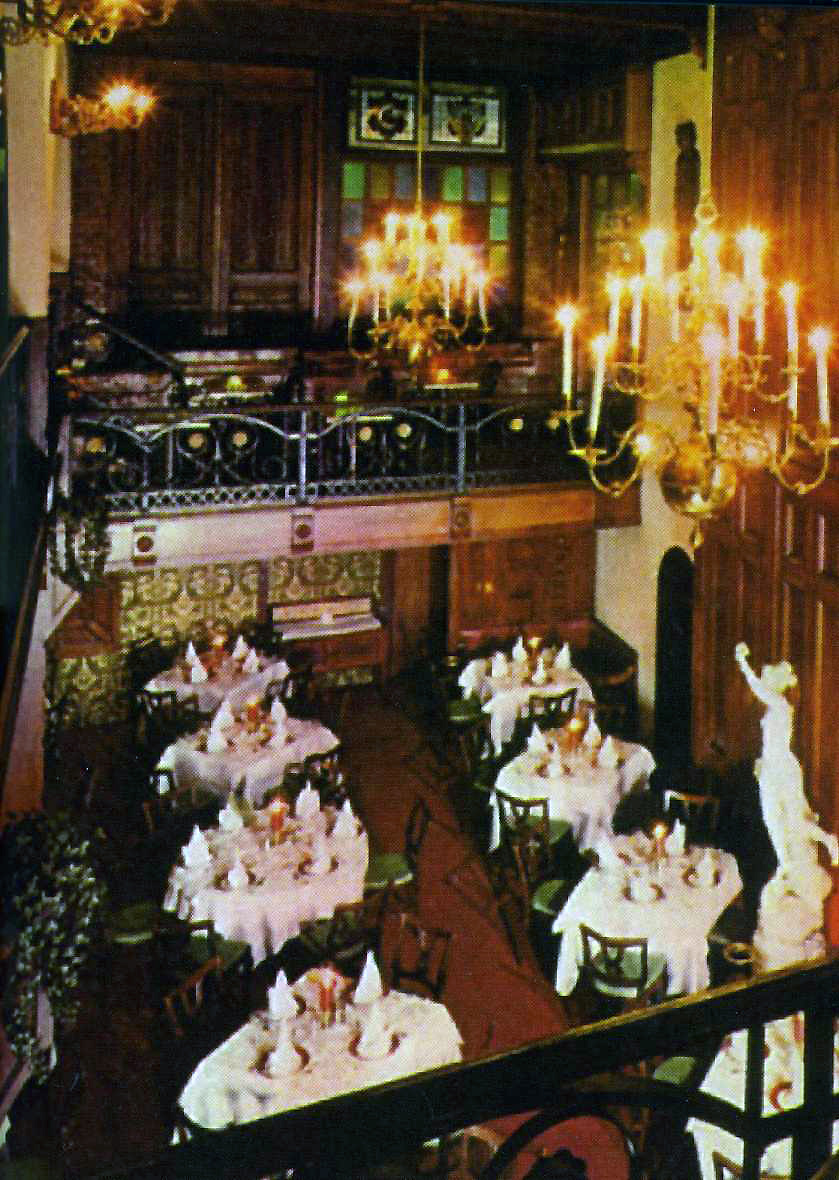
GSThreeFountainsINTThough it seems fairly obvious when you think about it, the development of entertainment districts post-WWII encouraged the growth of restaurant-ing in many cities across the U.S. On the minus side, the fate of such restaurants was highly dependent upon the fate of the districts.

The Three Fountains [pictured] was the star restaurant in the entertainment district of St. Louis which began in the late 1950s and was officially named Gaslight Square in 1961. The one-and-one-half block area attracted affluent suburban St. Louisans and the city’s many conventioneers with restaurants, live theater, and clubs that featured national acts such as the Smothers Brothers, Joni Mitchell, Lenny Bruce, and Miles Davis.

Developing out of a racially borderline, transitional neighborhood populated with apartments, music schools, and antiques stores, its pioneering establishments included the Crystal Palace theater, the Gaslight Bar, Smokey Joe’s Tavern, the Laughing Buddha coffeehouse, and the Dark Side jazz club.

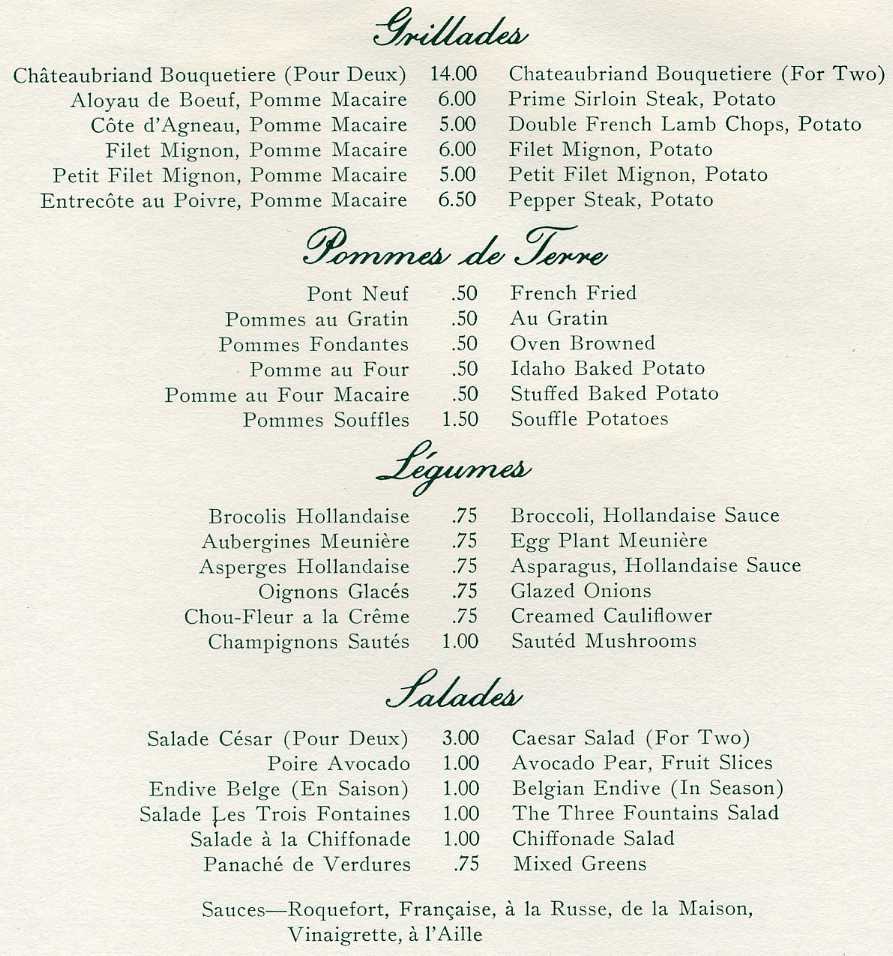
GSThreeFtnmenuThe Three Fountains exuded luxury with a multi-level interior lavishly decorated with  antique fixtures complemented by an oversize menu filled with expensive dishes (the $6.50 pepper steak would cost about $46 today). Its decor, like most of the restaurants and clubs in Gaslight, consisted of an extravagant, crazy melange of salvaged windows, doors, railings, paneling, statues, fountains, and light fixtures from structures mowed down by a city obsessed with urban renewal.

gsMillCreekValleySlum clearance in an area known as Mill Creek Valley brought its bounty. There the destruction of residences formerly housing 20,000 people (95% of them Afro-Americans) freed up tons of antique woodwork and hardware for decorators with a taste for Victorian. The transfer of objects from Mill Creek to the nightclubs and restaurants in Gaslight Square can also be seen as an illustration of a troubled relationship with the city’s black population who lived close by, worked in Gaslight’s restaurants, and performed in its clubs, yet whose patronage was not welcome.

According to Jorge Martinez, owner of a couple of jazz clubs, the block’s business association ruled against his proposal for a dance hall out of fear it would attract Afro-Americans. Terry Kennedy, an Afro-American who grew up in the neighborhood adjacent to the area and became a city alderman in 1989, observed that if you were black “you better not be there too long, or the police would run you off.” (Interviews with Kennedy, Martinez, and others are found in the book Gaslight Square, an Oral History, by Thomas Crone.)

Yet, Gaslight Square offered opportunity to a few Afro-Americans. Sandra J. Parks occupied a rare position in America, that of black female chef. She cooked in several of the area’s better restaurants, including Kotobuki and Port St. Louis and managed Two Cents Plain before moving to Chicago for a career in catering.

Compared to the city as a whole, Gaslight Square was a somewhat integrated area. Nonetheless racial tension would become a major factor in its downfall, most evident in white patrons’ grossly exaggerated fear of black-on-white crime.

From the area’s beginnings as an entertainment zone to its serious decline by 1968, at least 20 restaurants, dozens of nightclubs, and numerous coffeehouses and theaters were in business there [see map]. After-hour parties took place above street level, in apartment buildings and flats.

GScolorpostcard2centsannadels

There were steakhouses (Magnolia House, Marty’s, Jacks or Better, Mr. D’s), two Mexican restaurants (Tortilla Flat and a branch of Chicago’s La Margarita), a Polynesian restaurant (The Islander), a Japanese restaurant where servers dressed as geishas (Kotobuki), a fish restaurant where servers dressed as sailors (Port St. Louis), a Greek restaurant (Smokey Joe’s Grecian Tavern), a deli (Two Cents Plain), an Italian eatery (Bella Rosa), a tavern (O’Connell’s Pub), and several places whose cuisine I could not determine (Red Carpet, The Georgian, Carriage House, Die Lorelei, Left Bank).

Many of the restaurants were in converted town houses. Whenever possible they had patio dining in front, and most featured entertainment such as cabaret, folk music, or Dixieland, ragtime, or cool jazz.
GSLaughingBuhdaSTL60sThe more expensive restaurants were first to suffer from the area’s decline as well-dressed, well-heeled customers stopped coming. Conventioneers were warned off, in many cases, by cabdrivers who refused to drive there. Clubs with go-go dancers in the windows displaced coffeehouses with folksinging and poetry as a younger, more casually dressed crowd took over.
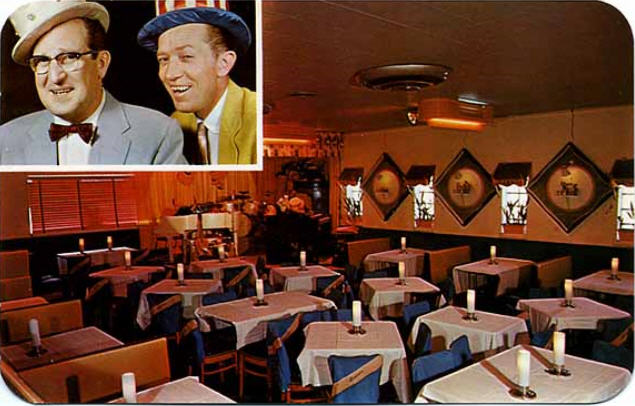
Although Gaslight Square was in ways a model for Chicago’s Old Town and Omaha’s Old Market, many businesses began closing or moving away by the mid 1960s. Port St. Louis and Two Cents Plain moved to more promising locations. In 1965 Craig Claiborne gave the Three Fountains a short – and horrid — review (“It is said to be the only French restaurant in the city and, if this is true, it is unfortunate.”) A few years later a number of gaslights were extinguished for nonpayment of gas bills. By 1972 when O’Connell’s moved to South Kingshighway, the area was largely in ruins.

Aside from a memorial constructed out of the pillars that once stood outside Smokey Joe’s, not a trace of Gaslight Square remains standing today.

© Jan Whitaker, 2013

9 Comments

Filed under atmosphere, Offbeat places

Restaurant as fun house: Shambarger’s

Shambarger'sAI came across this restaurant while looking through lists of winners of Holiday Magazine awards. I was intrigued to learn that Shambarger’s, in the small town of Redkey, Indiana, was one of only five restaurants in that state to win such an award in 1972.

As I learned more about Shambarger’s I had mixed reactions: fascination at its creator’s unstoppable spirit, surprise that it had won prestigious awards, and gratitude that I had never been compelled to sit through a 5- to 6-hour dinner and vaudeville show there.

BeaconSupperClubDenverFor Shambarger’s fell into a category I call the fun house restaurant, once occupied by hotspots of enforced jollity such as Greenwich Village’s Village Grove Nut Club or the Beacon Supper Club in Denver whose owners put on funny hats to make people laugh [pictured]. La Nicoise in Washington, D.C. had waiters on roller skates.

Shambarger’s, adjacent to a railroad track, resembled an abandoned building on the outside, a junk shop on the inside [see painting below by Clyde Thornburg, 1971]. Its proprietor John Shambarger “performed” most of the seven-course dinner preparation in front of 50 or so guests who made reservations many months in advance, often traveled some distance, and paid about $100 a person in today’s dollars.

Shambarger'sClydeThornburg1971Making ten or more costume changes an evening, as a pirate, Tiny Tim, a Hawaiian dancer, etc., John chopped and mixed while singing, pattering, or loudly playing records keyed to each dish. Sometimes he told jokes, kissed women diners, or screamed ‘Aaayyyyy’ in people’s ears in concert with a Spike Jones record.

And all this without cocktails! No alcoholic drinks were served, except in later years when dinner began with punch bowl of “Bloody Redkey” made of tomato juice spiked with a Budweiser six-pack. Burp.

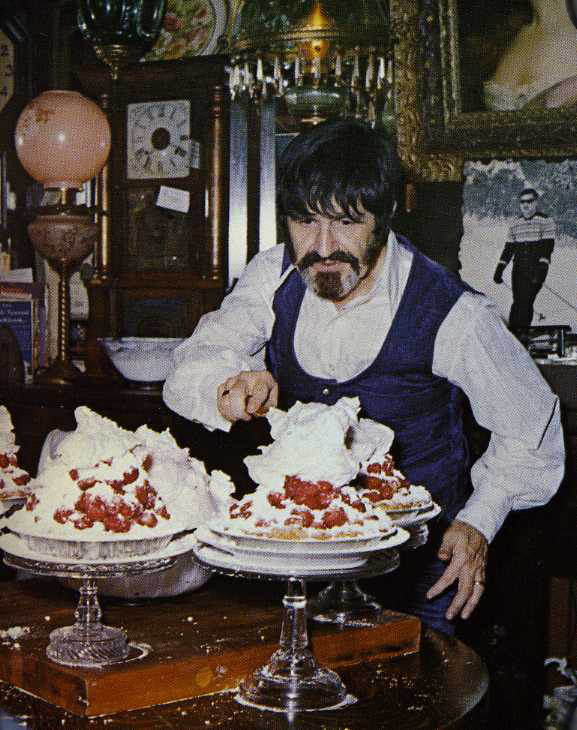
Holiday magazine’s volunteer judges in the 1960s and 1970s had a weakness for French cuisine. Which was what Shambarger’s provided, sort of. The menu was actually as jumbled as the decor of old clocks, menus, mirrors, lamps, and a moose head wearing a hat. It always included a main dish of Imperial Prime Ribs of Beef Flambee (in rum) and a dessert of sky-high strawberry pie (see above), but the first five courses varied. In one 1968 account they included – in a sequence that is perplexing – chicken soup, fresh fruit cup, corn fritters rolled in powdered sugar, shrimp, and guacamole with John’s special dressing.

Recipes for Shambarger’s guacamole and “Antique Salad Dressing” are furnished in the Holiday Magazine Award Cookbook (1976). I like guacamole and do not think it needs a dressing, especially not one made of cottonseed oil, vinegar, chopped onions, loads of sugar, catsup, concentrated lemon juice, and apple butter.

According to newspaper accounts, Redkey’s townspeople rarely ate at Shambarger’s, but they were always intrigued by the influx of well-dressed visitors from afar. In the words of Jayne Miller, who grew up in the area and now heads up Historic Redkey, Inc. (and provided information and images for this story), the locals knew that “magic” took place inside Shambarger’s humble structure.

The restaurant had its fans and its detractors, but enough of the former to keep Shambarger’s in business under John’s management from the 1960s through the early 1980s.

© Jan Whitaker, 2013

55 Comments

Filed under Offbeat places, proprietors & careers

Co-operative restaurant-ing

Although it is a footnote to restaurant history, the notion that restaurants could provide a solution to social and domestic problems is one that has cropped up quite a few times in American history, beginning in the 1840s, continuing into the 1970s, and not totally extinct even today.

The idea of community dining began with Frenchman Charles Fourier’s plan for a society organized into communes (phalanxes) where people both lived and worked. Several were established in the United States in the 1840s and 1850s, in Ohio, Texas, Wisconsin, New York, and New Jersey. The North American Phalanx in Red Bank NJ, which continued for 12 years, may have been the longest lasting. Its phalanstery, a kind of hotel or apartment building, had 85 rooms and a “refectory” where members gathered at long tables and chose their meals from a bill of fare with prices.

The Fourier-inspired communes did not survive, but the idea of collective dining did. From the 1870s until World War I feminists saw commercial restaurants as the next, virtually inevitable, step in evolutionary progress that would liberate women from kitchens. Suffragist Tennessee Claflin observed in 1871 that women’s chores such as teaching children and making clothes were leaving the home and becoming special trades. Noting that men were becoming accustomed to eating their midday meal in restaurants, she expected food preparation to be next.

Others observed the same thing, especially with the growing popularity of kitchenless apartments. An 1876 article in The American Socialist viewed NYC apartment buildings where meals were served in ground floor dining rooms as an outgrowth of Fourier’s ideals. Although limited to fairly affluent families then, apartment living was regarded as a step toward universal cooperative housekeeping.

A goal of some futurists and feminists, such as Edward Bellamy and Helen Starrett, was to have complete meals delivered to the home ready to eat. Starrett wrote in 1889 that the solution need not be a non-profit enterprise. Rather, just as butter and soap making had been commercialized, she expected that the business world would find a way to do this profitably. Indeed, in Knoxville, Tennessee, a woman started a meal delivery service as early as 1896, sending out “steaming hot” food to families. The idea got a boost during World War I when a surging war economy drew hired cooks out of affluent households (e.g., Florence Hulling).

Author and social thinker Charlotte Perkins Gilman knew of three cooked food companies in operation, in New Haven, Pittsburgh, and Boston. She fully expected efficient restaurants and food services to replace the home as a site of production, which, she wrote in 1903, “lingers on inert and blind, like a clam in a horse-race.” In her 1909 novel What Diantha Did, the enterprising heroine not only runs a hotel for working women, she also operates a lunchroom for business men, a cooked food delivery service, and a mini-maid service.

Other than supporting utopian societies and liberating women from household chores, the goals of “public service” style restaurants in the 19th and 20th centuries also variously encompassed providing inexpensive lunches for young working women, luring alcoholics away from saloons, resolving labor strife, reducing the cost of living, and promoting healthy diets.

Social motives often lay behind the start of commercial restaurants also, such as the Dennett’s chain whose funding came in part from missionary societies. And some eating places that had their starts as community co-operatives developed into commercial ventures, such as the Hollister Cooperative Coffee Club or the Mission Cafeteria in Long Beach [shown], both in California.

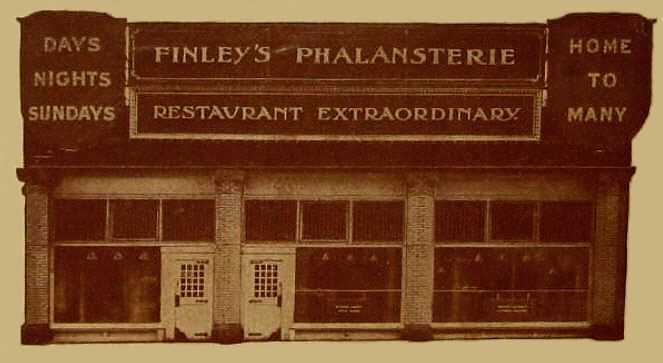
A curious outgrowth of the interest in communal dining occurred in Cleveland OH, where Richard Finley established Finley’s Phalansterie shortly after the turn of the century [pictured above]. Eventually he presided over six eating places in Cleveland and grew rich. Although he chose the generally unfamiliar name to pique interest in his restaurant, it turned out that he did in fact have communitarian motives in mind. His plan, reminiscent of Elbert Hubbard’s Roycroft in East Aurora NY, was to establish a colony in California where workers would live and produce arts and crafts furniture and objects. I was unable to discover how far he succeeded beyond building a hotel and cottages in La Canyada and publishing a magazine called Everyman.

The story of restaurants and eating places with social motives is not complete without mentioning the hippie and communal restaurants of the 1960s and 1970s – but that will be another chapter.

© Jan Whitaker, 2012

17 Comments

Filed under alternative restaurants, Offbeat places