Category Archives: food

The brotherhood of the beefsteak dungeon

reisenwebers

During the 1880s rustic beefsteak dinners became a popular form of entertainment among wealthy businessmen who formed beefsteak clubs whose traditions they traced back to England and the early Republic. Then, at the dawning of the 20th century, large restaurants and hotels began to create special banquet rooms for these feasts. Known as beefsteak dungeons, dens, caves, or garrets, they hosted groups of men who gathered for a night of boyish fun blissfully free from conventional dining etiquette.

The standard beefsteak dinner at these festivities involved diners donning white butcher’s aprons to eat steaks with their hands while sitting on boxes and barrels in a dark basement contrived to seem menacing. No utensils were furnished, but the thick slices of steak, dipped in melted butter and grilled on a hickory fire, were accompanied by triangles of bread. In the classic version little else was served other than stalks of celery and unlimited mugs of beer (the steaks were unlimited too). However, niceties such as pre-dinner sherry and appetizers did creep in over time, especially on the rare occasions when women were invited.

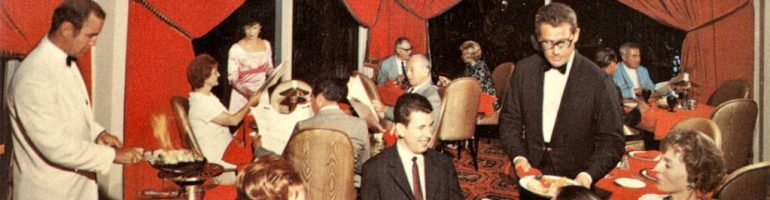
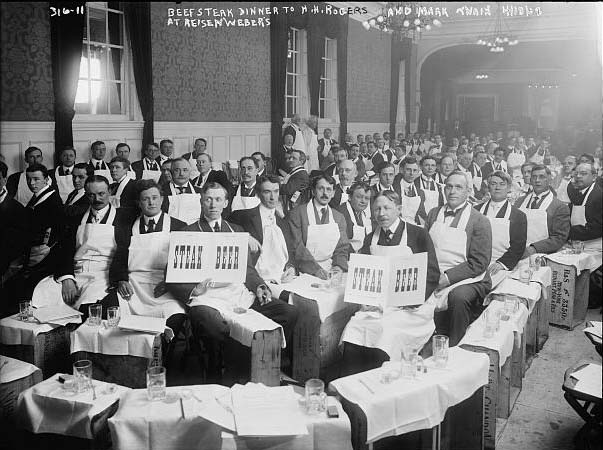
zangheri1903Among the leading venues for “beefsteaks” in New York City were Healy’s, the Castle Cave Grill Room, and Reisenweber’s garret. It was at Reisenweber’s where 150 or so humorists and cartoonists toasted Mark Twain at a beefsteak dinner in 1908. Apparently the size of the group required using an ordinary, civilized banquet room (pictured at top with their opened menus). Theodore Roosevelt was among the celebrities who “ate with his claws” in a dungeon at NYC’s Zangheri’s (pictured), whose basement rooms were rigged up with papier maché stone walls, built-in beer kegs, mugs, and purported murder weapons.

beefsteakgarret210

Beefsteak dungeons were not only found in New York, but appeared all over the country during the peak fad years before WWI. In Cleveland, the beefsteak dungeon in Finley’s Phalansterie attracted a delegation of Congregationalists from Oshkosh, Wisconsin, in 1907. Later they reported, “It was the most unique environment in which we ever took a meal, and although at first the novel surroundings startled us, the experience was thoroughly enjoyed.” When the Owyhee Hotel opened in Boise, Idaho, in 1910 it was furnished with a dungeon ready to host its first guests who turned out to be a group of ministers. San Francisco had barn-like beefsteak dens about this same time, such as at the Hof Brau and the Bismarck Café (pictured).

As popular as beefsteak dinners were with male college students, fraternal organizations, sports teams, and conventioneers, their appeal dimmed during the war and Prohibition and never fully returned. I can’t help but wonder if the memory of the churchmen’s trip to Cleveland in 1907 somehow explains why Oshkosh was one of the few cities which still had a beefsteak dungeon in 1939, in the Teddy George Grill and Taproom.

© Jan Whitaker, 2008
5 Comments

Filed under food, Offbeat places

Let’s do brunch – or not?

industrialchafingHaving brunch in restaurants became popular in the 1960s and 1970s and remains so today. It was not unheard of earlier – a few restaurants offered brunch in the 1930s. The Brown Derby in Los Angeles may have been the first to serve brunch, which was especially popular in Southern California. The meal itself was older but usually eaten at home. The word evidently was coined by British university students in the 1890s, late sleepers who woke at noon and combined their first two meals. Gossip columnists loved to twitter about Hollywood film stars and socialites who threw intimate brunches for their best chums in the 1920s, giving the informal meal a degree of cachet.

belgianwaffleAs modern as it might seem, brunch shares some aspects in common with the 18th-century Anglo-American tavern spread. Broadly speaking, both feature tables piled with edibles drawn mostly from two major groups: meat/fowl/fish (bacon, sausage, chicken, roast beef, ham, salmon) and pastry. They also share a third essential, the before-noon alcoholic beverage. In the 1770s the drink might be rum or ale, while in the 1970s it would be champagne or mixed drinks such as Mimosas, Ramos Fizzes, and Bloody Marys.

In 1950 a Los Angeles restaurant reviewer observed that most patrons turned down drinks, adding “After all, you got to be pretty far gone to drink before breakfast.” This abstinent attitude seems to have largely vanished by the 1970s. Then champagne, screwdrivers, and mimosas often formed a large part of the advertised brunch attractions. Many restaurants included a drink with the price of the brunch, while others charged extra but poured free refills.

buffettable203Especially popular on Sundays and holidays, brunch often features food that is — or once was — regarded as “special,” such as Canadian bacon, Hollandaise sauce, and Belgian waffles. Nonetheless, despite brunch’s ice sculptures and lavish food presentations, it has its detractors. Some would agree with the California critic who declared that she felt like Oliver Twist standing in line with plate in hand. In Kitchen Confidential, Anthony Bourdain spared no scorn, characterizing brunch as a restaurant’s “old, nasty odds and ends” prepared by its least talented cooks and way overpriced. Hence the Bloody Marys?

© Jan Whitaker, 2008

3 Comments

Filed under food, restaurant customs

Sweet and sour Polynesian

One remarkable accomplishment of Polynesian restaurants was how they lured the male diner without using steak as bait. Who would have believed mid-century Homo Americanus Modernus could swallow so many sugary rum drinks, pineapple chunks, and sticky sauces?

Another notable coup was that these tropical resorts were so obviously fake it was preposterous to accuse them of it. It is easy to imagine how Vic Bergeron, originator of Trader Vic’s, would have roared with laughter if charged with inauthenticity. (“Jeez, Honey, that was the whole point!”) Guests were well aware that the Tiki gods, fishnets, and outrigger canoes were artfully staged to stimulate escape fantasies, and vaguely conscious that the menu represented a culinary amalgam that never existed in the outside world. Bergeron once stated that the food of Polynesian islanders was “primitive” and “not acceptable to American tastes.” Stephen Crane, mastermind of Kon-Tiki Ports, admitted that many ingredients used in Polynesian dishes – bean sprouts, water chestnuts, tomatoes, and pea pods – didn’t grow on the islands. Who cared?

Don the Beachcomber and Trader Vic’s were the first Polynesian restaurants, beginning in California in 1934 and 1938 respectively. It was quite a while, though, before eating in pseudo-grass-huts became a fad. Around 1957 only about 20 Polynesian restaurants were known. But by 1962, after Hawaiian statehood and the debuts of the movie South Pacific and TV show Hawaiian Eye, the number had grown to 200, according to a National Restaurant Association estimate.

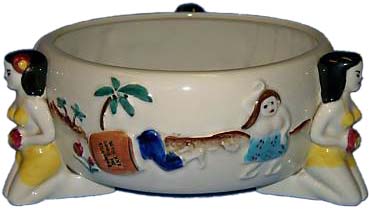
Many were in big hotels where their job was to boost profits. As a Wall Street Journal headline succinctly put it in 1959, “Cocoanut Milk, Idols, Waterfalls Help Hotels Lift Food, Drink Take.” The Polynesian restaurant was about merchandising. Whether it was Bonko Bonko soup at Columbus’s Kahiki, Pineapple Teriyaki Garni at The Lahala House in Corpus Christi, or a take-home scorpion drink bowl (pictured) at Trader Vic’s, the concept was greater than all the inexpensive ingredients combined.

The appeal of exotic drinks held steady longer than the rest of the package. Already by the mid-1960s, American and “continental” standbys were infiltrating menus. Steaks made a comeback and diners could also choose from a broad array of restaurant items not even remotely tropical such as clam chowder, chicken cordon bleu, and hush puppies. In the 1970s more adventurous diners rejected Cantonese, the core of Polynesian cuisine, for spicier Szechuan and Hunan. Decor was seen as a growing problem, too, as the cost of importing tapa cloths and outrigger canoes rose. Restaurateurs searching for a concept were counseled to think about Old English which was easier to accessorize, according to the journal Cooking for Profit, only requiring some paneling and “a few old swords, or other recognizable ‘art objects.’”

By the mid-1970s and into the 1980s critics heaped scorn on things Polynesian, food especially. It seemed hard to believe NY Times critic Craig Claiborne had given it an ounce of credibility in 1958. Actor Yul Brynner sued Trader Vic’s in NY’s Plaza Hotel in 1979 after eating spareribs there and acquiring trichinosis. Ten years later Vic’s was booted out of the Plaza. Vic himself, having died in 1984, was spared the ignominious news. The long-lived Kahiki closed in 2000. Yet, even today Polynesian motifs cast a campy spell.

© Jan Whitaker, 2008

1 Comment

Filed under food, history, Polynesian restaurants

Bar-B-Q, barbecue, barbeque

columbusga1940

Through most of American history the principal reason for barbecues was political campaigning. These outdoor events were characterized by huge crowds who feasted on animals cooked whole, such as pigs, sheep, oxen, and cattle, suspended on poles or laid on grates over charcoal pits dug in the ground. A Democratic Party barbecue in Lexington, Kentucky, in July of 1884 drew 10,000. Eighty-five oxen were roasted along with many sheep, hogs, and chickens. Accompanying dishes included burgoo (stew), “wagon-loads” of bread, and vegetables.

Barbecues were not usually commercial ventures until the 20th century, yet they were not entirely unknown among earlier caterers. A Tea and Coffee House in outlying Boston in 1769 offered to host barbecues for groups, “either Turtle or Pigg.” Also, occasionally in the 19th century a barbecued rabbit or such would show up on a hotel menu, particularly in the South. And toward the end of the 1800s barbecue stands, like hamburger stands, were likely to appear at fairs and other outdoor festivities.

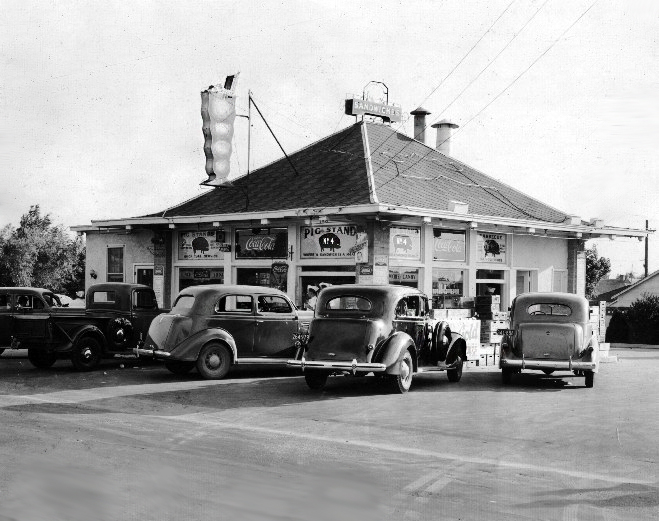
PigSTand#2DallasAlthough barbecue remains a relative rarity in Eastern restaurants up to this day, it began to show up at roadside stands elsewhere in the country not long after the turn of the century. Stands grew popular in the 1920s, probably because they were often located on cheap real estate at the edge of town where they were ideal for a pleasure drive at a time when many Americans were acquiring cars. The Pig Stand, often cited as America’s first curb service drive-in, started in Dallas in 1921 on the Dallas-Fort Worth highway. Memphis also built a strong reputation for barbecue restaurants — Leonard’s began in the 1920s while The Shanty Inn started later but both were known for barbecue cooked in a smoke oven. Yet barbecue was not only a product of the South. Barbecue shacks, shanties, and stands could be found, for instance, in Missouri, Kansas, Arizona, California, and Utah, particularly in the 1930s when the “roadside eats” business lured people looking for ways to make a living. Detroit became a barbecue mecca during World War II when Southern blacks moved North to work in the auto industry.

Despite the success of Pig Stands and Loves’ Wood Pit Barbecue (begun in Los Angeles in 1948), barbecue has not had a strong profile among nationwide restaurant chains. Maybe for this reason, along with regional variations in sauces and cooking methods, it is a favorite with fans of down-home “roadfood.”

© Jan Whitaker, 2008
Leave a comment

Filed under food

Beans and beaneries

“Beanery” was less a name that an eating place would claim for itself than a slang term for a cheap and lowly lunch room. In these eating places baked beans was a staple dish going back at least as far as the mid-1800s. Milliken’s Beefsteak & Coffee Room in lower Manhattan offered its customers pork and beans in 1845. The price was 6 cents, the same, surprisingly, as roast beef or chicken pot pie.

Before sweet things became standard breakfast fare, baked beans were considered ideal for the morning meal. In fact the beauty of beans was that they made a square meal 24 hours a day. Like ham and eggs, they were favorites at all-night eating places. They could also be found in other nighttime establishments such as Silk & Anderson’s Saloon, Billiard and Keno Hall in Trinidad, Colorado, established in 1876, where baked beans, ham, and cole slaw made up the free “lunch” spread from 9:00 at night until 2:00 in the morning.

Baked beans could be found in restaurants all over the U.S. – Cincinnati, San Francisco, New Orleans – but it was in hard-edged Chicago, New York, and Boston where the slang term “beanery” especially captured the imagination of writers. Despite the unsentimental words of a 1908 hash house waitress, “There ain’t no romance about pork and beans or any of it. It’s all to the real life, and a punched check for a finish,” novelists of that time loved to set their tales of salty characters in big city beaneries.

Each city’s beaneries had a different character. Chicago’s South Clark Street, “toothpick row,” was full of them but beans also did duty in the city’s saloons where a 5¢ glass of beer earned a free lunch of beef and baked beans, with pickles, olives, and celery for trimmings. New York City was known for its “beef and” places, as they were called. The beef, in this case, was corned and everyone knew the missing word after beef was beans.

In Boston baked beans formed a considerable industry. Bakeries and other bean specialists ran hot ovens full of beanpots every night, turning out 32 million quarts annually which they delivered daily to restaurants and lunch counters. Baked beans often appeared on menus accompanied by brown bread, a combo known as “B. B. B. & B. B.” Even in 1921 when beans were slipping out of favor as a restaurant dish, the Childs chain found demand strong enough to keep them (and oysters) on their Boston breakfast menus.

It was said that baked beans was too frugal a dish to be popular in Los Angeles where garden produce was available year round. Yet “Ptomaine Tommy” DeForest laid claim to inventing a bean dish unique to L.A., the mysteriously named “size,” a hamburger on a bun covered with chili and diced raw onions.

By the 1960s Americans had outgrown their love of baked beans. In a restaurant trade book of 1966 they are listed as “foods to shun,” along with kidneys, chipped beef, turnips, and rutabagas.

© Jan Whitaker, 2008

4 Comments

Filed under food, lunch rooms

Basic fare: hamburgers

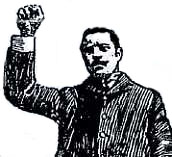
The hamburger sandwich got its start in the 1890s, probably in venues such as the night lunch wagons which were forerunners of diners. Before that, hamburger steaks (without bread) were mainly found in eating places patronized by German immigrants. Hamburger or “Hamburg” steaks were typically made of ground beef and minced onion and served with a sauce. They were such a menu staple that around 1900 black waiters in Chicago’s noisy lunch rooms created the hand signal shown here to convey orders to the kitchen. It may be a variation on the signal for “small steak” in which the fingers were raised as if taking an oath.

As a sandwich, the hamburger, of course, was designed to be eaten with the hands. It was a specialty of the horse-pulled lunch wagons which became widely known in Chicago at the time of the 1893 Columbian Exposition. Lacking inside seating, their customers, often nightshift workers, either took food away to eat elsewhere or consumed it standing in the street. For convenience, lunch wagons prepared every order between bread, whether it was pork chops, pigs’ feet, or eggs.

Although it provided sustenance for many, hamburger was not always considered fit food for discriminating people. It was often made from butchers’ scraps which were dosed with preservatives ranging from sulfites to formaldehyde before grinding. Doctors denounced it and in 1920 the Navy stopped buying it due to food safety concerns. All in all, hamburger’s associations with lowly lunch wagons, immigrants, the working class, spoiled meat and additives — and the smells of grease and onions — stigmatized it.

Yet somehow the hamburger on a bun survived all the attacks against it. By the late 1920s it was hailed as “the most characteristic American dish.” Because it was a thrifty meal, the Great Depression helped build its popularity. When a junior high school cafeteria in Cleveland’s Shaker Heights banned hamburgers in 1936, because “the type of young people in the Shaker Heights school are of a class that should be served a higher type of food,” the action met with negative publicity and charges of elitism.

By the mid-1950s, when suburban hamburger chains began to spread, hamburger was the “king of beef,” making inroads into New England, where roadside stands had long catered to a regional preference for hot dogs, and the South, where barbecue was a favorite. Because ground beef was well-liked, cheap year-round, and increasingly available in pre-cooked frozen patties, it became a foundational food for many restaurants.

In marketing the hamburger, proprietors have usually embraced or at least referenced its democratic unpretentiousness. In the 1920s this took the form of calling eateries shacks, hamlets, or, humorously, “castles,” while today it is evident in price appeals and representations of solidarity among diverse populations. Unless they attack on health grounds, critics of the hamburger risk being seen as culinary snobs.

© Jan Whitaker, 2008
Leave a comment

Filed under food

Famous in its day: Taft’s

Throughout much of the 19th century game topped the list of desirable restaurant fare. Taft’s Hotel located on the shore at Winthrop MA, 5 miles outside Boston, attained widespread fame as a place to enjoy a fish or game dinner. Proprietor Orray Augustus Taft called his place a hotel but did not accommodate overnight guests. Taft’s was actually a seasonal restaurant serving parties by reservation only, from May through October. It was established at Point Shirley around 1850 and closed in the mid-1880s.

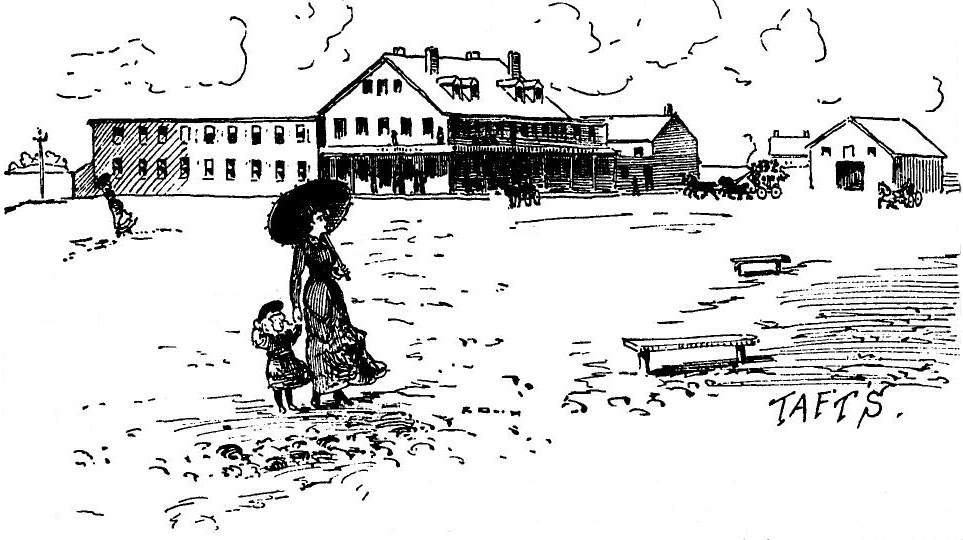
Taft’s was not much to look at. Two unattractive structures attached to the main building (shown here) held bowling alleys and billiard tables suggesting that groups often made a day of it. According to visitors of the 1870s, the resort might have had a nice view of the harbor if it had not been blocked by a reformatory on neighboring Deer Island. Taft’s fame was obviously not based on an elegant setup but rather on its provisions. Taft liked to entertain guests by taking them into his kitchen and showing off the contents of his ice chests. Fish came from the waters of Nantucket, Boston Bay, Long Island, and far beyond. Flat fish, such as turbot and plaice, were his specialty. Ducks and birds (snipe, plover, reed birds, grouse) came from all along the Atlantic Coast and the Great Lakes.

A couple of the strangest items on Taft’s menus were “owls from the north” and “humming birds in nut shells.” Exactly what the “owls” were is uncertain. Snowy owls, horned owls? Or, perhaps it was a code for something else altogether. Owls sometimes appeared on 19th-century menus for birds obtained in violation of game laws. On an 1877 Taft’s menu the selection was explained cryptically in parentheses as “Lady’s Birds.”

The hummingbirds, according to a hunter who obtained them for Taft, were actually bank swallows. Another opinion suggested they were English sparrows. Clearly they were tiny and many believed they were genuine hummingbirds. They were served in a delicately hinged nut shell, which opened to reveal what resembled a miniature roast turkey. A guest from Philadelphia reportedly felt they were “really not worth eating, being dry and tasteless.” “But,” he admitted, “I wanted to say that I had eaten a humming bird, and now I can say it.”

© Jan Whitaker, 2008

8 Comments

Filed under food

“Eating healthy”

Restaurants (and their critics) have often shown concern with patrons’ health, but the focus of concern has varied widely in different eras.

In the 18th century the idea that restaurants had a mission to restore health came to this country from France. The legend spread that a Frenchman named Boulanger invented the first restaurant, hanging out a signboard stating “I will restore you.” Whether or not this actually occurred — or whether he was “the first” — it is true that early restaurants in France promised to provide healthful dishes. The mission migrated to America as chefs arrived after the French revolution. When Julien’s opened in Boston the proprietor vowed to supply the infirm, convalescent, and weak with “nourishing” soups and broths, including turtle soups which, he advertised, would purify the blood.

But the early French “restorators” were voices shouting in the wilderness. For most of the next two centuries Americans believed their health depended on eating meat and lots of it. In the latter 19th century and into the 20th, concern shifted to unsanitary conditions in restaurants as health departments were created, ordinances established, and inspectors dispatched.

The vegetarian restaurants of the early 20th century demonstrated a renewed interest in healthy diets. Meat substitutes produced by the Kelloggs of the Battle Creek Sanitarium appeared on their tables, although breakfast cereals, whose popularity was aided by restaurant promotions, were undoubtedly the most successful of all health food products.

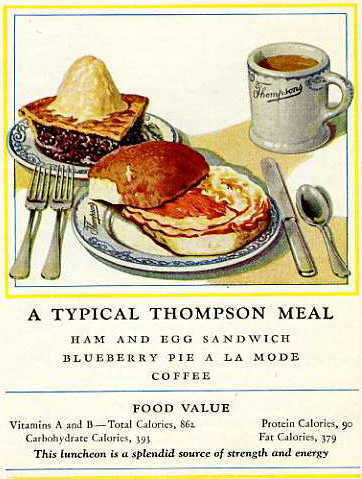
The food conservation guidelines of World War I lightened diets, with less meat and more vegetables on restaurant menus, as well as spreading knowledge of nutrition. A few chains, such as J. R. Thompson and Childs, provided vitamin and calorie counts in the 1920s. But the public was not too receptive. Stockholders booted out William Childs after he gained control of the mighty lunchroom corporation and removed meat from its menus, causing sales to plunge drastically.

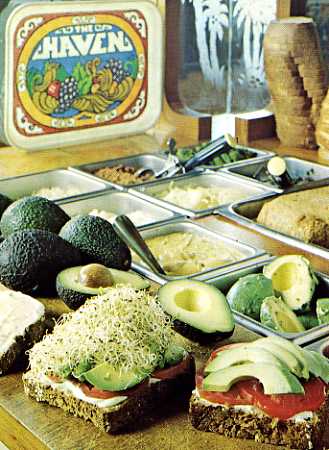
After a prolonged beef-eating revival following the end of WWII rationing, health-conscious restaurants made a comeback as part of a counterculture critique of industrialized food. The “holy war against adulterated foods and french-fried, frozen, super sugar wastelands,” reported Mary Reinholz in the Los Angeles Times in 1971, had produced at least 25 organic restaurants in southern California, including H.E.L.P., Aware Inn, The Source, and Nucleus Nuance which served “evolution burgers,” “Virgo vege-loaves,” and carob mousse. One Los Angeles counterculture restaurant favorite, carrot cake, crossed over onto mainstream menus.

Natural food eating places, such as St. Louis’s Sunshine Inn, Long Island’s Shamballah Gardens, the Haven in Honolulu, Homeward Bound in Flagstaff, and Mary’s Natural Food Restaurant in Denton TX, to name but a few, soon spread throughout much of the country, laying the groundwork for the restaurant revival of the 1980s.

© Jan Whitaker, 2008

24 Comments

Filed under alternative restaurants, food, restorators

Basic fare: fried chicken

Actually chicken, however it was prepared, was not so basic until well into the 20th century. Only then were poultry raising and marketing streamlined to produce the tender, year-round, low-cost product which made chain restaurants such as Kentucky Fried Chicken and Chicken Delight feasible. Until after World War II chicken was not terribly popular in most restaurants, often being rather expensive yet tough and stringy.

The chicken found on the menus of most American eating places of the 18th and 19th centuries was not fried, but roasted, boiled, or broiled. Fried chicken seemed to be limited to the South for many decades. The first instance of fried chicken in a restaurant that I have found occurred at the 1876 Centennial fair in Philadelphia where one of the concessions specialized in Southern dishes such as fried chicken and hominy. Despite this, fried chicken did not catch on in restaurants for some time. It could be found mainly in small, down-home style cafés run and patronized by Afro-Americans. An example in the 1890s was a small cabin called the Café Du Chat Noir in Washington, D.C., run by a former slave who went by the name Madame Early. A bit later, in San Francisco, a black restaurant provided possum and yams in season, corn pone, watermelon and chicken, fried, boiled, or roasted. Another type of early 20th-century fried chicken venue was the Chinese restaurant.

The third kind of eating place that made a specialty of fried chicken was the country tea room. In fact chicken of all kinds – fried, in salads, or creamed on waffles – dominated tea room menus. It’s likely that the substantial increase of women restaurant patrons in the 20th century, tea rooms’ main clientele, was behind the rise in chicken’s popularity. Restaurateurs often noted that while men preferred steak, women favored chicken. Taking the family for a Sunday automobile ride into the countryside for a fried chicken dinner at a tea room or family-style inn was a major form of entertainment for millions of Americans well into the 1950s.

The reason that fried chicken became popular primarily in out-of-the-way places, whether Afro-American, Chinese, or tea rooms, may have been due to these places having access to freshly killed chickens at a time when so much poultry served in restaurants had been ruined by long stays in cold storage. Cold storage chicken –- i.e., frozen — so dominated the market that in 1909 California law required restaurants to inform patrons if their chicken came from that source. On the other hand, restaurants run by blacks and Chinese often kept live chickens in cages, while rural tea rooms had local suppliers.

© Jan Whitaker, 2008

Leave a comment

Filed under food

Fried chicken blues

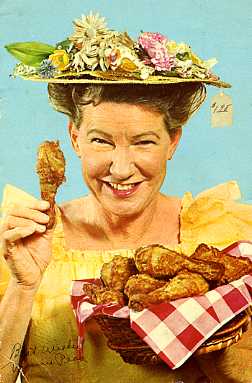
The 1960s were a boom decade for marrying fast food to franchise businesses christened with celebrity names. Chicken seemed like the up-and-coming successor to hamburgers in a business more about marketing concepts and stock quotations than food or hospitality. Following the success of Harlan Sanders, whose 500-unit Kentucky Fried Chicken chain mushroomed to 1,700 when he sold to a corporate buyer, entrepreneurs looked around for other celebrities to hitch their schemes to. Performers Minnie Pearl, Mahalia Jackson, James Brown, and Eddy Arnold, along with many sports figures, were persuaded to lend their names, rarely assuming any further involvement.

Minnie Pearl’s Chicken System, Inc., was the creation of Tennessean John Jay Hooker whose political ambitions included becoming governor, then president. Minnie Pearl, a Grand Ole Opry comedien whose frumpy stage persona suggested down-home eating, covered the white market, while gospel singer Mahalia Jackson lent her name to the black-owned side of the enterprise aimed at black inner-city consumers. Around the same time, ca. 1969, “king of soul” James Brown figureheaded the Gold Platter soul food chain which failed to get beyond the pilot stage in Macon, Georgia. Minnie’s and Mahalia’s ventures, too, lasted only a few years. Hooker, chicken systems mastermind, did not make it into office, but Benjamin Hooks, co-owner of Mahalia Jackson’s Gloree-Fried chicken (carryout only), went on to become executive director of the NAACP.

Though hailed as a restaurateur, Jackson received royalties for the use of her name but did not choose to invest in the Mahalia Jackson Chicken System, Inc. Perhaps she did not approve of its slogan: “It’s Gloree-Fried, and that’s the gospel truth.” The Minnie Pearl system totaled several hundred locations at its peak but it’s not clear how many outlets the Jackson chain comprised, probably many fewer. Chicago had only two units, paired with gas stations. The chain also operated in Memphis, Cleveland, Jacksonville, and Detroit. In addition to chicken, menus included fish sandwiches, sweet potatoes, fried pies, and a ‘Soul Bowl’ of chicken giblets in gravy on rice.

Minnie Pearl’s chicken — and later roast beef sandwiches — business went bankrupt in 1970.

© Jan Whitaker, 2008

Leave a comment

Filed under chain restaurants, food