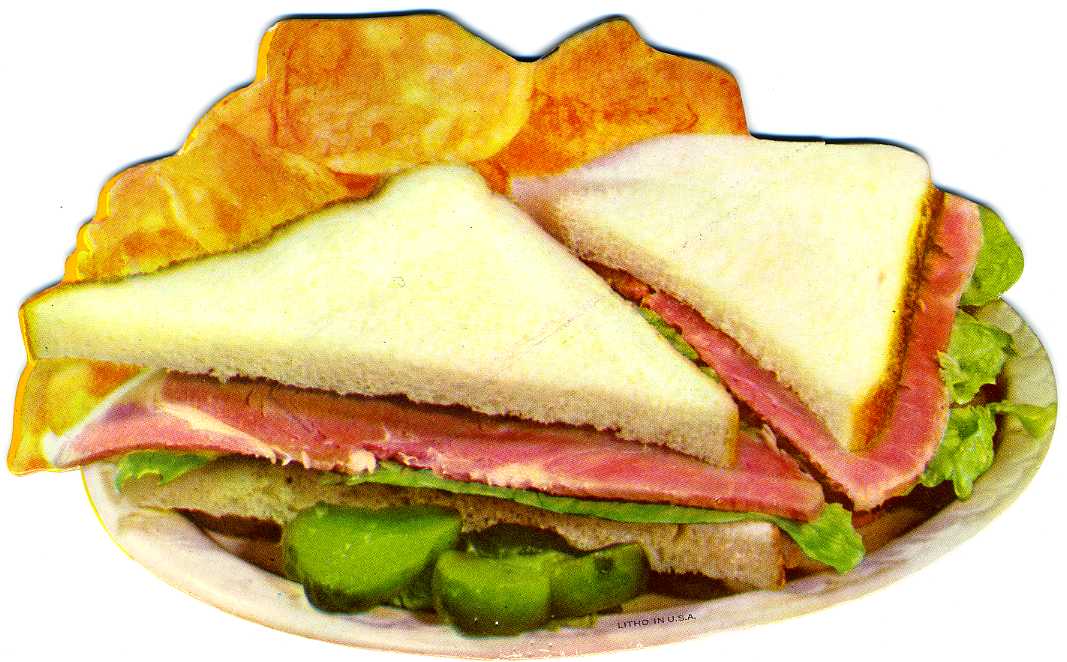
Basic fare: ham sandwiches

Because cured ham keeps for months at room temperature, it was always on hand in colonial and early American taverns. At any time of day and much of the night a hungry person could get the host to slice off a “cold cut” of ham. Ham and eggs was such a popular dish in eating places everywhere and at all times that many people have nominated it as America’s national dish.

Ham sandwiches were on tap at porter houses and went well with the dark brew as well as with ale (but what didn’t in those heavy-drinking days?). At New York’s Ring of Bells, host John Spencer advertised in 1807 that he furnished first-rate liquors, soups, and “Sandwiches, Anchovies and Relishes of every description.” Later many drinking places put out ham sandwiches as part of their free lunch spread.

Serve-yourself lunch counters of the 1880s were loaded with ham sandwiches, beef sandwiches, and pies. Customers grabbed what they wanted, often ate standing, and washed it all down with water or a hot beverage. At non-alcoholic dairy lunch bars, which featured fresh milk, coffee, and simple dishes such as beans, ham sandwiches cost 5 cents apiece. Wyman’s Sandwich Depot was famous throughout Boston for hefty sandwiches but a competitor in the 1890s claimed his sandwiches, on rolls 7 inches long and 5 inches wide, were larger. Also up and coming at the time were the lunch wagons that rolled onto city streets at night, vanishing in the daytime. They too specialized in ham sandwiches. But signs of change were on the horizon. Another lunch wagon specialty was the hamburger sandwich, destined eventually to trim the humble snack of ham between bread down to size.

© Jan Whitaker, 2008

Leave a comment

Filed under food

America’s first restaurant

It’s always risky to declare that anything is a first. In some ways Julien’s Restorator, newly opened in July of 1793, may have been similar to the taverns that had been in business in Boston for ages. Almost any kind of eating place at this time would have taken in boarders who not only regularly ate their meals on the premises but slept there as well.

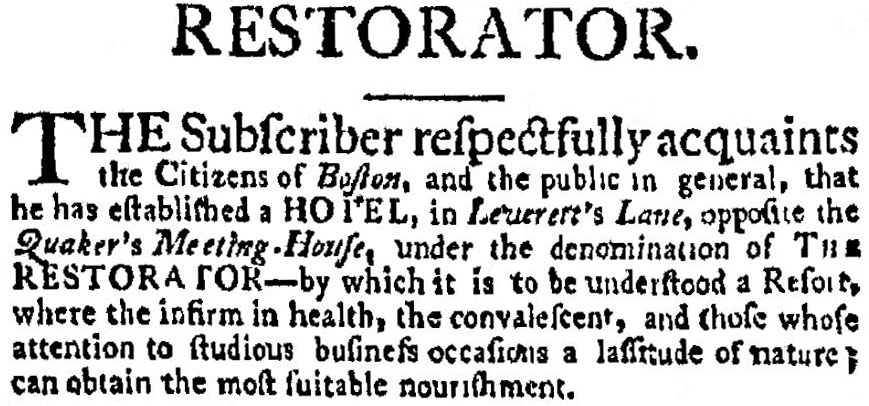
What set Julien’s apart was that he modeled his restorator on the restaurants of Paris. Like them, he emphasized the healthful attributes of his dishes (intended to restore health — thus “restorator” and the French “restaurant”), presented diners with a written menu from which they could choose, and charged them only for what they ordered rather than following the prevailing custom of providing a buffet-type meal at a set price. The newspaper advertisement of which this is a part states that he will furnish soups, broths, pastry, beef, bacon, poultry, wines, and cordials. He later added oysters, green turtle soup, and coffee.

Julien’s full name was Jean Gilbert Julien and he had previously worked as a private cook. At the bottom of the advertisement he states he was “Late Steward to the Honorable Monsieur Letombe, Consul of the French Republic.” He was successful at the Leverett’s Lane site and soon moved up to a substantial house on Milk Street where he remained in business until his untimely death in 1805, whereupon his widow Hannah ran the restaurant for ten years and then sold it to another Frenchman.

© Jan Whitaker, 2008

4 Comments

Filed under restorators

Joel’s bohemian refreshery

Joel Rinaldo’s was one of the all-night eating and drinking places that thrived around Times Square in New York before the First World War. “Refreshery” was an unusual term that probably related more to drinking than to eating since saloon owners often referred to their offerings as “refreshments.”

Exactly when Joel’s opened is unclear but chances are it was in the late 1890s. The real estate parcel at 206 West 41st Street that became Joel’s was part of his father’s estate when he died in 1895.

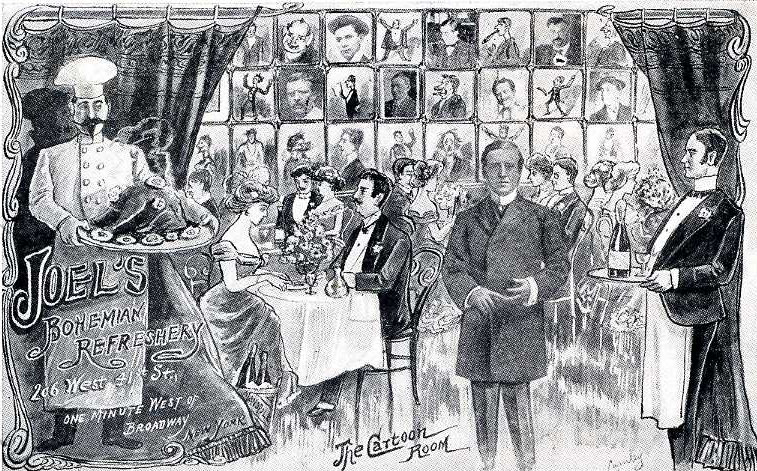
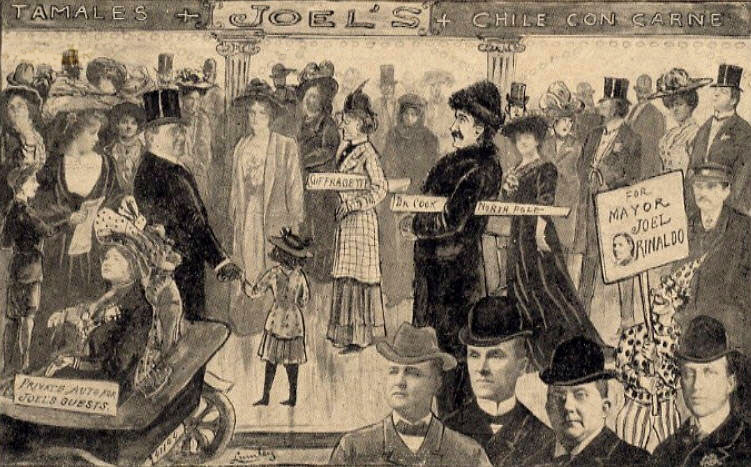
Looking at these 1910-ish postcards of Joel’s you might be misled into thinking it was an elegant after-theatre spot. It attracted all kinds of late-night visitors but was mainly famous as a hangout for musicians, artists, writers, heavy drinkers, “hop-heads,” and Mexican revolutionaries. In 1910 the restaurant was the headquarters of the Mexican Liberal Party opposed to the presidency of General Porfirio Diaz. The short story writer O. Henry was a regular also, though he may have spent more time drinking in the first-floor bar than eating in the café on the second floor. It is likely that El Refugio, a café described in O. Henry’s short story “The Gold That Glittered,” was based on Joel’s.

One of the most popular dishes at Joel’s was chili con carne, a dish not easily found in New York in the early 20th century. He also served tamales and “frijoles colorado.” In addition to Mexican dishes, Joel concocted a drink that became famous – or, more likely, notorious — called a Blue Moon. Only one to a customer but that was enough reportedly to “keep the patron pleasantly mellow the rest of the evening.”

Joel’s walls were filled with drawings, which can be seen on in the image above. Some were by caricaturist Carlo de Fornaro who spent time in jail after being successfully sued by a Mexican official in NY courts for libelous statements Fornaro made in his book, Diaz, Czar of Mexico. Joel, born in NYC around 1870, also had intellectual ambitions, was attracted to psychology and philosophy, and wrote an obscure treatise against Darwin’s account of evolution called Rinaldo’s Polygeneric Theory.

Joel took a paternalistic role toward many of his patrons, keeping prices low and announcing on a gilt sign that touring actors and musicians (he was near the Metropolitan Opera House) could send him their money and he would keep it safe for them. It is said that many took him up on the offer. Perhaps his motive for keeping a bank was to insure that eventually he would get paid, to offset all the bad checks he took from his erratic patrons.

The interesting thing about bohemian places like Joel’s was how they loosened up a middle class still under the spell of Victorian correctness. After a few hours in a heady atmosphere like this and they’d be talking to strangers (without even being introduced!), singing out loud, and ordering drinks all around.

Joel’s closed in 1925, a casualty of Prohibition.

© Jan Whitaker, 2008

8 Comments

Filed under Offbeat places