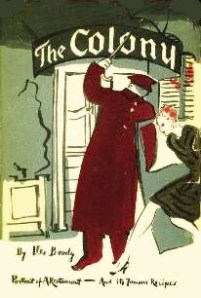
 What a pain the rich can be. That’s the message you’ll take away if perchance you pick up The Colony Cookbook by Gene Cavallero Jr. and Ted James, published in 1972. The dedication page is plaintively inscribed by Gene, “To my father and all suffering restaurateurs.” Chapter 3 details what caused the suffering, namely the privileged customers who imposed upon him and his father in so many ways. They stole peppermills, left behind ermine coats, false teeth, and glass eyes, asked for help getting through customs, requested restaurant staff to chauffeur their children – even called for reservations at other restaurants.
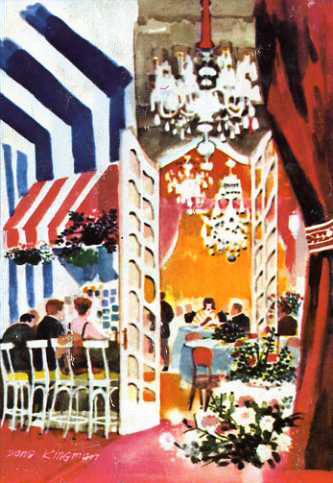
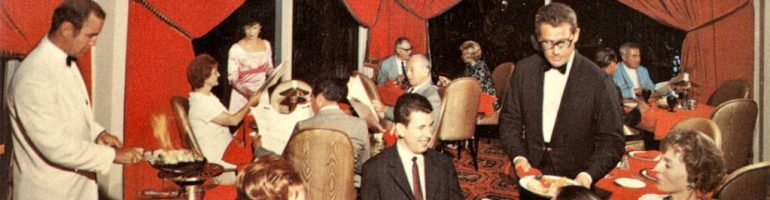
The Colony was the kind of place where terrible things could happen such as – oh god! – countesses and rich men’s wives showing up in the same designer gown. Thankfully they were so well bred that instead of pouting or running home to change they bravely stuck out the evening and even managed a smile as they picked at their truffled Salade à l’Italienne and Chicken Gismonda. Over the Colony’s 50 years all the big names from society, politics, entertainment, and royalty patronized it – Kennedy, Onassis, Capote, Dukes and dukes, Roosevelts, Biddles, Lodges, Cabots, and so on. It was referred to as a “boarding house for the rich” because some patrons were there so often. One woman sat in the same banquette and ate the same lunch nearly every day for over 40 years. Yes, she was an heiress. About 85% of the Colony’s customers signed a tab and received a monthly bill.
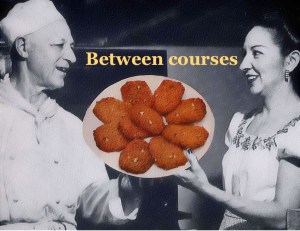
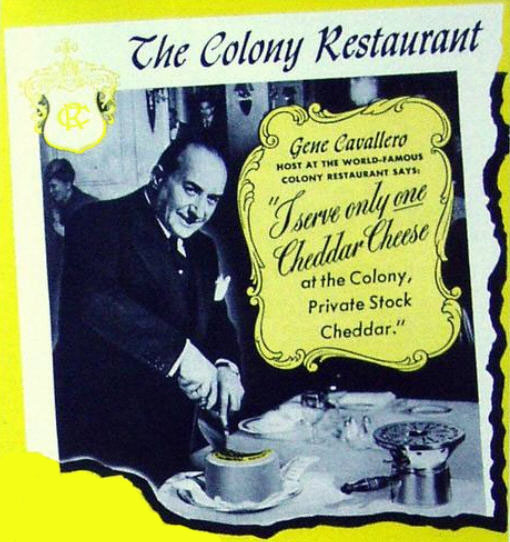 The Colony opened in 1919, at Madison Ave. and 61st Street. Three years later headwaiters Gene Cavallero Sr. (pictured slicing cheddar for the toffs) and Ernest Cerutti joined with its chef to buy it from its founder, legendary impresario and restaurateur Joe Pani. Pani also ran the Woodmansten Inn on Pelham Parkway where he introduced the world to then-dancer Rudolph Valentino. At the same time Pani managed Castles-by-the-Sea, a Long Island resort featuring the dancing Castles, Irene and Vernon.
According to the official story as told in Gene Cavallero Jr.’s book and just about every other account, the restaurant achieved status shortly after the new owners took over and upgraded it from a drinking hole for “two-bit gamblers.” Then capital-S Society, represented by the W. K. Vanderbilts, latched onto it and made it their headquarters. In fact “the 400″ had already been entertaining there while it was under Pani’s ownership. Gene Jr.’s book implies that Pani did not appreciate fine food but, given that Pani had European restaurant training and his own farm which supplied chickens and vegetables, this may have been an exaggeration. Both Pani and Cavallero claimed to have been the first to serve broccoli to New York’s dining public.
Like so many of its regulars, the Colony had slipped into senescence by the time it closed at the end of 1971. Restaurant critic Gael Greene was shocked to find how “tarnished” it was when she visited it about a year earlier (“how shabby and mundane are the haunts of the very, very rich, and how often undemanding their lamb-chop and tapioca palates”). And yet its faithful clientele didn’t seem to care. Truman Capote cried when it closed.
© Jan Whitaker, 2009
 The London Chop House, Detroit’s 21 Club, enjoyed a ranking as one of the country’s top restaurants in the 1950s, 1960s, and 1970s. James Beard named it as one of the ten best restaurants nationwide in 1961, the same year it won a Darnell Survey award as one of America’s Favorites. It won Holiday magazine awards repeatedly. Honors continued throughout the 1970s, and in 1980 it made Playboy’s top 25 list.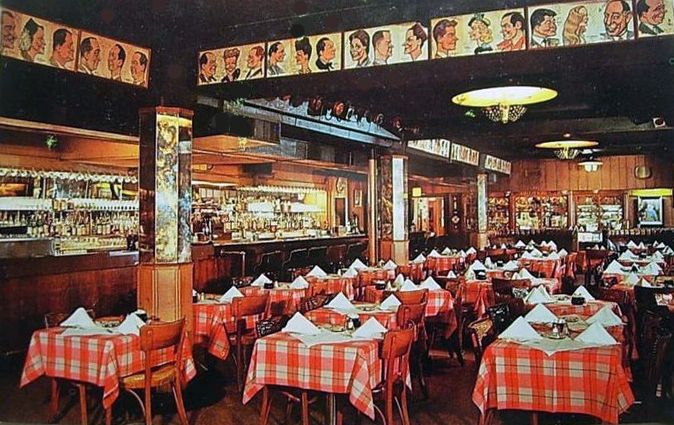
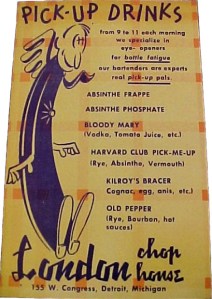 The Grubers were adept at flattering the male ego. When a guest made a reservation, he would arrive to find his table with books of matches and a reserved sign all imprinted with his name, as well as a card with a coin in a slot reimbursing him for his phone call. Alpha types jostled for table #1, while regulars glowed with the knowledge that their suavely jacketed waiter had remembered how many ice cubes they liked in their highballs. To keep up with escalating demand, in 1952 the Grubers opened a second place across the street, the Caucus Club. The 1980s turned out to be a tough decade for the Chop House. Les Gruber sold it in 1982, chef Schmidt left, and the new owner passed away. Despite efforts to keep it afloat, it closed in 1991.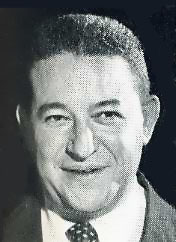
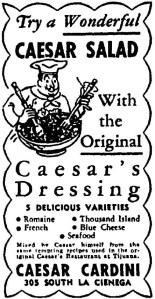 When we get into questions of the origins of certain dishes we have left history behind and entered into the murky depths of lore and legend.
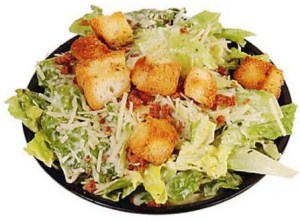 A strong inventorship claim was presented by Caesar’s brother, Alexander, in the 1960s. Caesar died in 1956, while running a grocery store in Los Angeles where he produced and bottled Caesar salad dressing. According to Alexander’s son, who ran Cardini’s in Mexico City, the two brothers had developed the salad together in a Tijuana restaurant in their younger days, improvising on a recipe their mother used when they were boys in Italy. In this “Mother’s recipe” account, the salad was initially called “Aviator’s salad” in honor of their customers who were soldiers, sailors, and airmen.
 In the 1850s the great landscape architect Frederick Law Olmsted, designer of New York’s Central Park, traveled through the South to investigate the institution of slavery. His observations were published in three volumes which were influential in turning readers against slavery. Around 1857 he traveled to Memphis, Tennessee, where he stayed at the Commercial Hotel. Although it was considered a first-class establishment, things did not go well for Frederick in the dining room as his journal entry for March 20, below, reveals. Among the dishes appearing on the not-too-elegant menu were “Beef heart egg sauce,” “Calf feet mushroom sauce,” “Bear sausages,” “Fried cabbage,” and, for dessert, “Sliced potatoe pie.” Better than whole potato pie, I guess.
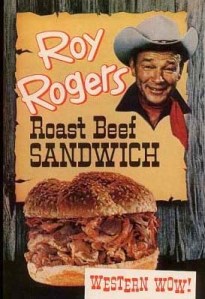 People have strong feelings about their favorite dishes from restaurant chains. I am thankful to all those who poured their hearts out on the subject on Jane & Michael Stern’s ever-fascinating Roadfood forums. I have excerpted the following wistful memories from “Long-gone regional franchises” which took on a life of its own and ran for years. After each snippet is the pertinent chain restaurant.
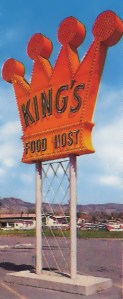 — The Cheese Frenchies were unique. [King’s Food Host]
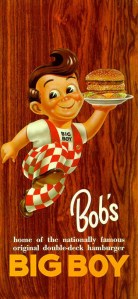 — Pickles, diced onion, relish, mustard, ketchup and mayo were all available. [25 Cent Hamburger]
 Who was first to realize that they could cover bad plaster on their ceilings and walls with canvas and call their restaurant a covered wagon or a chuck wagon? The idea seems to have struck initially in the 1930s, at least that’s when the first Covered Wagon restaurant I’ve found dates from. It was in the Old West – no, make that Minneapolis, with a second in St. Paul. Red checkered tablecloths covered the tables and in the 195os the female waitstaff wore long calico dresses with aprons, a fact I know thanks to the well-illustrated book Minnesota Eats Out. There was also a Covered Wagon in Chicago in the 1940s, presumably under different ownership but with the same tablecloths.
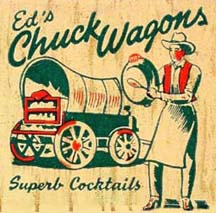 The wagon-esque theme caught on big during the 1950s, inspired partly by TV westerns and partly by the fame of Las Vegas chuck wagon buffets which provided grub for gamblers from midnight ‘til dawn. If not for Vegas envy, why else would there have been one in Miami Beach in 1955? Apparently seeing no local cuisine worth merchandising, restaurateurs there chose from a grab bag of themes such as Smorgs, Polynesian, and Ken’s Pancake Parade. (“Grandma’s Kitchen” was the town’s most venerable eating establishment at the time.)
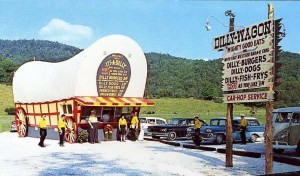 Around 1960 a Potsdam NY man got the idea of franchising
  During the war (1941-1945) the creation of 17 million new jobs finally pulls the economy out of the Depression. Millions of married women enter the labor force. The demand for restaurant meals escalates, increasing from a pre-war level of 20 million meals served per day to over 60 million. The combination of increased restaurant patronage with labor shortages, government-ordered price freezes, and rationing of basic foods puts restaurants in a squeeze. With gasoline rationing, many roadside cafes and hamburger stands close.
 1941 When the restaurant in the French pavilion at the New York World’s Fair closes, its head Henri Soulé decides he will not return to a Paris occupied by Germans. He and ten waiters remain in New York and open Le Pavillon. Columnist Lucius Beebe declares its cuisine “absolutely faultless,” with prices “of positively Cartier proportions.” – Chicago cafeteria operator
 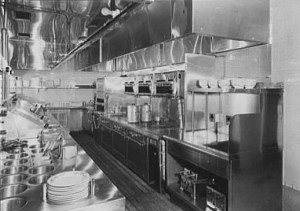 1946 Like health departments all across the country, NYC begins a crack down on
 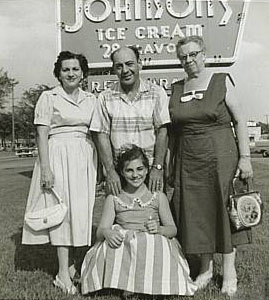 1949 Howard Johnson’s, the country’s largest restaurant chain, reports a record volume of business for the year. HoJos, which has not yet spread farther west than Fort Wayne IN, plans a move into California.
 Not many people get as excited as I do about books of obsolete restaurant reviews. I especially like The New Orleans Underground Gourmet. In the 1973 edition reviewer Richard H. Collin zapped a few well-known tourist places as well as some less expensive restaurants which had “little or nothing to recommend them” in order to “spare the reader’s time and stomach.” He not only performed a service but produced enjoyable reading for anyone inclined to find humor in bad reviews.
 In the mid-19th century there was only one American restaurant with a worldwide reputation,
 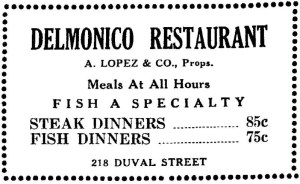 From the 1870s up to the 1930s, but not so much after that (except for New Orleans?), I’ve found Delmonicos in Los Angeles, Denver, Colorado Springs, Tombstone, Phoenix, Helena, Portland OR, El Paso, Dallas, Walla Walla, Mobile, Memphis, Winona MN, Leavenworth KS, Detroit, Key West (1931 ad pictured), Pittsburgh, Buffalo – and more. Proprietors names ranged from Gutekunst to Garibotti to McDougal.
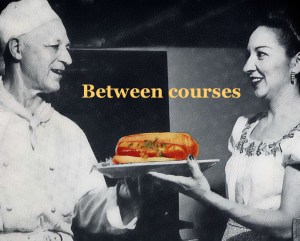 In the summer of 1953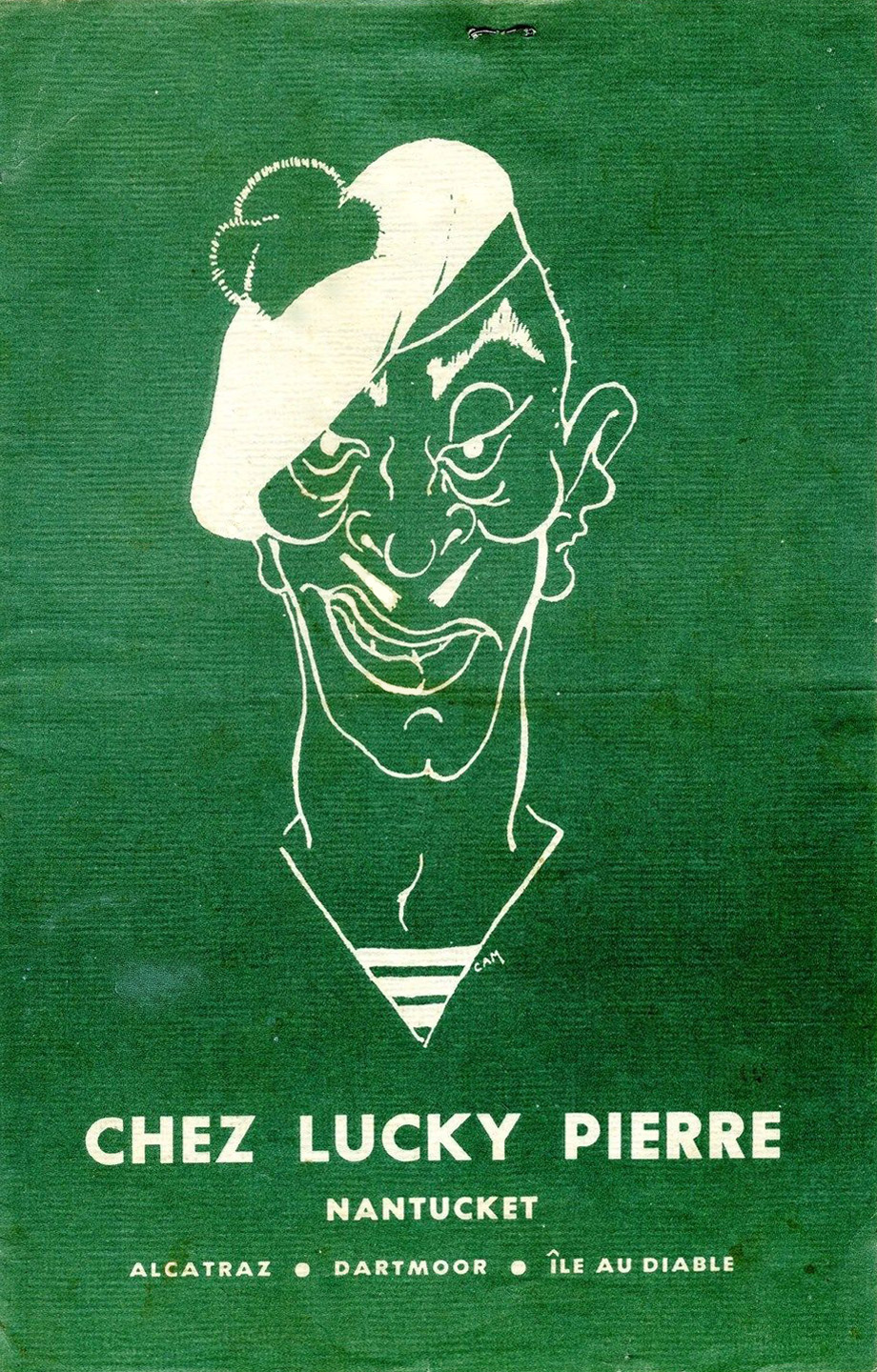
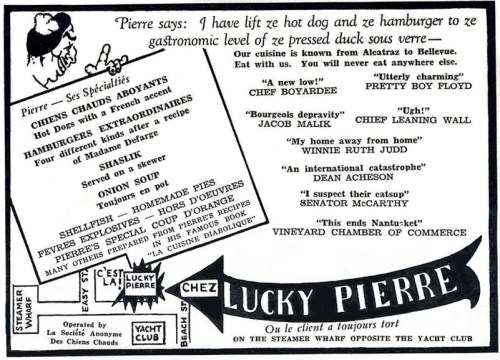 The advertisement shown here appeared at just about the exact time JB was stepping off the ferry, in the June 22, 1953, edition of “This Week in Nantucket.”
 It's great to hear from readers and I take time to answer queries. I can't always find what you are looking for, but I do appreciate getting thank yous no matter what the outcome.