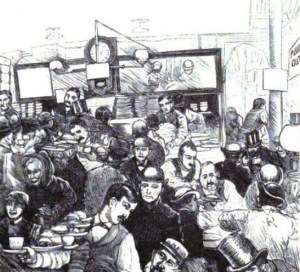
 As the decade starts there are over 19,000 restaurant keepers, a number overshadowed by more than 71,000 saloon keepers, many of whom also serve food for free or at nominal cost. The institution of the “free lunch” has become so well entrenched that an industry develops to supply saloons with prepared food. As big cities grow, the number of restaurants swells, with most located in New York, Pennsylvania, Illinois, Massachusetts, and the Midwest where young single workers live in rooming houses that do not provide meals. Southern states and the thinly populated West, apart from California, have few restaurants.
Cheap restaurants such as lunch counters, lunch wagons, and ethnic cafés are the leading types, buoyed by the heavy immigration of Southern Europeans, particularly Southern Italians. Chinese restaurants become more common in the East. More unescorted women patronize restaurants, particularly in downtown shopping districts and around office buildings where they work. Bigotry increases and, despite civil rights laws, Afro-Americans face greater rejection by restaurants.
An economic panic in 1893 sends the country into a severe four-year-long Depression. Self-service lunchrooms which operate on the honor system begin to notice that one out of every ten patrons shaves their check. Interest grows in an “automat” from Germany in which food is not accessible until money is deposited in a slot. Rumors spread that one will debut in St. Louis and another in Philadelphia.
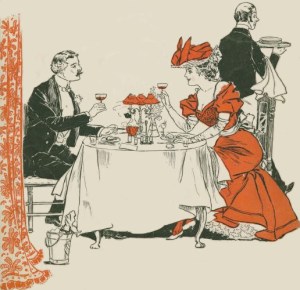 Near the decade’s end, the “Gay 90s” commence and those who are able and so inclined pursue the good life, which increasingly includes going to restaurants for the evening. It is still considered somewhat disreputable to do this, so some people go out to dinner only when visiting another city.
Highlights
1891 The Vienna Bakery restaurant of Los Angeles creates a stir when it advertises that it never serves “come backs” (food left on other people’s plates). “When a meal is served its remains are thrown away,” it insists. The following week it reaffirms the claim and further boasts, “No Chinaman Handles any of the food cooked at THE VIENNA.”
1893 Chicago is full of horse-drawn lunch wagons which cluster around railroad depots and the entrances to Jackson Park to take advantage of the crowds attending the World’s Columbian Exposition.
 1893 A drunken man fires five shots into Delmonico’s in New York City (5th Ave. and 26th St., pictured), later declaring he believes in equality among the classes and wanted to “give the rich people I saw in there enjoying themselves a good scare.”
1894 The Maverick Restaurant opens in Golden, Colorado, for the express purpose of serving 5-cent meals to the vast army of unemployed men who earn credit to pay for the meal of meat, potatoes, and a vegetable by cutting and stacking wood. Unlimited amounts of bread are included but no butter.
1894 In Chicago, jobless men are thankful for free food that saloons provide with the purchase of a beer. One declares, “This free lunch is all that keeps me alive. I have been out of work for three months…. Five cents now buys me a meal and another nickel goes for lodging. That is what I live on and I consider myself lucky.”
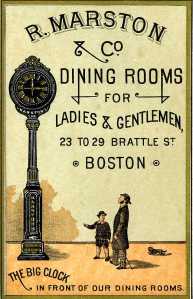 1895 Competition from cafés and restaurants in Massachusetts has just about wiped out the old boarding houses where renters had all their meals supplied. One reason is that people prefer restaurants because they get to choose what and when they eat. – Boston’s Marston restaurant, established by sea captain Russell Marston in the 1840s, opens a women’s lunch room on Hanover Street.
1896 With the passage of the Raines Law, which permits only hotels to sell liquor on Sunday (the busiest day for many restaurants), some New York restaurants begin to permit prostitutes to ply their trade in upstairs rooms which they have furnished with beds to qualify as hotels. The Maryland Kitchen on 34th Street, known for Southern cooking, and Gonfarone’s Italian restaurant in the Village are two of the many which take this route.
1897 In Michigan and Indiana bills are introduced in the legislature to outlaw French on menus. The Michigan bill is introduced by a legislator who had an embarrassing experience in a Chicago restaurant. Unable to figure out a menu, he ended up with two bowls of soup and some toothpicks.
1897 In the midst of the bicycling craze, two debutantes open a pink and white tea room serving lettuce sandwiches and café frappé to cyclists in Greenwich CT. Meanwhile a black cyclist who stops at Chicago’s Old Vienna café on Cottage Grove orders a lunch that never arrives. When he presses the manager, he is told, “You ought to know we don’t serve n*****s here.”
1898 During the war between the United States and Spain, public opinion against Spain whipped up by “yellow” (nationalist, sensationalist) journalism causes some restaurant keepers to rename “Spanish omelets.” Instead they are listed on menus as “tomato omelets.”
1899 A Chicago newspaper runs a story with a headline that reads: “Swell Gothamites Now Dine in Cafes. Members of New York’s Smart Set, with Some Exceptions, Have Adopted a Bohemian Fad Inaugurated in Paris and London. Society People Now Court Publicity and Love to Exhibit Their Marvelous Toilets [clothes] for the Admiration of the Vulgar. It Is Predicted That This Innovation, of Questionable Taste, Will Spread to Chicago.”
Read about other decades: 1800 to 1810; 1810 to 1820; 1820 to 1830; 1860 to 1870; 1920 to 1930; 1930 to 1940; 1940 to 1950; 1950 to 1960; 1960 to 1970; 1970 to 1980
© Jan Whitaker, 2009
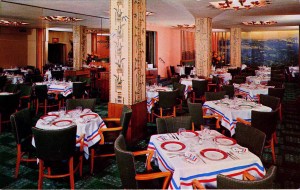 Where could you — once upon a time – enjoy European pastries, cinnamon toast, and ice cream soda while you hugged a teddy bear? Rumpelmayer’s, of course. A very popular rendezvous for pampered New York children after a visit to the zoo or the ballet. I suppose adults could hug the bears too, but Rumpelmayer’s sweetness – its confections, pink walls, and shelves of stuffed toys — might close in on you if you didn’t hold fast to some grown-up habits such as cigarettes and highballs.
 Rumpelmayer’s tea and pastry café began its Manhattan life in 1930 in the new Hotel St. Moritz on the corner of Central Park South and Sixth Avenue. The hotel almost immediately went into foreclosure though it continued in business. Oh, happy day when Repeal commenced in December of 1933 and the St. Moritz announced, “In Rumpelmayer’s, as in the Grill, we will feature a number of bartenders with Perambulating Bars, for serving mixed drinks.” Bars might be everywhere, but Rumpelmayer’s other attractions were not. For decades it provided a jolly spot for children’s birthday parties, lunches, late Sunday breakfasts, and afternoon teas and hot chocolates. It closed around 1998.
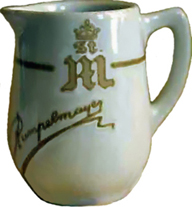 Always proud of its continental delicacies, New York’s Rumpelmayer’s was related (exactly how I’m not sure) to sister tea shops in London, Paris, and on the Riviera. The original Rumpelmayer’s was begun by an Austrian pastry cook in the German resort town of Baden-Baden in the last quarter of the nineteenth century. It then followed its Russian clientele to Cannes and Nice, then later to Mentone and Monte Carlo. In 1903 a shop was opened on Paris’s Rue de Rivoli (pictured, somewhat later) and in 1907 on St. James Street in London. Parisians, infected by Anglomania in the early 20th century, eagerly adopted the afternoon tea custom, in this case reputedly known as having a feeve o’clock-air at “Rumpie’s.” Though it was rated slightly less chic than the Ritz, it attracted mobs of fashionably dressed women who paraded their outfits up to the counter where, according to custom, they speared their chosen pastries with a fork.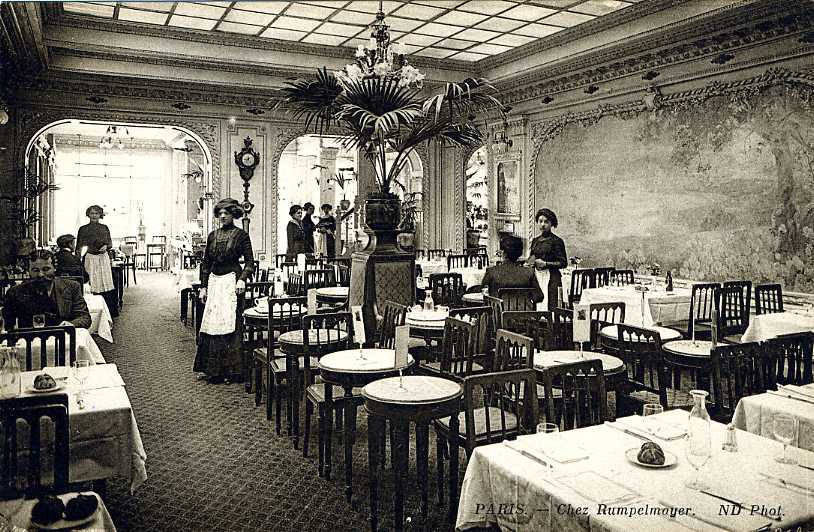
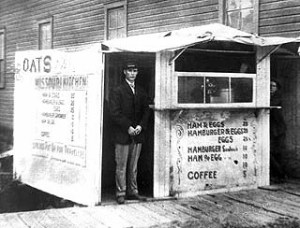 The restaurant business didn’t get much respect until it was sharply disconnected from drinking and put on a business-like footing in the Prohibition era of the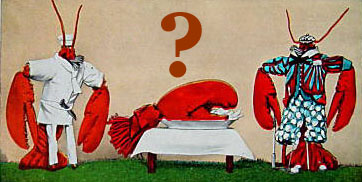
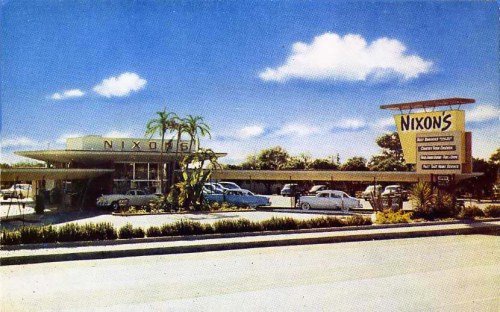 Since the 35th anniversary of Richard M. Nixon’s 1974 resignation from the presidency was commemorated this past weekend, it’s as good a time as any to focus on his brother Donald’s brief career as a restaurateur in Southern California. In the short span of five years in the 1950s, Don managed to go out of business while doing some serious damage to brother Richard’s political fortunes.
 The chain of five Nixon’s restaurants began modestly in 1943 when the Nixon family’s grocery store, established in 1922 by father Francis Nixon in Whittier, added a coffee shop. Although Don was involved in running the coffee shop, his first real business venture took place in 1952 when he opened a drive-in on East Whittier Blvd. (shown above). Two years later he opened Nixon’s Family Restaurant, also on East Whittier, home of the “Nixon Burger” whose unfortunate, opportunistic name would be used to taunt Richard Nixon during his two terms as President. Next Don opened a drive-in near Disneyland, in Anaheim, and a restaurant and bakery in Fullerton. In 1957, despite the Hughes loan and proceeds from the sale of Nixon’s Market to a supermarket chain, Don Nixon put all five restaurants up for sale to settle the chain’s debts.
 “Become a chef and see the world!” might have been the motto of many of the chefs who came to the United States from Europe in the 19th century. Take Joseph L. Legein, born in Belgium in 1852. He compressed a lot of traveling into his young working life. His biography could be used as a recipe for a colorful culinary career. Did he ever imagine he would end up as an ice cream maker in Springfield, Massachusetts?
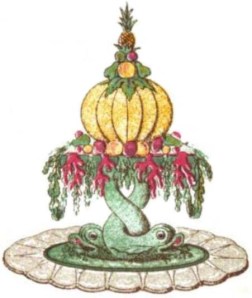 Every chance you get, travel throughout Europe visiting international exhibitions where pièces-montées made by chefs of spun sugar, gum and almond paste are displayed. You will need to make these for centerpieces at formal dinners.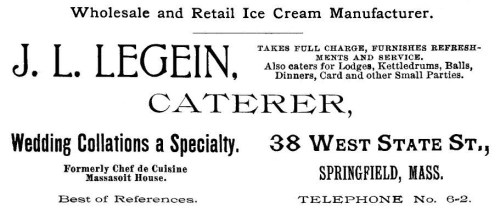
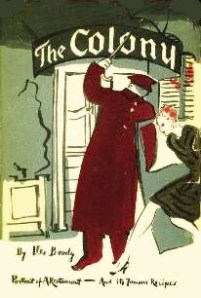 What a pain the rich can be. That’s the message you’ll take away if perchance you pick up The Colony Cookbook by Gene Cavallero Jr. and Ted James, published in 1972. The dedication page is plaintively inscribed by Gene, “To my father and all suffering restaurateurs.” Chapter 3 details what caused the suffering, namely the privileged customers who imposed upon him and his father in so many ways. They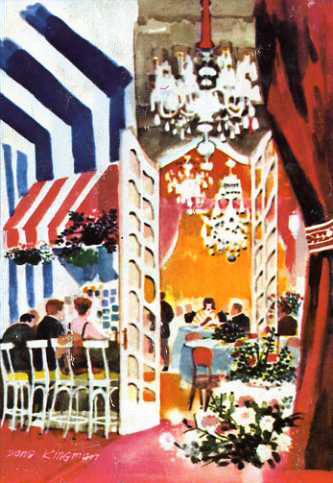
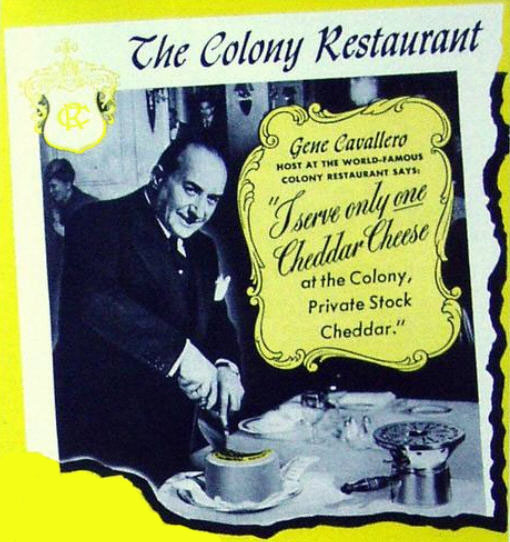
 The London Chop House, Detroit’s 21 Club, enjoyed a ranking as one of the country’s top restaurants in the 1950s, 1960s, and 1970s. James Beard named it as one of the ten best restaurants nationwide in 1961, the same year it won a Darnell Survey award as one of America’s Favorites. It won Holiday magazine awards repeatedly. Honors continued throughout the 1970s, and in 1980 it made Playboy’s top 25 list.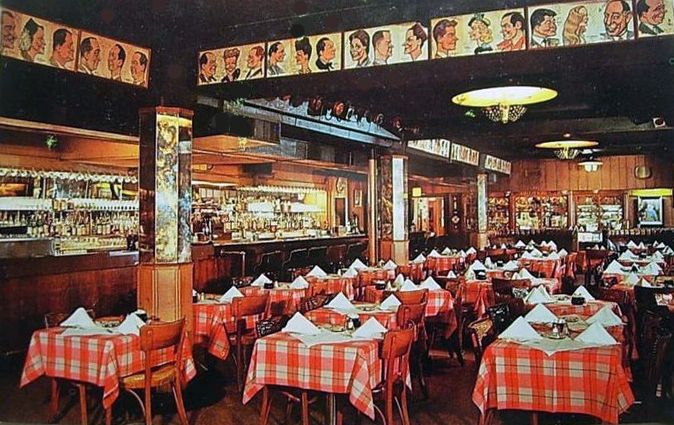
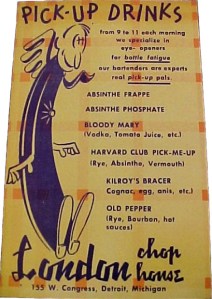 The Grubers were adept at flattering the male ego. When a guest made a reservation, he would arrive to find his table with books of matches and a reserved sign all imprinted with his name, as well as a card with a coin in a slot reimbursing him for his phone call. Alpha types jostled for table #1, while regulars glowed with the knowledge that their suavely jacketed waiter had remembered how many ice cubes they liked in their highballs. To keep up with escalating demand, in 1952 the Grubers opened a second place across the street, the Caucus Club. The 1980s turned out to be a tough decade for the Chop House. Les Gruber sold it in 1982, chef Schmidt left, and the new owner passed away. Despite efforts to keep it afloat, it closed in 1991.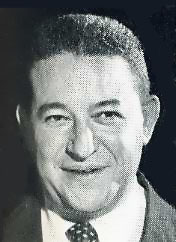
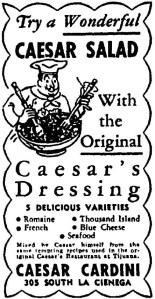 When we get into questions of the origins of certain dishes we have left history behind and entered into the murky depths of lore and legend.
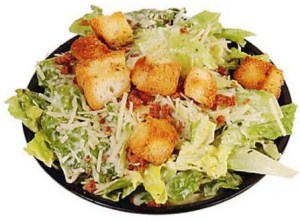 A strong inventorship claim was presented by Caesar’s brother, Alexander, in the 1960s. Caesar died in 1956, while running a grocery store in Los Angeles where he produced and bottled Caesar salad dressing. According to Alexander’s son, who ran Cardini’s in Mexico City, the two brothers had developed the salad together in a Tijuana restaurant in their younger days, improvising on a recipe their mother used when they were boys in Italy. In this “Mother’s recipe” account, the salad was initially called “Aviator’s salad” in honor of their customers who were soldiers, sailors, and airmen.
 In the 1850s the great landscape architect Frederick Law Olmsted, designer of New York’s Central Park, traveled through the South to investigate the institution of slavery. His observations were published in three volumes which were influential in turning readers against slavery. Around 1857 he traveled to Memphis, Tennessee, where he stayed at the Commercial Hotel. Although it was considered a first-class establishment, things did not go well for Frederick in the dining room as his journal entry for March 20, below, reveals. Among the dishes appearing on the not-too-elegant menu were “Beef heart egg sauce,” “Calf feet mushroom sauce,” “Bear sausages,” “Fried cabbage,” and, for dessert, “Sliced potatoe pie.” Better than whole potato pie, I guess.
 It's great to hear from readers and I take time to answer queries. I can't always find what you are looking for, but I do appreciate getting thank yous no matter what the outcome.