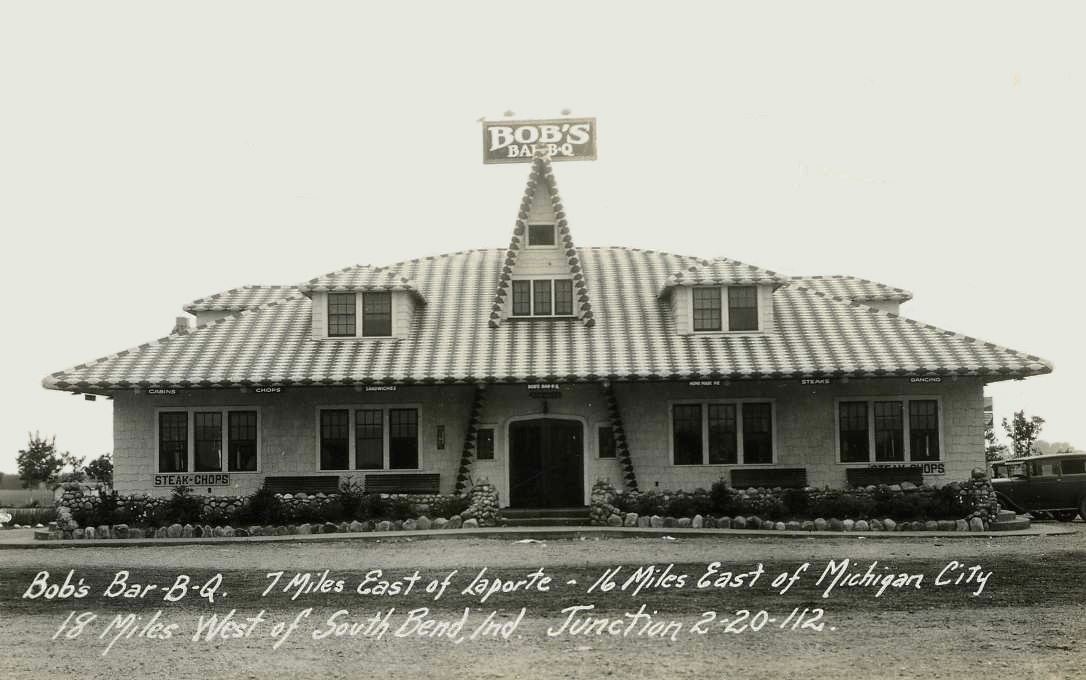
I’ve been exploring my postcard and ephemera collection and picking out favorites to see what I can find out about them. Judging from the geographical identification on this card – indicated by highway numbers and miles from towns, it clearly was a roadside enterprise catering to car and truck traffic on Route 20 in Indiana.
What I didn’t know is how very popular it was, not just with truckers and long distance drivers but with people living in the vicinity. Memories of it has inspired filmed interviews with former patrons who hung out there in their teens.
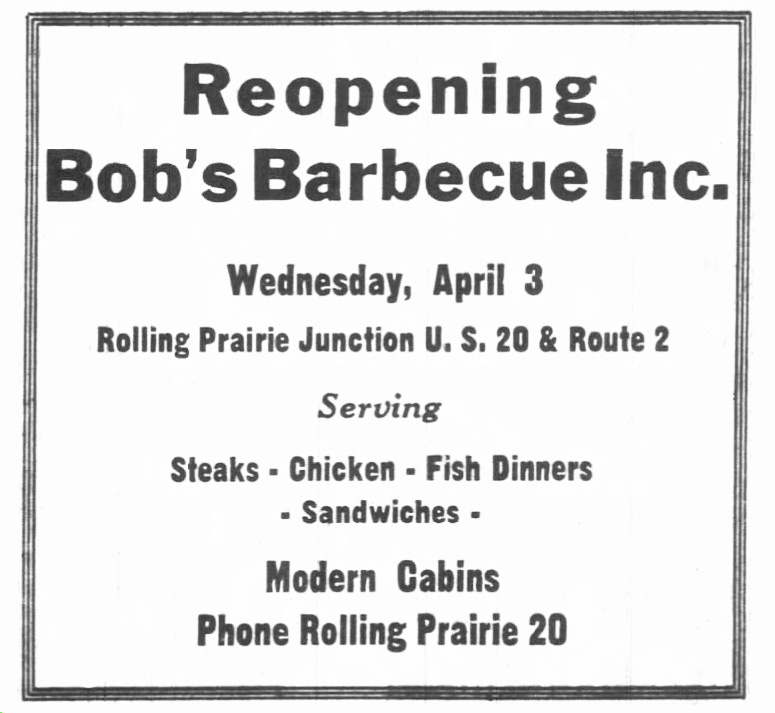
Bob’s initially opened in 1927, with a smaller building and was enlarged as shown above in 1932. In addition to getting business from traffic on Route 20, it also served as a stop for buses, with 10 to 15 stopping there daily. With the addition, the restaurant could host 150 patrons.
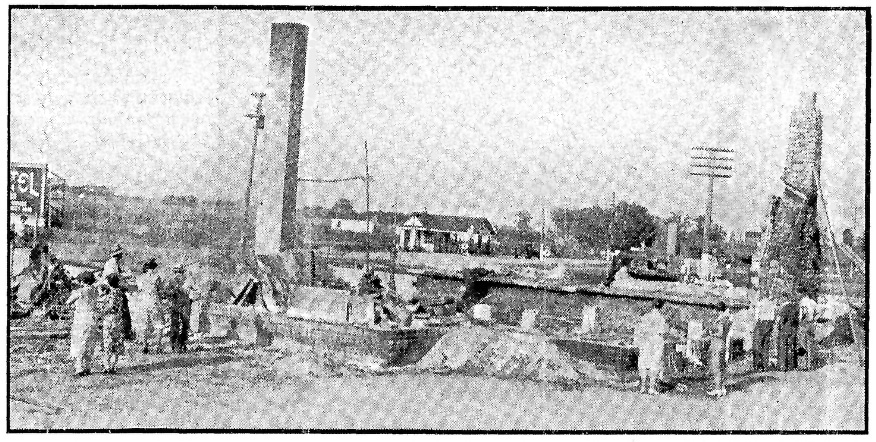
It belonged to by Robert Wiley and his wife Adah who worked there as a waitress. In 1933 it was totally destroyed by fire.
The Wileys and some relatives who lived with them were lucky to escape, although Adah was seriously injured. The Bob’s sign perched precariously on top of the central peak fell on Bob, but he was not badly hurt.
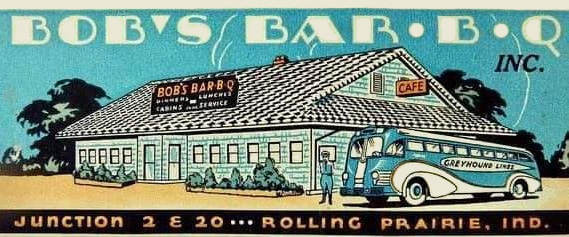
The Wileys were eager to replace the building quickly because it was on Route 20 where traffic was then headed toward Chicago’s World’s Fair. It soon reopened in a new building, shown above on a matchcover.
At some point tourist cabins were erected on land behind the restaurant. They were for travelers, but also housed restaurant waitresses.
With the new building in operation, the business continued to grow, But World War II presented new obstacles, namely difficulty in finding staff and a full range of food. At its busiest the restaurant had a staff of 40 but was down to 9 when it closed for the duration of the war. The South Bend newspaper declared it had been “one of the best-known highway restaurants and tourist camps in the middle west.”
When the restaurant closed Robert Wiley became a La Porte county deputy sheriff. Adah died in 1946. He remarried and reopened the restaurant in April 1946.
The highway set the tone for the restaurant in a number of ways. Obviously it brought travelers of all kinds, including some criminals on the run, and a jewel thieves who pulled off a daring heist in the parking lot. But stranger still — to me at least — was putting venison on the menu after a deer was killed on the highway.
Through much of U.S. restaurant history, smells were a problem. Partly this was because of a lack of ventilation that caused the build up of odors of all kinds blended together in a miasma. Then there was also the ideal of the smell-free middle-class dining room where even delicious kitchen aromas were frowned upon. All this kept numbers of people out of restaurants.
Eventually this began to change. Better ventilation was achieved and restaurants learned to use good smells to their advantage, even as a kind of advertising. Today a restaurant owner might even hire an aroma consultant so that they may begin “profiting from pungency”!
Clearly that was exactly what a small Wisconsin drive-in did when the owners developed the “pizza-burger” following the end of World War II. Of course they didn’t hire a consultant, but their new type of hamburger was deliciously smelly in a way that attracted customers.
The sandwich was launched sometime around 1951 by veterans who had returned from the war, got a VA loan and opened a small roadside stand in Muskego WI selling burgers, hot dogs, and frozen custard. Soon it became a drive-in named Big 3 from which the partners launched the pizza-burger. Served on a toasted bun, it was made of ground pork and beef, cheese, chopped onion, and pizza sauce, the latter being the special, secret ingredient.
By 1956 franchises had been sold in every state in the U.S. As with Colonel Sanders’ fried chicken and “Chicken in the Rough,” franchisees bought the right to advertise with the product’s logo – the boy with the freaky nose – and a guarantee that the company would not license competing sellers within a delineated territory. It was not long before the inventors found food producers who bought rights to sell the pizza sauce and the frozen patties, greatly simplifying production for drive-in operators. [above: 1956 advertisement, Washington PA — note “Not a Gimmick”]
Despite the licensing, however, I have no doubt that many eating places around the country that claimed to offer pizza-burgers were not authorized and used their own guesswork recipes. One that I saw incorporated black olives.
The basic sandwich was so popular with teens that a similar one was soon adopted by school cafeterias, although recipes may have varied – greatly. For example, one I found used ground bologna and beef, and substituted spaghetti sauce for the carefully spiced pizza sauce.
The Muskego drive-in, later turned into a full-scale restaurant, is gone. But as of 2004 when the founder’s son was interviewed there were still a couple of places producing pizza-burgers under franchise.
Remarkably, the pizza-burger has been memorialized with a roadside marker.
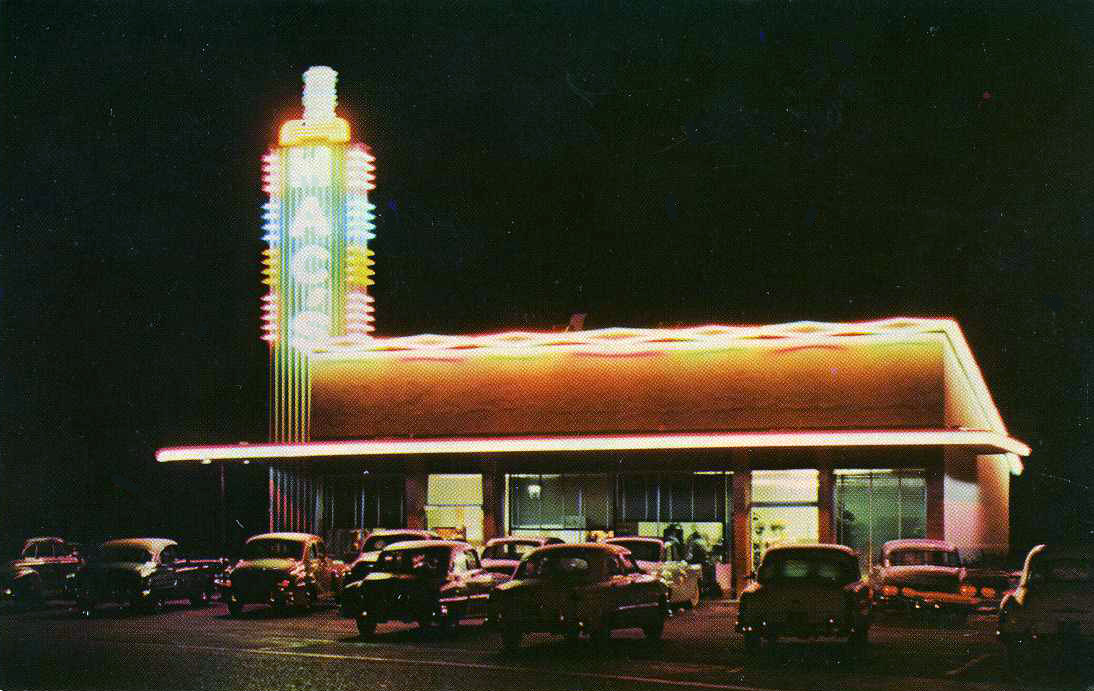
The four gases used initially by neon signs – neon, argon, krypton, xenon – were discovered by English scientists in the 1890s and adapted for use in signs by Frenchman Georges Claude a short time later. Though not the first, an early neon sign was used in Paris in 1913 to advertise Cinzano vermouth. [shown above: Mac’s, Corpus Christi TX]
But it wasn’t until the late 1920s that the signs became popular with restaurants in America. Particularly in the West where car culture was developing, the eye-catching signs helped attract the attention of drivers.
In the early days neon signs in a town’s business district could also be taken as a sign of progressiveness. A 1929 advertisement for an electrical display company in Great Falls MT advised businesses that their adoption of a neon sign would impress people, encourage progress, and “beautify Great Falls.”
Their use became well established in the 1930s. In the 1934 book Curious California Customs, the author commented, “To the casual visitor, Wilshire Boulevard, after dark, is a flashing cavern of Neon signs, most of which are calling attention to eating places.” A later postcard of Hollywood Boulevard at night in the 1950s demonstrates the effect of a street full of neon signs [shown above].
In the late 1920s the signs began moving across the country. Among early adopters were eight Benish Restaurants in St. Louis, four White Way Hamburger outlets in Colorado, the Horn & Hardart Automats in Philadelphia, and four Janssen’s Hofbraus in New York City. Salt Lake City outfitted multiple New York Coney Island Sandwich Shops with the signs.
Bright neon signs and images remained quite popular throughout the country into the 1940s. But if they were meant to make a business stand out from the crowd, that became more and more difficult as the numbers grew.
Neon signs were undoubtedly most effective for roadside restaurants on dark roads that stayed open at night [above: [Bratten’s Grotto, Salt Lake City, 1956]. Or for eating places in somewhat obscure locations that required signs that could be seen from afar. Unfortunately, they didn’t look as impressive during the daylight hours [below: Bratten’s Grotto, daytime].
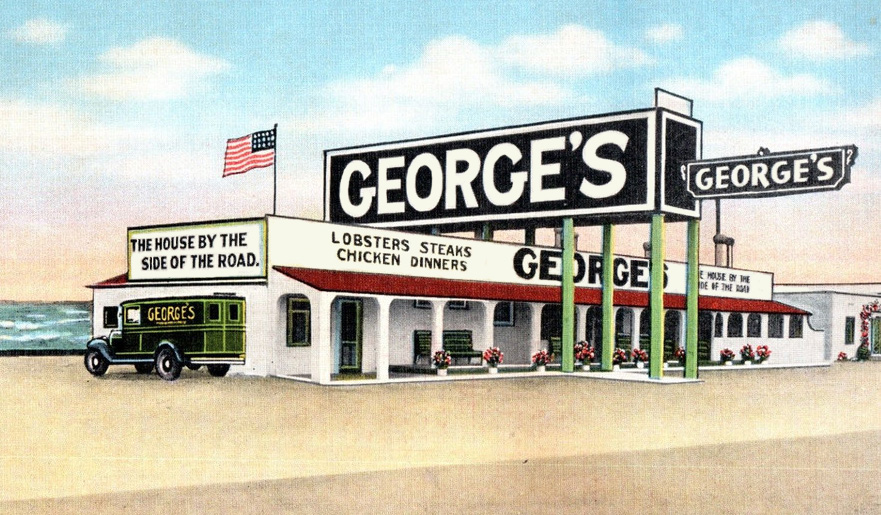
Before neon, efforts to craft signs that could attract distant or speeding traffic were undoubtedly less successful, less visible in the dark. George’s grotesquely large sign shown below, for example, was neither attractive nor sufficiently visible at night. As a slightly later version of this postcard revealed, the restaurant soon found it necessary to add spotlights atop the sign.
Neon wasn’t for every eating place. To critics it lacked artistic pedigree and dignity. Elite restaurants wanted nothing to do with it. It might announce the presence of the Green Frog or the Zig Zag Sandwich Shop, but certainly not New York’s La Chaumiere.
A 1960 book on restaurant decor pronounced neon in bad taste, saying, “Incandescent lighting is more expensive but has a kindlier glow and, thanks to the bad association arising from the tasteless use of neon, is generally considered ‘classier.’” As cities declined with the growth of suburbs, such attitudes toward neon grew more negative.
Nor was neon welcome in classy towns and communities such as Palm Springs, Carmel-by-the-Sea, and Sonoma in California; Santa Fe, New Mexico; the Hamptons on Long Island; and Cohasset, Massachusetts, to name but a few that banned it.
Rejection of neon grew in the 1960s and 1970s. In 1965, food critic and editor Craig Claiborne was uneasy about eating in the one (barely) acceptable restaurant he could find in Roswell NM, which he said had “the air of something once removed from Las Vegas or Miami Beach with its neon-silhouetted champagne glass and flashing neon bubbles.” His unease increased upon stepping inside and seeing a lighted goldfish tank, male customers not wearing coats, and bartenders with “narrow, abbreviated ties.”
Antipathy to neon in the 1970s, as before, was associated with urban decay and seedy neighborhoods characterized by run-down buildings and businesses such as bars and strip clubs. More cities and towns banned it.
Soon there were few “tube benders” left who could create or repair neon signs, which were increasingly being replaced with lighted plastic signs that were easier and cheaper to make and less prone to damage outdoors. Yesterday’s real neon signs that had survived soon showed up as quaint wall decor in warehouse-style theme restaurants.
A few commentators, such as a reporter for the Fort Wayne News-Sentinel, began to wonder about the return of neon. She speculated in 1975 that “that much-maligned symbol of everything that’s bad about American commercial districts” might “someday be recognized as art.”
Sure enough, in 1976 the Smithsonian put on an exhibit that included neon signs, among them examples from a Kosher restaurant, a foot-long hotdog place in Cleveland, and from a Spanish-American restaurant in Greenwich Village, a many-colored creation that combined a lobster, pig, fish, chicken, crab, and a steaming coffee cup.
Nowadays, vaguely quaint-looking plastic “neon” signs might show up as interior wall decor in the sort of restaurants that want to suggest they are fun places.
Despite the documentary absence of postcards, I’ve discovered that there were others — after a lot of searching. And I’m glad, because in nostalgic American culture, drive-ins are seen as deeply and exclusively white.
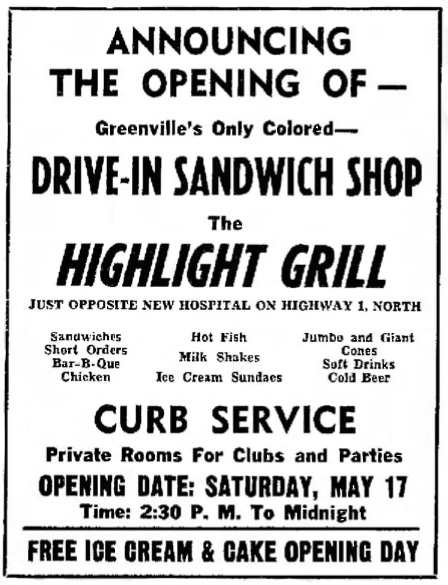
Most I’ve located got their start in the 1940s and 1950s, the same years that white-owned drive-ins made their first appearance many places, particularly warmer climates. More people in those years, especially after WWII, had cars and a little extra money to spend. [Highlight Grill, Greenville MS, 1952]
The earliest reference I’ve found was to The Drag, on Lyons Avenue in Houston. In an advertisement for its sale in 1941 it was described as a “famous colored drive-in.”
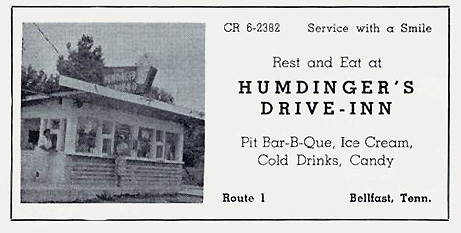
Black drive-ins were most likely to be found in Southern cities before the Civil Rights Act of 1964 made Jim Crow segregation illegal and all public restaurants had to serve everyone regardless of race. Although they could be found in Northern cities, it seems they were more likely to be in good-sized Southern cities such as Chattanooga, Memphis, and Nashville TN, Louisville KY, Little Rock AK, and Birmingham and Tuscaloosa AL.
Altogether I’ve run across 54 Black-owned drive-ins in this country, which is not many but surely an undercount. I have not found any in the Northeast. Nor in the land of drive-ins, Southern California, where they dated back to the 1930s. No doubt there were some, but probably fewer than elsewhere.
It was mainly in the 1960s that they began to show up in the yearly Green Books that advised Black travelers on places to stay, eat, fill up with gas, etc., in unwelcoming parts of the U.S. – i.e., most of it. (I cannot be 100% certain that every drive-in listed in the Green Books had a Black owner since sometimes white-owned restaurants that welcomed Black customers were also listed.) [Shown here, a Green Book advertisement from the 1961 edition.]
Many, maybe most, of the drive-ins served barbeque. For example, Nichol’s Drive-In in East St. Louis IL specialized in hickory-smoked Beef Ribs, Snoots, Pork and Chicken. It mentioned Soft Drinks, but a number of Black drive-ins served beer. Selling beer to underage customers seemed to get some of them into trouble.
I noticed that when a new Black-owned drive-in opened, it was usually greeted with enthusiasm in Black newspapers. White newspapers, on the other hand, often only reported on them in association with disorderly incidents and legal violations.
When a Black-owned drive-in was proposed for a location near a white residential area, it was unlikely the plan would be approved. (The same held true for Black-owned drive-in movie theaters.) In 1951 a Black man seeking official approval to build a drive-in restaurant in Memphis faced a hostile lawyer representing whites who opposed it. The opposition’s lawyer referred to the drive-in as a “Negro night club,” and when the applicant’s lawyer objected, maintained that a drive-in was “the same thing.”
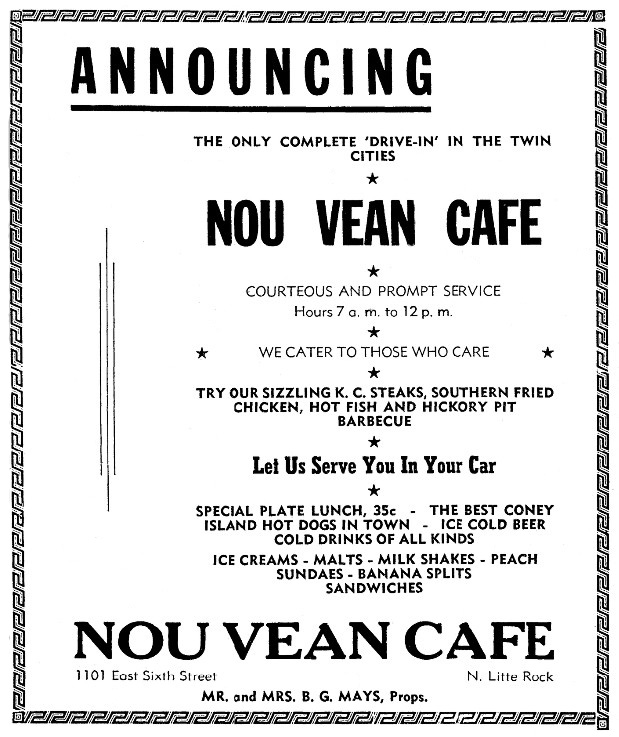
The drive-ins that seemed to fare the best were those owned and run by prominent figures in Black communities. In the 1940s Little Rock’s Nou Vean Drive In was owned by Barnett G. Mays, a realtor, developer, and liquor store owner. He encountered numerous roadblocks throughout his business career, but seemed to press onward despite them. In Milwaukee a drive-in called Robbys appeared to have a promising future when it opened in the late 1960s. It was named after the son of owner J. C. Thomas, a community leader who was also a realtor, operated two billiard parlors named Ebony Cue, and published a newspaper called Soul City Times. [Above: Nou Vean, 1945; Below, Robbys 1969]
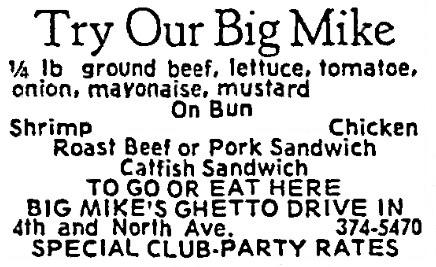
However, drive-ins generally – both Black and white – met major competition in the late 1960s when fast-food chain restaurants spread across the country. In Milwaukee Robby’s as well as Big Mike’s Ghetto Drive-In faced off with national chains and lost.
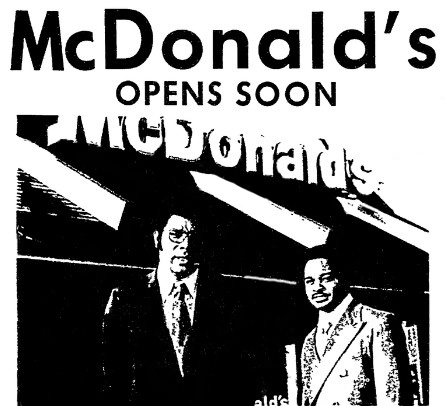
Big Mike’s owner Mike Watley, a social activist and close associate of comedian Dick Gregory, explained that he could not compete with a national corporation. With lower sales volume, he paid higher prices for food, a situation intensified by being given less financial support. His meat supplier, he said, capped his credit at $100, while white customers could run up their bill to three or four thousand. Although Watley blamed his failure on competition from a “white-owned corporation,” the nearby McDonald’s franchise was owned by two Black men, one of them Wayne Embry, a former player with the Milwaukee Bucks. Their McDonald’s venture was quite successful. [Above: Big Mike’s, Milwaukee, 1969; Below: Wayne Embry, left, and his partner, 1971]
Independent Black-owned drive-ins have not totally disappeared, however. In Longview TX White’s Drive-In, established in 1952 in conjunction with the White’s motel, has recently been re-opened by younger members of the family.
In 19th-century America most eating places were named for their owners. But in the 20th century, despite the continuing prevalence of proper names, more creative names began to appear. For instance, a 1912 directory of Black-owned restaurants in Chicago included the Crazy Corner Café and the Wa-Wa.
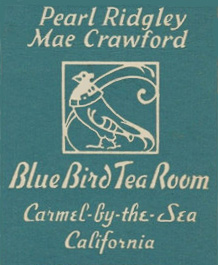
Greenwich Village of the 1920s pushed the vogue further. Columnist O. O. McIntyre was one who sneered at names of eating places there such as the Purple Pup, the Mauve Moon, and the Cerise Cat. In fact, they heralded a trend soon popping up everywhere, especially in casual eateries and tea rooms. Names linked to colors, birds, and animals proved especially popular with tea room proprietors.
Newspaper columnists were alert to new and strange restaurant names. In 1927 a Seattle writer noted, “The bluebird and the red robin both sing the song of food. Being an especially noble bird the eagle soars over four hamburger houses, and thus is more active than any other animal as far as eat signs are concerned.”
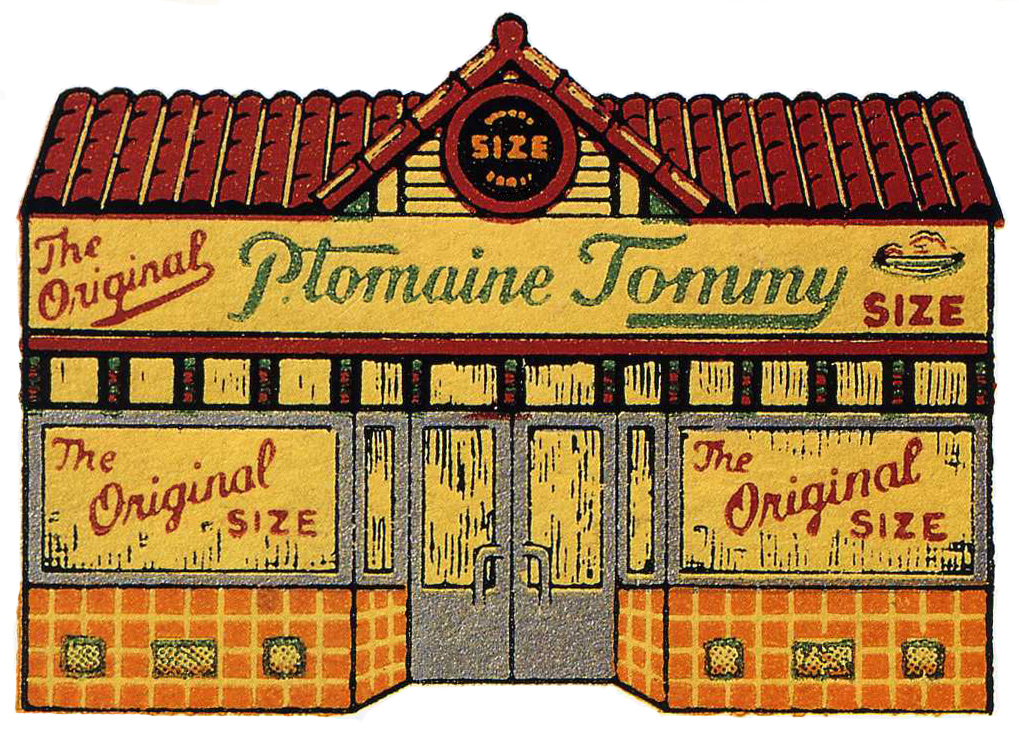
Other eateries went further, with names that were attention-getting but far from charming such as the O-U-Pig Stand in Knoxville TN or Ptomaine Tommy’s in Los Angeles.
Busy Bees were found in almost every city, but they didn’t seem to head into the countryside much.
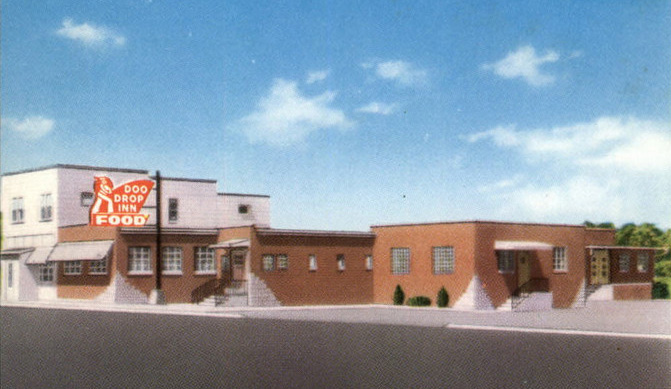
Restaurant names grabbed the attention of visitors from England. In 1929 the husband and wife authors of On Wandering Wheels noted inns and tea rooms in Connecticut with names such as Steppe Inn, Kumrite Inn, Wontcha Drive Inn and others they dubbed collectively “Ye Old Roade House.” A few years later another English vacationer marveled over a long list of “strange names” he compiled including Do Drop Inn, Dew Drop Inn, and Due Drop Inn. [Doo Drop Inn, Muskegon MI]
Why the rise of fanciful — and often hopelessly corny — names? I suspect it was competition that drove small businesses to attempt to stand out from the crowd. But it’s also probable that some proprietors who came from foreign lands were quite eager to hide their surnames during the anti-immigrant 1920s.
If anything, the Depression of the 1930s stimulated the use of creative names, as a glance at city directories reveals. Columbus OH had a Zulu Hut and a Pig Stile. Buffalo patrons could choose Da Nite Diner or Just-A-Mere Grille or one of seven “new” places, whether New Buffalo Lunch, New Chicago Lunch, New Genesee Restaurant, New Haven Lunch, New Main Lunch, New Popular Lunch, or New Texas Lunch. Exactly what about them was new is lost in time.
Even the trade magazine The American Restaurant got into the habit of collecting strange names in 1947, calling attention to lists that included Grabateria, Dizzy Whiz, and Blu Baboon. The columns also added to the growing list of names using the word “inn” with Weasku Inn, Hello Inn, Venture Inn, Brother-in-Law Inn, and Welcome Inn.
Continuing the once-irresistible urge to combine punning names with “inn,” here are others I’ve found, dating from the teens through the 40s: Always Inn, Bungle Inn, Chick Inn, Duck Inn, Du-Kum-Inn, Fiddle Inn, Fly Inn, Jitterbug Inn, Kum Inn, Pour Inn, Ramble Inn, Stumble Inn, Tip Toe Inn, Toddle Inn, and Tumble Inn.
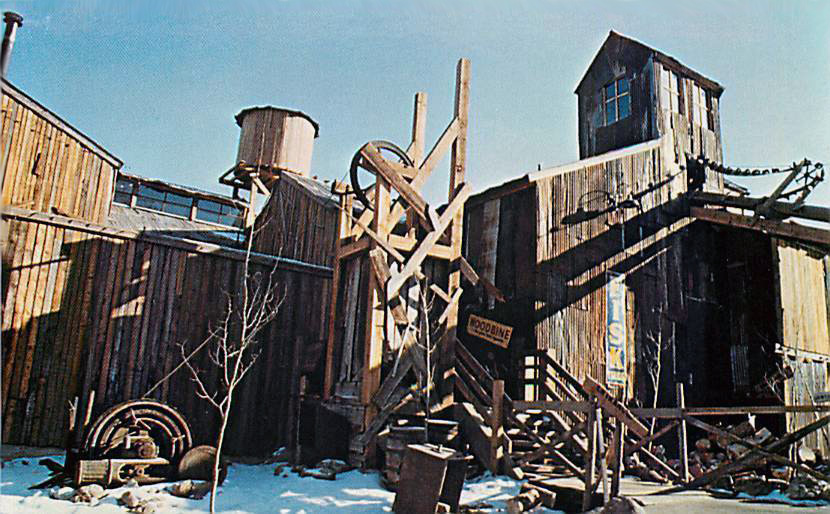
Perhaps the long-lasting attraction to bizarre names actually peaked in the 1970s when restaurant groups spread themed chains across the country, often with names I would nominate for the most absurd of all, exemplified by Baby Doe’s Matchless Mine [Denver location pictured].
By now we’ve grown accustomed to many names that once drew attention, but have become ordinary. It’s unlikely that anyone still thinks of Drive Inn, now usually without the second “n,” as an originally punning name. Maid Rite and White Castle seem unremarkable as does Applebee’s, especially since deleting the initials T. J. which, thankfully, had fallen out of fashion.
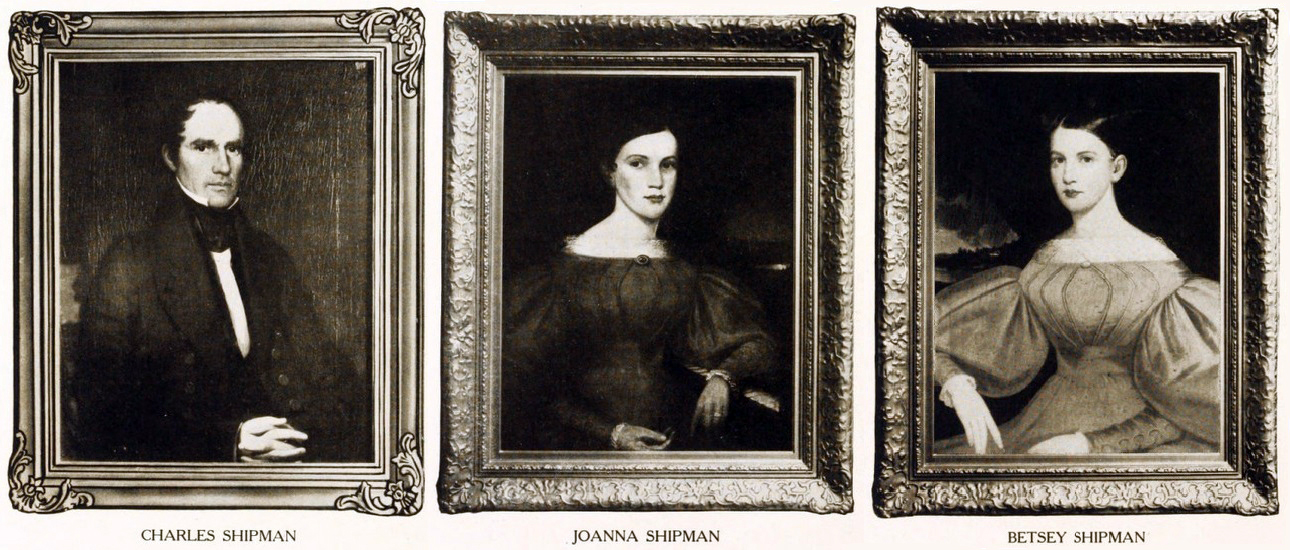
On Monday, October 6, 1834, Charles Shipman and his two teenage daughters, Joanna and Betsey, left Athens, Ohio, for Philadelphia. Charles went there twice a year to buy goods for his general store. They traveled in their two-horse carriage and would not return until November 15, by which time they had been through the mountains, traveled by steamship, visited Washington and Baltimore, and met with President Andrew Jackson.
Their usual plan was to get up early, travel for a while and then stop for breakfast and dinner at an inn or tavern. Their main meal was mid-day dinner. They ate “supper” wherever they were staying for the night. They stayed at inns, hotels, and for their longest stay, in Philadelphia, at a boarding house where their meals were supplied.
The meals in taverns and inns in small towns were surely humble. Joanna kept a record of their travels, more of a log of times and distances than a diary of subjective impressions and descriptive details. It’s disappointing that she was not inclined to record much about what they ate on their travels, but there are some interesting bits.
On their fourth day of travel they stopped in Morristown OH for breakfast at 9 a.m. Joanna writes: “Found some tomato preserves on the table, at first thought they were very good, but after tasting again concluded to the contrary.” On Joanna’s initial recommendation, Betsey ate some of the preserves but later told her sister that they made her feel sick.
That evening they arrived in Wheeling – now in West Virginia, but then Virginia – and stayed in a “very good country tavern” where Joanna reported she “Ate too much supper, and that with rainy weather and miserable roads makes me feel a little homesick.”
In the journal it becomes clear that the sisters were prone to feeling homesick and anxious – about traveling through the mountains, staying in cities, meeting people, and being on steamboats. Joanna found Smithfield VA, and then Petersburg VA where they stayed overnight, depressing: “Have had the horrors all day.” Seeing a fire from their window in Philadelphia, Joanna recorded that she and Betsey were “frightened out of our wits.”
Did anything thrill the sisters on what was probably their first trip outside Ohio? Joanna certainly shows no excitement about meeting “Old Hickory,” the President, and simply records that after shaking hands, and “looking at him as long as we cared to, we left his August presence and went into the yard.”
Joanna writes with a restrained tone, yet it’s clear she has a sense of humor. The Shipmans met with various people along the way. After one of them, a man who “ogled his eyes” when he looked at the sisters, told them he planned a future visit to Ohio, Joanna writes, “So now look sharp, Miss Betsey.”
On the way to Fredericktown MD, they stayed overnight at an inn. Joanna recorded her simple breakfast the next morning as “a piece of bread, strong [i.e, rancid] butter, peach sauce and a cup of milk.”
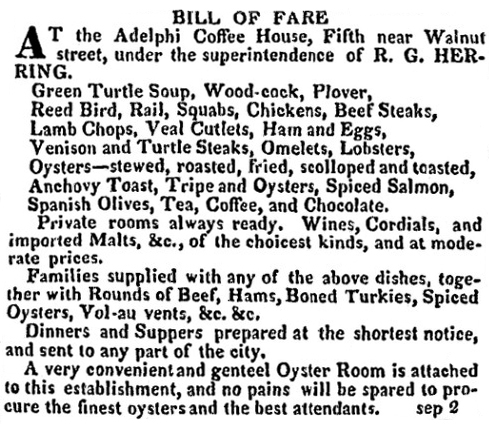
At that point they were about to reach that part of their trip that took them to larger cities. But I feel certain that they had no interest in exploring urban dining as itemized on the 1834 bill of fare of the Adelphi Coffee House in Philadelphia [shown above]. It gives a good idea of choice dishes of that time, but since the coffee house was also a drinking place it would have been forbidden territory for this family. Charles Shipman was a dedicated temperance follower who refused to handle alcohol in his store.
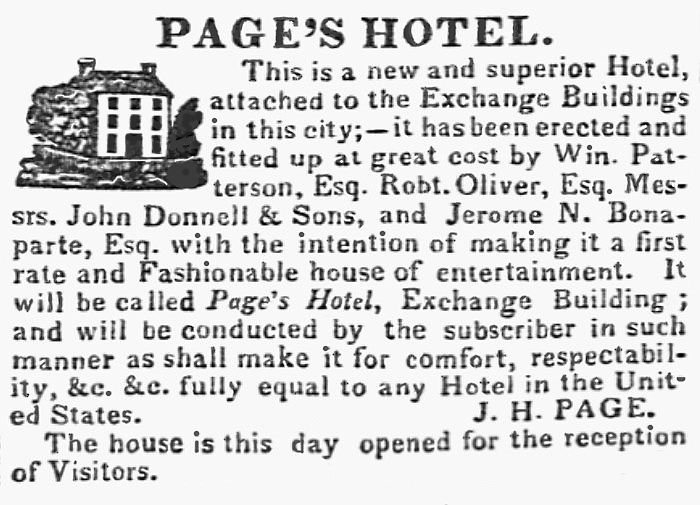
Upon reaching Baltimore the next evening, they had trouble finding a hotel that was not full, but on the third try discovered a new place called Page’s that had just opened. Joanna described it as “the most splendid house my little eyes ever beheld.” They had a private parlor and meals brought to their room. But despite these positive aspects, she wrote “It nearly frightens us out of our wits to go all through [the hotel]. Betsey says she never thought she was raised in the woods to be scared at an owl, but she has found tonight that she was.”
Their 11-day stay in Philadelphia included some strange-sounding entertainments. At the Hall of Independence they viewed dogs powering cloth making, and an automaton that wrote. The next day they went to Washington Hall where they saw speaking and dancing puppets and “the exhibition of the burning of Moscow.”
Their father offered Joanna and Betsey a trip to New York City, but they turned it down, preferring to head for home.
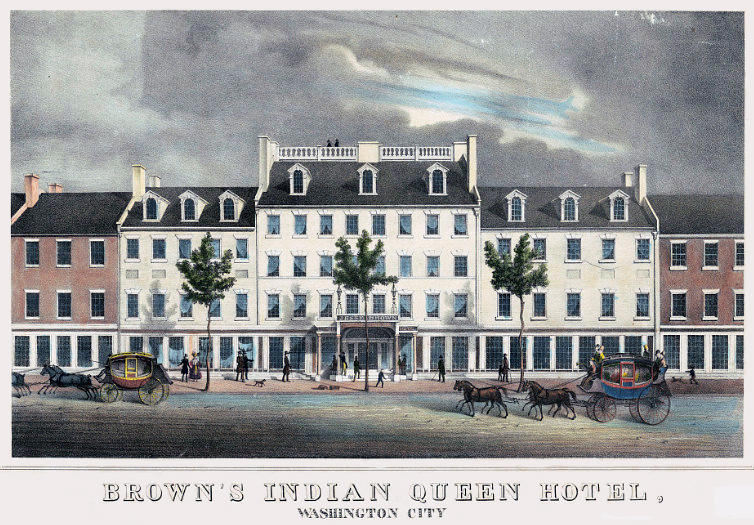
Leaving Philadelphia they returned to Washington, beginning their journey homeward. They stayed in a large hotel, Brown’s Indian Queen Inn, but did not record anything about it. Traveling through Virginia they stopped at Warm Springs, where they were weighed so they could see how much they gained at dinner. Charles (119½), Betsey (109), and Joanna, (118½) each added from 1 to 1½ pounds to their slight frames. They stayed overnight in the springs region, eating “a real country breakfast” the next morning. Then, for dinner at White Sulphur Springs, they “were treated to some fresh pork fried, some fresh beef fried, some light bread and some milk, rather tough this, as I look at it,” recorded Joanna.
Only two days from home, they stopped at Wilson’s Hotel in Charleston for dinner. She reported “the way dinner was served was a ‘touch above the vulgar.’” I would not think that was a resounding compliment.
Joanna was more than thrilled to get back home to her mother and brother.
After a start in the 1950s, pancake houses made it big in the following decade.
Of course pancakes were not new to eating places. Far from it. They had long been a staple of short order restaurants, known variously as flapjacks, hoecakes, hot cakes, griddle cakes, flannel cakes, batter cakes, butter cakes, and just plain cakes. The mighty Childs chain had built its business by transfixing pedestrians with women flipping pancakes in its windows.
Cheap yet filling, it’s hardly surprising that pancakes grew in popularity during the 1930s Depression. The Childs Corporation reported in 1931 that pancakes with butter and syrup ranked as “the most typical American dish.” Pancakes were once again in the spotlight in the film Imitation of Life (1934) in which a white woman’s Black cook runs Aunt Delilah’s Pancake Shop which makes a hit on the Atlantic City boardwalk. The 1930s was also the decade in which The Pancake House opened in Portland OR – a restaurant which James Beard playfully nominated in the 1950s as one of the 10 best in America.
But what was new in the 1960s, with the spread of economic prosperity through (white) America, was the popularity of the “family restaurant.” Children, who had earlier been a minor element in eating out, became a new factor in restaurant success. Now included in dining plans, they often ascended to the role of lobbyist and de facto decision maker. And, while Mom might frown on high-calorie menus and Dad might wish for steak, the kids loved pancakes.
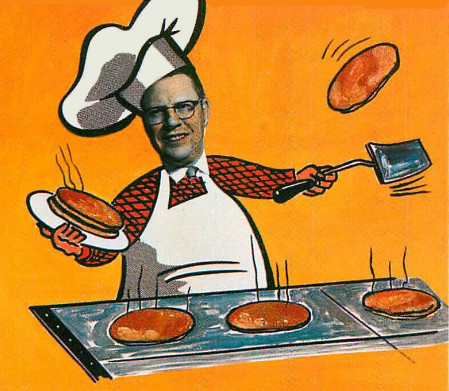
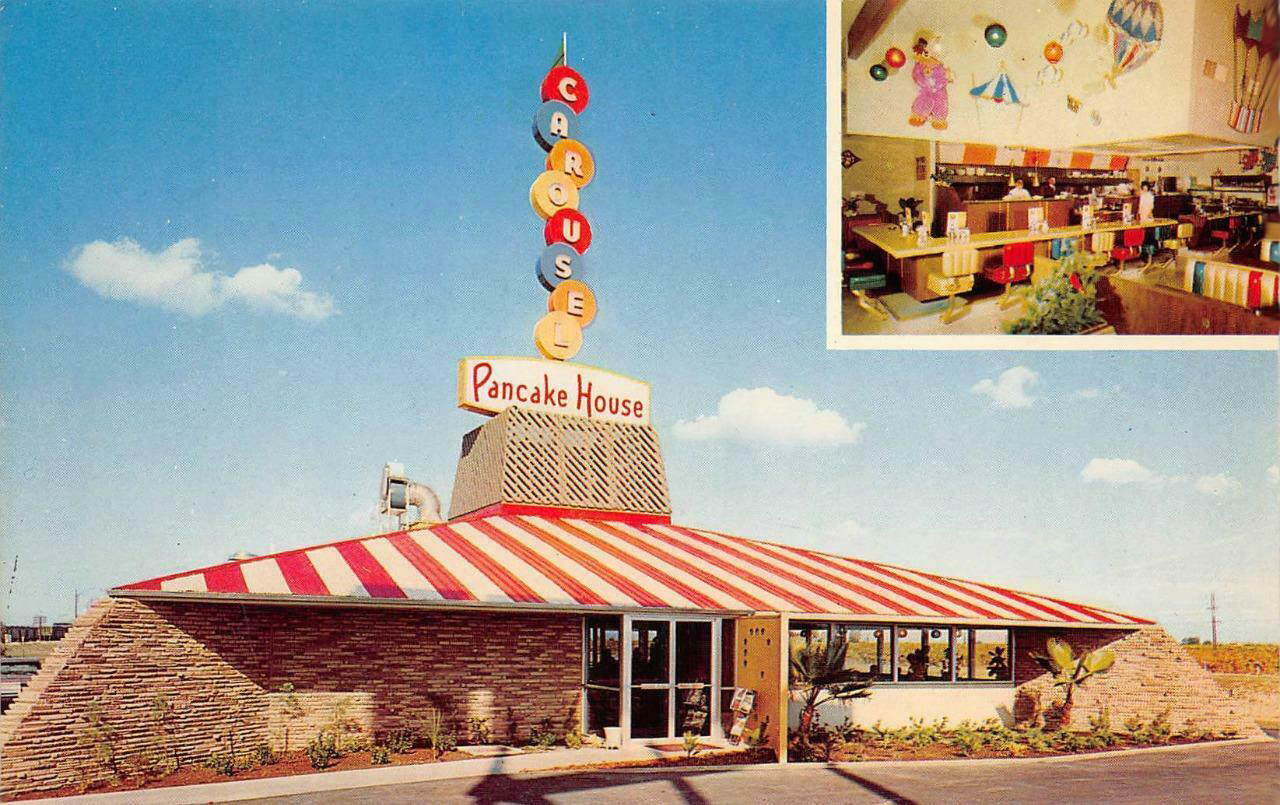
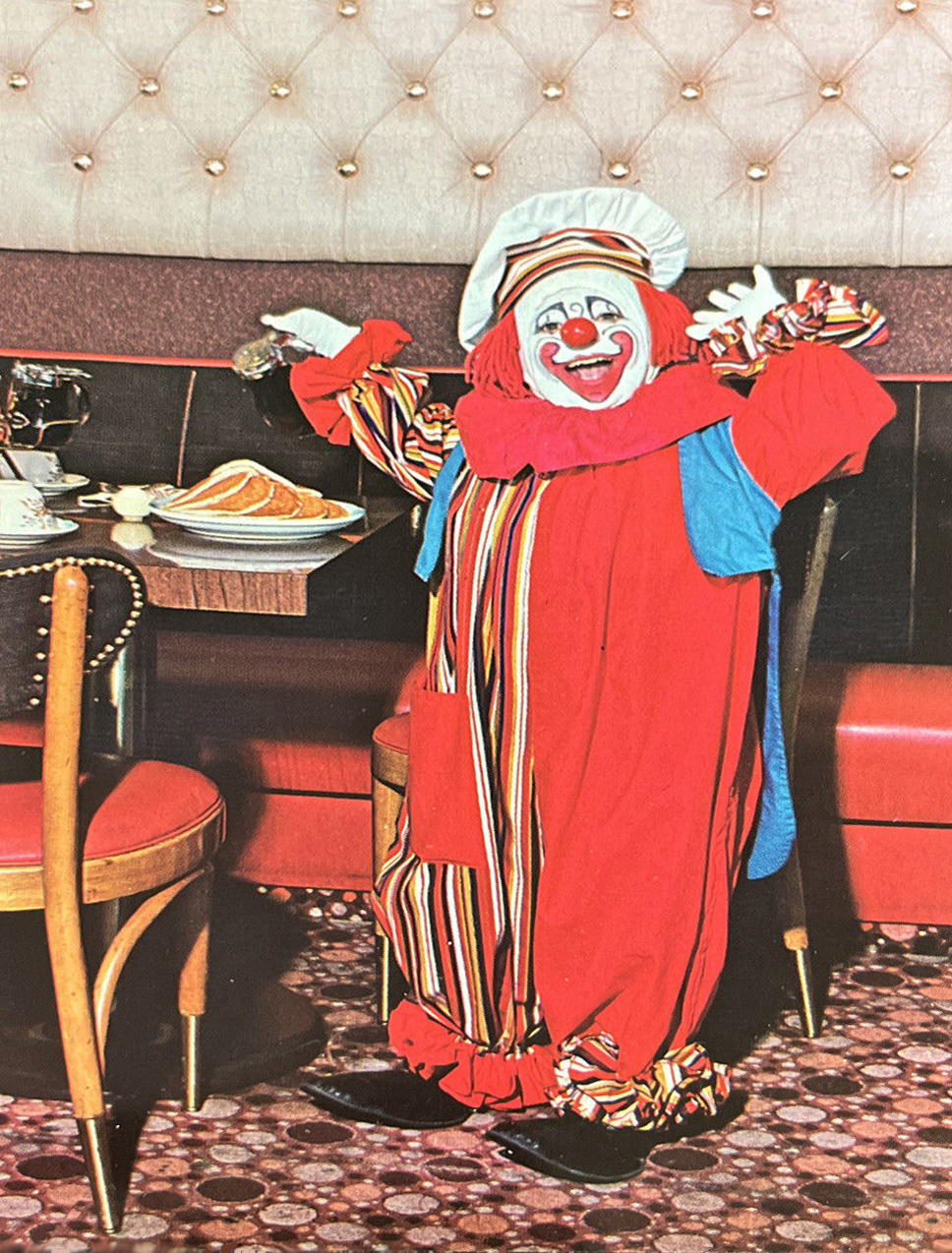
Pancake restaurants of the 1960s welcomed children with bright primary colors, cartoonish figures on menus and walls, and at least in one case with a rather alarming-looking costumed clown. If a child had not fully satisfied their sweet tooth with pancakes, they could raid the “old-time” candy barrels at Florida’s Kissin’ Cousins Pancake Inns. Meanwhile, an adjoining cocktail lounge beckoned parents with beer and bourbon.
What else was new about pancake restaurants? They were part of the advent of eating places focused on single foods, such as hamburgers or pizza. Like pizza, pancakes held special charm for restaurant owners because their ingredients were cheap and no skilled cooks were needed. Plus, they weren’t just for breakfast — customers were ready to order them all day and through the night. The trade journal American Restaurant mused in 1960, “Who ever dreamed that the lowly pancake would build a fortune . . .?”
Restaurant consultant George Wenzel asserted that pancake houses proved “that any one item, prepared with great care, and basically popular, can lead to fortunes especially if the menu price is reasonably low.” While regular service restaurants had food costs up to 48%, he figured they were only 35% in specialty restaurants such as pancake houses.
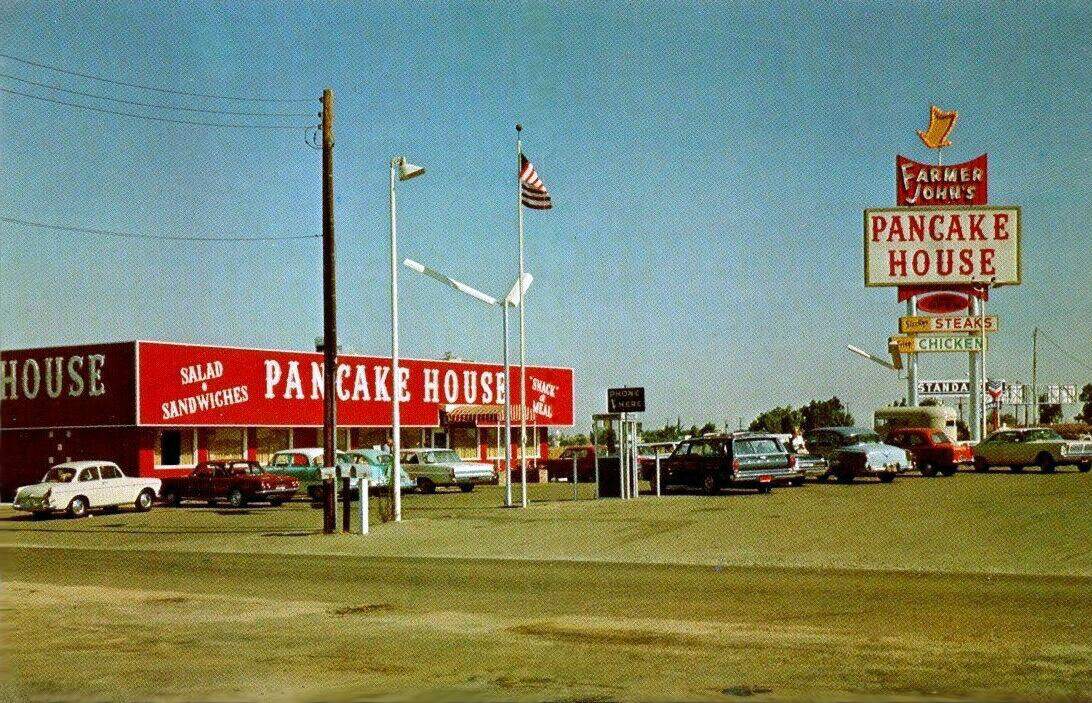
Chains built around pancakes spread rapidly. By 1961 the International House of Pancakes had opened 25 units in just three years, and was poised to expand into the Northeast. Uncle John’s Pancake Houses, begun in 1956, were doing business with 60 units in more than 20 states. Each of these chains may have been inspired by Aunt Jemima’s Pancake House that opened in Disneyland in 1955.
Despite the development of dozens and dozens of pancake varieties and their high profit margins, pancake restaurants gradually broadened their menus. The trade magazine Cooking for Profit noted in 1964 that pancake restaurants had found it necessary to put steak on the menu. The growing menus meant that the pancake restaurant boom would soon give way to a more general sort of family restaurant in the 1970s. Like pancake restaurants, full-service family restaurant chains such as Denny’s and Country Kitchen were also expanding.
Eating in restaurants continued to be popular with families in the 1970s. Reporting on a Gallup survey in 1975, Food Service Magazine observed that more working mothers, increased family income, and smaller families suggested “a more profitable family market than ever before.” The survey also found that preferences included table service restaurants that welcomed children, had moderate prices – typically $1.00 to $1.99 per person for breakfast — and a menu with a wide range of selections.
A 1978 New York Times story titled “Family Restaurant Booming” noted that dining out is extremely sensitive to economic conditions, a situation that is likely to be especially true for family dining.
So the current economy should favor patronage at IHOP, the reigning pancake kingdom.
In the 1890s old wayside inns and roadhouses removed the horse troughs and replaced them with bicycle stands. A new day was dawning!
For years, ever since railroads had reduced horse-and-carriage traffic on the old colonial turnpikes, roadside eating and drinking places outside cities had been in serious decline. After the Civil War they were visited mostly by farmers and marketmen taking their produce to the city by horse and wagon. But, due to the popularity of bicycling beginning in the late-1880s, city people became the favored customers, both because they came in larger numbers and because they spent more.
Bicycling was fast becoming the favorite leisure-time activity of the American public. They couldn’t wait to take a spin in their free time, often on a route with wayside inns and roadhouses. The oldest inns were in the East, mostly found in states such as Massachusetts and Pennsylvania. The Red Lion inn at Torresdale PA, for example, was built in 1730.
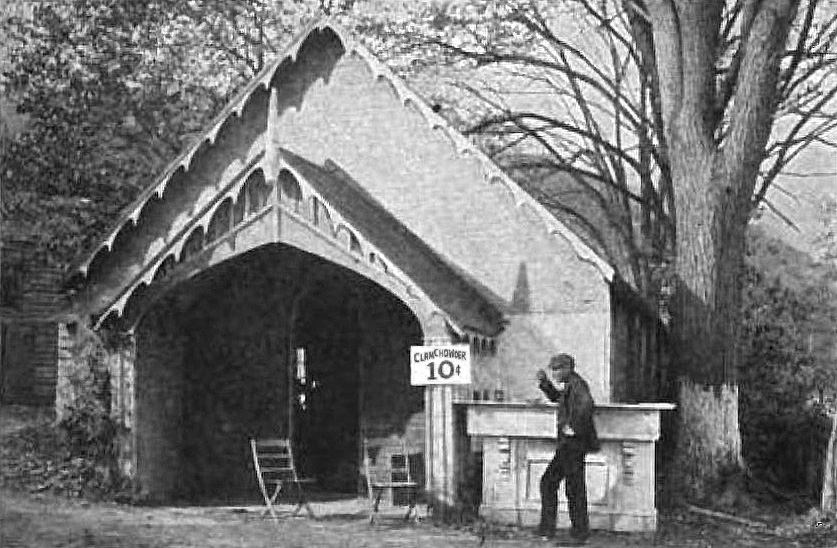
For those preferring shorter rides, city parks were attractive, perhaps none so much as Philadelphia’s Fairmount Park. It was well supplied with places to stop for a bite [such as The Dairy, shown here]. New Yorkers liked to tour the good roads on Staten Island or pedal out to Long Island and Coney Island, often making a stop at the beach. Bicyclists in Oregon were drawn to a rose farm outside Portland, site of the Ah Ben roadhouse where chicken dinners were served.
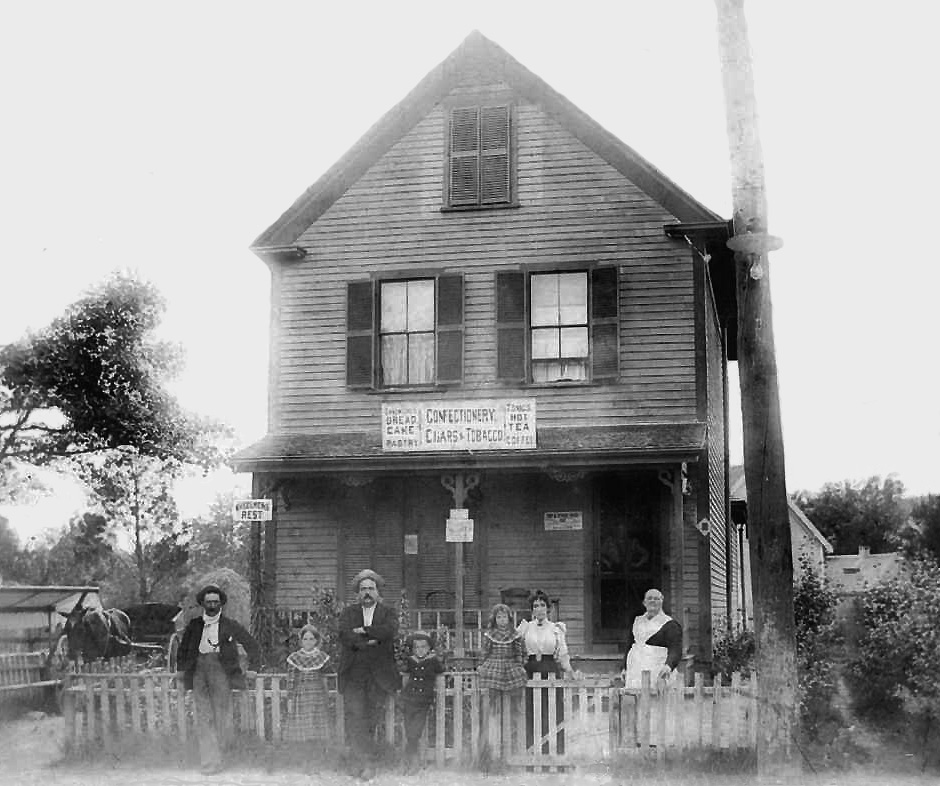
There were also eating places set up in homes along the wayside, and homemade refreshment stands in fields. Often these eating and drinking places were dubbed “Wheelman’s Rest.” One in Malden MA was offering light snacks in 1896, but apparently no beer or liquor, an activity that landed many proprietors who had no liquor licenses in jail.
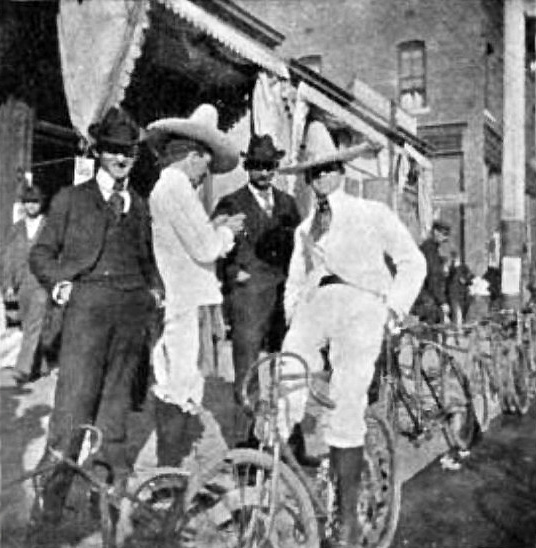
Californians boasted that bicycling was possible year round in “the land of sunshine.” Country trips might be planned around visits to old missions. Pictured above are members of San Diego’s Crown City club, wearing white suits and sombreros on a tour in 1896.
Bicycling was popular across the country with men and women, both white and Black. Black cyclists, however, were banned from some local clubs and, after 1894, from membership in the national League of American Wheelmen. That did not stop them from cycling, but I can’t help but wonder whether they were welcome at most inns and roadhouses.
White women, however, were welcome, despite those who criticized them for showing their ankles or adopting non-ladylike postures. For years feminists had tried and failed to reform constricting women’s clothing. Almost overnight, opposition faded as bicycling women began wearing split skirts and bloomers. Beyond clothing, it seemed as though the new past time had a freeing effect. A journalist visiting a Bronx beer garden one evening wrote: “The bicycle has made ‘new women’ of them. They lean their elbows on the table and call for beer, or, leaning back, cross their legs man fashion and sip from the foaming mug.”
More conventional “wheelwomen” might prefer tea-roomy places serving nothing alcoholic where menus included milk, root beer, and lemonade, along with sandwiches, cheese and crackers, and cakes. Servers there were women who, according to one account, were ready to repair a sagging hem, brush dirt off a costume, or attend to a minor wound. The short-lived Greenwich Tea Room in Connecticut, operated by two young society women, offered dainty sandwiches of tongue, ham, chicken, or lettuce, plus home-made cake and ice cream. Drinks included café frappe and café mousse, both 10 cents.
Bike paths were crowded from April through October, especially on Sundays, the most popular day of the week for cycling. Christian ministers were horrified, particularly if stopping at roadhouses was involved. As one wrote in 1897, this inevitably led to “blunting the moral sense, dulling the moral perceptions, and tainting the purity of the moral character . . .”
Shore dinners also attracted bicyclists. In 1899 a cyclist traveling along the shore from New York City to Boston stopped at Hammonasset Point in Madison CT for a dinner that included clam chowder, bluefish, steamed clams, boiled lobster, potatoes, corn, tomatoes, cucumbers, pudding, ice cream, coffee, and milk – all for 50 cents. And an abandoned church turned restaurant and bowling alley in Undercliff NJ [pictured] did a brisk summer business in clam chowder with cyclists traveling along the Hudson River cliffs.
In the early years of the 1900s, the fad began to slow somewhat. Bicycling on roads became more dangerous as the number of cars multiplied. Through the years bicycling organizations had lobbied ceaselessly for improvement of the nation’s roads, most of which were unpaved. But they did not reap full benefit. As roads were improved, cars soon took over and bicycling accidents, often fatal, increased. However, automobile drivers continued the Sunday habit of heading out to country inns, tea rooms, and roadhouses that bicyclists had begun.
Although he was English, it was John Dingle’s lifelong ambition to be regarded as a French chef. Ironically, it was while working at a Bronx roadhouse that he attained that recognition when he was dubbed “Monsieur Jean Dingle.” He expected his former co-workers in New York’s Ritz Hotel kitchen to ridicule him about it, but it turned out they were proud of him. [pictured: the roadhouse, ca. 1912]
His few years spent in New York capped what he regarded as on-the-job professional training. To help support his family, he had begun as kitchen boy at the Old Drawbridge Hotel in his home city of Bristol, England, at age 13. At 14, he resolved to become a first-class chef, even though he knew that it was an unusual aspiration for an Englishman. He knuckled down, working 12-hour days and teaching himself French. By the time he came to the U.S. nine years later, in 1911, he had worked in hotel and restaurant kitchens in London and throughout Europe. Despite facing ridicule because he was English — especially in France — he managed to work his way up. [Majestic Hotel, Paris, approx. when he worked there]
He tells his story in the book International Chef: Paris, New York, London, Monte Carlo, Lisbon, Frankfurt (1953).
He was recruited off the streets of London for a kitchen job at the soon-to-open NY Ritz-Carlton by an agent who offered him free passage and a wage of $27.50 a week. This was good pay contrasted with much of Europe where, he had discovered, the more prestigious the kitchen, the lower the wages. At the Ritz he was assigned to make hors d’oeuvres, but soon requested a move up: “I considered that I had already spent longer than was necessary in the cold department of the industry. I made my customary request to be transferred to the main kitchen and I was soon working in the sauce department, which is the most important in any kitchen . . .”
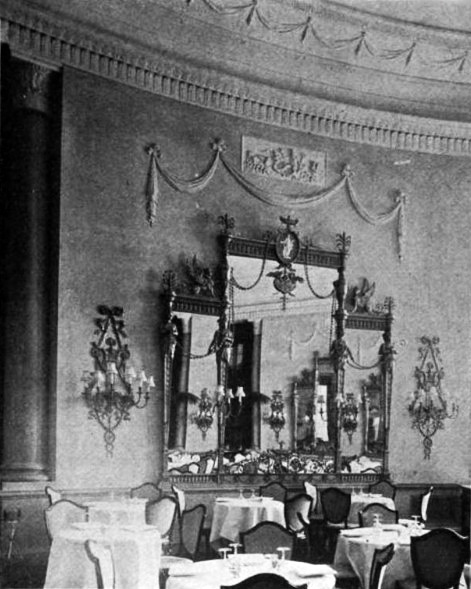
French was the language of the Ritz staff. Soon after he arrived his colleague “Monsieur Robert” showed him how to write out the daily supply requisition. Robert was surprised how well he did it, leading Dingle to reply, “I ought to be able to write it considering I’ve spoken it all my life.” Monsieur Robert (Trudge) was astounded, saying, “Well I’m blown, I thought I was the only English chef living.” Neither of them had ever met an English chef before. Of course, since an English chef had to masquerade as French, they might have been wrong. [pictured: Ritz dining room, ca. 1911]
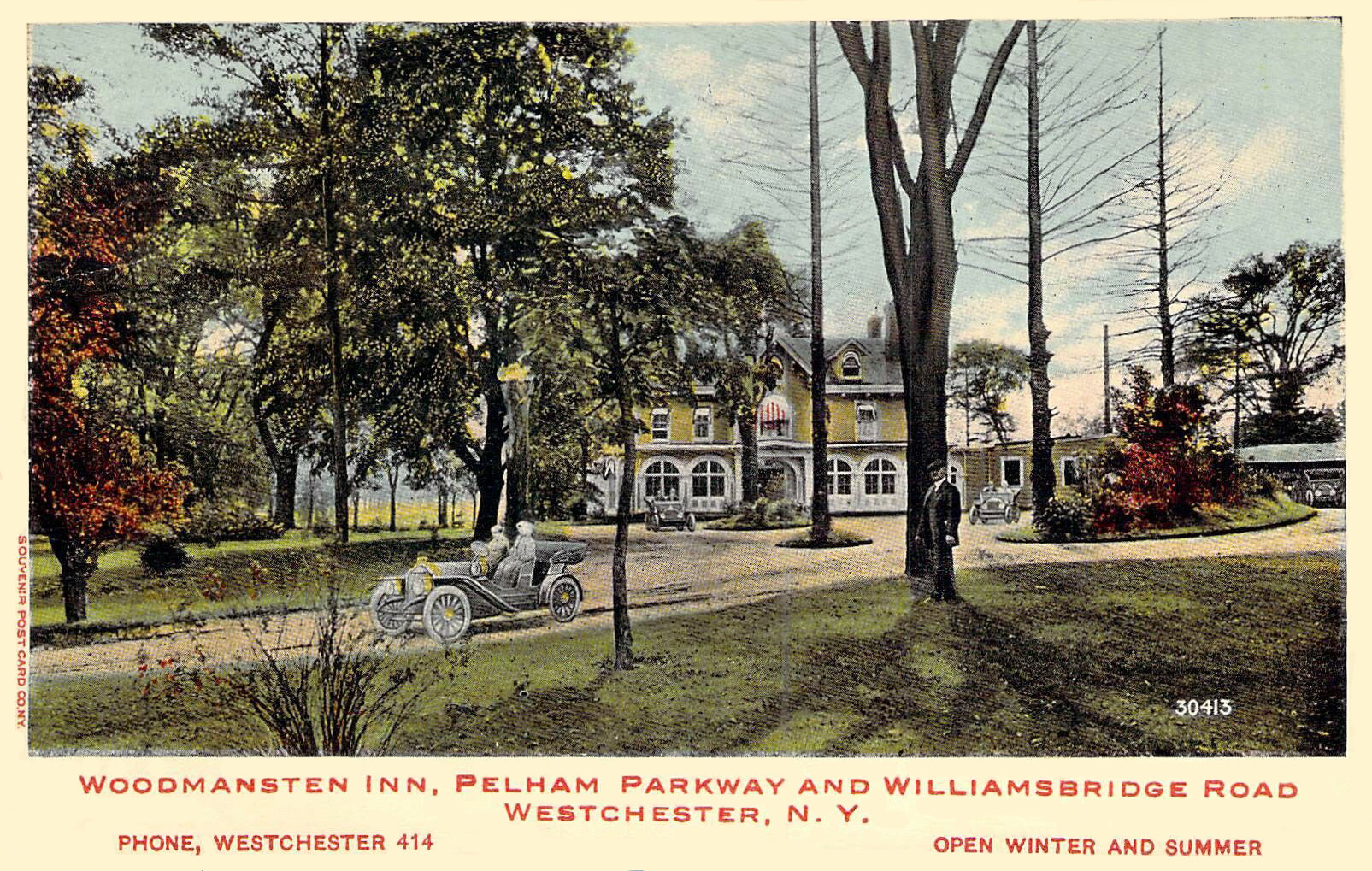
Dingle decided to move on and, after a few short stints at summer resorts, landed a job at the Woodmansten Inn, on the Pelham Parkway in the Bronx. Adjoining a racetrack in its early years, it also had the distinction of being one of the roadhouses closest to Manhattan.
If everything was in order at the Ritz-Carlton, with its 70 chefs and well-equipped kitchens, that was far from the case at the Woodmansten Inn. Hired as chef, he immediately began correcting problems. He discovered that waiters had quite a few tricks such as substituting cheap wines for good vintages, and getting kickbacks from suppliers who were furnishing inferior foods while charging for higher grades. Refrigeration was supplied by three ice boxes located in the hot kitchen where the ice melted rapidly and dripped on the floor. He moved one to the cool cellar and used the others as storage cabinets. He rescued the inn’s vegetable garden and fruit trees which had been allowed to go wild. He converted abandoned, rundown stables and sheds into chicken houses. Another major coup was his introduction of broccoli onto the menu after he found an Italian neighbor growing it. It was not widely known outside of Italian communities – he referred to it as “green cauliflower.” He guessed that it would be a novelty to guests, who would tell their friends about it. Apparently he was correct because the next proprietor of the inn, well-known NY restaurateur Joe Pani, earned the title “broccoli king” by claiming he had introduced it to the U.S.
After a couple of years in New York, Dingle decided it was time to return to England, to his fiancé and his aging parents. He announced the decision to his boss, a man simply identified as “Mr. Roberts” in the book. Roberts then proposed that Dingle return after his marriage and become a co-proprietor with him. He convinced Dingle to hand over his savings, which amounted to $1,000 – equal to 70% of his annual income. After his return to Bristol, Dingle received urgent messages from Roberts informing him that the owner of the property was about to sell it and was demanding accumulated back rent. Roberts claimed he had paid off the debt and moved to Chicago.
I’ve come to suspect that Dingle was the victim of a scam by Roberts, who knew that the actual property owner – and the restaurant’s proprietor – was planning to sell, and who had no intention of going into business with Dingle. In fact, Roberts was also probably in on the various fiddles that Dingle attributed to the cooks and waiters.
Despite seeing his plans for the future ruined, and having lost his savings, the ever-determined Dingle went on to open two successful restaurants in Bristol.
Will more people turn to food trucks for away-from-home meals this summer? With the cancellation of so many outdoor festivals and events, food truck operators may want to set up on city streets instead.
But in many places they may face obstacles that go back more than 100 years, to the era of the horse-drawn lunch wagon.
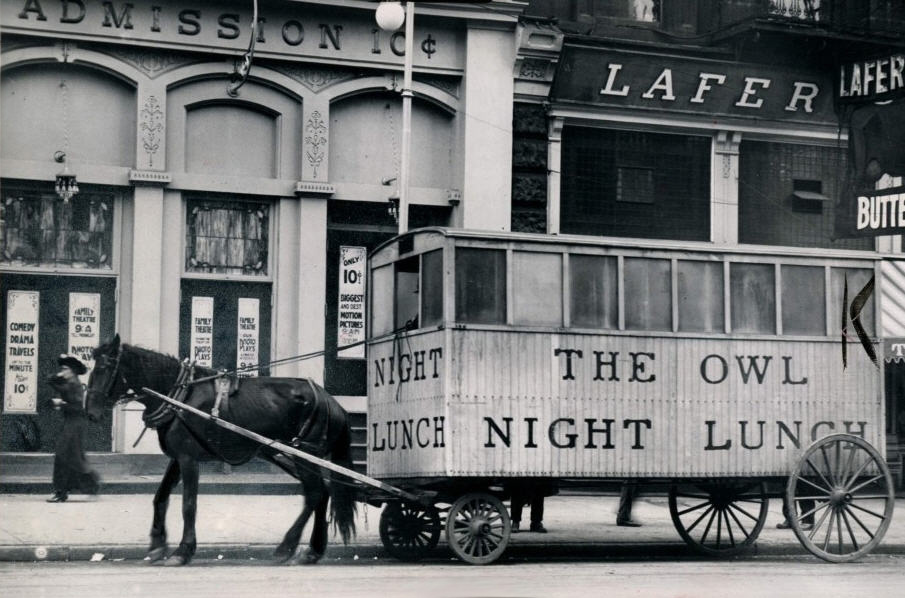
Selling ready-to-eat food on the street originated long ago. As far back as the 1830s, and again in the 1850s, “omnibuses” outfitted as cafes appeared on the streets of Paris and Lyons. But it wasn’t until the 1870s that some American sellers of prepared food graduated to vehicles. Following Chicago’s disastrous fire of 1871, “wagons gaily painted and covered with awnings” showed up on street corners supplying homeless crowds with basics such as sausages, fish, oysters, boiled onions, baked potatoes, pie, and coffee.
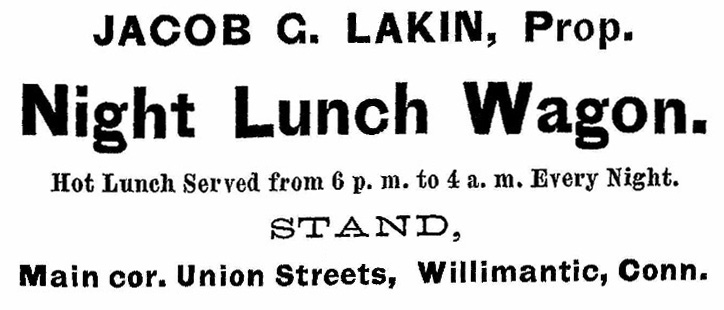
Early lunch wagons could be found in other states too. The oldest advertisement I’ve found is from Connecticut in 1877. In the 19th century they were usually referred to as night lunch wagons since night was their busy, sometimes only, time of business.
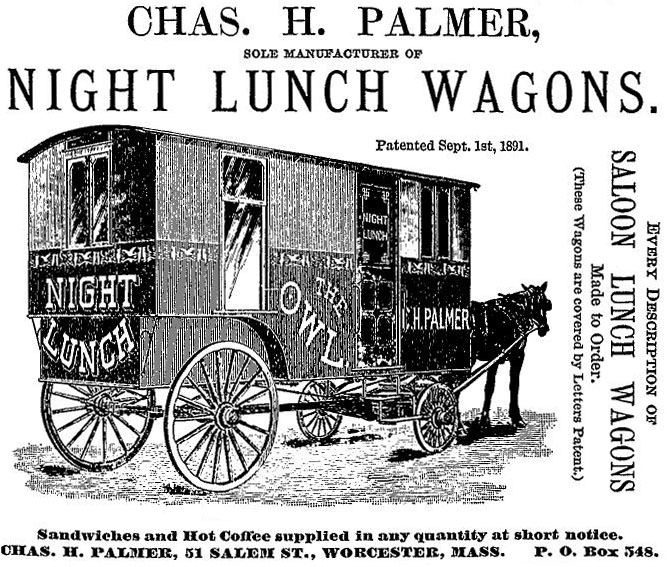
In the 1880s the number of lunch wagons grew. Temperance groups in Chicago and the Northeast adopted them as a way to lure late-night drinkers with coffee and rolls, naming their vehicles “owl wagons.”
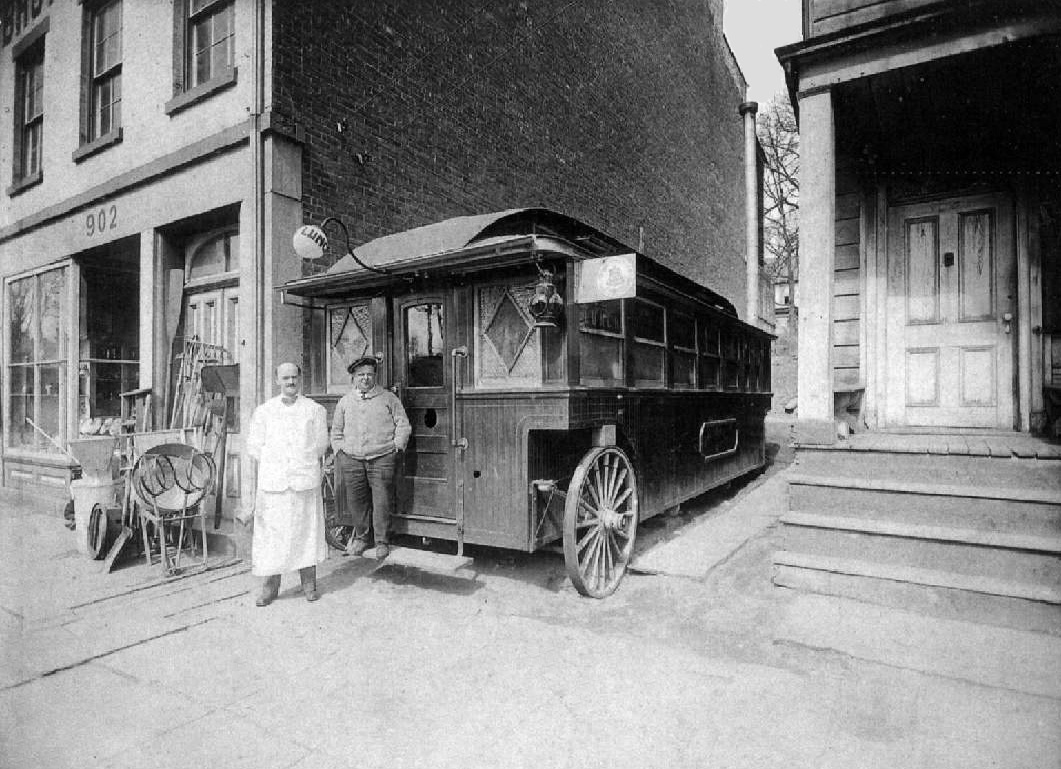
The first wagons tended to be cobbled together out of spare parts, but it wasn’t long before enterprising New Englanders realized the potential for profit in manufacturing them. Worcester, Massachusetts, became a center of production for a number of companies, as detailed in the classic book American Diner by Richard Gutman. By 1892, Worcester lunch wagon maker Charles Palmer was supplying his patented lunch wagons to many parts of the country. Some of them had elaborately painted exteriors that made them resemble circus wagons. Larger ones tended to have enough room inside to allow a few customers to sit at narrow side counters, while in older and homemade models orders were handed out a window.
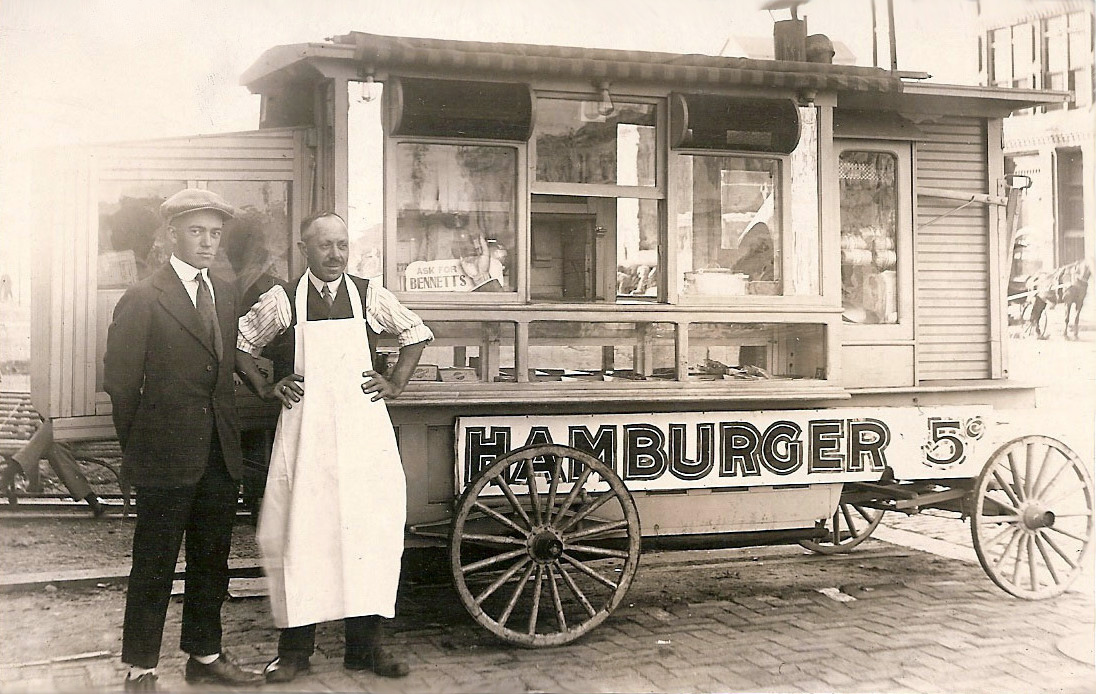
Except for in Southern states where they were rare, their numbers continued to grow in the 1890s. It’s likely that the economic depression of that decade expanded their popularity. The low prices lunch wagons charged for humble food such as hamburger sandwiches made them favorites of the poor who formed their main customer base along with heavy drinking saloon patrons. In some places they were known as sandwich or frankfurter wagons, and in California as tamale wagons. Whatever they served, it was inexpensive.
Some lunch wagon proprietors made a decent profit but there were costs to doing business in addition to supplies. These could include wagon rental, hiring a horse to haul the wagon back and forth, rental of a garage to store the wagon during off time, and sometimes various payoffs to authorities and saloon owners.
It didn’t take long for opposition to lunch wagons to emerge, particularly from all-night restaurant keepers who became angry when wagons took a stand outside their doors. In 1893 restaurant keepers in Hartford CT petitioned the city for an ordinance that would limit how many hours lunch wagons could be on the streets. Complaints against the wagons were extensive. Restaurant owners declared that their businesses built up the town by supporting taxable properties, while the lunch wagons did not. They also argued that city streets were not intended as business sites.
Other complaints — from city officials and the public at large — focused on traffic congestion, gaudy and ugly appearance, unsanitary conditions, and rough customers who got into fights. In Los Angeles in the early 1900s, wagon proprietors were criticized for serving “embalmed” beef dosed with chemical preservatives. There were complaints about cooking odors. In Fort Worth TX, a paper reported, “Some people simply don’t like the idea of seeing a man take a big greasy hamburger sandwich and standing on the sidewalk munching away, while ladies and children pass and cannot avoid seeing him.” (Hamburger was seen as undesirable poor people’s food then.)
Fancier lunch wagon designs may have been intended to win greater acceptance. “White House” lunch wagons, produced by Thomas Buckley in Worcester and regarded as the finest made, were not only painted a clean-looking white but had colored glass windows with images of presidents and military figures. By 1899 the Buckley company was said to operate and control the lunch wagon business in 25 cities. The company sent wagons all the way to the Pacific Coast. However, despite their finery, Buckley wagons in Chicago operated in the poor parts of the city, where payoffs to property owners and police were often necessary.
As the 19th century turned into the 20th more regulations and limitations were forced on lunch wagon operators. Some required restaurant licenses or limited the number any one owner could operate. Chicago was among the cities that banned wagons on main streets, while others such as Albany NY and Lynn MA banned them on all streets. Operators began to look for alleyways or permanent locations they could settle on, often hiding their wheels behind dummy foundations. Over time the prefab eateries – now called diners – were produced in larger sizes, without wheels, and with better seating and cooking facilities.
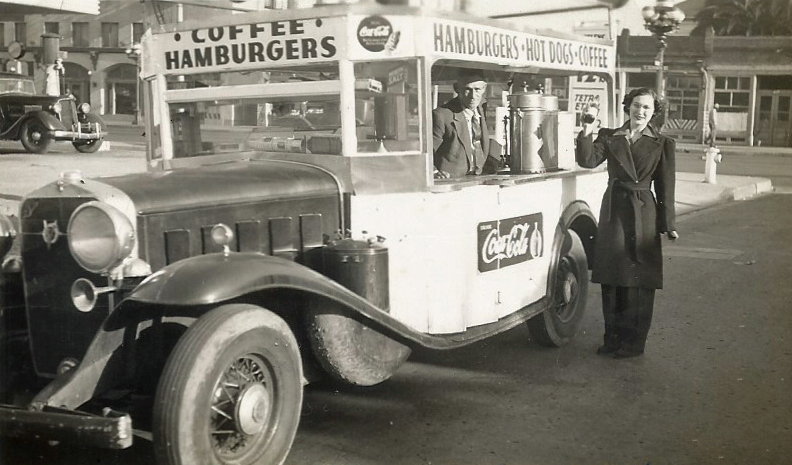
But, now-motorized portable restaurants on wheels did not go away – rather they adapted to the restrictions by going on the move. They traveled to factories for shift changes, or to fairs and carnivals. As long as they were moving all day and had a peddler’s license, they were legal. Then, in the 2000s, food trucks became somewhat upscale, appealing to customers interested in exploring dishes from a wide range of the world’s cookbooks.
Yet some of the issues that plagued early lunch wagons lingered on. Complaints today no longer target brawling customers or spoiled food, but not all cities welcome the trucks. Fumes from gasoline powered generators that many trucks use can be obnoxious. And of course restaurants still don’t want them parked outside. Regulation of food trucks has increased considerably since the olden days (see Wikipedia) and some locations are off limits.
But, with the threat of the spread of disease and some diners’ hesitations about indoor seating, I wonder if we’ll see some relaxation of regulations.
It's great to hear from readers and I take time to answer queries. I can't always find what you are looking for, but I do appreciate getting thank yous no matter what the outcome.
So, e-mail me!




















 It's great to hear from readers and I take time to answer queries. I can't always find what you are looking for, but I do appreciate getting thank yous no matter what the outcome.
 Restaurant-ing through history