Category Archives: restaurant prices

Continental cuisine comes to Orange County

In the mid 1950s Geril and Gosta Muller arrived on the west coast. They were born in Denmark and had graduated from a Hotel and Restaurant School in Copenhagen in 1943. Following that Geril had served royalty at a Royal Gun Club. [Gosta (left of then-president Nixon) and Geril, 1971, at Chez Cary]

After a few years in Reno NV, they would swiftly work their way to the top of the emerging luxury restaurant pyramid in Southern California, managing and eventually owning award-winning restaurants there.

In Reno, the brothers worked at a motel restaurant called The Bundox (meaning boondocks). After a few years Geril went on to San Francisco to work as manager of the Pink Chateau restaurant in the Continental Motel. It may be significant that the Pink Chateau featured steak cooked on a “flaming dagger,” because flaming food would be a featured attraction at their next engagement in Orange CA. There the brothers firmly established their reputations for creating and running fine restaurants. [above: River House Motel, home of The Bundox]

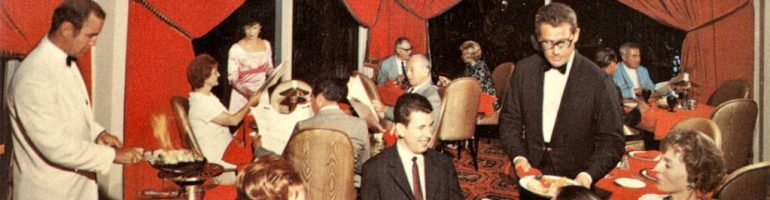
In 1965 the Mullers helped establish Chez Cary, named for owner Cary Sinclair. The Chez, as it became known, set a model for an exquisitely posh and precious style of “continental” restaurant-ing not found much outside San Francisco and Los Angeles at that time. Orange’s residents may have been well off but they were not used to dressing up for dinner. A suit and tie was a requirement at Chez Cary where princely male waiters threatened to outdress their wealthy customers. [1967 cartoon of Geril wearing tuxedo]

The brothers decorated the restaurant lavishly with red velvet upholstered swivel chairs, crystal chandeliers, silver candlesticks, fine china, and old world decorative objects. Geril rounded up a talented kitchen and dining room staff. And, of course, there was quite a lot of tableside theatrics, with salads tossed and dressed, sauces poured, and meats and desserts flamed.

There was a ladies’ menu – i.e., one with no prices — since madame couldn’t possibly be the one paying the bill. And there were ladies’ footstools under the tables. Why the footstools? I don’t know, but they seemed to impress reviewers.

In 1966 the restaurant reviewer from the Long Beach newspaper observed that the bill for a dinner with his wife came to $18 plus tip. But, he wrote, it was the sort of restaurant where guests were not supposed to care what the total came to. He gave it his highest rating: AAAA. While the brothers were at Chez Cary, acting as managers and maitre d’s, the restaurant won four Holiday Magazine Awards, an accomplishment generally attributed to the Mullers.

The Mullers remained at Chez Cary until 1973 when they opened their own restaurant, Ambrosia, in a Newport Beach location formerly occupied by a restaurant called Karam’s [shown above]. Their ability to win awards continued at Ambrosia [below: cartoon of Geril with a Holiday award, 1975].

Ambrosia strongly resembled Chez Cary in luxurious decor and smooth operation. According to one report the restaurant “served so many flaming dishes that at one point it had to get special permits from the town’s fire department.”

Evidently patrons found Ambrosia very comfortable. Five-hour-long meals were not unheard of. By the 1980s the typical tab for two had risen to $150. [Above, Ambrosia in Newport Beach]

But, alas, ten years after opening Ambrosia the building’s owner threatened to double the rent. The brothers hatched a plan to relocate Ambrosia to an elaborate and expensive new restaurant complex they built in Costa Mesa called Le Premier. But Ambrosia didn’t succeed in its new location, closing a mere two years after opening in 1983. Geril bitterly observed that Costa Mesa was not a good location for a first-class restaurant, saying there weren’t “enough well-traveled people in Costa Mesa” and “Anything exclusive will not work there.”

Despite declaring bankruptcy, the Mullers did not give up the struggle to revive Ambrosia. Another restaurateur had adopted the name Ambrosia and the type style the brothers had used. They sued him, hoping to get back the name. Then they bought the restaurant in Newport Beach that had taken over their former location there – 30th Street Bistro — planning to open a new Ambrosia once they won the suit. Sadly for them, they did not succeed.

© Jan Whitaker, 2024

10 Comments

Filed under decor, elite restaurants, proprietors & careers, restaurant prices

An early health food empire

It’s rare to find business documents from long-gone restaurants, but last weekend I stumbled upon two letters to investors from the Physical Culture Restaurant Company headed by fitness and health food advocate Bernarr Macfadden [shown above, age 42].

Macfadden was a body-builder, natural food proponent, and entrepreneur who decided to spread the gospel by opening inexpensive, largely plant-based restaurants at the turn of the last century. He attributed his strength and energy to this special diet.

The 1904 end-of-year letter reported that four new restaurants had been added to the ten already in business, and that they had done business totaling over $243,000, with a net gain of $2,637. Five restaurants had been judged failures and closed, four of them in NYC and one in Jersey City. He and his board of directors believed in rapidly shutting down locations that did not draw crowds. The letter blamed a “business depression” and the normally slow start of new locations for the smaller-than-hoped-for profits.

Although he wanted the restaurants to succeed, his personal income was not dependent upon them. Macfadden’s primary business was publishing periodicals, beginning in 1899 with Physical Culture, which discussed diet and health, followed by True Story, Liberty and then, increasingly, a large number of detective and romance magazines with titles such as Dream World, True Ghost Stories, and Photoplay. In addition he authored scores of books on fitness, sex, and health, and established a tabloid newspaper, The New York Evening Graphic. His publications earned him a fortune.

The total number of Macfadden restaurants open at the same time never seemed to exceed sixteen or so. The first ones were in New York City, of which there were nine at one point. Others were spread across the East and Midwest, including Boston, Newark, Jersey City, Philadelphia, Pittsburgh, Detroit, Cleveland, Cincinnati, Chicago, and St. Louis. There was also one in Toronto. [above: 1906 advertisement and 1906 restaurant at 106 E. 23rd, NYC]

In the 1907 letter to stockholders shown above he floated the idea that the restaurant holdings might grow to 40 or 50 units if stockholders invested in more stock. This never happened.

Despite the growing popularity of the restaurants, it seems that for Macfadden they served primarily as a way to spread the gospel of a healthful diet. He could not be described as a restaurateur. No doubt he helped to conceptualize the restaurants and make up the early menus, but he did not manage them except in his role as corporate executive.

Prices were low in his early restaurants. A bowl of thick pea soup was 1c, as was a bowl of steamed hominy or oats or barley. Whole wheat bread and butter, however, cost 5c as did creamed beans or whole wheat date pudding. He sold loaves of whole wheat bread for 10c. [shown above]

A Macfadden menu shown in a 1919 British book reveals a wealth of choices then but also higher prices that reflect post WWI inflation. Five cents now bought less. Mushrooms on Toast cost 20c, as did meat substitutes Nuttose and Protose. A Macaroni Cutlet or Lentil Croquettes cost 25c, while omelets such as Mushroom, Walnut and Pecan, Orange, or Protose and Jelly were 30c.

In 1931, at which point only three Physical Culture restaurants remained, Macfadden gave up his fortune, said to be $5,000,000, and created the Bernarr Macfadden Foundation. In a radio broadcast he said: “It is a source of indescribable relief to feel like a free man again. Too much money unwisely used makes people greedy and ungrateful, destroys the home, steals your happiness, enslaves, enthralls you, lowers your vitality, and enfeebles your will.”

Yet his personal life continued to be full of numerous wives, affairs, and lawsuits. And, despite being “freed” of his fortune in 1931, he continued to spend money lavishly, taking it from the treasury of the Physical Culture Publishing Company after he turned that into a public corporation. Stockholders accused him of using nearly a million dollars for his own private interests, which included failed attempts to become a presidential candidate, governor of Florida, or mayor of New York.

In 1931 the Foundation opened the first of several Depression-era penny restaurants, no doubt modeled on Macfadden’s first restaurant at the beginning of the century where most dishes cost only one or a few cents. The initial Depression “pennyteria,” run by the Foundation, was located in midtown NYC. Drawing a crowd of about 6,000 a day, it quickly became self-supporting.

At a penny restaurant run by the Foundation, one cent would buy any of the following: coffee, split pea soup, navy bean soup, lentil soup, green pea soup, creamed cod fish on toast, raisin coffee, honey milk tea, cabbage and carrot salad, steamed cracked wheat, hominy grits, raisins and prunes, bread pudding, whole wheat doughnuts, whole wheat bread, or whole wheat raisin bread.

As the operator of the 1930s restaurants, the Foundation proved more flexible than Macfadden about dietary standards, but evidently he still had some say over what was served. According to one account he agreed to let meat appear on the menu as well as dairy products. Meat took the form of beef cakes, beef stew, and chicken fricassee. But he stood firm about bread, insisting only whole wheat be served.

I found no trace of the Macfadden restaurants nor the Foundation’s penny restaurants in the 1940s. Macfadden largely faded from the headlines, dying in 1955 and leaving an estate valued at only $5,000.

© Jan Whitaker, 2024

6 Comments

Filed under alternative restaurants, chain restaurants, menus, popular restaurants, proprietors & careers, restaurant prices

Behind the scenes at Gonfarone’s

There is nothing as interesting (to me) as a memoir about a restaurant from an insider who reveals its workings not usually known to customers. Papa’s Table d’Hôte by Maria Sermolino is such a memoir, published in 1952, decades after her father’s ownership of the New York City restaurant, Gonfarone’s.

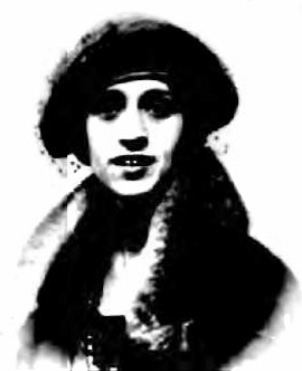
Maria’s career as an editor and writer was extensive. After graduating from the Columbia School of Journalism and spending a couple of years writing about post-WWI conditions in France, she interviewed Italian Fascist leader Benito Mussolini. Later she worked for Time, was the editor of The Delineator and for 11 years an associate editor for Life magazine. She attributed her lifelong unmarried status to overhearing conversations about women among waiters and from male guests invited by her father to join him at his table. [above, Maria at age 25, in 1920, the year she interviewed Mussolini]

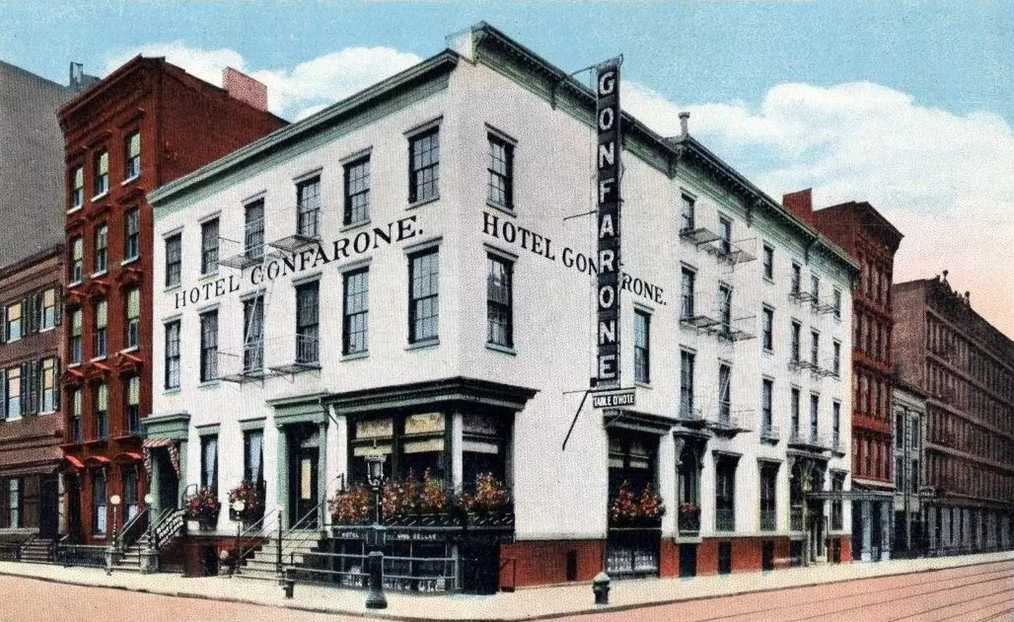
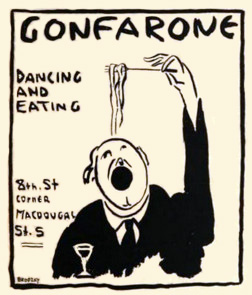
Gonfarone’s began in business around the turn of the last century as an Italian pension-type eating place, transitioning into a bohemian resort for Greenwich Villagers. It was run initially by Caterina Gonfarone who operated it in a basement on the corner of Eighth and McDougall streets. She soon partnered with Maria Sermolino’s father, Anacleto, who saw to it that the dining room was moved upstairs. Then, as neighboring residences were acquired by the partners, the popular Latin Quarter table d’hôte expanded to eventually accommodate 500 diners at a time. Sermolino soon acquired the restaurant from Madama Gonfarone, but kept her name.

After the Sermolino family moved into the complex of buildings (which also included a small hotel), Maria spent much of her childhood in the restaurant. Chapter 6 of her book is entitled “The Barroom Was My Playground.” She assisted her mother, the restaurant’s cashier, by spotting waiters who failed to pay her mother for drinks they ordered for customers at the bar. (They would have been reimbursed later, but without paying first they were able to keep the customers’ payments for themselves.)

But that is not the only way in which the staff tried to make extra money on the side. Dishwashers sold food scraps and fat to a company that made soap, with higher prices paid for barrels with more fat. On occasion Madama Gonfarone would catch a dishwasher pouring a large tin of unused lard into a barrel for a higher payoff. It was also common for the staff to smuggle out bottles of wine, chickens, lobsters, and other choice food items when they left at night. Her father refused to institute routine searches because he thought it would be bad for morale.

Because the restaurant was connected to a hotel, the bartender also acted as the room clerk. He took advantage of his position by renting rooms to prostitutes, even on occasion — when she was away — renting Madama’s room for more than double his usual charge.

Not all the restaurant’s customers were treated equally. Waiters would see to it that their favored regulars got larger portions, choicer cuts of meat, and less melted ice in their drinks. A standard menu, 50 cents on weeknights and 10 cents more on Saturdays and Sundays, featured Antipasto, Minestrone, Spaghetti, Salmon with Caper Sauce, a Sweetbread, Broiled Chicken or Roast Beef, Vegetables, Potatoes, Green Salad, Biscuit Tortoni or Spumoni, Fresh Fruit, Assorted Cheeses, and a Demi-tasse. In all likelihood the portions would have usually been on the small size.

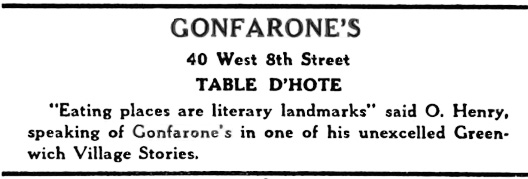
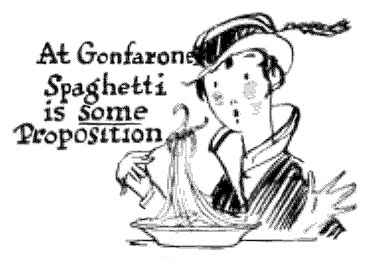
“By the simple act of ordering spaghetti an American was plunged into a foreign experience,” observes Sermolino. [above, 1916 advertisement from The Greenwich Village Quill; below, 1919 Quill]

All meals came with a glass of California claret, which the restaurant bought 40 or 50 barrels at a time, reducing their cost to ten cents a gallon. Apart from that free glass, which impressed many American patrons who were unfamiliar with wine and considered it exotic, the bar was a money maker. Maria called it “a gold mine.” A Manhattan cocktail — with cherry — cost 3 cents but sold for 15 cents, she explained.

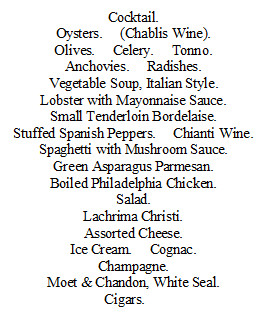
Banquet menus were grander and supplied more alcoholic beverages, as is shown in a 1904 menu above for a dinner given to honor a supporter of Democrats in the Tammany-controlled area occupied by the restaurant.

The restaurant’s best years were before World War I, when it was not unusual to serve four to five thousand dinners on an average weekday and double that on a good Saturday or Sunday, with waiting patrons spilling down the hall and into Macdougal Street. When food ran low the cooks would water the soup and waiters would offer patrons omelets.

With the onset of Prohibition, Maria’s father decided to get out of the business and concentrate on his other interest, real estate. Under new ownership, Gonfarone’s remained open for another 10 years, until 1930. The buildings were razed in 1937.

© Jan Whitaker, 2024

8 Comments

Filed under atmosphere, ethnic restaurants, menus, popular restaurants, proprietors & careers, restaurant customs, restaurant prices, waiters/waitresses/servers

Finds of the day

Slim pickings for a restaurant ephemera collector at the giant Brimfield flea market recently, but at least I turned up a few finds. Among them were two small menus and a business card, all from eating places run mainly by women. The size of the two menus makes me wonder if male-owned restaurants ever employed any this tiny.

The Henniker Tea Room

The oldest of the three finds was a menu from The Henniker Tea Room in 1932. It took me a while to realize that its location “Midway between Westfield and Brocton” put it in New York state.

I discovered that it is a relic of hard times in a double sense. The front of the menu says “Tenth Season,” so it was begun in 1922. That was the year that the owner’s husband, a superintendent of schools, died of tuberculosis, which probably meant that she had to earn a living for herself and her two daughters.

The second hardship associated with this menu is that it dated from the depths of the Depression. I suspect that is the reason she stopped charging an extra 15 cents for salad with Sunday dinner specials, and reduced the price of potato salad from 30 to 25 cents.

Possibly the tea room failed in the Depression because by 1940 Frances Swain was living in a lodging house and working as a secretary for the YMCA. But her fortunes must have improved after that because in 1950, at age 66, she had become director of the YMCA and headed her own household with additional income from three roomers.

The Salmagundi

The Salmagundi was a seasonal tea room that probably opened in the late 1920s. It was located on Beacon Street in Boston, in a rooming house that the married couple who operated it lived in. I’m guessing the menu shown here is from the early 1950s, an era when tomato juice appetizers were still popular.

The word salmagundi was an old-fashioned but rather artsy word. It could apply to many kinds of mixtures, whether art, collections of short stories or poems, or a multi-ingredient salad.

The Salmagundi was a frequent meeting place for women’s clubs, bridal showers, business and professional groups, and gatherings of college alums.

Duncan Hines, in the 1946 edition of Adventures in Good Eating, declared The Salmagundi “One of the most popular places in Boston,” and praised its “unusual food combinations, delicious hot breads, and good desserts.”

A student at the Massachusetts Institute of Technology took his girlfriend to dinner there in 1950. He said it was a quiet place with three small dining rooms and a limited menu but one he approved of since it included lobster, steak, and chicken. They ordered duck and found it delicious, and liked the “fancy rolls.” But the check totaled a bit over five dollars, so he had to borrow some money from his “chick.”

Around 1960 it passed into new hands, and the owner tried to get a license to serve wines and malt beverages. I found no trace of it after 1962.

Mary Hartigan Restaurant

Although Mary Hartigan’s business card is the smallest of the day’s finds, I discovered that hers was the most successful business of the three. She established it in 1933 in what was formerly a Dutchland Farms that she had run. [above, front and back of business card]

The Dutchland Farms chain in New England, beginning as dairy stores, developed into restaurants quite similar to Howard Johnson’s shortly before the chain failed in the Depression. Some were converted to Howard Johnson’s, but Mary Hartigan, who also ran one in Harwich Port MA, decided to run her Dedham place independently under her own name.

Nevertheless Mary Hartigan’s and Howard Johnson’s shared a similar appearance as well as a similar menu. A Hartigan menu from 1952 shows that she kept the strong link to dairy products in her new restaurant, dedicating an entire page to ice cream concoctions such as sodas, sundaes, freezes, frappes, floats, and malted milk. In addition to the standard steak and chicken entrees, the menu also presented a variety of seafood, including seafood plates, baked lobster, Cape scallops, broiled swordfish, and fried clams. Tomato, grapefruit, and pineapple juice served as appetizers.

1952 was also the year that the restaurant acquired a liquor license. In 1959 the building was enlarged and remodeled. [above, business card interior]

When Mary Hartigan died suddenly in 1961 her obituary in the Boston Globe observed that the restaurant was “one of the best known in the state.” She left it to a niece who ran the business until 1970 when it was sold to a new owner who said he planned to keep the staff, some of whom had worked there for three decades.

© Jan Whitaker, 2024

6 Comments

Filed under food, menus, proprietors & careers, restaurant prices, tea shops, women

In their own words

I’ve collected numerous provocative comments about restaurants over time. Most of the following samples are excerpts from diaries, others from newspaper interviews. I selected them mostly because they were informative about restaurant conditions and practices at various times in the past, as well as patrons’ experiences.

There are some recurring themes. A number of the comments reveal women’s opinions of restaurants and their roles in them. Others show how unfavorably foreign travelers tended to view American eating places during the 19th century. Several comments reveal the high prices and deteriorated conditions that prevailed in the South during the Civil War.

1825, a Boston portrait engraver: “In the evening, at 8 P.M. we called on Mr. Allston at Rouillard’s Restorator. Found him at dinner; we sent up our letters . . . ; after waiting a few minutes Mr. Allston entered the parlour, and received us very cordially. He took us up to his dining room (quite private) and invited us to partake of his wine and cigars.”

1850, daughter of James Fenimore Cooper, in Cooperstown: “Then, again, there are seven taverns in our village, four of them on quite a large scale. As for the eating-houses – independently of the taverns – their number is quite humiliating; it looks as though we must needs be a very gormandizing people: there are some dozen of them – Lunches, Recesses, Restaurants, etc., or whatever else they may be called . . .”

1861, a Confederate clerk, in Richmond VA: “Mr. Tyler then invited me to join him at breakfast at a neighboring restaurant, where we had each a loaf of bread, a cup of coffee with milk (but brown sugar), and three eggs. The bill was sixteen dollars!”

1861, an Irishman visiting Montgomery AL: “Then, as to food – nothing could be had in the hotel – but one of the waiters led us to a restaurant, where we selected from a choice bill of fare, which contained, I think, as many odd dishes as ever I saw, some unknown fishes, oyster-plants, ‘possums, racoons, frogs, and other delicacies, and, eschewing toads and the like, really made a good meal off dirty plates on a vile table-cloth . . .”

1861, and then the Irishman visited Washington: “I dined at a restaurant kept by one Boulanger, a Frenchman, who utilised the swarms of flies infesting his premises by combining masses of them with his soup and made dishes.” [To be fair, Joseph Boulanger was in ill health and had been trying to sell his restaurant for a while when the visitor from Ireland came along.]

1864, a visitor to New Orleans: “Charges for living were most exorbitant; a simple breakfast at a restaurant, one dollar; a frugal dinner, two dollars; two small slices of dry toast, fifteen cents; the same for a cup of tea or coffee; ten cents for ice and butter; sixty cents for one small mutton chop. The simplest fare cost six dollars a day.”

1883, a touring Englishman in San Francisco: “After dressing, we all went to the ‘Poodle Dog’ restaurant to dinner. Here my sister Sarah behaved in an extraordinary way, affecting a morality which appeared to me immoral, and questioning the propriety of dining at this place.”

1893, a woman attending the Chicago World’s Fair: “Then we went to Rector’s Marine Restaurant [shown here], and on its breezy gallery had the swellest sort of little dinner. (The first glimpse of the menu made me faint. All the salads were .60 & .75, the fish all .60 & .75, relishes .25 & .30, vegetables .30 & .40, ice cream .25 . . .)”

1921, a European woman visiting New York: “We ordered some steak for our dinner, and when the waiter brought enough for a school treat I exclaimed, and he said, ‘In Broadway they serve the dishes — here we serve the food!’ They did indeed; even sharing it with a starving cat I couldn’t get through with it. The restaurant was rather a good one and very clean. I reproached Kenneth for not having taken me somewhere with more local color. I hate being treated as a Bourgeoise.”

1951, a male peace activist traveling across the country: “Another group, two whites and a Negro, stopped for coffee at a lunch counter in Maryland. The counter woman brought two porcelain cups and one paper cup. When the white man gave the paper container to the white woman and not to the Negro, the counterwoman said, ‘We’re not allowed to serve colored, it’s against the law.’. . . On the wall, all red-white-and-blue, was a poster which read, ‘If you don’t like this country, there are boats leaving for Russia every hour.’”

1970, a New York book editor: “First we went to Chez Vito and all I had was spaghetti and wine and iced tea. And the check was $6. My God.”

1973, a group vice-president of Howard Johnson’s: “I think anybody who’s not using convenience foods is out of it. And some of the prepared food around today is top quality. You’d never know the difference. We’re going to open a restaurant a week this year, and where could we get cooks and chefs for this kind of expansion? Even if we could get them we couldn’t train them fast enough.”

1989, a woman chef trained at the Culinary Institute of America: “Interviewers tell me, ‘You don’t look like a chef. You look like a hostess. How can people work around you? Or they ask, ‘Do you mind getting dirty?’”

© Jan Whitaker, 2023

5 Comments

Filed under food, patrons, racism, restaurant prices

Dinner in Miami, Dec. 25, 1936

Judging from the number of restaurants and hotel dining rooms advertising Christmas or Xmas dinner that year, there must have been quite a few prospective diners around. It was still the Depression but prohibition had ended several years earlier, tourism was well underway, and Art Deco buildings were going up all over.

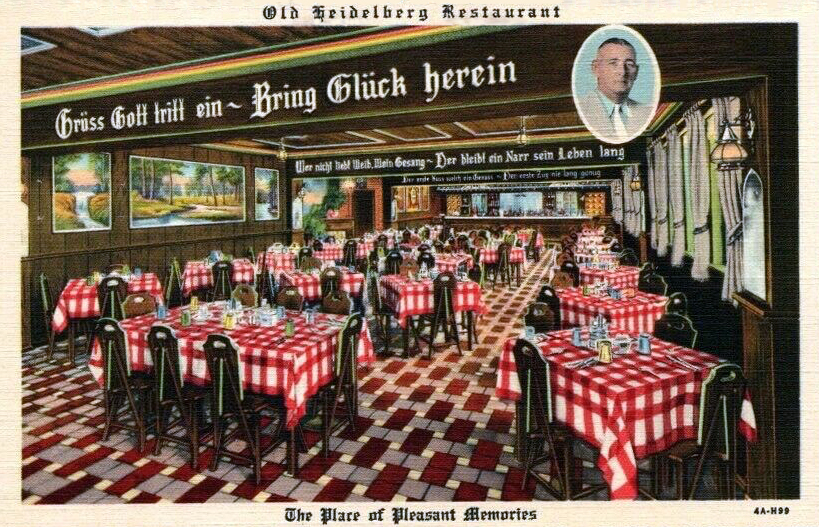
The not-at-all modernistic Old Heidelberg shown above – which had opened in the unfortunate year of 1929 — gave no details about its offerings that day, other than to characterize it as an “Old-Fashioned Dinner.” That’s a fairly meaningless description if you ask me. Given that Germany had withdrawn citizenship from Jews in 1935, this probably was not a restaurant popular with Miami’s Jewish community.

Most of the advertisements mentioned price, not surprising since most people had to watch their spending. They ranged from a low of 50¢ per person to a high of $2.00 at a place called the Rose Bowl, a restaurant specializing in Southern dishes, with a woman serving bread dressed as a “mammy.” Like the Heidelberg, the Rose Bowl made no effort in its Christmas advertisements to tout its dinner or whatever other attractions it might have possessed.

Others went to great length to attract diners. The Big And Little Grill had no end of attractions, including music, “gifts to all,” free parking, a chef who had formerly worked at a New Hampshire resort hotel, and a Santa Claus who once appeared in Charlie Chaplin’s movie “Circus.” All dinners were 75¢. The list of comestibles filled ten wide lines of text. It contained 35 separate items, among them a “Big and Little Salad,” Boiled Lobster Stuffed with Oysters, Supreme of Sole Florentine, Sizzling Steak with Wine, and numerous vegetables and desserts.

The Big and Little offered an equally good deal for its New Year’s celebration, with a return performance of Charlie Little, now in the role of clown. As for its advertisement, as a New Englander I’m obligated to point out that there is no Dixieville in New Hampshire – it’s Dixville.

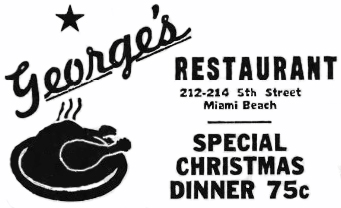
Attraction-wise, the Big and Little was hard to top. But George’s Restaurant tried hard, with even more inches of advertising, not to mention wine and bottled beer. Its 75¢ dinner comprised six courses: Cocktail (tomato juice, half grapefruit, etc.); a soup accompanied by olives and hearts of celery; a choice of five entrees that included Whole Broiled Lobster, Maitre d’Hotel (chances are these were clawless Florida lobsters, considered inferior to Maine’s); a salad; eight vegetables; choice of many desserts (six kinds of pie, a cake, a sundae, ice creams, jello, or stewed prunes). For those who didn’t have big appetites there was George’s Special 50¢ Dinner, which of course offered fewer choices and only half a lobster, but still looked like a bargain.

The Studio Grill’s turkey dinner included wine, which may have accounted for the $1.00 charge. Shortly after it opened a few years earlier, the suburban Miami curb service eatery had advertised for “Girls with Blonde Hair” who were 5’6″ tall, weighed 118 lbs., and had “striking” personalities. Undoubtedly reflecting Depression conditions, 800 showed up. The grill was owned by a magazine cover illustrator and was filled with his paintings of nude women.

The Laura Jacobsen Café, a high-class Chicago transplant, was located in a residential apartment hotel. Her Christmas dinner in the ritzy-looking Colonial Towers accommodating snowbirds from the North was $1.25.

Wherever and whatever you may eat, I hope you will enjoy your holiday dinner.

© Jan Whitaker, 2022

13 Comments

Filed under food, restaurant prices

An early restaurateur’s rise & fall

Life in the 19th century was chaotic and unpredictable in so many respects, but the weird and eventful life and restaurant career of the highly enterprising Mark Langdon Winn, with its succession of ups, downs, and strange twists, would stand out in any century.

As far as his many business schemes went, he never stuck with any of them for long, restaurants included. He bounced around Maine, Boston, New York City, Albany NY, San Francisco, Virginia City NV, and finally back to New York City where he died in 1881. His San Francisco restaurants were the most successful of his enterprises, but despite their promise he held onto them only for about six years.

Before going to California he owned two grocery stores in Boston. Next he went to New York City where in 1843 and 1844 he manufactured and sold a cure-all product called Winn’s Irish Vegetable Relief Candy, good for “weakness of the chest and lungs, liver complaint(s), asthmatic affection, impurities of the blood, dyspepsia and all bowel complaints.”

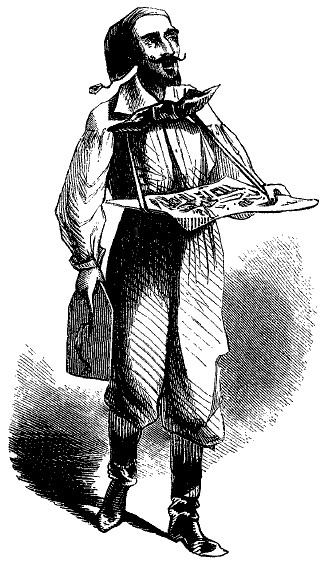
Maybe restless, disappointed by candy sales, or lured by gold, he took off for San Francisco in 1849, age 34, after leaving Albany where his wife and children remained for another couple of years. Borrowing money from a shipmate upon arrival, he began making candy and peddling it in the streets. After a short time he had enough money to open a confectionery with a partner. Before long he was running the business solo and had added bakery goods and simple meals to his offerings.

Fires were frequent occurrences in San Francisco and he was burned out at both of his initial locations in less than a year. In 1851 he opened his principal restaurant on Long Wharf, calling it Winn’s Fountain Head. Despite the abundance of eating places in the city, it rose to prominence rapidly due to its respectability, cleanliness, and relatively low prices. It was unique in heavy-drinking San Francisco for providing no alcoholic beverages. Winn was a dedicated temperance advocate, always emphasizing the cause in his frequent, wordy newspaper advertisements that often contained sermons on the evils of drink.

The Fountain Head was not fancy. Long Wharf (aka Commercial Street) was hardly a fine location. It was a busy street without sidewalks, filled with liquor saloons, gambling dens, and all-night stores. It vibrated with “a heterogeneous crowd” of carriages, horses, carts, and pedestrians. A writer in the March 1854 issue of The Pioneer wondered “Why there are not a dozen or two broken necks there daily.”

The Fountain Head was open seven days a week from 6 a.m. to midnight, with a menu that included a wide range of meats and vegetables, along with puddings bearing such homely names as Aunt Sally’s and Cousin Jane’s. According to a ca. 1853 menu, an order of roast beef, veal, or corned beef and cabbage cost 25c, while most vegetables were 12c.

According to the city’s Commercial Advertiser in April, 1854, the Winn enterprises — by then comprising the main Fountain Head restaurant and a more elegant “Branch” welcoming women with fancy desserts – had attained the pinnacle of success. Together, the story reported, the two places served 3,000 patrons daily, taking in $57,000 a month, and paying out monthly as much as $1,600 for advertising, $8,000 for meat, $4,000 for milk, $3,000 for potatoes, and $2,000 for ice.

But this account was misleading because only a few months later Winn went into bankruptcy.

Following bankruptcy he started up at a new address, combining the Fountain Head and its Branch into one. But things soon turned sour again. In Spring 1856, he and his new business partner dissolved their partnership with the partner taking over the business. Almost immediately after that, Winn’s wife Eliza took advantage of a California law that allowed women to run businesses independently, declaring that she would carry on the “Fountainhead Confectionery and Steam Candy Manufactory” in her name. It appears she continued to run the business of making and selling baked goods and confectionery until 1859. He may have briefly tried to make a comeback at his original address, but in 1859 the Fountain Head on Commercial Street and a confectionery run by Eliza Winn were put up for sale.

Years later, in a Poughkeepsie NY newspaper story of 1878, Mark Winn would blame the failure of his San Francisco restaurants on employees who robbed him. “Every man I employed was a thief,” he said, singling out his secretary, cashier, and cook. With honest help, he claimed, “I would have been worth a half a million of dollars.”

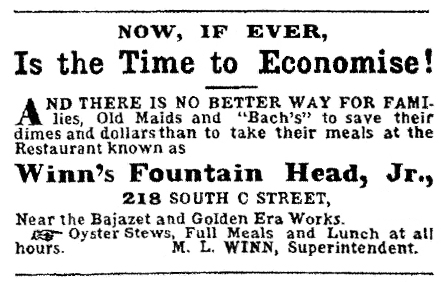
But the Winns’ western odyssey wasn’t over after leaving San Francisco. In 1860 they moved to the boomtown Virginia City, Nevada, where silver had just been discovered. There, Mark Winn struck silver, opened a restaurant and confectionery called Winn’s Fountain Head, Jr., and invested in a hotel. The hotel soon relocated to another city in Nevada and he lost his investment. The fate of the restaurant is unknown but it did not achieve fame as he had done in San Francisco [1864 advertisement]. He tried to sell shares in his silver mine, advertising that “there is no doubt that within the next six months a fair dividend will be made to the stockholders.”

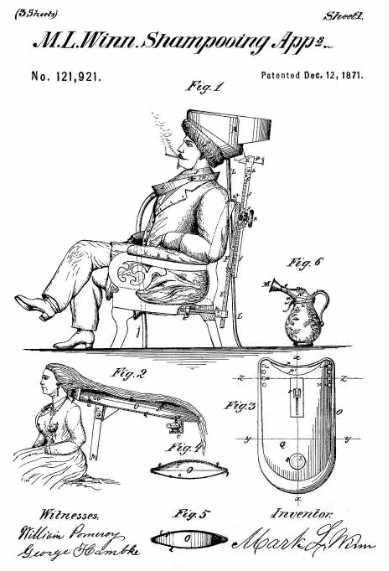
Apparently he didn’t strike it rich, though, because after five years in Virginia City he filed for insolvency and the Winns returned to San Francisco where he began work on the invention of a shampooing device that was patented in 1871 [shown above].

Next, the couple moved to New York City where he deteriorated rapidly, living in destitution and displaying signs of paranoia that had been in evidence as far back as 1854 when he referred to his “enemies” in an advertisement for the Fountain Head. On one occasion he was arrested as a public nuisance, wandering the streets of New York wearing “armor” and a tin helmet (possibly the shampooing device?) while distributing religious tracts. He spent his final days in the Alms House on Blackwell Island where he was described as suffering from “religious mania.” It also came out that his father had been an alcoholic.

Despite the uneven contours of his career as a restaurateur, Winn’s Fountain Head has become a subject of interest, often mentioned positively in a number of books and articles that tell of San Francisco’s early history. It’s presented as a triumphal success, when really it’s a boom and bust story sadly common in the restaurant business.

© Jan Whitaker, 2022

2 Comments

Filed under confectionery restaurants, food, popular restaurants, proprietors & careers, restaurant prices

Runaway menu prices

Restaurant prices are rising during the current inflationary period, but this is scarcely the first time. In fact it’s at least the fourth in little more than a century.

The first was during World War I, particularly after the war ended. In response, many restaurants teamed up for cooperative buying to keep costs under control to a degree. Drugstore soda fountains and other inexpensive eating places gained a thriving lunch business, while first-class restaurants raised prices as they whisked away frills including cloth tablecloths and napkins. The average restaurant operator’s motto became “simpler, cheaper, faster.” In New York, the venerable Mouquin’s hiked steak prices, charging $4.50 for a porterhouse steak with mushrooms that had historically been only $1.00.

The tough business climate combined with Prohibition caused the closure of droves of fancy restaurants such as Delmonico’s, which had been sliding for a while.

Complaints mounted. In 1920 Chicago’s city hall called restaurateurs on the carpet to explain their high charges, as the “Carry-Your-Lunch” movement grew. Boston put a U.S. District Attorney on the job to investigate prices at the city’s popular restaurants, including The Puritan and The Pilgrim.

Restaurant workers wanted raises, but it was a bad climate for strikes. Chicago’s 1000-seat faux-luxe North American Restaurant sacked their striking waiters and installed a cafeteria line. Their advertising copy assured customers they didn’t need to tip because “There was no one there to tip.” At the same time the North American’s advertising championed low prices, the ballyhooed bargain-priced “whole baby lobster” shrank to half a baby lobster. Did they think customers wouldn’t notice?

Although World War II also raised restaurant prices, that did not dampen patronage by war workers who enjoyed higher wages than ever. The president of the Society of Restaurateurs reported that from 1941 to 1944 New York City’s 19,000 restaurants went from serving 3 million to 8 million meals a day.

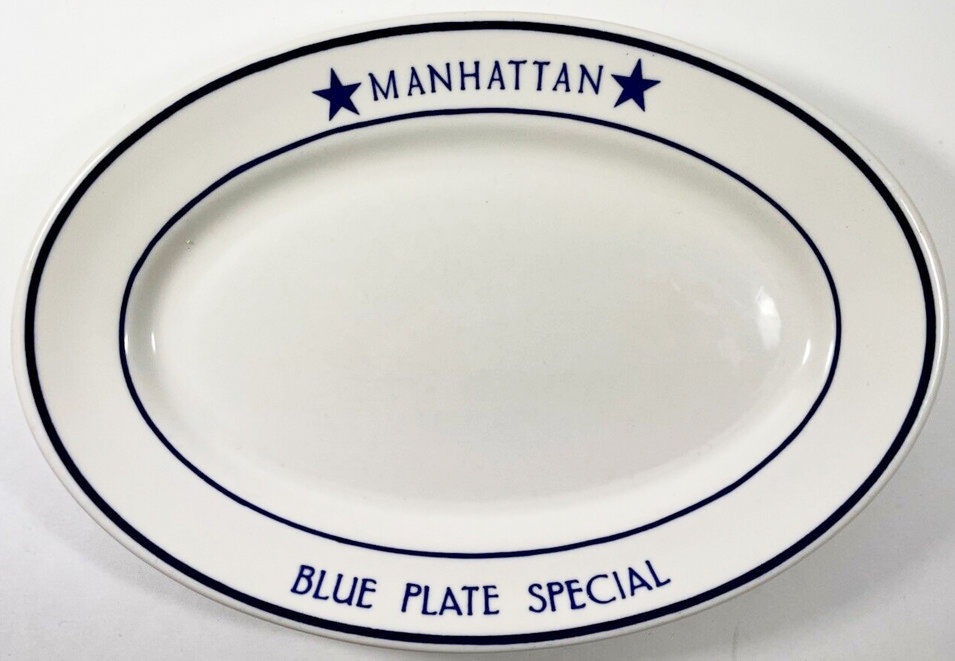
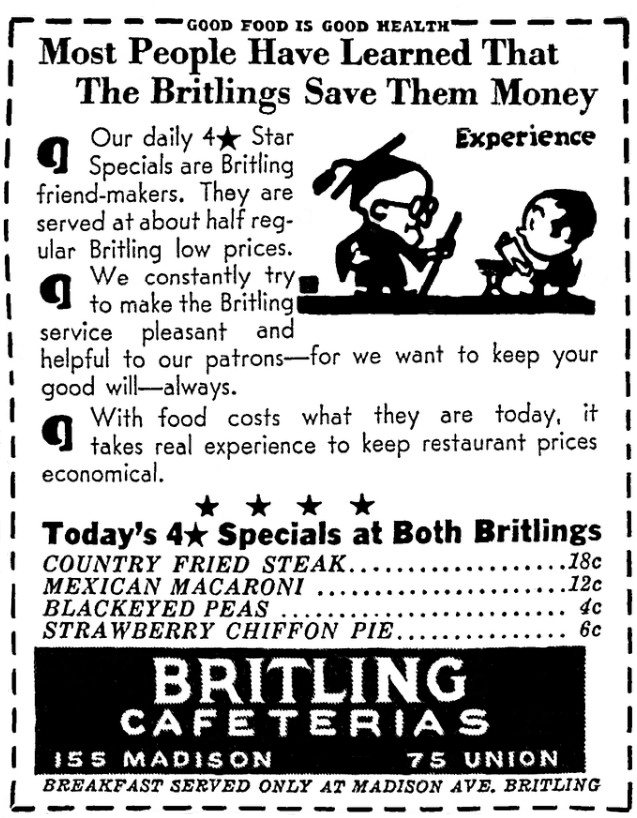
Soon the federal Office of Price Administration tried to control prices at restaurants across the country by freezing them to April 4-10, 1943, levels. Restaurateurs found ways to skirt regulations by reducing portions and substituting “blue plate” specials for what had previously been a regular meal including appetizer and dessert. In addition to reducing food costs, the move also saved a lot of dishwashing. Quality and sanitation went down as patrons mobbed restaurants severely short staffed due to military recruitment and the lure of defense industry jobs. High prices continued through 1948 as did meat rationing. [Britling advertisement, 1942]

The “stagflation” of the 1970s was still to come, with inflation accompanying a stagnating economy – a situation similar to what some economists see looming today.

In 1970 consumer prices rose steadily, especially for food and restaurant meals. Soon New York maitre d’s became friendlier and even the city’s rich began to complain about costs. A wealthy woman who had never paid attention to prices and customarily ate out six or more times a week became angry at being charged over $4 for a melon wrapped with prosciutto at the Plaza’s Oak Room. A nationwide Gallup survey found that a substantial percentage of restaurant goers had cut back on evening dinners out.

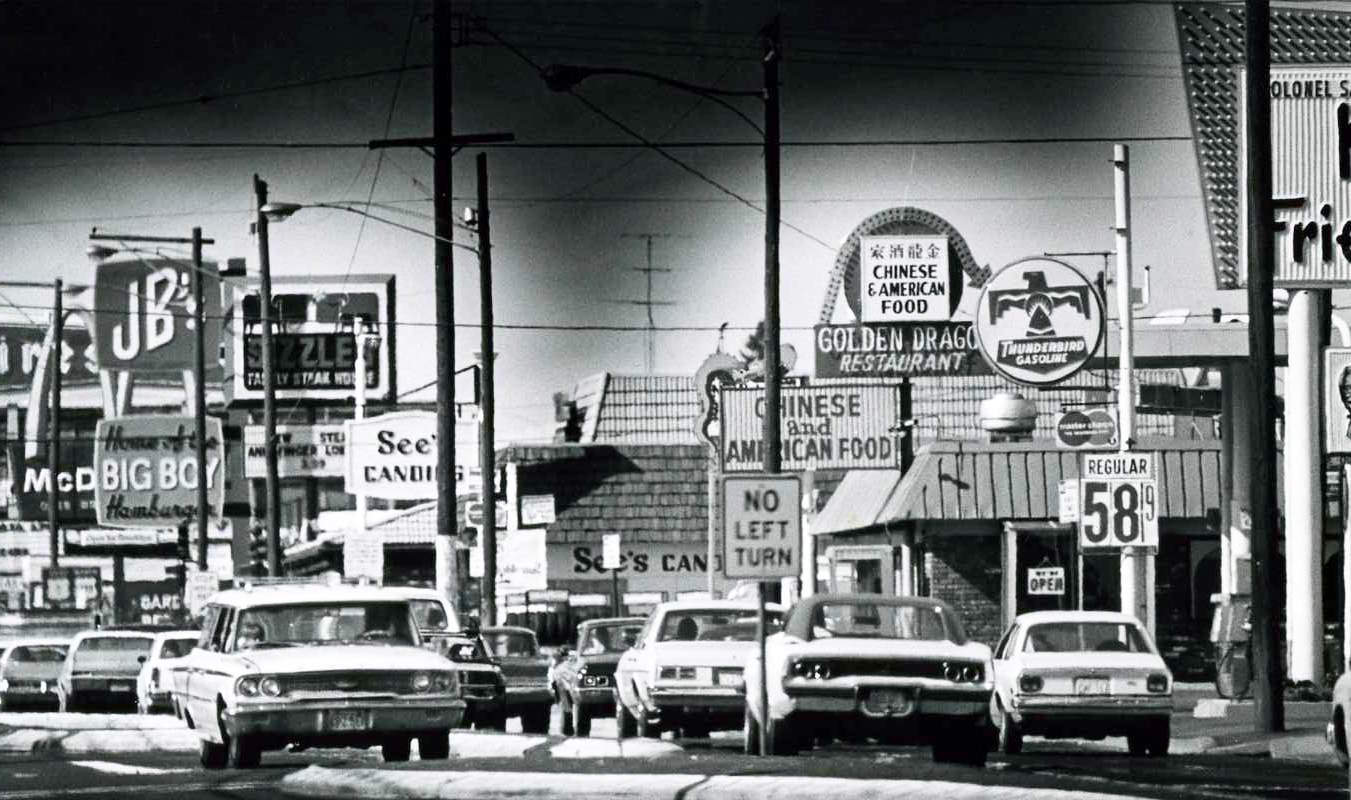
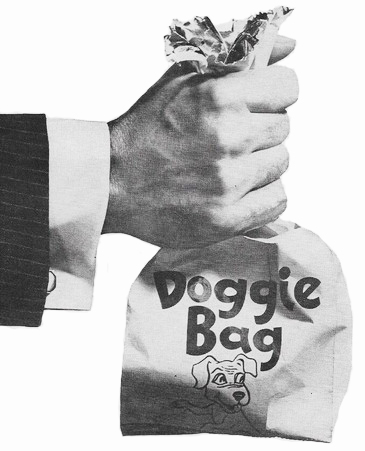
A few years later famous NYC restaurants including the Colony and Le Pavillon failed. At the same time Chinese restaurants were prospering. Across the country, salad bars became popular as did fast food outlets and restaurants specializing in dishes such as pizza, pasta, and tacos. Books recommending inexpensive restaurants did well. By 1974 three chains – McDonalds, Colonel Sanders, and Burger King — were furnishing 13% of all food eaten outside the home nationwide. Five years later there were 66,000 franchise outlets in the U.S., nearly double the number in 1973. Elsewhere, doggie bags soared in popularity and some customers began packing away anything edible on the table. A few restaurants went so far as to remove tops from ketchup bottles to discourage patrons from carting off their ketchup. [above: 1970s fast food streetscape]

Printing houses could barely keep up reprinting menus as prices went up, up, up. And still the restaurant industry experienced heavy, some said “booming,” business – even though patrons were eating more hamburgers than steaks. Analysts thought it was due to the number of working wives, along with the fact that the hike in supermarket prices outdid restaurant price increases. The president of the National Restaurant Association reported that the country’s half million restaurants enjoyed rising sales throughout the mid-1970s, with 1975’s take 16% higher than the year before. Nonetheless the industry fought a proposed increase in the federal minimum wage from $2.30 to $3.00 an hour.

Despite continuing challenges, the economy began to improve in 1982, ushering in a period of gastronomic innovation in restaurants.

© Jan Whitaker, 2022

2 Comments

Filed under chain restaurants, food, restaurant prices

Dining underground on Long Island

A couple of weeks ago when I wrote about the various editions of the Underground Gourmet, I omitted Long Island and Honolulu because I couldn’t find those books. But then a reader generously sent me a copy of the Long Island Underground Gourmet.

If you were looking for inexpensive restaurants with good food on Long Island in 1973, you might have been disappointed by the Underground Gourmet. It has me puzzled. Why were so many restaurants rated as expensive and even very expensive included in the book? Was it because of the opening sentence in the Foreword which said , “People still persist in saying there are no good restaurants on The Island.”

That sentence and others that say Long Island “has long been in the shadow of New York” and is “unjustly ignored” make me think that demonstrating the existence of fine restaurants took precedence over advising readers where they could find good food at bargain prices. The author’s belief that the Island’s restaurants were not well regarded was reflected in a 1972 restaurant review in New York magazine with a pull-quote referring to the Hamptons area as “a culinary desert.”

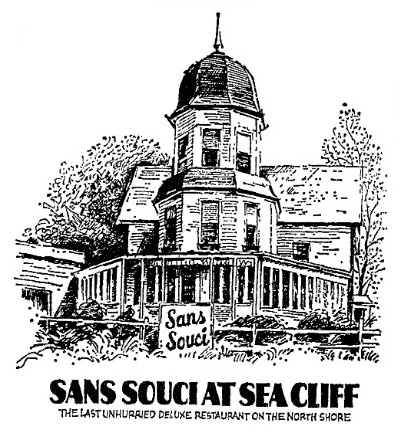
But, indeed, just how wonderful were many of Long Island’s restaurants that were rated “expensive” ($10 to $14) or “very expensive” (“Bring your checkbook”)? Barbara Rader made some ambiguous assessments of some of them, not saying they were bad, but planting little seeds of doubt. For example, she commented that the “very expensive” Greenbriar in Great Neck was beautifully decorated but, “I wish I could be as enthusiastic about the food as the decor.” Of the expensive Sans Souci, in Sea Cliff, she wrote, “the food is fairly good.” Similarly, expensive-to-very-expensive Hadaway House in Stony Brook had “some fairly good dishes.” The venerable Beau Sejour (“expensive to very expensive”) in Bethpage offered “good-to-excellent food” but sounded as though it was on the point of collapse, with “paint and wallpaper . . . showing their years, the chairs . . . a bit rickety and the electric wires draped across the paintings on the dining porch . . .” It closed a short time later.

The book leaves the impression that if Rader had limited her survey to “finds” comparable to those in other Underground Gourmet editions it would have made for a very slim volume. About 38 of the 300+ eating places covered in the book are given “mini reviews” of one short paragraph. They are mainly seafood stands, pizza joints, luncheonettes, and diners. No price range is given for them, but presumably they would fall in the category of “low cost” (95 cents for a meal) or “inexpensive” (under $3). I wonder if some of these would have qualified as finds but not a lot is said about the quality of their food.

There is not a great deal of cultural variety represented in the book, but what little exists is captured in a few of the mini reviews. Examples include a soul food place (Reid’s Bar-B-Que in Copaigue); a Puerto Rican restaurant (La Lechonera in Brentwood); and Pepe’s Taco in Smithtown.

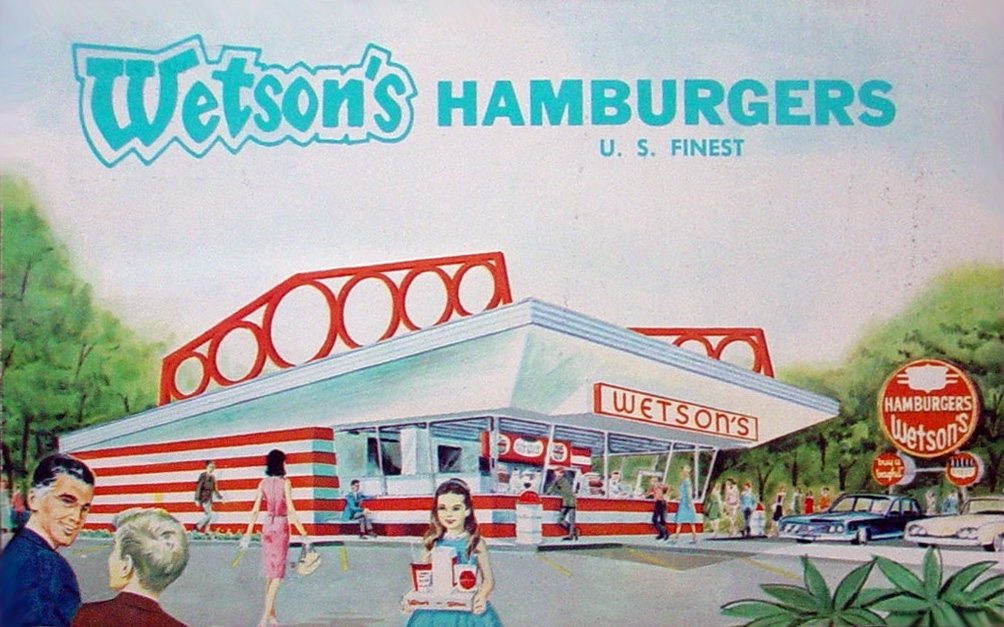
Perhaps to make up for the small number of bargain places with good food, the book concludes with 13 pages of chain and fast food restaurants. The section includes some local/regional chains such as Wetson’s, serving “Big Ws” at 16 Island locations. Her assessment of it is “Strictly a drive-in, mobbed with families with kids, or with young couples with poorly developed palates.” Of the Big W she says, “Stick with the plain hamburgers.”

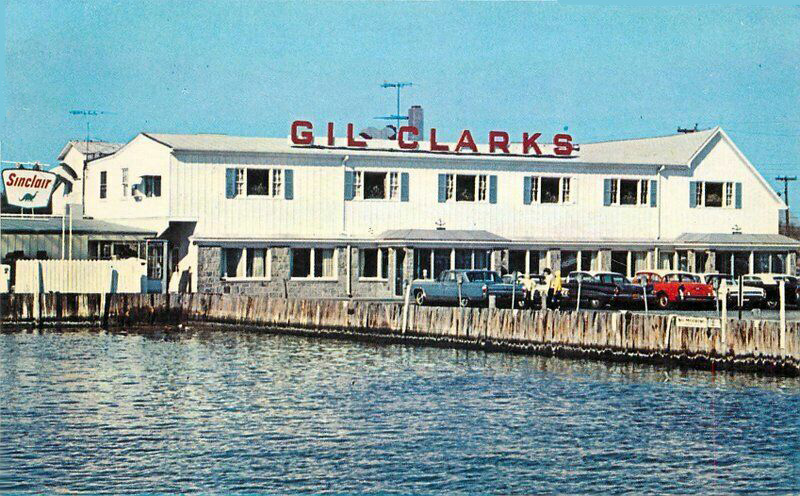
Other restaurants that I would think could be considered finds fall in the inexpensive to moderate ranges ($3 to $7 for a meal). They include Linck’s Log Cabin in Centerport (“A food fantasy for families; good food”); The Elbow Room in Jamesport (“plain but excellent food”), Wyland’s Country Kitchen in Cold Spring Harbor (“good home cooking”), and Gil Clark’s in Bay Shore (“one of the best known seafood houses on The Island” with “better-than-average food”).

Rader as well as the NY Times’ critic Craig Claiborne were in agreement that the “expensive to very expensive” Capriccio in Jericho was, as Claiborne put it, “probably the finest restaurant on Long Island,” one that could easily compete with the city’s best. However, on the whole the Long Island UG makes me think that the Island still had one foot in the era when many customers prized decor, atmosphere, and deferential service over cuisine, and were not interested in adventurous dining.

The contrast between Long Island in 1973 and San Francisco in 1969, as painted in the two books, is quite striking.

© Jan Whitaker, 2022

2 Comments

Filed under guides & reviews, restaurant prices

Underground dining

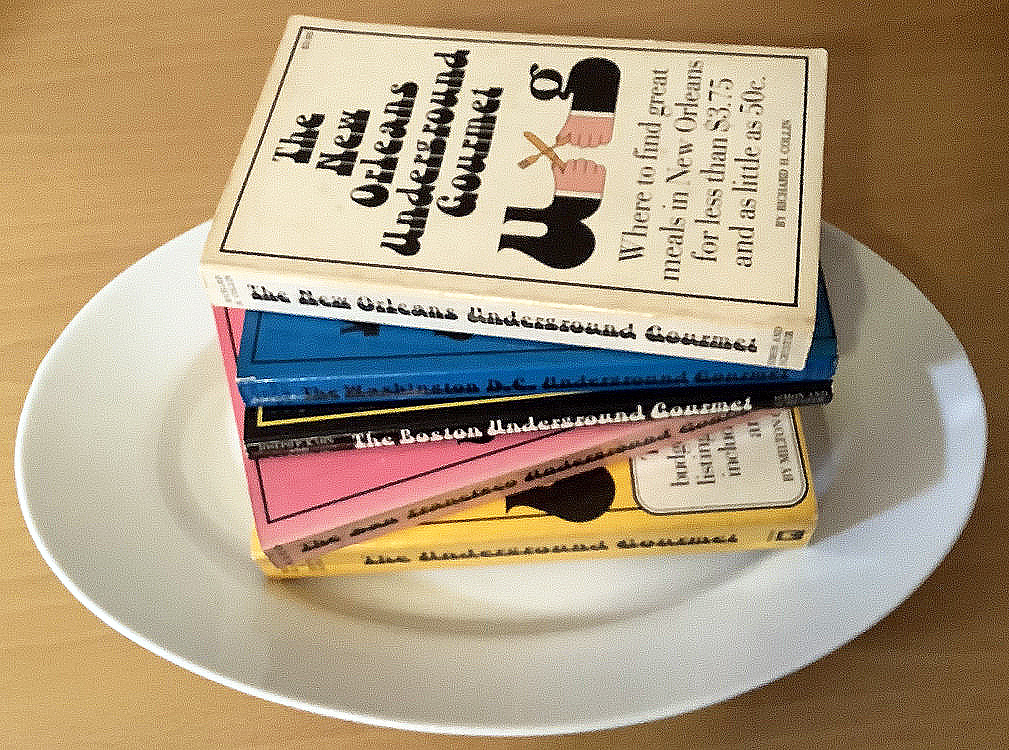
In the 1960s, with the rumble of social change came a flood of interest in low-priced eating places with character and good food. In this spirit, New Yorkers Milton Glaser and Jerome Snyder began a newspaper and magazine column titled The Underground Gourmet, followed by a guide book in 1966 with the same name.

Their book led to a series. It’s been a little difficult to nail down how many different UGs there were, but here is my list, with initial publication dates: New York (1966), San Francisco (1969), Los Angeles (1970), Washington D.C. (1970), New Orleans (1971), Boston (1972), Honolulu (1972), and Long Island (1973).

Several factors probably contributed to the new mood regarding restaurants. The economy was bad and the public was looking for bargains. Youth culture was blossoming as the baby boomers grew older, many becoming college students. And increased travel abroad was widening the public’s interest in unfamiliar foods and ways of cooking.

The public’s attraction to low-priced independent restaurants could also be seen as a reaction against the growth of fast food chains taking place, the greater use of frozen food in restaurants, and a rebellion against the blandness of much American food.

What was considered a low price for a meal during these years? The first New York edition specified in 1966, “Great meals . . . for less than $2 and as little as 50¢.” But the third edition (1977) explained that “unending inflation . . . has changed our perception of an inexpensive meal from one that cost $2.00 to one that costs $5.00 or $6.00.” For the New Orleans’ second edition in 1973, author Richard Collin promised meals “for less than $3.75 and as little as 50c.” This was still a lower price than featured by the others, which ran from $1.00 to $3.75 in San Francisco in 1969; $1.00 to $4.00 in D.C. in 1970; and “under $4.00″ in Boston in 1972. Dining in Honolulu remained a bargain, with the 1972 UG promising meals as inexpensive as in the first New York edition (50¢ to $2).

Low price was not really what set the best of the recommended restaurants apart from others. Rather it was the quality of the food for the price. Although Mr. Steak in 1970 offered its most expensive meal – Steak & Lobster with salad, toast and potatoes – for $3.99, it didn’t make the cut, though strangely enough a few other chain restaurants did win recommendations including a McDonald’s in D.C. and a Burger King in New Orleans.

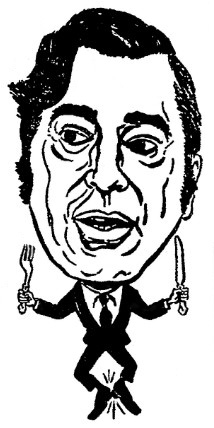
What were some of the most remarkable finds in these books? Richard Collin [above cartoon] discovered a number of dishes that he gave his highest praise, naming them “platonic dishes,” as perfect as that dish could possibly be. His New Orleans list of platonic dishes included Oysters Bienville and Fried Chicken at Chez Helene’s soul food restaurant — which he rated one of the city’s finest restaurants; Creole Gumbo at Dooky Chase; and Fried Potato Poor Boys at the dirt-cheap Martin’s Poor Boy.

The number of restaurants that met the criteria varied from city to city. Boston and D.C. are notably slim books. New York is the fattest volume. San Francisco and New Orleans have about 2/3 the heft of New York. However, with his shorter entries, Richard Collin packed over 250 restaurants into the 1973 revised New Orleans edition, rating everywhere he ate, including some very bad places. Needless to say, this makes for interesting reading.

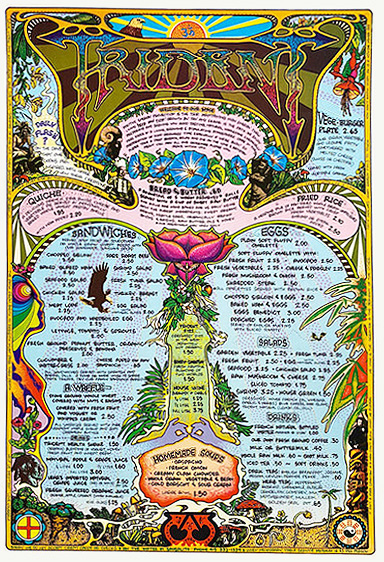
In his 1969 UG, R. B. Read made a case that the San Francisco area had a unique set of restaurants from all over the world, such as at The Tortola, which preserved “hacienda cookery” from the days before gringos settled in the state. He also heaped praise on restaurants that were rare in the U.S. then — from Korea, the West Indies, and Afghanistan. The latter instance, Khyber Pass, offered a “fabled” ashak, which he described as “aboriginal ravioli.” In a different category of unusual was The Trident in Sausalito, with jazz and a “debonairly eclectic” menu with a psychedelic design.

Because my copy is the third edition of the New York UG (The All New Underground Gourmet, 1977), I did not get the flavor of the earlier versions, which is a shame. Sadly, Jerome Snyder died during the publication of the book. That and rising prices may have cast a pall over this edition, which strikes me as less interesting than the New Orleans and San Francisco UGs. The original NYC book contained 101 of the best low-cost eating places (out of 16,000!). The third edition has about 130. The three given the highest ratings for “excellent food” were the Italian Caffe da Alfredo, and two Greek restaurants, Alexander the Great and Syntagma Square. Mamma Leone’s showed up in the book even though it met the price criterion only for its Buffet Italiano Luncheon where for $4.25 it spread out 25 feet of salami, mortadella, meatballs, celery, olives, green bean salad, and more.

The UG authors for Boston were Joseph P. and E. J. Kahn, Jr.; Washington D.C.’s were Judith and Milton Viorst. Both books show a lower level of enthusiasm. The Viorsts admitted that Washington “has not been known for its restaurants” and that of the 100 restaurants they visited, “a substantial proportion were so awful that we were unable to include them.” Father and son Kahn began by telling of a long-time resident of Boston and Cambridge who couldn’t imagine that anyone could recommend inexpensive restaurants since the area’s expensive restaurants were “bad enough.” The Kahns then admitted, “It is probably true that the Boston area does not loom large in the world of cuisine.”

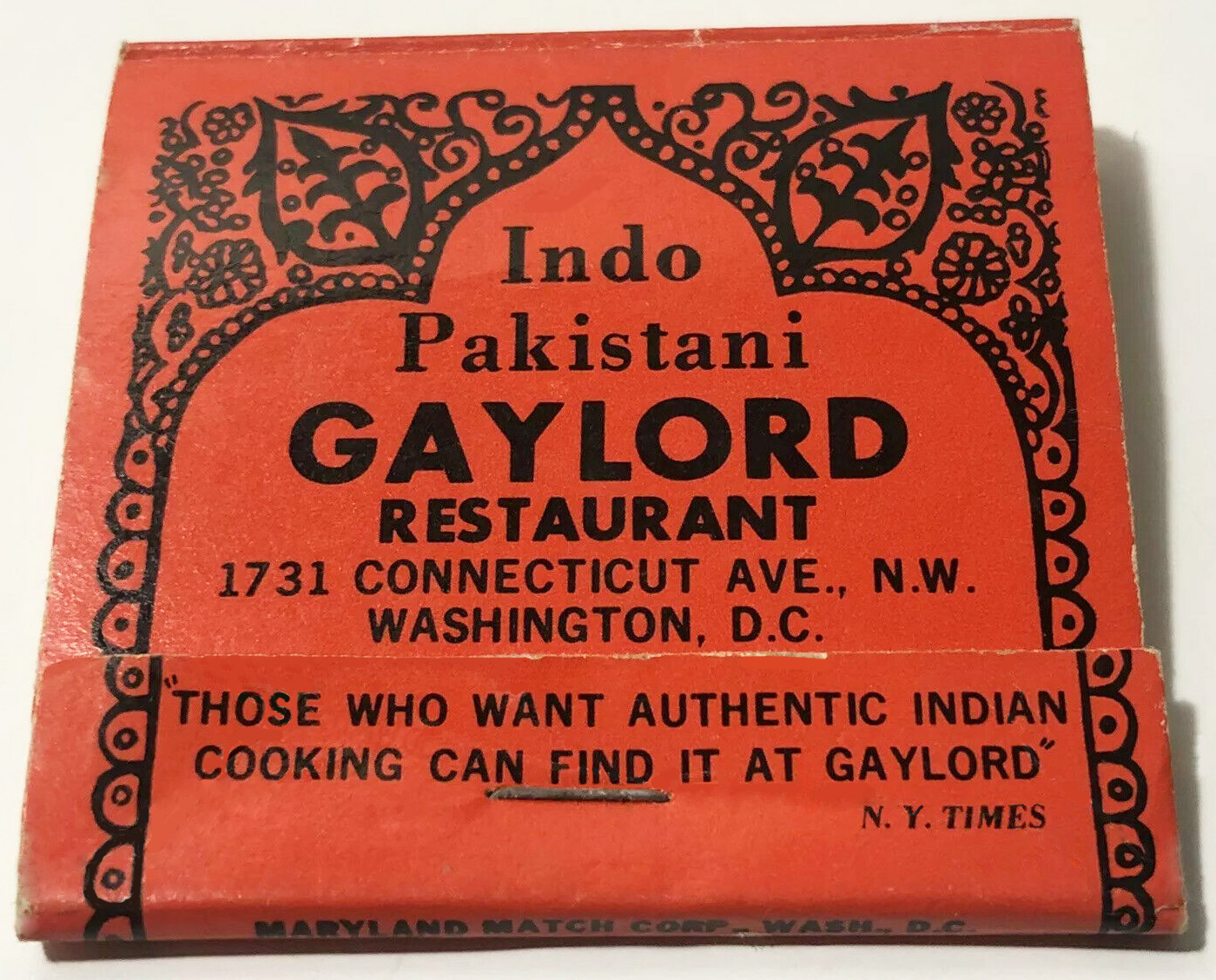
Despite their reservations, the authors of both books managed to find some places they liked. The Viorsts singled out five D.C. restaurants as “great finds.” They were: the Calvert Café, an Arabic place “worthy of shahs and empresses”; Don Pedro, Mexican, with a marvelous mushroom appetizer called hongos; the Cuban El Caribe, featuring raw Peruvian-style fish cubes in lemon-onion sauce (95¢); Gaylord, an Indo Pakistani restaurant with “delicious samosas”; and Warababa, a West-African place run by a Ghanaian couple with “exquisite” dishes such as peanut butter soup and Joloff rice flavored with bits of beef and vegetables.

The Kahns didn’t exactly rave about finds in Boston or Cambridge. But, after encountering “enough blandness while making our rounds to put us to sleep,” they enjoyed spicy lamb stew at Peasant Stock in Cambridge. They included the No Name restaurant on Fish Pier – no name, no sign, no lights, no decor — where a seafood chowder (50¢) served as the house special and was “so incredibly rich and so brimming with hunks of fresh fish that a cupful could be a meal in itself.” But the popular Jack and Marion’s in Brookline, known for its giant menu and huge portions, ranked merely as one of the area’s “better delicatessens.”

Alas, I couldn’t find the books from Honolulu, Los Angeles, or Long Island, but I saw a magazine piece that criticized the Los Angeles UG for its surprising inclusion of 25 restaurants in Palm Springs.

© Jan Whitaker, 2022

8 Comments

Filed under alternative restaurants, ethnic restaurants, restaurant prices