Category Archives: lunch rooms

Beans and beaneries

“Beanery” was less a name that an eating place would claim for itself than a slang term for a cheap and lowly lunch room. In these eating places baked beans was a staple dish going back at least as far as the mid-1800s. Milliken’s Beefsteak & Coffee Room in lower Manhattan offered its customers pork and beans in 1845. The price was 6 cents, the same, surprisingly, as roast beef or chicken pot pie.

Before sweet things became standard breakfast fare, baked beans were considered ideal for the morning meal. In fact the beauty of beans was that they made a square meal 24 hours a day. Like ham and eggs, they were favorites at all-night eating places. They could also be found in other nighttime establishments such as Silk & Anderson’s Saloon, Billiard and Keno Hall in Trinidad, Colorado, established in 1876, where baked beans, ham, and cole slaw made up the free “lunch” spread from 9:00 at night until 2:00 in the morning.

Baked beans could be found in restaurants all over the U.S. – Cincinnati, San Francisco, New Orleans – but it was in hard-edged Chicago, New York, and Boston where the slang term “beanery” especially captured the imagination of writers. Despite the unsentimental words of a 1908 hash house waitress, “There ain’t no romance about pork and beans or any of it. It’s all to the real life, and a punched check for a finish,” novelists of that time loved to set their tales of salty characters in big city beaneries.

Each city’s beaneries had a different character. Chicago’s South Clark Street, “toothpick row,” was full of them but beans also did duty in the city’s saloons where a 5¢ glass of beer earned a free lunch of beef and baked beans, with pickles, olives, and celery for trimmings. New York City was known for its “beef and” places, as they were called. The beef, in this case, was corned and everyone knew the missing word after beef was beans.

In Boston baked beans formed a considerable industry. Bakeries and other bean specialists ran hot ovens full of beanpots every night, turning out 32 million quarts annually which they delivered daily to restaurants and lunch counters. Baked beans often appeared on menus accompanied by brown bread, a combo known as “B. B. B. & B. B.” Even in 1921 when beans were slipping out of favor as a restaurant dish, the Childs chain found demand strong enough to keep them (and oysters) on their Boston breakfast menus.

It was said that baked beans was too frugal a dish to be popular in Los Angeles where garden produce was available year round. Yet “Ptomaine Tommy” DeForest laid claim to inventing a bean dish unique to L.A., the mysteriously named “size,” a hamburger on a bun covered with chili and diced raw onions.

By the 1960s Americans had outgrown their love of baked beans. In a restaurant trade book of 1966 they are listed as “foods to shun,” along with kidneys, chipped beef, turnips, and rutabagas.

© Jan Whitaker, 2008
4 Comments

Filed under food, lunch rooms

Fast food: one-arm joints

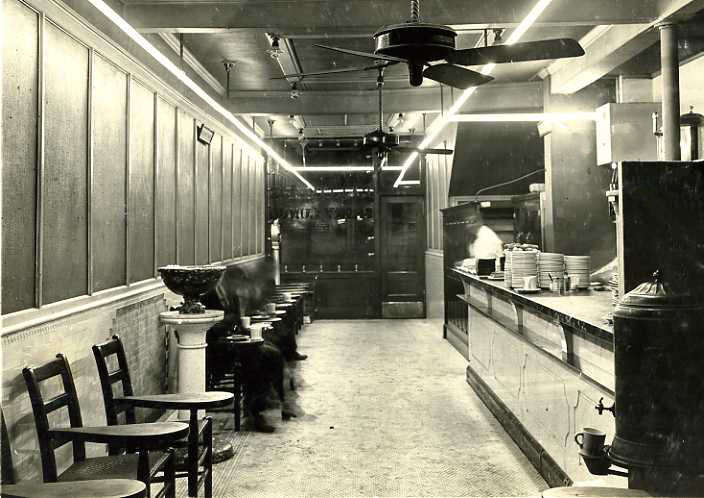
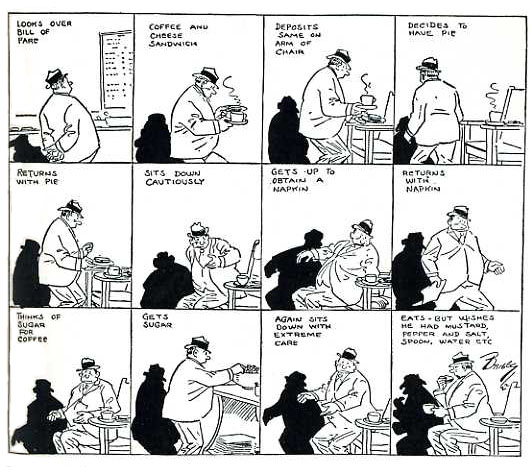
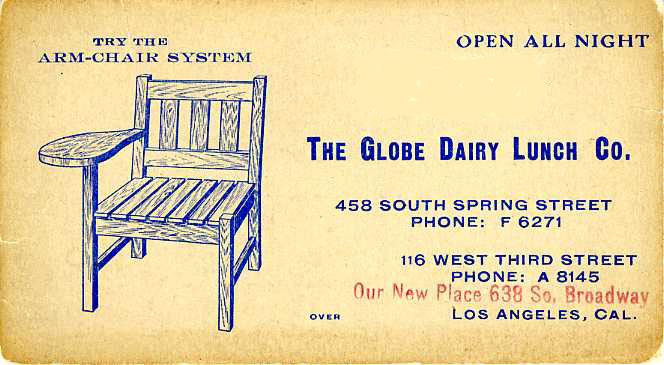
The wooden one-arm chair was a characteristic feature of the “quick lunch” type of eating place which became the popular choice for businessmen around the turn of the last century. The chairs were unattractive and uncomfortable as the cartoon below depicts. But considering that prior to their introduction patrons seeking a speedy lunch often ate while standing at a counter, they offered relative luxury. Solitary seating made sense in a café where businesspeople usually came in alone and spent little more than 10 or 15 minutes at their meal before rushing back to the office or store. (Later, in fact, more attractive one-arm chairs were used in Lord & Taylor Bird Cage restaurants.)

As is true of the fast food restaurants of today, one function of uncomfortable seats in the quick lunch eatery was to discourage lingering. These restaurants were usually shoe-horned into tight quarters in high-traffic, high-rent business centers, so it was paramount that each chair turned customers rapidly. The one-arm chair was patented by a Vermonter named James Whitcomb who designed fixtures for the Baltimore Dairy Lunch and also manufactured portable typewriters.

The core cuisine of the one-arms, and quick lunches in general, consisted of coffee and pie, supplemented by sandwiches and doughnuts. Some of the big one-arm concerns were the Chicago-based companies of John R. Thompson and Charles Weeghman, and the Baltimore Lunch and the Waldorf System, both of which originated in Springfield MA. The companies eventually broadened their menus to include hot dishes, supplying their locations in each city from central commissaries. Though the chains kept prices low, Waldorf prided itself on grating lemons for lemon pies and avoiding manufactured pie fillings, powdered milk, dried eggs and other cost-cutting ingredients developed for the military in World War I and widely used by chains in the 1920s.

Under the intense competition of the late 1920s and the depression, the Lunches replaced their one-arm chairs with tables and chairs and abandoned their utilitarian decor in favor of more colorful interiors in hopes of attracting more women.

© Jan Whitaker, 2008

25 Comments

Filed under lunch rooms

Basic fare: toast

Toast wasn’t really new on restaurant menus around 1914 but it was beginning to enjoy a bigger vogue. The soda fountain, often located in drug or department stores, was expanding into a lunch counter and as it did it added electric toasters to its battery of equipment. Most Americans still lacked electricity in their homes at this time so toast was something of a treat to them. By 1923 a new type of sandwich place, the luncheonette, had caught on. At the Tasty Toasty Luncheonette in New Haven a diner could almost certainly order a toasted cheese sandwich, an item once found only in English-style chop houses way before the Civil War.

Considering that restaurants in the early 19th century laboriously toasted bread by turning it slowly over an open fire, it is surprising that it was offered at all in those days. And yet Mrs. Poppleton, a versatile New York restaurateur, pastry cook, and confectioner, advertised in 1815 that she would provide refreshments such as savory patties, mock turtle soup, and anchovy toasts between 11 a.m. and 3 p.m. each day. Beyond being an accompaniment to eggs, toast also did service in many an eating place as an edible prop for such foods as quail, creamed chicken, or asparagus. Buttered toast floated in oyster stews and bowls of milk (“milk toast”). World War I put a temporary end to its sidekick role when the Food Administration ordered restaurants to conserve wheat by not using bread as a garniture.

After the war toasters stayed perpetually busy in luncheonettes. An Omaha chain of lunchrooms advertised “National Toast Week” in 1923. The R and C Sandwich Shops boasted in 1925 that “Our big double-deck special toast sandwiches are the talk of Chicago.” The following year there was a special demonstration on how to make toasted sandwiches at the National Restaurant Association convention.

The novelty of toast wore off over time until the cheap steakhouses that sprang up in the early 1960s revived it. Their dinners of sirloin steak, tossed salad, and baked potato came with garlic toast (called Texas toast when made of double thick bread), all for the magic price of $1.19.

Today toast can still be found filling all its historical restaurant roles, with the exception of milk toast which has been replaced with milk and cereal. But its leading role is perhaps in the club sandwich. As a 1960 restaurant trade magazine observed: “The dry, crispy consistency of toasted breads improves flavor and appearance, and also makes the customer feel he is getting a more exclusive product.” This, the article noted, allows toasted sandwiches to be priced a bit higher than plain ones.

© Jan Whitaker, 2008

3 Comments

Filed under food, lunch rooms, menus