Although the food-page story in a New Orleans newspaper said that this photo showed a jack-o-lantern just carved by Chef Gunter Preuss for his children, I can’t help feeling a little bit spooked by it. Is it how he’s holding that knife, or his serious gaze?
Never mind, because the story was about the Harvest Cream Soup he makes out of the pumpkin’s insides. (See recipe below.)
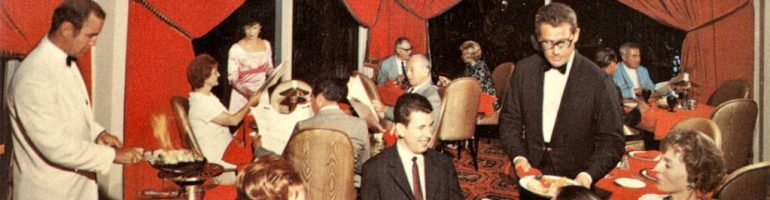
At the time of this story, 1976, Gunter Preuss and his wife Evelyn were owner-operators of the Versailles Restaurant in New Orleans. Eight years later they acquired a part interest in Broussard’s, which they took over from 1993 to 2013.
The Versailles received a glowing review in Richard Collin’s “Underground Gourmet” column in 1978 — although it was definitely not a restaurant for the price-conscious diner. Collin declared it “spectacular,”and “about as fine a restaurant as one can imagine.” He singled out many dishes as “platonic,” meaning they could not be more perfect. Among them were Bouilabaisse Marseillaise, Rack of Lamb Persillades, Ris de Veau Grenobloise, and Pears Cardinal. Chef Preuss was also featured on the show Great Chefs of New Orleans.
The recipe for pumpkin soup does not give amounts for every ingredient. It calls for a pumpkin’s interior, seeds removed, to be cubed and washed. Then sauté the cubes with onions and celery until glazed. Add flour and a half quart of chicken stock. Simmer the mixture over medium heat for 45 to 60 minutes, seasoning with salt, white pepper, powdered ginger, and white wine. Then strain the soup and add three eggs yolks and a cup of light cream. Simmer on low flame for five minutes, then pour into cups and serve with a whipped cream topping and a touch of ginger. Serves six.
Through the years a number of writers have described deceptive practices and foul scenes in restaurant kitchens where they have worked. Probably the best known authors are George Orwell (Down and Out in London and Paris, 1933) and Anthony Bourdain (Kitchen Confidential, 2000).
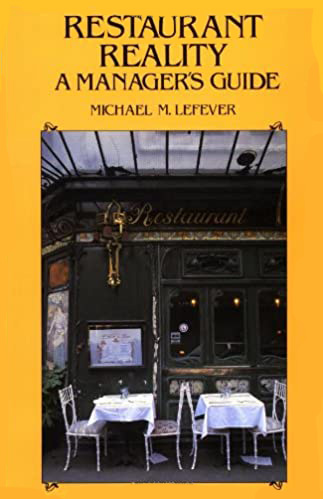
In those books, and in periodicals, I’ve read many reports of bad restaurant food, along with dishes misrepresented on menus. But I’m still a bit stunned after reading Restaurant Reality: A Manager’s Guide by Michael M. Lefever (1989). One of the biggest surprises is that he reveals his own willing involvement in kitchen tricks and horrors inflicted on guests — even in restaurants he and his wife owned and operated.
The book has a puzzling disclaimer on the copyright page: “This book is a composite of the author’s own experiences. Names, characters, places, and incidents are the product of the author’s imagination or are used fictitiously and any resemblance to actual persons, living or dead, or locales is purely coincidental.” But, whether absolutely factual or not, and despite being aimed at college students interested in restaurant management, the book seems to sanction questionable activities.
In his preface to Restaurant Reality the author makes several statements that seem to undermine the disclaimer somewhat. He says that he tried to present “an authentic overview” that was “a real eye-opener for anyone who has ever eaten in a restaurant.” He adds that while the content may be shocking, “that’s how things really are.”
Starting at age 14, Lefever had at least a 23-year career in a number of restaurant roles, including dishwasher, server, cook, and bartender for an Italian restaurant, followed by unit manager and district manager for a fast-food chain, and regional manager for a dinner-house chain. Plus, in between the chains, he and his wife were owner-operators of three independent restaurants. Following his restaurant career, he held academic positions both as Associate Dean of the Conrad Hilton College of Hotel and Restaurant Management at the University of Houston and as head of the Department of Hotel, Restaurant and Travel Administration at UMass Amherst.
Although no names of individuals, places, or restaurants are given in the book, I have discovered that the third restaurant the Lefevers owned briefly was The Balcony in Folsom, CA. According to a 1983 story in the town’s paper, their two previous restaurants were in Bend OR and Salt Lake City, probably in that order.
How things really were
At age 16 Lefever became head cook at an Italian restaurant. It was before microwave ovens were common so hot water was used for parboiling and defrosting items such as lobster tails. The same water might be used for multiple items, such as pasta, chicken, and fish, as well as frozen steaks before they went on the broiler. He remarks, “This may be of some interest to readers who are strict vegetarians.”
No matter what the customer ordered at the Italian restaurant, all steaks were delivered to guests rare and cooked further only if they complained. If the customer insisted on a well-done steak the kitchen took revenge by putting it in a deep-fat fryer, followed by treatment with a blowtorch which caused it to burst into flames. Just before it burned to a crisp they would throw it on the floor and smother it in salt, then shake off the salt, put it on a platter and brush it lavishly with butter. He claims – and maybe it was true – that customers loved these steaks and some started asking for theirs charred.
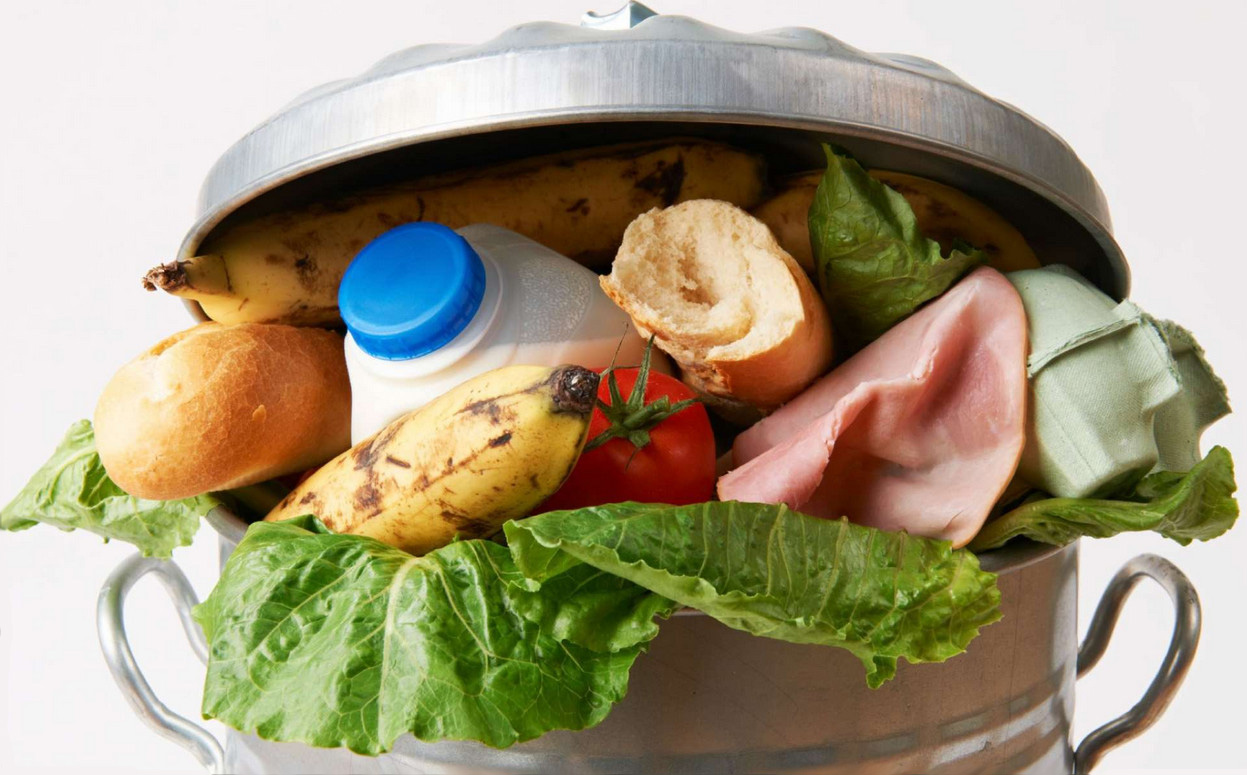
As a fast-food unit manager, he oversaw (or witnessed? or heard about?) some truly disgusting practices. For instance, afternoon employees hired mainly to clean toilets and dispose of trash often did some off-hour cooking as well — but they weren’t always terribly sanitary. If no fresh lettuce was available, he writes, “the afternoon employee might fish out of the garbage can some discarded outer leaves.” They were oversized with tough spines, so the worker would “simply place his palm on the assembled sandwich and smash it downward.” When condiments squished out, he would “take a dirty cleaning rag” and wipe off the bun.
Since Lefever’s monthly bonus was based on keeping costs down, he recycled sandwiches that had officially expired as often as he could, even though this subverted the chain’s system. Eventually they began to look inedible. Then the workers would replace limp lettuce, spray the dry bun with water, and make other repairs. If that didn’t work they would disassemble the sandwiches and salvage the valuable parts for remakes during the off-hours, and so much the better if the customers were nighttime drive-thrus who had spent their evenings in a bar.
At the Lefevers’ own restaurant, The Balcony, servers were instructed to tell customers that all dishes — Veal Piccata, Beef Wellington, and so on — were prepared on site though they actually came from a supplier of frozen entrees. The cooks were highschool students who defrosted them in a microwave while doing their homework.
He declares that customers who found eggshells in their omelets should have been grateful since this meant the restaurant used fresh eggs rather than processed omelet mixes. But it could also mean that they came from the bottom of containers they used to store hundreds of cracked eggs in water. And, he reveals, “The bottom also collected the heavier eggs, which result when hens are sick, given a strange diet, or frightened.” Customers requesting decaffeinated coffee didn’t necessarily get it, since servers randomly grabbed the handiest pot, switching the red or green plastic bands that indicated type of coffee.
In discussing food spilled on the floor, he writes, “I have served . . . entrees spilled and then salvaged such as lasagne, beef stew, chili, pasta, and scrambled eggs. Steaks and chops are no problem at all. Simply put them back on the grill or in the pan to freshen them, after washing them under the faucet.” But he advises cooks to inspect the entree “looking for hairs and foreign pieces of food that do not complement the dish.”
After a start in the 1950s, pancake houses made it big in the following decade.
Of course pancakes were not new to eating places. Far from it. They had long been a staple of short order restaurants, known variously as flapjacks, hoecakes, hot cakes, griddle cakes, flannel cakes, batter cakes, butter cakes, and just plain cakes. The mighty Childs chain had built its business by transfixing pedestrians with women flipping pancakes in its windows.
Cheap yet filling, it’s hardly surprising that pancakes grew in popularity during the 1930s Depression. The Childs Corporation reported in 1931 that pancakes with butter and syrup ranked as “the most typical American dish.” Pancakes were once again in the spotlight in the film Imitation of Life (1934) in which a white woman’s Black cook runs Aunt Delilah’s Pancake Shop which makes a hit on the Atlantic City boardwalk. The 1930s was also the decade in which The Pancake House opened in Portland OR – a restaurant which James Beard playfully nominated in the 1950s as one of the 10 best in America.
But what was new in the 1960s, with the spread of economic prosperity through (white) America, was the popularity of the “family restaurant.” Children, who had earlier been a minor element in eating out, became a new factor in restaurant success. Now included in dining plans, they often ascended to the role of lobbyist and de facto decision maker. And, while Mom might frown on high-calorie menus and Dad might wish for steak, the kids loved pancakes.
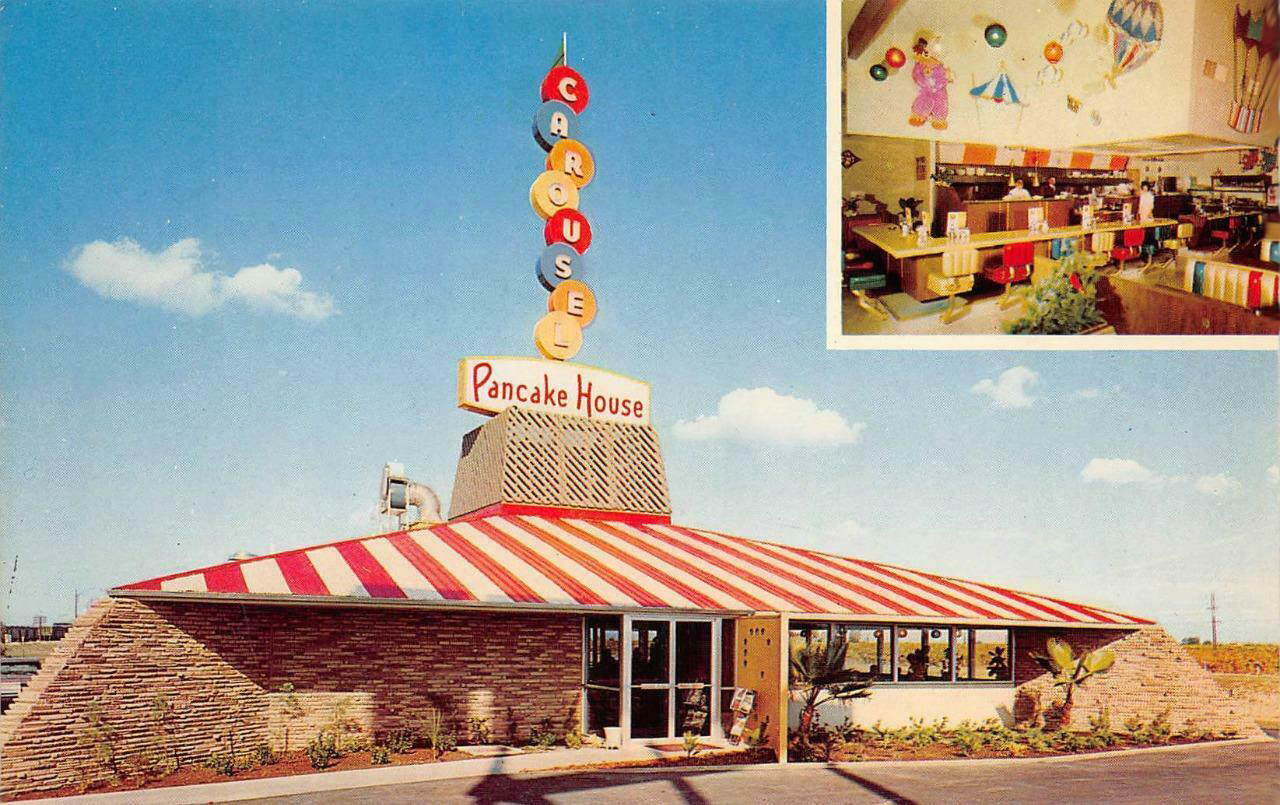
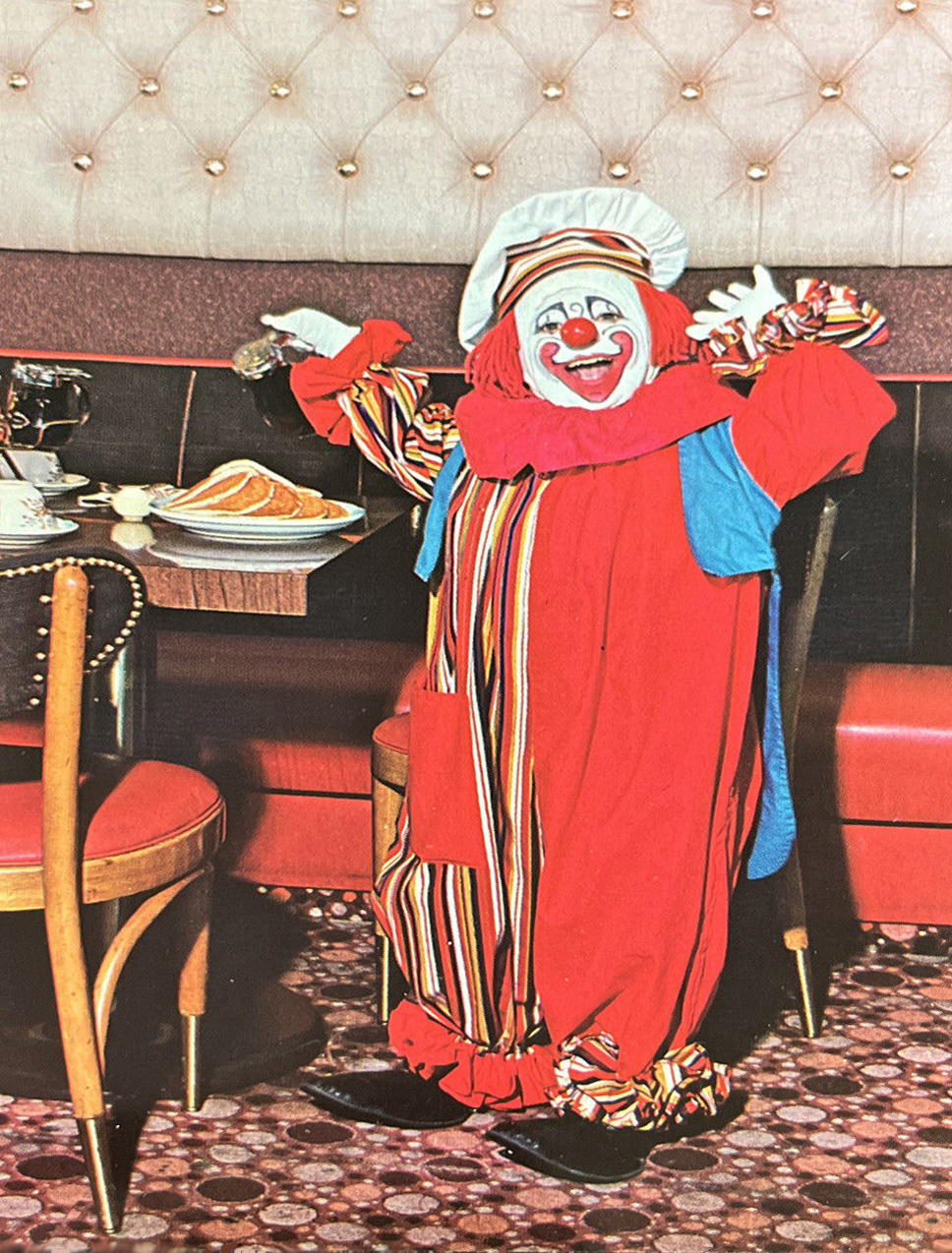
Pancake restaurants of the 1960s welcomed children with bright primary colors, cartoonish figures on menus and walls, and at least in one case with a rather alarming-looking costumed clown. If a child had not fully satisfied their sweet tooth with pancakes, they could raid the “old-time” candy barrels at Florida’s Kissin’ Cousins Pancake Inns. Meanwhile, an adjoining cocktail lounge beckoned parents with beer and bourbon.
What else was new about pancake restaurants? They were part of the advent of eating places focused on single foods, such as hamburgers or pizza. Like pizza, pancakes held special charm for restaurant owners because their ingredients were cheap and no skilled cooks were needed. Plus, they weren’t just for breakfast — customers were ready to order them all day and through the night. The trade journal American Restaurant mused in 1960, “Who ever dreamed that the lowly pancake would build a fortune . . .?”
Restaurant consultant George Wenzel asserted that pancake houses proved “that any one item, prepared with great care, and basically popular, can lead to fortunes especially if the menu price is reasonably low.” While regular service restaurants had food costs up to 48%, he figured they were only 35% in specialty restaurants such as pancake houses.
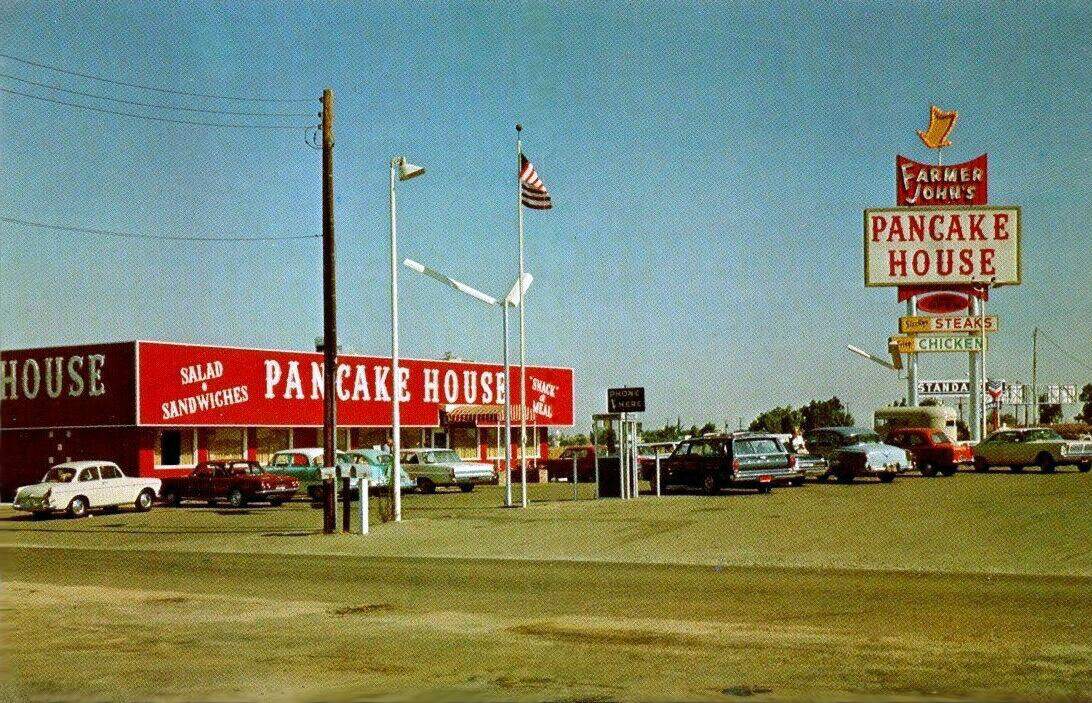
Chains built around pancakes spread rapidly. By 1961 the International House of Pancakes had opened 25 units in just three years, and was poised to expand into the Northeast. Uncle John’s Pancake Houses, begun in 1956, were doing business with 60 units in more than 20 states. Each of these chains may have been inspired by Aunt Jemima’s Pancake House that opened in Disneyland in 1955.
Despite the development of dozens and dozens of pancake varieties and their high profit margins, pancake restaurants gradually broadened their menus. The trade magazine Cooking for Profit noted in 1964 that pancake restaurants had found it necessary to put steak on the menu. The growing menus meant that the pancake restaurant boom would soon give way to a more general sort of family restaurant in the 1970s. Like pancake restaurants, full-service family restaurant chains such as Denny’s and Country Kitchen were also expanding.
Eating in restaurants continued to be popular with families in the 1970s. Reporting on a Gallup survey in 1975, Food Service Magazine observed that more working mothers, increased family income, and smaller families suggested “a more profitable family market than ever before.” The survey also found that preferences included table service restaurants that welcomed children, had moderate prices – typically $1.00 to $1.99 per person for breakfast — and a menu with a wide range of selections.
A 1978 New York Times story titled “Family Restaurant Booming” noted that dining out is extremely sensitive to economic conditions, a situation that is likely to be especially true for family dining.
So the current economy should favor patronage at IHOP, the reigning pancake kingdom.
After the early years of serving cold box lunches, U.S. airlines tried to improve their in-flight food service, sometimes through alliances with restaurants and restaurant chefs. As early as the 1930s, the decade in which transcontinental flights began, hot meals were becoming common. In 1939 George Rector, formerly of the swank and swinging Rector’s of pre-prohibition Broadway in New York City, advised Braniff Airways on their menus. He gave his blessing for a Thanksgiving menu that year that included roast turkey with oyster sauce and chestnut dressing, pickled watermelon rind, and other select dishes.
It’s fair to ask why airlines switched from cold box lunches, given how difficult and expensive it was to provide full-scale hot meals. A large part of the answer is that in the beginning they wanted to distinguish themselves in comparison with train travel. Over time, though, planes would become bigger and faster, offering cheaper fares and attracting many more passengers. Through all of this, meals would go from an attraction to a target for cost reduction.
It’s hard to know exactly what Rector’s role entailed. It may have been devising menus and training chefs rather than getting his hands dirty. Decades later that was probably equally true of another well-known chef, Wolfgang Puck of Spago in Los Angeles. In 1983 he advised luxury Regent Air Corp. on suitably impressive meals for its flights between LA and Newark. After being delivered to the airport via Regent’s limousine, passengers were treated to Beluga caviar, smoked salmon, and lobster fresh from Maine, washed down with fine wines. Within three years the airline had racked up $36 million in debt and was sold.
United Airlines was one of the few airlines that maintained their own flight kitchens. Starting in 1947 they were headed by Swiss chefs. Trained in European kitchens, they came to United with experience in major hotels and restaurants in the capital cities of Europe and America. Nonetheless United’s menus, whether in English or Franglais, were less than thrilling, especially when the various courses were all grouped together on a tray as depicted on this late 1960s postcard. Even though I’ve seen many United menus, I remain stumped about the ingredients in the “salad” that look remarkably like asparagus spears reposing on a bed of orange gelatin (though, to be fair, I’ve never seen gelatin on a United menu).
There were no Swiss chefs at the D.C. area’s Hot Shoppes drive-ins in 1937 when that company began to supply Eastern and Capital airlines with in-flight meals. Eventually the Hot Shoppes would become the Marriott Corp., a major airline caterer that became one of the largest, as did another that evolved from a restaurant chain, Dobbs House.
Meals in the 1950s may have been somewhat ho-hum (despite the fact that almost all flights were still first class only), but alcoholic beverages brightened the trip for some passengers. Despite the failed efforts of Senator Strom Thurmond of South Carolina, who introduced legislation in 1957 to outlaw the sale of alcohol on airplanes citing both safety and moral issues, nine domestic airlines began serving it in the 1950s, and the number grew from there. [Above, Delta, 1959]
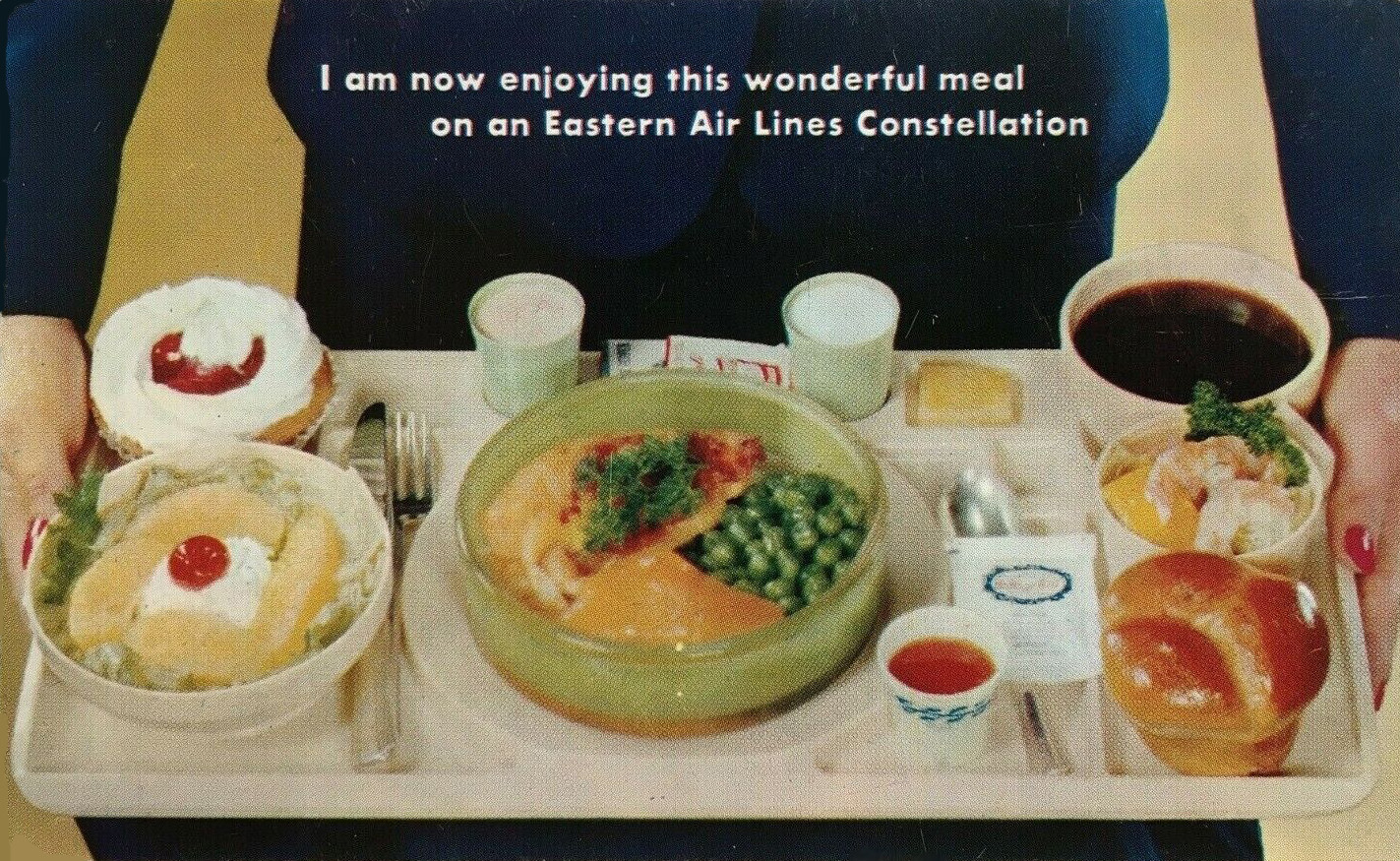
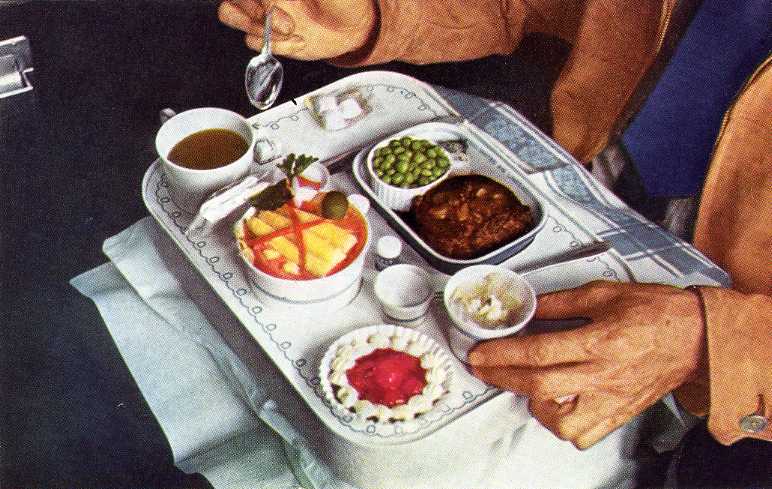
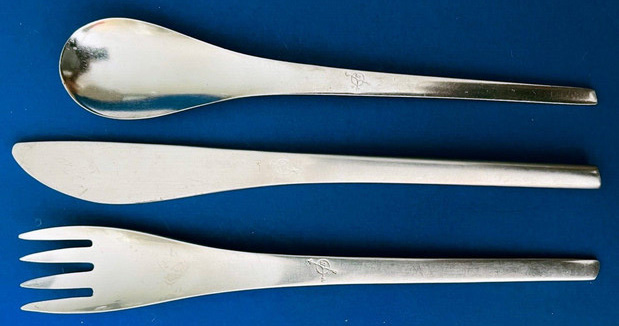
Two free drinks became an attraction offered by a number of airlines as they ramped up their meals. Competition in cuisine became intense among the major carriers in the 1960s, in some cases involving the participation of fine, or at least famous, restaurants. This was perhaps inspired by Pan Am who recruited Maxim’s to supply meals for flights departing from Paris. Soon airlines in the U.S. began to conjure intriguing flight names such as Famous Restaurant Flights, Captain’s Table, and Royal Dining Service. American Airlines enlisted “21″ to supply flights leaving NYC, while Eastern – once catered by the Y.M.C.A. – signed up the elite Voisin for first-class flights from New York and the Pump Room for those from Chicago. Eastern discarded its humdrum serving pieces [at top of page] of old for Rosenthal china and stylish silverware [shown below]. As a commentator said in 1967, “ Practically every airline worthy of the name also calls itself a flying five-star restaurant.” [above, Voisin chefs preparing food for Eastern Airlines, 1965]
The peak of competition in food probably occurred in the early 1970s, when airlines offered champagne breakfasts, a variety of hors d’oeuvres, lobster plus steak dinners, and prime rib sliced on a rolling cart for each guest — ditto for displays of salad tossing. Passengers could request special meals designed to suit taste, health, or cultural/religious requirements.
Through all of this, though, there were always complaints about food. Almost everyone agreed that warmed-up meals could never match good home cooking or fine restaurant fare. And, of course, there were those who preferred to make their own arrangements and have the cost of meals subtracted from the cost of their ticket.
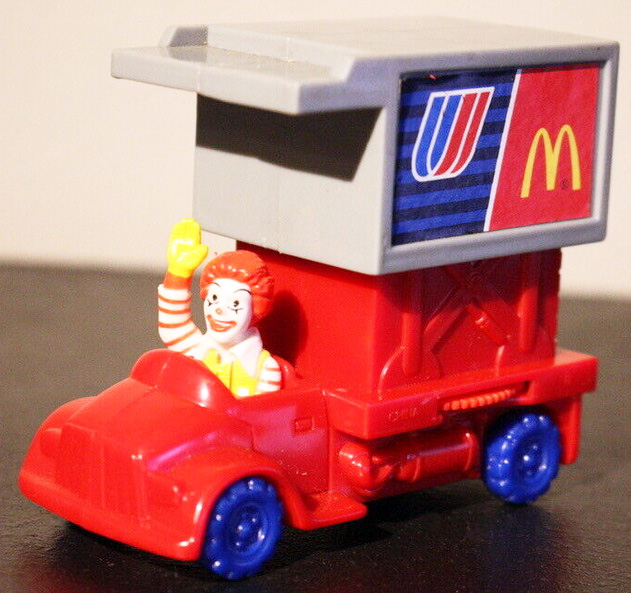
They got their wish in 1978 with the passage of the Airline Deregulation Act. Airlines were freed to compete in terms of fares and routes. New airlines were created. Some old ones grew mightier while others, such as Braniff and Eastern, disappeared in the 1980s recession. “Frills” were eliminated. Snack packs came into being, making the sandwich and apple of the 1930s seem almost generous. In the 1990s United began offering McDonald’s meals for children.
While hot meals did not completely disappear, they tended to be limited to first class passengers whose proportionate numbers had shrunk drastically since the 1950s. Today, meals by foreign carriers get the highest ratings.
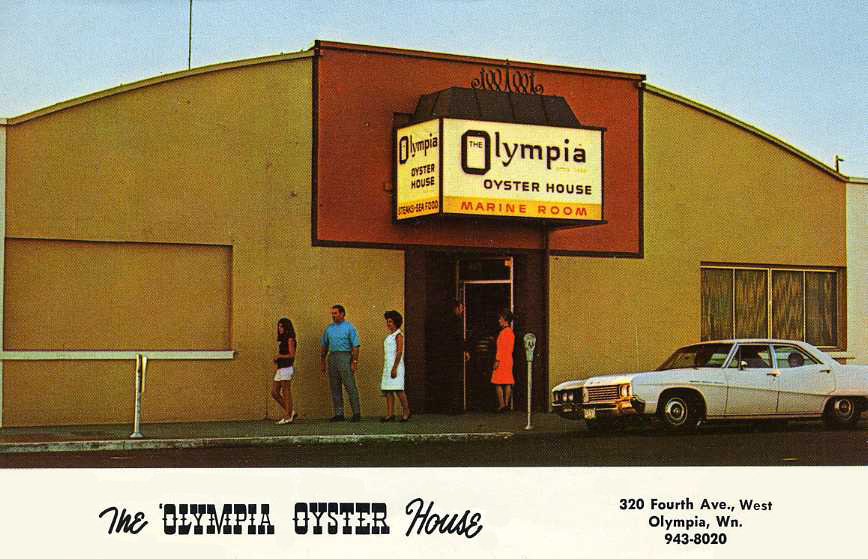
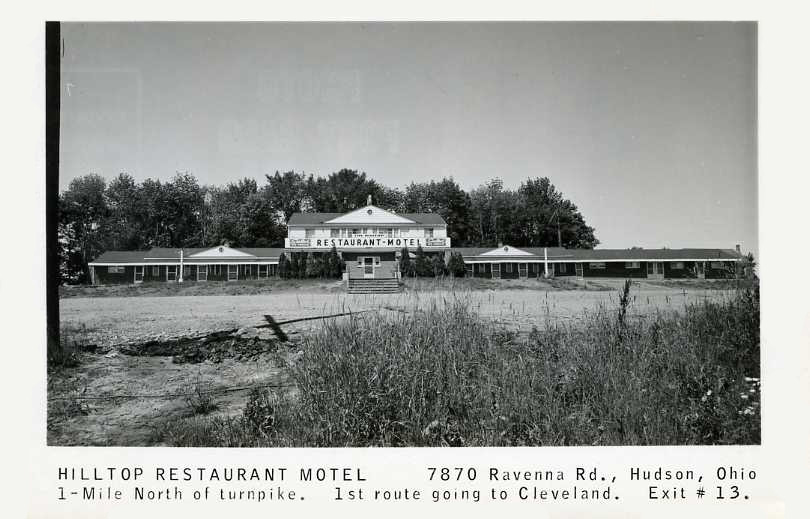
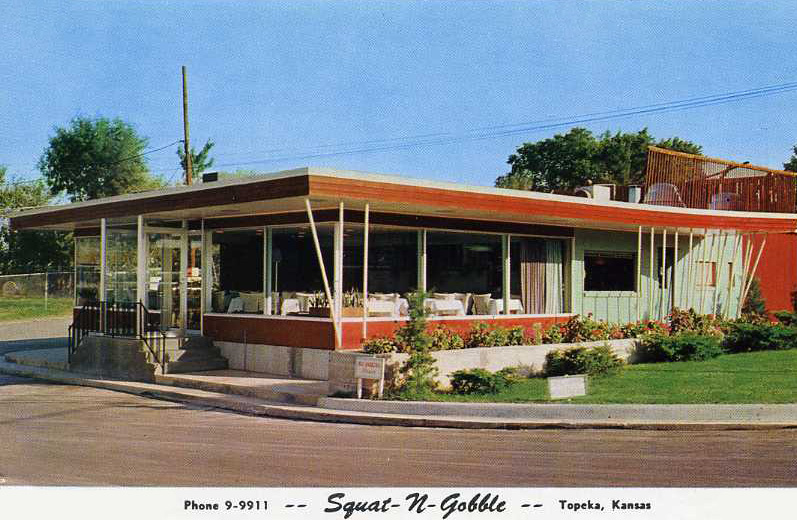
I have often been struck by how many postcards fail to present restaurants at their best. Most of those I’ve chosen for this post are from popular restaurants, some of which stayed in business for a very long time and were well loved.
But the whole idea behind postcards was to extend the appeal of a restaurant beyond its regular patrons, to those who perhaps never even heard of it. What would strangers think about the places associated with these self-presentations?
Why show an exterior like this?
I don’t know what explains the sad appearance of the Olympia Oyster House. It was a popular spot that had been around for decades, but the front of the building in 1971, with its high-school-gym style and blanked out window, does not seem attractive even to the people in the photo. It seems they can’t quite bring themselves to enter.
Apparently the Hilltop Restaurant, shown here in 1960, was listed for sale for an extended period of time. Years and years — all the while doing business. Nothing like a patch of weeds to set off a place.
The names!
Please, no more Squat-N-Gobbles! Such a strange name for a white-tablecloth restaurant advertising “Dinner by Candlelight.”
And yet, having no name at all doesn’t work well either.
Identity crisis
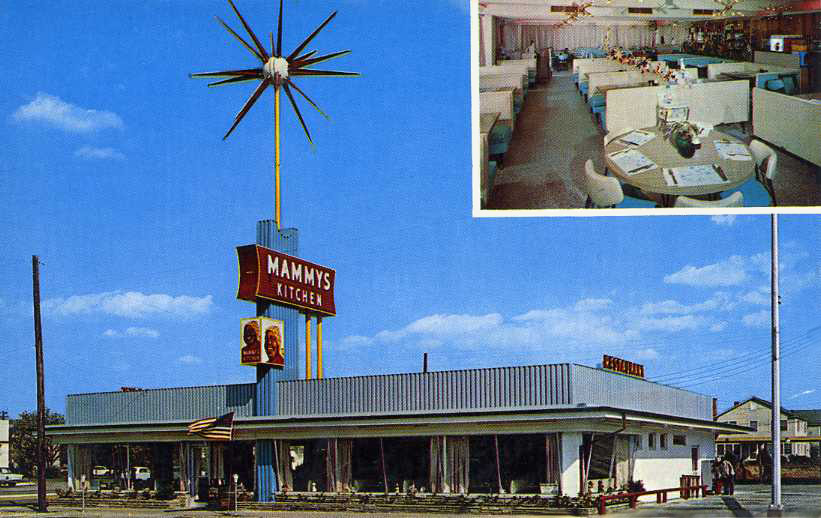
As names go, Mammy’s Kitchen is offensive, and, in the case of this 1970s Myrtle Beach restaurant, does not seem to have anything to do with either the food or the strange atomic symbol hovering overhead. Its cuisine is likewise heterogeneous, covering the usual steaks and chicken, but also offering “Italian Kitchen and KOSHER SANDWICHES.” New management took over in the mid-1980s but the objectionable name from an earlier age was still in use as late as 2019.
The Wolf’s Den in Knox, Pennsylvania, opened in 1972 in a very old barn that had been decorated with plows, saddles, old rifles and such. The section called the Hay Mow is shown on this card. Something about the dusty appearance of dried out straw and the chains and hooks does not convey an enjoyable dining experience. According to a 1977 review, the restaurant was expensive and served “standard American fare” such as escargot and French onion soup. I’m confused.
Do these look delicious?
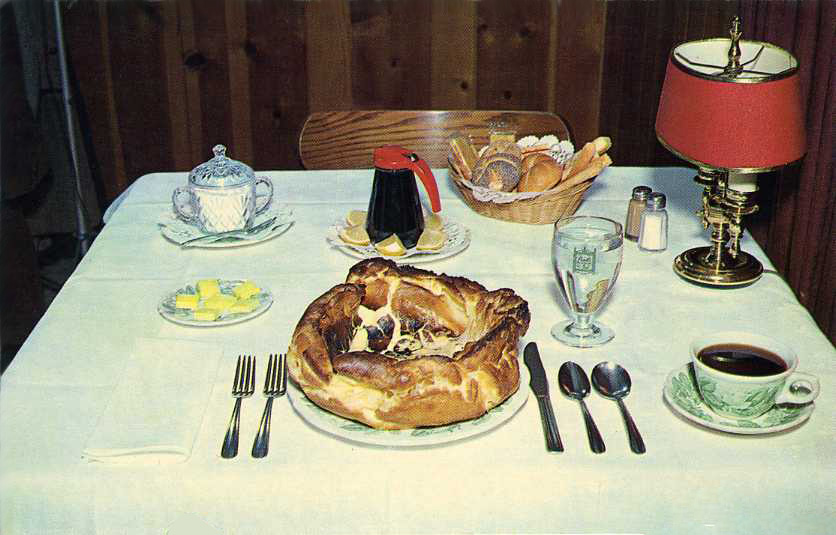
German pancakes have been a favorite at Pandl’s Inn in Whitefish Bay, Wisconsin, for decades. The trouble is they don’t photograph at all well. It is also a mystery to me why anyone would accompany a large pancake with a basket of bread and rolls.
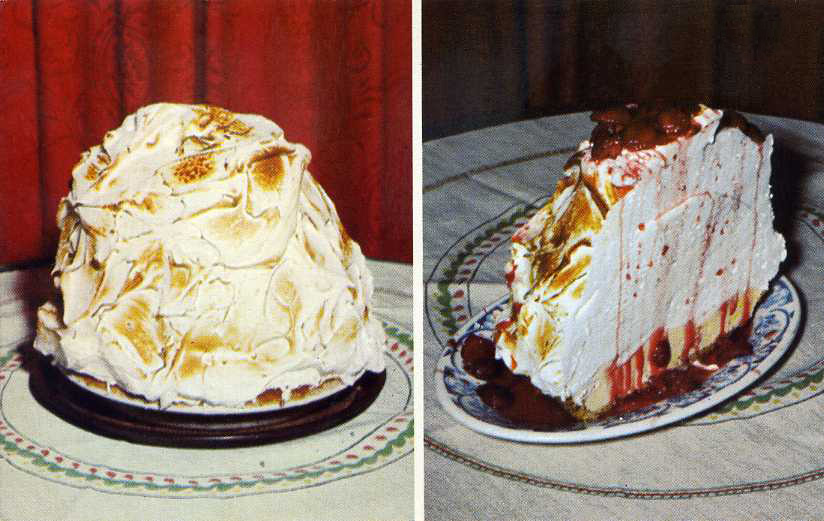
A similar problem afflicts the specialty ice cream pie at Tripp’s Restaurant in Bar Harbor, Maine.
The postcard was almost certainly created to celebrate the opening of the Sirloin Room at Dallas’ Town and Country Restaurant in 1951. Of course steaks are brown, plus this one seems to be resting in a pool of its own juices. I can see that some touch of color was needed, but maybe this parsley is a bit much.
Threatening interiors
Probably when you’re actually in King Arthur’s Court, a room at the Tower Steak House in Mountainside, New Jersey, the deadly implements wielded by the suits of armor recede into the distance and the blood red carpeting is barely noticeable. But in this shot they loom disturbingly.
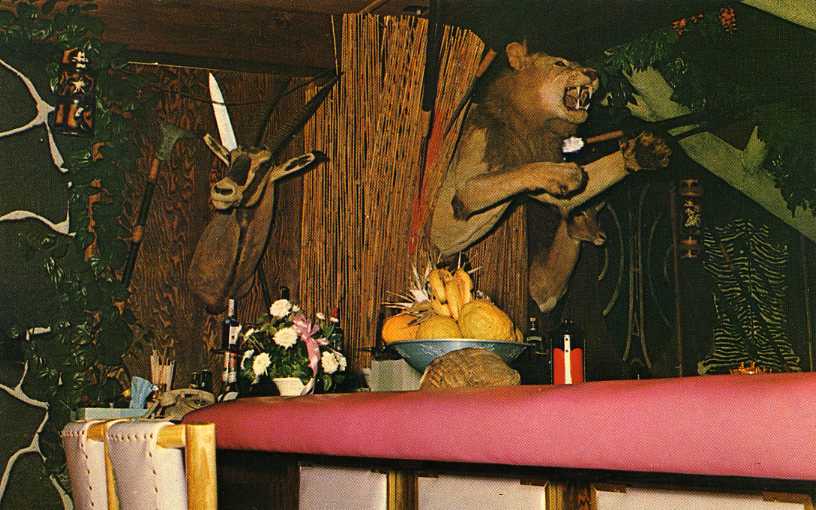
No, the lion is not actually holding a gun, but she is showing her teeth in a menacing way. Likewise those antelope horns look sharp at the Kenya Club in Palm Beach, Florida.
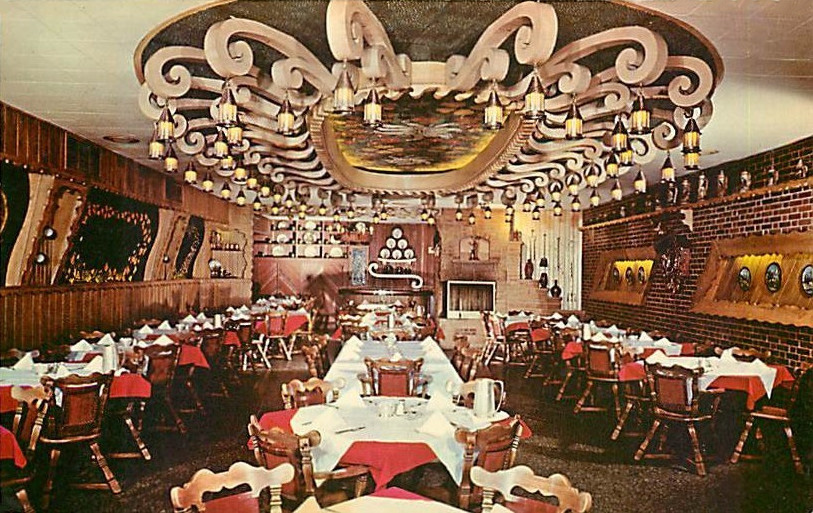
This light fixture? sculpture? installation? might just be the ugliest I’ve ever seen. Let’s hope that it was well connected to the ceiling of the William Tell Restaurant in Chicago. Then there are the inset wall displays, and . . .
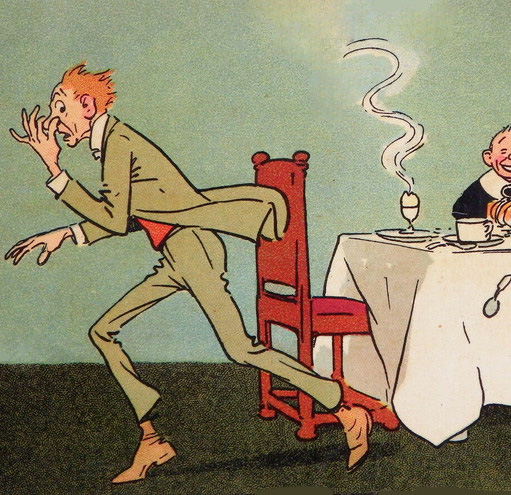
It is said that the sense of smell became less important when proto-humans began to walk upright. Yet it has played a significant role in restaurant history, for better and for worse.
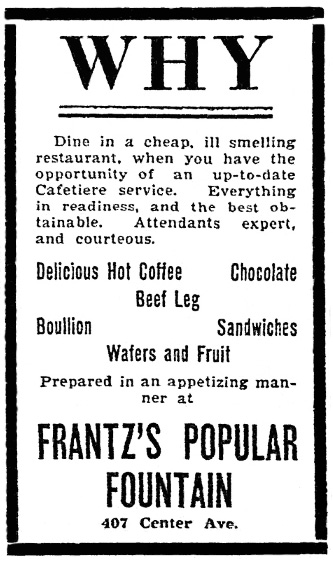
While not limited to the 19th century, complaints about bad odors in eating places abounded then. In that century, unwanted smells might come from the building itself, accumulated cooking odors, or the humans in the rooms. Worst of all were the cheap eating places located in damp and windowless basements where all three perils came into play.
A self-styled researcher in 1849 cancelled a plan to visit common eating houses in New York City, writing, “We once undertook to count these establishments in the lower part of the City, but got surfeited on the smell of fried grease before we got half through the first street, and were obliged to go home in a cab.”
Even Taylor’s, Broadway’s mid-19th-century hot spot where fashionable ladies went to consume fricandeaus and meringues, failed the smell test. It had a deluxe interior with 18-ft-high ceilings, gold leaf, fountains, and mirrors, leading journalist Fannie Fern to exclaim, “What a display of gilding and girls.” And yet, upon its close in 1866, a critic put things straight, admitting “there was always the restaurant odor, the mingled essence of many past dinners, and precisely the same from month to month and year to year.”
If Taylor’s wasn’t free of bad odors, what restaurant was? Well, according to a British visitor, the answer was just about none! In 1868 the author, after visiting New York, gave 99.9% of the city’s eating places a no-star rating when it came to smelliness. “The restaurants, with the exception of Delmonico’s on Fifth Avenue, generally speaking, are dingy and warm, and have a sickly smell about them,” he wrote. Not much later the Prince of Wales traveled to the U.S. and quickly grew sick of the sight and smell of one of the country’s most beloved foods: oysters. “During his sojourn he was always endeavoring to escape from the smell of them,” according to one chronicler. Obviously, one person’s bad odor might be another’s delicious aroma.
Old-fashioned chophouses, revered as hyper-masculine shrines to meat-eating, also came in for criticism. One critic denounced New York’s Old Tom’s, a venerable dining spot, as “the humbug of the century.” He characterized its atmosphere as “fat and greasy,” adding, “You breathe it, smell it, taste it.”
On the whole, though, it was unusual for men to criticize the smell of meat cooking. It was so enticing that the owner of an 1890s NYC ballroom arranged to pipe in the kitchen’s odor of steaks being grilled at the end of the night’s entertainment, ensuring a crowd for his dining room a floor below.
The restaurant foods usually singled out as unacceptably smelly tended toward fried, greasy things, as well as garlic, onions, cabbage, and, in certain cases — when they perfumed residential neighborhoods — hamburgers and hot dogs. Los Angeles regarded tamale wagons as “odor factories” and Scarsdale fought to remove a “smelly” stand operated by Castel Hitaltakides, aka ‘Hot Dog Joe.’
But it wasn’t until after the first world war that real improvements were made with ventilation and kitchen design. Wood surfaces were replaced with harder materials such as “Monel metal,” forerunner to stainless steel. And the use of vents and exhaust systems grew commonplace except in the poorest eating places. Air conditioning in the 1930s also made a big difference. However, improvements in air quality were always in order. A 1946 customer survey revealed that restaurant patrons’ biggest complaint after noise and clatter was still bad odors. They almost certainly would have included cigars and cigarettes, which would draw even more complaints as the movement to ban smoking in restaurants grew.
What could restaurants do to control odors? There were range hoods as far back as the 1880s, though I don’t know enough about them to judge their effectiveness. Another method employed by restaurateurs who could afford it was to locate their kitchen on the top floor of a building, with the dining room a floor below so the kitchen’s greasy hot air and odors would float inoffensively skyward.
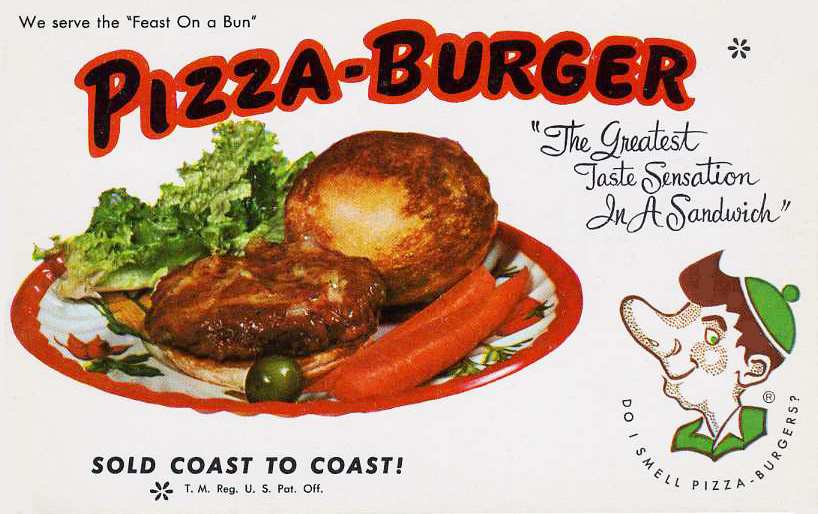
But then attitudes to food smells began to shift. An overlooked feature of the food “revolution” taking place in the late 1970s and 1980s was that cooking aromas – which, apart from beef, had rarely been regarded as a positive attraction in restaurants – became a plus, particularly when they emanated from the kitchens and platters of ethnic restaurants. Fast food smells, such as the pizza-burger’s, were also redeemed as pleasant.
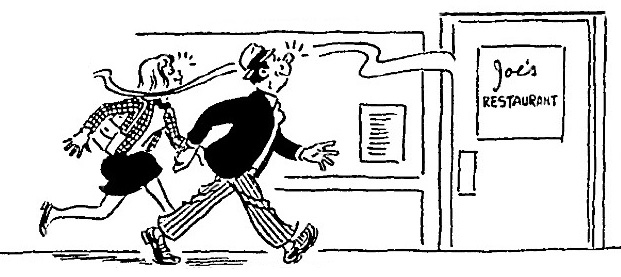
At Joe’s, yes, but not so much in luxury restaurants.
Remember that smelling was long associated with lowly creatures. And for decades the standard had been that proper middle class homes should be entirely free of cooking smells, even if this required a series of doors between kitchen and dining room as well as frequent daily airings of the kitchen. In the 1920s a genteel residential hotel in Cleveland went so far as to design suites in its new building with no kitchenettes “so that one family will not inconvenience other occupants with cooking odors.”
It seems this standard was adopted by luxury restaurants as well. I have been unable to find any reviews of elite restaurants that mentioned odors or aromas. Evidently the only time customers’ noses were allowed to come into use was in sniffing wine offered by the sommelier.
What would Julia (Child) have thought about this? In a 1972 interview, she was asked how, when traveling, she identified a good restaurant. Her answer: “If you poke your nose in, the smell will tell you something. A good restaurant smells good – of fresh food and butter and fresh olive oil.”
Sometimes I feel the need to focus on ridiculousness in restaurants, maybe because I run across so many instances of it when I’m meandering through old sources. Lately I’ve been exploring franchising and have encountered numerous silly concepts expressed in the names of chains. Many businesses across the country adopted “Mister” or “Mr.” as part of their names, and this seems to have been particularly true of restaurant chains. [For now, I’m calling all of them Mister.]
There are also scores of restaurants with names such as Mister Mike’s or Mister T’s, but those are usually not part of franchise chains and the letter or nickname refers to an actual person, usually the owner, who may be known by that name in real life. I’m not including those here.
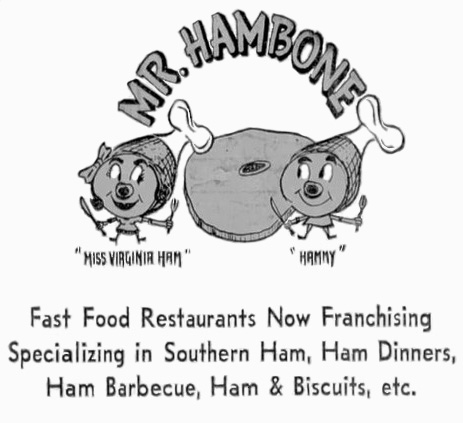
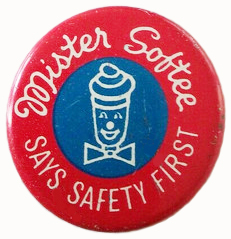
I’m more interested in the Misters that are not named for actual humans. At least I’m hoping that there is no real-life Mister Beef, Bun, Burger, Chicken, Drumstick, Fifteen, Hambone, Hamwich, Hofbrau, Pancake, Quick, Sandwich, Sirloin, Softee, Steak, Swiss, or Taco.
There were also Sir chains, such as Sir Beef, plus Kings and Senors. Were they in their own way an expression of multiculturalism? Being “continental,” Sir Beef was classier than most of the Misters.
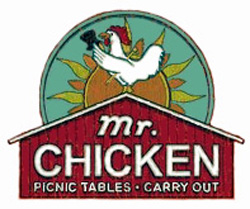
For quite a while I believed there could be no Mister Chicken. That seemed obvious to me – who wants to be called a chicken? But then it occurred to me that I should do a little more research. I was proven wrong. Maybe I shouldn’t be surprised. Surrounding the logo shown here were the words: Home of America’s Best Barbecue Chicken Since 1966!” Although there were restaurants by the same name in Rockford IL and Atlanta GA, I don’t know if they were related.
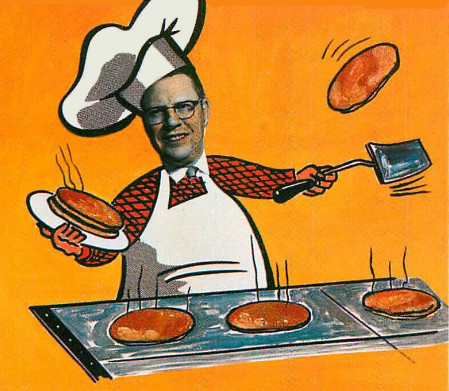
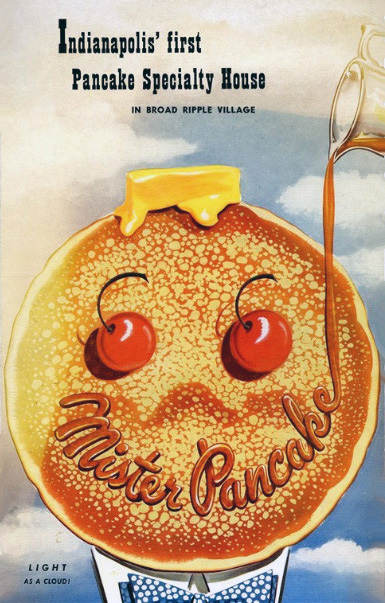
I find Mister Pancake’s face somehow threatening, but never mind that – he was a hit in his hometown of Indianapolis. He came into the world there in 1959, but I don’t know if he appeared anywhere else.
I especially like the logos that attempt to humanize food, particularly unlikely items such as hambones. Sadly for him and his girlfriend, Mister Hambone International – aka Hammy — really didn’t catch on. Starting out in Virginia in 1969, he opened at least one place in North Carolina, but nothing, I think, internationally.
Mister Softee with his natty bow tie, born in New Jersey, was mainly peddled out of ice cream trucks, but there were also restaurants of the same name that served hamburgers, steaks, hot dogs, fish, etc., along with the creamy guy. In 1967 a mobile franchise cost $2,500 while a restaurant was ten times that, which may account for why there were then 1,600 trucks — even as far off as the French West Indies — but only 5 restaurants. Overall, Mister Softee, like Mister Steak, had a more successful life than most of the Misters.
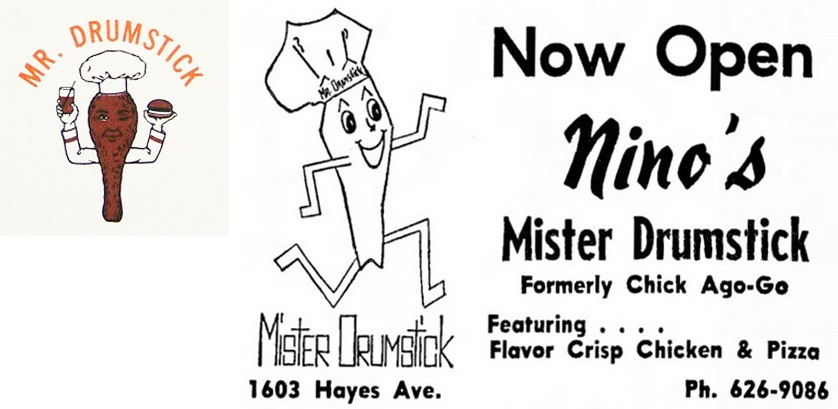
Mister Drumstick, born in Atlanta, offered the World’s Best Fried Chicken. I can’t help but wonder why he is holding a hamburger rather than a chicken leg. Maybe it was because his franchise was sold in connection with Mister Sirloin, a roast beefery, as well as Mister Hamwich, a ham sandwich purveyor. So far I’ve found four Mister Drumsticks in Atlanta and a few in Illinois, Ohio, and Missouri. Nino’s Mister Drumstick in Sandusky OH looks more athletic than Atlanta’s, but of course he has the advantage of legs. Was he a go-go dancer in an earlier phase of his career?
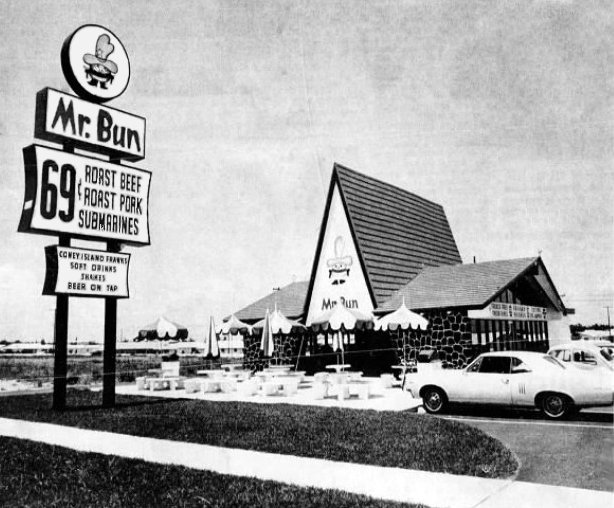
I like the Drumsticks, but my favorites are Mister Bun and Mister Sandwich (of New York City!). They are so versatile. They can handle anything that goes between two slices of bread. I don’t know what Mister Sandwich looked like but Mister Bun was a strange one, with his extremely short legs, his six-guns, and his 10-gallon hat. I can’t really figure him out. Is he trying to compensate for being nothing but bread?
The three Florida creators of Mister Bun had high hopes in 1968 when they opened their first location in Palm Beach, with plans to add more outlets in Florida as well as a number of other states where investors were interested. They advertised for franchisees by telling them that Mister Bun featured “the eight most popular food items in this nation.” It was true that Mister Bun could hold almost anything, so they settled on roast beef, cold cuts, roast pork, frankfurters and fish, accompanied by french fries and onion rings, and washed down with a range of beverages, including beer. Alas, Mister Bun had a rather unhappy life, experiencing little growth, abandonment by his primary creator, and time in court.
Females seemed to stay out of the game, so there are no Mrs. Buns, Mrs. Beefs, Mrs. Tacos . . . or Miss Steaks. Maybe theirs was the wiser course.
Driving around Connecticut a while back I noticed signs with the unfamiliar terms “lapizza” and “apizza.” Occasionally since then I’ve wondered what accounted for the deviation from the commonplace word “pizza.”
Thanks to a recent round of fundraising on Connecticut Public Television, when they featured showings of Pizza, A Love Story, I found out why pizza was spelled that way. Watching the show, I heard the word apizza pronounced – repeatedly – for effect. Can you say ah-BEETS? That pronunciation is Neapolitan dialect, a simplification of la pizza. New Haven CT is hailed as today’s apizza center of the U.S. by its dedicated fans who probably would refuse to even enter a pizza chain’s parking lot.
In fact, it’s impressive that in 1978, when Pizza Hut had expanded to over 3,000 units nationwide, none was listed in New Haven’s City Directory. However, there were at least 31 pizza places in that city then, ten of them with apizza as part of their name. One of the pizza restaurants in New Haven was that of Fancesco “Frank” Pepe, initially a baker, who started making pizza in 1925. [1960s postcard shown at top of page] Today Pepe’s Pizzeria Napoletana is a small New England chain that has won many awards.
Although the word apizza came into common usage in advertisements in Connecticut newspapers in the 1930s – not just in New Haven but also Bridgeport, Meriden, and other cities – it remains in use today in many of the state’s Italian restaurants. I haven’t run across any descriptions of the Connecticut apizza of earlier days, but it’s unlikely that it was the cheese-delivery vehicle that most Americanized pizza has become. In the early 20th century Neapolitan pizza was described as a somewhat puffy, foldable crust typically topped with cooked tomatoes, grated cheese, oregano, and/or anchovies.
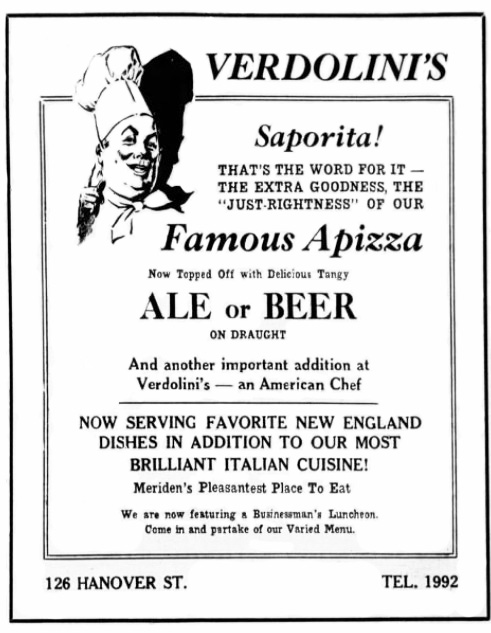
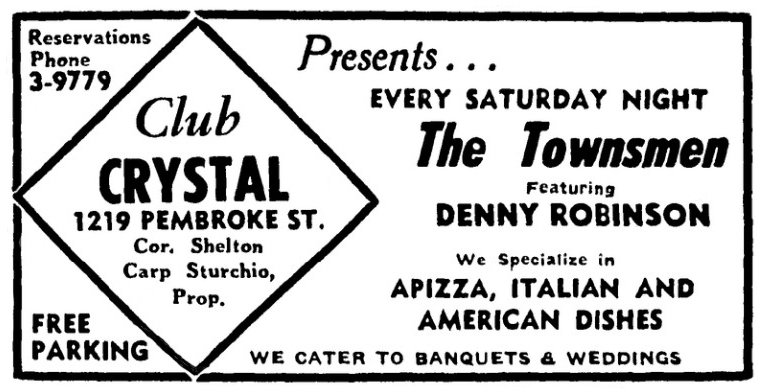
From the start in Connecticut and a few other parts of the Northeast, as well as California, pizza was take-out food, often bought at a bakery. But after Prohibition ended, it expanded into casual eating spots in Connecticut cities. Many of its purveyors ran taverns or other night spots, some of which featured it only on weekends. [below, Club Crystal, Bridgeport, 1940s] It was more of a snack than a meal, something to enjoy with friends. Beer was the favorite liquid accompaniment. As Meriden CT restaurant owner Vincent Verdolini put it in 1939, “beer to a lover of la pizza is like whipped cream to strawberry shortcake.”
Until the 1950s, most apizza consumers were Italian-Americans, many of them workers in Connecticut’s factories. Happily for them, pizza was inexpensive (in 1940, roughly 25¢ for small ones and 45¢ for large) and sellers delivered to workplaces. Early advertisements aimed at Italian speaking customers appeared in Italian-language newspapers such as La Sentinella in Bridgeport.
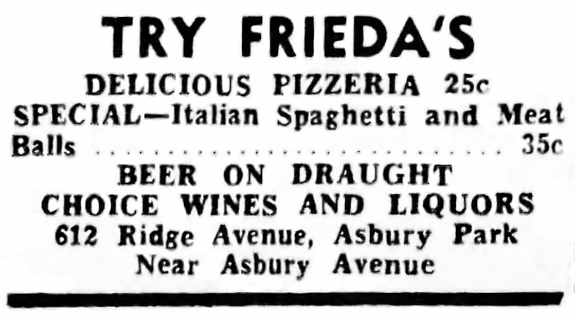
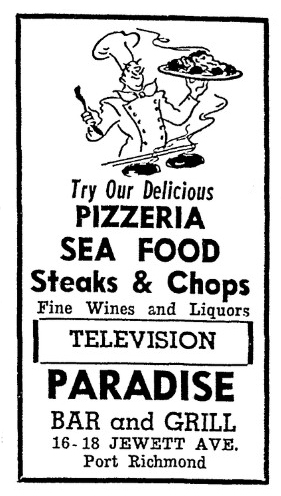
As I searched for the history of apizza in Connecticut, I happened upon another name for pizza, one that really surprised me because its meaning has shifted: pizzeria. Now a common name for a pizza parlor, at one time it was a word for pizza itself, as is evident in the advertisement for “delicious pizzeria, 25¢” at Frieda’s in Asbury Park NJ in 1936, shown above, or at the Paradise Bar and Grill on Staten Island in 1947 below.
For several decades restaurant chains have dominated the pizza market, making it all the more interesting that apizza, the word and the food, has survived.
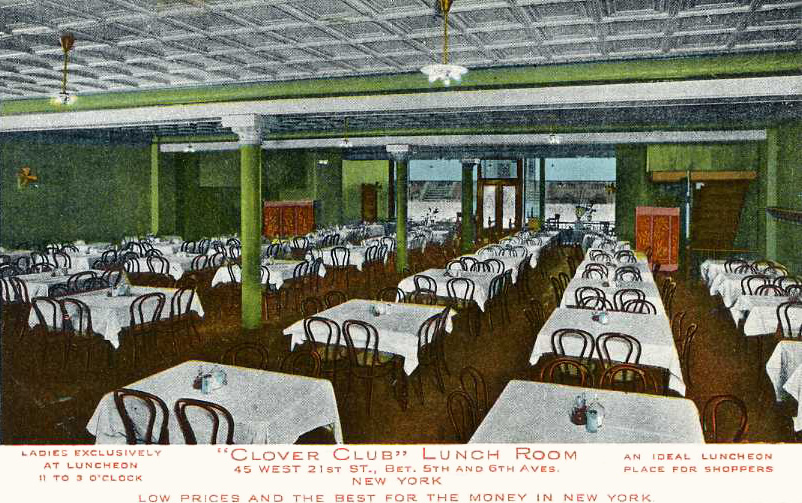
Lunch clubs for working women appeared in American cities in the 1890s and early 20th century. In a fairly short time they stimulated the development of commercial cafeterias, as well as employee cafeterias in large companies.
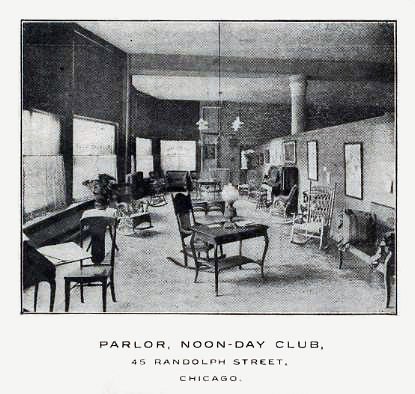
Chicago was regarded as a prime incubator of the lunch club idea. In 1891 a group of alumnae of the prestigious Ogontz finishing school near Philadelphia opened a space for women workers on an upper floor of Chicago’s Pontiac Building. At the start the club charged 10 cents a year for membership, and sold sandwiches for 4 cents and milk, tea, or coffee for 2 cents each.
By the end of the nineteenth century, women’s lunch clubs could be found in other major cities, including New York, Philadelphia, Boston, Cleveland, and San Francisco, but not in the South. Some, such as three in NYC, were affiliated with churches. In Indianapolis, temperance supporters – members of the W.C.T.U. — ran a lunch club.
The lunch clubs were meant to provide not only inexpensive noontime meals for working women, but also to give them a place to enjoy a little leisure in “rest rooms” supplied with sofas, rocking chairs and desks, as well as libraries and other amenities. Some offered evening lecture series.
The clubs came at a time when the number of office workers in cities was on the increase. The clubs mainly catered to “business women,” which then meant young white-collar workers in offices and department stores. Although women factory workers had a greater need for restful and inexpensive lunches than did office workers, their shorter lunch breaks and lower pay made it difficult to accommodate them.
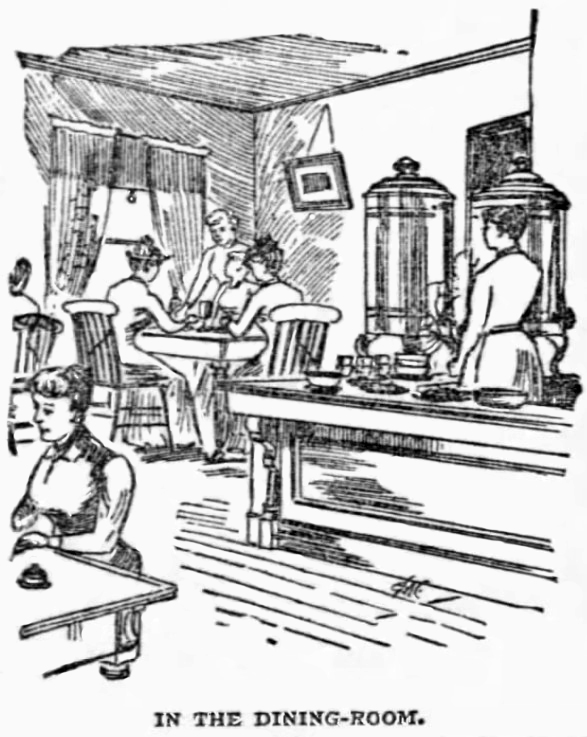
The earliest lunch clubs were launched by elite women as philanthropic projects to assist workers with affordable lunches, give them a place to hang out at noon, and to uplift them culturally. The food was not cooked on site, but supplied by other kitchens, such as that at Jane Addams’ Hull House in Chicago. To avoid the cost of hiring servers, food was set out on counters and diners selected what they wanted, a novel arrangement in the 1890s. [Above: Chicago’s Ursula lunch club, 1891] Prices were meant to cover costs but not to make a profit.
Lunch clubs had to tread a fine line in terms of how philanthropic backers related to the working women. At least one of the philanthropic lunch clubs made its lunchers feel pitied and failed to attract enough women. Those who had stuck with it then took it over as their own co-operative enterprise. Some other lunch clubs were begun as co-operatives. [Above: postcard of a commercial lunch club that admitted men]
A humorous turn-of-the-century story characterized the uneasy feeling of some working women toward philanthropy. In it, a wealthy man approaches a young sales clerk in a department store to say that he is thinking of starting a Noon-Day Rest Club, “where you and the others may come and drink Tea and listen to me read Advice to the Young.” She replies, “That would be lonely Billiards, wouldn’t it? We don’t want to be rounded up and sozzled over. Not on your Leaflards. The Poor Working Girl draws a line on having a kind-hearted Gentleman pull the Weeps on her. I think I can struggle along without having you come around to hold my Hand.”
Despite this obstacle, lunch clubs proliferated. The Klio Club’s Noon-Day Rest expanded its menu, adding dishes such as soup, baked beans, and salmon salad. In 1899 a sample menu in one of Chicago’s six lunch clubs might have looked like this: Two slices of bread or two rolls, with butter 5c With jam or cold meat 6c Extra butter 1c Tomato soup, beef hash, Spanish stew 5c Potato salad, sliced tomatoes, cucumbers, cottage cheese 5c Tea or coffee, with cream 5c With milk 3c Iced tea, buttermilk 3c Raspberry ice, lemon ice 5c Vanilla ice cream, tutti-frutti ice cream 5c
The success of serve-yourself lunch clubs spurred the development of commercial cafeterias. Over time it became harder for lunch clubs to attract large numbers of women patrons. Some began to accept men who, after all, tended to spend more for lunch. For-profit help-yourself businesses proliferated. In one case, a dispute at Klio’s Noon-Day Rest led its caterer, Kate Knox, to leave and start her own self-service lunch club business. [Mrs. Knox’s lunch club pictured above] Another enterprising woman, Mary Dutton, operated four cafeterias by 1915 after beginning with a single lunch club.
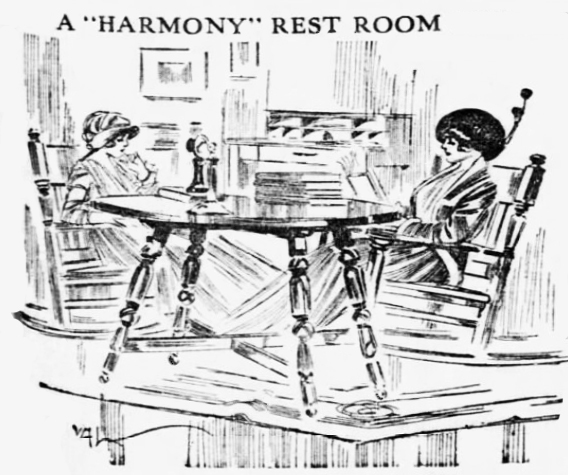
But the lunch clubs made an impact, for a time at least. Boston’s original noon-day lunch club closed because it felt it had elevated the standards of common restaurants. And businesses borrowed ideas from the lunch clubs. For example, The Harmony Cafeteria in Chicago, a commercial business, advertised in 1913 that it featured a basement rest area, with a drawing showing two women in rocking chairs reading books.
In 1958, an advertisement celebrating 40 years in business made the claim that El Fenix was “The Oldest Mexican Restaurant Chain in the U.S.” According to the family of founder Miguel Martinez, he opened his first restaurant in 1918 in Dallas TX. [El Fenix on McKinney Ave. pictured above, ca. 1954]
Of course Mexican eating places, including stands, were not a new thing in Texas. They had been around throughout the 19th century in San Antonio – which of course was part of Mexico for part of that time. A Mexican man and his French wife in Los Angeles were serving tamales, enchiladas, carne con chile, and albondigas in 1881 — along with French dishes!
Martinez had come to the U.S. around 1911 during the upheaval of the Mexican revolution. Then about 21 years old, he left behind a life of hard labor that began early in childhood, with no time for school. Before opening a small café in Dallas, he had worked as a streetcar track layer, a dishwasher, cook, pool hall operator, and barber.
It’s remarkable that he was so successful in the restaurant business – where failure within five years is the norm — and that he and his family altogether carried on the business for 90 years. But I am not convinced that El Fenix was the first Mexican restaurant chain in the U.S., since its true chain development took place after WWII.
Miguel’s first café – not yet named El Fenix — was located in the center of Dallas’ “Little Mexico” barrio, a part of the city virtually abandoned in terms of city services, without paved streets, and full of poorly constructed rental properties, many of which lacked plumbing.
About seven years later, Miguel — who adopted the name Mike – moved his restaurant to a new location, in a brick building that had been a food market. Although I’ve seen earlier dates quoted, the 1926 advertisement shown here suggests it was that year that the restaurant moved to 1608 McKinney Street, an address that would be a primary location until 1965 when construction of the Woodall Rodgers Freeway necessitated moving – across the street. The name Phoenix/Fenix referred to the mythical bird associated with rebirth and survival.
By the 1930s, Mike Martinez was regarded as the big success story of Little Mexico. According to a 1931 account his restaurant had become quite popular with visiting Northerners who came to Dallas to escape cold winters and were looking for something different in the form of enchiladas and chicken mole.
Within five years he had three restaurants. In addition to the El Fenix Café on McKinney [pictured] there was an El Fenix Coffee Shop on Oak Lawn Ave. and a Mexico City Café on Pacific Ave. However, within a few years, the group was down to just one, the McKinney Street address. The manager of the Mexico City Café had bought the business and moved to a new address. About the same time, the Coffee Shop’s manager joined rival El Chico and a grocery store took over its location.
Until the mid-1940s, when Mike Martinez turned over El Fenix to his eight children, the McKinney Street location remained the sole restaurant. It had become a popular place, equipped with a large banquet room and a ballroom annex and hosting many civic and social groups. The restaurant’s owners, now the second Martinez generation, soon began to build El Fenix into a chain. [Oak Cliff location, opened 1948]
Despite the popularity of Mexican food with certain Texans and out-of-town visitors, it appears that many patrons were not fans. El Fenix, like other Mexican places, found it necessary to offer standard American restaurant fare as well. Judging from advertisements, the American menu was often promoted more actively than the Mexican, suggesting that it took a while for many Dallasites to develop a taste for Mexican food, even when it was prepared to appeal to “Tex-Mex” preferences. Although the McKinney café redecorated with a Mexican theme in the mid-1930s, the menu featured standard American restaurant fare such as steak, fried chicken, fish, and shrimp, spaghetti and meat balls, combination salads, and french fries in addition to Mexican dishes. With the end of Prohibition, it began to offer alcoholic drinks, which no doubt expanded its appeal as a dinner venue.
In 1950 the family opened the first Oklahoma City restaurant [see above advertisement], then came new locations in shopping plazas. Meanwhile, the chain also produced much of its own food for sale, including candies, tacos, tamales, and canned chili. [below, Casa Linda Plaza El Fenix, ca. 1957]
By the 1960s, Mexican dishes formed a more prominent place in El Fenix advertising, with specialties such as “crispy” puffed tortillas filled with spiced beef, chili con quezo, or fried beans. With the opening of their restaurant at Lemmon and Innwood in 1960, tagged the “most elegant Mexican restaurant in the Southwest,” an advertisement touted its fare as “the ultimate in authentic . . . extraordinary Mexican cuisine.”
The chain continued to grow. By 1984 there were 18 El Fenix-owned/franchised restaurants, 11 of them in Dallas, 4 in other Texas cities, and 3 in Oklahoma City. Two went by other names: Don Miguel’s, in Addison TX; and Taco Burrito, in Oklahoma City. [pictured above, Galleria Mall, Houston]
In 1998 newspapers reported that the other venerable Dallas chain, El Chico, was set to buy El Fenix, but the deal fell through. Ten years later El Fenix – then consisting of 15 restaurants — was sold to the Firebird Restaurant Group which continues to own it.
It's great to hear from readers and I take time to answer queries. I can't always find what you are looking for, but I do appreciate getting thank yous no matter what the outcome.
So, e-mail me!




















 It's great to hear from readers and I take time to answer queries. I can't always find what you are looking for, but I do appreciate getting thank yous no matter what the outcome.
 Restaurant-ing through history