Category Archives: food

The dessert course

Not only have American’s favorite desserts changed over the course of history, but so has the meaning of the word dessert as used on menus.

In a series of articles in 1879, Lorenzo Delmonico explained the meaning of courses as presented in a proper French dinner. For a start, he explained, “when people believe that each dish served separately is a course in itself they have got the whole matter dreadfully mixed up.” There were only three courses, he stated. The first two comprised the “whole dinner” and the third, he wrote, “contains only the dessert.” Just how many dishes were presented in each course was entirely up to the host.

Sounds simple, but here’s where it gets confusing: the second course is accompanied by “Entremets” that are “the smaller dishes of the second course, including such puddings and pastries as may be served . . .” The third course – Dessert — comes last and “consists of ices, fruits, nuts, coffee, etc.” Today, we would consider the Entremets as Dessert.

Under Charles Ranhofer, Delmonico’s chef for most of the years from 1862 to 1896, Sweet Entremets continued to be presented with the Roast course, followed by Desserts as laid out by Lorenzo. At Delmonico’s Beaver Street location in 1899, for instance, an a la carte menu listed Entremets consisting of such things as Charlotte Russe, Peach Pie, and puddings, while Desserts included the subheadings Fancy Creams, Creams, Water Ices, Sorbets, Fresh Fruit, and Cheese.

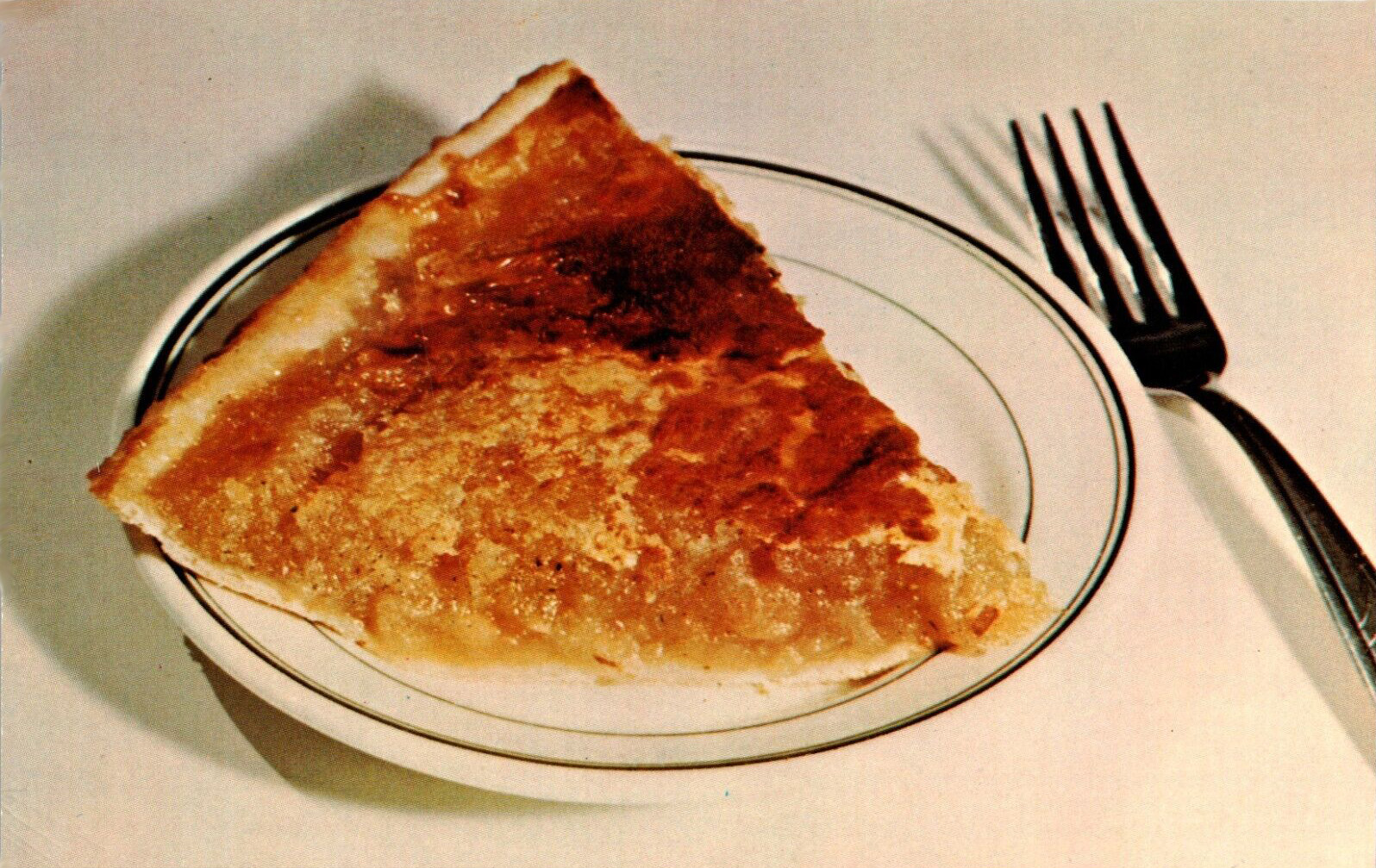
Not surprisingly, cheap eating places had completely done away with courses decades earlier. For instance, at Milliken’s Beefsteak & Coffee Room in New York in 1849, there were only two categories: Dinner (i.e., meat) and Dessert. Dessert consisted of a choice of one custard and seven pies — Cocoa Nut, Plum, Mince, Peach, Apple, Indian, and Rice.

But even in far-off San Francisco end-of-meal choices reflected something like a formal menu, but with a different organization. In 1887, the ever-busy Royal Dining Saloon presented five categories of sweets in this order: Fruit, Puddings, Pies, Cakes – and then Desserts! Desserts included Peaches and Cream, Cranberry Sauce, Apple Sauce, New Comb Honey, Hot Mince Pie, various stewed and baked fruits, and Ice Cream. So, Mince Pie was a Dessert but other Pies were not?

Across the land there were other logic-defying variations. But probably no one really cared about logic. They saw what they wanted, ordered it, and that was that.

Overall, it would be cheap eateries such as Milliken’s that prefigured a 20th-century in which all the end-of-meal categories would be boiled down into one: Desserts. Not only that – the offerings in that category at popular eateries, as at Milliken’s, would remain primarily Pie and Pudding for decades.

But it seems that women preferred cake. As more unescorted women patronized restaurants in the 20th century, and tea rooms catering especially to them opened, this difference in their dessert preferences made itself known. Tea rooms began to specialize in cakes, selling them whole to take away as well as portioned for meals. For example, a pop-up Suffrage kitchen opened in Chicago’s Loop in 1914 offered a 35-cent lunch of salad, sandwich, and beverage, plus a dessert of cake and ice cream for an extra 15 cents. A notice read, “if the luncheon is served to men pie a la mode.”

Of course tea rooms did serve pie, and other desserts too, but it is striking that many lunchroom menus did not include cake. Perhaps for the average eating place layer cake was too difficult to frost, slice, or keep moist when portioned in advance. My sense is that it was also considered a more refined dessert suited to female tastes, whereas pie was an older, heartier, basic food.

Tea room proprietors were well aware of women’s attraction to cake. As Fanny Evans of Mary Elizabeth’s in New York said in 1923, her tea room knew how to cater to American women’s love of unusual salads, creamed chicken, croquettes, and “delicious home-made cakes.” In 1933 the proprietor of the Ipswich Tea House in Massachusetts, a graduate of Miss [Fannie] Farmer’s School of Cooking, prepared special menus titled “A Meal for Men” and “A Ladies Luncheon.” The men’s meal ended with Ice Cream Pie and the women’s finished with Meringue Cake.

In the Depression Americans turned to desserts to cheer themselves up. According to a 1932 NYT story “the American’s Real Desire Is More Dessert,” driven by a wish for glamor, romance, and “the desire for escape from the standardization of the machine age.” Plus desserts yielded high profits. Schrafft’s was way ahead of the game. As early as 1929, the 181 Broadway location in New York offered 34 different desserts!

After WWII, returning soldiers as well as civilians were hungrier than ever for desserts. A 1946 manual advised restaurateurs that a winning menu formula was to have as many desserts as entrees, 7 to 9, but no more than 4 green vegetables.

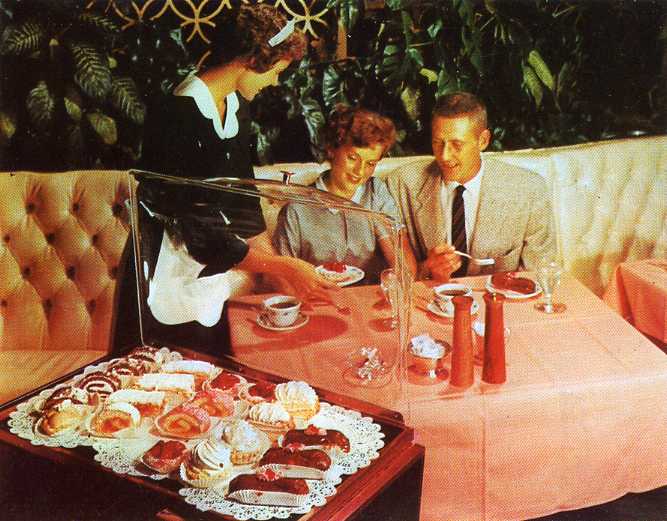
In the average eating places, apple pie was crowned the favorite American dessert until the 1970s, while layer cakes tended to vanish from the restaurant scene. But pie would not do for luxury diners. As demonstrated on a 1951 menu from Ciro’s in Hollywood, expensive restaurants gravitated to less common, fancier desserts such as Parfaits, Crepes Suzettes, and Baked Alaska. Dessert trays and carts bearing French pastries also came into use, while a flaming dessert was always a possibility worth considering.

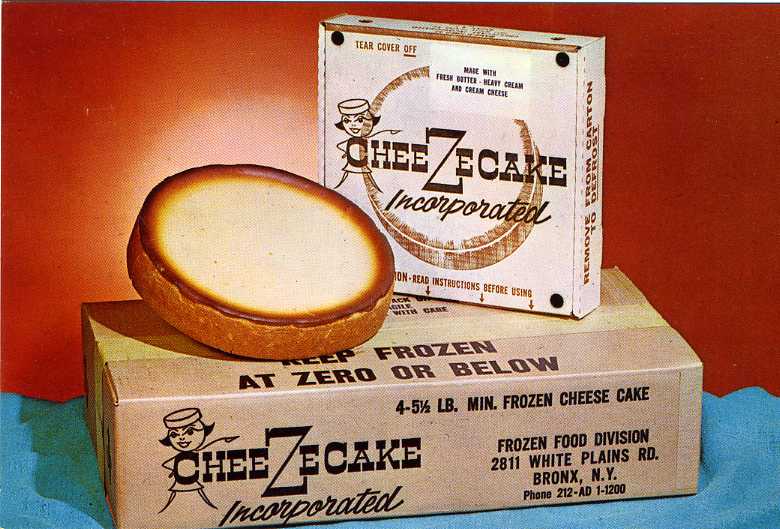
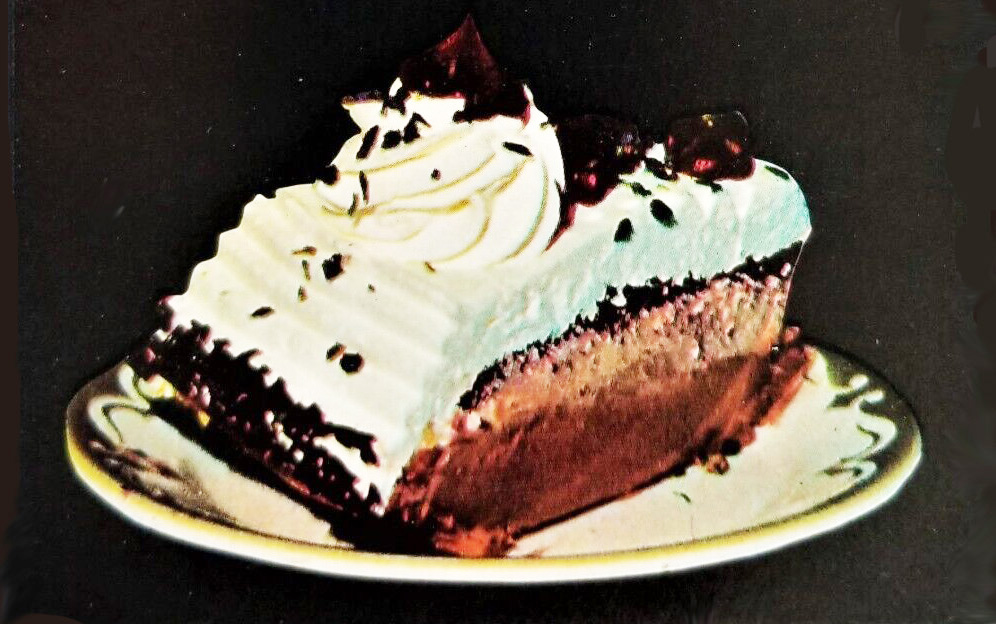
In 1996 a National Restaurant Association survey of restaurants found that the most popular desserts were cheesecake and pie. That is, cheesecake of the sort most commonly served today, made with cream cheese rather than cottage cheese. The latter was a very old sweet dish dating back to the early 1800s or earlier. Unlike some other factory-made desserts, cheesecake has the advantage of being regarded as genuine even when it comes frozen in a box. I am somewhat skeptical about this survey, though. How could it be possible that chocolate desserts weren’t mentioned when they had been advancing rapidly in popularity since the 1970s?

© Jan Whitaker, 2023

3 Comments

Filed under food, menus, restaurant customs, tea shops

In their own words

I’ve collected numerous provocative comments about restaurants over time. Most of the following samples are excerpts from diaries, others from newspaper interviews. I selected them mostly because they were informative about restaurant conditions and practices at various times in the past, as well as patrons’ experiences.

There are some recurring themes. A number of the comments reveal women’s opinions of restaurants and their roles in them. Others show how unfavorably foreign travelers tended to view American eating places during the 19th century. Several comments reveal the high prices and deteriorated conditions that prevailed in the South during the Civil War.

1825, a Boston portrait engraver: “In the evening, at 8 P.M. we called on Mr. Allston at Rouillard’s Restorator. Found him at dinner; we sent up our letters . . . ; after waiting a few minutes Mr. Allston entered the parlour, and received us very cordially. He took us up to his dining room (quite private) and invited us to partake of his wine and cigars.”

1850, daughter of James Fenimore Cooper, in Cooperstown: “Then, again, there are seven taverns in our village, four of them on quite a large scale. As for the eating-houses – independently of the taverns – their number is quite humiliating; it looks as though we must needs be a very gormandizing people: there are some dozen of them – Lunches, Recesses, Restaurants, etc., or whatever else they may be called . . .”

1861, a Confederate clerk, in Richmond VA: “Mr. Tyler then invited me to join him at breakfast at a neighboring restaurant, where we had each a loaf of bread, a cup of coffee with milk (but brown sugar), and three eggs. The bill was sixteen dollars!”

1861, an Irishman visiting Montgomery AL: “Then, as to food – nothing could be had in the hotel – but one of the waiters led us to a restaurant, where we selected from a choice bill of fare, which contained, I think, as many odd dishes as ever I saw, some unknown fishes, oyster-plants, ‘possums, racoons, frogs, and other delicacies, and, eschewing toads and the like, really made a good meal off dirty plates on a vile table-cloth . . .”

1861, and then the Irishman visited Washington: “I dined at a restaurant kept by one Boulanger, a Frenchman, who utilised the swarms of flies infesting his premises by combining masses of them with his soup and made dishes.” [To be fair, Joseph Boulanger was in ill health and had been trying to sell his restaurant for a while when the visitor from Ireland came along.]

1864, a visitor to New Orleans: “Charges for living were most exorbitant; a simple breakfast at a restaurant, one dollar; a frugal dinner, two dollars; two small slices of dry toast, fifteen cents; the same for a cup of tea or coffee; ten cents for ice and butter; sixty cents for one small mutton chop. The simplest fare cost six dollars a day.”

1883, a touring Englishman in San Francisco: “After dressing, we all went to the ‘Poodle Dog’ restaurant to dinner. Here my sister Sarah behaved in an extraordinary way, affecting a morality which appeared to me immoral, and questioning the propriety of dining at this place.”

1893, a woman attending the Chicago World’s Fair: “Then we went to Rector’s Marine Restaurant [shown here], and on its breezy gallery had the swellest sort of little dinner. (The first glimpse of the menu made me faint. All the salads were .60 & .75, the fish all .60 & .75, relishes .25 & .30, vegetables .30 & .40, ice cream .25 . . .)”

1921, a European woman visiting New York: “We ordered some steak for our dinner, and when the waiter brought enough for a school treat I exclaimed, and he said, ‘In Broadway they serve the dishes — here we serve the food!’ They did indeed; even sharing it with a starving cat I couldn’t get through with it. The restaurant was rather a good one and very clean. I reproached Kenneth for not having taken me somewhere with more local color. I hate being treated as a Bourgeoise.”

1951, a male peace activist traveling across the country: “Another group, two whites and a Negro, stopped for coffee at a lunch counter in Maryland. The counter woman brought two porcelain cups and one paper cup. When the white man gave the paper container to the white woman and not to the Negro, the counterwoman said, ‘We’re not allowed to serve colored, it’s against the law.’. . . On the wall, all red-white-and-blue, was a poster which read, ‘If you don’t like this country, there are boats leaving for Russia every hour.’”

1970, a New York book editor: “First we went to Chez Vito and all I had was spaghetti and wine and iced tea. And the check was $6. My God.”

1973, a group vice-president of Howard Johnson’s: “I think anybody who’s not using convenience foods is out of it. And some of the prepared food around today is top quality. You’d never know the difference. We’re going to open a restaurant a week this year, and where could we get cooks and chefs for this kind of expansion? Even if we could get them we couldn’t train them fast enough.”

1989, a woman chef trained at the Culinary Institute of America: “Interviewers tell me, ‘You don’t look like a chef. You look like a hostess. How can people work around you? Or they ask, ‘Do you mind getting dirty?’”

© Jan Whitaker, 2023

5 Comments

Filed under food, patrons, racism, restaurant prices

Irish restaurants & pubs

Opening an eating place or a tavern was popular with immigrants – especially the Irish — for much of the later 19th century and into the 20th. They served as waiters, waitresses, kitchen workers, and proprietors.

And before World War II, when it was easy and inexpensive to open an eating and drinking place, they started many a restaurant, becoming the leading nationality in the business according to restaurant insider J. O. Dahl. Although he had no established figures to go by, judging from “numerous interviews and personal observation over a period of twenty-five years,” he estimated in his 1935 National Handbook of Restaurant Data that the Irish made up 18% of restaurant keepers.

The restaurants run by Irish immigrants were not usually identified as Irish, nor were they particularly appealing. Many fell into the category of “hash house,” generally viewed as the lowliest sort of eating place. Neither hash house proprietors nor those who ran finer spots made any mention of being from Ireland.

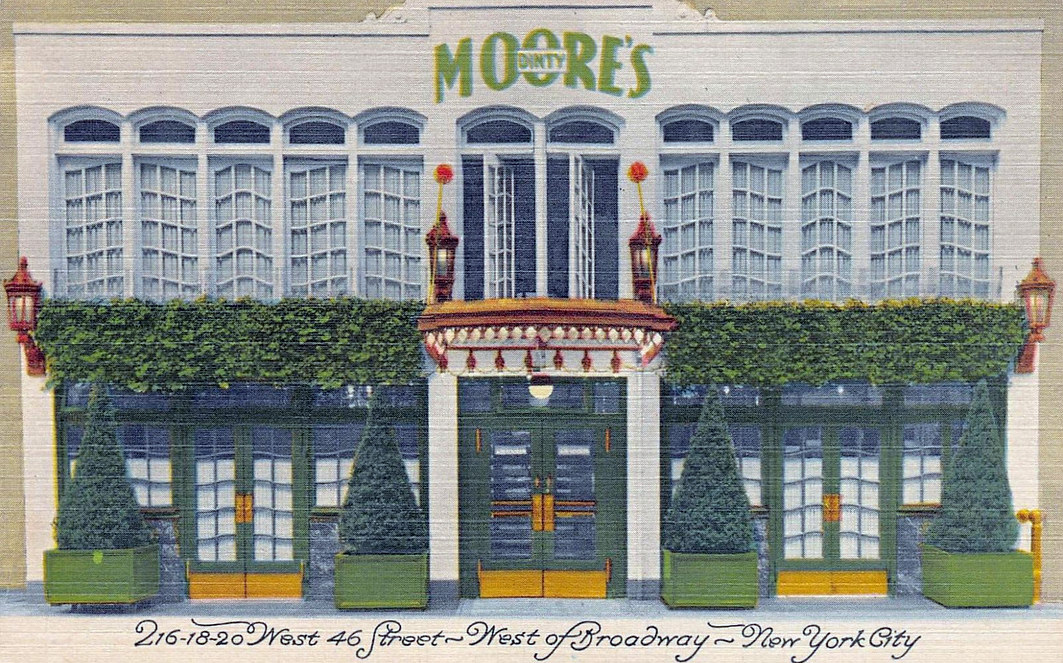
There were also numerous restaurants in New York City in the late 19th and early 20th centuries, run by well-known men of Irish birth, that were bigger and more prosperous. Typically they were oyster or chop houses that drew tourists and theater-goers. Among them was the prominent Shanley’s, established by Shanley brothers in the 1890s, and Dinty Moore’s, begun by James Moore whose name and fame were due to a comic strip. [above: Life with Father, 1923, by Jim McManus] Like many of the others, Shanley’s was put out of business by Prohibition, while Dinty Moore’s survived despite being “busted” time and time again.

In 1887 a journalist noted that “there is not an Irish restaurant in all these blessed United States.” He was wrong, but could his error have been due to the reticence of Irish businesses outside of New York’s entertainment districts regarding their heritage? He called on someone to explain why this was, “for of course it is significant of something.” Many immigrants sought to shed their difficult pasts and become “American,” but it’s hard not to wonder if the absence of overt ethnic identification also had something to do with the nativist “Know Nothing” movement of the 1850s that was based on fear that Catholic priests conspired to undermine Protestant values.

Whatever the reason, most Irish restaurant proprietors continued to keep a low profile in the 20th century. The resurgence of the Ku Klux Klan in the 1920s, now targeting Irish and Jewish citizens as well as Black Americans, may also have been a factor. An Irish-born family that opened a tavern in Indianapolis in the 1930s called the Golden Ace Inn later revealed that they had avoided choosing a name that would reflect their ethnicity because of its unpopularity. In 1937 they had tried out the name Erin Go Bragh but changed it back after they lost customers.

Most early Irish-run eating places had very little in common with the Irish pub type of eating place that would begin to appear in the 1960s, when the term “ethnic restaurant” came into use. But even then, they were often snubbed in guide books, not out of prejudice against the Irish so much as dislike of their cuisine. The Underground Gourmet series, for instance, did not recommend or “discover” Irish eateries or cuisine. Rather, the books’ alphabetical indexes typically jumped from Indian to Jewish. The author of New Orleans’ Underground Gourmet, Richard Collin, said in a no-star review of Molly’s Irish Pub that “Irish food at its best has a somewhat limited appeal.” As late as 1990 a columnist in Columbus OH included in his St. Patrick’s day restaurant survey several jokes about how bad Irish food was, adding that restaurant reviewers and food editors shared the opinion among themselves that there was no such thing as a good Irish restaurant.

Corned beef and cabbage? That was a dish that appeared on a variety of 19th-century menus before it was widely defined as Irish. For one thing, corned beef, or any meat that was preserved in barrels with salt, had been available throughout the 19th century (and earlier), and was not identified with any particular nationality. [above advertisement from 1788] And in 1850 McKenzie’s Exchange in New Orleans offered corned beef and cabbage, right along with curried frog and barbecued gopher. Hudson’s department store in Detroit put corned beef and cabbage on an 1896 summer menu. [see below]

Even the Irish did not universally love corned beef and cabbage. Many Irish women worked as domestic servants and one of them reported in 1902 that servants got better food if they worked for millionaires with few rather than many servants. In those cases, she said, you ate the same food the rich did, such as chicken, rib roasts, strawberries, and ice cream. But in households with a large number of servants you would be eating inferior dishes such as corned beef and cabbage.

Yet corned beef and cabbage grew in popularity in the later 20th century, at least for one day out of the year, and became strongly identified as Irish. But the real winner in Irish restaurants, or what might in many cases be called Irish-themed restaurants, was the pub concept that gave restaurants the ability to stay open later with drinks and light fare, generate male appeal, and build upon the popularity of “good cheer” that had come to be associated with Irishness. Some featured Irish folk singing [above advertisement, Charleston SC, 1986], while the Irishness of others rested entirely on decor and market-tested names.

Although corned beef and cabbage remained on the menu of Irish restaurants – especially on St. Patrick’s day — fare tended toward hamburgers and steak. In more recent years, reflecting changes in Irish restaurants and new approaches to traditional fare, some restaurants have emerged in the U.S. that explore what is considered authentic Irish cuisine. An Irish cuisine ambassador noted in 1998 that, “Chefs coming from Ireland to the United States are melding the finest provisions into such nouveau recipes as Irish smoked salmon salad with citrus dressing, Gaelic potatoes, and Irish oatmeal apple crumble with Irish whiskey cream.”

Sláinte!

© Jan Whitaker, 2023

8 Comments

Filed under ethnic restaurants, food, proprietors & careers, theme restaurants

America’s literary chef

One way or another Othello Pollard found ways to make a big impression in Cambridge MA in his relatively short tenure there as a caterer and restaurateur.

In 1794 he was listed as a member of The African Episcopal Church of St. Thomas, in Philadelphia, said to be the first “African” church in America. A short time later he came to the Boston area, marrying a woman in 1799 who kept a boarding house there.

Although I couldn’t find anything about where he was born, I suspect he may have been a freed slave from Haiti, then known as Saint Dominigue.

In 1801 he and his wife moved to a site on Tremont Street in Cambridge MA across from “the mall,” a shaded walk. They were near the Columbian Museum, which housed wax figures and advertised “curiosities” that included an elephant that drank liquor.

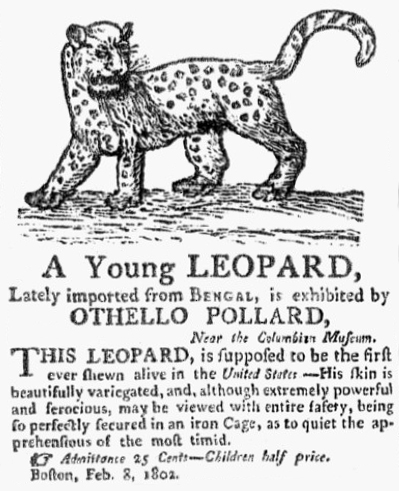
Othello knew how to get attention, for instance by wearing a diamond pinkie ring. In 1802, about six months before he established his eating place “for ladies and gentlemen,” he advertised an attraction perhaps inspired by the Museum: a live leopard.

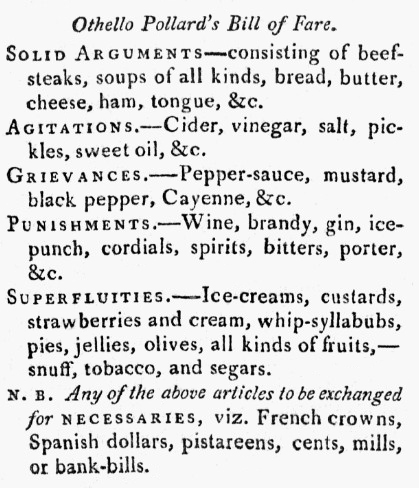
Maybe the leopard was not as big a draw as he had hoped, though, because in August 1802 he placed an elaborate advertisement for his “Attic Bower” supplied with “epicurean dainties” such as bread, butter, cheese, ham, tongue, ice cream, custards, “whip syllabubs,” pies, jellies, olives, pickles and all kinds of fruit, along with wine, brandy, gin, ice punch, cordials, spirits, bitters, and porter.

His advertisement was peppered with classical allusions and Latin phrases, such as in the above excerpt, roughly translated, “Where are you taking me, Bacchus?” According to The Wine Bible, ancient Falernian wine was so sought after in its time that “you practically had to be the emperor of Rome to get a taste,” so his claim to have some might have been a gimmick.

A short time later, he ran a longer advertisement with an expanded bill of fare [shown above] that included heartier food – introduced under intriguing headings – and indicated to patrons what kinds of money he would take in exchange.

No one could quite decide if he had composed his unusual advertisements himself, or whether the author was one of his regular visitors from Harvard who, perhaps, offered his writing skills as payment while short of funds.

When a fire wiped out his Attic Bower in 1803 he moved farther along Tremont, next door to a tavern, and appealed once again to “gentlemen of delicate taste, and well educated appetites.”

A little more than a year later, he moved again in the same general vicinity. In 1805 he notified Harvard students that he would not be able to entertain graduates as he had done for the past four years because he did not have enough space.

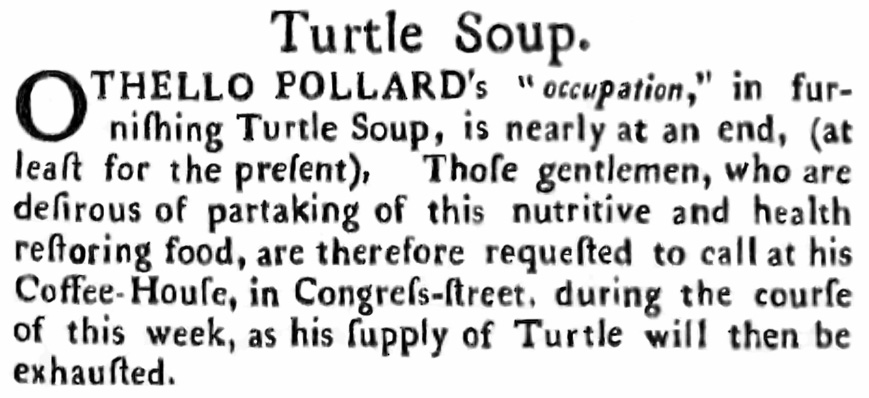
His last location seemed to be in Boston, where I found an advertisement for his coffee house in 1805. He simply mentioned having turtle soup, worded with what could be read as a resigned tone. Then he just seemed to disappear. He still remains a mystery, even though articles recalling him continued to appear as late as 1908.

© Jan Whitaker, 2023

6 Comments

Filed under food, Offbeat places, proprietors & careers

The smörgåsbord saga

Swedes began immigrating from rural Sweden to the United States in significant numbers in the 1870s, but it took a while before Swedish smörgåsbords were introduced to the American public. The earliest ones opened in cities in the 1910s, but even in the 1930s proprietors still found it necessary to explain the concept to Americans who were not of Swedish ancestry.

In 1912 a self-proclaimed high-class Swedish restaurant called Henry’s opened in New York City [advertisement 1918]. There had been earlier Swedish restaurants in the city but they appeared to serve workers and were unlikely to have offered smörgåsbord. In 1915 another first-class restaurant opened in New York, Scandia, headed by Gerda Simonson. It was the first known restaurant of its kind run by a woman.

It is somewhat surprising that these early examples were in New York City since both Chicago and Minneapolis had larger populations of Swedish immigrants. But it’s likely that at that time NYC restaurants were better able to attract travelers from abroad as well as Swedes living there.

Despite the presence of a Swedish restaurant with a smörgåsbord at the 1893 Columbian Exposition in Chicago, there do not seem to have been many such restaurants in Chicago until the 1920s. They were also evident in Rockford IL. As was true of tea rooms, many were run by women. The Bit of Sweden in Chicago, opened in 1925, billed itself as a tea room, but of course Prohibition was in effect, ruling out the smörgåsbord’s classic accompaniment to herring, a shot of Aquavit. The number of smörgåsbord restaurants increased during the 1930s, particularly after Prohibition ended. [pictured:Rococo House, run by the same woman who introduced Bit of Sweden]

At first it seemed that Swedish restaurants in the U.S. relied heavily on patrons of Swedish ancestry who enjoyed them on Sunday evenings. [above Rockford IL, 1928; kropkokn is a cake] Gradually they drew a non-Swedish clientele, many of whom had as much trouble with the concept of smörgåsbord as they did with its pronunciation.

At their finest, smörgåsbord restaurants achieved a high level of artistic beauty in food presentation as is evident in the above photograph of a New York restaurant in 1939.

Newspaper stories had appeared in the late 19th century explaining that Swedish steamships and hotels furnished smörgåsbord as appetizers before a meal. Patrons took a small plate with a slice of bread and then selected a few items to eat while standing, accompanied with a strong drink and beer. They might have seconds but they did not eat so much that they spoiled their appetite for a full meal which they would soon order from their table.

Non-Swedish Americans, however, tended to see the smörgåsbord as a meal in itself, piling their plates high and often returning for more. Soon restaurants adapted by pricing the smörgåsbord separately. For a higher price, patrons could precede a dinner with smörgåsbord if they chose to. In the 1930s the Bit of Sweden restaurant in Los Angeles went to some trouble to explain how it all worked, devoting a page of its menu to this, and instructing patrons that the correct pronunciation was SMIR-GOES-BOORD (rather than SMAR-GUS-BORD). The restaurant charged $1.50 for smörgåsbord with dinner, or $1.00 without, and included a warning on its instructions page that customers had better eat all they took or they would be charged extra.

Other stories also appeared in the 1930s with instructions on how to handle smörgåsbords. In 1948 well known food journalist Clementine Paddleford explained what she learned from the daughter of the manager of NY’s Three Crowns Restaurant — which made its debut at the 1939 NY World’s Fair. She was told there was a system to choosing from its famed 100 items. First, she wrote, take pickled herring and a bit of herring salad along with a boiled potato with sour cream. On the second visit, more fish – maybe shrimp, sardines, smoked salmon, and a marinated mussel. Trip three might be hot dishes, but alternatively could be cold meats, salads, and cheeses if the diner was planning a fourth trip for hot food.

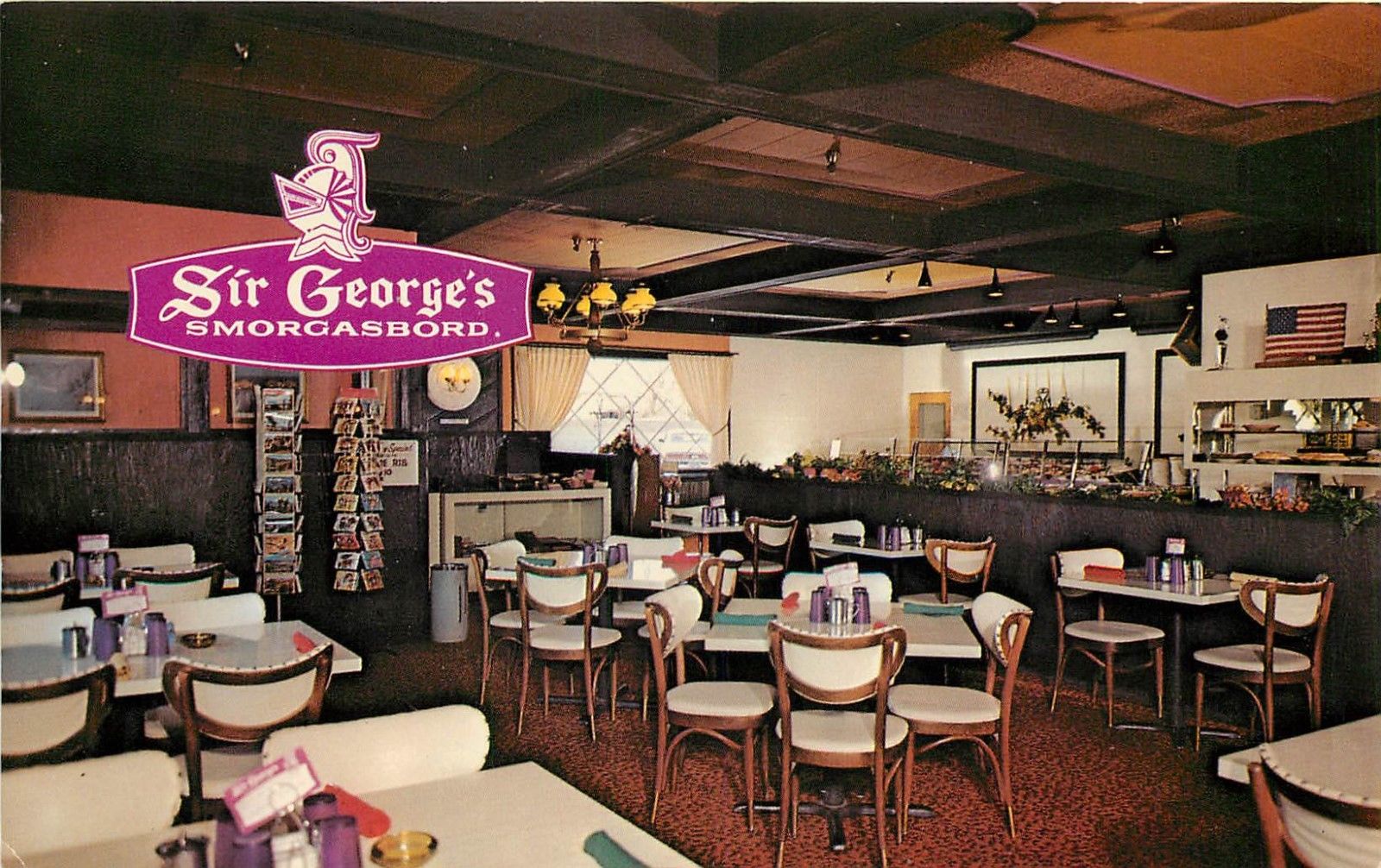
Decades later, smörgåsbord restaurants could still be found, but it seems that the idea of freely choosing food from a spread was being taken over by low-price, no-frills, all-you-can-eat buffets. Some, such as the Sir George’s chain called themselves smörgåsbords, but others named themselves “smorgies.” I doubt many, if any, were owned or operated by Swedish-Americans. [above, Sir George’s in Hemet CA]

As for authenticity, Tracy Nicole Poe explained in her 1999 dissertation that even the early examples of smörgåsbords in the U.S. represented an “invented tradition.” She wrote: “Like other elements of Swedish-American ethnicity . . . the smorgasbord’s origins are more a product of the National Romantic Ideal, and its rituals more concocted from the imagination of community leaders, than they are manifestations of rural immigrant culture. The fact is, most Scandinavian immigrants would probably never have attended an actual smörgåsbord in the classic nineteenth century European sense.”

On the other hand, I think the all-you-can-eat smörgåsbord derivative, though invented, is a genuine representation of American culture.

© Jan Whitaker, 2023

18 Comments

Filed under food, patrons, women

Dinner in Miami, Dec. 25, 1936

Judging from the number of restaurants and hotel dining rooms advertising Christmas or Xmas dinner that year, there must have been quite a few prospective diners around. It was still the Depression but prohibition had ended several years earlier, tourism was well underway, and Art Deco buildings were going up all over.

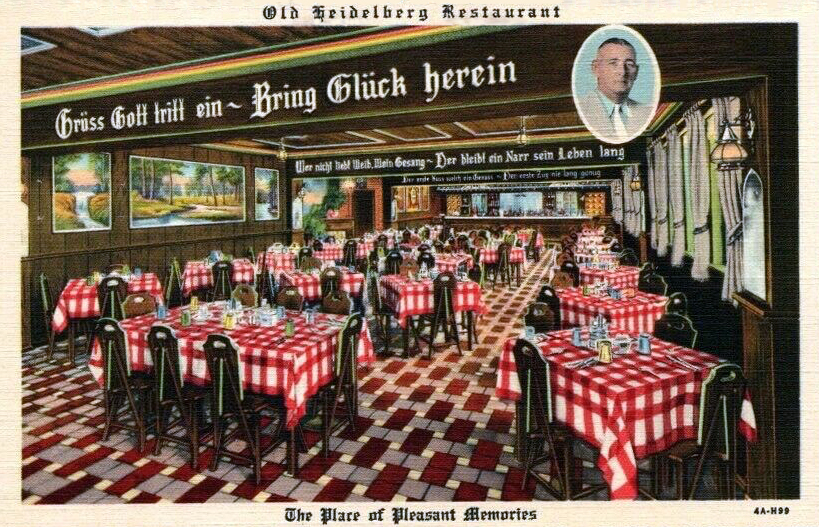
The not-at-all modernistic Old Heidelberg shown above – which had opened in the unfortunate year of 1929 — gave no details about its offerings that day, other than to characterize it as an “Old-Fashioned Dinner.” That’s a fairly meaningless description if you ask me. Given that Germany had withdrawn citizenship from Jews in 1935, this probably was not a restaurant popular with Miami’s Jewish community.

Most of the advertisements mentioned price, not surprising since most people had to watch their spending. They ranged from a low of 50¢ per person to a high of $2.00 at a place called the Rose Bowl, a restaurant specializing in Southern dishes, with a woman serving bread dressed as a “mammy.” Like the Heidelberg, the Rose Bowl made no effort in its Christmas advertisements to tout its dinner or whatever other attractions it might have possessed.

Others went to great length to attract diners. The Big And Little Grill had no end of attractions, including music, “gifts to all,” free parking, a chef who had formerly worked at a New Hampshire resort hotel, and a Santa Claus who once appeared in Charlie Chaplin’s movie “Circus.” All dinners were 75¢. The list of comestibles filled ten wide lines of text. It contained 35 separate items, among them a “Big and Little Salad,” Boiled Lobster Stuffed with Oysters, Supreme of Sole Florentine, Sizzling Steak with Wine, and numerous vegetables and desserts.

The Big and Little offered an equally good deal for its New Year’s celebration, with a return performance of Charlie Little, now in the role of clown. As for its advertisement, as a New Englander I’m obligated to point out that there is no Dixieville in New Hampshire – it’s Dixville.

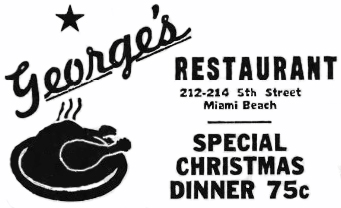
Attraction-wise, the Big and Little was hard to top. But George’s Restaurant tried hard, with even more inches of advertising, not to mention wine and bottled beer. Its 75¢ dinner comprised six courses: Cocktail (tomato juice, half grapefruit, etc.); a soup accompanied by olives and hearts of celery; a choice of five entrees that included Whole Broiled Lobster, Maitre d’Hotel (chances are these were clawless Florida lobsters, considered inferior to Maine’s); a salad; eight vegetables; choice of many desserts (six kinds of pie, a cake, a sundae, ice creams, jello, or stewed prunes). For those who didn’t have big appetites there was George’s Special 50¢ Dinner, which of course offered fewer choices and only half a lobster, but still looked like a bargain.

The Studio Grill’s turkey dinner included wine, which may have accounted for the $1.00 charge. Shortly after it opened a few years earlier, the suburban Miami curb service eatery had advertised for “Girls with Blonde Hair” who were 5’6″ tall, weighed 118 lbs., and had “striking” personalities. Undoubtedly reflecting Depression conditions, 800 showed up. The grill was owned by a magazine cover illustrator and was filled with his paintings of nude women.

The Laura Jacobsen Café, a high-class Chicago transplant, was located in a residential apartment hotel. Her Christmas dinner in the ritzy-looking Colonial Towers accommodating snowbirds from the North was $1.25.

Wherever and whatever you may eat, I hope you will enjoy your holiday dinner.

© Jan Whitaker, 2022

13 Comments
Filed under food, restaurant prices

An early restaurateur’s rise & fall

Life in the 19th century was chaotic and unpredictable in so many respects, but the weird and eventful life and restaurant career of the highly enterprising Mark Langdon Winn, with its succession of ups, downs, and strange twists, would stand out in any century.

As far as his many business schemes went, he never stuck with any of them for long, restaurants included. He bounced around Maine, Boston, New York City, Albany NY, San Francisco, Virginia City NV, and finally back to New York City where he died in 1881. His San Francisco restaurants were the most successful of his enterprises, but despite their promise he held onto them only for about six years.

Before going to California he owned two grocery stores in Boston. Next he went to New York City where in 1843 and 1844 he manufactured and sold a cure-all product called Winn’s Irish Vegetable Relief Candy, good for “weakness of the chest and lungs, liver complaint(s), asthmatic affection, impurities of the blood, dyspepsia and all bowel complaints.”

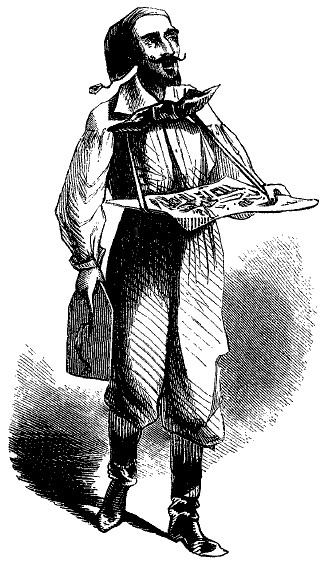
Maybe restless, disappointed by candy sales, or lured by gold, he took off for San Francisco in 1849, age 34, after leaving Albany where his wife and children remained for another couple of years. Borrowing money from a shipmate upon arrival, he began making candy and peddling it in the streets. After a short time he had enough money to open a confectionery with a partner. Before long he was running the business solo and had added bakery goods and simple meals to his offerings.

Fires were frequent occurrences in San Francisco and he was burned out at both of his initial locations in less than a year. In 1851 he opened his principal restaurant on Long Wharf, calling it Winn’s Fountain Head. Despite the abundance of eating places in the city, it rose to prominence rapidly due to its respectability, cleanliness, and relatively low prices. It was unique in heavy-drinking San Francisco for providing no alcoholic beverages. Winn was a dedicated temperance advocate, always emphasizing the cause in his frequent, wordy newspaper advertisements that often contained sermons on the evils of drink.

The Fountain Head was not fancy. Long Wharf (aka Commercial Street) was hardly a fine location. It was a busy street without sidewalks, filled with liquor saloons, gambling dens, and all-night stores. It vibrated with “a heterogeneous crowd” of carriages, horses, carts, and pedestrians. A writer in the March 1854 issue of The Pioneer wondered “Why there are not a dozen or two broken necks there daily.”

The Fountain Head was open seven days a week from 6 a.m. to midnight, with a menu that included a wide range of meats and vegetables, along with puddings bearing such homely names as Aunt Sally’s and Cousin Jane’s. According to a ca. 1853 menu, an order of roast beef, veal, or corned beef and cabbage cost 25c, while most vegetables were 12c.

According to the city’s Commercial Advertiser in April, 1854, the Winn enterprises — by then comprising the main Fountain Head restaurant and a more elegant “Branch” welcoming women with fancy desserts – had attained the pinnacle of success. Together, the story reported, the two places served 3,000 patrons daily, taking in $57,000 a month, and paying out monthly as much as $1,600 for advertising, $8,000 for meat, $4,000 for milk, $3,000 for potatoes, and $2,000 for ice.

But this account was misleading because only a few months later Winn went into bankruptcy.

Following bankruptcy he started up at a new address, combining the Fountain Head and its Branch into one. But things soon turned sour again. In Spring 1856, he and his new business partner dissolved their partnership with the partner taking over the business. Almost immediately after that, Winn’s wife Eliza took advantage of a California law that allowed women to run businesses independently, declaring that she would carry on the “Fountainhead Confectionery and Steam Candy Manufactory” in her name. It appears she continued to run the business of making and selling baked goods and confectionery until 1859. He may have briefly tried to make a comeback at his original address, but in 1859 the Fountain Head on Commercial Street and a confectionery run by Eliza Winn were put up for sale.

Years later, in a Poughkeepsie NY newspaper story of 1878, Mark Winn would blame the failure of his San Francisco restaurants on employees who robbed him. “Every man I employed was a thief,” he said, singling out his secretary, cashier, and cook. With honest help, he claimed, “I would have been worth a half a million of dollars.”

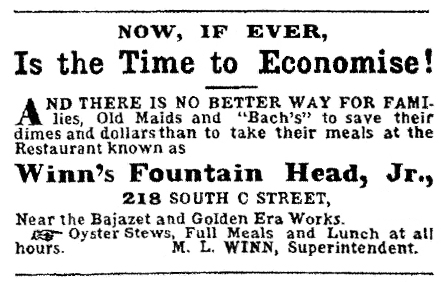
But the Winns’ western odyssey wasn’t over after leaving San Francisco. In 1860 they moved to the boomtown Virginia City, Nevada, where silver had just been discovered. There, Mark Winn struck silver, opened a restaurant and confectionery called Winn’s Fountain Head, Jr., and invested in a hotel. The hotel soon relocated to another city in Nevada and he lost his investment. The fate of the restaurant is unknown but it did not achieve fame as he had done in San Francisco [1864 advertisement]. He tried to sell shares in his silver mine, advertising that “there is no doubt that within the next six months a fair dividend will be made to the stockholders.”

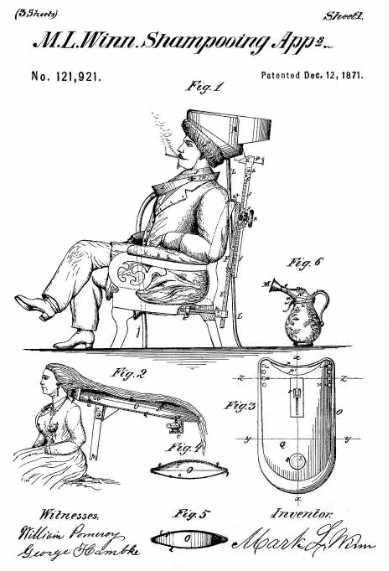
Apparently he didn’t strike it rich, though, because after five years in Virginia City he filed for insolvency and the Winns returned to San Francisco where he began work on the invention of a shampooing device that was patented in 1871 [shown above].

Next, the couple moved to New York City where he deteriorated rapidly, living in destitution and displaying signs of paranoia that had been in evidence as far back as 1854 when he referred to his “enemies” in an advertisement for the Fountain Head. On one occasion he was arrested as a public nuisance, wandering the streets of New York wearing “armor” and a tin helmet (possibly the shampooing device?) while distributing religious tracts. He spent his final days in the Alms House on Blackwell Island where he was described as suffering from “religious mania.” It also came out that his father had been an alcoholic.

Despite the uneven contours of his career as a restaurateur, Winn’s Fountain Head has become a subject of interest, often mentioned positively in a number of books and articles that tell of San Francisco’s early history. It’s presented as a triumphal success, when really it’s a boom and bust story sadly common in the restaurant business.

© Jan Whitaker, 2022

2 Comments

Filed under confectionery restaurants, food, popular restaurants, proprietors & careers, restaurant prices

Runaway menu prices

Restaurant prices are rising during the current inflationary period, but this is scarcely the first time. In fact it’s at least the fourth in little more than a century.

The first was during World War I, particularly after the war ended. In response, many restaurants teamed up for cooperative buying to keep costs under control to a degree. Drugstore soda fountains and other inexpensive eating places gained a thriving lunch business, while first-class restaurants raised prices as they whisked away frills including cloth tablecloths and napkins. The average restaurant operator’s motto became “simpler, cheaper, faster.” In New York, the venerable Mouquin’s hiked steak prices, charging $4.50 for a porterhouse steak with mushrooms that had historically been only $1.00.

The tough business climate combined with Prohibition caused the closure of droves of fancy restaurants such as Delmonico’s, which had been sliding for a while.

Complaints mounted. In 1920 Chicago’s city hall called restaurateurs on the carpet to explain their high charges, as the “Carry-Your-Lunch” movement grew. Boston put a U.S. District Attorney on the job to investigate prices at the city’s popular restaurants, including The Puritan and The Pilgrim.

Restaurant workers wanted raises, but it was a bad climate for strikes. Chicago’s 1000-seat faux-luxe North American Restaurant sacked their striking waiters and installed a cafeteria line. Their advertising copy assured customers they didn’t need to tip because “There was no one there to tip.” At the same time the North American’s advertising championed low prices, the ballyhooed bargain-priced “whole baby lobster” shrank to half a baby lobster. Did they think customers wouldn’t notice?

Although World War II also raised restaurant prices, that did not dampen patronage by war workers who enjoyed higher wages than ever. The president of the Society of Restaurateurs reported that from 1941 to 1944 New York City’s 19,000 restaurants went from serving 3 million to 8 million meals a day.

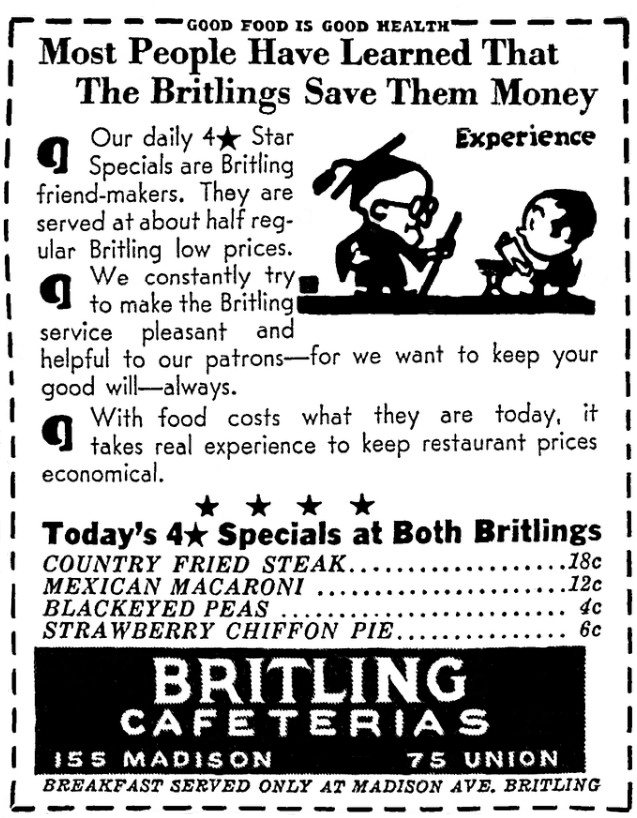
Soon the federal Office of Price Administration tried to control prices at restaurants across the country by freezing them to April 4-10, 1943, levels. Restaurateurs found ways to skirt regulations by reducing portions and substituting “blue plate” specials for what had previously been a regular meal including appetizer and dessert. In addition to reducing food costs, the move also saved a lot of dishwashing. Quality and sanitation went down as patrons mobbed restaurants severely short staffed due to military recruitment and the lure of defense industry jobs. High prices continued through 1948 as did meat rationing. [Britling advertisement, 1942]

The “stagflation” of the 1970s was still to come, with inflation accompanying a stagnating economy – a situation similar to what some economists see looming today.

In 1970 consumer prices rose steadily, especially for food and restaurant meals. Soon New York maitre d’s became friendlier and even the city’s rich began to complain about costs. A wealthy woman who had never paid attention to prices and customarily ate out six or more times a week became angry at being charged over $4 for a melon wrapped with prosciutto at the Plaza’s Oak Room. A nationwide Gallup survey found that a substantial percentage of restaurant goers had cut back on evening dinners out.

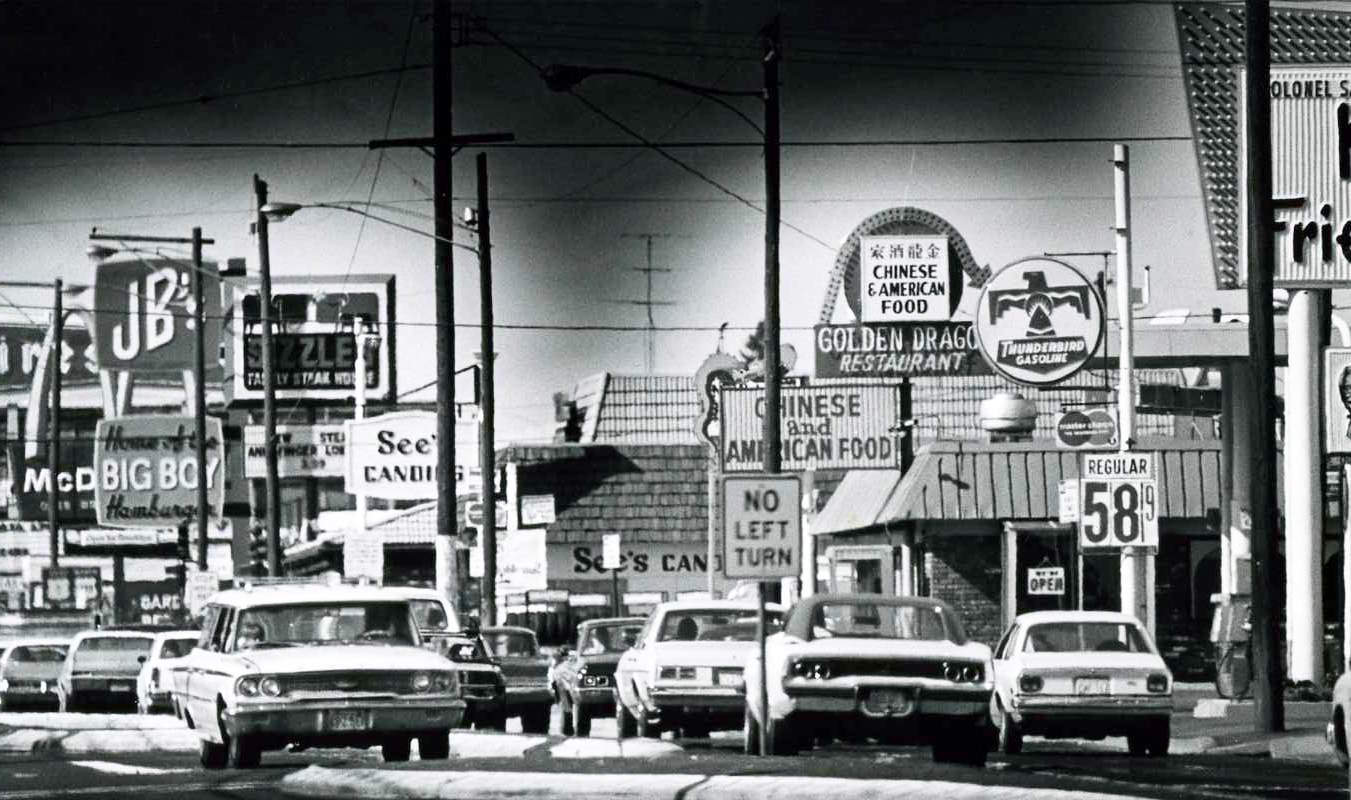
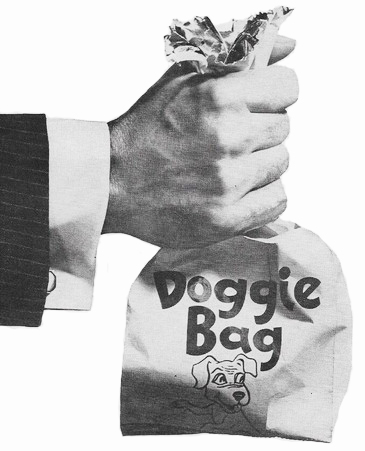
A few years later famous NYC restaurants including the Colony and Le Pavillon failed. At the same time Chinese restaurants were prospering. Across the country, salad bars became popular as did fast food outlets and restaurants specializing in dishes such as pizza, pasta, and tacos. Books recommending inexpensive restaurants did well. By 1974 three chains – McDonalds, Colonel Sanders, and Burger King — were furnishing 13% of all food eaten outside the home nationwide. Five years later there were 66,000 franchise outlets in the U.S., nearly double the number in 1973. Elsewhere, doggie bags soared in popularity and some customers began packing away anything edible on the table. A few restaurants went so far as to remove tops from ketchup bottles to discourage patrons from carting off their ketchup. [above: 1970s fast food streetscape]

Printing houses could barely keep up reprinting menus as prices went up, up, up. And still the restaurant industry experienced heavy, some said “booming,” business – even though patrons were eating more hamburgers than steaks. Analysts thought it was due to the number of working wives, along with the fact that the hike in supermarket prices outdid restaurant price increases. The president of the National Restaurant Association reported that the country’s half million restaurants enjoyed rising sales throughout the mid-1970s, with 1975’s take 16% higher than the year before. Nonetheless the industry fought a proposed increase in the federal minimum wage from $2.30 to $3.00 an hour.

Despite continuing challenges, the economy began to improve in 1982, ushering in a period of gastronomic innovation in restaurants.

© Jan Whitaker, 2022

2 Comments

Filed under chain restaurants, food, restaurant prices

Digesting the Madonna Inn

The Madonna Inn complex in San Luis Obispo CA, including a fantasyland motel, wedding venue, shops, and restaurants, represents the genius and determination of a rugged male individual – assisted by his wife — conquering all obstacles to build a dream.

Alex Madonna had been planning his project from 1953 if not earlier. The motel opened in the full sense of the word in early 1959, but it was not until a couple of years later that the complex was furnished with eating facilities.

Although all along it has had plenty of overnighters, honeymooners, lunch and dinner patrons, banqueters, and gawkers who love it, the place has also had detractors. Among their assessments: “a fantasy run amok,” “the epitome of lousy taste,” and “a crazy, outrageous Hansel-and-Gretel complex.”

Madonna Inn lore credits its unorthodox design to Alex and Phyllis Madonna’s untutored creativity. Alex, according to legend, speedily dismissed the architects he initially consulted. Yet, up until the end of 1958 Madonna worked with plans developed by Beverly Hills architect Louis Gould, a former Hollywood film set designer. And as late as 1966 an advertisement for an apartment complex Gould designed credited him with other “outstanding landmarks . . . including the famed Madonna Inn.” To the extent that the Inn’s exterior achieved any coherence, it may be due to his early influence.

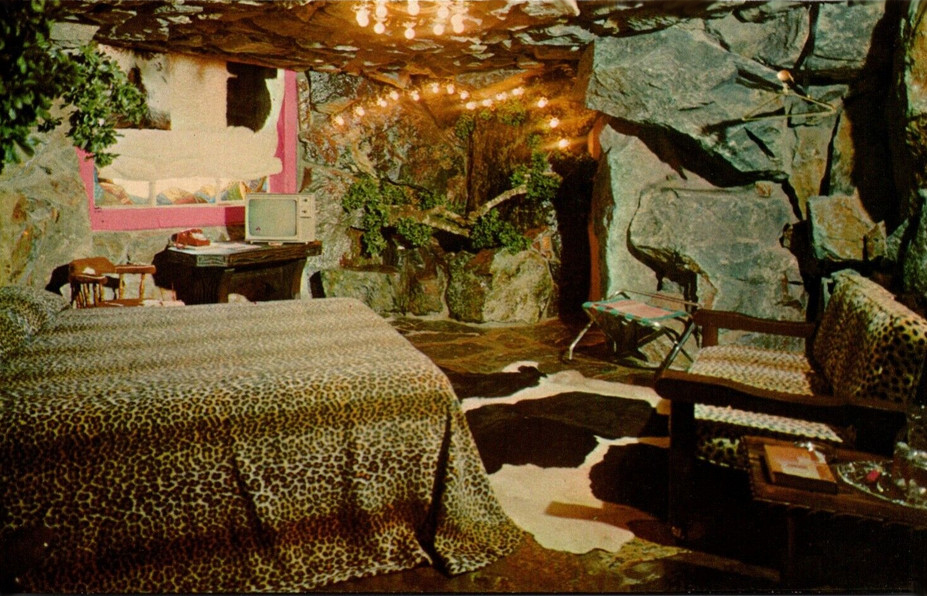
Yet there was a point where no professionals guided the design, as revealed especially in the striking – to me jarring – use of large stones and boulders. The two most celebrated rooms – a men’s public bathroom with a urinal flushed by a waterfall and the Caveman Room [shown above] – prominently feature these materials.

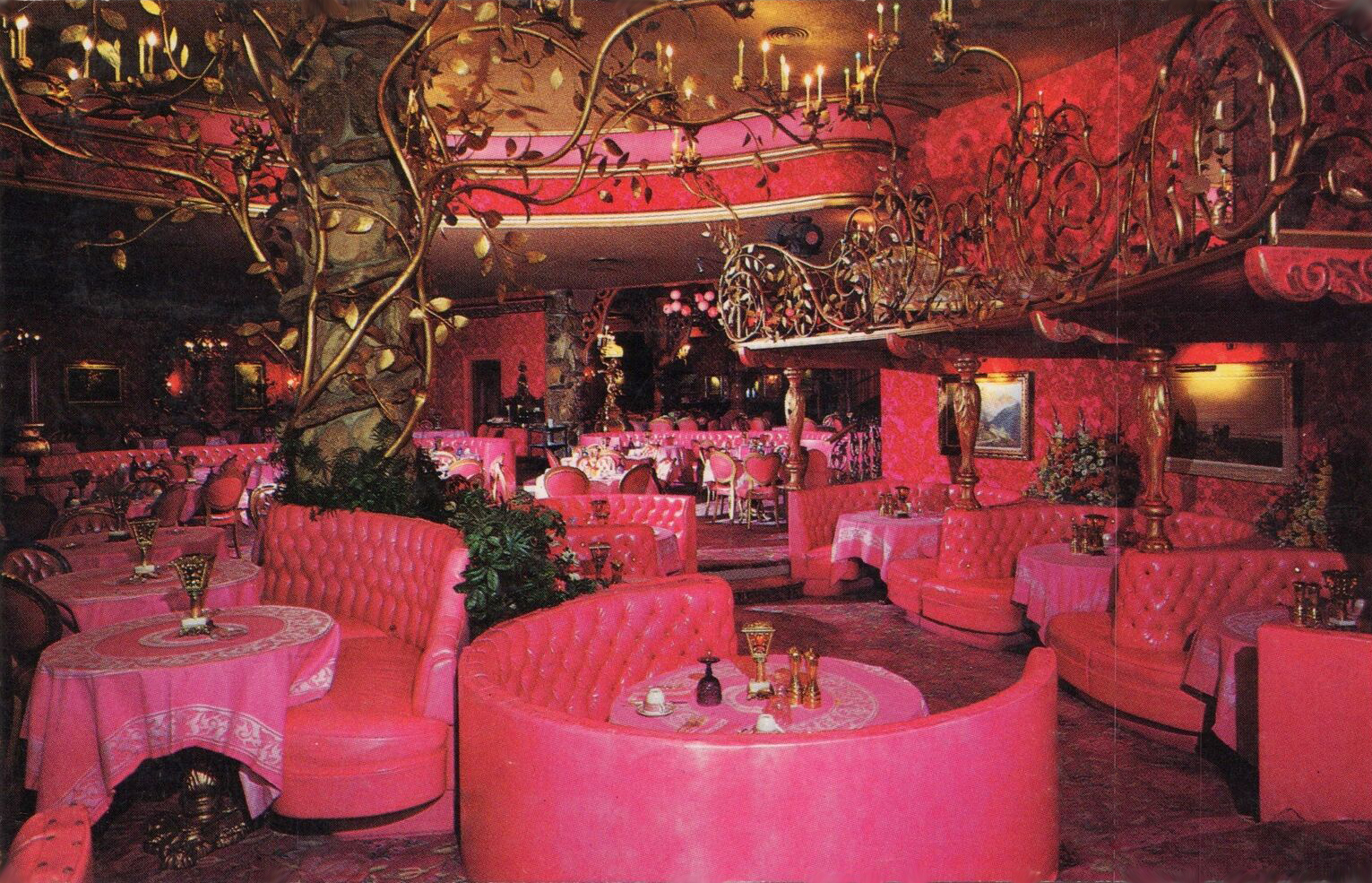
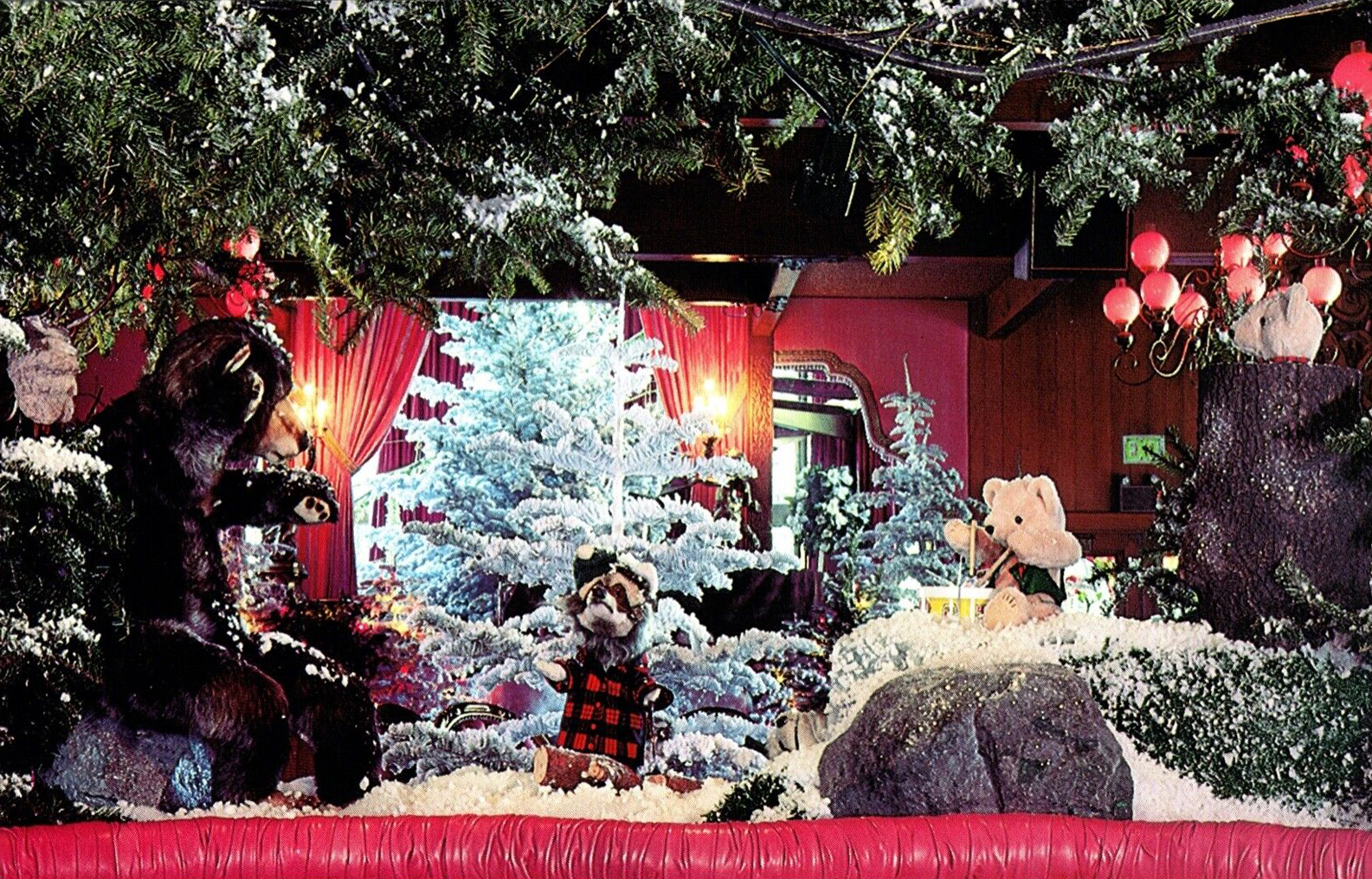
Throughout the interior, the combination of stones and boulders with bright primary colors, artificial flowers and vines, gilded cupids, figured textiles, and plush carpeting is disturbing. The Inn’s eating places exemplify the common observation that many American restaurants are more about decor than food. This was especially true of the primary dining room, the Gold Rush Room [shown below]. Its jangling decor, superficially suggesting luxury but not allowing the eye to rest, is out of keeping with fine dining where food is the star.

A Los Angeles Times reviewer said he lost his appetite in the Gold Rush Room after viewing the giant tree with “fat, glossy, grinning cherubs, spray-painted gold and swimming in Pepto-Bismol.” Alex Madonna responded with a letter defending the room’s centerpiece. The 25-foot tall tree, he pointed out, had been “hand-crafted” on the spot out of “electrical conduit and copper remnants left over from building projects.” The pink, he wrote, was inspired by a visit to Hawaii where it was used lavishly in hotels and restaurants. At one point, even the Inn’s bread and sugar were pink.

The images of the Madonna Inn shown here are difficult to date, but most are probably from the 1960s and 1970s. Everything was subject to change and frequently overhauled. As a 1973 story in the Los Angeles Times observed, Alex Madonna perpetually thought up new ideas, one being an indoor lake featuring a floating cocktail bar that patrons would reach by canoe. The room would have been furnished with a snowflake machine and a three-story fireplace that burned entire trees. That dream did not materialize, nor did the plan to build another motel complex atop the San Luis Mountain behind the Inn that he bought from the city of San Luis Obispo in1972.

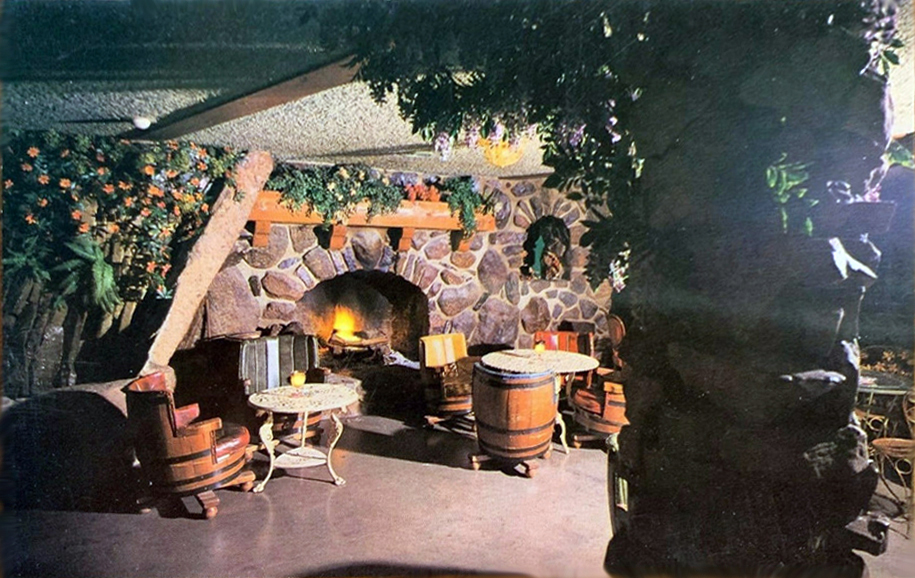
The Inn’s basement Wine Bar below the Gold Rush Room featured boulders incongruously festooned with vines and blooming flowers, a beamed ceiling, and chairs fashioned from barrels. If the wine list was anything like the coffee shop’s, it too would have specialized in Lancers and Paul Masson selections such as Rosé and Sparkling Burgundy, along with Port and Sherry aperitifs.

Lunch and supper specials on a ca. 1960s coffee shop menu were also uninspired. They included low-calorie choices such as Ground Beef Patty with Cottage Cheese, and entrees like Top Sirloin Steak with Cottage Cheese and Peaches. “Chilled” Tomato Juice as an appetizer.

The 1960s and 1970s were not distinguished decades gastronomically, and in that sense the Inn was typical. Patrons might be thrilled with the oversized pastries available in the coffee shop, but otherwise the fare did not receive many comments. A few observed that it was nothing special and overpriced. Recent photos taken by guests are not flattering, though it’s only fair to admit that they may reflect Covid-era staffing issues.

The Inn was hailed in the 1970s by fans of vernacular roadside architecture, such as John Margolies, as well as some influential writers and scholars. Not only did Margolies declare the Inn’s meals “delicious,” he considered the complex “a labor of love” designed to make people happy” and “a place where things that don’t go together go together.”

Hmm. I’d say that in the Gold Rush Room’s Christmas scene, among others, things could never go together.

© Jan Whitaker, 2022

13 Comments

Filed under decor, food, odd buildings, Offbeat places, popular restaurants, proprietors & careers

Halloween soup

Although the food-page story in a New Orleans newspaper said that this photo showed a jack-o-lantern just carved by Chef Gunter Preuss for his children, I can’t help feeling a little bit spooked by it. Is it how he’s holding that knife, or his serious gaze?

Never mind, because the story was about the Harvest Cream Soup he makes out of the pumpkin’s insides. (See recipe below.)

At the time of this story, 1976, Gunter Preuss and his wife Evelyn were owner-operators of the Versailles Restaurant in New Orleans. Eight years later they acquired a part interest in Broussard’s, which they took over from 1993 to 2013.

The Versailles received a glowing review in Richard Collin’s “Underground Gourmet” column in 1978 — although it was definitely not a restaurant for the price-conscious diner. Collin declared it “spectacular,”and “about as fine a restaurant as one can imagine.” He singled out many dishes as “platonic,” meaning they could not be more perfect. Among them were Bouilabaisse Marseillaise, Rack of Lamb Persillades, Ris de Veau Grenobloise, and Pears Cardinal. Chef Preuss was also featured on the show Great Chefs of New Orleans.

The recipe for pumpkin soup does not give amounts for every ingredient. It calls for a pumpkin’s interior, seeds removed, to be cubed and washed. Then sauté the cubes with onions and celery until glazed. Add flour and a half quart of chicken stock. Simmer the mixture over medium heat for 45 to 60 minutes, seasoning with salt, white pepper, powdered ginger, and white wine. Then strain the soup and add three eggs yolks and a cup of light cream. Simmer on low flame for five minutes, then pour into cups and serve with a whipped cream topping and a touch of ginger. Serves six.

Enjoy Halloween!

1 Comment

Filed under chefs, food, popular restaurants, proprietors & careers