 For decades pizza was seen as a light snack rather than a meal, much as it had been on the streets of Naples for centuries. An English visitor to Naples in 1843 noticed small bakeshops where “a constant hissing and thick smoke indicated the preparation of pizze, (composed of flour, lard, eggs, and garlick) and muzzarella.” In 19th-century Italy, as now, there were a variety of toppings: grated Swiss cheese, olive oil, tomatoes, and anchovies or other fish. Southern Italians brought the dish to America, and in 1903 a New York newspaper took note of a dish known as “pomidore pizza” or “tomato pie” sometimes topped with salami.
By 1905 there were a number of shops selling pizza in Italian neighborhoods of New York City, one on Spring Street (probably this was run by Gennaro Lombardi), the other on Grand. Evidently there were others but, according to an early pizza connoisseur, their pizzas were inferior “Americanized substitutes.” Although Lombardi is often cited as America’s first pizza maker it seems most likely that pizza shops existed earlier, probably beginning in the 1880s when numbers of Southern Italians began coming to this country.
Early pizza places were rarely frequented by non-Italians, and outside that community few Americans had heard of pizza before WWII. A few pizzerias here and there caught the attention of columnists and guidebook writers in the 1930s and early 1940s, such as Tom Granato’s Pizzeria Napolitana in Chicago, Lupo’s in San Francisco, and Salvatore “Sally” Consiglio’s in New Haven CT. In 1943 Ike Sewell and Ric Riccardo put aside their idea of starting a Mexican restaurant in Chicago and instead opened Pizzeria Riccardo on the corner of Ohio and Wabash. After launching a second place, they rechristened the original as “Pizzeria Uno.”
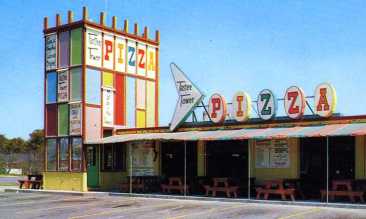 Boosted by prosperity, casual suburban lifestyles, and burgeoning youth culture after the Second World War, pizza leaped into popularity. But it was not known well everywhere. For instance, in 1948 a Corpus Christi TX restaurant review referred to the “unusual” item as “pietza pie.” It was much better known in Chicago. In 1953 there were already more than 100 pizza parlors there.
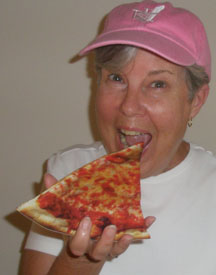
By 1956 pizza had outstripped the hot dog in popularity. But that was only the start. Pre-made crusts and frozen pizzas were coming on the market in the mid-1950s, ready to spread pizza parlors to areas of the country where few Italian-Americans had ever set foot. Increasingly, many operators of pizza parlors were not of Italian ethnicity, including the founders of the big chains such as Pizza Hut, Shakey’s, and Domino’s, all of which got their start around this time.
In the last 30 years pizza began to turn into a major cheese-delivery vehicle. Largely because of pizza, annual cheese consumption more than doubled from just over 8 pounds per person in 1960 to over 17 pounds in 1978. By 1981 most mozzarella cheese produced in the US – more than 600 million pounds a year – was for the pizza industry. Today on average we each eat somewhat more than 30 pounds of cheese a year, mozzarella is #1, and pizza has surpassed hamburgers in popularity.
© Jan Whitaker, 2009












 It's great to hear from readers and I take time to answer queries. I can't always find what you are looking for, but I do appreciate getting thank yous no matter what the outcome.

 Restaurant-ing through history