During the war (1941-1945) the creation of 17 million new jobs finally pulls the economy out of the Depression. Millions of married women enter the labor force. The demand for restaurant meals escalates, increasing from a pre-war level of 20 million meals served per day to over 60 million. The combination of increased restaurant patronage with labor shortages, government-ordered price freezes, and rationing of basic foods puts restaurants in a squeeze. With gasoline rationing, many roadside cafes and hamburger stands close.
For a time after the war, rationing continues and wholesale prices stay high but patronage falls off as women leave jobs and return to the kitchen. Trained restaurant personnel are in short supply. Restaurants take advantage of food service methods and materials developed for the armed services. The frozen food industry supplies restaurants with fish, French fries, and baked goods. Boil-in bags of pre-cooked entrees become available. Fast food assembly lines and serving techniques used by the military are transferred to commercial establishments.
Highlights
1940 Based on how many restaurant tablecloths have numbers scribbled on them, executives of the National Restaurant Association reason that mealtime deals are being made and that business is finally bouncing back from the Great Depression.
 1941 When the restaurant in the French pavilion at the New York World’s Fair closes, its head Henri Soulé decides he will not return to a Paris occupied by Germans. He and ten waiters remain in New York and open Le Pavillon. Columnist Lucius Beebe declares its cuisine “absolutely faultless,” with prices “of positively Cartier proportions.” – Chicago cafeteria operator Dario Toffenetti, who also had a successful run at the Fair, decides to open a cafeteria in Times Square.
1942 According an official of the National Restaurant Association, nearly one tenth of the 1,183,073 employees and proprietors in the U.S. restaurant business are in California.
1943 Decreeing that patrons will not need to turn in ration coupons for restaurant meals, Washington makes a fateful decision that will fill restaurants to the bursting point. In Chicago, restaurants in the “Loop” experience nearly a 25% increase over the year before, while in New York City patronage doubles and earlier seatings must be devised.
1943 Food imports cease and Chinese restaurants cannot get bamboo shoots. They substitute snow peas, now grown in California and Florida. Because of restrictions, restaurants of all kinds leave cakes unfrosted and substitute honey and molasses for sugar. Instead of beef, lamb, and pork, vegetable plates, fish, omelets, spaghetti, and salad bowls fill menus.
1944 In Reno, Nevada, the White House offers a menu with many fish, seafood, and poultry selections, including lobster, crab legs, frog legs, oysters, fried prawns, brook trout, guinea hen, squab, pheasant, sweetbreads, turkey, duckling, and chicken a la king.
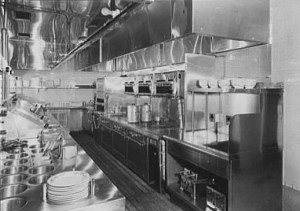 1946 Like health departments all across the country, NYC begins a crack down on unsanitary conditions in restaurants, a problem that worsened with skeleton crews and extended mealtimes during wartime. An official says that of five inspections he witnessed only a Schrafft’s (shown here: Schrafft’s at Rockefeller Center) could be pronounced “sanitary and clean.”
1947 The Raytheon Corporation, maker of radar systems and components for the military, teams with General Electric to introduce the first microwave oven, the Radarange. Not available for home use initially, it is rented to hotels and restaurants for $5 a day.
1947 After numerous Afro-Americans are refused service in Bullocks department store tea room in Los Angeles, a group sponsored by C.O.R.E. stages a sit-in. Later a supportive white veteran publishes a letter to the editor of a paper declaring that since black soldiers regarded it as their duty to protect him from the “enemy abroad” during wartime, he now feels it is his duty “to protect them from the enemy at home.”
1948 An advice column tells girls to let their date handle all restaurant transactions, including complaints or questions about overcharges. “The girl does not intrude or ask, later, who won the argument,” advises the columnist. – In Chicago, a year-long trade school program in professional cooking enrolls veterans to help relieve the city’s acute chef shortage.
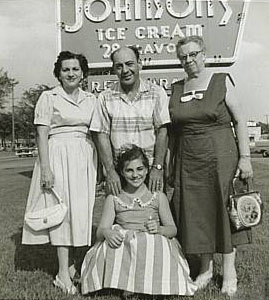 1949 Howard Johnson’s, the country’s largest restaurant chain, reports a record volume of business for the year. HoJos, which has not yet spread farther west than Fort Wayne IN, plans a move into California.
Read about other decades: 1800 to 1810; 1810 to 1820; 1820 to 1830; 1860 to 1870; 1890 to 1900; 1900 to 1910; 1920 to 1930; 1930 to 1940; 1950 to 1960; 1960 to 1970; 1970 to 1980
© Jan Whitaker, 2009
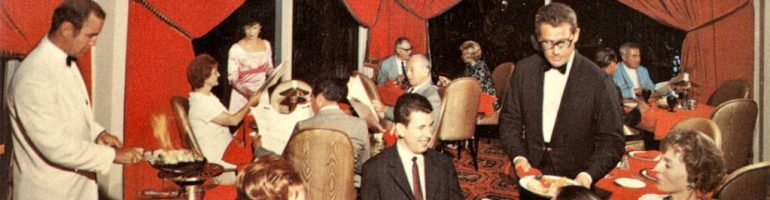

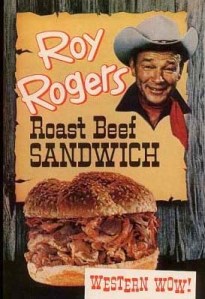 People have strong feelings about their favorite dishes from restaurant chains. I am thankful to all those who poured their hearts out on the subject on Jane & Michael Stern’s ever-fascinating Roadfood forums. I have excerpted the following wistful memories from “Long-gone regional franchises” which took on a life of its own and ran for years. After each snippet is the pertinent chain restaurant.
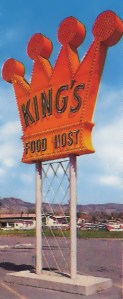 — The Cheese Frenchies were unique. [King’s Food Host]
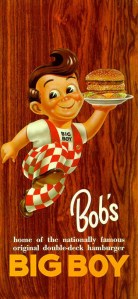 — Pickles, diced onion, relish, mustard, ketchup and mayo were all available. [25 Cent Hamburger]
 Who was first to realize that they could cover bad plaster on their ceilings and walls with canvas and call their restaurant a covered wagon or a chuck wagon? The idea seems to have struck initially in the 1930s, at least that’s when the first Covered Wagon restaurant I’ve found dates from. It was in the Old West – no, make that Minneapolis, with a second in St. Paul. Red checkered tablecloths covered the tables and in the 195os the female waitstaff wore long calico dresses with aprons, a fact I know thanks to the well-illustrated book Minnesota Eats Out. There was also a Covered Wagon in Chicago in the 1940s, presumably under different ownership but with the same tablecloths.
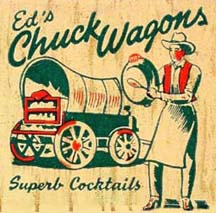 The wagon-esque theme caught on big during the 1950s, inspired partly by TV westerns and partly by the fame of Las Vegas chuck wagon buffets which provided grub for gamblers from midnight ‘til dawn. If not for Vegas envy, why else would there have been one in Miami Beach in 1955? Apparently seeing no local cuisine worth merchandising, restaurateurs there chose from a grab bag of themes such as Smorgs, Polynesian, and Ken’s Pancake Parade. (“Grandma’s Kitchen” was the town’s most venerable eating establishment at the time.)
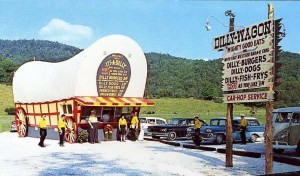 Around 1960 a Potsdam NY man got the idea of franchising
  Not many people get as excited as I do about books of obsolete restaurant reviews. I especially like The New Orleans Underground Gourmet. In the 1973 edition reviewer Richard H. Collin zapped a few well-known tourist places as well as some less expensive restaurants which had “little or nothing to recommend them” in order to “spare the reader’s time and stomach.” He not only performed a service but produced enjoyable reading for anyone inclined to find humor in bad reviews.
 In the mid-19th century there was only one American restaurant with a worldwide reputation,
 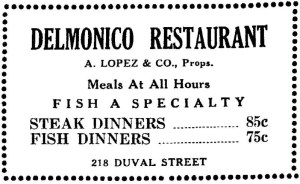 From the 1870s up to the 1930s, but not so much after that (except for New Orleans?), I’ve found Delmonicos in Los Angeles, Denver, Colorado Springs, Tombstone, Phoenix, Helena, Portland OR, El Paso, Dallas, Walla Walla, Mobile, Memphis, Winona MN, Leavenworth KS, Detroit, Key West (1931 ad pictured), Pittsburgh, Buffalo – and more. Proprietors names ranged from Gutekunst to Garibotti to McDougal.
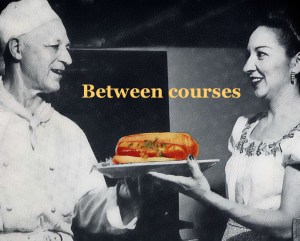 In the summer of 1953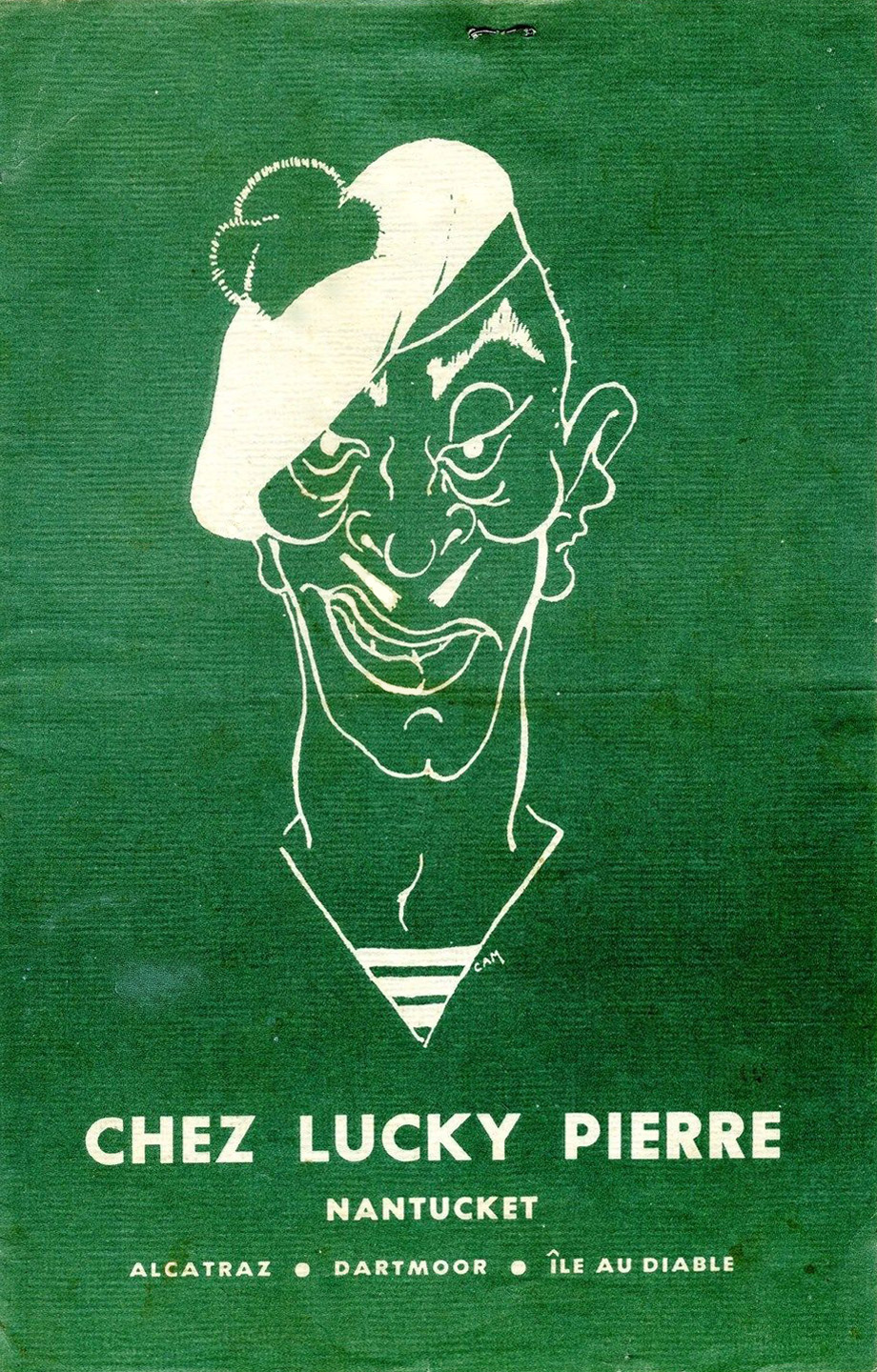
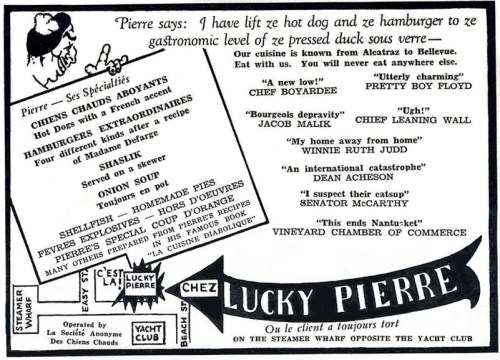 The advertisement shown here appeared at just about the exact time JB was stepping off the ferry, in the June 22, 1953, edition of “This Week in Nantucket.”
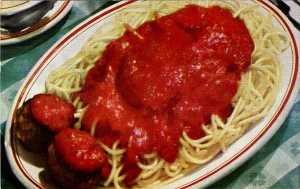 In the 1890s it was considered daring to go to an Italian restaurant and eat spaghetti. The restaurants were not in affluent neighborhoods and some middle-class people worried (largely needlessly) about how clean they were. Non-drinkers didn’t approve of the “red ink” (wine) that came with the spaghetti. Some women felt it was not ladylike to eat spaghetti in public. Then there was the garlic, which was considered seriously foreign by many Americans. But others, especially offbeat types – artists, musicians, and free spirits known as “bohemians” — loved the whole experience: spaghetti, wine, garlic, low prices, and the friendly atmosphere found in most Italian places. The future of spaghetti belonged to them.
 The bohemian fad for spaghetti grew stronger in the early 20th century, particularly in lower Manhattan and San Francisco. Diners flocked to Gonfarone’s in Greenwich Village. Despite its low prices, the restaurant made money because a 50-cent dinner with a complimentary glass of wine cost but pennies to put on the table – about 2 cents for the spaghetti and a few cents for a carafe of the red California claret bought by the barrel, 40 or 50 at a time.
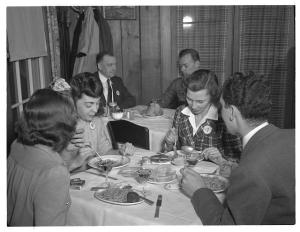 Spaghetti, Italian and non, continued as a staple restaurant dish during successive decades, in speakeasies of the 1920s, Depression dives and diners, and a variety of restaurants during the meatless months of World War II. Next came pre-cooked meatballs and prepared sauces in the 1960s and 1970s which meant even virtually kitchenless restaurants could serve spaghetti. Its cheapness and the fact that children like it also made spaghetti a favorite of family restaurants, and the basis of chains such as the Old Spaghetti Factory, the original of which was started in Portland OR by a Greek immigrant in 1969.
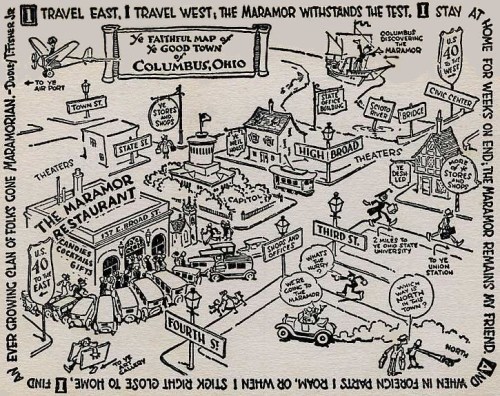 Imagine a restaurant management style diametrically opposed to Gordon Ramsay’s (as he takes command in nightmarish kitchens on TV), and you might well be picturing how Mary Love ran her restaurant, The Maramor in Columbus, Ohio.
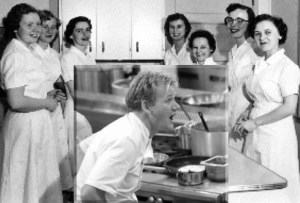 In 1941 Mary described to a home economics conference how she ran her kitchen. She avoided frying and stressed the nutritional properties of food, preparing fresh vegetables to retain flavor and vitamins. Each day her planning department presented the production manager with the day’s menus, while a weighing and measuring specialist prepared trays with complete ingredients for every dish. The trays were given to the cooks, along with detailed instructions for cooking. “This,” Mary said, “helps them to keep their poise and self-respect through the working day, and a cook with poise and self-respect has a better chance of turning out a good product.” (Gordon?)
 In the early 1950s middle- and upper-income people in cities of 25,000 or more were surveyed about their restaurant habits. People with lesser incomes and those living in rural areas and small towns were excluded because they were considered to be infrequent restaurant patrons. Thirty-five percent of those surveyed reported eating a restaurant lunch or dinner, or both, four to seven times a week. About one-third of the respondents also volunteered complaints, some of which follow:
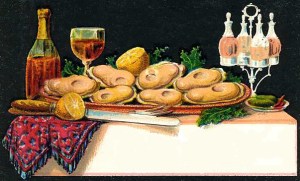 The nation has begun to grow westward though settlement is still mostly along the coast. Seven cities exceed 10,000 in population in 1810, rising to eight over the decade. In the largest city, NY (152,056 in 1820), commerce is on the rise, yet by mid-decade there are only eight hotels and five banks. Pigs run free in the streets. The defeat of Britain in the War of 1812-1815 does not cause an immediate end to British influence on public eateries, though there are a few French restorators. Beefsteaks are popular and oysters are served almost everywhere. Alcohol flows freely. Most eating places are also drinking places and boarding houses as well. Board can include lodging or not — some people pay a weekly or monthly fee simply for meals.
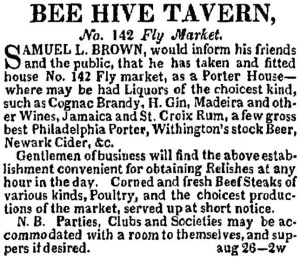 1815 On July 17 Hannah Julien, who has run Julien’s Restorator since the death of her husband Jean ten years earlier, informs the public that she will be serving a “fine green turtle” that day. – In Salem MA, John Remond, who is black and from the West Indies, also runs a restorator where he prepares soups, green turtles, cakes, wafers, French rolls, and other delicacies.
 It's great to hear from readers and I take time to answer queries. I can't always find what you are looking for, but I do appreciate getting thank yous no matter what the outcome.