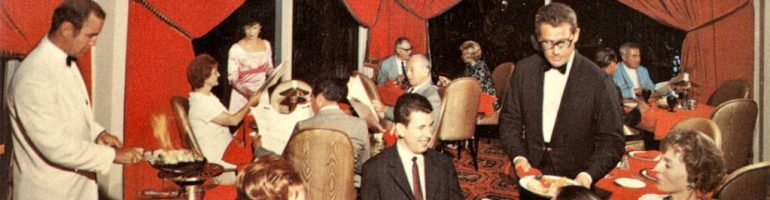
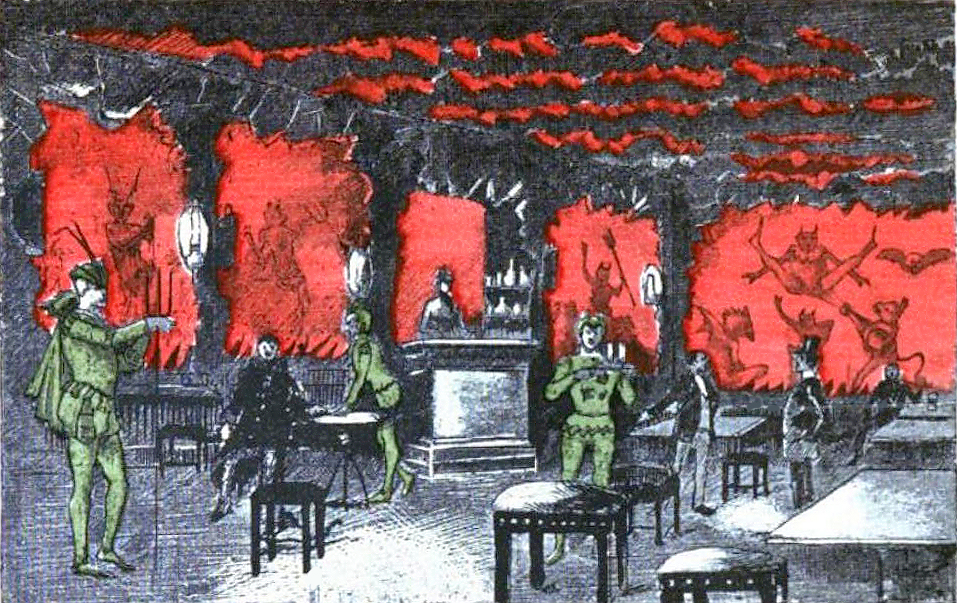
Credit for the development of the first theme restaurants goes to Paris cafés and cabarets which opened in Montmartre in the later nineteenth century. They were primarily drinking spots rather than full-scale restaurants but they served food also. Like American theme restaurants today they were built around a concept and created an environment which appeared to be something other than a mere eating and drinking place.
In their early years these artistic cafés had a counter-cultural impetus that in some cases celebrated the revolutionary Paris Commune of 1871 which had been rooted in Montmartre.
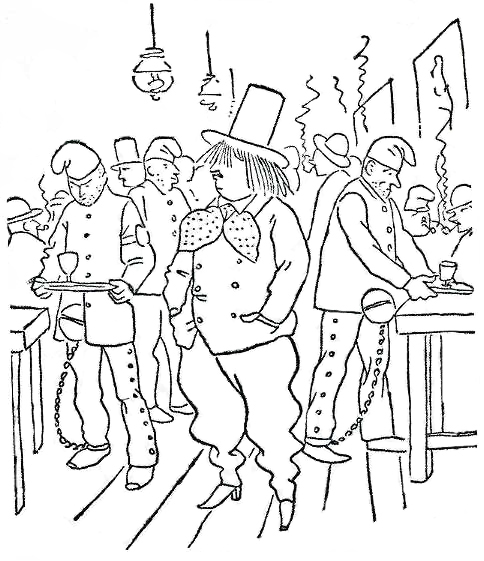 That was particularly true of the Café du Bagne (Café of the Penitentiary) established in 1885 by Maxime Lisbonne (shown with waiters), a member of the Commune long exiled in a South Pacific penal colony. Posters on the wall of his café, which replicated a prison eating hall, hailed Commune heroes. Waiters were dressed as real convicts but with fake balls and chains. The place caused an instant sensation when it opened, with patrons lining up outside to get in. Possessed of a socialistic mission, Lisbonne posted a sign in 1886 announcing a free breakfast for the poor residents of Montmartre: “Come, and eat your fill, your appetite sharpened by the knowledge that it was from their [the capitalists] coffers the money was extracted.”
The Chateau d’If’ of the 1880s, possibly an imitator of the Café du Bagne, was designed to resemble the prison by the same name in Dumas’s The Count of Monte Cristo. Outside it had an imitation drawbridge which stretched from the street to a large oak door, while inside were cells and dungeons. The L’Abbaye de Thélème, with a medieval theme, dressed its servers as monks and nuns.
At Le Chat Noir, the decor was in Louis XIII style, with waiters dressed in the authentic green jackets of the Immortals of the French Academy whose job it was to protect the purity of the French language – the object being, of course, to mock them. When it was established in 1881, Le Chat Noir, which was also decorated with images of black cats throughout, served as a club for artists where they exhibited their work. Its fame spread quickly and it became a magnet for visitors to Paris. (Later incarnation of Le Chat Noir pictured below.)
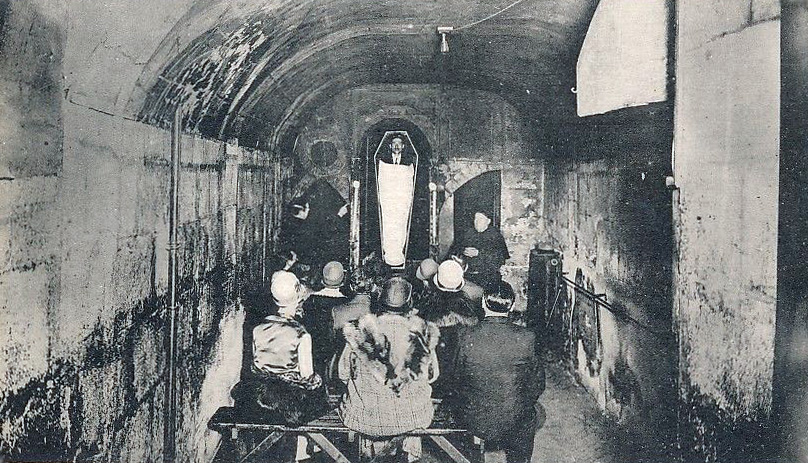
Many of the Montmartre cafés celebrated the macabre, with paintings and decor whose subjects included infanticide, crucifixion, and assassination, but in 1894 The Café of Death opened, furnished with coffins serving as tables. The police objected to its name and its habit of serving beer in imitation human skulls so its name was changed to the Cabaret du Néant [of Nothingness] (see above).
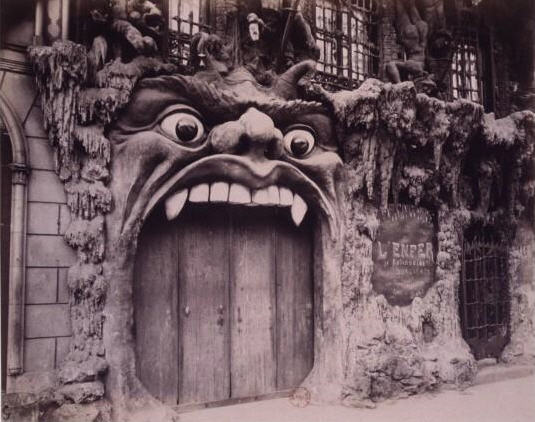 The 1890s marked a turning point at which original owners left the scene, artists stopped coming, bohemianism vanished, and new café owners took dead aim at tourists. Certainly few of the popular cafés and cabarets of the early 20th century had much connection with earlier enterprises even when old names remained. Many felt that the Café de l’Enfer (Café of Hell) exemplified the purely commercial type of enterprise.

The spirit of Paris’s bohemian cafés passed into the United States first in New York City. Au Chat Noir was in business there in 1895, decorated with a wall frieze of black cats. Otherwise, though, it seemed like a fairly standard small French restaurant of the day serving dishes such as cold lobster, tripe, and deviled crabs. Later at least a couple of other cafés named The Black Cat appeared in NY and Coppa’s in San Francisco adopted a similar theme.
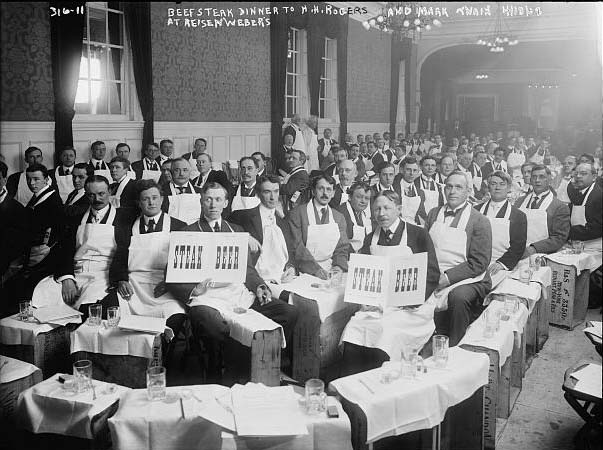
Other early theme restaurants undoubtedly inspired by Paris cafés include beefsteak dungeons in New York and elsewhere, as well as tea rooms and cabarets in Greenwich Village both before and after World War I, a prime example being the Pirates’ Den. As in Paris, theme restaurants and cafés rapidly lost any counter-cultural overtones.
© Jan Whitaker, 2010

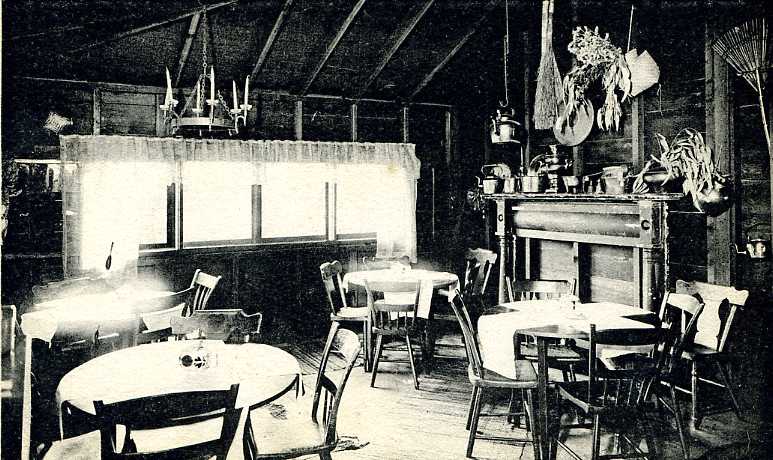
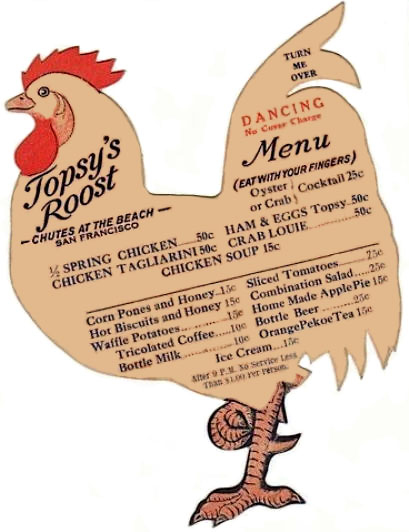
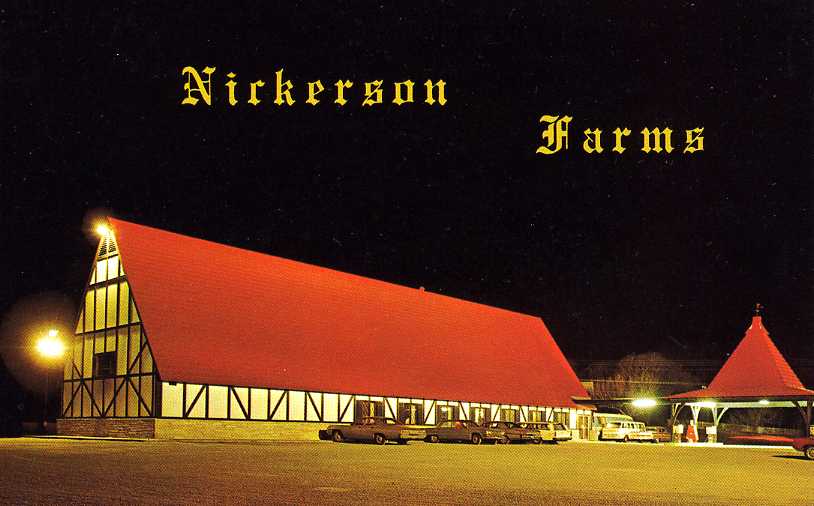
 Who was first to realize that they could cover bad plaster on their ceilings and walls with canvas and call their restaurant a covered wagon or a chuck wagon? The idea seems to have struck initially in the 1930s, at least that’s when the first Covered Wagon restaurant I’ve found dates from. It was in the Old West – no, make that Minneapolis, with a second in St. Paul. Red checkered tablecloths covered the tables and in the 195os the female waitstaff wore long calico dresses with aprons, a fact I know thanks to the well-illustrated book Minnesota Eats Out. There was also a Covered Wagon in Chicago in the 1940s, presumably under different ownership but with the same tablecloths.
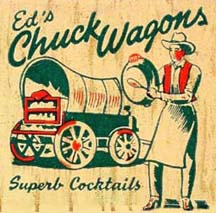 The wagon-esque theme caught on big during the 1950s, inspired partly by TV westerns and partly by the fame of Las Vegas chuck wagon buffets which provided grub for gamblers from midnight ‘til dawn. If not for Vegas envy, why else would there have been one in Miami Beach in 1955? Apparently seeing no local cuisine worth merchandising, restaurateurs there chose from a grab bag of themes such as Smorgs, Polynesian, and Ken’s Pancake Parade. (“Grandma’s Kitchen” was the town’s most venerable eating establishment at the time.)
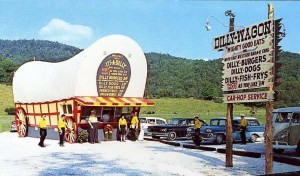 Around 1960 a Potsdam NY man got the idea of franchising
 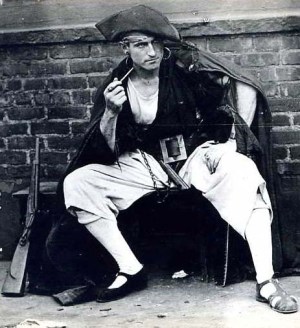 Don Dickerman was obsessed with pirates. He took every opportunity to portray himself as one, beginning with a high school pirate band. As an art student in the teens he dressed in pirate garb for Greenwich Village costume balls. Throughout his life he collected antique pirate maps, cutlasses, blunderbuses, and cannon. His Greenwich Village nightclub restaurant, The Pirates’ Den, where colorfully outfitted servers staged mock battles for guests, became nationally known and made him a minor celebrity.
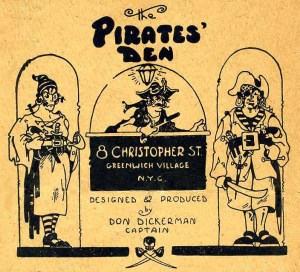 Over time he ran five clubs and restaurants in New York City. After failing to make a living as a toy designer and children’s book illustrator, he opened a tea room in the Village primarily as a place to display his hand-painted toys. It became popular, expanded, and around 1917 he transformed it into a make-believe pirates’ lair where guests entered through a dark, moldy basement. Its fame began to grow, particularly after 1921 when Douglas Fairbanks recreated its atmospheric interior for his movie The Nut. He also ran the Blue Horse (pictured), the Heigh-Ho (where Rudy Vallee got his start), Daffydill (financed by Vallee), and the County Fair.
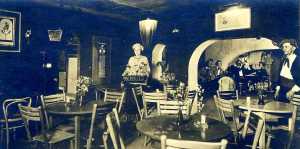 On a Blue Horse menu of the 1920s Don’s mother is listed as manager. Among the dishes featured at this jazz club restaurant were Golden Buck, Chicken a la King, Tomato Wiggle, and Tomato Caprice. Drinks (non-alcoholic) included Pink Goat’s Delight and Blue Horse’s Neck. Ice cream specials also bore whimsical names such as Green Goose Island and Mr. Bogg’s Castle. At The Pirates’ Den a beefsteak dinner cost a hefty $1.25. Also on the menu were chicken salad, sandwiches, hot dogs, and an ice cream concoction called Bozo’s Delight. A critic in 1921 concluded that, based on the sky-high menu tariffs and the “punk food,” customers there really were at the mercy of genuine pirates.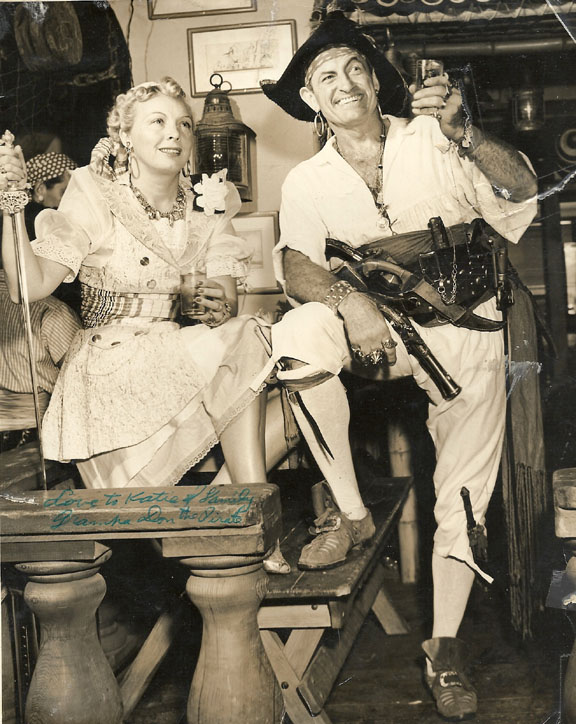


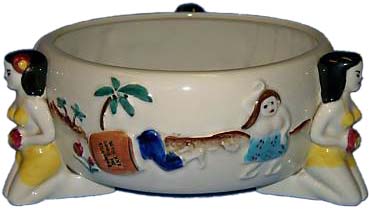

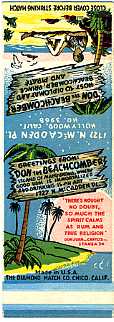
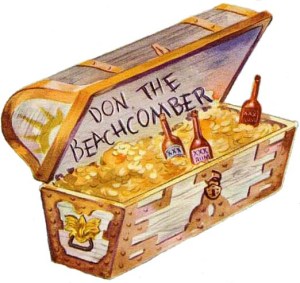 Don ran into trouble with the postwar longshoremen’s strike and decided to limit his Honolulu Beachcomber to a drinking spot. By the early 1960s he was also in the restaurant business, operating a South Seas Cabaret Restaurant, a Colonel’s Plantation Steak House, a Colonel’s Coffee House, and at least one restaurant boat. Cora’s popular Chicago Don the Beachcomber was named one of the top 50 US restaurants in 1947. She soon opened another location in Palm Springs and by 1972, when it was acquired by Getty Financial, the chain had 6 or 7 units.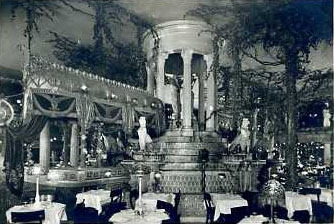

 It's great to hear from readers and I take time to answer queries. I can't always find what you are looking for, but I do appreciate getting thank yous no matter what the outcome.
 Restaurant-ing through history