Tag Archives: desserts

Rolling dessert carts

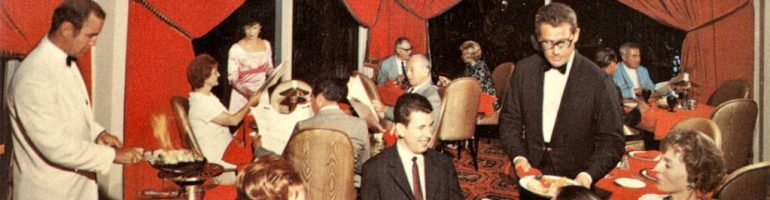
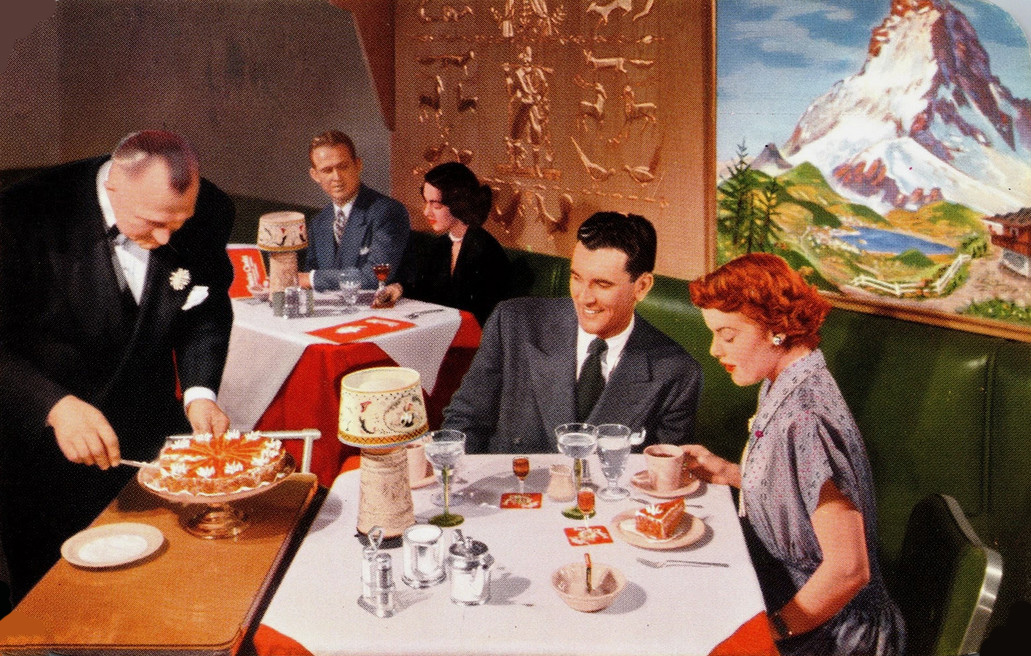
A few years back I published a post called “tableside theater” that looked at cooking performances at guests’ tables in restaurants. This sort of dining room drama occurred mainly in restaurants that wanted to give a sense of luxury that justified a higher price than the meal might otherwise command. [Above: Hotel Bismarck, Chicago]

Another aspect of restaurant theater, usually less dramatic, but also certain to draw attention and oohs and aahs from patrons was the use of carts for ready-to-eat food, usually desserts.

The trend toward tableside food preparation and dessert carts came along mainly after World War II. It is not hard to imagine how restaurant goers then might have longed for normalcy and entertainment.
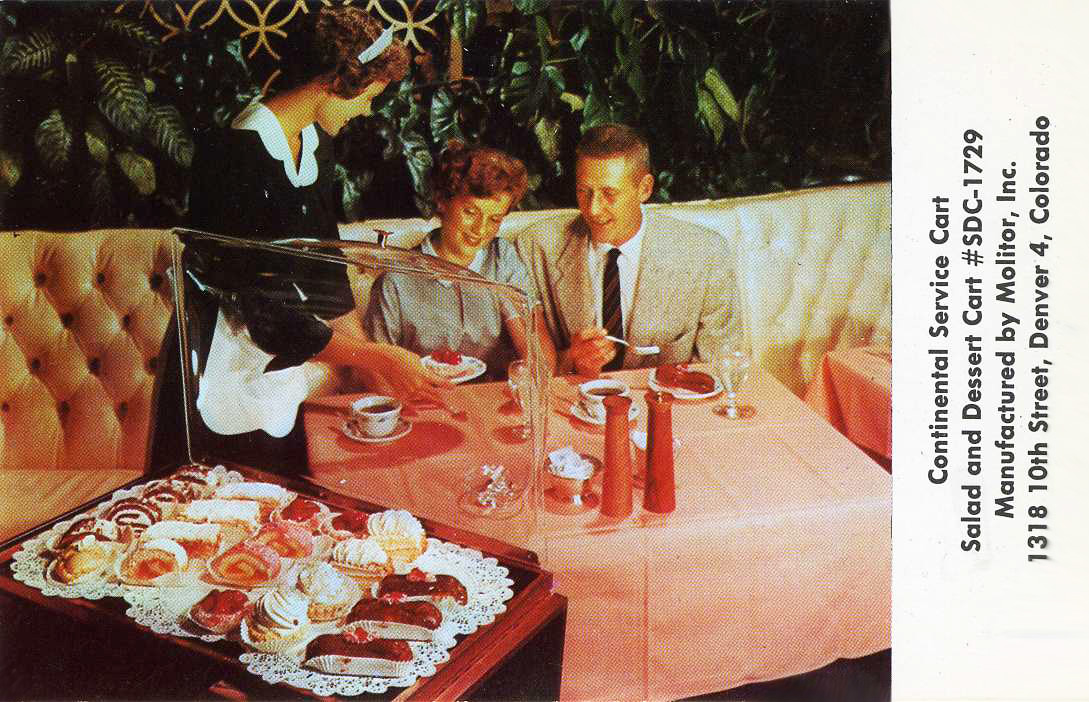
The 1950s is seen as the pinnacle decade of rolling carts of all kinds as well as tableside flambéing. Although carts with ready-to-eat desserts were likely to be found in a wider assortment of restaurants than those that provided tableside preparation, they too delighted guests. And the carts also enabled restaurants to boost demand for desserts. As the back of the postcard shown here notes, “Actual figures show customers buy more high profit desserts when Continental Carts are used to move them.” [The plastic cover of the cart shown above is not very elegant, but it was a practical way of keeping desserts from drying out.]

In Cleveland OH, the Taylor department store, inspired by New York and Europe, introduced rolling carts with salads, cold entrees, and desserts in 1950, in a space that had earlier been a cafeteria. Dessert carts were often used in department store restaurants. Chicago’s Marshall Field’s was not far behind, nor was the restaurant in Oakland CA’s airport. Pastry carts were also used at the Arnoldton, the restaurant in Trenton NJ’s Arnold Constable store.
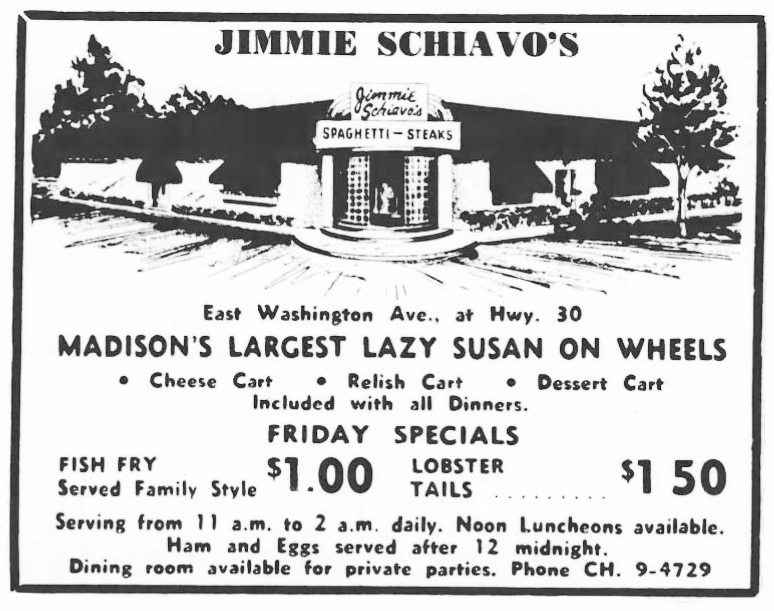
In some restaurants the dessert carts held a variety of after-dinner items including some that are unfamiliar to me. Jimmie Shiavo’s in Madison WI, which had cheese and relish carts in addition to dessert carts, offered desserts such as Italian cookies, a fresh fruit bowl, roasted pumpkin or sunflower seeds, mints, candied fruit, roasted ceci (chickpeas seasoned with spices) and “St. John’s bread” (carob bean pods). St. John’s bread turned up again at Club El Bianco in Chicago, where carts contained olives, St. John’s bread, cheese, peppers, fruits, and nuts, though whether they were all intended as desserts and grouped on the same cart is unclear.
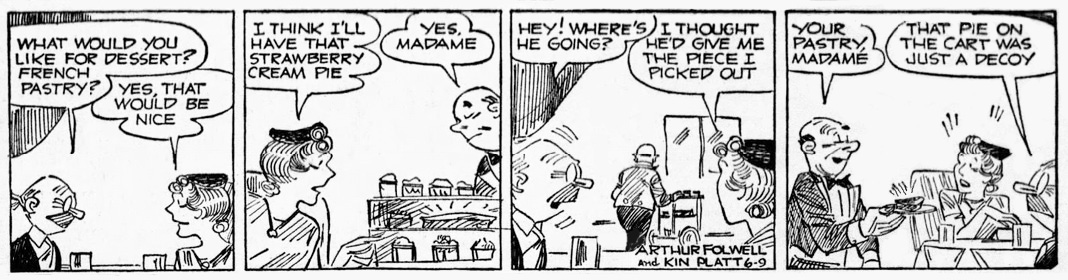
That dessert carts sell more desserts than would otherwise be the case seems to derive from their visual presentation, which is more powerful than a menu description. So it seems strange to me that carts would have items such as seeds, nuts, cheese, or other items such as those at Jimmie Shiavo’s since their appeal is not based on their looks. [The 1947 comic strip above suggests that sometimes carts were for display rather than serving.]
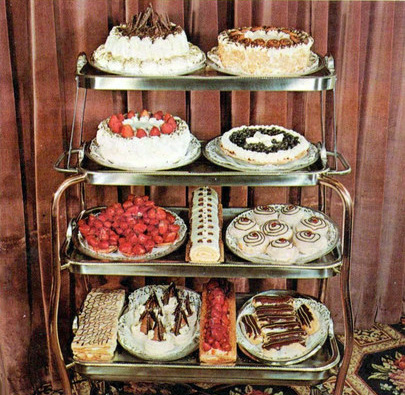
Tableside food presentation did not end in the 1950s, but continued through the 1960s and into the 1990s, though I have the impression it was fading by the late 1980s.

An example of a restaurant that eliminated tableside drama in the 1980s was The Buckingham Inn of Lima OH. Through the 1960s, 1970s, and much of the 1980s it specialized in luxury symbolism. Despite also operating an adjoining place called the Peanut Barrel that offered beer, pizza, and sing-alongs, it appeared to be an old English Inn adorned with knights’ armor and deadly weapons such as a truncheon and a lance. Steaks were the popular fare, but a pastry cart offered chocolate, lemon, and cocoanut cakes three inches high.

In 1986, as the Buckingham Inn’s owner made plans to replace the inn with a more casual family-style restaurant on the site, the pastry cart was auctioned along with the crystal chandeliers.

© Jan Whitaker, 2026
9 Comments

Filed under food, restaurant customs

Tea rooms for students

College and high school students of the 20th century led many eating-out trends and customs. Not only did they help make certain foods popular, they also influenced meal habits and adopted frequent restaurant-going as part of their social lives.

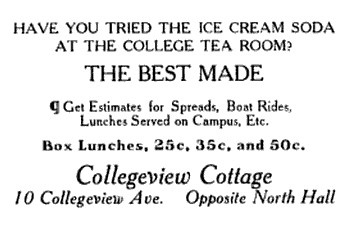
Drive-ins, coffee houses, and vegetarian restaurants were some of the types of eating places heavily shaped by student patrons in the middle and later decades of the last century. But a bit earlier, in the early 20th century, the eating places of choice for many college students were tea rooms that attracted women students. Not that men students didn’t also like tea rooms. An example was The Cactus Tea Room, built in 1917 with weird carvings of university types adorning its eaves, and serving both male and female students at the University of Texas in Austin.

Although tea rooms were more likely to be found near residential colleges, high school students also enjoyed them for after-school stops. In the 1920s students at Decatur High School in Decatur GA hung out at the Elite Tea Room, while Haverling High School students in Bath NY gravitated to the Chat-A-Wile Tea Room.

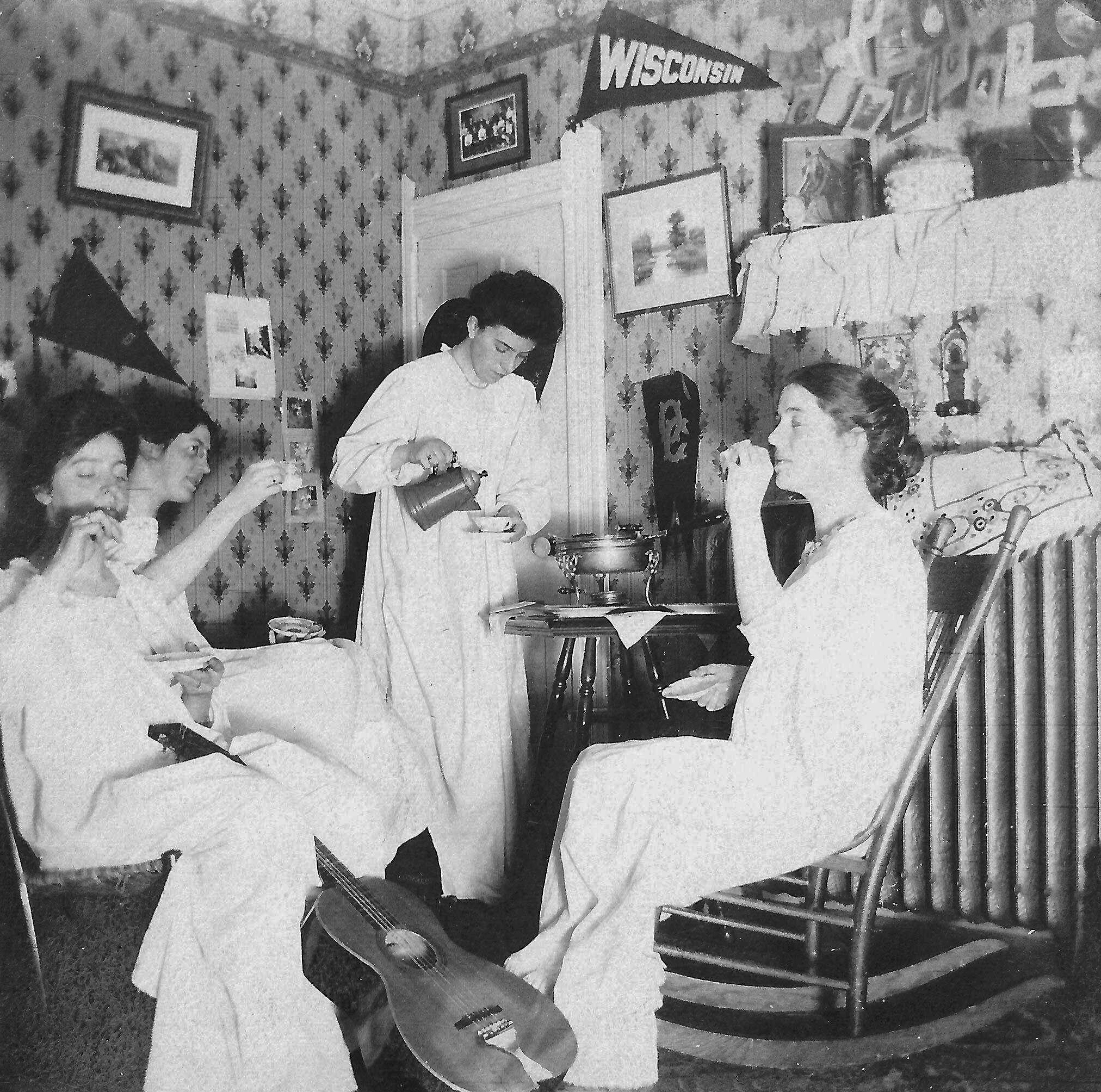
Rather than being stuffy and proper, many tea rooms that catered to students were relaxed and informal. They carried on college traditions such as midnight “spreads,” at which foods pilfered from the school’s dining halls were remade into chafing dish repasts. The feasts were occasions for casual attire, sprawling on the floor, and high spirits at the thought of evading detection while breaking college rules. [shown here is an Oberlin College dorm room spread, 1905]

Tea rooms also carried on the tradition of college dining clubs, which involved groups of friends joining together to hire a local woman to prepare their meals. The clubs adopted humorous names such as Vassar College’s Nine Nimble Nibblers, Grubbers, and Gobbling Goops of the late 19th century.

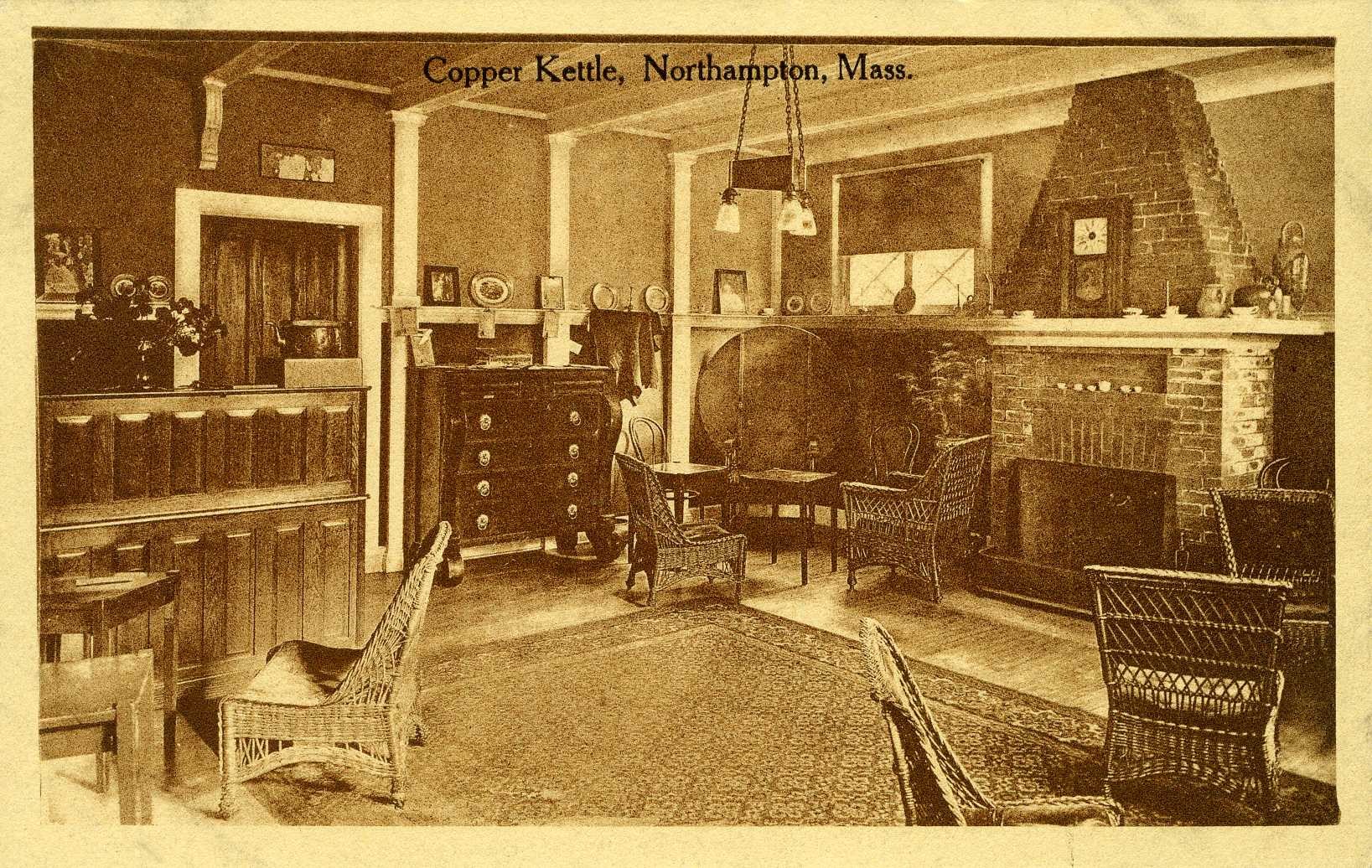
For example, a popular spot for students from Smith College was the Copper Kettle, which played a role much like the coffee shops of today. Students hung out there, read, chatted, and snacked on popcorn, ice cream, and tea. Its decor was cosy, shabby-chic style with mismatched furniture, wicker lounge chairs, posters, and window seats. Smith students were also enamored of the Rose Tree Inn, where full meals were served in a Bohemian atmosphere created by the intriguing Madame Anna de Naucaze.

Some colleges were almost surrounded by tea rooms. That was true in Western Massachusetts where both Smith College and Mount Holyoke College are located. Northampton, home of Smith College, was described in 1922 as having “more tea-houses than churches.” Not so far away, Mount Holyoke College was also well supplied with tea rooms, among them The Croysdale Inn, The Mary-Elin Tea Shop, and The Art Nook. I find it interesting that the Mary-Elin advertised in 1921 that it would stay open until 10 p.m., which was quite late for a tea room.

Parents did not always approve of their free-wheeling daughters’ behavior. In 1912, a mother wrote a critical article titled “One Disintegrant of Our Home Life,” about the typical college girl who socialized constantly, ignored rules of proper dress, and loved going to “the Green Coffee Pot or the Carnation Tea Urn.” “I tell my husband that college doesn’t breed home-building girls,” she wrote.

Among the most notable changes that tea rooms brought was simply that of providing a welcoming and friendly place for unescorted women to gather. This, of course, encouraged women and girls to spend more time eating away from home.

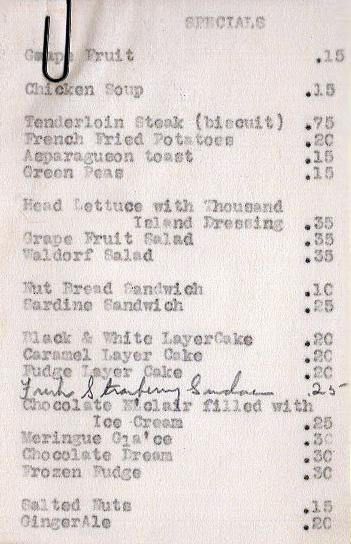
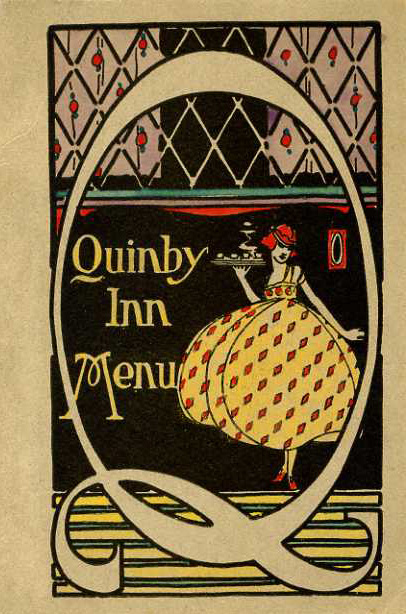
As for food, apart from popularizing eating cake and ice cream at any time of day or night, tea room food was a departure from typical lunch rooms and restaurants of the early 20th century that served fairly heavy meals based around meat. Although meat was certainly served in tea rooms, patrons also had many other choices. A 1920s menu from The Quinby Inn (shown above) — popular with students at Goucher College near Baltimore — offers Tenderloin Steak and Roast Pork, but also many other choices, with quite a few of them revealing the popularity of sweet food. Among them are 12 desserts, 22 salads, many of which involved mixed fruits and whipped cream, and 22 sandwiches, including Olive & Egg and Sliced Pineapple (no, not together!).

The list of specials clipped onto a 1920s menu from The Mary-Elin Tea Shop near Mount Holyoke College also shows its patrons’ fondness for sweets [thanks to Donna Albino for scans of the menu from her Mount Holyoke College collection].

A number of college women opened tea rooms of their own either as a summer project or after graduation. But that will be another post.

© Jan Whitaker, 2019

4 Comments

Filed under alternative restaurants, food, menus, patrons, restaurant customs, restaurant fads, tea shops, women