Taste of a decade: 1920s restaurants

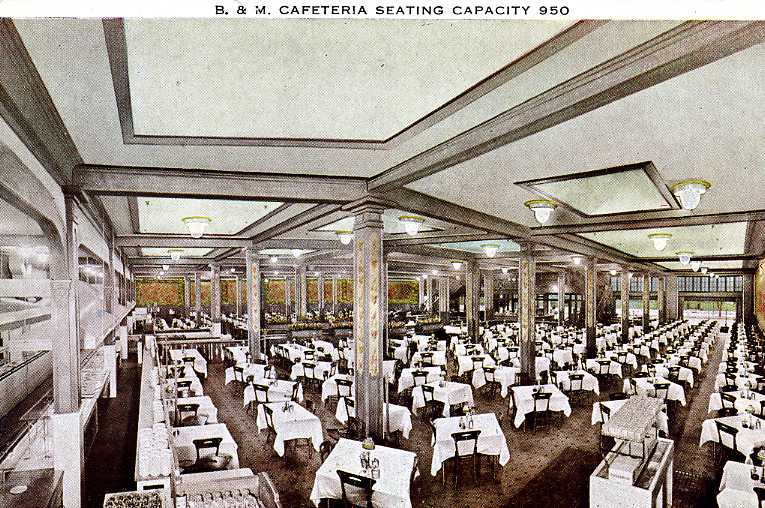
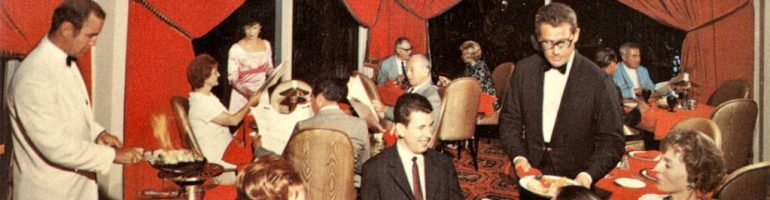
The 1920s is an important decade because it marked the birth of the modern restaurant industry. The advent of national prohibition stripped away liquor profits, shifting emphasis to low-price, high-volume food service. More people ate out than ever before. Restaurant owners formed professional associations to raise industry standards, counter organized labor, and lobby for their interests. Famous pre-war restaurants closed, while cafeterias, luncheonettes, and tea rooms thrived. Female servers began to replace men. Restaurant chains incorporated and were listed on the stock exchange. While critics bemoaned the demise of fine dining, the newborn industry and its patrons celebrated simple, home-style, “American” fare.

Highlights

1920 After a strike of 1,100 cooks and waiters in Chicago, the Congress Hotel hires a crew of waitresses. – Milwaukee restaurateurs report that Sunday has become their biggest day because of families eating out.

1921 A character in Alexander Black’s novel The Seventh Angel observes, “Life is just one damned restaurant after another,” then asks plaintively, “Is there any home-eating any more?” – A restaurant trade magazine reports that half of all restaurant meals in Los Angeles are sold in cafeterias and other self-service eateries. – In New York City, a former “lobster palace,” Murray’s Roman Gardens, advertises sodas and candy in its Ice Cream Salon.

1922 The International Association of Hotel Stewards endorses the elimination of French terms on menus.

1924 A brochure from the B/G Sandwich Shop chain boasts of “Food selected and prepared as in your American home; served by the sort of people you find at home, – high class ambitious young Americans who do not desire to submit to the European custom of depending upon the master’s gratuities.” – Cafeteria chain manager Harry Boos, president of the National Restaurant Association, declares: “Men and women want their goods quick and clean. The restaurant business is a greater industry than ever before in history.” – “Quick and Clean” is also the slogan of the White Cafeteria in Indianapolis.

1925 After the closure of his once-celebrated NYC nightspot restaurant “Jack’s,” owner John Dunstan complains “The town’s full of cafeterias.” – Henri Mouquin’s famed French restaurant is demolished to make room for a Princeton Cafeteria.

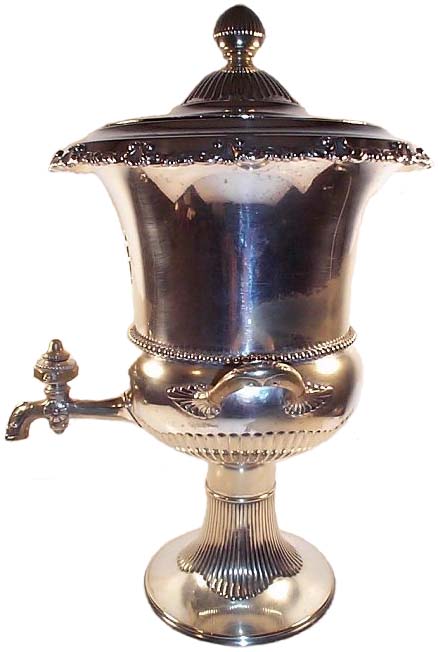
1926 The Cordleyware Co. advertises that its champagne buckets for restaurants can be used as carriers for soiled silverware.

1927 The journal Restaurant Management reports that from 25% to 30% of all meals in cities are eaten in restaurants and that close to 60% of restaurant patrons are women. – A restaurant of the Happiness Candy Stores chain opens on the Fifth Avenue site once occupied by Delmonico’s.

1928 In recognition of the growing number of women in the restaurant business, the American Restaurant journal begins a special section called “The Restaurant Woman.” – Chicago’s corned beef sandwich mogul, John P. Harding, known for catering exclusively to men, opens a restaurant especially for women.

1929 A restaurant trade magazine editorial asserts that the industry has finally won respectability. There is, it notes, “tremendous change in popular feeling toward a business once thought precarious – as well as beneath consideration, socially.”

Read about other decades: 1800 to 1810; 1810 to 1820; 1820 to 1830; 1860 to 1870; 1890 to 1900; 1900 to 1910; 1930 to 1940; 1940 to 1950; 1950 to 1960; 1960 to 1970; 1970 to 1980

© Jan Whitaker, 2008

21 Comments

Filed under miscellaneous

Never lose your meal ticket

“Meal ticket” is a term known better for its metaphorical meaning than for its original usage. It’s easy to conjure up a gangster in a 1940s film noir complaining that someone thinks he’s their meal ticket. Meaning, of course, that the person (probably a woman, alas) believes s/he has a found someone who can be manipulated into picking up the tab. This meaning came quick on the heels of the introduction of meal tickets around 1870.

Meal tickets were a way of life for young single people typically employed as department store clerks or office workers of the 1890s and early 20th century. They probably carried a meal ticket with them all the time. They lived alone in furnished rooms without kitchens, ate all their meals in restaurants designated for “ladies and gents” (see below), and were known as “mealers.” Periodically they would buy a meal ticket good for a week’s worth of restaurant meals. Because they paid in advance, they received a discount. A ticket for 21 meals costing 25 cents each might sell for as little as $4.00 rather than its face value of $5.25, giving the purchaser several “free” meals. If they could afford it, mealers would keep more than one ticket on hand so they could enjoy a little variety. Living lives of stupefying monotony and near-poverty, most needed all the variety they could come by.

Tickets did not have to be used up within a week, but their owners knew that holding a ticket for too long ran the risk that the restaurant would go out of business before it was all punched out. The unused meal ticket from the White Front Café of Joplin breaks down quarters into smaller sums thereby allowing that some meals might cost less, some more. It appears to be from the 1930s, a time when meal tickets were no longer being used in larger cities.

© Jan Whitaker, 2008

3 Comments

Filed under restaurant customs

Beans and beaneries

“Beanery” was less a name that an eating place would claim for itself than a slang term for a cheap and lowly lunch room. In these eating places baked beans was a staple dish going back at least as far as the mid-1800s. Milliken’s Beefsteak & Coffee Room in lower Manhattan offered its customers pork and beans in 1845. The price was 6 cents, the same, surprisingly, as roast beef or chicken pot pie.

Before sweet things became standard breakfast fare, baked beans were considered ideal for the morning meal. In fact the beauty of beans was that they made a square meal 24 hours a day. Like ham and eggs, they were favorites at all-night eating places. They could also be found in other nighttime establishments such as Silk & Anderson’s Saloon, Billiard and Keno Hall in Trinidad, Colorado, established in 1876, where baked beans, ham, and cole slaw made up the free “lunch” spread from 9:00 at night until 2:00 in the morning.

Baked beans could be found in restaurants all over the U.S. – Cincinnati, San Francisco, New Orleans – but it was in hard-edged Chicago, New York, and Boston where the slang term “beanery” especially captured the imagination of writers. Despite the unsentimental words of a 1908 hash house waitress, “There ain’t no romance about pork and beans or any of it. It’s all to the real life, and a punched check for a finish,” novelists of that time loved to set their tales of salty characters in big city beaneries.

Each city’s beaneries had a different character. Chicago’s South Clark Street, “toothpick row,” was full of them but beans also did duty in the city’s saloons where a 5¢ glass of beer earned a free lunch of beef and baked beans, with pickles, olives, and celery for trimmings. New York City was known for its “beef and” places, as they were called. The beef, in this case, was corned and everyone knew the missing word after beef was beans.

In Boston baked beans formed a considerable industry. Bakeries and other bean specialists ran hot ovens full of beanpots every night, turning out 32 million quarts annually which they delivered daily to restaurants and lunch counters. Baked beans often appeared on menus accompanied by brown bread, a combo known as “B. B. B. & B. B.” Even in 1921 when beans were slipping out of favor as a restaurant dish, the Childs chain found demand strong enough to keep them (and oysters) on their Boston breakfast menus.

It was said that baked beans was too frugal a dish to be popular in Los Angeles where garden produce was available year round. Yet “Ptomaine Tommy” DeForest laid claim to inventing a bean dish unique to L.A., the mysteriously named “size,” a hamburger on a bun covered with chili and diced raw onions.

By the 1960s Americans had outgrown their love of baked beans. In a restaurant trade book of 1966 they are listed as “foods to shun,” along with kidneys, chipped beef, turnips, and rutabagas.

© Jan Whitaker, 2008

4 Comments

Filed under food, lunch rooms

Basic fare: hamburgers

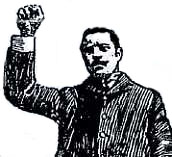
The hamburger sandwich got its start in the 1890s, probably in venues such as the night lunch wagons which were forerunners of diners. Before that, hamburger steaks (without bread) were mainly found in eating places patronized by German immigrants. Hamburger or “Hamburg” steaks were typically made of ground beef and minced onion and served with a sauce. They were such a menu staple that around 1900 black waiters in Chicago’s noisy lunch rooms created the hand signal shown here to convey orders to the kitchen. It may be a variation on the signal for “small steak” in which the fingers were raised as if taking an oath.

As a sandwich, the hamburger, of course, was designed to be eaten with the hands. It was a specialty of the horse-pulled lunch wagons which became widely known in Chicago at the time of the 1893 Columbian Exposition. Lacking inside seating, their customers, often nightshift workers, either took food away to eat elsewhere or consumed it standing in the street. For convenience, lunch wagons prepared every order between bread, whether it was pork chops, pigs’ feet, or eggs.

Although it provided sustenance for many, hamburger was not always considered fit food for discriminating people. It was often made from butchers’ scraps which were dosed with preservatives ranging from sulfites to formaldehyde before grinding. Doctors denounced it and in 1920 the Navy stopped buying it due to food safety concerns. All in all, hamburger’s associations with lowly lunch wagons, immigrants, the working class, spoiled meat and additives — and the smells of grease and onions — stigmatized it.

Yet somehow the hamburger on a bun survived all the attacks against it. By the late 1920s it was hailed as “the most characteristic American dish.” Because it was a thrifty meal, the Great Depression helped build its popularity. When a junior high school cafeteria in Cleveland’s Shaker Heights banned hamburgers in 1936, because “the type of young people in the Shaker Heights school are of a class that should be served a higher type of food,” the action met with negative publicity and charges of elitism.

By the mid-1950s, when suburban hamburger chains began to spread, hamburger was the “king of beef,” making inroads into New England, where roadside stands had long catered to a regional preference for hot dogs, and the South, where barbecue was a favorite. Because ground beef was well-liked, cheap year-round, and increasingly available in pre-cooked frozen patties, it became a foundational food for many restaurants.

In marketing the hamburger, proprietors have usually embraced or at least referenced its democratic unpretentiousness. In the 1920s this took the form of calling eateries shacks, hamlets, or, humorously, “castles,” while today it is evident in price appeals and representations of solidarity among diverse populations. Unless they attack on health grounds, critics of the hamburger risk being seen as culinary snobs.

© Jan Whitaker, 2008

Leave a comment

Filed under food

Famous in its day: Taft’s

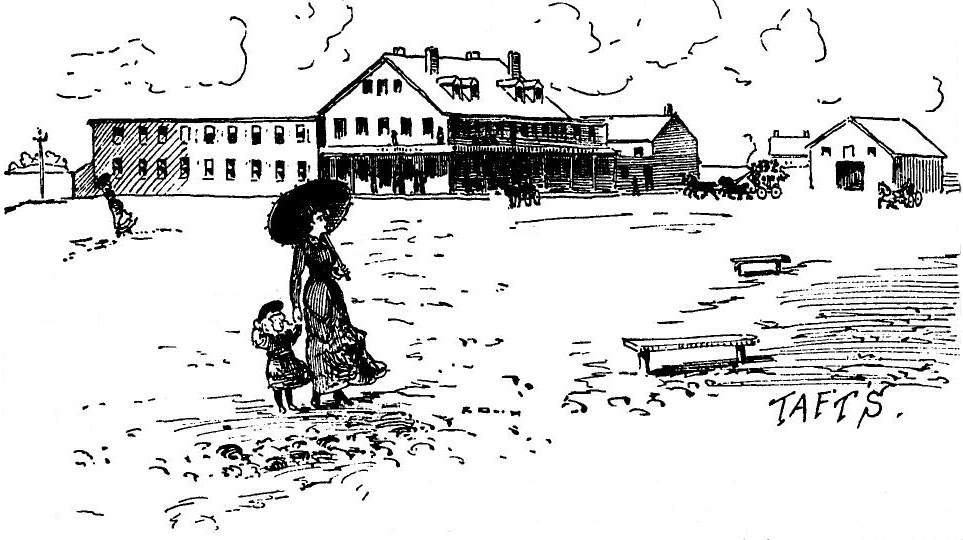
Throughout much of the 19th century game topped the list of desirable restaurant fare. Taft’s Hotel located on the shore at Winthrop MA, 5 miles outside Boston, attained widespread fame as a place to enjoy a fish or game dinner. Proprietor Orray Augustus Taft called his place a hotel but did not accommodate overnight guests. Taft’s was actually a seasonal restaurant serving parties by reservation only, from May through October. It was established at Point Shirley around 1850 and closed in the mid-1880s.

Taft’s was not much to look at. Two unattractive structures attached to the main building (shown here) held bowling alleys and billiard tables suggesting that groups often made a day of it. According to visitors of the 1870s, the resort might have had a nice view of the harbor if it had not been blocked by a reformatory on neighboring Deer Island. Taft’s fame was obviously not based on an elegant setup but rather on its provisions. Taft liked to entertain guests by taking them into his kitchen and showing off the contents of his ice chests. Fish came from the waters of Nantucket, Boston Bay, Long Island, and far beyond. Flat fish, such as turbot and plaice, were his specialty. Ducks and birds (snipe, plover, reed birds, grouse) came from all along the Atlantic Coast and the Great Lakes.

A couple of the strangest items on Taft’s menus were “owls from the north” and “humming birds in nut shells.” Exactly what the “owls” were is uncertain. Snowy owls, horned owls? Or, perhaps it was a code for something else altogether. Owls sometimes appeared on 19th-century menus for birds obtained in violation of game laws. On an 1877 Taft’s menu the selection was explained cryptically in parentheses as “Lady’s Birds.”

The hummingbirds, according to a hunter who obtained them for Taft, were actually bank swallows. Another opinion suggested they were English sparrows. Clearly they were tiny and many believed they were genuine hummingbirds. They were served in a delicately hinged nut shell, which opened to reveal what resembled a miniature roast turkey. A guest from Philadelphia reportedly felt they were “really not worth eating, being dry and tasteless.” “But,” he admitted, “I wanted to say that I had eaten a humming bird, and now I can say it.”

© Jan Whitaker, 2008

8 Comments

Filed under food

“Eating healthy”

Restaurants (and their critics) have often shown concern with patrons’ health, but the focus of concern has varied widely in different eras.

In the 18th century the idea that restaurants had a mission to restore health came to this country from France. The legend spread that a Frenchman named Boulanger invented the first restaurant, hanging out a signboard stating “I will restore you.” Whether or not this actually occurred — or whether he was “the first” — it is true that early restaurants in France promised to provide healthful dishes. The mission migrated to America as chefs arrived after the French revolution. When Julien’s opened in Boston the proprietor vowed to supply the infirm, convalescent, and weak with “nourishing” soups and broths, including turtle soups which, he advertised, would purify the blood.

But the early French “restorators” were voices shouting in the wilderness. For most of the next two centuries Americans believed their health depended on eating meat and lots of it. In the latter 19th century and into the 20th, concern shifted to unsanitary conditions in restaurants as health departments were created, ordinances established, and inspectors dispatched.

The vegetarian restaurants of the early 20th century demonstrated a renewed interest in healthy diets. Meat substitutes produced by the Kelloggs of the Battle Creek Sanitarium appeared on their tables, although breakfast cereals, whose popularity was aided by restaurant promotions, were undoubtedly the most successful of all health food products.

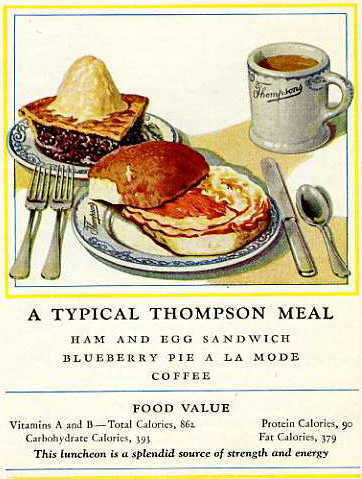
The food conservation guidelines of World War I lightened diets, with less meat and more vegetables on restaurant menus, as well as spreading knowledge of nutrition. A few chains, such as J. R. Thompson and Childs, provided vitamin and calorie counts in the 1920s. But the public was not too receptive. Stockholders booted out William Childs after he gained control of the mighty lunchroom corporation and removed meat from its menus, causing sales to plunge drastically.

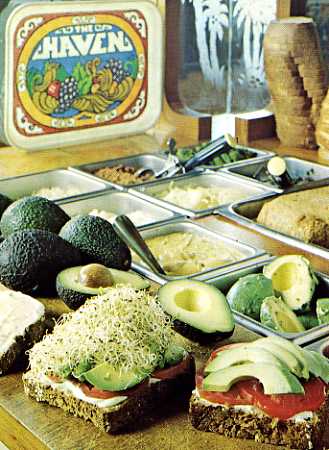
After a prolonged beef-eating revival following the end of WWII rationing, health-conscious restaurants made a comeback as part of a counterculture critique of industrialized food. The “holy war against adulterated foods and french-fried, frozen, super sugar wastelands,” reported Mary Reinholz in the Los Angeles Times in 1971, had produced at least 25 organic restaurants in southern California, including H.E.L.P., Aware Inn, The Source, and Nucleus Nuance which served “evolution burgers,” “Virgo vege-loaves,” and carob mousse. One Los Angeles counterculture restaurant favorite, carrot cake, crossed over onto mainstream menus.

Natural food eating places, such as St. Louis’s Sunshine Inn, Long Island’s Shamballah Gardens, the Haven in Honolulu, Homeward Bound in Flagstaff, and Mary’s Natural Food Restaurant in Denton TX, to name but a few, soon spread throughout much of the country, laying the groundwork for the restaurant revival of the 1980s.

© Jan Whitaker, 2008

24 Comments

Filed under alternative restaurants, food, restorators

Mary Elizabeth’s, a New York institution

Mary Elizabeth Evans, for whom the landmark tea room was named, began her career in 1900 at age 15 as a small grocer and candymaker in Syracuse. After one year in business she cleared the then-handsome sum of $1,000 which she contributed to the support of her family while supervising a growing crew of helpers which included her two younger sisters who served as clerks and her brother who made deliveries.

Her family, though in seriously reduced circumstances, had valuable social connections. Her late grandfather had been a judge, her uncle an actor, and her departed father a music professor. That may help explain how she achieved success so rapidly – and why her story garnered so much publicity. By 1904 several elite NYC clubs and hotels sold her candy and soon thereafter it was for sale at summer resorts such as Asbury Park and Newport and in stores as far away as Chicago and Grand Rapids. In 1913 the all-women Mary Elizabeth company, which included her mother and sisters Martha and Fanny, was prosperous enough to sign a 21-year lease totaling nearly $1 million for a prestigious Fifth Avenue address close to Altman’s, Best & Co., Lord & Taylor, and Franklin-Simon’s.

By the early teens the candy store had expanded into a charming tea room with branches in Newport and two in Boston, one on Temple Street and the other in the basement of the Park Street Church near the Boston Common (pictured ca. 1916). Like other popular tea rooms of the era, Mary Elizabeth’s bucked the tide of chain stores and standardized products by emphasizing food preparation from scratch. Known for “real American food served with a deft feminine touch,” Fanny Evans said the tea rooms catered to women’s tastes in “fancy, unusual salads,” “delicious home-made cakes,” and dishes such as “creamed chicken, sweetbreads, croquettes, timbales and patties.” For many decades, the NYC Mary Elizabeth’s was known especially for its crullers (long twisted doughnuts).

Mary Elizabeth distinguished herself as a patriot during the First World War by producing a food-conservation cookbook of meatless, wheatless, and sugarless recipes, and by volunteering to help the Red Cross develop diet kitchens in France. After her marriage to a wealthy Rhode Island businessman in 1920 she apparently played a reduced management role in the business.

In its later years the NYC restaurant passed out of the family’s hands and began to decline, culminating in an ignominious Health Department citation in 1985.

© Jan Whitaker, 2008

112 Comments

Filed under tea shops, women

Fast food: one-arm joints

The wooden one-arm chair was a characteristic feature of the “quick lunch” type of eating place which became the popular choice for businessmen around the turn of the last century. The chairs were unattractive and uncomfortable as the cartoon below depicts. But considering that prior to their introduction patrons seeking a speedy lunch often ate while standing at a counter, they offered relative luxury. Solitary seating made sense in a café where businesspeople usually came in alone and spent little more than 10 or 15 minutes at their meal before rushing back to the office or store. (Later, in fact, more attractive one-arm chairs were used in Lord & Taylor Bird Cage restaurants.)

As is true of the fast food restaurants of today, one function of uncomfortable seats in the quick lunch eatery was to discourage lingering. These restaurants were usually shoe-horned into tight quarters in high-traffic, high-rent business centers, so it was paramount that each chair turned customers rapidly. The one-arm chair was patented by a Vermonter named James Whitcomb who designed fixtures for the Baltimore Dairy Lunch and also manufactured portable typewriters.

The core cuisine of the one-arms, and quick lunches in general, consisted of coffee and pie, supplemented by sandwiches and doughnuts. Some of the big one-arm concerns were the Chicago-based companies of John R. Thompson and Charles Weeghman, and the Baltimore Lunch and the Waldorf System, both of which originated in Springfield MA. The companies eventually broadened their menus to include hot dishes, supplying their locations in each city from central commissaries. Though the chains kept prices low, Waldorf prided itself on grating lemons for lemon pies and avoiding manufactured pie fillings, powdered milk, dried eggs and other cost-cutting ingredients developed for the military in World War I and widely used by chains in the 1920s.

Under the intense competition of the late 1920s and the depression, the Lunches replaced their one-arm chairs with tables and chairs and abandoned their utilitarian decor in favor of more colorful interiors in hopes of attracting more women.

© Jan Whitaker, 2008

25 Comments

Filed under lunch rooms

The family restaurant trade

As far back as the 1700s families in cities obtained some of their meals from public eating places. Usually the food came to them rather than the reverse. If they were wealthy they sent a servant to pick up dinner from the local caterer. “Any Family may be supplied at any time with dishes of victuals hot or cold,” advised a standard newspaper advertisement of the 1790s.

No one realized it of course but the habit of getting the family dinner from a restaurant and eating it at home would become a mainstay of American restaurant business of the future, especially after World War II when carry-out increased.

Families occasionally went out to eat in the 19th century, yet it was unusual enough that when children were spotted in restaurants it tended to set off alarms that still echo today. A magazine in 1853, observing children at New York’s Thompson’s, Taylor’s, and Weller’s – all of which specially catered to women and children – noted, “The little people are taken out, to save trouble, and fed on dainties at the brilliant restaurants, where their appetites are awfully vitiated, and they eat most alarming quantities of ice-creams and oysters.”

Ladies’ restaurants aside, most places were and would remain male turf almost until World War I. Families usually ate in private rooms upstairs, away from barrooms, ruckus, and rude stares. Even in small towns the more ambitious restaurants provided special accommodations for families. In Tombstone, Arizona, the International Restaurant, a miners’ café, advertised dining rooms reserved for them in 1881. Conditions changed little until tea rooms became popular around 1910. They established a kind of “beachhead” for women diners, also multiplying the places where children might eat. Early ones such as the Mother Goose-theme tea room in NYC and the Whistling Oyster in Ogunquit, Maine, which produced its own souvenir children’s book, made a specialty of pleasing young patrons.

After the First World War restaurants became cleaner, more informal, and alcohol-free — and they did more business than ever before. Families were especially attracted to cafeterias, particularly on the West Coast where they thrived. As more families acquired cars, the custom developed of taking a country drive on Sundays, capped off by an early dinner at a roadside inn or tea room. Children’s menus appeared, such as those of California’s Pig ‘N Whistle chain in 1937. The South’s S&W cafeteria chain began to present weekly children’s entertainment nights in 1939. Thanks to rising incomes, more vacations, and a pro-family culture, the restaurant industry of the 1950s saw families as the customer base of the future. “You get a picture of the powerful social and economic trends working in your favor,” an advertising agency spokesman told a restaurant association in 1955.

Working mothers and smaller families in the 1960s further enhanced restaurant growth. By the mid-1960s there were 18,000 restaurants in Southern California, where sales had increased almost 100% since the end of WWII, attributed primarily to family dining. In 1976 the National Restaurant Association identified families’ favorite eating spots as family restaurants, fast-food eateries, theme restaurants, cafeterias, and coffee shops. Chains such as Howard Johnson’s, Bonanza, Ponderosa, Pizza Hut, International House of Pancakes, and Denny’s looked forward to a bright future.

© Jan Whitaker, 2008

1 Comment

Filed under family restaurants

Taste of a decade: restaurants, 1800-1810

The American population is settled mainly along the Eastern seaboard. The largest city, New York, with almost 80,000 people, is one of only about 15 cities with more than 1,000 inhabitants. Meals are available in taverns, oyster houses, coffee houses, and French restorators. Most diners are male travelers, businessmen, or boarders, though religious societies and clubs of firefighters, politicians, or old soldiers gather for banquets from time to time. The dinner hour falls between noon and 3:00 p.m.

Highlights

1800 Meat, fish, and fowl are the principal offerings of eating places, and an establishment’s quality is measured by the amount and assortment of animal protein set out on the table. At the Portland Restorator in Portland, Maine, the proprietor proudly announces he has “potted lobster, potted eel, chicks fricaseed, and fine ragouts, beef alamode, and barbicues, sausage Bologna, Hamburgh, Naples, choice venison pastry, pork pie Cheshire, good beef steak, and bacon rasher” as well as “round of beef, fat Sirloin, turkey roast, or calf’s head boil’d with tongue & brains.” Beyond these main dishes, he supplies only soup and a few pies. Strangely, he does not mention one of the most popular edibles of the 19th century, oysters.

1801 Well-off Americans who read fashionable magazines are fascinated by the popularity of restaurants in Paris. There, it is said, “everybody” (who is anybody) dines frequently outside the home. The awkward term “restorator,” an Americanized version of restaurateur which refers either to a place to dine or to its proprietor, becomes a trendy metaphor for a publication, an essay, or an editor.

1802 Napoleon offers amnesty to his opponents and many French citizens who escaped to America during the revolution return to France, shrinking the number of skilled restaurateurs. Not all leave, however. Julien continues in Boston.

1802 The inimitable black caterer Othello Pollard, of Cambridge MA, beckons “select” clients from nearby Harvard with beefsteak, soup, cheese, ham, tongue, ice cream, custard, strawberries and cream, whip-syllabub, pies, jellies, olives, and fruit, along with a well-stocked liquor cabinet. In an unusual advertisement, he observes: “It is a wise saying … that the Body is as much a subject of education as the Mind. Both require tuition and discipline. The UNIVERSITY takes the Mind for its pupil; OTHELLO takes the Body. He, therefore, who has not been at both schools is half a Scholar.”

1803 In Charleston, South Carolina, a new hotel opens with a banquet room accommodating 300.

1807 The beefsteak and oyster house remains a popular sort of eating place. Turtle soup is a delicacy and restaurants place notices in papers when they are about to prepare it. On June 8 Wm. Fryatt, who has recently opened a Porter, Beef Steak and Oyster House on the corner of Pine and Nassau in New York, advertises he will prepare the last turtle of the season.

1808 Henry Doyhar of New York City announces that he will list his dinner specials in writing each day: “To accommodate those who wish to procure their Dinner …, the bill of fare, containing the dishes regularly numbered, will be exhibited every day from nine till eleven o’clock, A.M. for the purpose of engaging beforehand such dishes as may be wanted.” Since so many people are illiterate at this time, this suggests his clients are educated and probably wealthy.

1809 In Boston the elegant and expensively built Boston Exchange Coffee-House opens with a coffee room on the ground floor, furnished with a bar and 14 private and “handsome boxes, each containing a mahogany table, seats, and a bell rope.” On the second floor is a banquet hall and a dining room whose “walls are painted a beautiful green, and the windows decorated with curtains of scarlet moreen.”

Read about other decades: 1810 to 1820; 1820 to 1830; 1860 to 1870; 1890 to 1900; 1900 to 1910; 1920 to 1930; 1930 to 1940; 1940 to 1950; 1950 to 1960; 1960 to 1970; 1970 to 1980

© Jan Whitaker, 2008

6 Comments

Filed under miscellaneous