Dining on the border: Tijuana

TijuanaGardenCafe1922Borderlands are fascinating social and cultural mixing bowls. Their restaurants exemplify how variable these places can be. Lacking tradition as well as a local clientele and culture, there is little shaping them other than market forces. In Tijuana prominent historical factors shaping the market were drinkers’ desire for alcohol and restaurant owners’ need to recoup lost business.

The history of restaurants and cafes in Tijuana is marked by all the instability and calamity that the restaurant business is known for – and then some! Partnerships shifted, scandals erupted, and fires swept through the main street, Avenida Revolucion.

When Prohibition became the law in the United States, a number of San Diego restaurant, café, and bar owners – Italians, Jews, Slavs, and others — set up shop a stone’s throw away, in Tijuana, then a village of little more than 1,000 people. American visitors who began to head there did not go to soak up Mexican culture, but to escape restraints [see 1922 advertisement above]. Tourist eating places, all furnishing drinks and often entertainment, had names like Johnny’s Place, Aloha [American teens in Aloha Cafe, 1940s, below] , and Alhambra. Few were run by Mexicans and Mexican food ranked low on the culinary scale.

From the point of view of San Diego’s anti-alcohol, cafeteria-loving reformers, the drinking, gambling, and prostitution that went on in Tijuana made it a hell hole. Tijuana’s reputation, of course, did not stop everyone from going there, even many respectable, well-off San Diegans and Los Angelenos, as well as civic organizations. Determined to limit vice, prohibitionists waged vigorous battle to restrict passage by shortening border crossing hours, finally succeeding in closing the border from 6 pm to 6 am in 1926.

TijuanaAlohaCafeca1949

Despite the curfew, San Diego’s hotel and restaurant industries protested in 1931 that the 6 pm closing “ha[d] not prevented one single person from going to Tijuana,” and had actually reduced their business by 25%. They alleged that visitors went for the whole day or stayed overnight, enabling them to engage in more drinking, gambling, or whatever than previously. Tijuana flourished, opening more cafes, clubs, and hotels.

The better restaurants specialized in “international cuisine” which consisted mainly of steaks and seafood along with Italian, French, German, and Mexican dishes. In this category were restaurants variously operated by Alex and Caesar Cardini of salad fame. Julia Child wrote in her 1975 book From Julia Child’s Kitchen that she remembered going to Caesar’s for lunch in 1925 or 1926 with her parents. They had heard of his special salad and were eager to taste it. “Caesar himself rolled the big cart up to the table, [and] tossed the romaine in a great wooden bowl,” she wrote.

The border curfew was relaxed in1932 and lifted entirely in 1933. But if that had an adverse impact on Tijuana tourist trade, it was nothing compared to the blows delivered by the repeal of U.S. Prohibition in 1933 and a Mexican gambling ban in 1935. Tijuana bartenders correctly predicted few bars and cafes would survive. Sure enough, proprietors headed back to the U.S. Caesar Cardini opened a place in San Diego in 1936.

TijuanaGermanrestaurant

The tourist economy waxed and waned thereafter, thanks to such things as the 18-year-old drinking age, the availability of marihuana, and incidents of violence. Mexican cuisine became more popular in Tijuana’s tourist district in the latter 20th century. Richard Nixon, then Vice President of the United States, ordered Mexican dishes and German beer in an informal visit to the Old Heidelberg there in 1960.

Today Tijuana is a large global city, yet Americans tend to stick to the main tourist avenue as of old. There is a diversity of restaurants, many with Hispanic names and owners. Caesar’s has continued, off and on, since the Cardinis departed. Yet, as much as I’d like to believe a recent comment about it on TripAdvisor.com (“nice place to feel the real culture and history of Tijuana”), I have to ask, “Real culture? Real history? What?”

© Jan Whitaker, 2013

2 Comments

Filed under miscellaneous, night clubs

Postscript: beefsteak dinners

healysphotoThis year marks the 100th anniversary of the Armory Show, an art exhibit that introduced Americans to modern art, most notably to Marcel Duchamp’s Nude Descending a Staircase [No. 1]. Last week I received a copy of the Smithsonian’s Archives of American Art Journal which commemorates the show. To my surprise, the journal contains an article (Meat and Beer, by Darcy Tell) about a beefsteak dinner given by the artists who organized the Armory Show in gratitude to the press whose extensive coverage helped make the show a popular success.

The Armory Show was largely organized by American artists Walt Kuhn, Arthur Davies, and Walter Pach. (Kuhn’s and Pach’s papers are preserved in the Archives of American Art, Smithsonian Institution.)

In an earlier post I wrote about beefsteak dens, dungeons, and caves where men put on butchers’ aprons and threw aside the trappings of civilization. Sitting uncomfortably on boxes in dingy cellars, they drank beer and ate steaks without silverware or napkins.

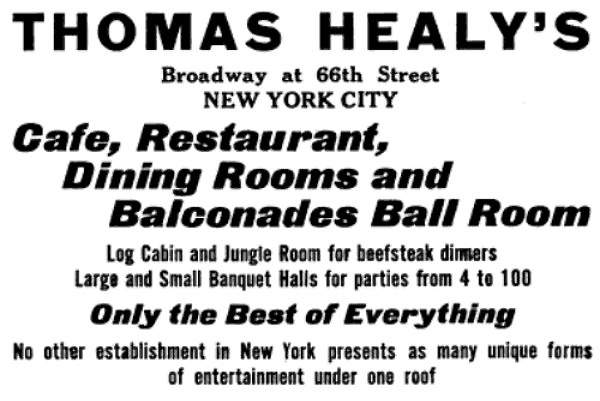
BeefsteakHealy'sADV1916The 1913 Armory Show dinner was held at Healy’s restaurant, on 66th Street in NYC, a popular place for these feasts. It had three rooms dedicated to them: the Dungeon, the Jungle Room, and the Log Cabin Room. The artists and their “friends and enemies from the press,” as they were designated on the menu, gathered in the Log Cabin Room, probably the most civilized space of the three, furnished with long tables and chairs and complete with tablecloths and napkins. While the guests ate, someone read aloud humorous, insiderish (fake) telegrams, even one purporting to be from Gertrude Stein [see link below].

I have to admit I was a tiny bit disappointed to learn that such a (presumably) sophisticated group of men as was represented at this dinner would choose to attend a beefsteak at Healy’s. By 1913, if not long before, beefsteaks were recognized as evenings of orthodox jollity for business men and conventioneers. Yet, the Association of American Painters and Sculptors paid out $234 [at least $5,500 today] for a dinner much like that enjoyed by the Paper Box Makers Association and the League of Associated Hat Men.

And, just like the hat men and box makers, they took away a regulation group photo to show for it.

© Jan Whitaker, 2013
5 Comments

Filed under atmosphere, patrons

Three hours for lunch

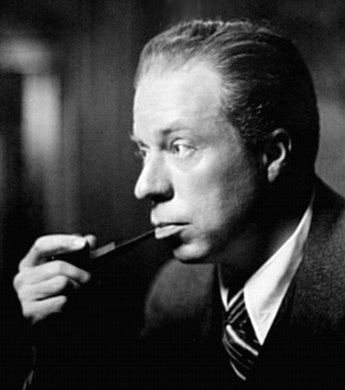
ChristopherMorley1930For every devoted restaurant-goer who likes to keep up with the latest restaurant trend there are probably two others who would prefer an eating place from the past. Despite my fascination with the history of restaurants, it might surprise some readers to learn that as a diner I am not attracted to historic restaurants; I study the past but eat in the present. Journalist and author Christopher Morley, however, might have been the patron saint of those who would gladly flip back the calendar when dining out.

Through the 1920s he gathered together friends who loved to explore the corners, alleys, and waterfronts of Manhattan and environs, especially Hoboken which he christened the “seacoast of Bohemia.” Their whimsical jaunts centered on a leisurely lunch.

The group, whose personnel was always changing, was made up of men who had enough time to join Morley’s Three Hours for Lunch Club. He initiated it in 1920 when he began writing a column for The New York Evening Post called “The Bowling Green” that chronicled his explorations of New York and the escapades of the club. Later the column appeared in the Saturday Review of Literature.

The club was less about food than about male camaraderie, conversation, and humorous one-upmanship. In earlier times, before Prohibition, it might have been a drinking club. The loss of masculine drinking culture and the alleged feminization of restaurants underwrote a lament for a present era supposedly ruined by women lunching on sandwiches and soft drinks at soda fountains. By contrast, Morley & Co. searched out old-fashioned taverns and chop houses.

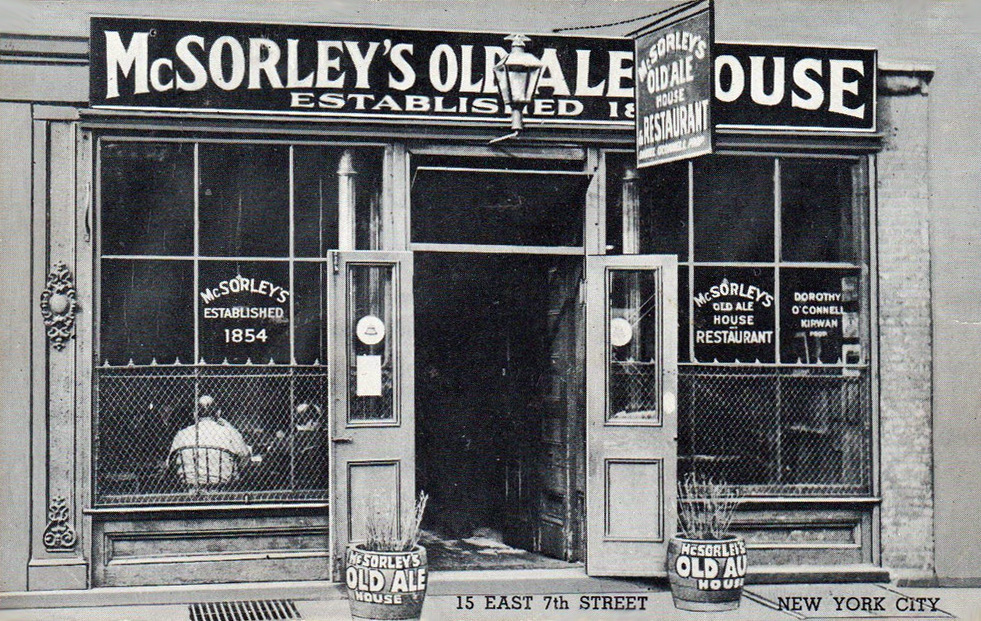
mcSorley'sHe wrote in a tribute to McSorley’s Ale House (which did not admit women until 1970), “Atrocious cleanliness and glitter and raw naked marble make the soda fountain a disheartening place to the average male. He likes a dark, low-ceilinged, and not too obtrusively sanitary place to take his ease. At McSorley’s is everything that the innocent fugitive from the world requires.”

Without his male buddies, Morley might have been limited to the company of his wife Helen, whom he called Titania in his columns. Although the pair enjoyed frequent Saturday lunches in the basement of Moretti’s table d’hôte on East 14th Street, he complained publicly, “Anyplace that I think is peculiarly amusing, or quaint, or picturesque, Titania thinks is unhealthy. Sometimes I can see it coming. We are on our way to Mulberry Bend, or the Bowery, or Farrish’s Chop House. I see her brow begin to pucker . . .”

The club, which included Don Marquis, sea captain/writer David William Bone, Sinclair Lewis, and other editors and writers, flourished about the same time as the Round Table whose literary stars met at the Algonquin Hotel. For a time before he founded his own club Morley was part of a group of Vanity Fair writers who congregated at the Café Noir, but he felt edged out because he lacked the Vanity Fair style. “Even Thackeray would have been grayballed,” he wrote later.

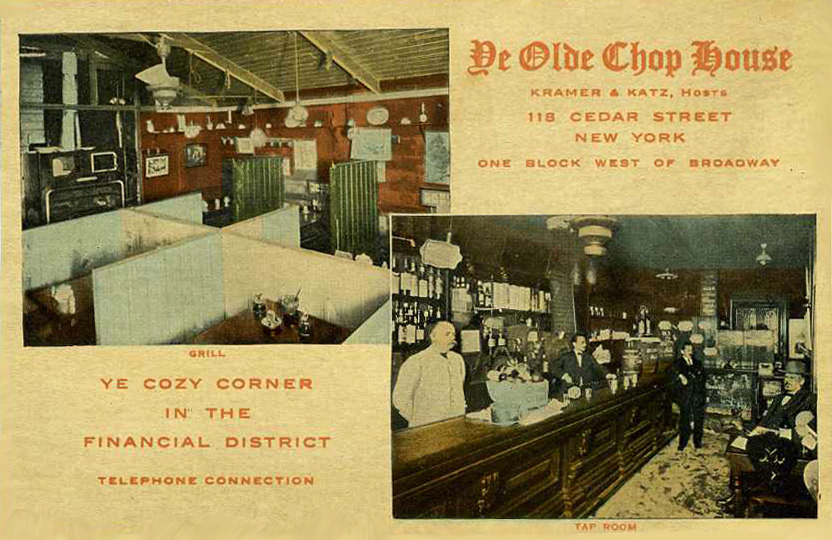
YeOldeChopHouse423

A favorite THFL place in lower Manhattan was Ye Olde Chop House on Cedar Street (pictured pre-Prohibition with sawdust floors beloved by CM) where the club named a waitress “the Venus of Mealo.” The cuisine of chop houses, as might be expected, featured grilled meat and homey dishes such as pickled beets, corned beef hash, tapioca pudding, and rhubarb pie. Far from seeking adventure in the culinary department, Morley once ordered swordfish steak, but declared it “too reptilian.”

Other than the musty hangouts of lower Manhattan, Hoboken’s Hofbrau, Meyer’s Restaurant, and the American Hotel were popular with the club. In 1929 Morley and others bought a bankrupt ironworks on River Street in Hoboken to become club headquarters. But it seems the club was waning around this time and it’s not clear how long that experiment continued. Three-Hours-for-Lunch was succeeded by another club, the Baker Street Irregulars, which Morley – a Sherlock Holmes fan –  formed at Prohibition’s end.

© Jan Whitaker, 2013

2 Comments

Filed under patrons

Light-fingered diners

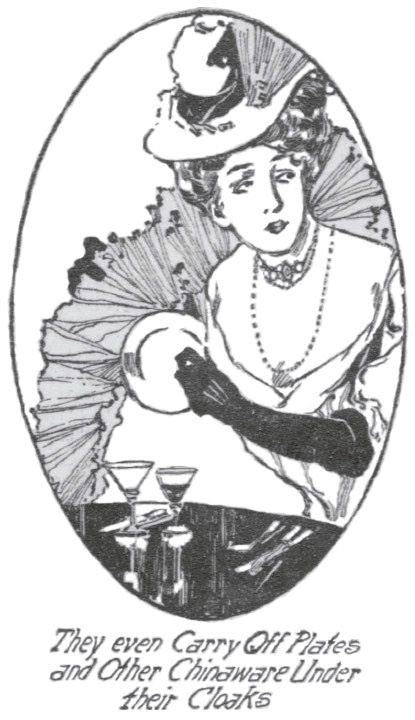
1920sPilferingIf the number of newspaper stories is a reliable index to a trend, then a fad for stealing small items from restaurant tables began in the 1890s. Its continuing incidence is perhaps one reason why table appointments gradually became far less elegant and costly.

A flurry of stories appeared in the late 19th and early 20th centuries about affluent society people who “collected” cordial glasses, demitasse cups, salt cellars, silver spoons, oyster forks, and nut picks as “souvenirs” of first-class hotel dining rooms and restaurants. Anything small that bore an insignia from an elite establishment sent out an irresistible message: “Take me home with you.” Or, as a NYC restaurant owner would confirm decades later, “Put a spoon on a table with a fancy crest on it and kiss it goodbye.” 1906pilfering

The “thieves” – a term pointedly avoided by all – were usually identified as young women from the best families, though men were also known to freely pocket alluring items. It was especially attractive to pick things up while traveling. Women would display their booty in cabinets with little ribbons and tags that gave the date and occasion that each bibelot commemorated.

How cute! A little less cute, though, were college student pranks following athletic competitions. A gang of Amherst College students met with suspension after they raided three railroad restaurants on the return train trip from a Dartmouth football game in 1893. During their “wilding” episode they descended en masse on three successive Vermont depot restaurants, making off with everything they could grab from sandwiches and ginger ale to dishes and spoons to remind them later of their escapades.

Typically souvenir hunters were portrayed as feeling not the least bit guilty about their some-would-say-larcenous activities. “I must steal one of those lovely things,” said a woman at a fashionable restaurant. Her friends merely laughed. Another received encouragement from her luncheon companions when she declared she wanted to snag a silver match case for her husband. “So she tucked it in her muff and went out with the glee of a smuggler,” the story relayed.

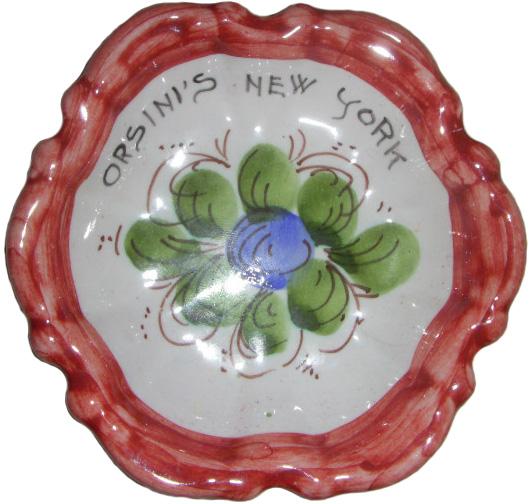
Often these activities brought forth a degree of censure among reporters and readers. Was it not true, for instance, that these same people would probably condemn a poor man for stealing food? Was it really a victimless crime? Didn’t waiters have their small wages docked for missing silver? orsini'sDish

The moral code, such as it was, decreed that stealing from need was a crime, but stealing something you didn’t need or could easily afford to pay for was not a crime. Plus, as much as restaurateurs hated it, who wanted to accuse wealthy guests of stealing? Prosecution, or even confrontation, was rare though sometimes additional charges – curiously hard to read – were levied on a check. Over time menu prices crept up to cover shrinkage, tableware became ordinary, and pepper mills grew monstrous.

We’d probably hear more on this subject, particularly on the diverse range of things taken from restaurants, but restaurant managers prefer to keep silent. As one confessed in 1976, “We don’t like to talk about this sort of thing. It only gives the public more ideas.”

© Jan Whitaker, 2013
7 Comments

Filed under patrons, restaurant customs

Mind your manners: restaurant etiquette

EtiquettetablemannersWhen etiquette manuals address manners in restaurants they are usually discussing first-class restaurants since that is where people are at their most self-conscious and insecure. Cheap, casual restaurants, on the other hand, have been understood as living museums of what not to do, presumably being filled with patrons who are perfectly content to slurp their coffee, eat off their knives, tuck napkins under their chins, and chew on toothpicks.

For many people, middle-class women of the late 19th and early 20th centuries in particular, the notion of eating among strangers required some getting used to. Although etiquette at its most basic means being considerate of the feelings of others, it is clear that much advice was meant to make female readers themselves at ease in restaurants.

Anxiety started at the point of entry. Walking through a restaurant toward a table was agony for some women. As a woman writer in American Kitchen Magazine remarked in 1899, “Even today it is a severe trial for many women, and some men, to enter a hotel dining room and particularly hard if it must be done without a companion. Some that march in with boldest front and utmost nonchalance are but actors, trembling within while brave to outward seeming.”

Etiquette101REV

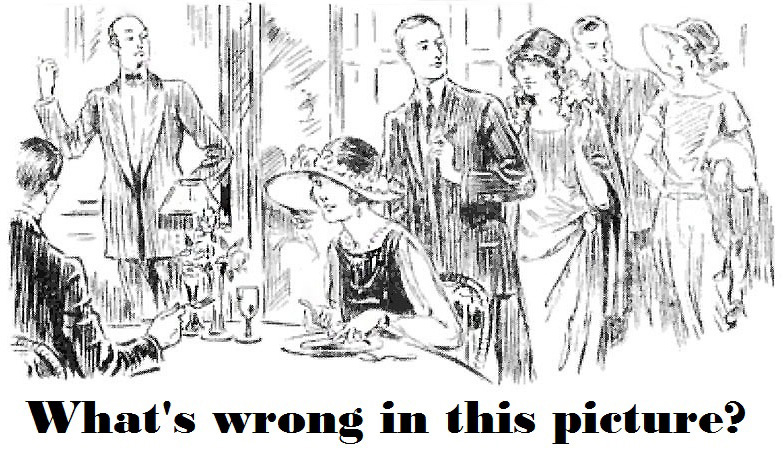
As a result of discomfort about walking to a table, for years etiquette books and columns seemed preoccupied with this subject. All agreed that when the headwaiter beckoned, the woman of the duo should go ahead of her male companion. I would think that would have made women even more uncomfortable but perhaps the ruling of etiquette mavens relieved the stress of uncertainty. Horrors, the man is going first in the above illustration.

As women went to restaurants more often, things began to change. Young women grew restless at the confinement of propriety which required that they could not go out with a man without a chaperon, could not drink wine, and should only pick at their food. How shocking that they began to have fun, devour their dinners with enthusiasm, and lean their elbows on the table!

As late as 1915, though, women were still being advised to let the man do the ordering and not to even look at the menu unless he suggested it. As for the bill, heaven forbid she should view it: “A woman makes a point, always in restaurants, of not seeing the check when it is brought by the waiter, and while the man is getting out the money to pay it she should keep her gaze from it.”

EtiquetteDon'tEatLikeaBoob1917

If the 1917 novel The Rise of David Levinsky is at all representative, ambitious immigrants also wanted advice on restaurant-ing. In it David admits that on his first visit to a high-class restaurant with a business associate, “The occasion seemed to call for a sort of table manners which were beyond the resources . . . of a poor novice like myself.” He confesses ignorance to his kindly companion who agrees to tutor him on how to order, use a napkin, eat soup, fish, and meat and “what to do with the finger bowl.”

Conservative advice continued to be issued in the 1920s, such as Emily Post’s 1923 dictum: “Absolutely no lady (unless middle-aged – and even then she would be defying convention) can go to dinner or supper in a restaurant alone with a gentlemen.” But the Depression and World War II eras were about to have the effect of relaxing American customs.

Still, even today many people have questions about how to act in a formal restaurant setting. As for how to handle bread, break it into pieces and butter each piece individually before eating it. And what if you drop a fork? Ask the server for another. Personally, I truly wish more people would follow this 1904 counsel: “Private affairs should not, ordinarily, be discussed in the public dining room, but if they are, a low tone should be used.”

© Jan Whitaker, 2013

8 Comments

Filed under restaurant etiquette

Celebrity restaurateurs: Pat Boone

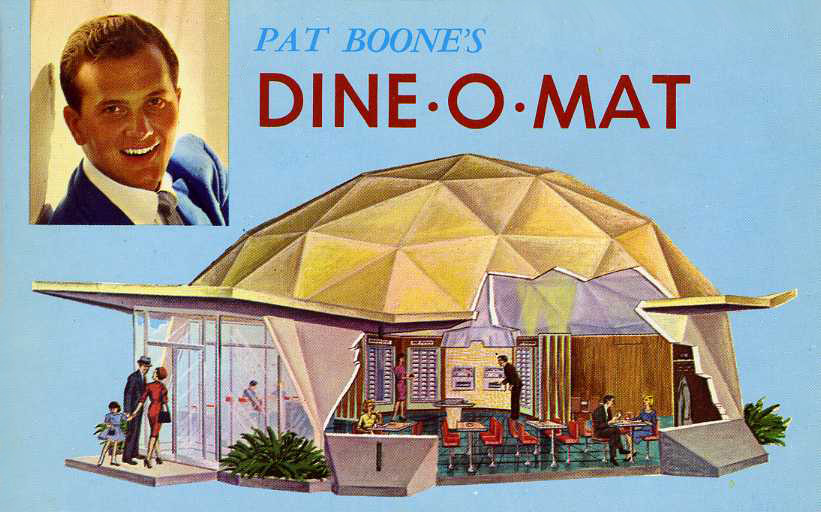
PatBooneDine-O-Mat

Few celebrities become deeply involved in the restaurants that bear their names. That was true of the singer Pat Boone, who was known to visit his namesake restaurants occasionally and to sing and sign autographs at openings. How much good his – or any celebrity’s – connection does for a restaurant is debatable. Neither Pat Boone’s success as a performer nor his pro-family, clean-cut, Christian image saved the ventures he lent his name and money to.

Pat Boone’s Dine-O-Mat appears to have barely gotten off the ground despite what publicity referred to as its “space age” design. “This . . . new type of fully automatic roadside restaurant is destined to be an important landmark on highways all over America,” boasted a 1963 advertisement aimed at investors. The initial plan was to build 100 of the restaurants by summer of 1964, but few seem to have been constructed.

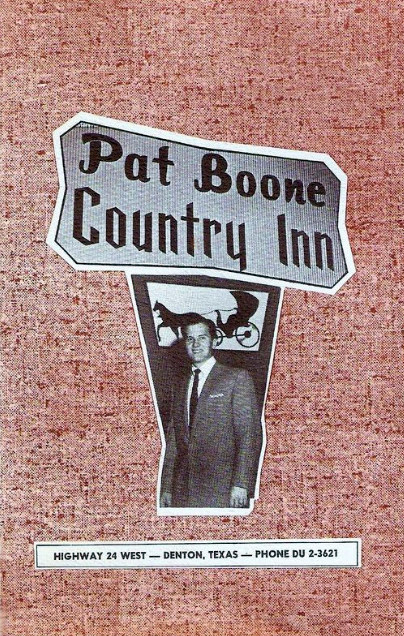
PatBooneCountryInn1959An earlier disappointing experiment in restauranting, Pat Boone’s Country Inn, in Denton TX, closed a mere four years after opening in 1958, even though Boone was connected to the town because of attending North Texas State College there.

While the Country Inn was a conventional restaurant, Dine-O-Mats were designed to be “revolutionary.” Perhaps the New Jersey entrepreneurs who cooked up the Dine-O-Mat concept were inspired by Stouffer’s 1961 foray into selling frozen food from vending machines to Ohio turnpike motorists who reheated it in microwave ovens.

Little could Pat Boone and company know when they launched Dine-O-Mats in 1962 that Stouffer’s would announce less than a year later their intention to phase out the roadside restaurants after realizing that travelers only wanted “speed and price.”

Both Stouffer’s highway restaurants and Dine-O-Mats might be called automats. But unlike Horn & Hardart automats, coins put in a slot did not call forth ready-to-eat selections. Dine-O-Mats had only one employee on the premises, an attendant whose job was to keep the machines loaded with frozen food. Rather comically, the postcard above shows customers (and Pat) dressed in their Sunday best, yet they are “dining” in a dismal geodesic-domed hut surrounded by vending machines and two microwaves sunk into an imitation hearth.

Similar to Stouffer’s restaurants, Dine-O-Mats were to be located near “motels, service stations, shopping centers, bowling alleys, country clubs, amusement parks, factories, air and bus terminals and along major highways,” according to a 1962 prospectus. How many were ever built, other than the prototype on Route 46 in Little Ferry NJ, is unclear. There may have been a few additional ones in New Jersey and Georgia.

Since kitchenless Dine-O-Mats relied on cooked food supplied by an offsite commissary, the scheme made sense only if deliveries could reach multiple outlets easily. In 1964 construction was to begin on a unit in Augusta, Georgia, but the project was delayed because of company “reorganization.” It was to be part of a group of Dine-O-Mats in Albany, Macon, and Savannah, but whether any of the Georgia restaurants opened I cannot determine.

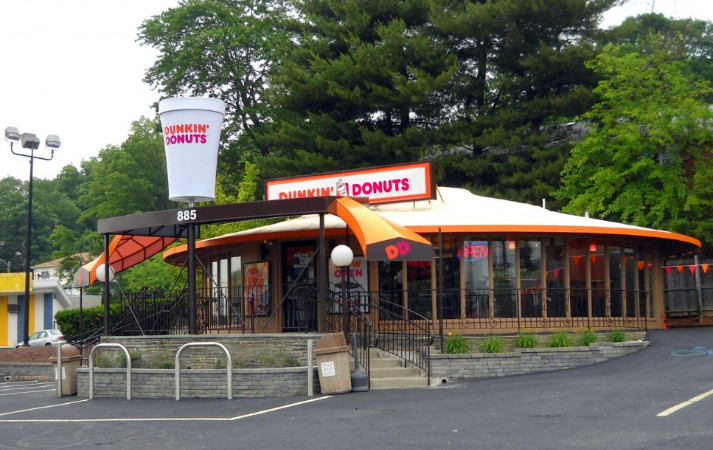
PatBooneDunkinDonutsNPlainfieldNJIn 1965, when the Augusta construction was slated to begin, a newspaper report announced, “The Pat Boone Restaurant Corp. has revised all plans and has just now completed reorganization with new, modernized plans for its restaurants.” Though it’s hard to imagine what could be more modern than “space age,” it’s possible the geodesic dome had been scrapped and that the North Plainfield NJ Dunkin Donuts pictured here was once a Dine-O-Mat as some people believe.

The company’s confusing advertisements for prospective investors required differing minimum investment amounts ranging from $2,500 to $10,000 for a “limited (inactive) partnership” in April of 1963, to $15,000 to become an “area controller” in October, then asking $10,000 for an “investment opportunity” in March of 1965. Did anyone ever get the 10% to 13% returns that were estimated?

© Jan Whitaker, 2013
15 Comments

Filed under chain restaurants, proprietors & careers, roadside restaurants, technology

Diary of an unhappy restaurateur

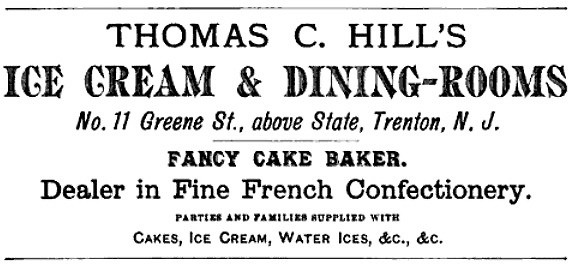
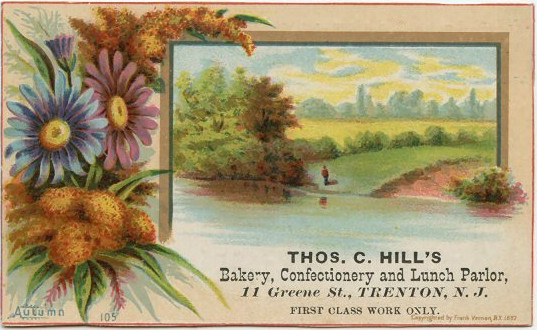
hill'sTrenton1882or1883Edmund Hill began working in his father’s bakery and restaurant full-time in 1873 when he was 18. His help was needed because of his father’s poor health. He wanted to go on to Yale, yet he devoted his career to the business, which was operated under his father’s name Thomas C. Hill.

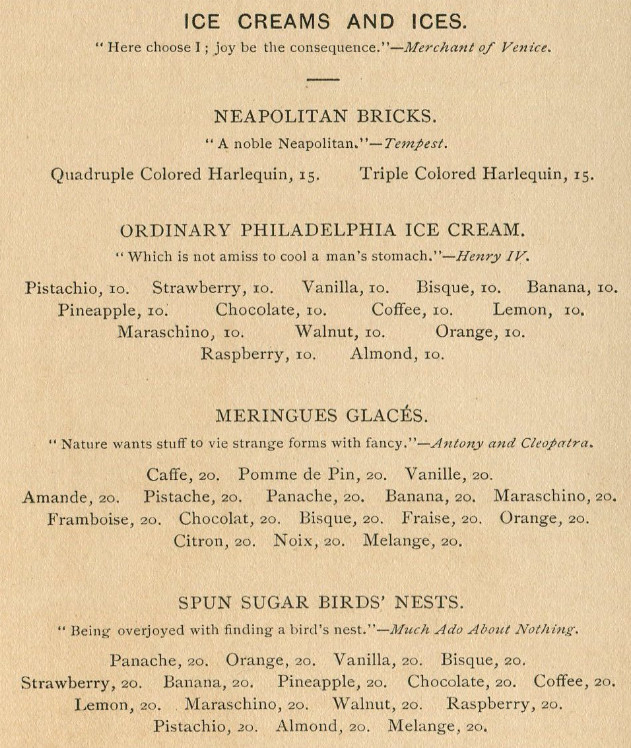
Hill'sMenuCardSAMPLEThomas Hill founded the business in 1860, rapidly becoming one of the city’s leading caterers and furnishing everything needed for soirees, suppers, and weddings except, as a 1866 newspaper story remarked, the brides and bridegrooms. Located in the center of Trenton, New Jersey, the restaurant advertised in 1882 that it was “the largest and finest between New York and Philadelphia” and could provide in its dining rooms or beyond all the fancy dishes of the day: boned turkeys, croquettes, rissoles, jellied meats, carved ice blocks, charlottes, spun sugar centerpieces, and bon bons. Hill’s hosted many organizations at its Greene Street location, including the Young Men’s Gymnastic Association whose members stuffed themselves in 1883 with many of the above plus a variety of ice creams, meringues, and walnut kisses. He specialized in fancy desserts, as is demonstrated by a portion of an 1883 souvenir menu shown here (courtesy of Henry Voigt — The American Menu).

Hill'sDiningRoomsEdmund’s diary from 1876 through 1885 has been transcribed and digitized by the Trenton Historical Society and makes fascinating reading. Among other things it gives rare glimpses into the running of a combined bakery, restaurant, confectionery, and catering business in the later 19th and early 20th centuries. Edmund was a reluctant restaurateur. As the Historical Society’s site says, “Edmund severely disliked, even hated, working in the restaurant business and he focused much of his energies elsewhere, such as pursuing real estate and civic affair concerns throughout Trenton.”

Despite Edmund’s lifelong disappointment over being forced to take up a trade, he ran a successful business which he diligently kept abreast with the progress of the times, remodeling the restaurant, increasing baking capacity, and installing electricity. In the 1880s Hill’s restaurant and catering service, almost certainly run on a temperance basis, was known throughout New Jersey. And it made money as his diary entry of December 31, 1881, shows: “Finished up accounts in store. We took in $18,146.60, against $15,294.40 last year. Very satisfactory all around.”

Edmund became an expert cake baker and could, and did, fill in for just about any employee. In 1880 he paid his German baker to teach him how to make the Vienna bread made popular by the 1876 Centennial Exposition in Philadelphia. (“Bargained with Karl to teach me baking for twenty five dollars.”) On at least two occasions he organized a series of public cooking lessons taught in Trenton by cookbook author Maria Parloa of New York. In his diary he wrote that he found her lecture on bass with tartar sauce, baked fish with hollandaise sauce, ginger bread and vegetables “very instructive.”

Hill'sADV1880When he traveled to New York City or other cities he often ate at leading restaurants and probably toured their facilities. He mentions going to Dorlon’s, the renowned oyster restaurant in Fulton Market as well as Delmonico’s, the Hotel Bellevue, the Astor House, and the Vienna Model Bakery, all in NYC. He went to Moretti’s – Charles Delmonico’s favorite place for ravioli – but evidently did not care for it. (“Do not like Italian cooking.”) He even attended the French Cooks Ball to check out the fare. (“Dresses and dancing were ridiculous. The tables were superb.”)

In addition to ensuring the reputation of Hill’s Restaurant and Bakery, he was a well-off, well-read man of the world who traveled to Europe several times, a successful real estate developer, a banker, a city councilman, an esteemed civic benefactor, as well as a devoutly religious family man. He was friends with famous people, including Leo Tolstoy, whose son he hosted at an honorary dinner at Delmonico’s. Yet, according to the Historical Society’s site, he never got over having to end his education to take over the family business and considered himself a failure.

He sold the restaurant building and all his catering equipment in 1905 while moving the bakery which continued in business for many years thereafter.

© Jan Whitaker, 2013
4 Comments

Filed under confectionery restaurants, proprietors & careers

Basic fare: bread

BreadbasketBread has always been basic to restaurants ranging from the lowliest hash house to the most elegant French dining room. This was made evident in 1912, for instance, when Los Angeles drafted a city ordinance permitting no liquor to be served without meals. The ordinance defined a meal as “not costing less than 15 cents, to consist of bread, or equivalent, together with meat, fish, cheese or beans in sufficient quantity to go beyond the question of subterfuge for a meal.”

From the early decades of the 19th century, bread not only accompanied almost every meal, in many cases it was the meal. The most fundamental early eating house meal was bread and coffee or bread and hot milk. When ordering the typical cheap meal of a thin slice of meat accompanied by some potatoes, customers were consoled by the fact that their meal would be filled out with two slices of bread.

In addition to brown bread, i.e., whole wheat bread, restaurant customers could hope for other varieties to pair with their coffee. Waffles and pancakes tended to be classified as breads in those days. In San Francisco in 1858, the Empire State Dining Saloon also served “Mississippi Hot Corn Bread, Hot English Muffins, Hot American Waffles, Hot Hungarian Rolls, Boston Cream Toast, German Bread, and New York Batter Cakes.” After Vienna-style yeast bread was introduced at the 1876 Centennial Exposition in Philadelphia, restaurants associated with bakeries scrambled to hire bakers who could produce this newest sensation.

In order to get their free bread, diners had to order something costing at least 10 cents, as recounted in the comical tale of the hapless diner who asked for bread with a too-small order. The amount of bread given with an order was limited. An 1849 bill of fare from Sweeny’s House of Refreshment in New York City shows 3 cents was the going rate for extra bread.

breadRollonplateBread – and butter – were often poor or deliberately adulterated in the 19th and early 20th centuries, so many eating places advertised that they observed quality standards. In the 1880s, cooking teacher Jessup Whitehead almost went apoplectic about the poor quality of baking-powder biscuits often found in low-priced restaurants. He wrote:

Such biscuits are yellow, dirty on the bottom, greasy to the touch; they have rough sides, no edges, for they rise tall and narrowing towards the top; they are wrinkled and freckled and ugly; they will not part into white and eatable flakes or slices, but tumble in brittle crumbs from the fingers, and eat like smoked sawdust.

BreadGingerbreadTeaRoomEven today it is commonplace to form a quick judgment about a restaurant by the quality of its bread. Historically patrons probably fared best if they went to a bakery restaurant that made its own baked goods. Or to a tea room in the early 20th century, many of which made a specialty of raisin, nut, or gingerbread, preferably served hot from the oven. In tea rooms, however, patrons often paid dearly for bread and rolls, usually on an a la carte basis.

By the turn of the century many habitual restaurant-goers had a habit of eating all the bread as soon as it was placed on the table. Etiquette minders disliked this behavior and owners preferred to serve bread only after other dishes were served. Waiters, on the other hand, liked the bread and butter set up because it enabled them to serve more guests who, with something to nibble on, were less impatient for their orders.

Not all eating places did their own baking even in the 19th century, and the number that did was drastically reduced by the mid-20th. As few as 6% of all restaurants did their own baking by 1952. However, the advent of frozen bread made “Doing our own baking” a common advertising claim in the 1960s. That decade also saw a spread in the novelty of individual loaves of bread served on a carving board, made possible by in part by frozen doughs, loaves, and rolls.

BreadADVPortlandOR1976As popular as the “cute” little loaves were for a time, discriminating patrons rejected them as mushy and tasteless. The counterculture preferred heavier whole grain breads, which soon made their way into restaurants such as Sausalito’s Trident. On a ca. 1968 menu, the rather high price charged for a basket of rolls was justified as follows: “Our rolls are hand baked for us daily using only the purest ingredients: finest organic grains, fertile eggs, organically grown onions & raisins, raw butter, oils & honey.”

© Jan Whitaker, 2013
8 Comments

Filed under food

Busboys

busboyHave you ever wondered how many items in a first-class restaurant are placed on and later removed from a table of two diners? Think of tablecloths, napkins, bread plates, water and wine glasses, candles, flower vases, six or more separate pieces of silverware for each, some of them replaced during the meal, salt and pepper shakers, condiment bottles, butter and olive oil holders, bread baskets, not to mention all of the food-bearing dishes in a multi-course meal . . .

In 1929 a highly systematized hotel chain that kept track of these things – probably the Statler – declared the number was 100. Most of the items were brought and removed by the waiter’s waiter, the busboy. (There were no busgirls then, few now.)

The busboy’s job also entailed ferrying heavy loads of dishes, glasses, and silverware – clean and dirty – to and from the kitchen which was often in the basement. And, should anything be broken or spilled by anyone, it was his job to clean it up. And to keep the waiter happy. In European restaurants, and perhaps a few in America, the waiter never entered the kitchen, this being delegated to his busboy.

Omnibus boy was the name of the position in the 19th century, meaning a restaurant worker who does all kinds of menial jobs. Around the turn of the last century it was shortened to busboy, and after World War I the longer word was rarely used. The word “boy” of course is routinely applied to holders of lowly jobs, all the more so if they are black or ethnic minorities as so often happens. Historically many busboys were in fact in their 30s and 40s.

The job can work out as an apprenticeship particularly useful for those who are learning English as an additional language. Many stories tell of those who began as busboys, such as Oscar Tschirky of Switzerland, maître d’hôtel of Delmonico’s and the Waldorf, who rose to high positions in hotels and restaurants. This was unusual. Mere survival was difficult enough in a position so strenuous and poorly paid. A bus boy revealed in 1920 that he received $15 a week plus meals  for working an 11-hour shift that ran from 7:30 pm until 6:30 am. Meals were no small thing to busboys, nor to other restaurant personnel. Some hotels and restaurants paid no wages to busboys, considering them in the employ of the waiters. In any case, waiters were, and are, expected to share their tips with busboys.

The classic European uniform for busboys – not often adopted in the US — consisted of a short black jacket, black tie (in contrast to the waiter’s white tie), and a long apron. Over time busboy uniforms have become varied, though usually inconspicuously so. However, in the 1980s busboys at Sonny Bono’s restaurant in Palm Springs wore T-shirts decorated with his picture.

© Jan Whitaker 2013

2 Comments

Filed under proprietors & careers

Greek-American restaurants

GreekrestaurantMarlboroMA

Ethnic restaurants are generally seen as places where people from cultures outside the U.S. provide meals similar to what they ate in their homelands. A high degree of continuity between restaurant owners, cooks, and cuisines is presumed, as in: the Chinese run Chinese restaurants in which Chinese cooks prepare Chinese dishes.

Questions are sometimes raised about whether, for example, Chinese restaurants in America have adapted to American consumer’s tastes to the point where the Chinese cuisine is not “authentic,” but few question how obviously true or historically accurate it is to assume that Chinese always cooked or served Chinese food.

History is rarely tidy. Chinese, Germans, and Italians cooked French food. Germans ran English chop houses. And people of almost all ethnicities — Irish, Italian, German, Croatian, Greek — cooked American food and owned American restaurants.

GreekPaul'sLuncheonette233Greek immigrants, in fact, have been especially inclined to run American restaurants which serve mainstream American food, with little suggestion of the Mediterranean. Typically they’ve been  the independent quick lunches, luncheonettes, coffee shops, and diners that are open long hours, serving breakfast, lunch, and dinner to working people. Many have been run under business names such as Ideal, Majestic, Elite, Cosmopolitan, Sanitary, Purity, or Candy Kitchen, rather than the proprietor’s name.

The emphasis on names suggesting quality or cleanliness is explained by the tendency of Americans in the early 20th century to brand Greek-run eateries as “greasy spoons” or “holes in the wall.” A negative attitude to Greek eating places is evident in the following piece of rhyme published in the Cleveland Plain Dealer in 1926 entitled “Where Greek Meets Greek”:

The other day I wandered in where angels fear to tread –
I mean the well known Greasy Spoon, where hungry gents are fed;
Where eats is eats and spuds is spuds, and ham is ham what am –
And the pork in the chicken salad is honest-to-goodness lamb.

GreekConstantineDrive-In

Certainly there were substandard Greek restaurants, but I’ve found that Greek-American proprietors had a propensity to plow profits into modern equipment and fixtures whenever possible.

Greek immigrants showed strong affinity with the restaurant business since the beginning of the 20th century when they began coming to the U.S. in large numbers. The reason for this is often attributed to a lack of English skills, but the first Greek restaurants, actually coffeehouses where patrons could linger, probably had more to do with the absence of women among early Greek migrants. Coffeehouses furnished community. Although in big Eastern cities many Greek restaurants continued to focus on Greek immigrants, many enterprising Greeks took the step of expanding beyond their compatriots. Some, such as Charles Charuhas who established the Washington, D.C. Puritan Dairy Lunch in 1906, were expanding or transitioning from the confectionery and fruit business.

While heavily invested in the New England lunch room business, especially in Providence RI and Lowell MA, Greek immigrants spread to many regions of the U.S, bringing restaurants to the restaurant-starved South. It is impressive that a Raleigh-based Greek trio opened its 15th restaurant in North Carolina as early as 1909. At that time, Greeks were said to be “invading” the lunch room trade in Chicago, operating about 400 places. Because of the simplicity of American cuisine, it was said that two months spent shadowing an American cook was all it took for Greek restaurateurs to pick up the necessary skills.

GreekTorchofAcropolisDallasOther successful Greek restaurateurs of the past century included John Raklios who at one point owned a chain of a couple dozen lunch rooms in Chicago. In New York City Bernard G. Stavracos ran the first-class restaurant The Alps on West 58th, established in 1907. The Demos Cafe in Muskegon MI was one of that city’s leading establishments. In Dallas The Torch of the Acropolis (pictured) had a 36-year-long run, closing in 1984, while the College Candy Kitchen was an institution in Amherst MA.

The children of successful Greek restaurant owners often preferred professional careers, but a new wave of Greek immigrants arrived after WWII, gravitating to diners, particularly it seems, in New Jersey. In 1989 the author of the book Greek Americans wrote that according to his estimate about 20% of the members of the National Restaurant Association had Greek surnames. And, as if demonstrating a flair for adaptation, according to a 1990 study, Greek-Americans were then dominating Connecticut’s pizza business.

GreekdinerDrimonesBrosNJ

© Jan Whitaker, 2013
54 Comments

Filed under lunch rooms, proprietors & careers, sanitation