Category Archives: restaurant customs

Once trendy: tomato juice cocktails

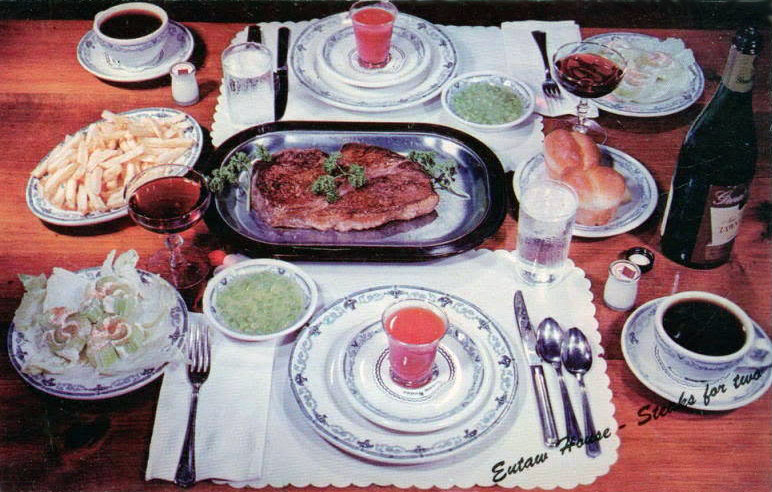
eutawhouse

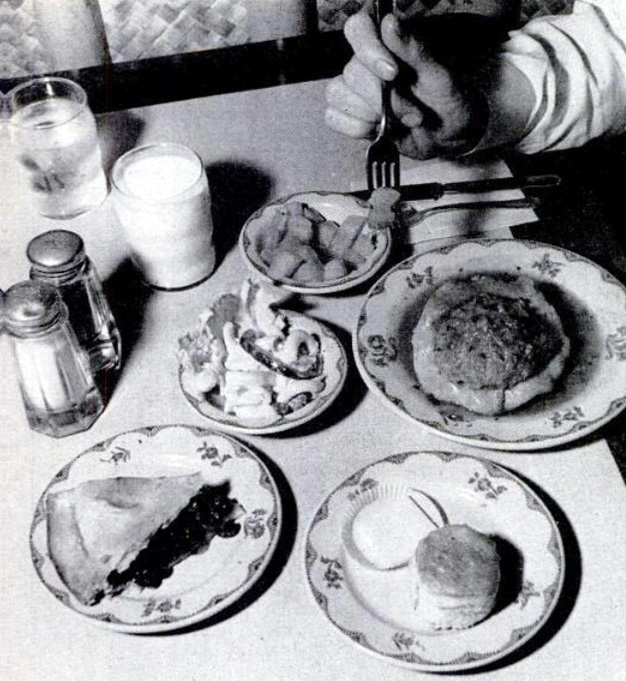
Recently I acquired a 1947 menu from the Algonquin Hotel of “round table” literary fame. I noticed that one of the appetizers was tomato juice and I thought to myself how commonplace a selection that once was and how rarely it is seen today.

No doubt there are restaurants that still have it on the menu – nothing really ever goes away totally. It reminds me strongly of an old standby restaurant in Massachusetts that closed about ten years ago. I was fascinated by the quaint metal contraptions on each table holding little pots of appetizers such as cottage cheese, olives, and pickles. There must have been tomato juice on the menu, too, despite it being decidedly out of style by then.

I was so convinced that tomato juice was hopelessly unimaginative that I was taken by surprise when I did a little research and discovered that it was considered a fashionable snob drink in the 1920s and 1930s. It came into vogue in the 1920s along with other good-for-you foods such as Melba toast, cottage cheese, pineapple, and sauerkraut juice. Women’s magazines touted it as smart, healthful, and perfect for anyone wanting to lose pounds just like a Hollywood movie star.

It is said that a chef at the French Lick resort hotel in Indiana introduced tomato juice to  American diners in 1917. It MIGHT be true that he was first to serve it in a public dining room – it does not seem to appear on American menus prior to World War I. However tomato juice was well known and available in cans in the 19th century so he clearly did not invent it (as is often reported).

A tomato juice cocktail could be made by the addition of tobasco sauce, paprika, sauerkraut juice, clam juice, etc. Mix well, shake until foamy, and pour over crushed ice. Restaurants tried all sorts of combinations. The Wrigley Building Restaurant in Chicago came up with clabbered tomato juice which was tomato juice mixed with a goodly amount of cottage cheese. Denver’s Blue Parrot Inn blended orange and tomato juices, while The Colony in New York mixed clam and tomato.

tomatojuice

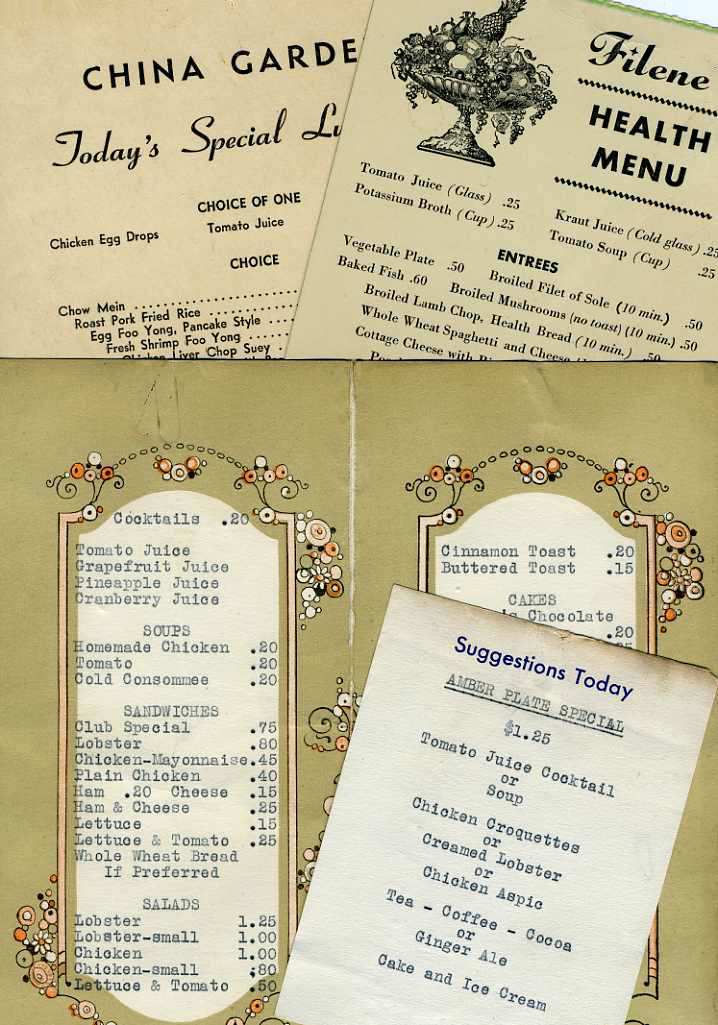
Although tomato juice could be found on menus of all kinds of eating places, even Chinese-American restaurants, it tended to be an appetizer favored by those who eat luncheon, not lunch. It was especially popular in restaurants that appealed to women then such as tea rooms, quaint inns, and department store restaurants. [illustration shows portions of menus from China Garden, Filene’s department store, and Willow Tea Cottage]

Arriving on the scene as it did during Prohibition, tomato juice clearly served as a non-alcoholic cocktail. Non-drinkers appreciated it, as did serious imbibers who had overdone things at their neighborhood speakeasy. It was a well known morning-after tonic continuing into the 1950s (and perhaps the present). In 1939 a restaurant in Shawnee OK allegedly served a “hangover breakfast” of tomato juice with hot sauce, soft-boiled egg, whole wheat toast, coffee, and two aspirins.

Tomato juice was so popular by the mid-1930s, both in homes and restaurants, that government scientists were said to be working on disease-resistant tomato varieties that would yield more juice. But by the 1980s it was considered an appetizer totally lacking in sex appeal, analogous to vanilla ice cream as a dessert. But, who knows? It could make a comeback. Tomato and kale juice cocktails?

© Jan Whitaker, 2014

28 Comments

Filed under food, restaurant customs

Serving the poor

Created with Nokia Smart Cam

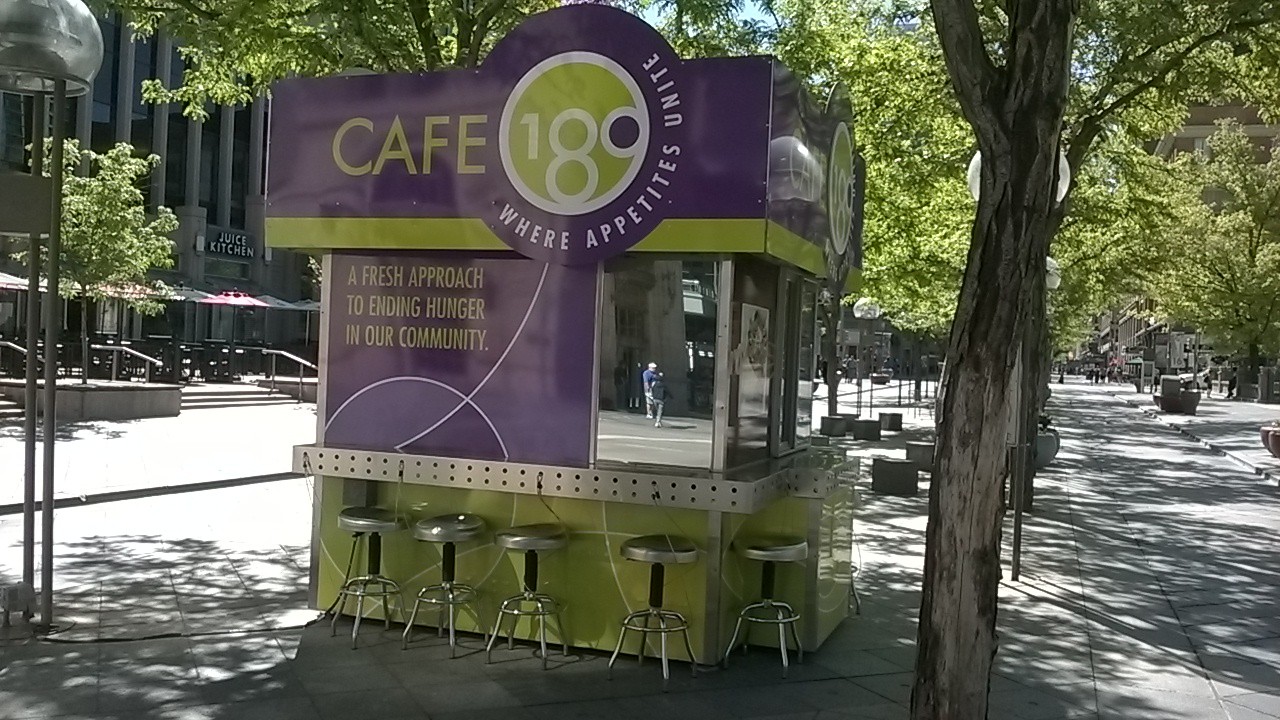
Recently, in Colorado Springs, I ate lunch at Seeds, a “community restaurant” devoted to making meals affordable to all. Guests are invited to pay what they can and, if that is nothing, to volunteer for an hour. A few days later, I saw another similar enterprise, Café 180, located on Denver’s outdoor 16th Street Mall.

It might seem like a new phenomenon but it’s more of an old idea with a new twist. Sellers of cooked food ranging from vendors with a cart all the way up to deluxe restaurants have long given away food to the needy.

In 1820 a French restaurateur in the City of Washington (D.C.) informed the public that he would sell the beef left over after being boiled for his special bouillon, while “to persons unable to pay it will be given gratis.”

John W. Farmer, a wealthy plumber, opened a Free Dining Saloon in New York City during the financial panic of 1857. After the first six months he announced he had served nearly 231,000 meals composed of dishes such as soup, corned beef, pork, ham, fish, bread, potatoes, cabbage, and turnips. Though hailed by the poor, especially the Irish, the New York Tribune rebuked him for failing to distinguish the deserving poor from the drunks, reprobates, and other “vile” persons “who prefer the bread of idleness to that of industry.” He carried on for several years, then opened the Farmer Institute, a reading room and lecture hall where speakers promoted an economy based on cooperation. A Cooperative Building Association that was formed as a result was quite successful.

Many free and low-price dining rooms as well as restaurant breadlines have sprung up during panics and depressions (of which there have also been many). Some have been motivated by religion or a social cause. In the 1870s a bad economy combined with the temperance movement helped make Holly Tree Coffee Inns successful. They were designed by Christian groups as alternatives to saloons, pitting “Queen Mocha against King Alcohol.” In addition to serving coffee, the self-supporting coffee houses provided low-priced food for working-class men in Hartford, Chicago, New York City, Washington, Boston, and many smaller New England towns. Quaker Joshua L. Bailey created similar coffee houses in Philadelphia.

The severe depression of the 1870s inspired others to open cheap restaurants. Some had meals for 10 cents, some for 5 cents, and some sold dishes for as low as 1 cent apiece. In New York a restaurant proprietor described only as an “old lady” was popular with newsboys for bargains like “Plate of soup one cent” and “All kinds of meat one cent.” Despite her rock-bottom prices she claimed to make a good profit.

CharityFleischman'sbreadline1913

Louis Fleischmann earned a fine reputation for the breadline he started at his New York Vienna Bakery restaurant during the Depression of the 1890s. He kept it going until his death in 1904, whereupon his son continued it for several years [shown above]. Another New Yorker, the Bowery’s Mike Lyon was also well known for his beneficence. Every morning at 5:00 a.m. he handed out food left from the night before to hundreds of women and children who gathered at his back door.

Physical fitness advocate Bernarr Macfadden also fed New York’s poor, thereby introducing what he claimed was the city’s first vegetarian restaurant in 1902. He recreated a similar penny cafeteria in 1931, selling soup, codfish, beans, prunes, bread, and other dishes for 1 cent each. He charged more for coffee because he didn’t think it was a “vital” food. Similar restaurants could be found then in Detroit and Springfield MA and probably many other cities. Max Rosoff invited the poor to eat for free in his NY Times Square restaurant after 10 pm., while Harry Rapoport, operator of a Jewish dairy restaurant on the Lower East Side was called the “Mayor of Second Avenue” in recognition of his culinary charity, especially after feeding 300 capmakers during a 7-week strike during the 1930s Depression.

charityclifton's30centmealEqually impressive were the efforts of Clifford Clinton who not only ran a penny restaurant for about six months during the Depression but also made low-priced or nearly free meals a standard in his Los Angeles Clifton’s cafeterias. [30-cent meal shown, 1940s] Patrons were instructed they could pay what they wanted. He was patronized largely by the elderly who appreciated getting “A Tra-ful for a Tri-ful” at his odd but cheerfully upbeat cafeterias. Hot cereals ran about 8 cents while an egg was 9 cents. In 1954 he served a whopping 20,000 meals each day in his two cafeterias. During World War II he created a “Meals for Millions” foundation that funded scientists to develop an inexpensive soy-based meal distributed by wartime relief agencies to refugees throughout the world.

BTW, the lunch at Seeds was good as was the service. It’s a popular spot.

© Jan Whitaker, 2014
10 Comments

Filed under alternative restaurants, restaurant customs

We never close

allnight758One way of sorting eating places is by the hours they keep. Those that are open 24 hours a day stand out from the crowd by their tirelessness and involvement in sometimes unwanted adventures.

Mostly there are three kinds of customers for all-night restaurants: those who travel at night, those who work at night, and those who play at night.

In pre-Civil War NYC all night eateries were haunts of “b’hoys,” a class of rogue males (sometimes accompanied by their g’hals) prominently made up of firemen and the more prosperous newsboys. They enjoyed oyster cellars, but one of their favorite places in the 1840s was Butter-cake Dick’s, where for a mere 6 cents they could get a generous plate of biscuits with butter and a cup of coffee.

ComicCheatingHusbandThe authors of the many Victorian “lights and shadows” books about urban immorality were quite fascinated by the dubious goings on in all-night supper clubs. No doubt their readers felt a shiver of horrified excitement when they spotted signs along city streets advising “Ladies’ dining parlor, up stairs”’ or “Refreshments at all hours.” Was it or wasn’t it?

One such book was George Ellington’s The Women of New York; Or, the Under-world of the Great City. But even Ellington observed that patrons of private dining rooms in these quasi-bordellos were also there to eat. He reported that patrons could be discovered consuming fish balls or pickled salmon at 3 or 4 a.m.

allnight761

People working at night surely outnumbered the pleasure seekers. Thomas Edison recalled that when his machine shop was on Goerck Street in NYC in the 1880s he used to grab a bite at 2 or 3 a.m. at a rough little place: “It was the toughest kind of restaurant ever seen. For the clam chowder they used the same four clams during the whole season, and the average number of flies per pie was seven. This was by actual count.” No doubt many of his fellow diners included some outside the law but also other denizens of the night such as newspaper printers, trolley conductors, bakers, and factory shift workers.

All-night restaurants were not just found in NYC but in all big cities and were often densest in areas near newspapers, city food markets, and ferries. Chicago’s all-night cafes on State Street were often portrayed as unsavory places where police connected with “stool pigeons” enjoying their midnight snack. Upstanding citizens shrank from the mere thought of all-night eateries but in actuality they were probably some of the most democratic places in that they drew characters from all stations of life.

allnight760

An all-nighter of renown in the 20th century was Coffee Dan’s, originally in San Francisco, which operated as an eating and entertainment venue, then a speakeasy in the 1920s and early 1930s. Its attitude in the mid-1920s is nicely expressed in the claim, “There will be dancing to the tinkle of a piano; there will be songs and it will never, never close, not even for fire, not even if the supply of ham and eggs is exhausted.” Coffee Dan’s expanded into a small chain and the Hollywood location became something of a gay hangout in the 1950s, a role played by all-night cafeterias such as Stewart’s in NYC’s Greenwich Village.

With so many night shifts for war workers in World War II, the demand for all-night restaurants rose to new heights. A 1948 restaurant sanitation manual noted how difficult it became to clean restaurants during wartime because of the never-ceasing 24-hour influx of customers.

allnight757The only figures I’ve run across concerning all-night restaurants were from the mid-1960s when 10% of eating places fell into that category. Some chain restaurants, especially coffee shops, pancake houses, and places offering breakfast at all hours, are founded on the 24-hour principle. Often they are located near highway exits to capture truck drivers and other nocturnal travelers.

© Jan Whitaker, 2014
See also:
Toddle House
Cabarets and lobster palaces

3 Comments

Filed under restaurant customs

Tablecloths’ checkered past

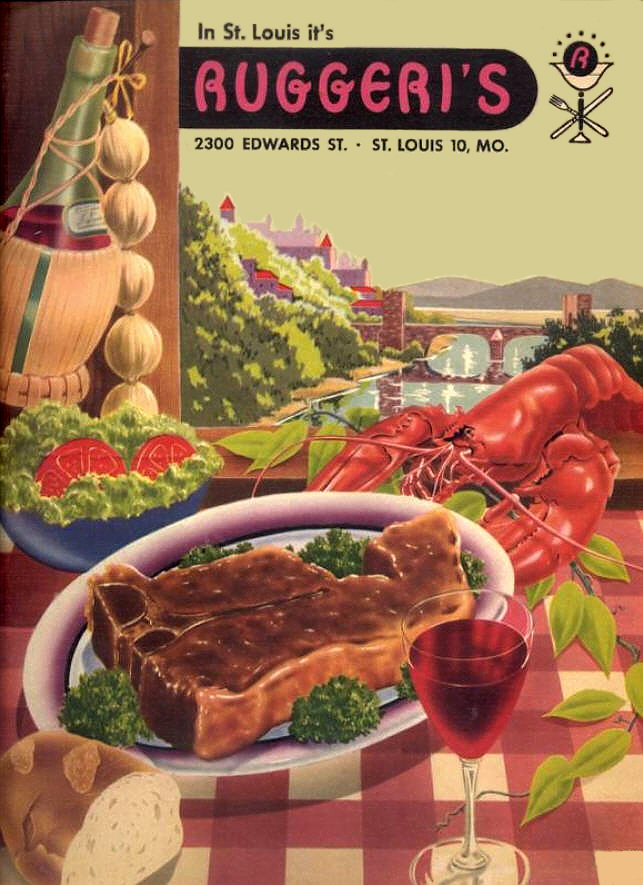
tableclothruggerisSTL50Throughout the 20th century red and white checked tablecloths in restaurants sent clear messages to patrons: this restaurant is inexpensive, friendly, and unpretentious. Whether ethnic or “American” they suggested that the customer was in a homey place, either authentically old fashioned or old world.

What kind of ethnic? Beyond noting that they were never Chinese (that I’ve discovered — so far), restaurants with checked tablecloths could be Italian or French, but also German, Viennese, Spanish, British, Greek, Hungarian, or Mexican.

tablecloths3752

As for signaling old-fashioned Americanness, that could mean “Pioneer Days on the Prairie,” “Frontier Saloon,” “Old-Time Beer Hall,” “Country Barn Dance,” “California Gold Rush,” “Grandma’s Kitchen,” “Colonial New England,” or “Gay Nineties.”

I use the past tense when referring to red and white checked tablecloths, not because they aren’t still around, but because I sense their vogue has ended, at least temporarily. I would say their appeal was strongest from the 1930s through the 1970s.

tablecloths3751The fabric itself dates far back into the 19th century. Already by 1900 checked tablecloths were seen as old fashioned. But unlike other material culture of restaurant-ing, the meanings of the tablecloths were created as much by fundraising events and celebrations sponsored by churches, clubs, and schools as they were by restaurants.

In restaurants, as well as outside them, the tablecloths have been accompanied by at least one of the following decorative touches: candles in wine bottles, lanterns, travel posters, braided garlic hung from walls, murals of villages, beamed ceilings, knotty pine paneling, sawdust floors, wagon wheels, and peasant costumes. Candles in bottles were close to mandatory.

tablecloth21club1939A number of famed restaurants used the tablecloths at some point in their history. A few of them fell outside the inexpensive class such as the “21″ Club [pictured] and the London Chop House. In 1961, a New York restaurant reviewer wrote that checked tablecloths were “almost obligatory for unpretentious Gallic restaurants in this city.” Boston’s Durgin-Park used them on their long communal tables, furnishing the means for burglars to tie up the staff during a 1950s robbery. In Chicago, the Drake Hotel’s Cape Cod Room added the colorful cloths to its busy decor that included pots and pans hanging from the ceiling.

Surprisingly it wasn’t until the 1980s that anyone admitted they were tired of seeing the classic tablecloths in restaurants. The ascent of Italian restaurants into the higher reaches of culinary status provided the rationale. Now, for example, reviews would begin with the assertion that Restaurant X didn’t represent, “the Italy of checkered tablecloths and melted candles in Chianti bottles, but the Italy of designer Giorgio Armani.”

It’s been quite a while since I’ve seen tables covered in red checks. Now it could be risky, suggesting not authenticity but tired mediocrity.

© Jan Whitaker, 2014
12 Comments

Filed under atmosphere, restaurant customs

Champagne and roses

CoupleDining111Four years ago I wrote a Valentine’s Day post that’s really more interesting than this one, about how the thought of romance in a restaurant was a scandalous at least until after WWI. It’s one of my favorites.

This year I thought I’d explore pre-1980s restaurants that specifically advertised special dinners for Valentine’s Day. What kind of food did they typically feature, I wondered?

Turns out I found way fewer of them than I expected, especially before the 1970s, which seems to be the decade in which the idea of a going out to a restaurant for a Valentine’s dinner took off.

clarkscleveland

Most of the dishes I found in advertisements sound less than wonderful to me. Unless you like Chicken a la King on Crisp Noodles accompanied by a “molded cherry salad with creamed cheese and nut ball center.” That was from one of the earlier advertisements (1957) for Clark’s in Cleveland (pictured above). Call me unromantic, but I don’t picture myself sitting there eating jello.

shelterislandinnDitto for the Strawberry Gelatin Salad at the Shelter Island Inn in San Diego, 1972. Rare New York Strip steak, maybe, but no thanks to the Artichoke Bottoms filled with Petite Green Peas. Does that say Be My Valentine to you?

All the advertisements from the 1960s and 1970s seem to be addressing male readers. The Ohio Brown Derby chain, offered an $8.95 Champagne dinner for two in 1969, with a 20 oz. Napoleon steak “for you” and a 10 oz. Josephine steak “for her.”

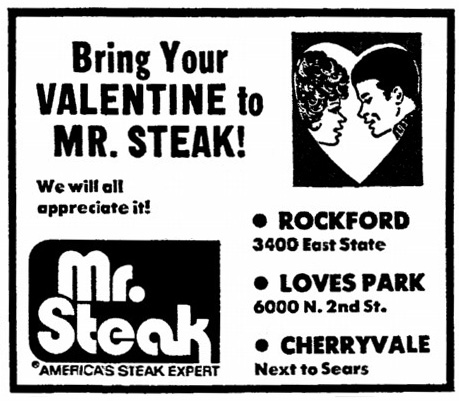
ValentineRockfordIL1975But, console yourself. If you lived in Rockford IL in 1975 you might have been munching on a Perch Dinner accompanied by Complimentary Glass of Pink Champagne at Maggie’s (All You Can Eat, $2.25) or dining at Mr. Steak.

My favorite advertisement was the dinner at the Thai Pavilion in Springfield MA, 1976. No sign of Thai food whatsoever. Instead, the menu featured Baked Stuffed Shrimp, Prime Rib, or Filet Mignon with Tossed Salad, Baked Potato, and a Fudge Pecan Cake Ball. Dinner served from 5 pm to midnight, $21 per couple. Did I mention the Thai Pavilion was handily located in a motel?

Happy Valentine’s however you celebrate. No corsages, please.

© Jan Whitaker, 2014
3 Comments

Filed under atmosphere, restaurant customs

Charge it!

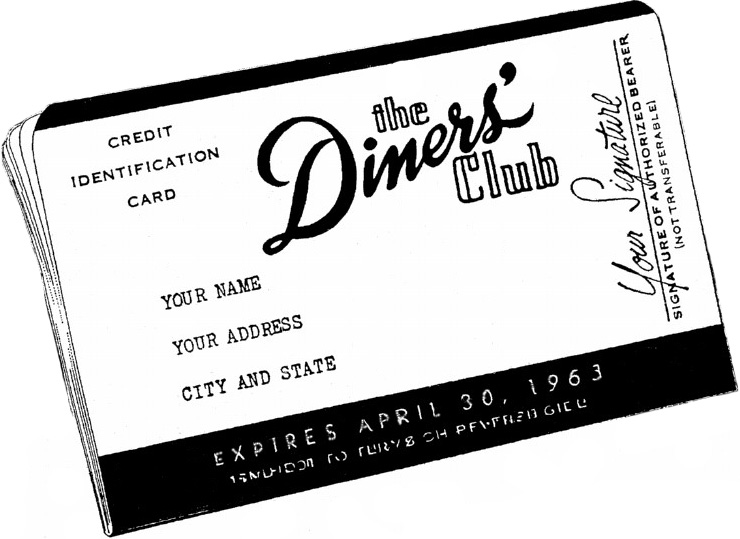
DinersClubcard1955The advent of travel and entertainment (T&E) credit cards in the 1950s was instrumental in sparking a renaissance in luxury restaurants that hadn’t been seen since pre-Prohibition days.

Nowhere was the effect felt more strongly than in NYC, birthplace of the Diners’ Club.

On February 8, 1950, Frank McNamara paid for his lunch at a steak house called Major’s Cabin Grill in NYC with a Diners’ Club card numbered 1,000 (i.e., #1). With his little paper card he made the very first charge on a nationwide credit card.

DinersClub1956ADV

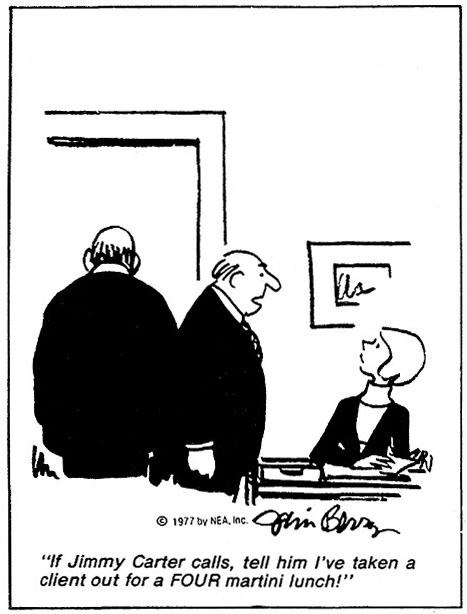
The timing of the Diners’ Club launch was perfect. During World War II expense accounts had proliferated as a way companies could use income for entertaining clients rather than hand it to the government as a tax on “excess” profits (profits greater than those before the war). Now, in 1950, the excess profits tax lifted at the end of WWII was only a few months away from reinstatement for the Korean War.

The growth of T&E credit cards went hand in hand with the growth of expense accounts. As one publication put it, credit cards were spinoffs of expense accounts. And, each time the IRS tightened up its requirements for itemizing deductions, more credit card applications came in.

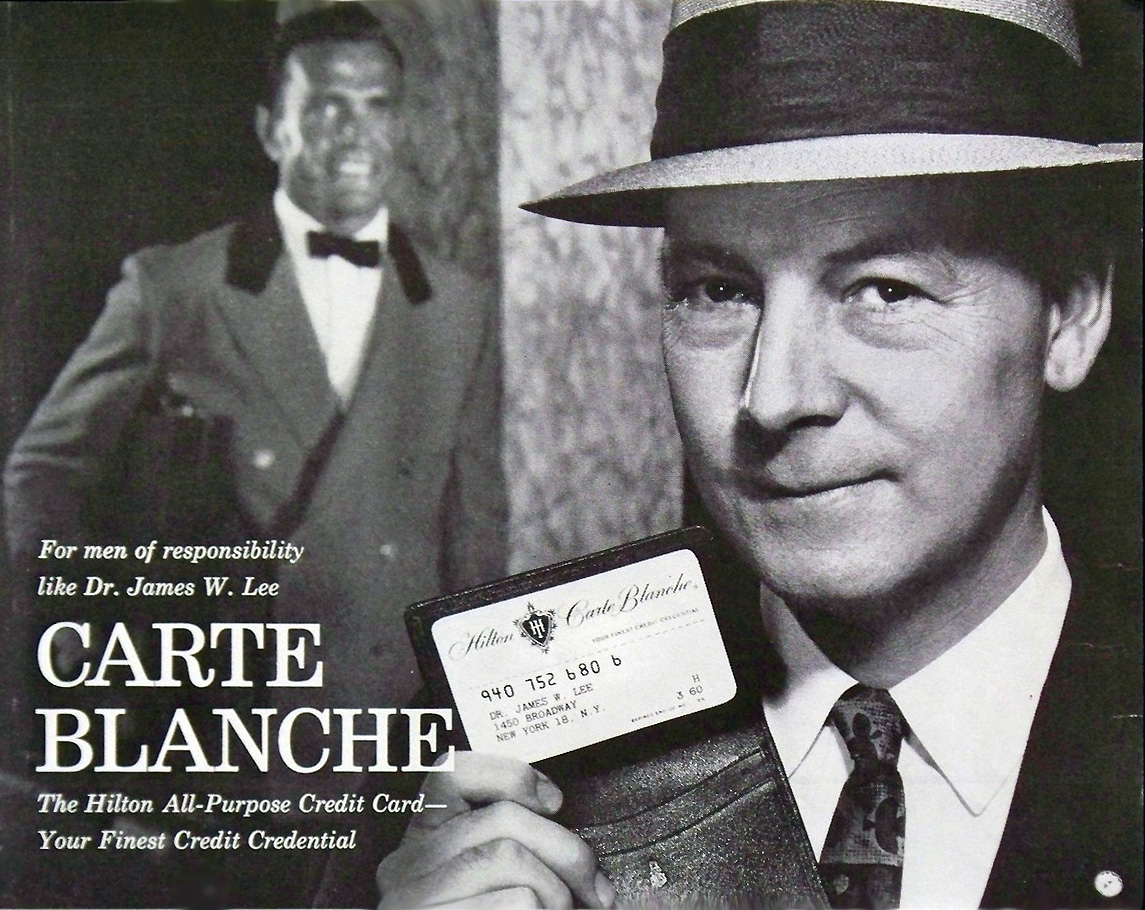
Carteblanche1959Unlike the nationwide bank cards that would eventually swamp T&E cards, the latter required high financial standing, an annual membership fee, and full payment of balances within 30 days. Having one of these cards brought cachet.

Following quickly on the heels of the Diners’ Club launch came many others: Dine ’n Sign, National Credit Card, Your Host, Inc, Duncan Hines’ Signet Club, the American Hotel Association’s Universal Travelcard, Hilton’s Carte Blanche, the Esquire Club, and the Gourmet Guest Club (the last two linked to Esquire and Gourmet magazines). A smaller Diners’ Club continues today, but the only other survivor is American Express, which inaugurated its credit card in 1958, then quickly rose to the top of the T&E field.

Traveling salesmen and men (rarely women) in industries such as public relations, advertising, publishing, manufacturing, and wholesaling were fans of the convenience of charging business meals. And, of course, in the early days of T&E club cards it was a status factor to simply dash off a signature on a slip, particularly if the lunch took place in a top restaurant.

Bizlunch

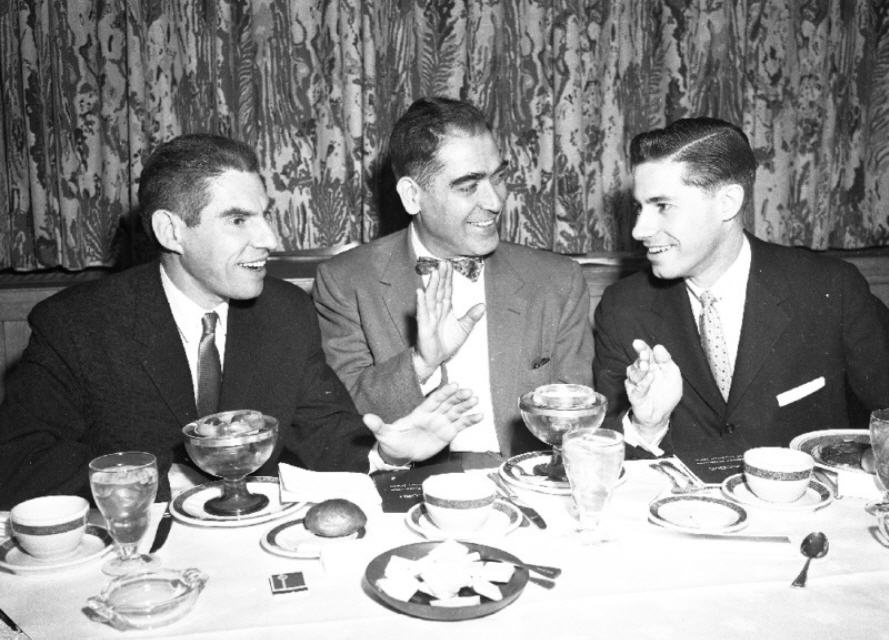
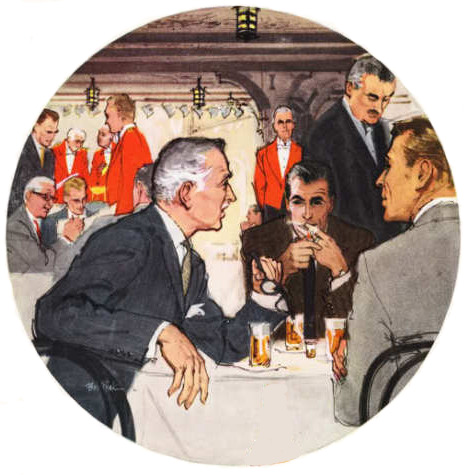
Expense accounts and credit cards were a boon to restaurants. There were estimates that in the mid-1950s 50% to 80% of meals in high-priced restaurants were “on the company.” Vincent Sardi admitted that a big chunk of his NYC business was made up of men on expense accounts. Peter Canlis, of Seattle’s first-class Canlis Restaurant, said in 1953 that he decided to establish a restaurant there because “a lot of good expense account money wasn’t being spent because there was no place fancy enough to gobble it up – and I was happy to fill the gap.”

But not all restaurateurs were enamored of the cards at first. For one thing, Diners’ charged a 7% fee on transactions. Restaurant owners felt that they spent too long waiting for their payments and that they had to raise prices to make up for the fees, thus punishing cash customers. Some restaurants refused Diners’ Club cards or added surcharges for meals paid with them. The Diners’ Club lowered its transaction fees in 1966.

By 1965 the three biggest T&E cards, Diners’ Club, American Express, and Carte Blanche claimed a total of about 3.15M cardholders, a small fraction of the number of cards starting to be doled out then, often unsolicited, by nationwide bankcards.

© Jan Whitaker, 2013

5 Comments

Filed under restaurant customs

Dressing for dinner

FarmersinCafe

In the vast majority of eating places customers never had to be told to “come as you are.” That’s how they were going to come – or else they weren’t coming at all. Farmers wearing overalls were likely to show up in small town cafes, while white collar workers in shirtsleeves grabbed seats in city lunchrooms.

Nevertheless, there was a segment of society that “dressed” for dinner. People of high society were accustomed to donning formal wear for dinner parties given in private homes. Then, as New York society began to expand beyond “the 400″ in the late 1890s, growing ranks of wealthy newcomers adopted formal dress for dinners in hotel dining rooms and swanky restaurants.

Rector's1913Geo.HectorInc

In the late 1890s men began to wear tuxedos for such outings. Women wore long gowns, cut lower than their daytime dresses. [Rector’s, 1913, illustrated] But the era of luxury dressiness was brief. After WWI, with prohibition forcing the closure of many fine restaurants and “lobster palaces,” more informal clothing became acceptable in most restaurants. What was known as afternoon wear – coats and neckties for men and daytime dresses and hats for women – became the new standard. But even that dress standard tended to erode.

It isn’t as easy to enforce a dress code as it might seem. As long as a restaurant isn’t using a dress code as a foil for illegal discrimination, it can set the dress bar as high as it wants. But will customers constantly challenge it? Even worse, will they shun the restaurant entirely?

Rejection of the Café de l’Opera’s formal wear requirement was cited as one reason for its sudden demise in NYC in 1910. And the 1930s Depression encouraged a lower standard. After World War II some predicted a return to elegance, but that proved shaky. Many well-established fine restaurants struggled with turtleneck-wearing male guests in the 1960s and 1970s. At New York’s “21″ the maitre d’ developed a practice of requiring necktie-less men to put on a hideously garish tie that he provided. This had the effect of either making them (a) leave, or (b) feel so embarrassed they never dared come without a tie again. Other places relented and admitted guests in “dressy casual” wear.

Pittari's1963NewOrleansA new restaurant wishing to enter the esoteric fine dining ranks, underwritten by a dining room of well-dressed guests,  has to ask itself if it can pull it off. If it does not draw the “top-drawer” clientele it aims for it may find its dress code impossible to enforce. For instance, resorting to posting a “Dress Code for Ladies” notice near the front door, as a San Diego reviewer said of a restaurant there in 1981, is “simply tacky.” It is scarcely better than a sign reading “No shirt, no shoes, no service.”

Likewise, a restaurant may portray itself as elegant, on a postcard, publicity photo, or website, but rarely will the actual guests look quite so sophisticated as those pictured. And, needless to say, fancy dress does not in itself project elegance.

SultansTableRestDunesHotel

Today there is a small top tier of restaurants whose guests would not dare to wear shorts, t-shirts, baseball caps, or overlarge rubber-soled shoes. But, most restaurants are far more informal. Overall, “come as you are” – a phrase first used by churches — has remained in effect.

The phrase itself attained widespread use by restaurants in the 1960s when it appeared in advertisements for suburban establishments wishing to attract families. A new segment of chain restaurants came into being, a few notches less casual than fast food establishments, but entirely non-intimidating in their standardized cuisine, friendly service, and “fun” decor. Philip Langdon, in his book Orange Roofs and Golden Arches, sees the “chain dinnerhouses” as coming from the West (where restaurant dress rules were always more relaxed). Examples included Victoria Station, originating in San Francisco, and Steak & Ale, from Dallas.

At the present moment, at least, it is difficult to imagine a return to turn-of-the-century formality. I’d guess that even the 1% don’t like to dress up.

© Jan Whitaker, 2013

10 Comments

Filed under patrons, restaurant customs

Light-fingered diners

1920sPilferingIf the number of newspaper stories is a reliable index to a trend, then a fad for stealing small items from restaurant tables began in the 1890s. Its continuing incidence is perhaps one reason why table appointments gradually became far less elegant and costly.

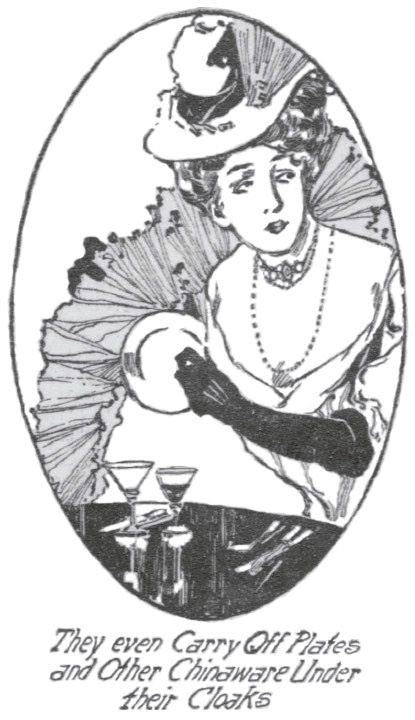
A flurry of stories appeared in the late 19th and early 20th centuries about affluent society people who “collected” cordial glasses, demitasse cups, salt cellars, silver spoons, oyster forks, and nut picks as “souvenirs” of first-class hotel dining rooms and restaurants. Anything small that bore an insignia from an elite establishment sent out an irresistible message: “Take me home with you.” Or, as a NYC restaurant owner would confirm decades later, “Put a spoon on a table with a fancy crest on it and kiss it goodbye.” 1906pilfering

The “thieves” – a term pointedly avoided by all – were usually identified as young women from the best families, though men were also known to freely pocket alluring items. It was especially attractive to pick things up while traveling. Women would display their booty in cabinets with little ribbons and tags that gave the date and occasion that each bibelot commemorated.

How cute! A little less cute, though, were college student pranks following athletic competitions. A gang of Amherst College students met with suspension after they raided three railroad restaurants on the return train trip from a Dartmouth football game in 1893. During their “wilding” episode they descended en masse on three successive Vermont depot restaurants, making off with everything they could grab from sandwiches and ginger ale to dishes and spoons to remind them later of their escapades.

Typically souvenir hunters were portrayed as feeling not the least bit guilty about their some-would-say-larcenous activities. “I must steal one of those lovely things,” said a woman at a fashionable restaurant. Her friends merely laughed. Another received encouragement from her luncheon companions when she declared she wanted to snag a silver match case for her husband. “So she tucked it in her muff and went out with the glee of a smuggler,” the story relayed.

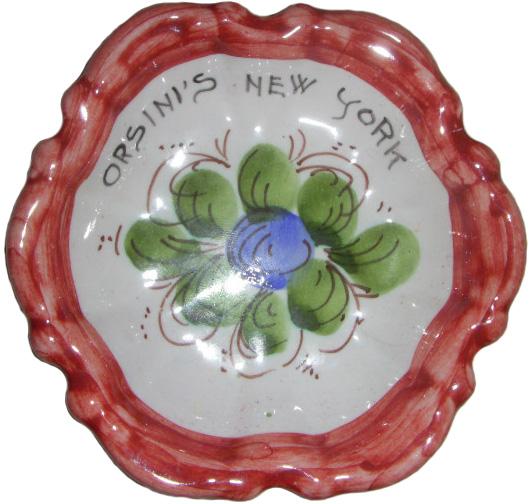
Often these activities brought forth a degree of censure among reporters and readers. Was it not true, for instance, that these same people would probably condemn a poor man for stealing food? Was it really a victimless crime? Didn’t waiters have their small wages docked for missing silver? orsini'sDish

The moral code, such as it was, decreed that stealing from need was a crime, but stealing something you didn’t need or could easily afford to pay for was not a crime. Plus, as much as restaurateurs hated it, who wanted to accuse wealthy guests of stealing? Prosecution, or even confrontation, was rare though sometimes additional charges – curiously hard to read – were levied on a check. Over time menu prices crept up to cover shrinkage, tableware became ordinary, and pepper mills grew monstrous.

We’d probably hear more on this subject, particularly on the diverse range of things taken from restaurants, but restaurant managers prefer to keep silent. As one confessed in 1976, “We don’t like to talk about this sort of thing. It only gives the public more ideas.”

© Jan Whitaker, 2013

7 Comments

Filed under patrons, restaurant customs

Fortune’s cookies

fortunecookiecolorThey’ve been used in political campaigns, as a method of publicizing new movies, and as a clever way to announce engagements, but most people have encountered fortune cookies in Chinese restaurants.

Searching for their origins in old Chinese customs is pointless because the fortune cookie was almost certainly “invented” in America, in California to be more specific. And probably by Japanese confectioners as a variety of senbei wafers.

Yet, even with their probable Japanese origins, there is nothing particularly Asian about them. The idea of embedding charms or slips of paper with fortunes on them in pastries and candies is an old idea in Western culture. The Victorians loved such things. Halloween was a popular time for fortune cakes and cookies and even fortune popcorn balls. A 1903 book suggested fortunes such as “You are going to marry and live abroad.” and “Thy flour barrel shall never be empty.”

fortunecookiesConfuciusRestOaklandCAPrecisely why they were adopted by Asian restaurants remains a mystery. Could it have been that restaurant proprietors knew finding fortunes was popular with their non-Asian customers? Or was it the need to supply some kind of dessert to Western customers with a sweet tooth? A 1939 menu from San Diego’s Chinese Village restaurant shows Mixed Candy and Oolong Tea as finales to $1.00 and 75-cent meals but tea and Fortune Cookies with a 50-cent dinner.

As to when fortune cookies made their debut, there is general agreement that it was in the early 20th century, before World War I. Certainly they are never mentioned in stories about Chinese restaurants in the 19th century. Many have claimed to be the cookie’s inventor, but Jennifer 8. Lee, author of The Fortune Cookie Chronicles, thinks it likely that around 1910-1914 Makoto Hagiwara introduced them as accompaniments to tea at the Japanese Tea Garden in Golden Gate Park in San Francisco where he was the concessionaire.

fortunecookieArchieThe cookies came into widespread restaurant use across the United States after WWII. For some inscrutable reason they also became frequent topics of gags in comic strips, newspaper gossip columns, and comedians’ routines. The fictive message “Help, I’m a prisoner in a Chinese cookie factory,” is one that falls flat with Asian-American cookie producers. But if you ask me most of the jokes are remarkably unfunny including the one from Archie comics.

Writing fortunes was a part-time job for somebody’s cousin or a freelance writer, Asian or not, who would come up with a fresh batch of several hundred at a time. Supposedly beginning with translations from much-abused Confucius, eventually anything – anything at all – provided inspiration. Occasionally they are offensive to patrons, as exemplified by the 1942 lulu, “Every woman like to be taken with a grain of assault.”

By the 1970s production of cookies was fully mechanized and they were turned out in huge batches by Japanese and Chinese makers who supplied restaurants all over the country. Today they are an unquestionable part of American restaurant history, one that has spread around the world.

© Jan Whitaker, 2012

Leave a comment

Filed under restaurant customs