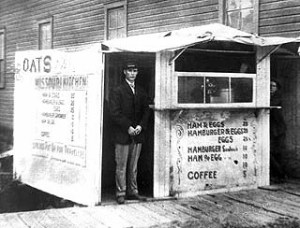
 The restaurant business didn’t get much respect until it was sharply disconnected from drinking and put on a business-like footing in the Prohibition era of the 1920s. Before this there were, of course, some high-paid chefs as well as many restaurant owners who made good money but their financial success did not generally translate into social status as it often does today. On the whole anyone who had an education and options in how they earned their living stayed far away from work in restaurants.
The negative attitude toward restaurants is illustrated in a passage in the 1894 novel Dan of Millbrook by Charles Carleton Coffin. The following exchange between two old friends speaking of a former schoolmate named Caleb Krinkle is revealing of the low esteem held by the typical native-born middle class American for anyone working in a restaurant or “eating-saloon” (a common lunchroom).
Miss Wayland: By the way, how are our old friends at Millbrook – that sweet girl, Miss Fair, and Mr. Krinkle?
Her friend: Mr. Krinkle is not there; he is in this city.
Miss Wayland: In Boston?
Her friend: Yes; and rather low down in the world: he is in an eating-saloon.
Miss Wayland, looking sad: You surprise me. I thought him an estimable young man, with a bright future before him.
Her friend: There came a sudden change in his fortunes; his father was drowned … while attempting to save a little girl; all of his property was swept away, and Caleb was forced, of course, to step down from the position he had occupied. He is plodding along now in an eating-room …
Miss Wayland: Mr. Krinkle tending an eating-saloon? How strange!
Her friend: Truth is stranger than fiction, it is said.
Miss Wayland: I am really sorry for him.
© Jan Whitaker, 2009
 “Become a chef and see the world!” might have been the motto of many of the chefs who came to the United States from Europe in the 19th century. Take Joseph L. Legein, born in Belgium in 1852. He compressed a lot of traveling into his young working life. His biography could be used as a recipe for a colorful culinary career. Did he ever imagine he would end up as an ice cream maker in Springfield, Massachusetts?
 Every chance you get, travel throughout Europe visiting international exhibitions where pièces-montées made by chefs of spun sugar, gum and almond paste are displayed. You will need to make these for centerpieces at formal dinners.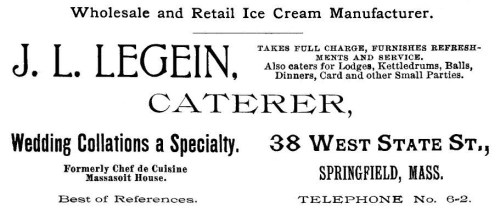
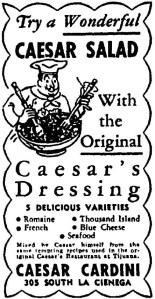 When we get into questions of the origins of certain dishes we have left history behind and entered into the murky depths of lore and legend.
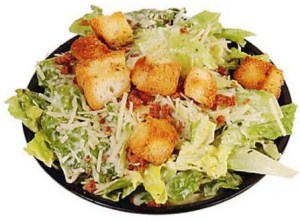 A strong inventorship claim was presented by Caesar’s brother, Alexander, in the 1960s. Caesar died in 1956, while running a grocery store in Los Angeles where he produced and bottled Caesar salad dressing. According to Alexander’s son, who ran Cardini’s in Mexico City, the two brothers had developed the salad together in a Tijuana restaurant in their younger days, improvising on a recipe their mother used when they were boys in Italy. In this “Mother’s recipe” account, the salad was initially called “Aviator’s salad” in honor of their customers who were soldiers, sailors, and airmen.
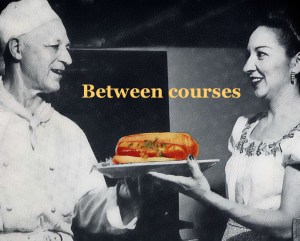 In the summer of 1953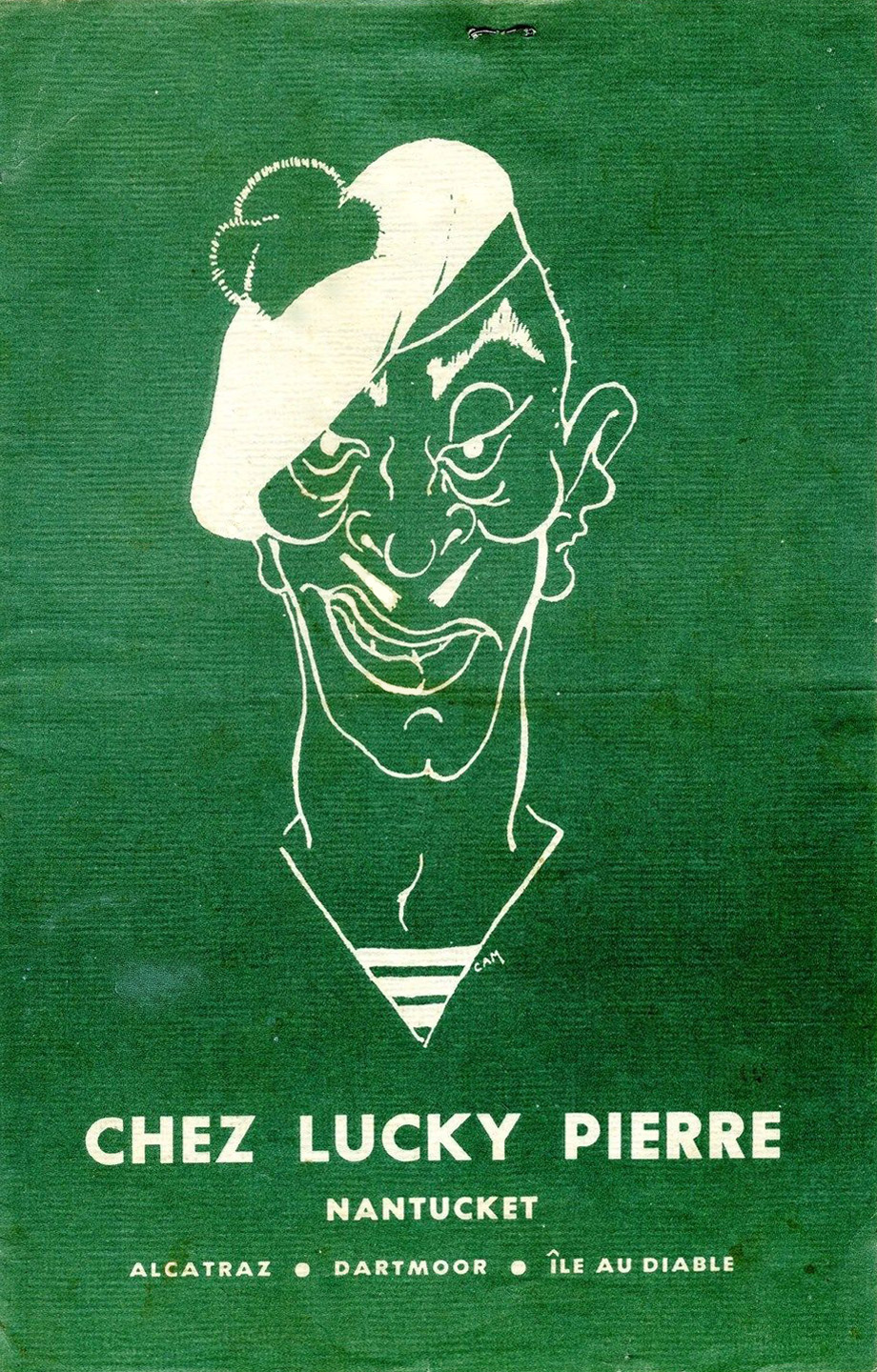
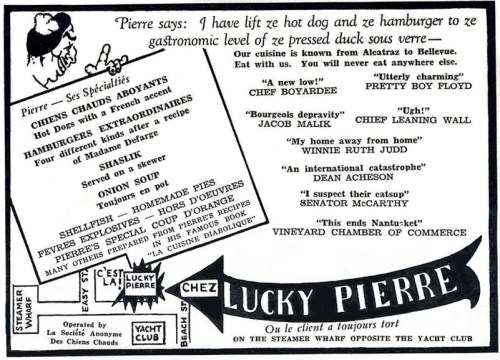 The advertisement shown here appeared at just about the exact time JB was stepping off the ferry, in the June 22, 1953, edition of “This Week in Nantucket.”
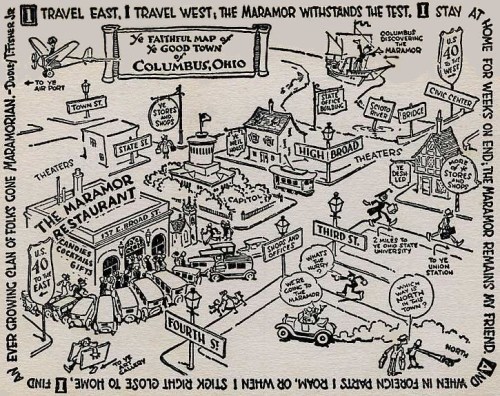 Imagine a restaurant management style diametrically opposed to Gordon Ramsay’s (as he takes command in nightmarish kitchens on TV), and you might well be picturing how Mary Love ran her restaurant, The Maramor in Columbus, Ohio.
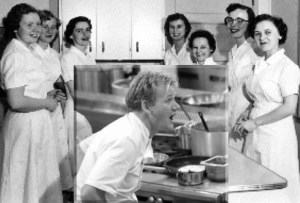 In 1941 Mary described to a home economics conference how she ran her kitchen. She avoided frying and stressed the nutritional properties of food, preparing fresh vegetables to retain flavor and vitamins. Each day her planning department presented the production manager with the day’s menus, while a weighing and measuring specialist prepared trays with complete ingredients for every dish. The trays were given to the cooks, along with detailed instructions for cooking. “This,” Mary said, “helps them to keep their poise and self-respect through the working day, and a cook with poise and self-respect has a better chance of turning out a good product.” (Gordon?)
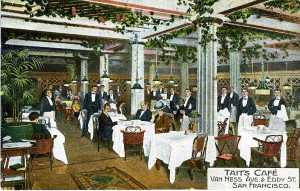 James Beard enjoyed eating out – in fact much of his life revolved around restaurants. When he was a child his mother often took him to places such as the Royal Bakery in his hometown of Portland OR and Tait’s in San Francisco (pictured). Although he was an accomplished cook, cooking teacher, and author of over 20 cookbooks, like many a New Yorker he patronized restaurants frequently, including
 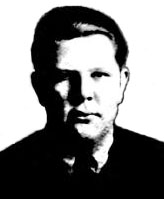 He preferred restaurants that were “homey” and where he was known and liked, such as the Coach House and Quo Vadis. At the latter he became good friends with owners Bruno Caravaggi and Gino Robusti with whom he shared a love of opera. As a young man (pictured, age 19) he prepared for a musical career at London’s Royal Academy of Music. He said that his early performance training helped him with radio and TV appearances.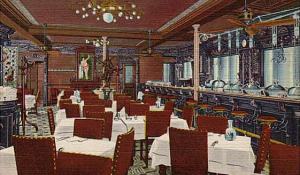
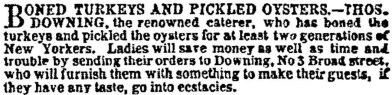 The Downing family of caterers and restaurateurs, Thomas and his sons George T. and Peter W., were activists in the causes of the abolition of slavery, black suffrage, and black education. They assisted Afro-Americans fleeing slavery before Emancipation as well as those escaping terrorism in the South in the post-Civil War period. Like many free blacks living in cities, they took up the catering trade. Similar to undertaking and barbering, catering was a personal service occupation which offered a degree of opportunity for enterprising people of color.
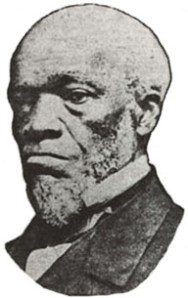 Thomas Downing (pictured), the son of freed slaves from Virginia, specialized in oysters. He opened an oyster cellar on Broad Street in New York City in the 1820s, gradually expanding it and earning a fine reputation. Often oyster cellars were “dives” but his was considered first class. He won awards for his pickled oysters which, along with his boned and jellied turkeys, were especially popular at Christmas (see 1856 ad). Over time he owned the Broad Street place and at least one other in NYC and, according to a Rhode Island directory, another in Providence. However, the press seemed always to confuse the various Downings, so it’s possible the latter was under the direction of a son.
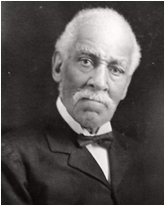 Thomas’s place on Broad was patronized by men in political and financial circles and he was rumored to have influential connections. Both his sons, George and Peter, had enough pull to win concessions for restaurants in government buildings. Peter ran an eating place in the Customs House in NYC, while George, a friend of MA Senator Charles Sumner, managed one in the House of Representatives in Washington, D.C. George (pictured) was also well known as the proprietor of a resort hotel, the Sea Girt House, in Newport, Rhode Island.
 Historically, few tea rooms have enjoyed financial success. So, while “empire” may be a bit grandiose, it’s hard not be impressed by the tea rooms enterprise Ida Frese and her cousin, Ada Mae Luckey, built in New York City in the early 20th century. Ida and Ada, both from a small town near Toledo OH, struck it rich by winning the patronage of wealthy society women. Over time they owned six eating places: the Colonia Tea Room (their first), the 5th Avenue Tea Room, the Garden Tea Room in the O’Neill-Adams dry goods store, the Woman’s Lunch Club, and two Vanity Fair Tea Rooms.
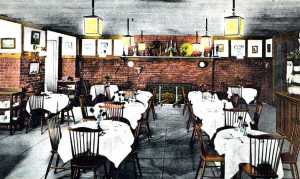 Clearly they valued a good location. The Vanity Fair at 4 West Fortieth Street began in 1911, bearing a notice on its postcard (pictured) that it was across the street from the “new” public library which also opened in 1911. The tea room’s upstairs ballroom was the site of many a party, such as a Shrove Tuesday celebration in February 1914 attended by 150 masked guests.
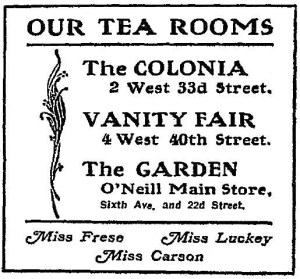 Adding to their financial success were several real estate coups. In 1914 Ida somehow obtained a lease on a coveted Fifth Avenue property. Her feat astonished everyone who followed real estate deals since the owner, a granddaughter of William H. Vanderbilt, had turned down repeated offers from would-be lessees and buyers. The house at #379 was one of the last residences on Fifth Avenue between 34th and 42nd streets which had not been turned into a store or office building. Ida and Ada moved the Colonia, previously on 33rd Street, to this address and rented the remaining space to retail businesses, dubbing the structure the “Women’s Commercial Building.”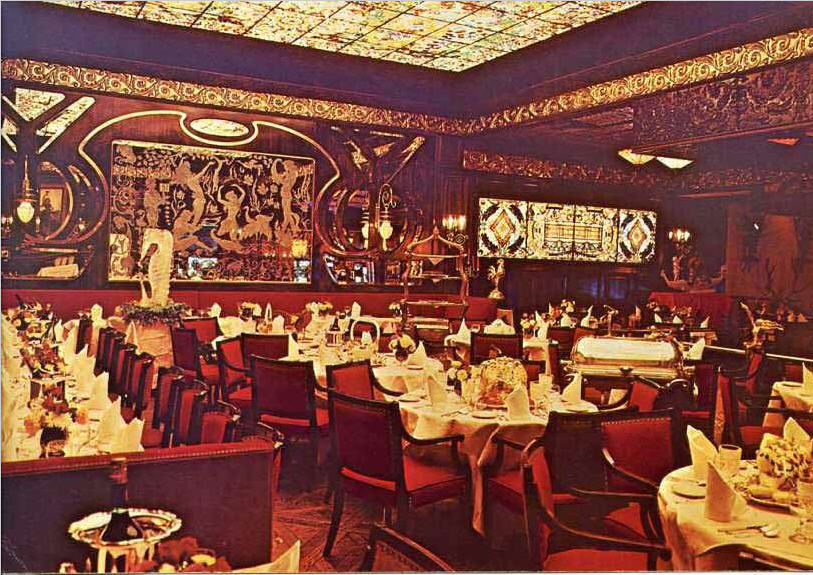
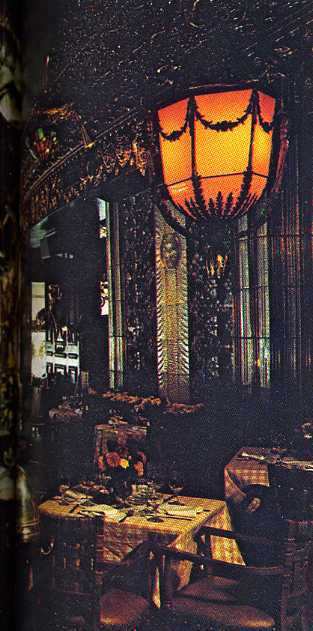

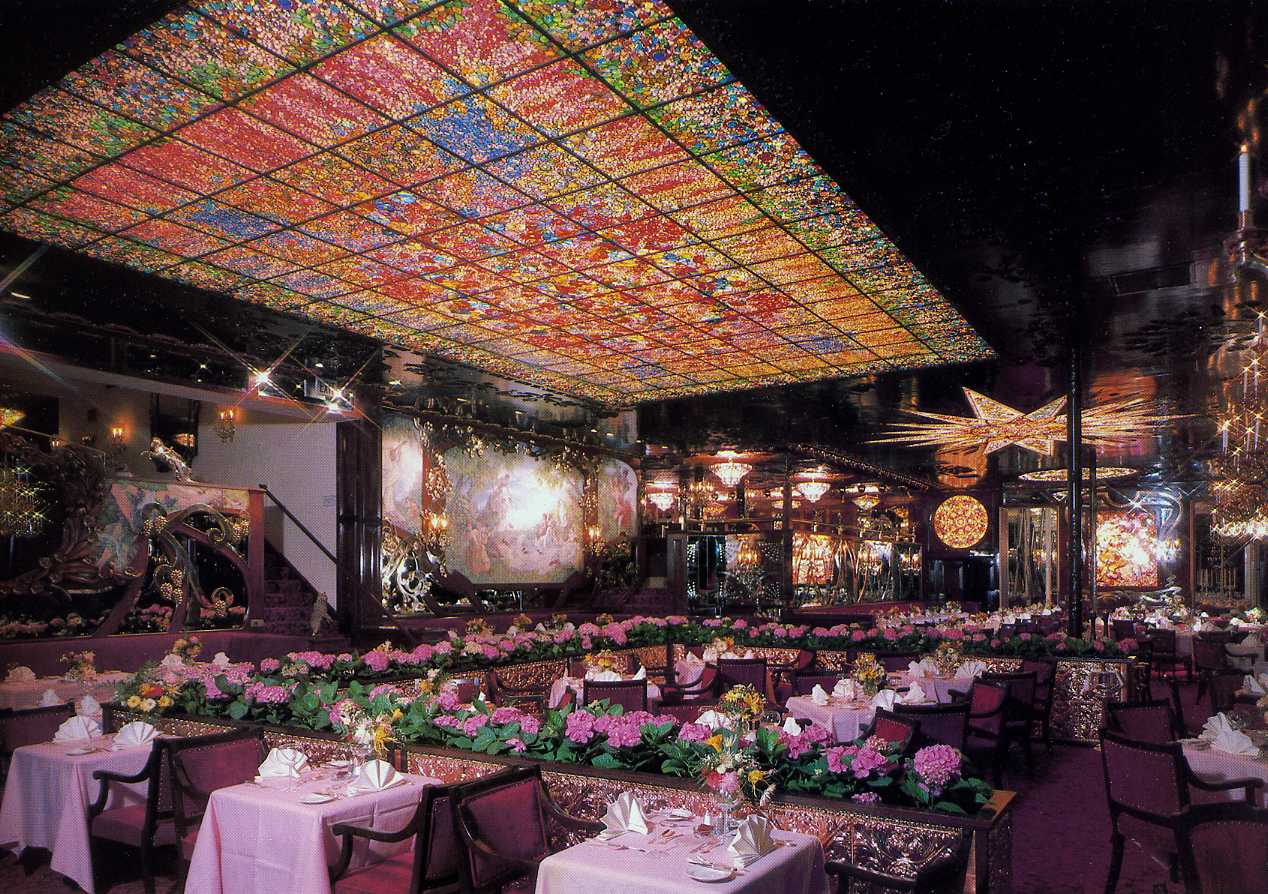
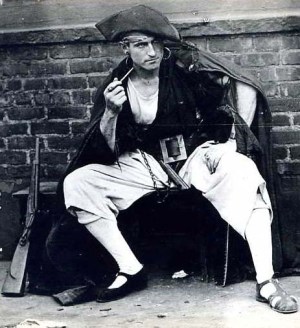 Don Dickerman was obsessed with pirates. He took every opportunity to portray himself as one, beginning with a high school pirate band. As an art student in the teens he dressed in pirate garb for Greenwich Village costume balls. Throughout his life he collected antique pirate maps, cutlasses, blunderbuses, and cannon. His Greenwich Village nightclub restaurant, The Pirates’ Den, where colorfully outfitted servers staged mock battles for guests, became nationally known and made him a minor celebrity.
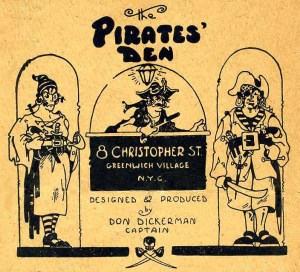 Over time he ran five clubs and restaurants in New York City. After failing to make a living as a toy designer and children’s book illustrator, he opened a tea room in the Village primarily as a place to display his hand-painted toys. It became popular, expanded, and around 1917 he transformed it into a make-believe pirates’ lair where guests entered through a dark, moldy basement. Its fame began to grow, particularly after 1921 when Douglas Fairbanks recreated its atmospheric interior for his movie The Nut. He also ran the Blue Horse (pictured), the Heigh-Ho (where Rudy Vallee got his start), Daffydill (financed by Vallee), and the County Fair.
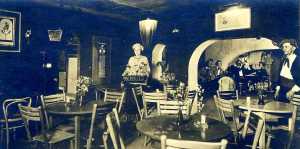 On a Blue Horse menu of the 1920s Don’s mother is listed as manager. Among the dishes featured at this jazz club restaurant were Golden Buck, Chicken a la King, Tomato Wiggle, and Tomato Caprice. Drinks (non-alcoholic) included Pink Goat’s Delight and Blue Horse’s Neck. Ice cream specials also bore whimsical names such as Green Goose Island and Mr. Bogg’s Castle. At The Pirates’ Den a beefsteak dinner cost a hefty $1.25. Also on the menu were chicken salad, sandwiches, hot dogs, and an ice cream concoction called Bozo’s Delight. A critic in 1921 concluded that, based on the sky-high menu tariffs and the “punk food,” customers there really were at the mercy of genuine pirates.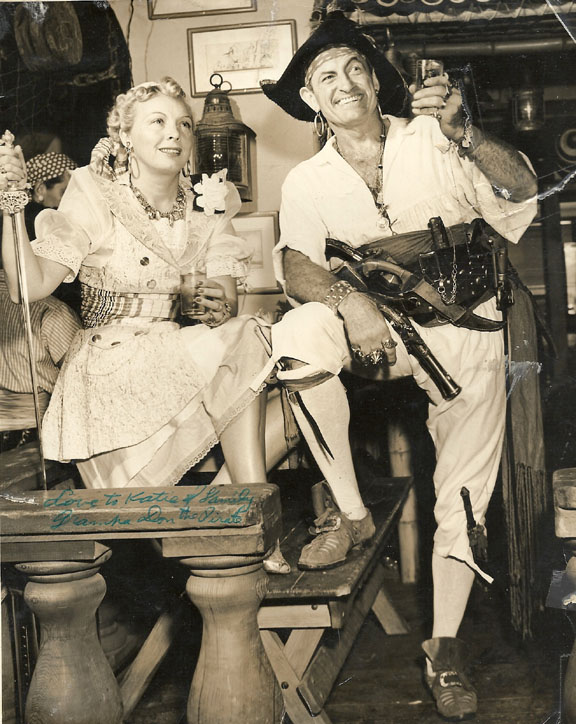

 It's great to hear from readers and I take time to answer queries. I can't always find what you are looking for, but I do appreciate getting thank yous no matter what the outcome.