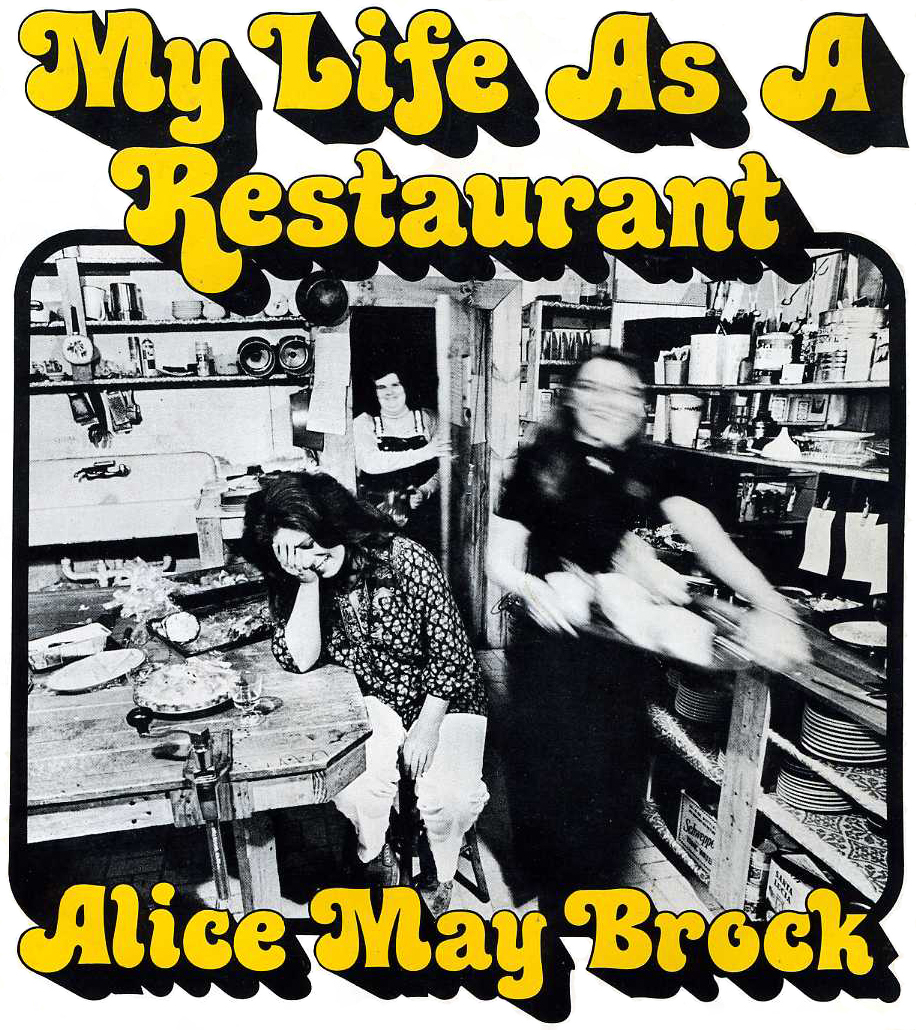
 A 1965 Thanksgiving dinner at the former church where Alice Brock and her husband Ray lived inspired Arlo Guthrie’s ballad of his arrest and subsequent draft board rejection for illegally disposing of trash. But “Alice’s Restaurant” also created vibrations so strong they imbued Alice’s whole career as a restaurant proprietor. Although she enjoyed a degree of success, her career was also filled with disappointments such as a nationwide chain of Alice’s Restaurants and a TV show (Cookin’ with Alice) that did not materialize.
In April 1966 she opened the first of her three restaurants, The Back Room, in an old luncheonette in Stockbridge which Alice described as “painted two-tone institutional green, and … definitely not the kind of place where I would eat, much less own.” Alice ran it for one year before she “freaked out” and closed it. In her book My Life as a Restaurant, she declares, “I didn’t know what I was going to do, but I knew I would never have another restaurant.” Not so – she would have two more.
After a year as consultant on the Arthur Penn movie built around Guthrie’s song, Alice decided to try again. But now she was a counterculture celebrity, portrayed in the film as a “dope-taking, free-loving woman,” a depiction which she insisted was false but which would bedevil her relations with town authorities whose approval she needed to open or expand a restaurant.
 She would tussle with the town of Stockbridge throughout the four years she operated her second restaurant, “Alice’s.” Located in a semi-ramshackle former liquor store on Route 183, it began in the summer of 1972 as a roadside stand called “Take Out Alice.” Partly because of her celebrity and partly because she provided superior roadside fare – sushi, borscht, salmon mousse, and cream cheese & walnuts on homemade bread – she attracted volumes of summer visitors.
The next year she was granted permission to add a small dining room, but further expansion requests were denied, leading her to move the restaurant to Lenox, near Tanglewood, in 1976. In 1979 she closed Alice at Avaloch (shown below), the Lenox restaurant-plus-motel, after difficulties with the property’s sewage system and other adversities, permanently ending her restaurant career.
 In interviews and in her two books Alice espoused the value of fresh ingredients, garlic, meals with friends, and an experimental approach to cooking. Her words convey a free-wheeling, irreverent outlook. Some examples:
* On cooking: “Hell, you can make a soufflé in a garbage can lid if you want to.”
* On busy nights: “Oh, if only you could just cry and it would be over, but it won’t be over. Crying will come to nothing but wasted time, and you could cry forever, but this night is existing, the dining room is filling, the orders … are lining up on their clothespins.”
* On her Lenox restaurant: “We still serve everyone from schlumps to snobs.”
* On being a restaurateur: “Crazy, the restaurant has become my life, there is no life outside it, only in relation to it.”
© Jan Whitaker, 2008





 It's great to hear from readers and I take time to answer queries. I can't always find what you are looking for, but I do appreciate getting thank yous no matter what the outcome.