When I wrote my book about the history of tea rooms, Tea at the Blue Lantern Inn, I knew very little about tea rooms run by and for African-Americans. There were few historical sources available on the internet then and even a research trip to Chicago turned up nothing. Since then I’ve discovered that there were many of these tea rooms and that they shared numerous characteristics with tea rooms run by and for whites, yet were also different in significant ways.
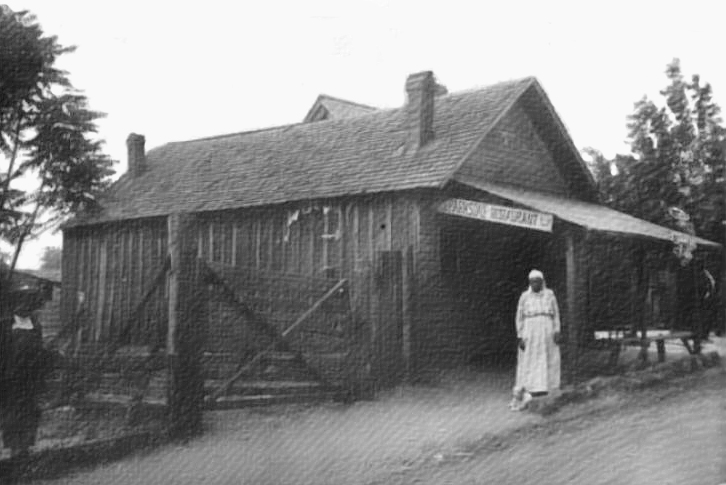
It’s easy to see why black women, and men, wanted to create their own tea rooms. For one thing, even in states where Jim Crow policies were not enacted into law it was common for white-run tea rooms and restaurants to engage in racial discrimination. Secondly, starting a business represented the fulfillment of the idea of self-help for blacks as advanced by leaders. Perhaps that was what inspired Mittie Burgess, a Georgia-born caterer in her late 30s, to name her newly opened 1916 place in Lexington KY the Booker T. Washington Tea Room. Although Mittie’s tea room was in the South, quite a few of the proprietors I’ve been able to trace were part of the 20th-century’s Great Migration of Southern blacks to Northern cities.
Like white tea room proprietors, blacks who took up this business tended overall to be of higher social status than the average restaurant owner, white or black. Proprietors I’ve come across included a woman who was a former pharmacist and a man who had been a college professor. Some of the more elite women who operated tea rooms were married to life insurance executives, ministers, doctors, and successful business men. Others were wives of porters, cabbies, and chauffeurs but still seemed to have achieved standing in their communities.
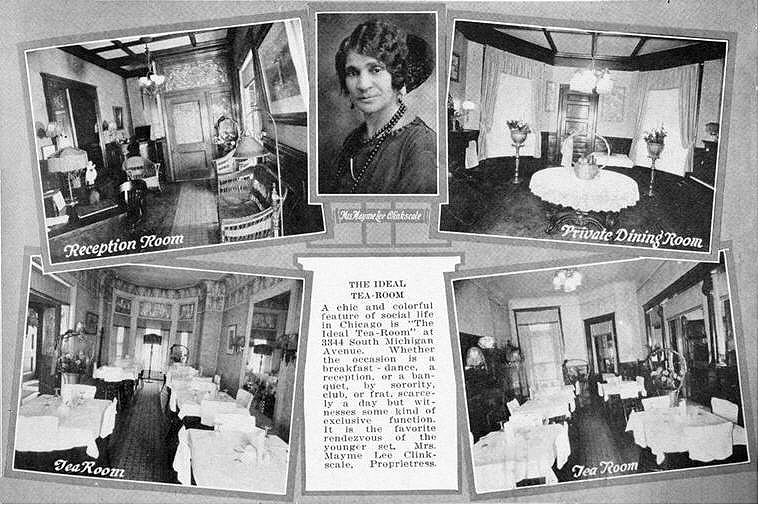
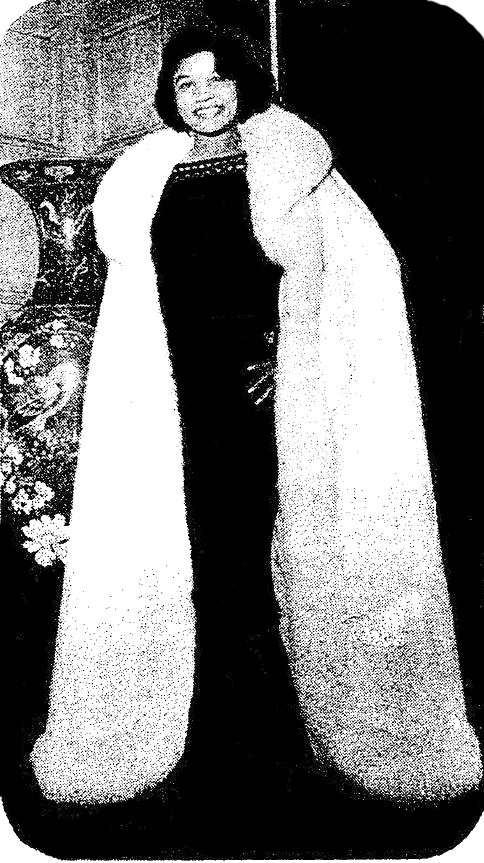
The advertisement for the 1922 opening of Mayme Clinkscale’s Ideal Tea Room [shown above] in Chicago said it was designed for club, society, and lodge banquets, and furnished with “the latest and best in silverware, linen, and glassware.”
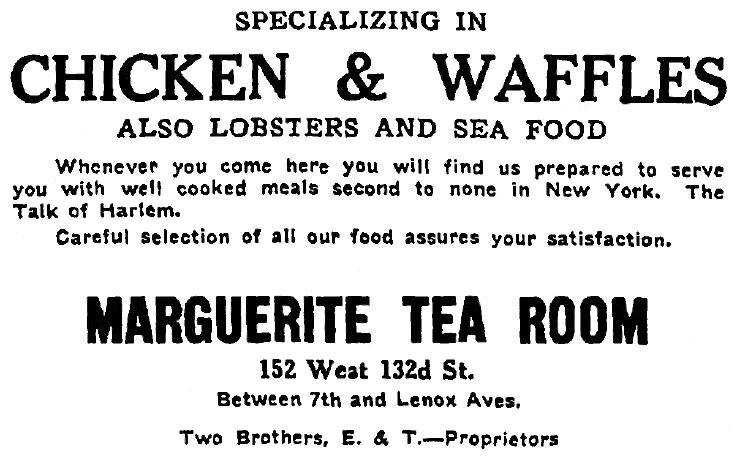 A number of tea rooms were clearly meant for the black upper crust. Common phrases in advertisements and news stories include “exclusive,” “the elite of the city are found [here],” or “where the wealthier class of colored people dine.” Mentions of table appointments and decor often include silver bud vases, exotic themes, and carefully coordinated color schemes. Menus offered fried chicken and corn sticks as well as steaks and salads, but were less likely to list rural Southern favorites such as pigs’ feet or greens.
Tea rooms in African-American communities in the teens, 20s, and 30s, frequently hosted important social events. Community leaders hailed them as badly needed establishments. Groups such as the NAACP Women’s Auxiliary, black sports writers, and the Negro Business League held luncheons and dinners at tea rooms. Red Caps from Grand Central and Penn Station hosted their peers at the Gilt Edge Tea Room during a national convention in NYC. Newspaper people from the black newspaper The Amsterdam News celebrated a colleague’s college graduation at Harlem’s Jack and Jill Tea Room in 1928. They certainly received a warmer welcome than had Charlotte Bass, black publisher of the California Eagle, when she and several of her guests were refused service at the white-run Old Adobe in Ventura CA.
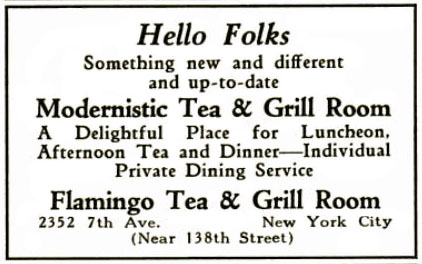 Since they were small and did not make money from alcoholic beverages (not legally anyway, during Prohibition) all tea rooms were hard to operate profitably. Yet I sense that owners of Afro-American tea rooms had to work even harder than whites to succeed. They seem to have been open much longer hours, covering meals that ran from breakfast until late into the night. They were also more likely than white tea rooms to offer entertainment such as music and dancing. Many took in table boarders, regular patrons who contracted to eat their meals there for a week or month at a time.
© Jan Whitaker, 2011


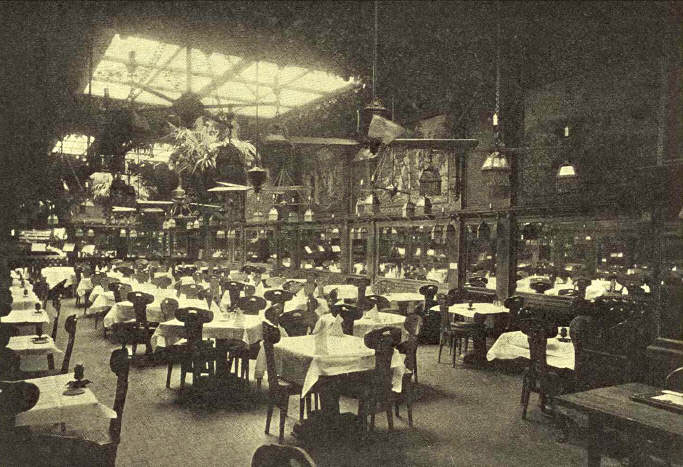
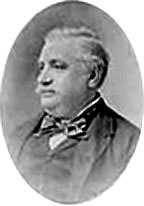
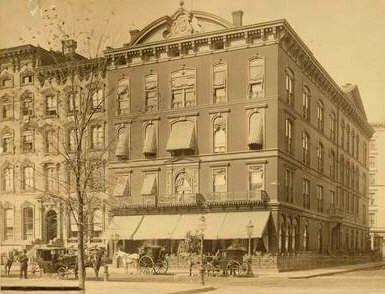
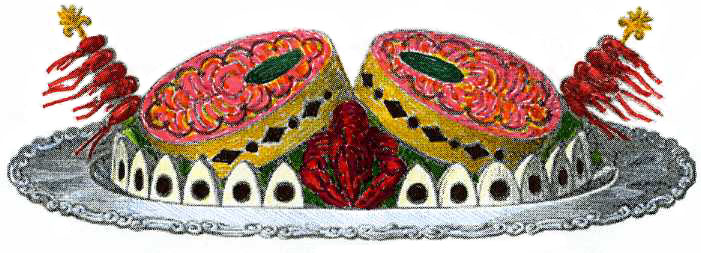


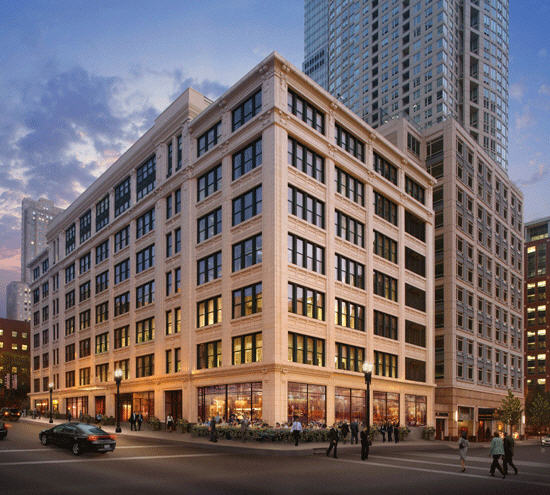



 All things considered, the best restaurants that this country has produced probably have been unpretentious, inexpensive, high-volume eateries located close to sources of fresh food. In 19th-century New York City’s Smith & McNell’s, across from the booming Washington Market, was a leading example of the type. Its patronage came largely from dealers, farmers, and customers who worked and shopped at the market. Around 1891 the restaurant reportedly provided more meals than any eating place in the city, as many as 10,000 a day.
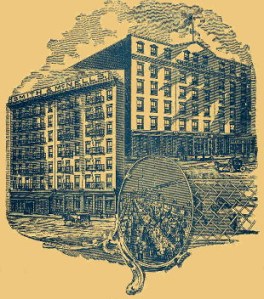 There are many discrepancies in accounts of this restaurant’s history but it seems most likely it was established in the late 1840s by Thomas R. McNell and Henry Smith. McNell was an Irish immigrant, born sometime between 1825 and 1830. According to one account he and Smith had been night watchmen before taking over the coffee house run by Frederick Way on Washington Street near the market. Both McNell and Smith became wealthy and McNell acquired a lordly estate in Alpine, New Jersey, as well as a California ranch. He continued working in the business until a ripe old age and died in 1917 a few years after the restaurant (and associated hotel) closed.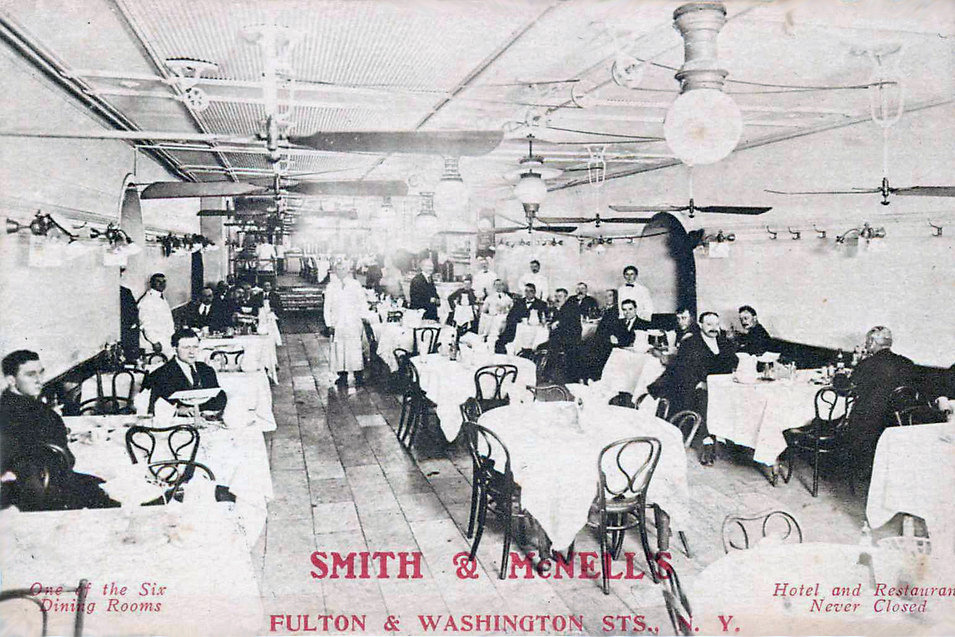

 According to accounts, “D. L.” wrote his own colorful advertising copy, such as, “These hams are cut from healthy young hogs grown in the sunshine on beautifully rolling Wisconsin farms where corn, barley, milk and acorns are unstintingly fed to them, producing that silken meat so rich in wonderful flavor.” Equally over the top was his copy for Idaho baked potatoes, with references to a “bulging beauty, grown in the ashes of extinct volcanoes, scrubbed and washed, then baked in a whirlwind of tempestuous fire until the shell crackles with brittleness…” Customers who had not previously eaten baked potatoes soon learned to ask for “an Idaho.” Another heavily promoted dish, “Old Fashioned Louisiana Strawberry Shortcake,” was “topped with pure, velvety whipped cream like puffs of snow.”
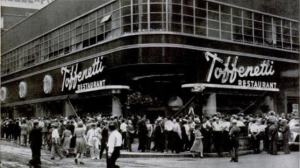 Another factor in his success was winning catering contracts at two world’s fairs, Chicago in 1933 and New York in 1939-40. Following the NY fair he outbid Louis B. Mayer for an immensely valuable piece of Times Square real estate on the corner of 43rd and Broadway. He hired Skidmore, Owings & Merrill to design a two-story, glass-fronted moderne building (pictured), outfitted with an escalator and a show-off gleaming stainless steel kitchen. The restaurant served 8,500 meals on opening day.
 It's great to hear from readers and I take time to answer queries. I can't always find what you are looking for, but I do appreciate getting thank yous no matter what the outcome.