Category Archives: food

Fried chicken blues

The 1960s were a boom decade for marrying fast food to franchise businesses christened with celebrity names. Chicken seemed like the up-and-coming successor to hamburgers in a business more about marketing concepts and stock quotations than food or hospitality. Following the success of Harlan Sanders, whose 500-unit Kentucky Fried Chicken chain mushroomed to 1,700 when he sold to a corporate buyer, entrepreneurs looked around for other celebrities to hitch their schemes to. Performers Minnie Pearl, Mahalia Jackson, James Brown, and Eddy Arnold, along with many sports figures, were persuaded to lend their names, rarely assuming any further involvement.

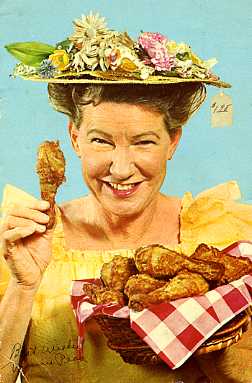
Minnie Pearl’s Chicken System, Inc., was the creation of Tennessean John Jay Hooker whose political ambitions included becoming governor, then president. Minnie Pearl, a Grand Ole Opry comedien whose frumpy stage persona suggested down-home eating, covered the white market, while gospel singer Mahalia Jackson lent her name to the black-owned side of the enterprise aimed at black inner-city consumers. Around the same time, ca. 1969, “king of soul” James Brown figureheaded the Gold Platter soul food chain which failed to get beyond the pilot stage in Macon, Georgia. Minnie’s and Mahalia’s ventures, too, lasted only a few years. Hooker, chicken systems mastermind, did not make it into office, but Benjamin Hooks, co-owner of Mahalia Jackson’s Gloree-Fried chicken (carryout only), went on to become executive director of the NAACP.

Though hailed as a restaurateur, Jackson received royalties for the use of her name but did not choose to invest in the Mahalia Jackson Chicken System, Inc. Perhaps she did not approve of its slogan: “It’s Gloree-Fried, and that’s the gospel truth.” The Minnie Pearl system totaled several hundred locations at its peak but it’s not clear how many outlets the Jackson chain comprised, probably many fewer. Chicago had only two units, paired with gas stations. The chain also operated in Memphis, Cleveland, Jacksonville, and Detroit. In addition to chicken, menus included fish sandwiches, sweet potatoes, fried pies, and a ‘Soul Bowl’ of chicken giblets in gravy on rice.

Minnie Pearl’s chicken — and later roast beef sandwiches — business went bankrupt in 1970.

© Jan Whitaker, 2008

Leave a comment

Filed under chain restaurants, food

Basic fare: toast

Toast wasn’t really new on restaurant menus around 1914 but it was beginning to enjoy a bigger vogue. The soda fountain, often located in drug or department stores, was expanding into a lunch counter and as it did it added electric toasters to its battery of equipment. Most Americans still lacked electricity in their homes at this time so toast was something of a treat to them. By 1923 a new type of sandwich place, the luncheonette, had caught on. At the Tasty Toasty Luncheonette in New Haven a diner could almost certainly order a toasted cheese sandwich, an item once found only in English-style chop houses way before the Civil War.

Considering that restaurants in the early 19th century laboriously toasted bread by turning it slowly over an open fire, it is surprising that it was offered at all in those days. And yet Mrs. Poppleton, a versatile New York restaurateur, pastry cook, and confectioner, advertised in 1815 that she would provide refreshments such as savory patties, mock turtle soup, and anchovy toasts between 11 a.m. and 3 p.m. each day. Beyond being an accompaniment to eggs, toast also did service in many an eating place as an edible prop for such foods as quail, creamed chicken, or asparagus. Buttered toast floated in oyster stews and bowls of milk (“milk toast”). World War I put a temporary end to its sidekick role when the Food Administration ordered restaurants to conserve wheat by not using bread as a garniture.

After the war toasters stayed perpetually busy in luncheonettes. An Omaha chain of lunchrooms advertised “National Toast Week” in 1923. The R and C Sandwich Shops boasted in 1925 that “Our big double-deck special toast sandwiches are the talk of Chicago.” The following year there was a special demonstration on how to make toasted sandwiches at the National Restaurant Association convention.

The novelty of toast wore off over time until the cheap steakhouses that sprang up in the early 1960s revived it. Their dinners of sirloin steak, tossed salad, and baked potato came with garlic toast (called Texas toast when made of double thick bread), all for the magic price of $1.19.

Today toast can still be found filling all its historical restaurant roles, with the exception of milk toast which has been replaced with milk and cereal. But its leading role is perhaps in the club sandwich. As a 1960 restaurant trade magazine observed: “The dry, crispy consistency of toasted breads improves flavor and appearance, and also makes the customer feel he is getting a more exclusive product.” This, the article noted, allows toasted sandwiches to be priced a bit higher than plain ones.

© Jan Whitaker, 2008

3 Comments

Filed under food, lunch rooms, menus

Basic fare: ham sandwiches

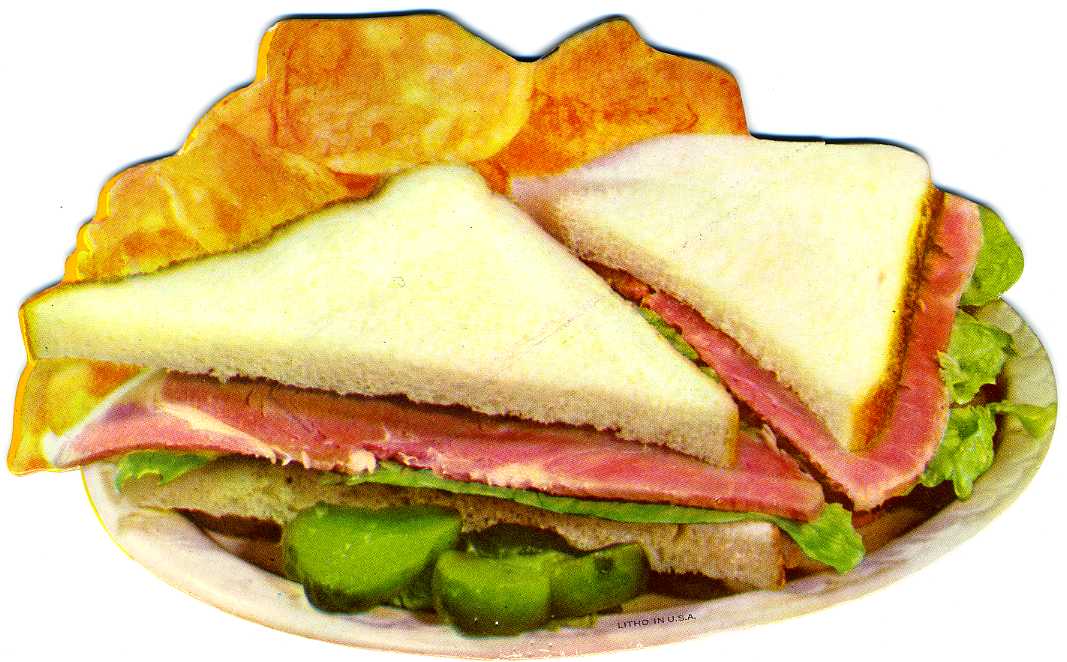
Because cured ham keeps for months at room temperature, it was always on hand in colonial and early American taverns. At any time of day and much of the night a hungry person could get the host to slice off a “cold cut” of ham. Ham and eggs was such a popular dish in eating places everywhere and at all times that many people have nominated it as America’s national dish.

Ham sandwiches were on tap at porter houses and went well with the dark brew as well as with ale (but what didn’t in those heavy-drinking days?). At New York’s Ring of Bells, host John Spencer advertised in 1807 that he furnished first-rate liquors, soups, and “Sandwiches, Anchovies and Relishes of every description.” Later many drinking places put out ham sandwiches as part of their free lunch spread.

Serve-yourself lunch counters of the 1880s were loaded with ham sandwiches, beef sandwiches, and pies. Customers grabbed what they wanted, often ate standing, and washed it all down with water or a hot beverage. At non-alcoholic dairy lunch bars, which featured fresh milk, coffee, and simple dishes such as beans, ham sandwiches cost 5 cents apiece. Wyman’s Sandwich Depot was famous throughout Boston for hefty sandwiches but a competitor in the 1890s claimed his sandwiches, on rolls 7 inches long and 5 inches wide, were larger. Also up and coming at the time were the lunch wagons that rolled onto city streets at night, vanishing in the daytime. They too specialized in ham sandwiches. But signs of change were on the horizon. Another lunch wagon specialty was the hamburger sandwich, destined eventually to trim the humble snack of ham between bread down to size.

© Jan Whitaker, 2008

Leave a comment

Filed under food