 A “faux” want-ad for a young clerk, allegedly placed by “Iscariot Grasp, 1 Brokers’ Alley,” was published in New York in 1849. It represents a humorous take on Puritanical notions of morality of that time. Evidently an upstanding young man then was supposed to confine his dining to home. If he wanted the clerk job he had to promise to reside with his parents and not to frequent “oyster-cellars, porter-houses, theatres, balls, ten-pin alleys, billiard rooms, sweat-boards [a dice game], raffles for poultry or game, restaurants, confectioners, steam-boats, Coney-Island, Rockaway or Saratoga.”
Monthly Archives: March 2009
Between courses: keep out of restaurants
Filed under miscellaneous
The Automat, an East Coast oasis
 In the late 19th century owners of large popular-price restaurants began to look for ways to cut costs and eliminate waiters. The times were hospitable to mechanical solutions and in 1902 automatic restaurants opened in Philadelphia (pictured below) and New York. In both cities, a clever coin-operated set-up – and a name – were imported from Germany. There was, however, a striking difference between the two operations. The Philadelphia Automat, run by Joseph Horn and Frank Hardart, served no alcoholic beverages, while the New York Automat, true to its European origins, did.
 The Automat in NYC was owned by James Harcombe, who in the 1890s had acquired Sutherland’s, one of the city’s old landmark restaurants located on Liberty Street. The Harcombe Restaurant Company’s Automat was at 830 Broadway, near Union Square. Reportedly costing more than $75,000 to install, it was a marvel of invention decorated with inlaid mirror, richly colored woods, and German proverbs. It served forth sandwiches and soups, dishes such as fish chowder and lobster Newburg, and ice creams. Beer, cocktails, and cordials flowed from its faucets. A bit too freely. The Automat’s staff had to keep a sharp lookout for young boys dropping coins into the liquor slots.
While the Philadelphia Automat thrived, the New York counterpart ran into financial difficulties shortly after opening, possibly because of a poor location. It advertised in an NYU student magazine in 1904: “Europe’s Unique Electric Self-serving Device for Lunches and Beverages. No Waiting. No Tipping. Open Evenings Until Midnight.” The disappearance of the Harcombe Automat ca. 1910 seemed to fulfill pessimistic views that an automatic restaurant couldn’t succeed in New York, allegedly because machinery would malfunction and customers would cheat by feeding it slugs.
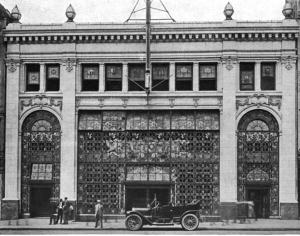 Undeterred by the first Automat’s fate, Horn & Hardart moved into New York in 1912, opening an Automat of their own manufacture at Broadway and 46th Street (pictured). It turned out that New Yorkers did indeed use slugs, especially in 1935 when 219,000 were inserted into H&H slots. But despite this, the automatic restaurant prospered, expanded, and became a New York institution. By 1918 there were nearly 50 Automats in the two major cities, and eventually a few in Boston. Horn & Hardart tried Automats in Chicago in the 1920s but they were a failure. On an inspection tour in Chicago, Joseph Horn noted problems such as weak coffee, “figs not right,” and “lem. meringue very bad.”
Part of the lore of the Automat derives from the unexpected forms of sociability it inspired among strangers. Others found in it a unique entertaining concept. Jack Benny hosted a black tie dinner in a New York Automat for 500 friends in 1960, but he was scarcely the first to come up with the idea. As early as 1903 a Philadelphia hostess rented that city’s Automat for a soirée, hiring a caterer to replace meatloaf and coffee with terrapin and champagne. In 1917 a New York bohemian group calling themselves “The Tramps” took over the Broadway Automat for a dance party, inserting in the food compartments numbered slips corresponding to dance partners. For most customers, though, the Automat meant cheap food and possibly a leisurely place to kill time and watch the parade of humanity.
 The Automats hit their peak in the mid-20th century. Slugs aside, the Depression years were better for business than the wealthier 1960s and 1970s when some units were converted to Burger Kings. In 1933 H&H hired Francis Bourdon, the French chef at the Sherry Netherland (fellow chefs called him “L’Escoffier des Automats”). In 1969 Philadelphia’s first Automat closed, being declared “a museum piece, inefficient and slow, in a computerized world.” That left two in Philadelphia and eight in NYC. The last New York Automat, at East 42nd and 3rd Ave, closed in 1991.
© Jan Whitaker, 2009
Filed under chain restaurants
Good eaters: James Beard
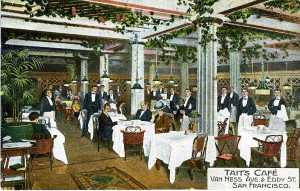 James Beard enjoyed eating out – in fact much of his life revolved around restaurants. When he was a child his mother often took him to places such as the Royal Bakery in his hometown of Portland OR and Tait’s in San Francisco (pictured). Although he was an accomplished cook, cooking teacher, and author of over 20 cookbooks, like many a New Yorker he patronized restaurants frequently, including Maillard’s, Longchamps, and the Automat. At one point, when he had become more prosperous, he ate almost nightly for a solid month at one of his regular haunts, the Coach House near his home in Greenwich Village, where his favorite dishes included corn sticks, black bean soup, and mutton chops. One summer in 1953 he managed a restaurant on Nantucket.
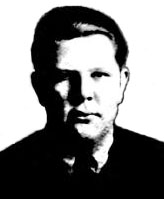 He preferred restaurants that were “homey” and where he was known and liked, such as the Coach House and Quo Vadis. At the latter he became good friends with owners Bruno Caravaggi and Gino Robusti with whom he shared a love of opera. As a young man (pictured, age 19) he prepared for a musical career at London’s Royal Academy of Music. He said that his early performance training helped him with radio and TV appearances.
In 1956 he issued his list of the country’s best restaurants, revealing a fondness for clubby male establishments and for places that were friendly — though usually expensive: Le Pavillon, ‘21,’ Quo Vadis (NYC); Jack’s (SF); Locke-Ober (Boston, pictured); Perino’s, Musso & Frank (Los Angeles); London Chop House (Detroit); and Walker Bros. Pancake House (Portland).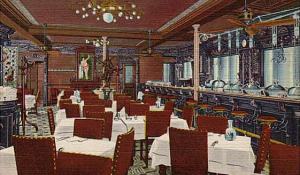
Restaurants also figured prominently in his professional life. He served as a consultant for restaurants in NY and Philadelphia, including the Four Seasons. For years he wrote a column on restaurants for the Los Angeles Times in which he touted places as diverse as Quo Vadis and Maxwell’s Plum in NYC and the Skyline Drive-In in Portland OR (“they make a whale of a good hamburger”). Despite occasional harsh opinions expressed about women in his 1950s barbecue cookbook days (“They should never be allowed to mix drinks.”), in later years he hailed Berkeley CA restaurateurs Alice Waters at Chez Panisse and Suzy Nelson, co-owner of The Fourth Street Grill.
He advised men on cooking and ways of suavely handling their culinary affairs, being careful, even when promoting French cuisine, to keep a down-to-earth tone. He disavowed the term gourmet, claiming he was definitely not one. In a review of Maxwell’s Plum he declared, “Not being a highbrow about food, I appreciate a really good hamburger or chili as much as a velvety quenelle or a rich pâté en croute.”
In a column he wrote for the National Brewing Company of Baltimore he urged discontented diners to stand up for good food, suggesting, “The only way to combat the stupid treatment of food in many restaurants is to be firm about sending food back to the kitchen whenever it is not right.” If asked how your dinner is, he insisted, do not say (if it was bad), “Oh very good, thank you.” In another piece he chided “mannerless” diners who make multiple reservations with the intention of deciding later which to honor. “When you dine out you have a certain responsibility to the management,” he wrote, explaining that no-shows seriously undermine small restaurants.
© Jan Whitaker, 2009
Filed under guides & reviews, proprietors & careers
Basic fare: waffles
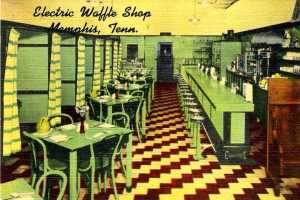 In the early 19th century Philadelphians enjoyed driving their carriages to the falls on the Schuykill River, the area now known as East Falls, then lined with hotels and restaurants. Eating places there specialized in a favorite dish associated with Philadelphia long before the advent of cheese steaks, namely catfish and waffles. (I’d like to believe that the dish did not include maple syrup.)
Jumping ahead some 50 years, waffles also turn up again in Philadelphia as a featured specialty at a Civil War fundraiser in which an old-time kitchen recreated the food and cooking methods of early German settlers. While gazing at souvenirs such as Benjamin Franklin’s desk and a copper kettle used to make coffee for Revolutionary War soldiers, diners could indulge themselves with buttered waffles with sugar and cinnamon, sausages, or “omelette etwas” (scrambled eggs).
Of course waffles could be found in many restaurants over the past 200 years but they seem to have been especially popular in certain places and times. The “Wild West” was well supplied with waffle kitchens and houses. In mining camps and early settlements in Oregon, California, and Colorado waffles turn up on many menus in the 1880s and 1890s. Only in the West was the term “waffle foundry” used to describe lunch rooms like those in Los Angeles where in 1894 “a large waffle, swimming in melted butter and syrup is served for ten cents.”
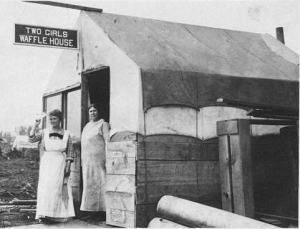 Well into the 20th century waffles were familiar fare in boom towns such as Anchorage, Alaska, and the oilfields of Oklahoma. Around 1915 two young women from Seattle decided to seek their fortune in Alaska with the Two Girls Waffle House (pictured). In what was not much more than a shack with a canvas roof they could handle only eight customers at the counter. But after a year they had made enough money from railroad construction workers to build a permanent structure. A similar success story could be told about the two young men who ran the Kansas City Waffle House in Drumright, Oklahoma, before graduating to a bigger enterprise in Tulsa.
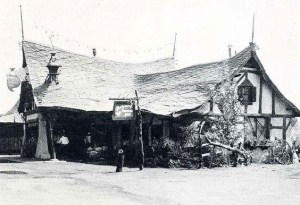 Waffles were also a staple of tea rooms in the early 20th century. In places as varied as big city afternoon tea haunts and humble eateries in old New England homesteads, waffles attracted patrons. In 1917 New Yorkers could choose among the Colonia Tea Room, At the Sign of the Green Tea Pot, or the Brown Betty for their waffles fix. In the early 1920s, the fantastical Tam O’Shanter Inn of Los Angeles, then known as Montgomery’s Country Inn (pictured), offered chicken and waffles, a common dish at roadside tea rooms then. Tea room and coffee house magnate Alice Foote MacDougall attributed her successful career to the waffles she served in her Little Coffee House Grand Central Station restaurant in 1919.
As the Wells Manufacturing Company, maker of commercial waffle bakers, advertised in 1948: “Look! There’s a lot of Money in Waffles!”
© Jan Whitaker, 2009

 It's great to hear from readers and I take time to answer queries. I can't always find what you are looking for, but I do appreciate getting thank yous no matter what the outcome.
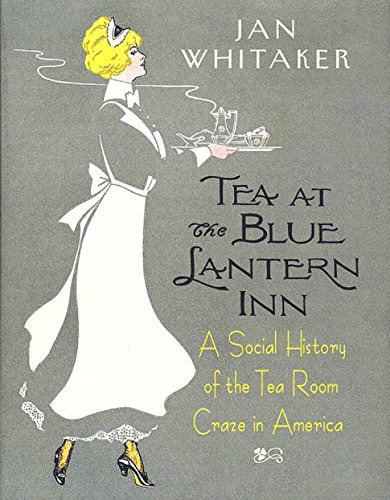
 Restaurant-ing through history