Tag Archives: tea rooms

Mary Elizabeth’s, a New York institution

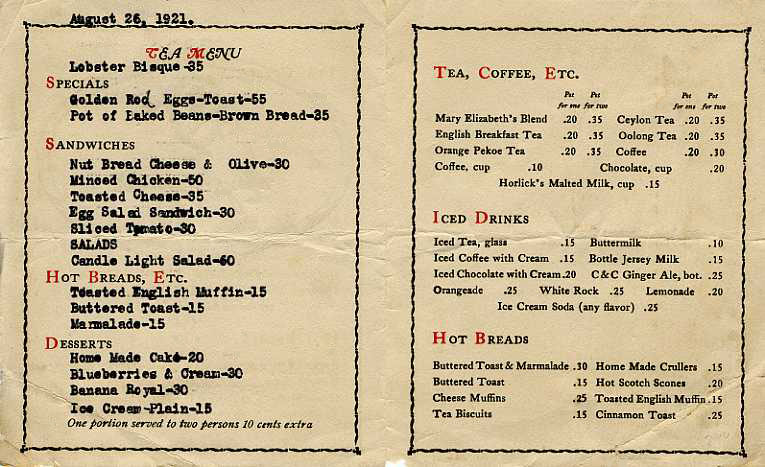
Mary Elizabeth Evans, for whom the landmark tea room was named, began her career in 1900 at age 15 as a small grocer and candymaker in Syracuse. After one year in business she cleared the then-handsome sum of $1,000 which she contributed to the support of her family while supervising a growing crew of helpers which included her two younger sisters who served as clerks and her brother who made deliveries.

Her family, though in seriously reduced circumstances, had valuable social connections. Her late grandfather had been a judge, her uncle an actor, and her departed father a music professor. That may help explain how she achieved success so rapidly – and why her story garnered so much publicity. By 1904 several elite NYC clubs and hotels sold her candy and soon thereafter it was for sale at summer resorts such as Asbury Park and Newport and in stores as far away as Chicago and Grand Rapids. In 1913 the all-women Mary Elizabeth company, which included her mother and sisters Martha and Fanny, was prosperous enough to sign a 21-year lease totaling nearly $1 million for a prestigious Fifth Avenue address close to Altman’s, Best & Co., Lord & Taylor, and Franklin-Simon’s.

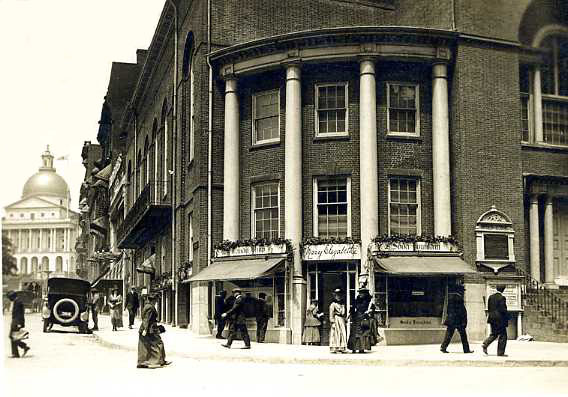
By the early teens the candy store had expanded into a charming tea room with branches in Newport and two in Boston, one on Temple Street and the other in the basement of the Park Street Church near the Boston Common (pictured ca. 1916). Like other popular tea rooms of the era, Mary Elizabeth’s bucked the tide of chain stores and standardized products by emphasizing food preparation from scratch. Known for “real American food served with a deft feminine touch,” Fanny Evans said the tea rooms catered to women’s tastes in “fancy, unusual salads,” “delicious home-made cakes,” and dishes such as “creamed chicken, sweetbreads, croquettes, timbales and patties.” For many decades, the NYC Mary Elizabeth’s was known especially for its crullers (long twisted doughnuts).

Mary Elizabeth distinguished herself as a patriot during the First World War by producing a food-conservation cookbook of meatless, wheatless, and sugarless recipes, and by volunteering to help the Red Cross develop diet kitchens in France. After her marriage to a wealthy Rhode Island businessman in 1920 she apparently played a reduced management role in the business.

In its later years the NYC restaurant passed out of the family’s hands and began to decline, culminating in an ignominious Health Department citation in 1985.

© Jan Whitaker, 2008

112 Comments

Filed under tea shops, women

When ladies lunched: Schrafft’s

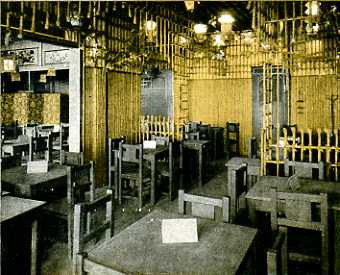
Schrafft’s began as a candy manufacturer in Boston but over time morphed into a well-known restaurant chain. In 1898 Frank G. Shattuck, a salesman for the Schrafft company from upstate New York, opened a candy store at Broadway and 36th in New York. His sister, Jane Shattuck, was largely responsible for the introduction of light lunches into the stores. The first to serve food was the Syracuse store in 1906 where a “Japanese Tea Room” (shown here) was boldly advertised as “the daintiest luncheon spot in all the State.” By 1909 Jane also introduced meals to the second NYC Schrafft’s, at 54 West 23rd Street in the heart of a thriving shopping district. By 1927, when there were 25 units, most located in NYC, the Wall Street Journal estimated that around 75% of Shattuck’s business was in the restaurant trade, with the rest candy-related.

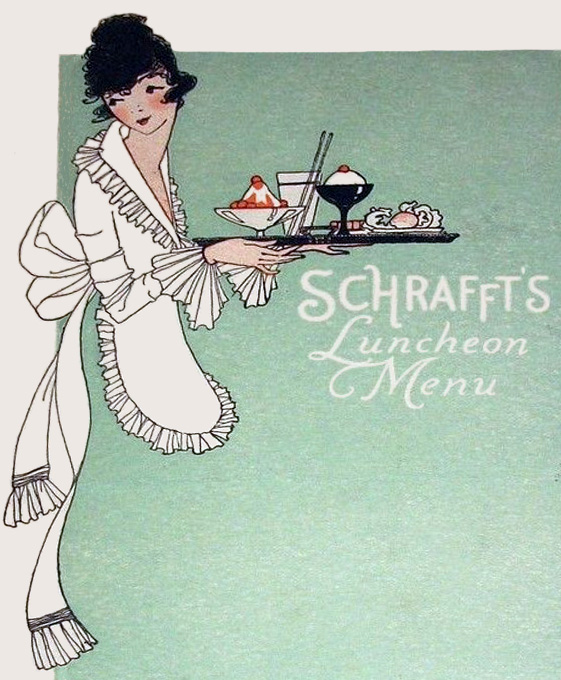
schrafft's1920Schrafft’s was known for reproducing an air of gentility typical of the upper middle-class WASP home. Cooks, supervisors, and even some executives were women. Menus of the 1920s and 1930s included many salads, more desserts than entrees, and non-restaurant-y vegetable selections such as creamed cauliflower and fried eggplant. Frank claimed Schrafft’s cuisine was inspired by his mother’s cooking. Repeated efforts to overcome connotations of a “women’s restaurant” and attract men met with disappointing results despite customers such as James Beard. Women dominated even after some units began to serve cocktails in 1934.

Rent cuts in the depression encouraged chain expansion and by 1937, when Frank died, there were 43 Schrafft’s, most in metro NYC but a few in Boston and Philadelphia. At its peak there were about 50 units in greater NYC. In 1961 the chain played briefly with the idea of selling frozen dinners on the roadside. In the late 1960s the Schrafft’s candy company was sold to Helme Products while Pet, Inc. took over the restaurants. Pet made a renewed effort to renovate Schrafft’s image and attract men. At the Fifth Ave location (between 45th & 46th) the soda fountain was removed and a bar installed. The second floor, men-only dining room was given dark wood paneling, zebra-stripe carpeting, and named “The Male Animal.” The 1970s saw confusion as a Schrafft’s opened in Los Angeles (sporting a Chinese room and an Elizabethan room), new ownership took control, and numerous NYC locations were shut down. In 1981 the candy company ceased while the few restaurants remaining were in various hands.

© Jan Whitaker, 2008

147 Comments

Filed under chain restaurants, tea shops, women

Department store restaurants: Wanamaker’s


Until very recently I thought John Wanamaker’s in Philadelphia had the first in-store restaurant in the U.S. Several scholars have insisted this is true, with the exception of a Macy’s historian who claimed R. H. Macy was first, in May 1878. Wanamaker’s, I’ve discovered, did not install eating facilities until September of 1879 when it enticed a local caterer, Alice Weldon, to run her restaurant inside The Grand Depot, as the store was known then. Weldon, a confectioner born in Ireland, operated a popular oyster-plus-ice-cream café near the store (it sounds like an odd combination but such places were once common). Every day all the shoppers would vacate the store to go eat at Alice’s, so Wanamaker reasoned he had to have her on his side. For about six years she ran the forerunner of The Dairy, an eatery the store created in 1883, one year after installing a soda fountain (another department store first claimed by Wanamaker’s).

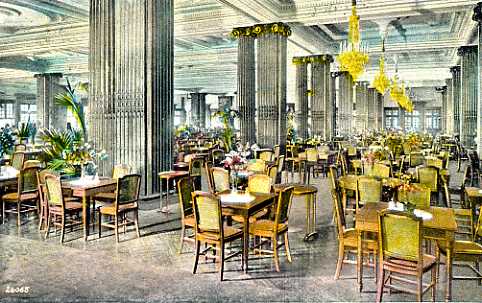
The better known restaurant in the Philadelphia store was the Grand Crystal Tea Room which opened on the 8th floor of the new Wanamaker’s completed in 1911. Immense and filled with chandeliers, it was modeled on the tea room in the Philadelphia mansion of Robert Morris, a financier of the American Revolution. Also on the 8th floor, speedily reached by 24 direct-service elevators, were a number of private dining rooms, a men-only tea room, and the store’s ultra-modern kitchens. The Grand Crystal Tea Room survived the demise of Wanamaker’s and the tenure of its successor but finally closed in 1995 and is now a private banquet hall.

The New York City Wanamaker’s, opened in 1896 in the old A. T. Stewart store and closed in 1954, was also well supplied with esteemed eating places. A 1900 menu shows a full complement of delectable lunch choices, including blue points, cream of new asparagus soup, and lamb with mint sauce. The store’s tea room advertised ca. 1908 that its tea was “specially imported,” and prided itself on its “quaint service.” In 1940 the store operated three eating places on the 9th floor: the main restaurant, Green Shutters; a more casual Side Walk Café; and a Men’s Grill decorated with antique French tapestries.

© Jan Whitaker, 2008

25 Comments

Filed under department stores, tea shops

Basic fare: fried chicken

Actually chicken, however it was prepared, was not so basic until well into the 20th century. Only then were poultry raising and marketing streamlined to produce the tender, year-round, low-cost product which made chain restaurants such as Kentucky Fried Chicken and Chicken Delight feasible. Until after World War II chicken was not terribly popular in most restaurants, often being rather expensive yet tough and stringy.

The chicken found on the menus of most American eating places of the 18th and 19th centuries was not fried, but roasted, boiled, or broiled. Fried chicken seemed to be limited to the South for many decades. The first instance of fried chicken in a restaurant that I have found occurred at the 1876 Centennial fair in Philadelphia where one of the concessions specialized in Southern dishes such as fried chicken and hominy. Despite this, fried chicken did not catch on in restaurants for some time. It could be found mainly in small, down-home style cafés run and patronized by Afro-Americans. An example in the 1890s was a small cabin called the Café Du Chat Noir in Washington, D.C., run by a former slave who went by the name Madame Early. A bit later, in San Francisco, a black restaurant provided possum and yams in season, corn pone, watermelon and chicken, fried, boiled, or roasted. Another type of early 20th-century fried chicken venue was the Chinese restaurant.

The third kind of eating place that made a specialty of fried chicken was the country tea room. In fact chicken of all kinds – fried, in salads, or creamed on waffles – dominated tea room menus. It’s likely that the substantial increase of women restaurant patrons in the 20th century, tea rooms’ main clientele, was behind the rise in chicken’s popularity. Restaurateurs often noted that while men preferred steak, women favored chicken. Taking the family for a Sunday automobile ride into the countryside for a fried chicken dinner at a tea room or family-style inn was a major form of entertainment for millions of Americans well into the 1950s.

The reason that fried chicken became popular primarily in out-of-the-way places, whether Afro-American, Chinese, or tea rooms, may have been due to these places having access to freshly killed chickens at a time when so much poultry served in restaurants had been ruined by long stays in cold storage. Cold storage chicken –- i.e., frozen — so dominated the market that in 1909 California law required restaurants to inform patrons if their chicken came from that source. On the other hand, restaurants run by blacks and Chinese often kept live chickens in cages, while rural tea rooms had local suppliers.

© Jan Whitaker, 2008
Leave a comment

Filed under food

Restaurateurs: Alice Foote MacDougall

Alice, shown in this 1929 book frontispiece at least 20 years younger than her true age at the time, was one of the most carefully crafted restaurant personas of her day. Due to numerous magazine stories spun by her publicity agent, she was widely known as the poor widow with three children who built a coffee wholesaling and restaurant empire on $38. Even she had to admit (or was this PR also?) that the story was overplayed. “How tired I did get of that woman and those interminable three!” she confessed. Quite honestly, I’ve always felt her much-vaunted opposition to suffrage for women was a publicity stunt too.

She was from a distinguished New York City family. Her great grandfather, Stephen Allen, was mayor of New York City in the 1820s, while her wealthy father Emerson Foote was a charter member of the Union League. Alice, her daughter, and her two sons were listed in the city’s Social Register in 1918. Her career in the coffee wholesaling business began in 1909 with the death of her husband Allan MacDougall. In the 1920s she was said to be the only woman expert in coffee grading and blending in the U.S.

She opened her first eating place, The Little Coffee Shop, in Grand Central Station in New York in December 1919. Waffles were the specialty in her homey café which was decorated with a plate rail and shelves holding decorative china. (Evidently tips were good, because MacDougall had the nerve to charge her waitresses $10 a day to work there.) By 1927 she had signed a $1 million lease for her fifth coffee house, Sevillia, at West Fifty-seventh Street. Her places became known for their Italian-Spanish scene setting. The reason, she said, was that it provided a way to disguise long, narrow spaces, as was clearly the case with the Cortile (shown here).

At Firenze, reputedly used as a movie set, she dressed her black servers like Italian peasants in bright uniforms and head scarves and had them go about filling copper jugs with water from a stone well. Tables were set with imported pottery which she sold as well, along with her Bowling Green Coffee. The Mediterranean village style mimicking courtyard interiors became wildly popular throughout the U.S. in the 1920s and countless women were inspired by MacDougall to open tea and coffee shops of their own. The chain went bankrupt in the depression and new management took over for a time, lowering prices and adding cocktails to the menu.

© Jan Whitaker, 2008

9 Comments

Filed under tea shops, women

Lunching in the Bird Cage

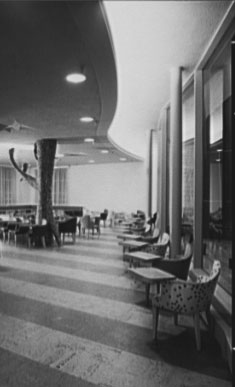
Lord & Taylor’s Bird Cage restaurant and tea room was opened in the late 1930s. It continued on the fifth floor of the Fifth Avenue New York City store until the 1980s when it was updated and renamed Café American Style. Accommodating only about one hundred persons, the Bird Cage was considerably smaller than the main restaurant in Altman’s which held over two hundred, as well as Abraham & Straus’s in Brooklyn which held over four hundred. Until the mid-1970s the Bird Cage was outfitted with armchairs with trays connected to them. In the early years each tray was supplied with a complimentary cigarette. Diners selected sandwiches, salads, and desserts from rolling carts modeled on Italian racing cars. As Lord & Taylor branches were opened after World War II in locations such as Westchester (shown here, 1948), Millburn NJ, Hartford CT, and Washington DC, they too were furnished with their own Bird Cages.

For many years the Bird Cage staff at the Fifth Avenue store provided refreshments to shoppers who arrived before the store opened each morning. Lord & Taylor president Dorothy Shaver initiated the custom and insisted that the coffee, juice (in summer), or bouillon (when temperatures were frigid) be served in china, not paper, cups.

birdcagemilkbarny1950Other well-loved eateries in the Manhattan store were the men’s Soup Bar on the tenth floor and the children’s Milk Bar (shown, 1950). Scotch broth and deep-dish apple cobbler with rum sauce were specialties at the Soup Bar.

© Jan Whitaker, 2008

49 Comments

Filed under department stores, tea shops

Department store restaurants

In small cities – and some large ones too – restaurants in department stores were frequently the best places to eat. Often they did their own baking and made desserts from scratch. It was not unusual for them to whip up mayonnaise and produce their own potato chips. Their kitchens were often directed and entirely staffed by women professionally trained in restaurant management.

They invariably favored home-style methods of cooking. Dishes popular through the decades included chicken pot pies, tomatoes stuffed with chicken salad, club sandwiches, and frozen fruit salads. The dessert sections of their menus were lengthy — layer cakes, eclairs, and chiffon pies were always to be had. [see 1925 menu, Abraham & Straus, Brooklyn NY] If the diner wanted more sweets at meal’s end, she could always pick up a box of bon bons or chocolate pralines made in the store’s candy kitchen. In the 1950s and 1960s menus cropped up with diet specials such as vegetable plates and cottage cheese salads.

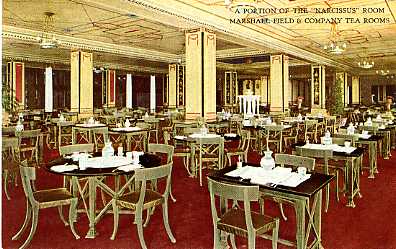
To list the most famous department store restaurants and tea rooms (as they were often called) would be an impossible task, but among those that leap to mind are: Marshall Field in Chicago (which ran 11 restaurants simultaneously at one point and might serve as many as 10,000 meals on an especially busy Saturday before Christmas); Wanamaker’s Grand Crystal Tea Room; Lord & Taylor’s Bird Cage in New York City (liverwurst and lettuce on rye); Altman’s Charleston Garden (“no tipping please”); Rich’s Magnolia Room; Higbee’s Silver Grille; and G. Fox’s Connecticut Room (which served Guernsey milk fresh from the store’s Auerfarm dairy).

By the late 1960s, modernity made department store restaurants obsolete. The times had changed and so had the pace of life. Women no longer had time to linger. Men who had once enjoyed eating in department store “grill” rooms reserved especially for them also moved on to quicker venues. Stores closed or revamped their large, elegant tea rooms, switching to speedier Bite Bars and Cafeterias. An era had ended.

© Jan Whitaker, 2008

4 Comments

Filed under department stores, menus

Roadside restaurants: tea shops

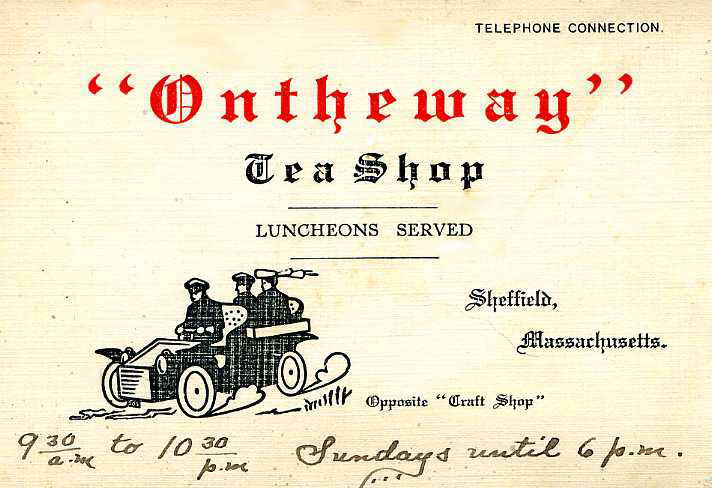
Tea shops were among the earliest restaurants that built their business around customers arriving by car. In the densely populated Northeast in particular, roadways were thick with the small eating places which specialized in lunches and afternoon teas for vacationers. They also made up box lunches for automobile parties and rented out rooms to overnight guests. In hot weather many offered an amenity now vanished, sleeping porches. People who traveled by car in those days tended to be well-off. City tea rooms had already established an upscale cachet and this association no doubt served the roadside places well.

One of the first roadside tea shops was the Tiffin Shop in White Plains, New York, which was in business by 1906. A story in Town and Country magazine titled “A Tiffin Shop for Motorists” noted it featured “cool green tints and Japanese prints, mission furniture, nasturtiums on the tables, a tinkly wind-harp,” as well as sandwiches, salads and “cake served on an embroidered doily.”

MAAuntTempy's3 (2)Most of the tea rooms and shops in outlying areas were run by women in their own homes. Letters to advice columns such as the following from “Flora” in 1909 show how eager many were to earn money using their housewifely skills: “I am thinking of starting a wayside inn or tearoom for ‘autoists’ this summer, and would ask you to give me some ideas if you will. I have thought it best to serve some ‘specialties.’ We have a grand empty front room and a beautiful, wide, grassy front yard for resting. Any suggestions as to furnishing room, menu, and way of serving would be a great help.” Included in the column’s advice was to use the finest ingredients and hang a sign featuring a teakettle.

© Jan Whitaker, 2008

3 Comments

Filed under tea shops