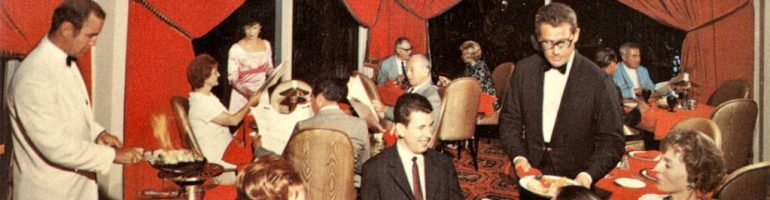
 I hadn’t thought about this until I started to write this post but now I realize that I’m picky about restaurant napkins. I abhor polyester and am sort of iffy about colors. My favorite fold is a compact, squarish one called “the book.” Last night I went to a very nice place in Western Massachusetts. The food was delicious and everything was perfect – almost. Approaching the table, I felt the tiniest inadvertent ripple of irritation at seeing napkins folded to resemble a tuxedo. (Thought that flashed through my mind: Do they think their guests are that “easy”?) Please, no trickiness. No bishop’s hats [pictured below], and especially no fans with either side hanging limply from a goblet.
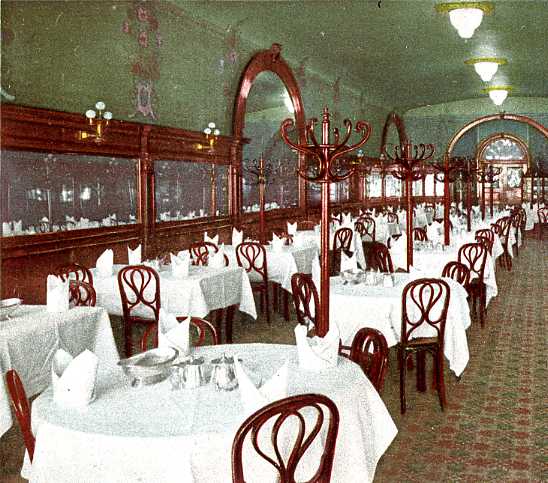 Do restaurateurs imagine that guests will critique their napkin folds? I hope they have better things to focus on. Actually though, it’s not really a new area of complaint. Twentieth-century consultants advised that men disliked small, ladylike napkins or ones that left lint on dark suits. But it was the lack of cleanliness in table linens that drew the most disapproval from guests, especially in the 19th century. How endless were the complaints about filthy tablecloths, themselves sometimes used as napkins for hands and mouths when none were provided – which was often.
After the hungry hordes finished breakfast in American hotels, one London visitor remarked in the 1840s, they left behind tablecloths littered with food fragments and overturned crockery and “defiled with stains of eggs, coffee, gravy.” In cheap restaurants the stains could accumulate for days before the cloth would be replaced.
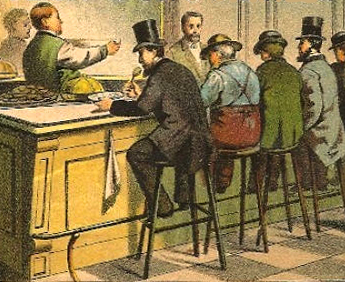 Increasingly a first-class restaurant was distinguished by its immaculate linens. Some said Delmonico’s taught discriminating diners to expect this. However, in the 1890s, and no doubt later, some lunch counters furnished nothing more than a common towel hanging from a hook. Other restaurants, clearly not first-class, folded napkins nicely and placed them in a glass but, trouble was, they had already been used by other people.
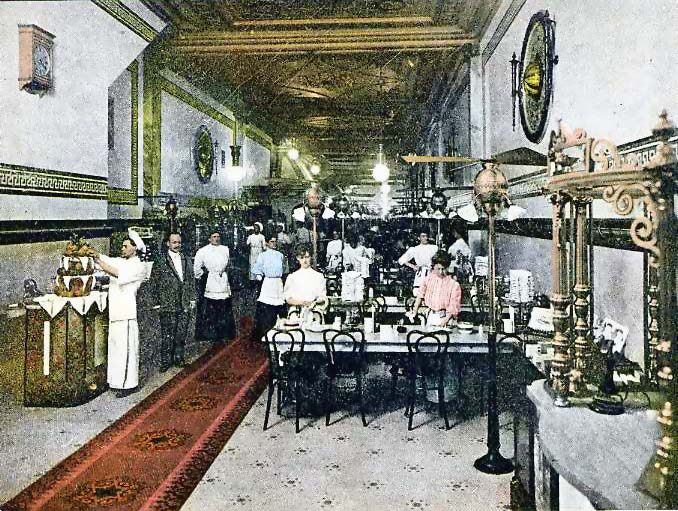
As early as 1885 some eating places began to substitute paper napkins for cloth, a move that was hailed by the hygiene-minded. A Philadelphia restaurant run by the Women’s Christian Temperance Union adopted them in the 1890s, as did modern self-service chain lunch rooms which placed table casters on tabletops which held napkins, condiments, and silverware [though in this image the napkins look like cloth]. 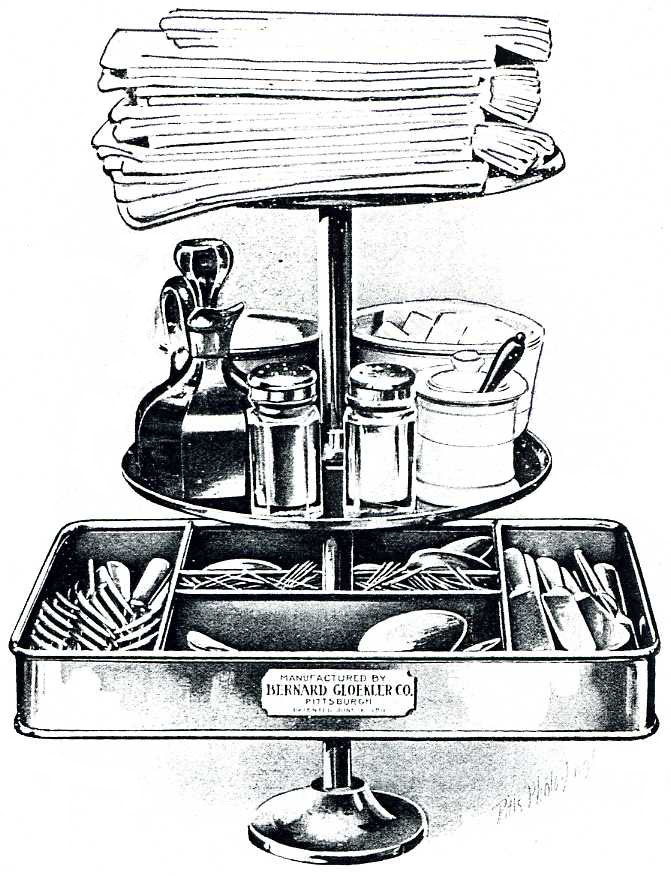
In the early 20th century almost all tea rooms used paper napkins, often dainty ones imported from Japan or China. They also did away with tablecloths, leaving tabletops bare or using doilies or placemats. Tea room proprietors were motivated not only by a wish to cut laundry expense but also because they were of a time and social class that believed it was more sanitary to rid interiors of the excessive furbelows of the Victorian age. Reflecting this mentality, Alice Foote MacDougall remarked in a 1928 article titled “Eating Aesthetically,” “There is nothing particularly alluring about long rows of tables, standing like shrouded sepulchers in winding sheets of more or less unsanitary tablecloths.”
As the 20th century wore on most restaurants got rid of tablecloths making them something of a rarity, resulting in the term “white-tablecloth restaurant” for more luxurious establishments.
© Jan Whitaker, 2010






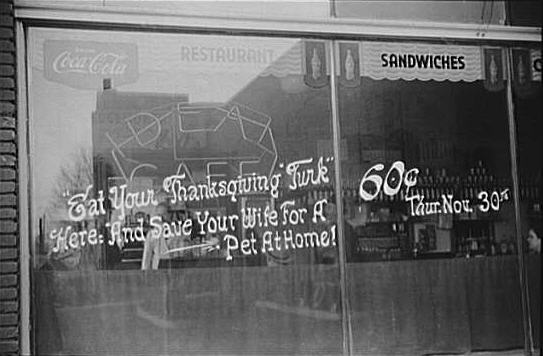

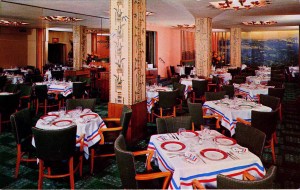 Where could you — once upon a time – enjoy European pastries, cinnamon toast, and ice cream soda while you hugged a teddy bear? Rumpelmayer’s, of course. A very popular rendezvous for pampered New York children after a visit to the zoo or the ballet. I suppose adults could hug the bears too, but Rumpelmayer’s sweetness – its confections, pink walls, and shelves of stuffed toys — might close in on you if you didn’t hold fast to some grown-up habits such as cigarettes and highballs.
 Rumpelmayer’s tea and pastry café began its Manhattan life in 1930 in the new Hotel St. Moritz on the corner of Central Park South and Sixth Avenue. The hotel almost immediately went into foreclosure though it continued in business. Oh, happy day when Repeal commenced in December of 1933 and the St. Moritz announced, “In Rumpelmayer’s, as in the Grill, we will feature a number of bartenders with Perambulating Bars, for serving mixed drinks.” Bars might be everywhere, but Rumpelmayer’s other attractions were not. For decades it provided a jolly spot for children’s birthday parties, lunches, late Sunday breakfasts, and afternoon teas and hot chocolates. It closed around 1998.
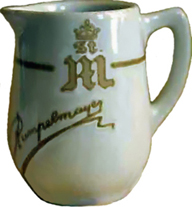 Always proud of its continental delicacies, New York’s Rumpelmayer’s was related (exactly how I’m not sure) to sister tea shops in London, Paris, and on the Riviera. The original Rumpelmayer’s was begun by an Austrian pastry cook in the German resort town of Baden-Baden in the last quarter of the nineteenth century. It then followed its Russian clientele to Cannes and Nice, then later to Mentone and Monte Carlo. In 1903 a shop was opened on Paris’s Rue de Rivoli (pictured, somewhat later) and in 1907 on St. James Street in London. Parisians, infected by Anglomania in the early 20th century, eagerly adopted the afternoon tea custom, in this case reputedly known as having a feeve o’clock-air at “Rumpie’s.” Though it was rated slightly less chic than the Ritz, it attracted mobs of fashionably dressed women who paraded their outfits up to the counter where, according to custom, they speared their chosen pastries with a fork.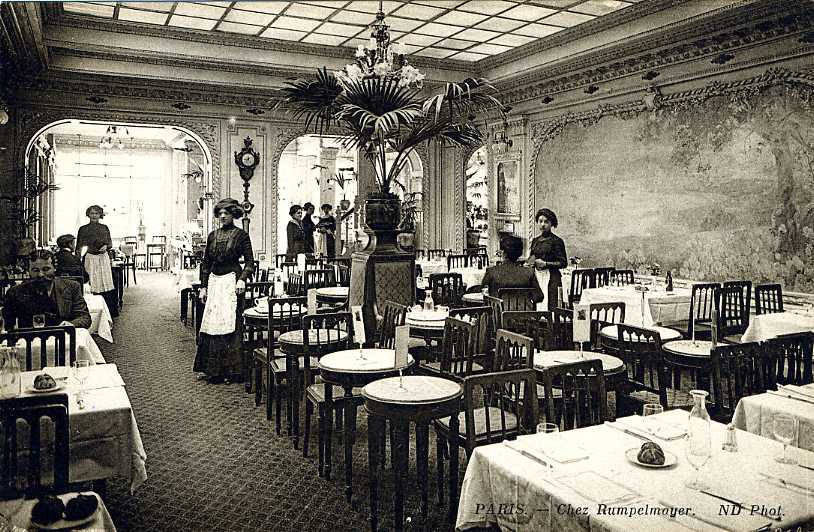
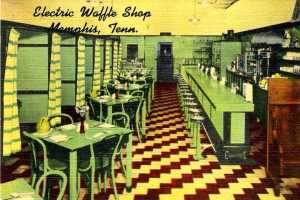 In the early 19th century Philadelphians enjoyed driving their carriages to the falls on the Schuykill River, the area now known as East Falls, then lined with hotels and restaurants. Eating places there specialized in a favorite dish associated with Philadelphia long before the advent of cheese steaks, namely catfish and waffles. (I’d like to believe that the dish did not include maple syrup.)
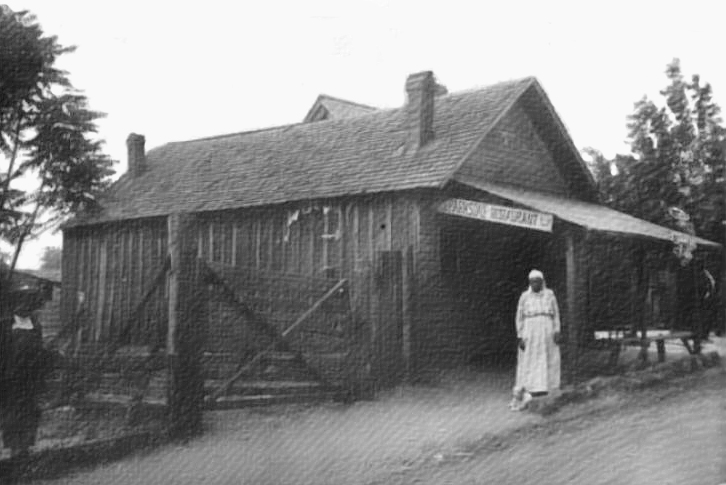
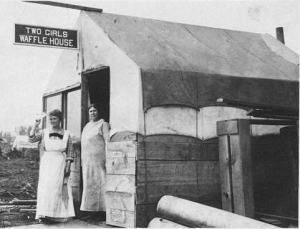 Well into the 20th century waffles were familiar fare in boom towns such as Anchorage, Alaska, and the oilfields of Oklahoma. Around 1915 two young women from Seattle decided to seek their fortune in Alaska with the Two Girls Waffle House (pictured). In what was not much more than a shack with a canvas roof they could handle only eight customers at the counter. But after a year they had made enough money from railroad construction workers to build a permanent structure. A similar success story could be told about the two young men who ran the Kansas City Waffle House in Drumright, Oklahoma, before graduating to a bigger enterprise in Tulsa.
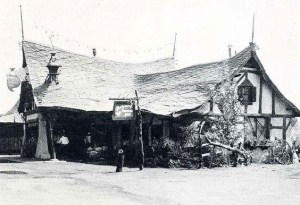 Waffles were also a staple of tea rooms in the early 20th century. In places as varied as big city afternoon tea haunts and humble eateries in old New England homesteads, waffles attracted patrons. In 1917 New Yorkers could choose among the
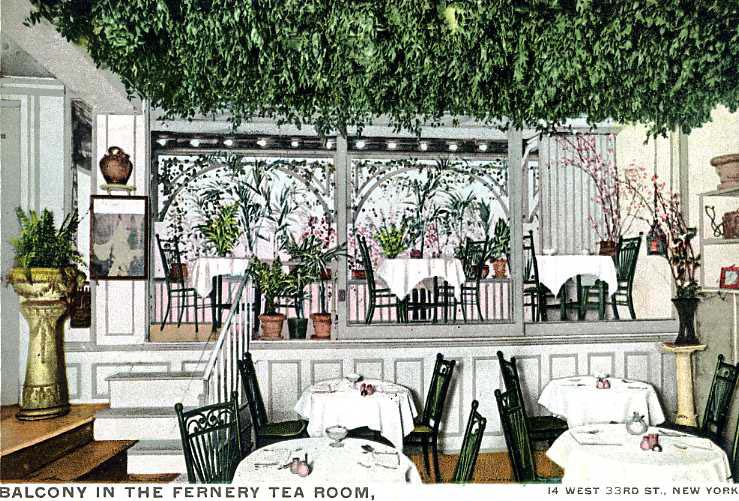
  Historically, few tea rooms have enjoyed financial success. So, while “empire” may be a bit grandiose, it’s hard not be impressed by the tea rooms enterprise Ida Frese and her cousin, Ada Mae Luckey, built in New York City in the early 20th century. Ida and Ada, both from a small town near Toledo OH, struck it rich by winning the patronage of wealthy society women. Over time they owned six eating places: the Colonia Tea Room (their first), the 5th Avenue Tea Room, the Garden Tea Room in the O’Neill-Adams dry goods store, the Woman’s Lunch Club, and two Vanity Fair Tea Rooms.
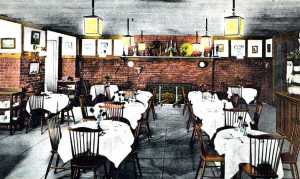 Clearly they valued a good location. The Vanity Fair at 4 West Fortieth Street began in 1911, bearing a notice on its postcard (pictured) that it was across the street from the “new” public library which also opened in 1911. The tea room’s upstairs ballroom was the site of many a party, such as a Shrove Tuesday celebration in February 1914 attended by 150 masked guests.
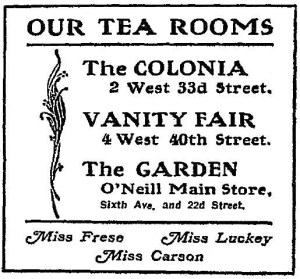 Adding to their financial success were several real estate coups. In 1914 Ida somehow obtained a lease on a coveted Fifth Avenue property. Her feat astonished everyone who followed real estate deals since the owner, a granddaughter of William H. Vanderbilt, had turned down repeated offers from would-be lessees and buyers. The house at #379 was one of the last residences on Fifth Avenue between 34th and 42nd streets which had not been turned into a store or office building. Ida and Ada moved the Colonia, previously on 33rd Street, to this address and rented the remaining space to retail businesses, dubbing the structure the “Women’s Commercial Building.”
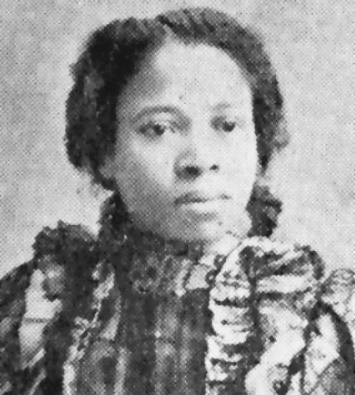
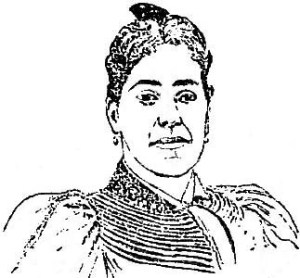
 In 1890 Harry Gordon Selfridge, manager of Field’s in Chicago, took the then-unusual step of persuading a middle-class woman to help with a new project at the store. Her name was Sarah Haring (pictured) and she was the wife of a businessman and a mother. In the parlance of the day, she was needed to recruit “gentlewomen” (= middle-class WASPs) who had “experienced reverses” (= were unexpectedly poor), and knew how to cook “dainty dishes” (= middle-class food) which they were willing to prepare and deliver to the store each day.
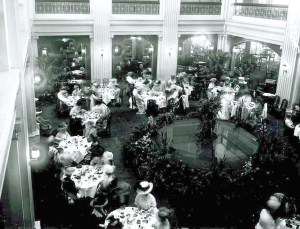
 And so — despite Marshall Field’s personal dislike of restaurants in dry goods stores — the Selfridge-Haring-gentlewomen team created the first tea room at Marshall Field’s. It began with a limited menu, 15 tables, and 8 waitresses. Sarah Haring’s recruits acquitted themselves well. One, Harriet Tilden Brainard, who initially supplied gingerbread, would go on to build a successful catering business, The Home Delicacies Association. Undoubtedly it was Harriet who introduced one of the tea room’s most popular dishes, Cleveland Creamed Chicken. Meanwhile, Sarah would continue as manager of the store’s tea rooms until 1910, when she opened a restaurant of her own, patenting a restaurant dishwasher in her spare time.
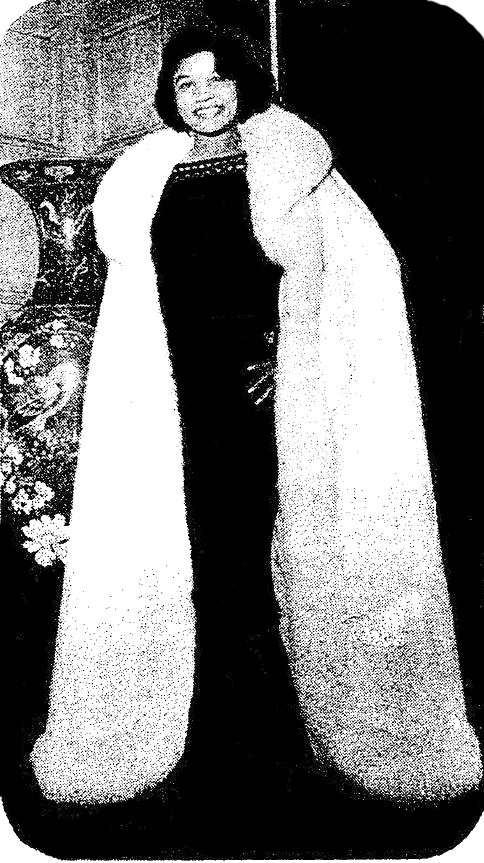
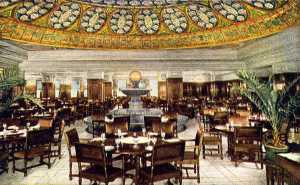 A graduate of Chicago’s School of Domestic Arts and Sciences named Beatrice Hudson opened the all-male sanctum Men’s Grill (pictured) about 1914 and was responsible for developing a famed corned beef hash which stayed on the menu for 50+ years. Later she would own several restaurants in Los Angeles, coming out of retirement at age 76 to manage the Hollywood Brown Derby and again in her 80s to run The Old World Restaurant in Westwood.
 It's great to hear from readers and I take time to answer queries. I can't always find what you are looking for, but I do appreciate getting thank yous no matter what the outcome.
 Restaurant-ing through history