Tag Archives: New York City

Mary Elizabeth’s, a New York institution

Mary Elizabeth Evans, for whom the landmark tea room was named, began her career in 1900 at age 15 as a small grocer and candymaker in Syracuse. After one year in business she cleared the then-handsome sum of $1,000 which she contributed to the support of her family while supervising a growing crew of helpers which included her two younger sisters who served as clerks and her brother who made deliveries.

Her family, though in seriously reduced circumstances, had valuable social connections. Her late grandfather had been a judge, her uncle an actor, and her departed father a music professor. That may help explain how she achieved success so rapidly – and why her story garnered so much publicity. By 1904 several elite NYC clubs and hotels sold her candy and soon thereafter it was for sale at summer resorts such as Asbury Park and Newport and in stores as far away as Chicago and Grand Rapids. In 1913 the all-women Mary Elizabeth company, which included her mother and sisters Martha and Fanny, was prosperous enough to sign a 21-year lease totaling nearly $1 million for a prestigious Fifth Avenue address close to Altman’s, Best & Co., Lord & Taylor, and Franklin-Simon’s.
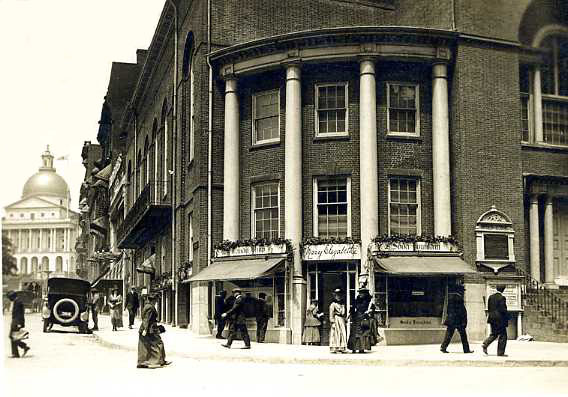
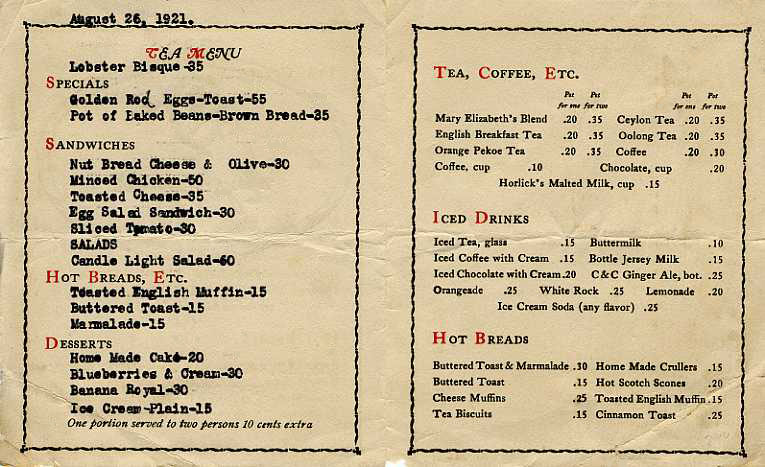
By the early teens the candy store had expanded into a charming tea room with branches in Newport and two in Boston, one on Temple Street and the other in the basement of the Park Street Church near the Boston Common (pictured ca. 1916). Like other popular tea rooms of the era, Mary Elizabeth’s bucked the tide of chain stores and standardized products by emphasizing food preparation from scratch. Known for “real American food served with a deft feminine touch,” Fanny Evans said the tea rooms catered to women’s tastes in “fancy, unusual salads,” “delicious home-made cakes,” and dishes such as “creamed chicken, sweetbreads, croquettes, timbales and patties.” For many decades, the NYC Mary Elizabeth’s was known especially for its crullers (long twisted doughnuts).

Mary Elizabeth distinguished herself as a patriot during the First World War by producing a food-conservation cookbook of meatless, wheatless, and sugarless recipes, and by volunteering to help the Red Cross develop diet kitchens in France. After her marriage to a wealthy Rhode Island businessman in 1920 she apparently played a reduced management role in the business.

In its later years the NYC restaurant passed out of the family’s hands and began to decline, culminating in an ignominious Health Department citation in 1985.

© Jan Whitaker, 2008
112 Comments

Filed under tea shops, women

Early chains: Vienna Model Bakery & Café

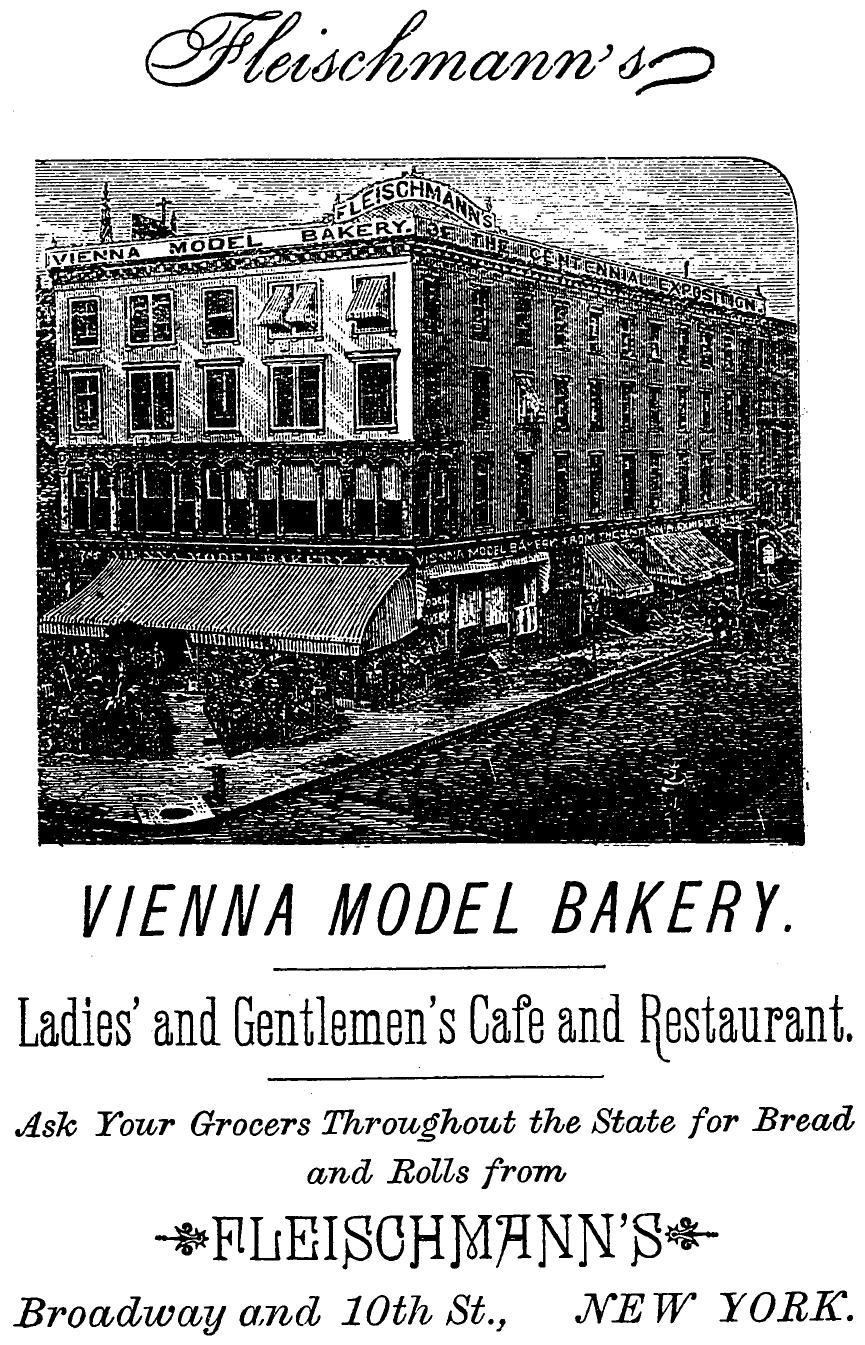
Contemporary bakery restaurant chains such as Au Bon Pain and Panera Bread may have more units but they are scarcely the sensations that Vienna bread cafés were in the 1870s. America was a country that many considered plagued with inferior bread, whether commercial or home baked. The Fleischmann brothers, Charles, Maximillian, and Louis, were determined to improve American bread with their compressed yeast. Although they manufactured it as early as 1872 – as a byproduct of distilled spirits (another Fleischmann enterprise) – its fame was established at the 1876 Centennial Exposition in Philadelphia. There the crusty Vienna-style bread produced with Fleischmann’s yeast won a prize for excellence and attained international renown. Although the fair’s Vienna Model Bakery café which served this bread was intended mainly to showcase the baked goods that could be made with the company’s yeast, it became a runaway hit in its own right. Some said the bakery café’s fame was as great as the fair itself.

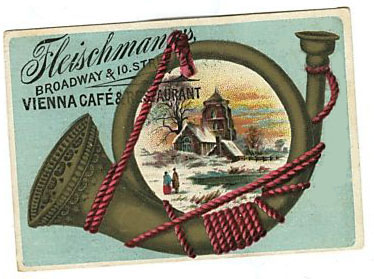
A short time after the Centennial ended, Vienna Model Bakeries and cafés were opened in Philadelphia, New York City, San Francisco, St. Louis, and Chicago, very likely making this the country’s first restaurant chain. The cafés, whose coffee was as prized as their baked goods, were modeled on European coffee houses and furnished guests with comfortable seating and newspapers from all over the world. The St. Louis branch was so popular it had to move to larger quarters within months of opening. In Chicago, as in New York City, the cafes were located close to the cities’ major dry goods firms, Field & Leiter and A. T. Stewart, respectively, thereby attracting women customers as well as men. In the 1880s New Yorkers could enjoy their refreshments outdoors amidst planters of flowers under a large awning stretching in front of the 10th and Broadway café, which also had a full-scale restaurant on the second floor.

Another distinction of the Manhattan Fleischmann’s was its practice of giving away bread to anyone who would wait in line at midnight. Dubbed “the bread line,” it continued until around 1918 when the bakery café closed.

© Jan Whitaker, 2008

4 Comments

Filed under chain restaurants

Department store restaurants: Wanamaker’s


Until very recently I thought John Wanamaker’s in Philadelphia had the first in-store restaurant in the U.S. Several scholars have insisted this is true, with the exception of a Macy’s historian who claimed R. H. Macy was first, in May 1878. Wanamaker’s, I’ve discovered, did not install eating facilities until September of 1879 when it enticed a local caterer, Alice Weldon, to run her restaurant inside The Grand Depot, as the store was known then. Weldon, a confectioner born in Ireland, operated a popular oyster-plus-ice-cream café near the store (it sounds like an odd combination but such places were once common). Every day all the shoppers would vacate the store to go eat at Alice’s, so Wanamaker reasoned he had to have her on his side. For about six years she ran the forerunner of The Dairy, an eatery the store created in 1883, one year after installing a soda fountain (another department store first claimed by Wanamaker’s).

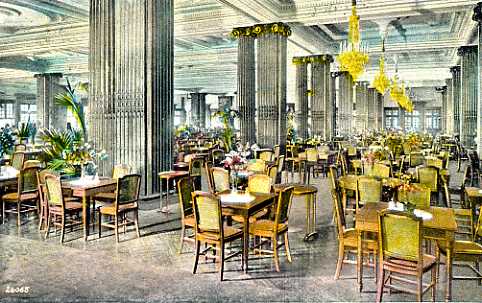
The better known restaurant in the Philadelphia store was the Grand Crystal Tea Room which opened on the 8th floor of the new Wanamaker’s completed in 1911. Immense and filled with chandeliers, it was modeled on the tea room in the Philadelphia mansion of Robert Morris, a financier of the American Revolution. Also on the 8th floor, speedily reached by 24 direct-service elevators, were a number of private dining rooms, a men-only tea room, and the store’s ultra-modern kitchens. The Grand Crystal Tea Room survived the demise of Wanamaker’s and the tenure of its successor but finally closed in 1995 and is now a private banquet hall.

The New York City Wanamaker’s, opened in 1896 in the old A. T. Stewart store and closed in 1954, was also well supplied with esteemed eating places. A 1900 menu shows a full complement of delectable lunch choices, including blue points, cream of new asparagus soup, and lamb with mint sauce. The store’s tea room advertised ca. 1908 that its tea was “specially imported,” and prided itself on its “quaint service.” In 1940 the store operated three eating places on the 9th floor: the main restaurant, Green Shutters; a more casual Side Walk Café; and a Men’s Grill decorated with antique French tapestries.

© Jan Whitaker, 2008

25 Comments

Filed under department stores, tea shops

Restaurateurs: Alice Foote MacDougall

Alice, shown in this 1929 book frontispiece at least 20 years younger than her true age at the time, was one of the most carefully crafted restaurant personas of her day. Due to numerous magazine stories spun by her publicity agent, she was widely known as the poor widow with three children who built a coffee wholesaling and restaurant empire on $38. Even she had to admit (or was this PR also?) that the story was overplayed. “How tired I did get of that woman and those interminable three!” she confessed. Quite honestly, I’ve always felt her much-vaunted opposition to suffrage for women was a publicity stunt too.

She was from a distinguished New York City family. Her great grandfather, Stephen Allen, was mayor of New York City in the 1820s, while her wealthy father Emerson Foote was a charter member of the Union League. Alice, her daughter, and her two sons were listed in the city’s Social Register in 1918. Her career in the coffee wholesaling business began in 1909 with the death of her husband Allan MacDougall. In the 1920s she was said to be the only woman expert in coffee grading and blending in the U.S.

She opened her first eating place, The Little Coffee Shop, in Grand Central Station in New York in December 1919. Waffles were the specialty in her homey café which was decorated with a plate rail and shelves holding decorative china. (Evidently tips were good, because MacDougall had the nerve to charge her waitresses $10 a day to work there.) By 1927 she had signed a $1 million lease for her fifth coffee house, Sevillia, at West Fifty-seventh Street. Her places became known for their Italian-Spanish scene setting. The reason, she said, was that it provided a way to disguise long, narrow spaces, as was clearly the case with the Cortile (shown here).

At Firenze, reputedly used as a movie set, she dressed her black servers like Italian peasants in bright uniforms and head scarves and had them go about filling copper jugs with water from a stone well. Tables were set with imported pottery which she sold as well, along with her Bowling Green Coffee. The Mediterranean village style mimicking courtyard interiors became wildly popular throughout the U.S. in the 1920s and countless women were inspired by MacDougall to open tea and coffee shops of their own. The chain went bankrupt in the depression and new management took over for a time, lowering prices and adding cocktails to the menu.

© Jan Whitaker, 2008

9 Comments

Filed under tea shops, women

Lunching in the Bird Cage

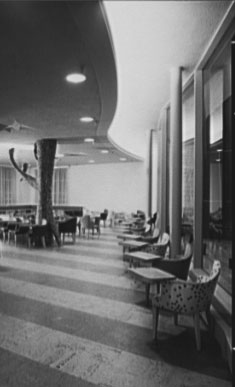
Lord & Taylor’s Bird Cage restaurant and tea room was opened in the late 1930s. It continued on the fifth floor of the Fifth Avenue New York City store until the 1980s when it was updated and renamed Café American Style. Accommodating only about one hundred persons, the Bird Cage was considerably smaller than the main restaurant in Altman’s which held over two hundred, as well as Abraham & Straus’s in Brooklyn which held over four hundred. Until the mid-1970s the Bird Cage was outfitted with armchairs with trays connected to them. In the early years each tray was supplied with a complimentary cigarette. Diners selected sandwiches, salads, and desserts from rolling carts modeled on Italian racing cars. As Lord & Taylor branches were opened after World War II in locations such as Westchester (shown here, 1948), Millburn NJ, Hartford CT, and Washington DC, they too were furnished with their own Bird Cages.

For many years the Bird Cage staff at the Fifth Avenue store provided refreshments to shoppers who arrived before the store opened each morning. Lord & Taylor president Dorothy Shaver initiated the custom and insisted that the coffee, juice (in summer), or bouillon (when temperatures were frigid) be served in china, not paper, cups.

birdcagemilkbarny1950Other well-loved eateries in the Manhattan store were the men’s Soup Bar on the tenth floor and the children’s Milk Bar (shown, 1950). Scotch broth and deep-dish apple cobbler with rum sauce were specialties at the Soup Bar.

© Jan Whitaker, 2008

47 Comments

Filed under department stores, tea shops

Cabarets and lobster palaces

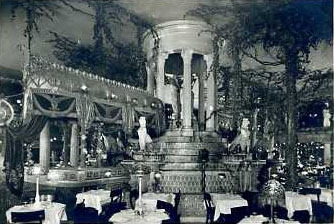
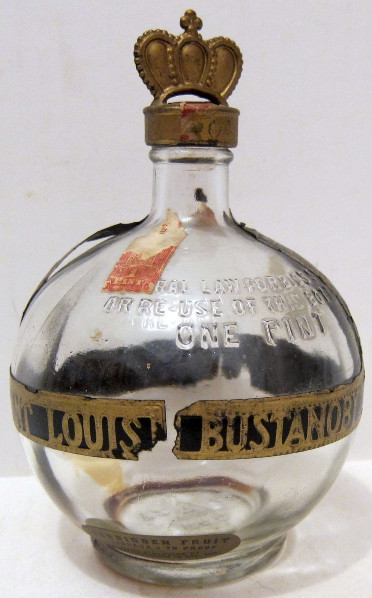
Around 1908 Murray’s Roman Gardens in Times Square, pictured here, was just the place to sample the “high life” after seeing the popular operetta The Merry Widow. Murray’s, which has been called “New York’s first theme restaurant,” demonstrated a kind of decadent Roman-Pompeian-Egyptian-Babylonian grandeur that appealed to tourists. It was one of the so-called lobster palaces that sprang up around the turn of the last century. Other cities had them, but New York led the trend with Murray’s, Bustanoby’s (known for its Forbidden Fruit liqueur), Churchill’s, Faust’s, Martin’s, Maxim’s, Rector’s, Reisenweber’s, Shanley’s and others. After surviving the depression of the 1890s, Americans were ready to drink champagne and order the most expensive dish on the menu, preferably lobster. Restaurants, department stores, and soon movie theaters all styled themselves as palaces outfitted with marble fountains, chandeliers, and velvet draperies. The era’s “luxury for the masses” set a precedent later followed by Las Vegas.

New York’s lobster palaces were in possession of a valuable asset, the all-night liquor license which enabled them to sell drinks round the clock. Anti-liquor forces were determined to clamp down on the partying. One by one cabarets saw their licenses revoked, forcing them to close by 1 a.m. In 1913 the early closing rule was applied across the board — and rightly so, according to New York’s mayor. He asserted, “The people who patronize such places after the regular closing hour of 1 o’clock are not, as a rule, decent people. They are vulgar, roystering, and often openly immodest. They get intoxicated, behave boisterously, and indulge in lascivious dancing in rooms devoted to that use.”

Critics insisted that sophisticates wouldn’t be seen in a warehouse-style palace. Despite their high prices, the food they served was prepared assembly-line fashion hours before the rush. Waiters made a grand table-side show of shaking and pouring drinks which had been premixed before the crowds arrived. Patrons dressed to the nines vied for a table. Critic Julian Street sneered at the whole scene of what he regarded as social pretenders. He commented in 1910, “About the wide doorway of this room stood a knot of twenty or thirty men and women, all in evening dress and eager to get in – a comic sort of bread-line, held back by a plush rope and a young head waiter, who, St. Peter-like, examined the candidates with a critical eye.”

Although they instituted cover charges when national Prohibition began in 1919, lobster palaces could not carry on without the liquor sales which had made up as much as two-thirds of their gross. By 1923 most had closed.

© Jan Whitaker, 2008

1 Comment

Filed under night clubs

Tipping in restaurants

Until I found this card I was convinced that the custom of waiters disclosing their first name started in the 1970s. The Village Barn was a Greenwich Village restaurant and night club. I’d guess this card dates from the 1950s. Many people dislike having servers tell them their names because they feel it’s a smarmy way to wangle a bigger tip.

The first mention of tips (originally known as fees or douceurs) I’ve found was in 1840: “The renumeration [sic] of the eating-house waiter, though based on the voluntary system, is yet a fixed one, like a physician’s fee. His honorarium is the moderate sum of one penny.” Keep in mind that an average dinner at this time usually cost 25 to 50 cents.

Today we pretty much accept tipping as an inevitable part of eating out but that wasn’t always so. One hundred years ago there were many people who wanted to eradicate tipping, which had only become commonplace around 1890. They were convinced the custom was a foreign one that didn’t belong in a democratic society. They felt it created an unhealthy master-servant relationship in which the server either groveled or tried to manipulate the customer.

One of the things critics hated most were snooty waiters in upscale restaurants who made guests anxious by subtly hinting they were low-class pretenders who didn’t belong in a fine restaurant. This worked like a charm with insecure folks who compensated by leaving a generous tip to prove they were legit.

More recently, other waiters revealed that the snooty method produces better tips than the friendly approach. Maybe servers should say, “Hello, my name is . . . none of your business.”

© Jan Whitaker, 2008

2 Comments

Filed under restaurant customs

Joel’s bohemian refreshery

Joel Rinaldo’s was one of the all-night eating and drinking places that thrived around Times Square in New York before the First World War. “Refreshery” was an unusual term that probably related more to drinking than to eating since saloon owners often referred to their offerings as “refreshments.”

Exactly when Joel’s opened is unclear but chances are it was in the late 1890s. The real estate parcel at 206 West 41st Street that became Joel’s was part of his father’s estate when he died in 1895.

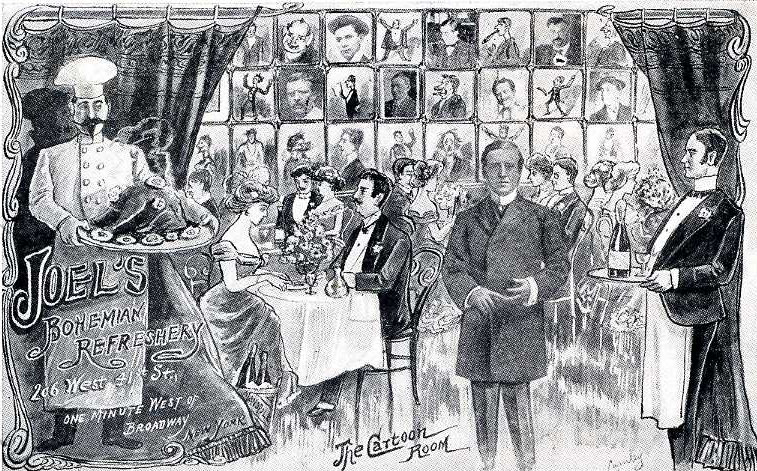
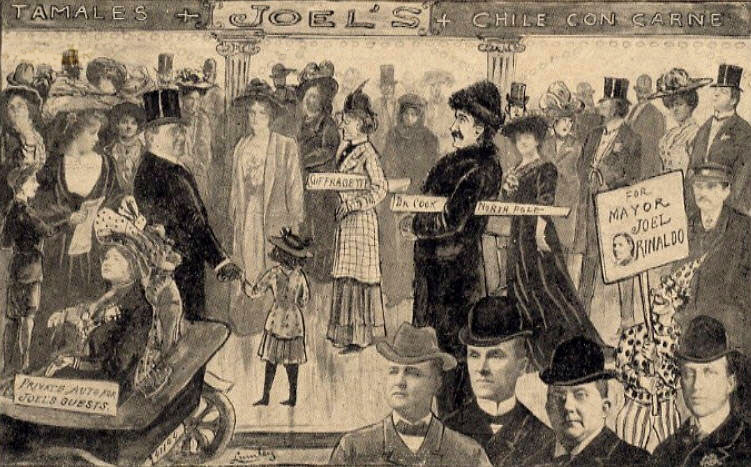
Looking at these 1910-ish postcards of Joel’s you might be misled into thinking it was an elegant after-theatre spot. It attracted all kinds of late-night visitors but was mainly famous as a hangout for musicians, artists, writers, heavy drinkers, “hop-heads,” and Mexican revolutionaries. In 1910 the restaurant was the headquarters of the Mexican Liberal Party opposed to the presidency of General Porfirio Diaz. The short story writer O. Henry was a regular also, though he may have spent more time drinking in the first-floor bar than eating in the café on the second floor. It is likely that El Refugio, a café described in O. Henry’s short story “The Gold That Glittered,” was based on Joel’s.

One of the most popular dishes at Joel’s was chili con carne, a dish not easily found in New York in the early 20th century. He also served tamales and “frijoles colorado.” In addition to Mexican dishes, Joel concocted a drink that became famous – or, more likely, notorious — called a Blue Moon. Only one to a customer but that was enough reportedly to “keep the patron pleasantly mellow the rest of the evening.”

Joel’s walls were filled with drawings, which can be seen on in the image above. Some were by caricaturist Carlo de Fornaro who spent time in jail after being successfully sued by a Mexican official in NY courts for libelous statements Fornaro made in his book, Diaz, Czar of Mexico. Joel, born in NYC around 1870, also had intellectual ambitions, was attracted to psychology and philosophy, and wrote an obscure treatise against Darwin’s account of evolution called Rinaldo’s Polygeneric Theory.

Joel took a paternalistic role toward many of his patrons, keeping prices low and announcing on a gilt sign that touring actors and musicians (he was near the Metropolitan Opera House) could send him their money and he would keep it safe for them. It is said that many took him up on the offer. Perhaps his motive for keeping a bank was to insure that eventually he would get paid, to offset all the bad checks he took from his erratic patrons.

The interesting thing about bohemian places like Joel’s was how they loosened up a middle class still under the spell of Victorian correctness. After a few hours in a heady atmosphere like this and they’d be talking to strangers (without even being introduced!), singing out loud, and ordering drinks all around.

Joel’s closed in 1925, a casualty of Prohibition.

© Jan Whitaker, 2008

8 Comments

Filed under Offbeat places