Tag Archives: New York City

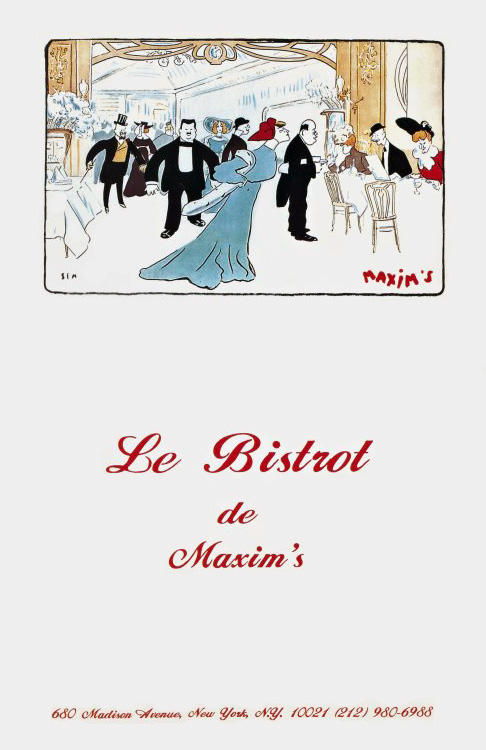
Maxim’s three of NYC

As some New Yorkers may recall, their city once boasted a certified branch of the famed Maxim’s de Paris. It opened in 1985 on two floors in the Carlton House on Madison and 61st. After seven years in which it went through many changes, it closed in 1992. It was grand and expensive, but despite its golden name never made it into the highest ranks of NYC restaurants.

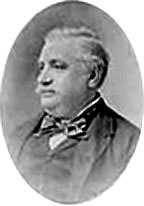
The proprietor of an earlier, independent Maxim’s in New York, Julius Keller [pictured below], once wrote that “the American people reveled in anything that savored of a European atmosphere,” but perhaps that was truer in his day than the 1980s. His Maxim’s thrived from 1909 until 1920 when it fell victim to wartime austerity.

It was one of the “lobster palaces” on and near Broadway that appeared before the First World War to cater to fun-seeking after-theater crowds. Typically the palaces adopted French names, poured champagne like water, and featured some form of entertainment as well as premium-priced chicken sandwiches and broiled crustaceans.

Keller, who liked to be called Jules because it was classier, was a Swiss immigrant who landed in New York solo in 1880 at age 16. After working as a waiter in a number of restaurants and hotels, and eventually owning a few, he found a promising location on 38th street between Broadway and Sixth Avenue. Activity was moving in that direction and he thought he could make a go of it despite the hundreds of thousands of dollars lost by four failed predecessors which included the Café des Ambassadeurs and the Café de France.

At first he operated under the name Café de France. Nobody came. So, being resourceful, he dressed his waiters like servants to Louis XIV, hired an orchestra, and, most importantly, borrowed the name of the famous Paris house of good food and naughty gaiety, Maxim’s. Success followed quickly. Each year on New Years Eve he gave away souvenir plates displaying the words, “Let us go to Maxim’s, where fun & frolic beams,” possibly lyrics from the 1899 French play The Girl from Maxim’s.

His clientele was made up of society figures, financiers, celebrities, and those indispensable “others” with money to spend. Maxim’s courtly tone had a tendency to slip occasionally, as was often the case with lobster palaces. On one occasion in 1911, 250 people coming from the annual automobile show jammed the place, causing quite a fracas when the staff had to forcibly eject them in the wee hours. But Keller drew the line at known criminals. He deliberately discouraged the patronage of gangster friends from the old days – when he had ventured into gambling and, as part of the operation of his Old Heidelberg, prostitution. He wanted Maxim’s to be first-class.

During his years operating Maxim’s Jules was known as “the father of café society,” and for providing male dance partners for lone women patrons in the dance craze of 1914. Among these was his discovery, Rudolph Valentino. He was proud of his restaurant. As he wrote in his 1939 autobiography Inns and Outs, his visit to the original Maxim’s convinced him “that the replica we had put together . . . suffered nothing from comparison.”

Given restaurant-world Francophilia and the fame of the Maxim’s name, it’s to be expected that there were namesakes scattered across the U.S.A. (even in pre-WWI Salt Lake City, a city not generally known for kicking up its heels). And it’s hardly surprising that there was yet another Maxim’s in New York, this one sprouting in the Depression among other Greenwich Village hotspots such as The Black Cat, The Blue Horse, and El Chico. Other than that it acquired new banquettes around 1931, I know absolutely nothing about it.

© Jan Whitaker, 2012

7 Comments

Filed under proprietors & careers

Spectacular failures: Café de l’Opera

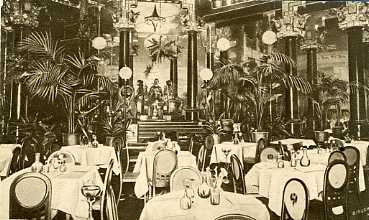
In 1910 the media was abuzz with the new Café de l’Opera on Broadway between 41st and 42nd streets in NYC. Its enormous cost and the stunning, over-the-top lavishness of its interior set a new standard for opulence on the glittering White Way. Could anyone have guessed that in a mere four months this splendid “lobster palace” would fail?

Given its fate, how perfect was it that the crowning jewel of the interior decor was a billboard-sized painting of the fall of Babylon installed prominently on a landing of the 22-ft wide staircase?

The after-theater eatery was designed to be the showplace of Times Square. It was financed by a consortium of investors that included architect/decorator Henry Erkins and John Murray, impressario of the almost-as-splendiferous Murray’s Roman Gardens, also designed by Erkins. The team sunk millions into gutting the old Saranac Hotel and turning it into a fantasy Babylonian stage set worthy of the Hippodrome. The bill for interior renovations and decor, under Erkins’ direction with Stern Brothers department store acting as general contractor, came to $1,250,000, a sum that borders on $30 million in today’s dollars.

The silver service alone cost a quarter of a million 1910 dollars, while a huge painting by Georges Rochegrosse cost something like $50,000. Er, or so it was gushingly reported. However another source claimed the painting was a copy, which is probably true. As for many of the imported ancient treasures, they were replicas cast from Middle Eastern artifacts housed in British and French museums. The gleaming black marble covering interior surfaces and pillars on the ground floor and balconies was artificial.

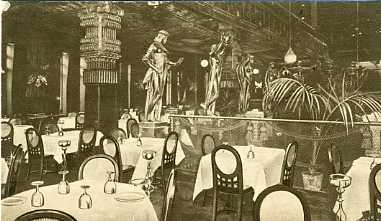
The interior was a startling demonstration of the transformative power of life-size statuary, concealed lighting, mirrored walls, and a million or so sheets of gold leaf. The electrical industry was thrilled with the restaurant’s flair for showcasing what miracles modern lighting could perform. But the architectural community was rather scandalized. They hid their distaste in a haze of apparent flattery, producing choked praise in which adjectives like magnificent served as insults. The “lurid and gorgeous” restaurant was so overwhelming it could “overcome at once the more sober judgment of the critic,” claimed The Architects’ and Builders’ Magazine.

The restaurant’s dining rooms occupied four floors with its main kitchen located above them. Manager Henri Pruger, hired from the Hotel Savoy in London at the princely salary of $50,000 a year, oversaw a staff of 750. Six months after arriving in NYC he headed back home, and one can only wonder how much of his salary he managed to collect. Stern Brothers wasted no time seizing all the furnishings for auction but a goodly number of them apparently were acquired by the new owner, Louis Martin. A restaurant pro, he had formerly presided over the famed Café Martin at Broadway and 26th with his brother J. B.

Martin quickly made changes, moving the kitchen to the basement to solve the problem of food arriving cold at the tables as had happened under the previous management. He installed a bar on the first floor and eliminated the previous regime’s terrifically unpopular formal dress requirement, said to be an English notion. But the jinx was on. If ever a location reeked with bad omens, it was this. On opening night in December 1910 an employee of the Café de l’Opera started an accidental fire in a storeroom causing firemen to parade through the dining room with axes. Well, there was that foreboding fall of Babylon depicting invaders in the banquet hall. But what possessed Louis Martin to create a dining room lighted by a dozen perched owls with electrified eyes the size of silver dollars?

Martin, who ran the restaurant as Café Louis Martin, withdrew from the business in 1913. The new management renamed it the Café de Paris. On the color postcard shown here it is clear that the golden statues on the balcony are gone, replaced by flowers during this incarnation. In 1914 the Café de Paris went bankrupt and in February the restaurant’s “furniture, pictures, ornaments, rugs, carpets, curtains, linen, tableware, kitchenware, and other equipment and furnishings” were auctioned. The building was razed in 1915.

© Jan Whitaker, 2011

13 Comments

Filed under elite restaurants, night clubs, restaurant decor

Waitress uniforms: bloomers

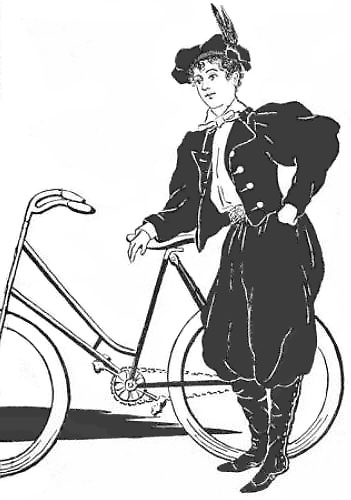
The bicycling craze of the mid-1890s brought “wheelwomen” dressed in bloomers into public view. It didn’t take long for enterprising restaurant men to latch onto the sensational pants-like garment as a waitress uniform. It was the middle of a nationwide depression and they hoped that male customers would flock to their establishments and the money would pour in. And this proved true, sort of.

Bloomers were originally a pragmatic garment of the 1850s woman’s rights movement intended to permit women to conduct everyday affairs without dragging 50 pounds of skirts and petticoats over filthy floors and streets. They were designed to do this by raising the skirt hem up to the shoe tops — with long gathered trousers worn underneath to modestly hide the ankles. But because of relentless ridicule, prior to the bicycle craze they had been worn only in private or in exceptional situations: doing gymnastics, while housecleaning, or by Westward-bound women crossing prairies and mountains.

The bloomers worn by female cyclists in the 1890s were more daring than those of the 1850s because they ended just below the knee, revealing stocking-covered calves and ankles. When “waiter girls” (as waitresses were known then) wore them, crowds of men gathered on sidewalks outside restaurants, jostling for a view. Although some restaurant owners claimed that bloomers were more practical than long dresses, it was pretty clear that most were motivated by a wish for publicity.

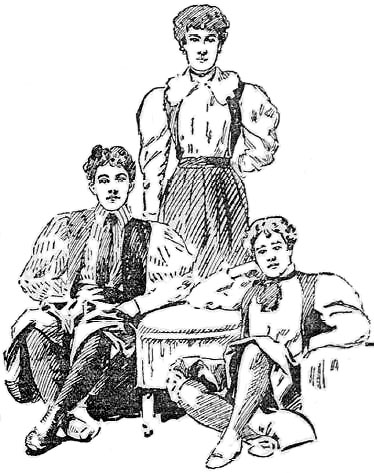
The bloomer uniform typically consisted of full-cut navy, brown, or black serge pants gathered at waist and knees and worn with a short matching vest (pictured on San Francisco waitresses) or “Zouave” jacket, and a colored blouse with leg o’mutton sleeves. Often the outfit was accessorized with black stockings, patent leather slippers, and caps imprinted with the restaurant’s name.

The first restaurant to adopt the fascinatingly curious uniform, in 1895, was the Bloomer Café in San Francisco. It was rapidly followed by restaurants in St. Louis and NYC. In 1896 and 1897 a few more opened in NYC, in Oakland CA, Chicago, and — gasp! — Boston. The police immediately closed the Chicago café on moral grounds. But they all seem to have been short-lived, usually because the crowds stopped coming once the sensationalism wore off.

Waitresses sometimes balked at bloomers because they feared they would be “on exhibit” and treated crudely by male patrons. Those who did agree to wear them, under threat of losing their jobs, reported that although they missed the “swish” factor of layers of starched skirts, they liked the new style because it enabled them to move quickly without trailing hems to get stepped on or slammed in doors.

Restaurant bloomers were an interesting example of a style crossing under coercion from one social class to another. Bloomers were seen as symbolic of the “new woman” – a decidedly privileged, well-educated, independent-minded daughter of the middle class. The new woman loved riding bicycles and engaging in sports. Working class women, by contrast, did not typically ride bicycles, play tennis or golf, or exercise in gyms. More than one bloomer waitress disclosed upon being interviewed that she had never been on a bicycle.

By 1898 the restaurant bloomer fad was over, but the idea of dressing waitresses in eye-catching costumes was only beginning.

© Jan Whitaker, 2011

11 Comments

Filed under uniforms & costumes, women

Linens and things — part II

One trouble with the ideal of snowy white restaurant linens is, of course, laundry that piles up and must be washed. By the late 19th century huge steam laundries in big cities were able to handle up to 100,000 pieces a day. And about the same time a new idea in laundry service came along. Rather than owning linens a restaurant could, in effect, rent them from a service that would bring fresh supplies every time they picked up dirty laundry. Many of the first such businesses called themselves towel services, reflecting that their primary customers were factories using thousands of shop towels. Restaurants and hotels developed as the next customer base.

According to a book called Service Imperative, it was around World War I that the modern linen supply industry developed, with over 900 firms in the US. Most were in New York, followed by Illinois, Ohio, and Pennsylvania. At about the same time a national organization of linen supply companies was formed, the forerunner to the Linen Supply Association of America, renamed the Textile Rental Services Association of America in 1979 to better reflect the full range of member services – and to improve the organization’s public image.

It seems to me that the name change was mostly about public relations. While it may have been true that “linen supply” did not reflect all services, the difference between “textile rental” and “linen supply” is a bit subtle. Why the change? On the face of it the words “linen supply” sound completely innocent. Yet by the mid 20th century they had acquired a negative tinge thanks to mob infiltration in the business coupled with widely publicized congressional hearings, particularly the U.S. Senate’s McClellan committee which investigated organized crime in the late 1950s and early 1960s.

Linen supply was one of a number of services to restaurants, along with garbage hauling, that attracted the mob in the 1920s and even more so in the 1930s when Prohibition ended and bootlegging profits dwindled. It offered itself as a legitimate business in which it was possible to gain dominance rapidly as well as a way for mobsters who had migrated into narcotics to launder money. In Kansas City, a mob magnet in the 1930s, gangs made handsome profits in linen supply. Running the industry as a monopoly, they reportedly divided up the city, agreed not to compete, and set prices high.

Certainly not all linen supply companies were, or are, mob affiliated or engaged in illegal activities, yet in some places – notably NYC, Chicago, and Detroit — many have been. In 1958 New Jersey linen supply corporations charged with violation of anti-trust laws were said to control 85% of business in that state. Linen supply racketeering continues today. In 2003 the NY Times reported that the president of White Plains Coat & Apron Co., doing business with restaurants in NYC, Westchester, and parts of Connecticut and New Jersey, pled guilty to conspiring to restrain trade over a ten-year period in which sales had totaled better than $500M.

The cost of monopoly linen services does not affect consumers enough that they notice it. Restaurant owners, on the other hand, experience higher operating costs. And, as Patricia Murphy found out long ago, they are likely to be paid a visit by a “plug-ugly” if they try to switch suppliers. “I chased him out the door with a broom,” she said, adding, “I suppose I was too insignificant a client for him to carry out threats of reprisals.”

© Jan Whitaker, 2010

1 Comment

Filed under restaurant customs

A chef’s life: Charles Ranhöfer

Or, how Americans got dishes fit to set before a king.

In the middle of the 19th century highly trained European chefs began arriving in the United States. Many were lured to California by the inflated gold mining economy while others stopped on the East coast. Charles Ranhöfer (he soon dropped the umlaut) arrived in 1856, first working for a Russian diplomat in NYC, then for a Washington DC restaurant and a private family in New Orleans. After spending some time in his home country of France in 1860, he returned to New York and in 1862 accepted a position as chef at the “uptown” Delmonico’s on Fifth Avenue near Union Square.

At this time New York City was engorged with wealth from the Civil War. The rich bought up yachts, race horses, fancy carriages, and real estate. It was the perfect time to introduce them to fancy French cuisine. Despite his young age, 26, Ranhofer had extensive experience, having begun his career as a child and running Paris restaurants and the kitchens of European royalty.

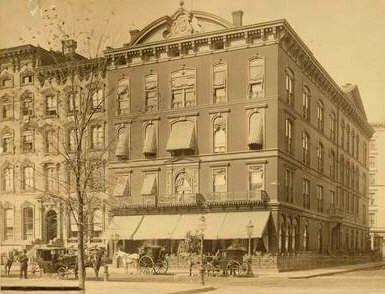
The reputation of Delmonico’s as the premier American restaurant, the one most nearly resembling the finest in London and Paris, was built largely during Ranhofer’s reign which lasted from 1862 to his death in 1899, with a brief interruption when he returned to Paris in 1876 around the time Delmonico’s moved from Union Square to Madison Square (shown).

The restaurant’s glory was founded less on regular patronage than on lavish banquets given to honor prominent men. Grand dinners of the 1860s included one given by British railway tycoon Sir Morton Peto and one for President Andrew Johnson and another for Charles Dickens. The Peto dinner, costing $30,000 in 1865 (over $400,000 now), spread Delmonico’s fame across the nation. Another celebrated dinner planned by Ranhofer featured a 30-foot pond set into the banquet table, banked with flowers to protect guests from splashing by four live swans.

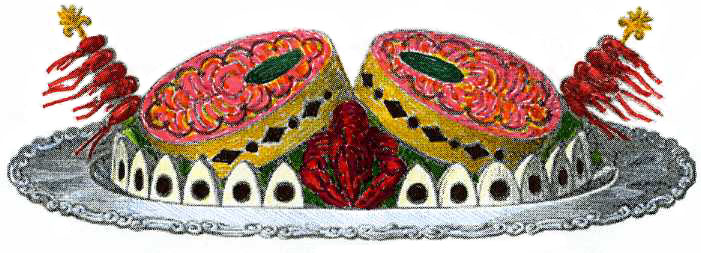
Ranhofer’s name became widely known after he published his vast cookbook, The Epicurean, in 1894, divulging how “haute” restaurant cuisine was produced. The cookbook reveals just how many props and quantities of plaster of paris and glue (jelly) are needed to turn out highly decorated French dishes. The illustration of salmon steaks from The Epicurean shown here exhibits salmon coated along the sides with butter paste onto which circles and diamonds cut from truffles have been attached. Truffles also cover the yolks in the boiled egg border. On either side of the salmon dish are decorative spears (hatelets/attelets) of prawns. Ranhofer is also known for inventing baked Alaska – in his recipe ice cream is stuffed inside a hollowed out cone-shaped cake before the meringue is added.

Although his early training was similar to other top chefs, he was atypical in holding one job for over 30 years. Perhaps his percentage share of profits explains his long tenure with Delmonico’s. His base pay was good for its time – $300 ($7,300 today) a month in 1890 – yet not the highest on record. William K. Vanderbilt’s top kitchen man reportedly earned $6,000 a year. However when his share was added, it’s likely Ranhofer’s income exceeded Vanderbilt’s chef’s as well as those of the top men at New York’s Savarin Café and Hoffman House.

© Jan Whitaker, 2010

2 Comments

Filed under proprietors & careers

Anatomy of a restaurateur: Mary Alletta Crump

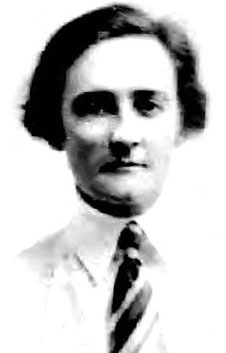
Because she ran a tea room, Mary Alletta “Crumpey” Crump (pictured, age 31) actually would not have called herself a restaurateur. She made a distinction between a tea room and a restaurant: the former served light food, mainly lunch and afternoon tea, while a restaurant served heavy food and was open for dinner. Not so The Crumperie. It served sandwiches, salads, soup, and desserts only. At 6 P.M. she and her partner, her mother “Bee,” shut down for the day. (M. Alletta, as she signed herself, advised prospective tea room operators in 1922 that “a mother or older person is a great asset to a young girl who is contemplating the opening of a tea room.”)

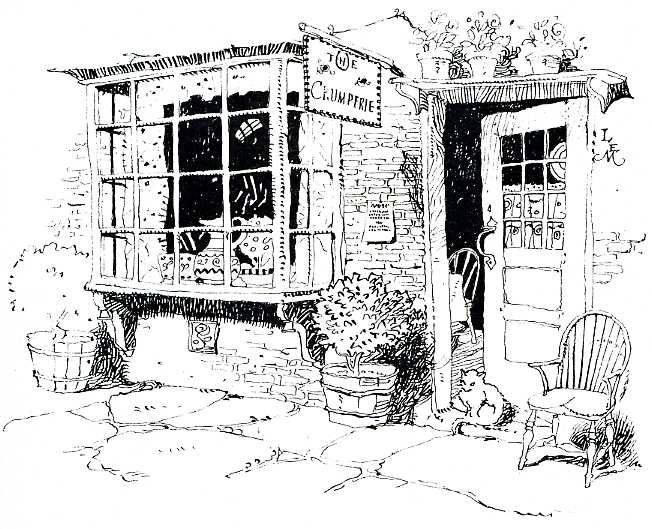
The two opened their first Greenwich Village Crumperie in 1917 (pictured), taking over the spot formerly occupied by photographer Jessie Tarbox Beals’ tea room and art gallery. Sharing the other half of the building at 6½ Sheridan Square with The Crumperie was a gift shop known as The Treasure Chest. By the time Crumpey’s mother passed away in 1926, The Crumperie had occupied five locations in the Village, first moving to Sheridan & Grove, then to the basement of 55 Christopher Street, then to 229 West 4th Street, and finally to 104 Washington Street. She would make one more — unsuccessful — attempt at running a Crumperie after her mother’s death, teaming up with Marie Saint Gaudens (niece of sculptor Augustus Saint Gaudens), at 13 West 51st Street in 1927. After this she abandoned the tea room business.

She and her mother opened the first Crumperie on a shoe string, spending only $100 for the first month’s rent plus all the furnishings and equipment. Start simple, that was their motto. Crumpey decorated with odds and ends: tables and chairs she painted herself, illustrations from magazines, a discarded old settle, family quilts, and table runners made from dime store toweling. Her mother did the cooking, specializing in crumpets of course, but also offering pea soup, “crumpled” eggs, and peanut butter sandwiches. Beverages included tea, coffee, and chocolate — nothing alcoholic!

The various Greenwich Village Crumperies were gathering places for New York City artists, musicians, literary figures, and actors with the Providence Players. The tea rooms were frequented by singer Enrico Caruso, artist Tony Sarg, and writers Theodore Dreiser, Eugene O’Neill, Sinclair Lewis, and Edna St. Vincent Millay. Writer and editor Christopher Morley steered his “Three Hours for Lunch” club to the Crumperie, though how they could have stretched out a meal there for that long I don’t know.

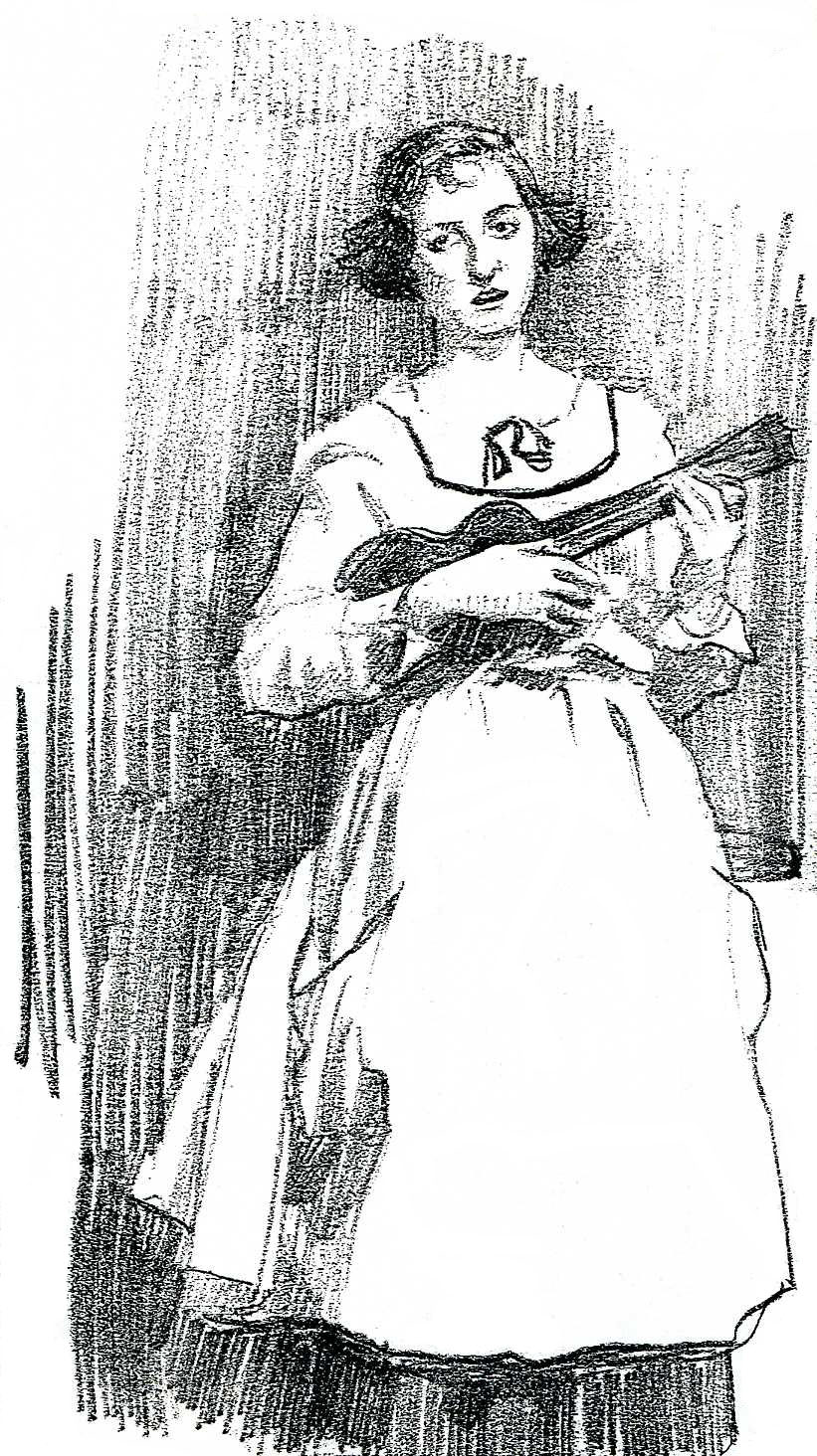
During and after her years in the food business, M. Alletta volunteered for war work, entertaining the troops in England with her ukulele playing during WWI (she also sang spirituals and folk songs in the tea room). After 1927 she apparently had a variety of jobs. She had studied at Smith College and trained to become a nurse before opening The Crumperie and may have returned to teaching or nursing. She taught a tea room management class in Brooklyn and worked for a time at the Grenfell Mission in Labrador. In 1958 she made five appearances on the TV quiz show “The $64,000 Question,” winning $16,000 which she used to fund a European trip.

© Jan Whitaker, 2010

7 Comments

Filed under Offbeat places, proprietors & careers, tea shops, women

Between courses: dining with reds

In July of 1928 the Communist Party in the United States opened a public cafeteria on the ground floor of their headquarters in New York City, home also to The Daily Worker. The headquarters, known as the Workers’ Centre, was at 26-28 Union Square East and also contained a cooperative barber shop in which the barbers did not accept tips.

The restaurant was called Proletcos Cooperative Cafeteria. Proletcos was said to be a name created by a garment worker who combined the first two syllables of PROLETarian with the CO of cooperative, then added an S.

It’s not surprising that Communists would select a cafeteria as their preferred format for a restaurant. There is something socialistic about cafeterias, with their self-service and no-tipping customs. They were widely adopted in industrial plants and among working women’s organizations of the 1890s. Two home economists created a chain of cooperative cafeterias in NYC in 1920, called Our Cooperative Cafeterias, which dispersed an annual rebate to customers who were members. Evidently it was unrelated to the Communists’ project. Proletcos, whose prices were about average for a cafeteria, gave a 10% discount to its 600 shareholders. Its workers were guaranteed an 8-hour day and good working conditions.

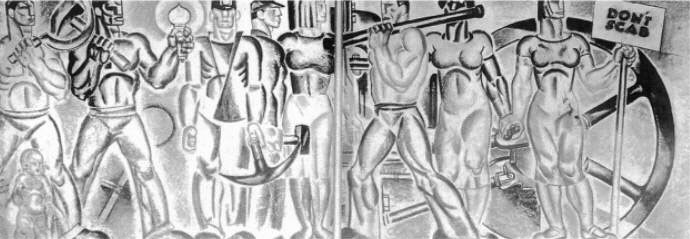
Proletcos was enlarged in November of 1928 and was able to serve nearly 6,000 meals a day. Artist Hugo Gellert, a lifelong Marxist and co-founder of The New Masses magazine, created a mural for the expanded and refurbished restaurant in which sturdy workers and Communist heros such as Sacco and Vanzetti, John Reed, and Vladimir Lenin, all 10 feet tall, loomed over the dining room (pictured). According to a story in the New Yorker, the cafeteria was quite up to date, with tile floors, brass railings, and modern light fixtures.

The cafeteria had a short life lasting only a couple of years in which it served workers, many of them from the garment district, along with students who liked to hang out, drink coffee, and discuss the issues of the times. It evidently came to an end in 1930 when the CP moved its headquarters from Union Square to East 13th Street.

© Jan Whitaker, 2010

7 Comments

Filed under cafeterias, Offbeat places

Banqueting at $herry’s*

In 1898 Sherry’s and Delmonico’s faced off on two corners of Fifth Avenue and 44th Street. Which would win the favor of New York City’s high society whose core membership was known as the Four Hundred? Even before Sherry’s boldly moved onto Delmonico’s turf it had been successfully poaching “Del’s” clientele. For a time there seemed to be enough elite diners to go around, but the days were numbered for both of New York City’s grand restaurants. Before too long each would suffer from the negative impact of Prohibition and World War I on food and drink and social life. Nonetheless many spectacular balls and dinners were still in store at Sherry’s before its demise.

Louis Sherry began his professional life in restaurants in New Jersey and New York in the 1870s, working as a waiter, then steward and head waiter at establishments such as the Hotel Brunswick. In 1881 he started a confectionery and catering business at Sixth Avenue and 38th Street where he supplied ice cream, cakes, and deluxe dinner party staples such as lobster, salmon, deviled crab, chicken salad, and terrapin. He soon opened a restaurant at the casino at Narragansett Pier, Rhode Island. His businesses grew, and he moved to Fifth Avenue at 37th Street, and when that became too small he commissioned Stanford White to design a multi-story restaurant with ballrooms and residential suites opposite Delmonico’s.

Although he has been singled out as one of the few American-born proprietors of a fine NYC restaurant at the turn of the 20th century, it is likely that he was a native of Canada rather than Vermont as is frequently reported. On several passport applications he attests that he was born in Quebec, in 1855.

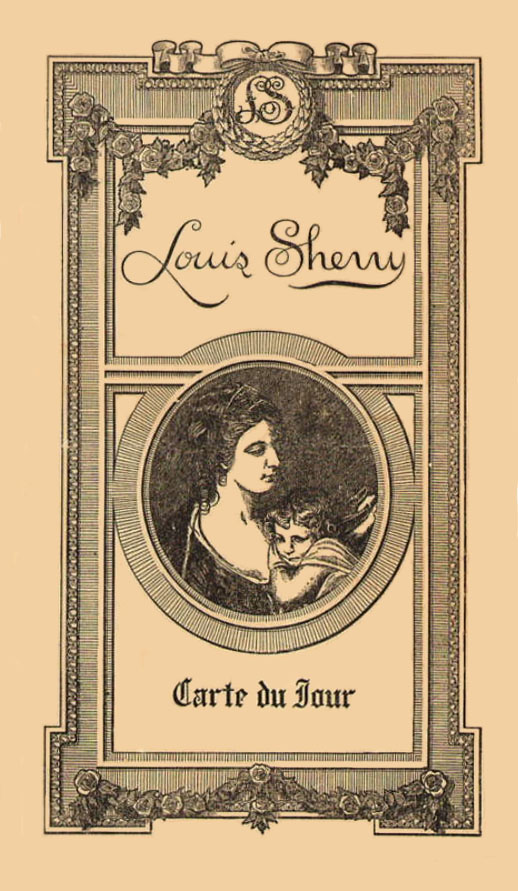
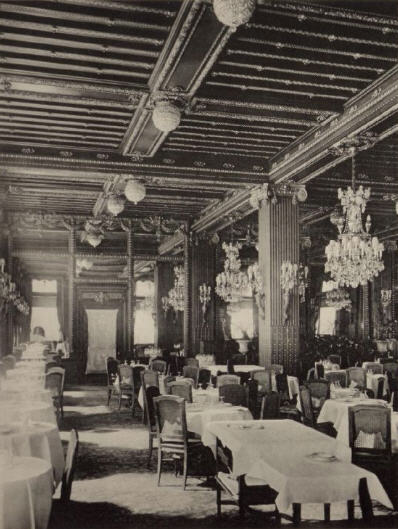
Sherry was known for getting every detail right, particularly table appointments and decorations which could include everything from asparagus served in a hollowed out block of ice to tabletop forests and lakes (1908 dinner pictured). But from time to time the expense and elaborateness of his dinners prompted critics to call them symptoms of a decadent society. This was especially true of the $250 per person dinner on horseback given by C. G. K. Billings to 36 members of his Equestrian Club in 1903 – and the 1905 dinner for 500 guests costumed as 18th-century French royalty given by James H. Hyde where even the waiters wore powdered wigs.

In 1912 Sherry’s was hit hard by a restaurant workers’ strike which targeted the city’s top eating places. He professed indifference but bitterly cited “Bolshevik waiters” as one of the reasons for closing the restaurant and hotel in 1919 and moving up to 58th Street to continue with catering and confectionery. In 1921 Sherry joined a corporation headed by Lucius Boomer that opened a Sherry’s restaurant and candy shop at 300 Park Avenue. A subsidiary of the corporation owned the Sherry-Netherland Hotel. Sherry, who did not seem to be actively involved in these enterprises, died in 1926. Later, under a succession of owners, there were Louis Sherry restaurants in the Metropolitan Opera and the Philharmonic, while ice cream is still (or was until fairly recently?) produced under the Louis Sherry name.

* In The Real New York (1902), Rupert Hughes suggested that because the restaurant was so expensive, its name should be written this way.

© Jan Whitaker, 2010

19 Comments

Filed under elite restaurants

Good eaters: Andy Warhol

He certainly wasn’t from the same category of eaters as James Beard, yet both Beard and Andy Warhol celebrated American cuisine, even in its more humble pancake/sandwich/barbecue forms. Warhol was a typical American eater in many regards. He was conservative about his food, preferred simple dishes, and was happy eating in front of the TV.

As for restaurants, he explained in his 1975 book The Philosophy of Andy Warhol that he stayed thin by ordering things he disliked in restaurants — even fashionable and expensive ones such as La Grenouille. While his companions ate, he picked at his plate and then had the food wrapped up so he could leave it somewhere for a homeless person to find. He called this the “Andy Warhol New York City Diet.”

He much preferred “good, plain American lunchroom[s] or even the good plain American lunchcounter” to chic eateries. His favorites, already vanished by 1975, were the “old-style” Chock Full O’ Nuts and Schrafft’s. “The days were carefree in the 1940s and 1950s when I could go into a Chocks for my cream cheese sandwich with nuts on date-nut bread and not worry about a thing,” he wrote. He felt that people could not handle many challenges to their food habits without becoming upset. As he put it, “Progress is very important and exciting in everything except food.”

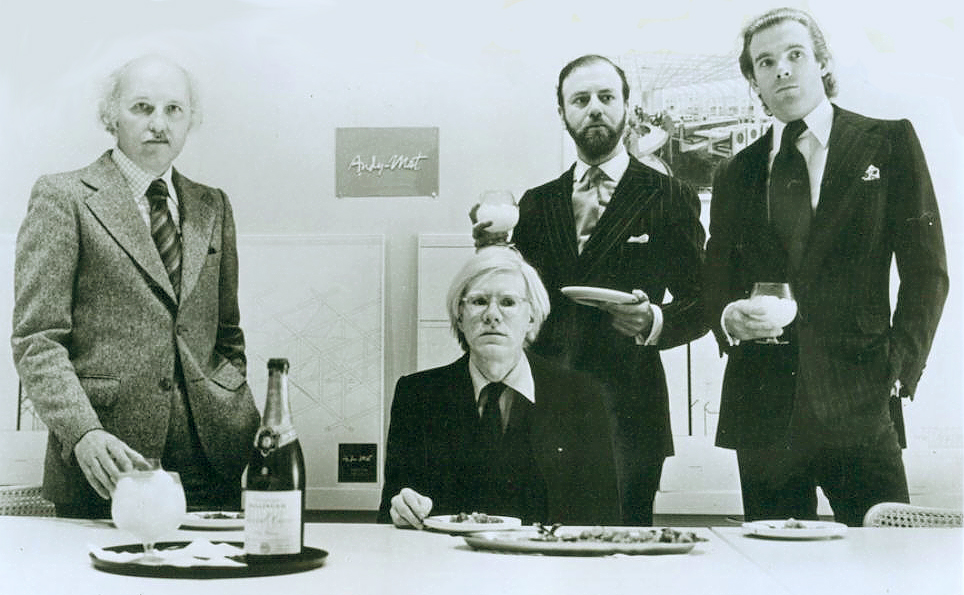
He came close to becoming a restaurateur himself when he announced the coming of the “Andy-Mat,” an unpretentious neighborhood restaurant serving homely comfort food at reasonable prices which was slated to open in fall of 1977 on Madison Avenue at 74th Street in NYC, perhaps launching a chain. (See photo with Warhol and his partners, [standing L to R] architect Araldo Cossutta, developer Geoffrey Leeds, and financier C. Cheever Hardwick III.) Described as “a tinker toy for sophisticates,” Warhol’s concept included pneumatic tubes through which customers’ orders would be whooshed into the kitchen. The meals served in Andy-Mats, in keeping with the times, were to be frozen dinners requiring only reheating.

For some reason — poor location or failure to raise capital or maybe because the whole plan was cooked up over “twelve stingers at El Morocco” — the restaurant did not materialize.

© Jan Whitaker, 2010

6 Comments

Filed under patrons

Today’s specials: books on restaurants

Appetite City

As someone who has spent years researching the history of restaurants I can give no higher praise than to say “I couldn’t have done it better myself.” That is my appraisal of William Grimes’ Appetite City: A Culinary History of New York (Farrar, Straus and Giroux/North Point Press), a book I highly recommend to anyone interested in the history of both restaurants and New York City. And, though I might have matched the book’s exhaustive research, I doubt I could have written it so engagingly. I appreciate Grimes’ level gaze and ability to sidestep the hype that has always surrounded New York restaurants, even as far back as 1825 when a journalist insisted that New York rivaled Paris with its “consummate institutions for cultivating the noble science of gastronomy.” Grimes’ response: “New York a rival of Paris? Hardly.” Though its star would rise throughout that century and the next, there were plenty of dips along the way. In the late 1960s and early 1970s the city was depressed and “cultural energy no longer radiated” from it. California restaurants became the locus of culinary innovation. Inevitably, though, many of its leading chefs migrated to New York as almost everyone who wants to make their mark does at some point.

Readers will find everything they are looking for in this book. All the leading restaurants and restaurant types are covered, in text and illustration: from Delmonico’s to the Automat, speakeasies and lobster palaces, beaneries and night clubs, oyster bars and world’s fairs eateries, from the 1820s to the present. I particularly enjoyed the book’s final chapter in which Grimes discusses his five years as a restaurant critic for The New York Times, during a “frenzied restaurant boom fed by a robust economy” (1999-2004) when “the dining scene was a complete free-for-all, as chefs dipped into Pacific Rim and Nuevo Latino with equal enthusiasm…” If I find anything missing in the book it is a characterization of New York restaurants which identifies how they have been, and are, different from those in the rest of the U.S., and the world — perhaps an impossible task, but worth a try. And something that applies to all capital/global cities that I would have liked to see would have been an attempt to separate the local dining spots (where the natives eat) from those that rely heavily on visitors to the city. But these are minor omissions in a valuable and thoroughly enjoyable book.

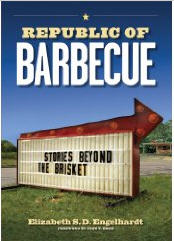
Republic of Barbecue

The Republic of Barbecue: Stories Beyond the Brisket (University of Texas Press) takes us far beyond New York City and its trendiness and glitz. Here we are introduced to more than one expects from a purely local tradition in cooking, eating, and restaurant-ing.

The book is by Professor Elizabeth S. D. Engelhardt of the American Studies Department at the University of Texas at Austin and 11 graduate students. With cameras and tape recorders the crew explored Central Texas eateries to create an oral history of barbecue and answer the question, “What does barbecue tell us about who we are?” Proprietors tell in 23 first-person narratives how and why they barbecue. These are supplemented by essays by the authors which explore the area’s history as well as subjects such as gender and race.

So the book sprawls, intentionally. As Engelhardt says, the idea is not to solidify Texas barbecue mythology but to find its complexities. Myth would have it that Texas barbecue is about beef and sausage; cowboys; rich and poor sitting side by side; eating off of butcher paper without utensils; slow cooking over mesquite and post oak in brick pits; no sauce; and only bread or crackers as sides. They find all of these things are real, but they also trace historical roots to Southern cotton culture rather than Western cattle culture; find decades of exclusion of blacks and Mexicans as customers; discover pork, chicken, turkey, goat, and mutton alongside beef; and find varied practices such as some barbecuers using sauce, some cooking on rotisserie pits fueled by propane instead of wood pits, and some cooking the meat for only three hours rather than twelve or more.

The book is well illustrated and, though somewhat repetitive and a bit inconclusive, filled with fascinating essays and narratives. I enjoyed reading about what to drink with barbecue – Big Red and Dr. Pepper sodas, and Shiner Bock and Lone Star beers. I appreciated Gavin Benke’s “Authenticity” which explores issues such as the restoration of butcher paper for the feel of the “real barbecue” experience, Eric Covey’s “Keep Your Eye on the Boll,” which examines barbecue in the context of a cotton-growing economy, and Remy Ramirez’s essay on her Mexican-American grandparents. The book is nicely produced and a pleasure to read and a must-have for anyone interested in barbecue or restaurant history and culture.

© Jan Whitaker, 2009

3 Comments

Filed under miscellaneous