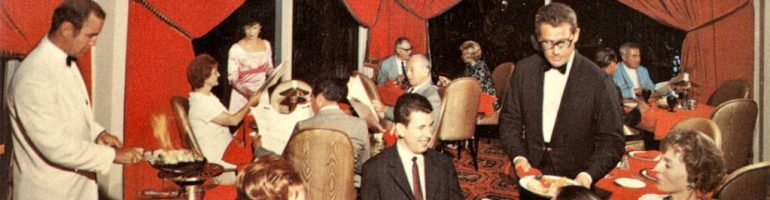
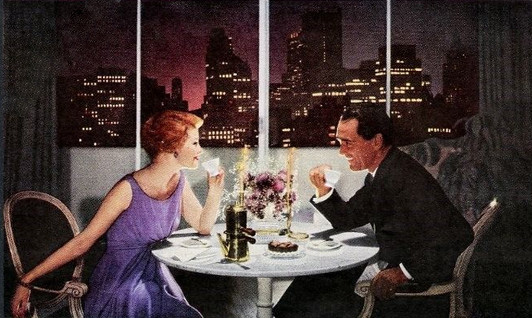
Dinner in a romantic restaurant is a popular way to celebrate Valentine’s Day. But that would have been far from true in the nineteenth century when going to what was known as a romantic restaurant meant something entirely different. Something disreputable.
It took decades before a romantic restaurant dinner became part of an evening primarily meant to please the woman rather than the man.
As late as the 1920s young single women had to guard their reputations closely when they went out in public, especially in restaurants in the evening. Emily Post advised in 1923 that “It is not good form for an engaged couple to dine together in a restaurant, but it is all right for them to lunch, or have afternoon tea . . . They should take a chaperon if they motor to road-houses for meals.”
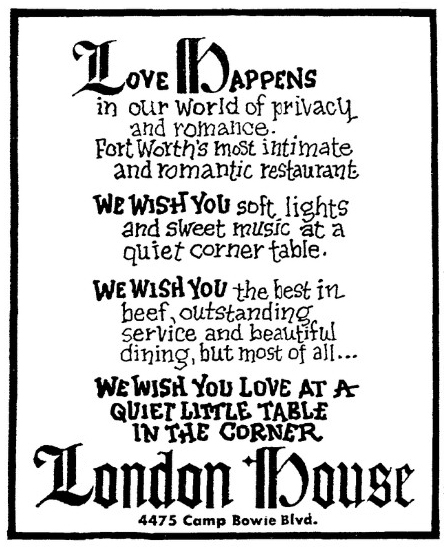 Things loosened up not long after Emily’s edict, and celebrations in romantic restaurants increased in the 1960s. Yet it wasn’t until the 1970s that the typical Valentine’s Day restaurant experience we know today with its wine, candlelight, and soft music became popular. [see London House, Fort Worth TX, 1971] In the late 1970s and 1980s February ads for candlelit dinners “for lovers only” appeared frequently.
 But earlier, when many married women were primarily homemakers, it was enough just to get a night off from cooking, even if the destination restaurant was nothing more than a cafeteria or a drive-in. How odd now to see a 1930s advertisement saying, Take Your Valentine to Dinner at Mrs. Adkins’, a cafeteria where “we never embarrass your pocketbook!” What? no service, no splurging, no Champagne, no tableside theatrics?
Even that pedestrian cafeteria meal was a celebration of sorts then. Being taken out for a Valentine’s dinner was still fairly unusual in the 1940s and 1950s. For many women, the day meant more cooking, not less. Newspaper food columns of the 1950s and even the 1960s gave the impression that mothers were expected to show love for their families by making special dinners for them.
But by the late 20th century, newspapers had changed their focus from family dinners at home to romantic couples-only dinners in restaurants. Even readers living in a city less blessed with romantic restaurants could find a hotel that filled the need. A writer in the Huntsville Times admitted that “the selection of truly romantic restaurants . . . is limited in Huntsville,” but at least there was a Radisson, or a Marriott offering a Sweetheart Dinner for Two consisting of Chateaubriand, Champagne, and Strawberries Romanoff.
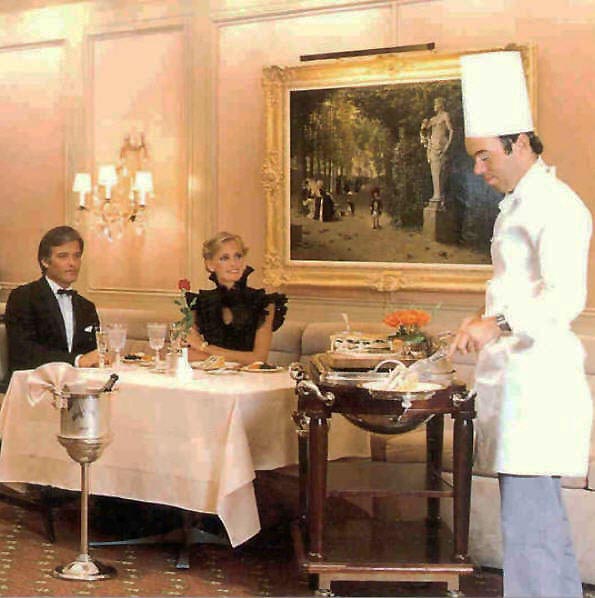 In 1979 a Cleveland journalist convinced his wife to travel with him all over the U.S. to verify the romantic value of ten of the country’s restaurants as recommended in an airline magazine. Several failed the test, but they were delighted with Maxim’s de Paris in Chicago, with its “beautiful wall sconces and tiny, rose-colored table lamps, all imported from Paris, and gold service plates that were originally designed for Sarah Bernhardt.” They ate Rack of Lamb that “looked like a picture from a gourmet magazine.”
Guess what kind of food was deemed most romantic – at least by those newspaper food writers who assembled lists of best places to celebrate the day? It certainly wasn’t beef stew or mixed vegetables. Better to be served something sauced, stuffed, or puffed. Many restaurants, in fact, stuck to the old standbys, steak and prime rib, but they didn’t score as high on the romance scale as did those purveying food with French names. Ah, bisque, terrine of lobster, pommes duchesse, tournedos de beef, and Grand Marnier soufflé!
Champagne and long-stemmed roses aside, could it be that the ladies especially enjoyed that their dinners had been fretted and fussed over by male chefs?
© Jan Whitaker, 2019


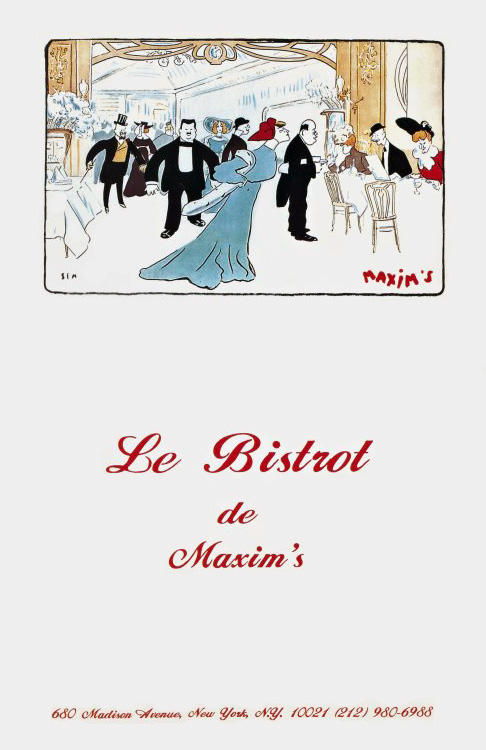


 The name has cast a spell over Americans since the 1890s and bits of its odd history have played out in the U.S. The fortunes of the “world’s most famous restaurant” have risen and fallen. It has won high ratings and lost them. It has been the subject and site of operettas, songs, and movies. It has been declared a French national treasure and an altar to haute cuisine, but also a fraud and a tourist trap. Maxim’s name has appeared on perfumes, airplane meals, and franchised outlets, yet even today it resonates.
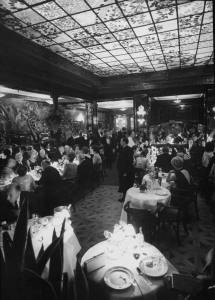 According to most accounts a waiter named Maxime Gaillard began Maxim’s in 1893. Yet another report calls him maitre d’hôtel Signor Maximo, while another stakes a claim for Georges Everard as founder in 1890. Everyone seems to agree, though, that the early Maxim’s was a late-night glamour magnet for American and English visitors to Paris, liberally supplied with friendly prostitutes. In 1899 it acquired a flamboyant Art Nouveau interior with enough murals, curves, and mirrors for a loopy carnival ride. Its prices were high, which may explain why many turn-of-the-century patrons, though dressed in silks and tuxedos, preferred to watch the action while munching pommes frites, an early specialty of the house.
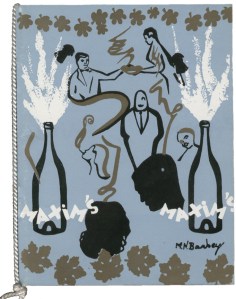 Detractors, such as H. L. Mencken, charged that Maxim’s “gypsy” orchestra was composed of Germans and that the toy balloons floating around were from “the Elite Novelty Co. of Jersey City, U.S.A.” In “Paris à la Carte” (1911), Julian Street, an authority on French food and wines, asserted “I abominate it,” and denounced it as “a brazen fake, over-advertised, ogling, odoriferous; a nightmare of smoke, champagne, and banality.” Debauched merrymakers aside, these were the golden years, before World War I, the era of wine, women, and song on which the Maxim’s legend would be built.
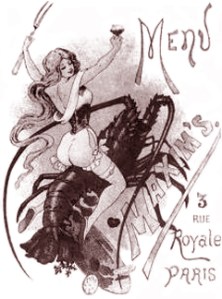 By 1953 the restaurant had earned 3 stars in the Michelin Guide and was starting on a new course. It had developed a frozen food division which supplied airplane meals and was poised to sell frozen sauces and entrées in select American stores. In another twist, Maxim’s authorized a
 It's great to hear from readers and I take time to answer queries. I can't always find what you are looking for, but I do appreciate getting thank yous no matter what the outcome.
 Restaurant-ing through history