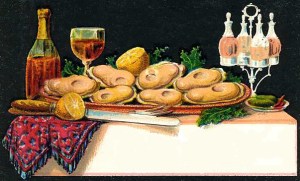
 The nation has begun to grow westward though settlement is still mostly along the coast. Seven cities exceed 10,000 in population in 1810, rising to eight over the decade. In the largest city, NY (152,056 in 1820), commerce is on the rise, yet by mid-decade there are only eight hotels and five banks. Pigs run free in the streets. The defeat of Britain in the War of 1812-1815 does not cause an immediate end to British influence on public eateries, though there are a few French restorators. Beefsteaks are popular and oysters are served almost everywhere. Alcohol flows freely. Most eating places are also drinking places and boarding houses as well. Board can include lodging or not — some people pay a weekly or monthly fee simply for meals.
Highlights
1810 With close to 34,000 inhabitants Boston, the nation’s fourth largest city, has almost 50 victuallers who run either cook shops where householders take food to be cooked or places where cooked food is served on the premises. There are also five confectioners, one restorator (Jean Gilbert Julien), three taverns, three coffee houses, and seven wine shops, some of which serve cooked food.
1811 Robert Wrightson, owner of the Union Coffee House in Boston, advertises for “a young Woman to do Kitchen Work.” He has recently opened a hotel near Cambridge where, he promises, he will stock the finest Champagne, Madeira, Sherry, Port, and London Brown Stout. Also on tap: bowling alleys and “Dinners and other Refreshments provided at the shortest notice.”
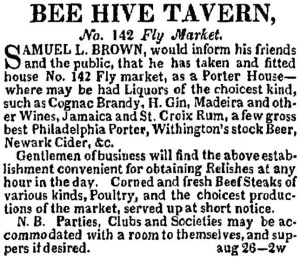
1814 In Newport RI, N. Pelichan announces he has opened a Victualling House and is ready to serve “good Beef-Steaks, Oysters, Turtle-Soups, etc. with Pastries, Wines and all kinds of Spiritous Liquors, of the very best quality.” He looks forward to hosting dinners and suppers for men’s clubs and societies which make up a good part of the dining public.
 1815 On July 17 Hannah Julien, who has run Julien’s Restorator since the death of her husband Jean ten years earlier, informs the public that she will be serving a “fine green turtle” that day. – In Salem MA, John Remond, who is black and from the West Indies, also runs a restorator where he prepares soups, green turtles, cakes, wafers, French rolls, and other delicacies.
1817 Boasting that he has cooked for wealthy men as well as President James Madison, Henry F.Doyhar promises to furnish breakfasts, dinners and suppers at his Washington, D.C. fruit and pastry shop “on the shortest notice.” Evidently he also has a billiard table on the premises because a few months later he receives a pardon from President James Monroe for keeping it without a license. – Meanwhile, over in Georgetown William Collins lures epicures with “the richest gravies, finest jellies,” York, Cove, and Nantiquoke oysters, canvassback ducks, and “every article that will serve to embellish a supper, and give gaiety and animation to the repast.”
1818 For a day of recreation, Philadelphia families head to Greenwich Point Tavern on the Delaware River. They order a meal or simply graze on turtle soup and ice cream which are prepared every Sunday. If they become bored they take a boat ride across the river to Gloucester Point on the New Jersey side.
1819 A New York oyster cellar on Chatham Street fills up around 9 pm with patrons who drop by for fried, stewed, or raw oysters washed down with their favorite alcoholic beverages. A visitor describes the interior: “There were several tables in little boxes, covered with cloths not very clean, and having broken castors, filled with thick vinegar and dirty mustard, together with knives and forks not very tempting in their appearance.” He is also critical of the age of the patrons (too young), their appetites (too big), and the times (too extravagant).
© Jan Whitaker, 2009
Read about other decades: 1800 to 1810; 1860 to 1870; 1890 to 1900; 1900 to 1910; 1920 to 1930; 1930 to 1940; 1940 to 1950; 1950 to 1960; 1960 to 1970; 1970 to 1980
 After passing up Bamboo Isle (“Strictly Kosher Turkey Sandwiches, Fifteen Cents”), he heads to what was probably Mother Goose. “Finally, in an eatery built in the shape of an old boot I was able to procure a satisfying meal of barbecued pork fritters and orangeade for seventy-five cents. Charming platinum-haired hostesses in red pajamas and peaked caps added a note of color to the scene, and a gypsy orchestra played Victor Herbert on musical saws.”
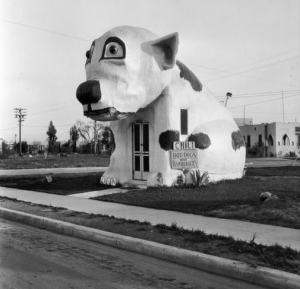 In a 1936 photo series called “Chamber of American Horrors” for which he wrote captions he describes Mother Goose as a place where “Inside, kiddies from six to sixty, most of whom are indistinguishable from each other, gnaw sizzling steaks and discuss their movie favorites.” Other eating places included in the Chamber were the Toed Inn (“tasty combinations of avocado and bacon, pimento and peanut butter”), the Laughing Pig Barbecue Pit (“Etched in red and blue neon lights against the velvety southern California night, it can be seen and avoided for miles.”), and the Pup (“The most ravenous appetite fades before this elaborate cheese dream.”).
 If it weren’t for the steady number of souls searching the spheres for Nucleus Nuance, I’d hesitate to touch this subject. After all, it was a clubby hangout that I never experienced personally so I’m at risk of leaving out things that true-blue fans care about. On the other hand, there doesn’t seem to be much written about the restaurant side of this jazz nightclub, so here goes.
 In 1979 Nucleus acquired new partners, the Venieros, who introduced fine vintage California wines, hooked up the restaurant with the Garlic Festival, and expanded the premises. Evidently, though, it remained unbeautiful. According to the Los Angeles Times in 1976, the dining room was windowless and “The front door leads you down a long corridor that makes you think you’ve walked in the back door by mistake.” In 1988 it sounded pretty much the same. A review by Alan Richman describes the entrance as “a nightmare, a series of twists and turns along a gloomy cinder-block passageway,” adding that the uninviting exterior was “white cinder-block, the front door solid black, the overhead awning worn out.” (He liked the place once he got settled.)
 A “faux” want-ad for a young clerk, allegedly placed by “Iscariot Grasp, 1 Brokers’ Alley,” was published in New York in 1849. It represents a humorous take on Puritanical notions of morality of that time. Evidently an upstanding young man then was supposed to confine his dining to home. If he wanted the clerk job he had to promise to reside with his parents and not to frequent “oyster-cellars, porter-houses, theatres, balls, ten-pin alleys, billiard rooms, sweat-boards [a dice game], raffles for poultry or game, restaurants, confectioners, steam-boats, Coney-Island, Rockaway or Saratoga.”
 In the late 19th century owners of large popular-price restaurants began to look for ways to cut costs and eliminate waiters. The times were hospitable to mechanical solutions and in 1902 automatic restaurants opened in Philadelphia (pictured below) and New York. In both cities, a clever coin-operated set-up – and a name – were imported from
  The Automat in NYC was owned by James Harcombe, who in the 1890s had acquired Sutherland’s, one of the city’s old landmark restaurants located on Liberty Street. The Harcombe Restaurant Company’s Automat was at 830 Broadway, near Union Square. Reportedly costing more than $75,000 to install, it was a marvel of invention decorated with inlaid mirror, richly colored woods, and German proverbs. It served forth sandwiches and soups, dishes such as fish chowder and
 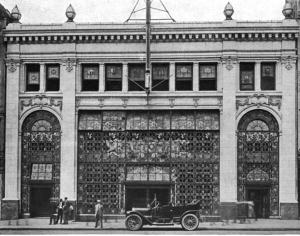 Undeterred by the first Automat’s fate, Horn & Hardart moved into New York in 1912, opening an Automat of their own manufacture at Broadway and 46th Street (pictured). It turned out that New Yorkers did indeed use slugs, especially in 1935 when 219,000 were inserted into H&H slots. But despite this, the automatic restaurant prospered, expanded, and became a New York institution. By 1918 there were nearly 50 Automats in the two major cities, and eventually a few in Boston. Horn & Hardart tried Automats in Chicago in the 1920s but they were a failure. On an inspection tour in Chicago, Joseph Horn noted problems such as weak coffee, “figs not right,” and “lem. meringue very bad.”
 The Automats hit their peak in the mid-20th century. Slugs aside, the Depression years were better for business than the wealthier 1960s and 1970s when some units were converted to Burger Kings. In 1933 H&H hired Francis Bourdon, the French chef at the Sherry Netherland (fellow chefs called him “L’Escoffier des Automats”). In 1969 Philadelphia’s first Automat closed, being declared “a museum piece, inefficient and slow, in a computerized world.” That left two in Philadelphia and eight in NYC. The last New York Automat, at East 42nd and 3rd Ave, closed in 1991.
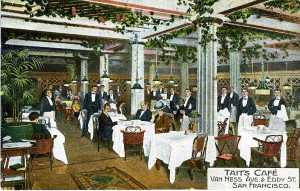 James Beard enjoyed eating out – in fact much of his life revolved around restaurants. When he was a child his mother often took him to places such as the Royal Bakery in his hometown of Portland OR and Tait’s in San Francisco (pictured). Although he was an accomplished cook, cooking teacher, and author of over 20 cookbooks, like many a New Yorker he patronized restaurants frequently, including
 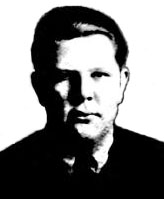 He preferred restaurants that were “homey” and where he was known and liked, such as the Coach House and Quo Vadis. At the latter he became good friends with owners Bruno Caravaggi and Gino Robusti with whom he shared a love of opera. As a young man (pictured, age 19) he prepared for a musical career at London’s Royal Academy of Music. He said that his early performance training helped him with radio and TV appearances.
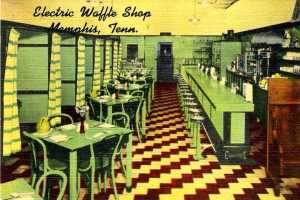 In the early 19th century Philadelphians enjoyed driving their carriages to the falls on the Schuykill River, the area now known as East Falls, then lined with hotels and restaurants. Eating places there specialized in a favorite dish associated with Philadelphia long before the advent of cheese steaks, namely catfish and waffles. (I’d like to believe that the dish did not include maple syrup.)
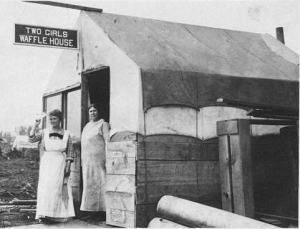 Well into the 20th century waffles were familiar fare in boom towns such as Anchorage, Alaska, and the oilfields of Oklahoma. Around 1915 two young women from Seattle decided to seek their fortune in Alaska with the Two Girls Waffle House (pictured). In what was not much more than a shack with a canvas roof they could handle only eight customers at the counter. But after a year they had made enough money from railroad construction workers to build a permanent structure. A similar success story could be told about the two young men who ran the Kansas City Waffle House in Drumright, Oklahoma, before graduating to a bigger enterprise in Tulsa.
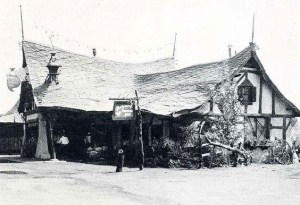 Waffles were also a staple of tea rooms in the early 20th century. In places as varied as big city afternoon tea haunts and humble eateries in old New England homesteads, waffles attracted patrons. In 1917 New Yorkers could choose among the
 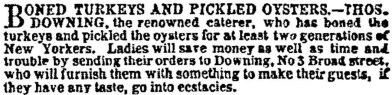 The Downing family of caterers and restaurateurs, Thomas and his sons George T. and Peter W., were activists in the causes of the abolition of slavery, black suffrage, and black education. They assisted Afro-Americans fleeing slavery before Emancipation as well as those escaping terrorism in the South in the post-Civil War period. Like many free blacks living in cities, they took up the catering trade. Similar to undertaking and barbering, catering was a personal service occupation which offered a degree of opportunity for enterprising people of color.
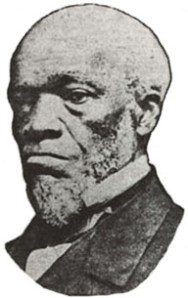 Thomas Downing (pictured), the son of freed slaves from Virginia, specialized in oysters. He opened an oyster cellar on Broad Street in New York City in the 1820s, gradually expanding it and earning a fine reputation. Often oyster cellars were “dives” but his was considered first class. He won awards for his pickled oysters which, along with his boned and jellied turkeys, were especially popular at Christmas (see 1856 ad). Over time he owned the Broad Street place and at least one other in NYC and, according to a Rhode Island directory, another in Providence. However, the press seemed always to confuse the various Downings, so it’s possible the latter was under the direction of a son.
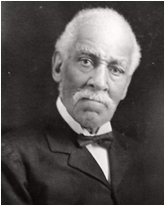 Thomas’s place on Broad was patronized by men in political and financial circles and he was rumored to have influential connections. Both his sons, George and Peter, had enough pull to win concessions for restaurants in government buildings. Peter ran an eating place in the Customs House in NYC, while George, a friend of MA Senator Charles Sumner, managed one in the House of Representatives in Washington, D.C. George (pictured) was also well known as the proprietor of a resort hotel, the Sea Girt House, in Newport, Rhode Island.
 By the end of the decade almost 40% of Americans live in suburbs and 75% have televisions. Church-going enjoys a revival. “Under God” is added to the Pledge of Allegiance and “In God we trust” is stamped on coins. Even as social pressures push women toward homemaking, 40% work outside the home. Congress passes the Internal Security Act requiring communists to register with the Attorney General. In Brown vs. Board of Education the Supreme Court rules that “separate but equal” education must end. Casual dining prevails, both at home and in public, yet interest in new dining experiences, luxury, and exotic cuisines is apparent. The restaurant industry looks forward to a bright future.
 1952 A Chicago restaurant advertises its “atomic menu,” with items such as “Guided Mussels.” – Teens get behind the wheel and drive-ins flourish. In Stockton CA patrons can choose among Billy’s Drive-In, Dick’s Drive In, Don’s Drive-In, Travo-Burger Drive Inn, or the Snow White Drive Inn. – A prominent black Denver physician wins a suit against a drive-in restaurant in Fort Morgan CO after he and his wife are
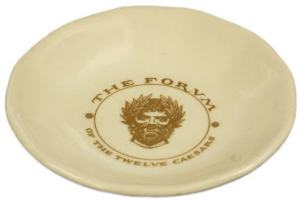
  1957 The Hot Shoppes company operates restaurants and cafeterias in 11 states and D.C. as well as serving meals on airlines, the NY Thruway, and in government dining facilities. It keeps a 3,000-acre sheep and cattle ranch in Virginia, as well as a commissary, butcher shop, bakery, and ice cream plant in D.C. – In NYC the Forum of the Twelve Caesars opens. Unfazed by its campy decor and toga-clad waiters, NYT reviewer Craig Claiborne hails its “lusty elegance,” “opulent” food, and “superb” service.
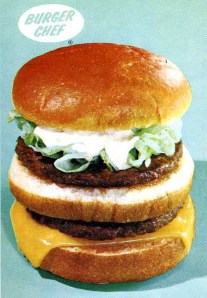 1958 When the IRS cracks down on expense accounts by requiring detailed proof of expenses, membership in The Diners’ Club rises sharply. In NYC, advertising executives make up the largest category of members, followed by people in the TV industry. – The Burger Chef chain gets its start.
 For decades pizza was seen as a light snack rather than a meal, much as it had been on the streets of Naples for centuries. An English visitor to Naples in 1843 noticed small bakeshops where “a constant hissing and thick smoke indicated the preparation of pizze, (composed of flour, lard, eggs, and garlick) and muzzarella.” In 19th-century Italy, as now, there were a variety of toppings: grated Swiss cheese, olive oil, tomatoes, and anchovies or other fish. Southern Italians brought the dish to America, and in 1903 a New York newspaper took note of a dish known as “pomidore pizza” or “tomato pie” sometimes topped with salami.
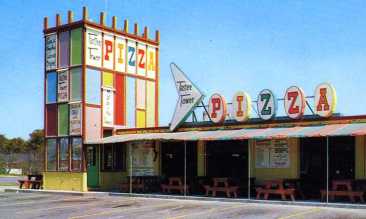 Boosted by prosperity, casual suburban lifestyles, and burgeoning youth culture after the Second World War, pizza leaped into popularity. But it was not known well everywhere. For instance, in 1948 a Corpus Christi TX restaurant review referred to the “unusual” item as “pietza pie.” It was much better known in Chicago. In 1953 there were already more than 100 pizza parlors there.
 It's great to hear from readers and I take time to answer queries. I can't always find what you are looking for, but I do appreciate getting thank yous no matter what the outcome.
 Restaurant-ing through history