Charge it!

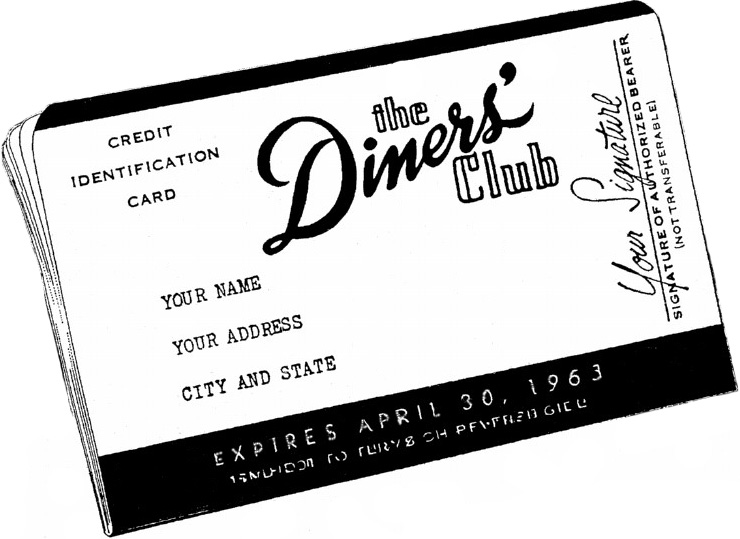
DinersClubcard1955The advent of travel and entertainment (T&E) credit cards in the 1950s was instrumental in sparking a renaissance in luxury restaurants that hadn’t been seen since pre-Prohibition days.

Nowhere was the effect felt more strongly than in NYC, birthplace of the Diners’ Club.

On February 8, 1950, Frank McNamara paid for his lunch at a steak house called Major’s Cabin Grill in NYC with a Diners’ Club card numbered 1,000 (i.e., #1). With his little paper card he made the very first charge on a nationwide credit card.

DinersClub1956ADV

The timing of the Diners’ Club launch was perfect. During World War II expense accounts had proliferated as a way companies could use income for entertaining clients rather than hand it to the government as a tax on “excess” profits (profits greater than those before the war). Now, in 1950, the excess profits tax lifted at the end of WWII was only a few months away from reinstatement for the Korean War.

The growth of T&E credit cards went hand in hand with the growth of expense accounts. As one publication put it, credit cards were spinoffs of expense accounts. And, each time the IRS tightened up its requirements for itemizing deductions, more credit card applications came in.

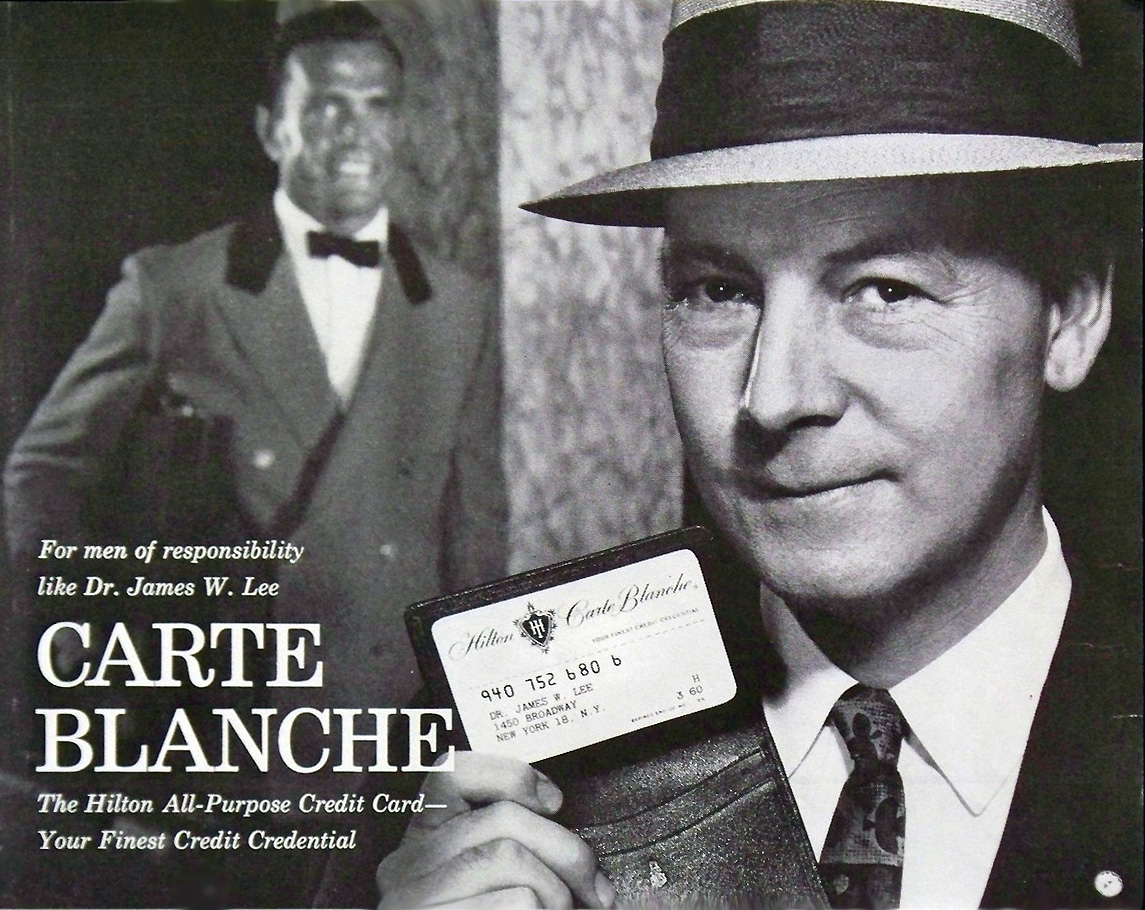
Carteblanche1959Unlike the nationwide bank cards that would eventually swamp T&E cards, the latter required high financial standing, an annual membership fee, and full payment of balances within 30 days. Having one of these cards brought cachet.

Following quickly on the heels of the Diners’ Club launch came many others: Dine ’n Sign, National Credit Card, Your Host, Inc, Duncan Hines’ Signet Club, the American Hotel Association’s Universal Travelcard, Hilton’s Carte Blanche, the Esquire Club, and the Gourmet Guest Club (the last two linked to Esquire and Gourmet magazines). A smaller Diners’ Club continues today, but the only other survivor is American Express, which inaugurated its credit card in 1958, then quickly rose to the top of the T&E field.

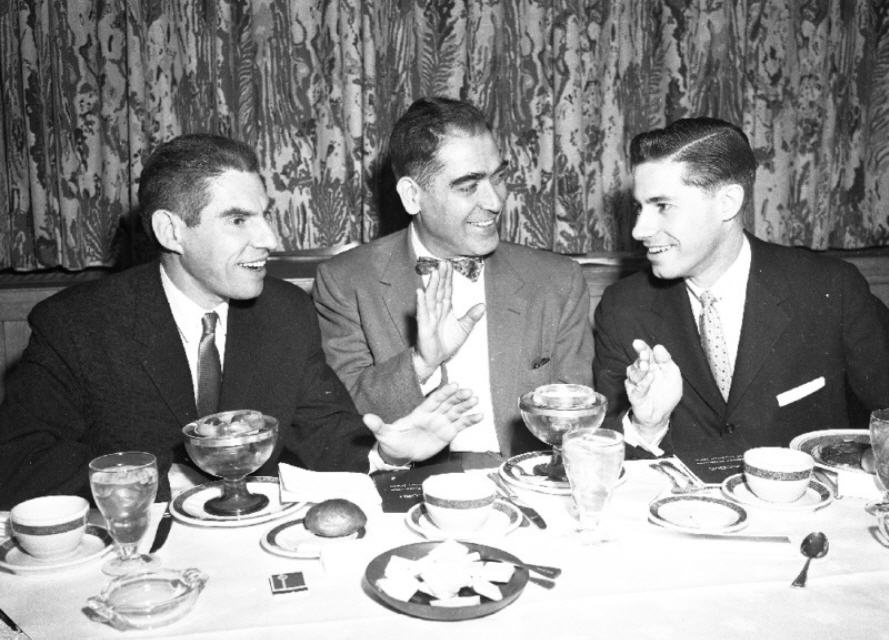
Traveling salesmen and men (rarely women) in industries such as public relations, advertising, publishing, manufacturing, and wholesaling were fans of the convenience of charging business meals. And, of course, in the early days of T&E club cards it was a status factor to simply dash off a signature on a slip, particularly if the lunch took place in a top restaurant.

Bizlunch

Expense accounts and credit cards were a boon to restaurants. There were estimates that in the mid-1950s 50% to 80% of meals in high-priced restaurants were “on the company.” Vincent Sardi admitted that a big chunk of his NYC business was made up of men on expense accounts. Peter Canlis, of Seattle’s first-class Canlis Restaurant, said in 1953 that he decided to establish a restaurant there because “a lot of good expense account money wasn’t being spent because there was no place fancy enough to gobble it up – and I was happy to fill the gap.”

But not all restaurateurs were enamored of the cards at first. For one thing, Diners’ charged a 7% fee on transactions. Restaurant owners felt that they spent too long waiting for their payments and that they had to raise prices to make up for the fees, thus punishing cash customers. Some restaurants refused Diners’ Club cards or added surcharges for meals paid with them. The Diners’ Club lowered its transaction fees in 1966.

By 1965 the three biggest T&E cards, Diners’ Club, American Express, and Carte Blanche claimed a total of about 3.15M cardholders, a small fraction of the number of cards starting to be doled out then, often unsolicited, by nationwide bankcards.

© Jan Whitaker, 2013

5 Comments

Filed under restaurant customs

Ohio + Tahiti = Kahiki

kahikiExterior

In the heyday of Polynesian restaurants, the 1960s and 1970s, the business attracted operators because of high profits in rum drinks. Their marketing relied on bar decoration, bartender apparel, drink names, elaborate serving vessels, and imaginative presentation.

The same was true for “Polynesian cuisine.” There could be no such thing as a Polynesian restaurant without fabulously kitschy decor.

Whatever Polynesian cuisine was, it certainly wasn’t what real Polynesians ate past or present. The Kahiki’s reference point was Tahiti. So, what were Tahitians eating in 1961 when the Kahiki opened? According to a geographer, the traditional Tahitian diet consisted of baked fish, breadfruit, and taro, but natives then preferred French baguettes with Australian butter, rice from Madagascar, canned beef from New Zealand, and Canadian canned salmon, all “washed down with generous drinks of Algerian red wine.”

KahikiDrinksIt’s doubtful that Tahitians ate much in the way of Oriental Beef or Tahitian Flambee (flaming ice cream with rum). Not to mention Tossed Green Salads, Eggs Benedict, or Reuben Sandwiches.

But people didn’t go to the Kahiki mainly for its food. As an unenthusiastic reviewer wrote in 1975, “If decor is your reason for dining out, the Kahiki in Columbus is the place for you.”

Its drinks, on the other hand, were hard to resist. With three bars on the ground floor alone, the Kahiki’s menu at one point illustrated drinks served in 30 different glasses, goblets, and ceramic cups and bowls. The most expensive was the Mystery Drink served with four straws. Its presentation involved a scantily dressed server, a gong, a lei, and a kiss. There were also Smoking Eruptions, with fumes emanating from chunks of dry ice, as well as Pago Passages, Malayan Mists, Tonga Tales, and Native Nectars.

kahikiserverBeyond rum, customers were dazzled by the restaurant’s architecture, decor, and theatricality (e.g., periodic thunder and lightning). In the restaurant’s last decades its fans celebrated it as a temple of kitsch but, surprisingly, in earlier years it was often regarded as authentic.

The building reportedly cost $1 million to build in 1960 and, with 560 seats, was the largest Polynesian restaurant in the U.S. In a flat landscape peppered with indifferent utilitarian structures, it was a startling sight that promised relief from drab ordinariness. Stepping beyond the up-swooping 50-foot facade the visitor entered a darkened Tahitian village with tall palm trees, waterfalls, thatched huts, idols, and a wild profusion of South Seas-style artifacts.

The Kahiki’s decorator, artist and engineer Coburn Morgan, was a prominent Ohio restaurant designer whose career may have been launched by his work on the Kahiki. The flamboyant design of the Kahiki was undoubtedly due to him.

In 1960, when he drew the sketch shown above, Morgan was head of the design division of the Tectum Corporation which furnished many of the composite building materials used in the construction of the Kahiki, including pressed wood for roof supports as well as for soundproofing and decorative wall panels. It may also have been used for flooring and for the stylized fish arrayed along the roof’s crest.

kahikiTangierCMorganFollowing completion of the Kahiki, Morgan designed the Aztec-themed Thunderbird Restaurant (Lima), a red-fronted prototype for the Bob Evans chain (Chillicothe), McGarvey’s Nautical Restaurant (Vermillion), the Wine Cellar (Columbus), Jack Bowman’s Steak House (Columbus), the Brown Derby (Columbus), the 18th-century-themed Old Market House Inn (Zanesville), the Tangier Restaurant (Akron — pictured), Mawby’s (Cleveland), and the “Western Victorian-style” Judd’s (Cleveland).

For theme-restaurant inspiration, Morgan traveled to the American West for the Bob Evans chain and to Lebanon for the Tangier, which was modeled on the summer palace of the head of state. The Wine Cellar, owned by Kahiki creators Bill Sapp and Lee (Leland) Henry, had a Shakespeare theme. When it failed in 1991 “16 tall carved knight’s chairs” and a “grand piano bar with winged dragon” were among the furnishings auctioned.

During its more than 50-year run the Kahiki, which was also a nightclub and banquet center, entertained hundreds of thousands of individuals and groups such as Jaycee-ettes, senior citizens, anniversary and wedding parties, and so on. Despite its listing on the National Register of Historic Places and the efforts of local preservationists who felt the Kahiki was an important part of Columbus’ cultural identity, it was demolished in 2000.

© Jan Whitaker, 2013

Leave a comment

Filed under Polynesian restaurants, popular restaurants

Find of the day: the Redwood Room

RedwoodRoom

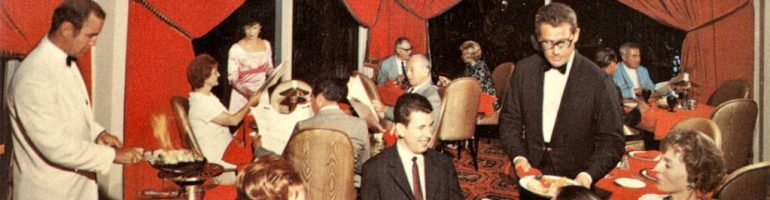
Sometimes after a day of largely fruitless hunting in the antiques marketplace – such as a recent trip to the Brimfield flea market – it takes a while to realize I’ve acquired a gem. In this case it is the above postcard of the Redwood Room in San Francisco’s Clift Hotel, ca. 1965.

I bought it because it has features that I like: diners, a chef, paneling, and red carpeting. From looking at thousands of images I’ve learned that the last two signify Beef, Money, and Masculinity. But it wasn’t until I read the back of the card that I realized it was a “find.”
On the back is the printed message: “The Redwood Room is unexcelled for fine dining. With its huge panels of 2000-year-old Redwood and the spacious bar, it conveys a feeling of masculinity that has for years appealed to leading San Francisco executives and their wives.”

Little did the people on the postcard know, but “barbarians” were about to descend on the Redwood Room.

The hotel opened around 1916 and the Redwood Room and the French Room (shown through the doorway) were created during the 1930s. Both served the same food, but the hyper-manly Redwood Room was also outfitted with a long redwood bar not shown on the card.

Craig Claiborne visited the Clift in 1964, and declared it was one of the few U.S. hotels that still maintained a kitchen of “relative eminence.” Its decor, he said, was of “undeniable elegance” and its tuxedoed waiters exhibited “politesse.” The menu specialty, as might be expected from a restaurant that borrowed dinner carts from London’s Simpson’s, was “absolute first rank” roast beef accompanied by Yorkshire pudding ($4.50).

The postcard photograph was taken when the hotel was at its peak, prior to a slump in the early 1970s brought on by a poor economy aggravated by a policy of turning away guests who violated the hotel’s conservative dress and hairstyle code. When Burt Lancaster and his longhaired son were refused admittance to the Redwood Room in 1971, the item made newspapers across the nation.

The Clift’s president, Robert Stewart Odell, created the dress code. When the musical “Hair” opened at the nearby Geary Theatre in 1968, “They came in from the theater, barefoot and bareback. For a time . . . the Redwood Room entrance was the scene of an almost daily confrontation between longhairs and the maitre d’hotel,” said a manager. The hotel posted signs and ran advertisements that advised: “The Clift Hotel caters to a conservative, well-groomed clientele. Registration, dining room and bar service is refused to anyone in extreme or abnormal dress and to men with unconventional hair styling.”

In response to the hotel’s conservatism, San Francisco Chronicle columnist Herb Caen ridiculed it relentlessly, claiming it maintained “standards set in the Coolidge era as opposed to the Cool era.”

After Odell’s death in 1973, the hotel’s new president (whose hair was longish) welcomed well-dressed stockbrokers, lawyers, and businessmen with hair descending below their collar tops, along with women in pantsuits.

In 1976 the Clift was renamed the Four Seasons-Clift after its acquisition by Toronto’s Four Seasons Hotels, Ltd. After almost two years of remodeling and restoration, the Redwood Room became a bar only rather than a bar and restaurant. Yet it was little changed as that would have brought howls of protest from San Franciscans. A 2001 re-do brought the by-then-shabby Redwood Room bar back into fashionability.

© Jan Whitaker, 2013

1 Comment

Filed under elite restaurants, restaurant decor

Behind the kitchen door

behindthekitchendoor482Although restaurant patrons often question servers about the sources of the food on the menu – whether it’s organic, local, or fresh – they rarely think about the work life of their server or other restaurant personnel. In the words of Saru Jayaraman, author of Behind the Kitchen Door, most “are totally unaware of the horribly exploitative working conditions in restaurants, which affect the quality of our food and, ultimately, our health.”

They do not know, for instance, that many restaurant workers earn less than poverty-level incomes in jobs that are ranked among the nation’s worst paying, are often cheated out of their earnings, and often feel compelled to work when sick. Or that female restaurant workers and all workers of color face discrimination pushing them into the lowest ranks of restaurant jobs where their chances of rising are often blocked.

Jayaraman, one of the founders of the Restaurant Opportunities Center (ROC) in 2002, wrote Behind the Kitchen Door to make the restaurant public as thoughtful about restaurant employees as they are about restaurant food, and to engage them in the movement to better workers’ pay and opportunities. The book intersperses facts about restaurant working conditions with moving stories of individuals.

If you read this book it’s true that you will probably not be quite as carefree about future restaurant experiences as you were before. You may become more selective about which restaurants you patronize. On the bright side, you may decide to help change things.

Consider the following, much of which is from surveys conducted by ROC:

● Restaurant workers made, on average, an annual income of $15,092 in 2009, one third of what other workers in the private sector made on average.

● The $2.13 federal minimum wage for tipped workers, originally calculated as one half the minimum wage (when it was $4.25), has not risen since 1991. (Restaurants are allowed to apply tips to workers’ hourly wages to meet the current $7.25 federal minimum wage.)

Waitstaff● The National Restaurant Association, “dominated by large multinational restaurant corporations that have a lot of money to spend on lobbyists,” such as the Darden group (Red Lobster, Olive Garden, and others) firmly opposes increases in the minimum tipped wage of $2.13.

● States can set a minimum wage for tipped workers, and seven (Alaska, California, Minnesota, Montana, Nevada, Oregon, and Washington) have the same minimum wage for tipped as for non-tipped workers. The NRA claims raising the minimum wage for tipped workers would create a hardship, yet the seven states “all have thriving restaurant industries,” according to Jayaraman. Look at the Department of Labor’s 2013 table “Minimum wages for tipped workers” to see how states compare.

● ROC surveys of more than 4,000 restaurant workers found that 90% had no paid sick days and most could not afford to take off work when sick. According to Jayaraman, the National Restaurant Association “has spent years lobbying to prevent restaurant workers from winning paid sick days. In Washington, D.C., the NRA struck a closed-door deal with the city council to exempt all tipped workers from a local paid sick-leave law.”

● In ROC’s national survey, “three-quarters of all white workers held a position in the front of a restaurant, while less than half of all African American and about one-third of all Latino workers held a front of the house position.” When African Americans and Latinos do work in the dining room they are most likely to be bussers – and to find it hard to get promoted to server with the chance to multiply their earnings times five or more.

These are but a few of the revelations in Behind the Kitchen Door. If the book has a single message about what to do, it is, “Adopt a definition of ‘sustainable food’ that includes sustainable labor practices.”

ROC puts out an annual National Diners Guide. Although it contains relatively few restaurants, it is worth looking at.

© Jan Whitaker, 2013

1 Comment

Filed under miscellaneous, proprietors & careers

Before Horn & Hardart: European automats

Note: In preparing for an interview for a documentary on Automats I looked at new sources I wasn’t aware of when I originally wrote this post in 2010, among them a wonderful German trade publication which pictures European Automats produced by the Sielaff company of Berlin. The booklet, from the Hagley Museum and Library’s digital archives, also contains rare exterior and interior shots of NYC’s first Automat, opened in 1902 by James Harcombe. I’ve made modifications to the post and have included some new illustrations.

AutomatKarlsruhe1903

When automats opened in New York and Philadelphia in 1902 many people were convinced they were an American invention. But they were not. A reporter for the New York Tribune captured a conversation between an American businessman and a foreign guest at James Harcombe’s NYC Automat in 1903, shortly after its opening. After examining the place, the American exclaimed, “What a tribute to American inventive skill!” The man at the next table replied, speaking with an accent, “This is a German idea. There are dozens of these restaurants on the Continent and this one was moved bodily from Berlin …” As the editors of the American Architect and Building News had observed in 1892, when it came to “penny-in-the-slot” machines the U.S. was “far behind the rest of the civilized world.” Even though Americans detested tipping, admired gadgetry, and loved fast service, for some reason the US lagged in the area of automated restaurants.

AutomatDortmund1902BSlot machines actually go back to antiquity. The first may have been a holy water dispenser in Egypt over 2,000 years ago. But it was Germany that developed the first automatic restaurant, applying electricity to the idea of self-service. Germany was also responsible for the term “automat” which in German usage applies to any type of coin-operated dispensing apparatus. The world’s first automatic refreshment dispenser appeared on the grounds of the zoo in Berlin in June of 1895 and was considered a “howling success.” On its first Sunday in operation it sold 5,400 sandwiches, 9,000 glasses of wine and cordials, and 22,000 cups of coffee. The first “automatisches restaurant,” providing hot meals as well as sandwiches and drinks was also designed by Max Sielaff of Berlin. It was presented to the public at a Berlin industrial exposition in 1896.

AutomatWurzburg

The fame of automatic restaurants spread rapidly in 1897 when one was installed and won a gold medal at the Brussels world’s fair. That same year an announcement was made that a similar restaurant would open soon in Philadelphia and in St. Louis – as far as I can determine neither of these became a reality at that time. In 1900 Paris had ‘buffets automatique’ — which resembled automats — all along the boulevards. Automats appeared in London a bit later. Around this time a visitor to St. Petersburg, Russia, found an automatic restaurant by the name of Quisisana, which evidently was the name of a Sielaff competitor in the European automatic restaurant industry. (pictured: top, Karlsruhe, 1903; middle, Dortmund, 1902; bottom, Wurzburg).

© Jan Whitaker, 2010, revised 2013

23 Comments

Filed under lunch rooms, technology

“Distinguished dining” awards

HolidayAward470After World War II American consumers were filled with pent-up demand accrued over years of rationing and deprivation. They wanted to sample the joys of the good life, which included American and world travel, even if only in their imaginations. A sophisticated magazine – Holiday — was created to cater to their aspirations.

HolidayMag1954Holiday’s first issue came out in March 1946. A couple of months later Madison Avenue advertising man Ted Patrick took over as editor. A gourmet and bon vivant, Patrick gravitated toward fine restaurants. In 1952 the magazine began presenting awards to American restaurants that achieved dining distinction, recognizing 49 the first year. Among the winners were Bart’s (Portland OR), Commander’s Palace (New Orleans), Karl Ratzsch’s (Milwaukee), and Win Schuler’s (Marshall MI).

Winners tended to remain on the list, though it was not guaranteed. Win Schuler’s (still in business today) featured steaks, prime rib, and pork chops, and hosted 1,200 patrons a day at its Marshall location [menu below]. In 1971 it won its 20th Holiday award, no doubt not its last.

Even if, as Harvey Levenstein writes in Paradox of Plenty, Holiday stuck to “safe, sound, and usually American” choices where “the steak, lobster, and roast beef syndrome . . . reigned supreme,” its recommendations carried weight and raised the seriousness with which many American diners and restaurateurs regarded restaurants.

HolidayWinSchuler'sMenuTo win, a restaurant’s offerings were supposed to compare to French cuisine. It’s hard to see how a steak-and-baked-potato place could do that, but plenty such restaurants won awards. On the other hand, many of the winners were French inflected, particularly in NYC. A quick scan of restaurants included in the 1976 Holiday Magazine Award Cookbook shows that nearly 25% had French names and many more specialized in French dishes.

What some thought was a bias for restaurants in NYC and, to a lesser degree, NY state prevailed until 1968 when California restaurants won as many awards as New York (even though the number of winners in San Francisco still lagged behind NYC, 17 to 25).

HolidayAug1953The overall volume of winners grew over the years, reaching over 200 by the mid-1970s. The numbers reflected the growth in dining out – and maybe the tendency of award programs to expand. In the beginning whole swaths of the country had nary a winner. Winners would boast that they were “the only” restaurant – for example, in Wisconsin, in the South outside of Florida, among Midwestern states, etc. But over time winners could be found in all parts of the country, requiring some adjustment in the meaning of distinction. Statements appeared saying that awards were not given solely to elegant places. As Patrick’s successor Silas Spitzer said, “Elegance has a certain value in making our judgment of restaurants – but it’s not essential.”

I suspect that the significance of the awards was greatest during Patrick’s editorship, which ended with his death in 1964. The magazine fell on hard times in the 1970s and was sold in 1977. Even earlier the awards were losing clout. Among those in the 1976 cookbook were several that had come under harsh criticism. Many specialized in “continental” cuisine which had lost its glamour by this time, or were considered uninspired. In 1974 John Hess wrote that The Bakery in Chicago and Ernie’s in San Francisco were “disappointing.” NYT critic John Canaday declared in 1975 that Le Manoir was the French restaurant where he had the worst meal in the past 20 months, Le Cirque the “worst restaurant in proportion to its popularity,” and the “21″ Club “least worth the trouble.”

The awards, called Travel-Holiday awards after Holiday’s 1977 merger with Travel, continued until 1989.

© Jan Whitaker, 2013

9 Comments

Filed under guides & reviews

Restaurant as fun house: Shambarger’s

Shambarger'sAI came across this restaurant while looking through lists of winners of Holiday Magazine awards. I was intrigued to learn that Shambarger’s, in the small town of Redkey, Indiana, was one of only five restaurants in that state to win such an award in 1972.

As I learned more about Shambarger’s I had mixed reactions: fascination at its creator’s unstoppable spirit, surprise that it had won prestigious awards, and gratitude that I had never been compelled to sit through a 5- to 6-hour dinner and vaudeville show there.

BeaconSupperClubDenverFor Shambarger’s fell into a category I call the fun house restaurant, once occupied by hotspots of enforced jollity such as Greenwich Village’s Village Grove Nut Club or the Beacon Supper Club in Denver whose owners put on funny hats to make people laugh [pictured]. La Nicoise in Washington, D.C. had waiters on roller skates.

Shambarger’s, adjacent to a railroad track, resembled an abandoned building on the outside, a junk shop on the inside [see painting below by Clyde Thornburg, 1971]. Its proprietor John Shambarger “performed” most of the seven-course dinner preparation in front of 50 or so guests who made reservations many months in advance, often traveled some distance, and paid about $100 a person in today’s dollars.

Shambarger'sClydeThornburg1971Making ten or more costume changes an evening, as a pirate, Tiny Tim, a Hawaiian dancer, etc., John chopped and mixed while singing, pattering, or loudly playing records keyed to each dish. Sometimes he told jokes, kissed women diners, or screamed ‘Aaayyyyy’ in people’s ears in concert with a Spike Jones record.

And all this without cocktails! No alcoholic drinks were served, except in later years when dinner began with punch bowl of “Bloody Redkey” made of tomato juice spiked with a Budweiser six-pack. Burp.

Holiday magazine’s volunteer judges in the 1960s and 1970s had a weakness for French cuisine. Which was what Shambarger’s provided, sort of. The menu was actually as jumbled as the decor of old clocks, menus, mirrors, lamps, and a moose head wearing a hat. It always included a main dish of Imperial Prime Ribs of Beef Flambee (in rum) and a dessert of sky-high strawberry pie (see above), but the first five courses varied. In one 1968 account they included – in a sequence that is perplexing – chicken soup, fresh fruit cup, corn fritters rolled in powdered sugar, shrimp, and guacamole with John’s special dressing.

Recipes for Shambarger’s guacamole and “Antique Salad Dressing” are furnished in the Holiday Magazine Award Cookbook (1976). I like guacamole and do not think it needs a dressing, especially not one made of cottonseed oil, vinegar, chopped onions, loads of sugar, catsup, concentrated lemon juice, and apple butter.

According to newspaper accounts, Redkey’s townspeople rarely ate at Shambarger’s, but they were always intrigued by the influx of well-dressed visitors from afar. In the words of Jayne Miller, who grew up in the area and now heads up Historic Redkey, Inc. (and provided information and images for this story), the locals knew that “magic” took place inside Shambarger’s humble structure.

The restaurant had its fans and its detractors, but enough of the former to keep Shambarger’s in business under John’s management from the 1960s through the early 1980s.

© Jan Whitaker, 2013

55 Comments

Filed under Offbeat places, proprietors & careers

Dressing for dinner

FarmersinCafe

In the vast majority of eating places customers never had to be told to “come as you are.” That’s how they were going to come – or else they weren’t coming at all. Farmers wearing overalls were likely to show up in small town cafes, while white collar workers in shirtsleeves grabbed seats in city lunchrooms.

Nevertheless, there was a segment of society that “dressed” for dinner. People of high society were accustomed to donning formal wear for dinner parties given in private homes. Then, as New York society began to expand beyond “the 400″ in the late 1890s, growing ranks of wealthy newcomers adopted formal dress for dinners in hotel dining rooms and swanky restaurants.

Rector's1913Geo.HectorInc

In the late 1890s men began to wear tuxedos for such outings. Women wore long gowns, cut lower than their daytime dresses. [Rector’s, 1913, illustrated] But the era of luxury dressiness was brief. After WWI, with prohibition forcing the closure of many fine restaurants and “lobster palaces,” more informal clothing became acceptable in most restaurants. What was known as afternoon wear – coats and neckties for men and daytime dresses and hats for women – became the new standard. But even that dress standard tended to erode.

It isn’t as easy to enforce a dress code as it might seem. As long as a restaurant isn’t using a dress code as a foil for illegal discrimination, it can set the dress bar as high as it wants. But will customers constantly challenge it? Even worse, will they shun the restaurant entirely?

Rejection of the Café de l’Opera’s formal wear requirement was cited as one reason for its sudden demise in NYC in 1910. And the 1930s Depression encouraged a lower standard. After World War II some predicted a return to elegance, but that proved shaky. Many well-established fine restaurants struggled with turtleneck-wearing male guests in the 1960s and 1970s. At New York’s “21″ the maitre d’ developed a practice of requiring necktie-less men to put on a hideously garish tie that he provided. This had the effect of either making them (a) leave, or (b) feel so embarrassed they never dared come without a tie again. Other places relented and admitted guests in “dressy casual” wear.

Pittari's1963NewOrleansA new restaurant wishing to enter the esoteric fine dining ranks, underwritten by a dining room of well-dressed guests,  has to ask itself if it can pull it off. If it does not draw the “top-drawer” clientele it aims for it may find its dress code impossible to enforce. For instance, resorting to posting a “Dress Code for Ladies” notice near the front door, as a San Diego reviewer said of a restaurant there in 1981, is “simply tacky.” It is scarcely better than a sign reading “No shirt, no shoes, no service.”

Likewise, a restaurant may portray itself as elegant, on a postcard, publicity photo, or website, but rarely will the actual guests look quite so sophisticated as those pictured. And, needless to say, fancy dress does not in itself project elegance.

SultansTableRestDunesHotel

Today there is a small top tier of restaurants whose guests would not dare to wear shorts, t-shirts, baseball caps, or overlarge rubber-soled shoes. But, most restaurants are far more informal. Overall, “come as you are” – a phrase first used by churches — has remained in effect.

The phrase itself attained widespread use by restaurants in the 1960s when it appeared in advertisements for suburban establishments wishing to attract families. A new segment of chain restaurants came into being, a few notches less casual than fast food establishments, but entirely non-intimidating in their standardized cuisine, friendly service, and “fun” decor. Philip Langdon, in his book Orange Roofs and Golden Arches, sees the “chain dinnerhouses” as coming from the West (where restaurant dress rules were always more relaxed). Examples included Victoria Station, originating in San Francisco, and Steak & Ale, from Dallas.

At the present moment, at least, it is difficult to imagine a return to turn-of-the-century formality. I’d guess that even the 1% don’t like to dress up.

© Jan Whitaker, 2013

10 Comments

Filed under patrons, restaurant customs

Dining on the border: Tijuana

TijuanaGardenCafe1922Borderlands are fascinating social and cultural mixing bowls. Their restaurants exemplify how variable these places can be. Lacking tradition as well as a local clientele and culture, there is little shaping them other than market forces. In Tijuana prominent historical factors shaping the market were drinkers’ desire for alcohol and restaurant owners’ need to recoup lost business.

The history of restaurants and cafes in Tijuana is marked by all the instability and calamity that the restaurant business is known for – and then some! Partnerships shifted, scandals erupted, and fires swept through the main street, Avenida Revolucion.

When Prohibition became the law in the United States, a number of San Diego restaurant, café, and bar owners – Italians, Jews, Slavs, and others — set up shop a stone’s throw away, in Tijuana, then a village of little more than 1,000 people. American visitors who began to head there did not go to soak up Mexican culture, but to escape restraints [see 1922 advertisement above]. Tourist eating places, all furnishing drinks and often entertainment, had names like Johnny’s Place, Aloha [American teens in Aloha Cafe, 1940s, below] , and Alhambra. Few were run by Mexicans and Mexican food ranked low on the culinary scale.

From the point of view of San Diego’s anti-alcohol, cafeteria-loving reformers, the drinking, gambling, and prostitution that went on in Tijuana made it a hell hole. Tijuana’s reputation, of course, did not stop everyone from going there, even many respectable, well-off San Diegans and Los Angelenos, as well as civic organizations. Determined to limit vice, prohibitionists waged vigorous battle to restrict passage by shortening border crossing hours, finally succeeding in closing the border from 6 pm to 6 am in 1926.

TijuanaAlohaCafeca1949

Despite the curfew, San Diego’s hotel and restaurant industries protested in 1931 that the 6 pm closing “ha[d] not prevented one single person from going to Tijuana,” and had actually reduced their business by 25%. They alleged that visitors went for the whole day or stayed overnight, enabling them to engage in more drinking, gambling, or whatever than previously. Tijuana flourished, opening more cafes, clubs, and hotels.

The better restaurants specialized in “international cuisine” which consisted mainly of steaks and seafood along with Italian, French, German, and Mexican dishes. In this category were restaurants variously operated by Alex and Caesar Cardini of salad fame. Julia Child wrote in her 1975 book From Julia Child’s Kitchen that she remembered going to Caesar’s for lunch in 1925 or 1926 with her parents. They had heard of his special salad and were eager to taste it. “Caesar himself rolled the big cart up to the table, [and] tossed the romaine in a great wooden bowl,” she wrote.

The border curfew was relaxed in1932 and lifted entirely in 1933. But if that had an adverse impact on Tijuana tourist trade, it was nothing compared to the blows delivered by the repeal of U.S. Prohibition in 1933 and a Mexican gambling ban in 1935. Tijuana bartenders correctly predicted few bars and cafes would survive. Sure enough, proprietors headed back to the U.S. Caesar Cardini opened a place in San Diego in 1936.

TijuanaGermanrestaurant

The tourist economy waxed and waned thereafter, thanks to such things as the 18-year-old drinking age, the availability of marihuana, and incidents of violence. Mexican cuisine became more popular in Tijuana’s tourist district in the latter 20th century. Richard Nixon, then Vice President of the United States, ordered Mexican dishes and German beer in an informal visit to the Old Heidelberg there in 1960.

Today Tijuana is a large global city, yet Americans tend to stick to the main tourist avenue as of old. There is a diversity of restaurants, many with Hispanic names and owners. Caesar’s has continued, off and on, since the Cardinis departed. Yet, as much as I’d like to believe a recent comment about it on TripAdvisor.com (“nice place to feel the real culture and history of Tijuana”), I have to ask, “Real culture? Real history? What?”

© Jan Whitaker, 2013

2 Comments

Filed under miscellaneous, night clubs

Postscript: beefsteak dinners

healysphotoThis year marks the 100th anniversary of the Armory Show, an art exhibit that introduced Americans to modern art, most notably to Marcel Duchamp’s Nude Descending a Staircase [No. 1]. Last week I received a copy of the Smithsonian’s Archives of American Art Journal which commemorates the show. To my surprise, the journal contains an article (Meat and Beer, by Darcy Tell) about a beefsteak dinner given by the artists who organized the Armory Show in gratitude to the press whose extensive coverage helped make the show a popular success.

The Armory Show was largely organized by American artists Walt Kuhn, Arthur Davies, and Walter Pach. (Kuhn’s and Pach’s papers are preserved in the Archives of American Art, Smithsonian Institution.)

In an earlier post I wrote about beefsteak dens, dungeons, and caves where men put on butchers’ aprons and threw aside the trappings of civilization. Sitting uncomfortably on boxes in dingy cellars, they drank beer and ate steaks without silverware or napkins.

BeefsteakHealy'sADV1916The 1913 Armory Show dinner was held at Healy’s restaurant, on 66th Street in NYC, a popular place for these feasts. It had three rooms dedicated to them: the Dungeon, the Jungle Room, and the Log Cabin Room. The artists and their “friends and enemies from the press,” as they were designated on the menu, gathered in the Log Cabin Room, probably the most civilized space of the three, furnished with long tables and chairs and complete with tablecloths and napkins. While the guests ate, someone read aloud humorous, insiderish (fake) telegrams, even one purporting to be from Gertrude Stein [see link below].

I have to admit I was a tiny bit disappointed to learn that such a (presumably) sophisticated group of men as was represented at this dinner would choose to attend a beefsteak at Healy’s. By 1913, if not long before, beefsteaks were recognized as evenings of orthodox jollity for business men and conventioneers. Yet, the Association of American Painters and Sculptors paid out $234 [at least $5,500 today] for a dinner much like that enjoyed by the Paper Box Makers Association and the League of Associated Hat Men.

And, just like the hat men and box makers, they took away a regulation group photo to show for it.

© Jan Whitaker, 2013

5 Comments

Filed under atmosphere, patrons