 It’s so hard to find anything about the history of Afro-American women in restaurants that I decided to go ahead with a sketchy story rather than none at all. As far as the “historical record” goes, you’d be tempted to think that they had no place in restaurants. That’s certainly false, but they were frequently out of sight. The notice placed by John Kirk in a New York City paper sums up black women’s primary role in public eating places: as cooks and kitchen helpers. Kirk advertised in 1781, “Wanted to hire an active Negro Wench, used to a kitchen, with a good character.”
In his 1899 classic The Philadelphia Negro, W. E. B. Du Bois praised black men for their prominent place in the city’s catering business, writing of “self-reliant, original business men, who amassed fortunes for themselves and won general respect for their people.” He mentioned no women, yet there is reason to think that black women not only did much of the cooking in both black and white restaurants but ran many of the eating places in black communities too. They rarely made fortunes but surely must have commanded respect.
Although black women are nearly invisible in 19th-century documents, we see glimpses of them near its end. Several women ran Denver restaurants in the 1880s and 1890s, including Miss Jane Outland in the 1880s and at least six others in the 1890s, including Tennessee-born Callie Fugett who kept a restaurant on Market Street. In Washington D.C. in the late 1890s a former slave known as Madame Early provided chicken dinners in a cabin called the Café Du Chat Noir. I wonder if she was Haitian.
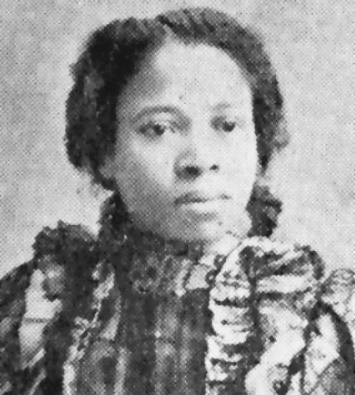 The first meeting of Booker T. Washington’s National Negro Business League in 1901 reported that women ran restaurants in Denver as well as Jacksonville and Tampa FL, including two in Tampa that were “among the best in the city.” A few years later, according to a directory of Afro-American businesses in Memphis, about half of the restaurants listed were run by women. Miss Lucy Hughes (pictured) ran the Climax Café and Ice Cream Parlor on N. Main where she sold “hot and cold lunches at all hours,” while residing with her mother, son, brother, and one male lodger who worked as a kitchen helper.
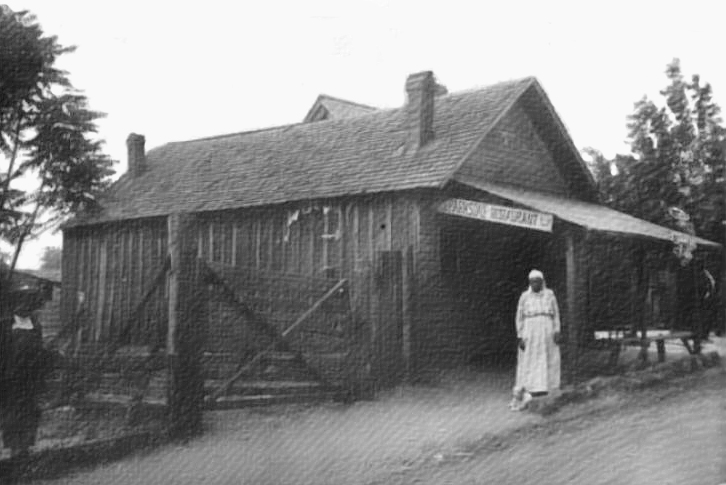 Overall, black women had even fewer employment opportunities than black men. The Department of Interior reported that in 1910 almost half of the 2 million employed black women were farm laborers. Private laundresses came next in the list, followed by cooks in private homes, hotels, and other settings. Only 2,734 women ran restaurants, probably humble eateries such as the one pictured here, one of four run by black business women in Gainesville GA ca. 1913.
After World War I things began to change in big cities. Middle-class black women opened fashionable tea rooms where they provided dainty lunches and hosted afternoon card parties. Chicago’s 1923 blue book of Afro-American society lists a number of these, such as Mrs. E. H. Hord’s Delmonico Tea Room on Prairie Avenue. In Pittsburgh, Mrs. A. E. Bush, a former pharmacy manager and wife of a prominent life insurance executive, opened the Melrose Tea Room which she decorated in old rose and blue. I have found no record of how black tea room operators dressed their black servers but I strenuously doubt they put them in mammy costumes as did so many white restaurateurs of the 20th century.
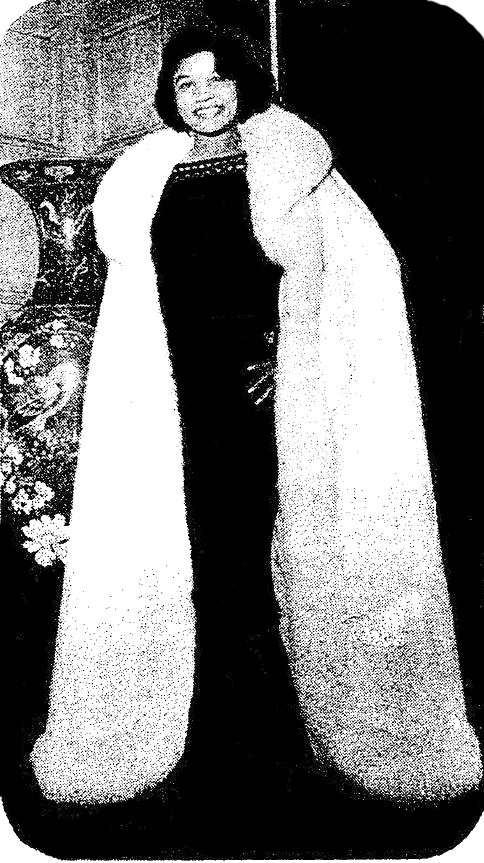 After the 1960s some black women who ran or cooked in restaurants acquired celebrity status. After her divorce, Helen Maybell opened the Soul Queen Café on Chicago’s near south side. In the 1970s the statuesque Helen (pictured), who was active in the NAACP and loved elegant gowns and furs, opened a second restaurant in which she hosted fashion shows. Leah Chase (who co-owned and cooked at Dooky Chase’s in New Orleans) and Edna Lewis (who promoted Southern cooking, authored cookbooks, and cooked for Café Nicholson in Manhattan, Gage & Tollner in Brooklyn, and others) became venerated figures in their lifetimes.
© Jan Whitaker, 2010
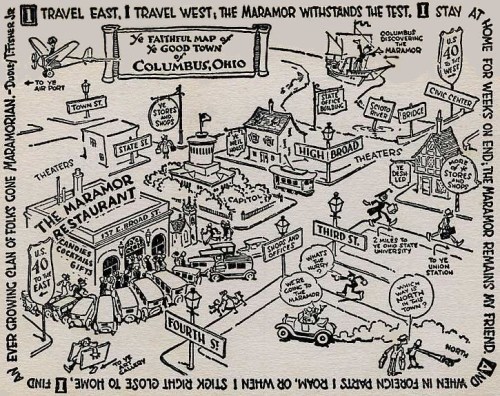 Imagine a restaurant management style diametrically opposed to Gordon Ramsay’s (as he takes command in nightmarish kitchens on TV), and you might well be picturing how Mary Love ran her restaurant, The Maramor in Columbus, Ohio.
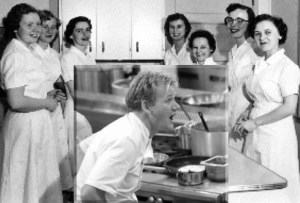 In 1941 Mary described to a home economics conference how she ran her kitchen. She avoided frying and stressed the nutritional properties of food, preparing fresh vegetables to retain flavor and vitamins. Each day her planning department presented the production manager with the day’s menus, while a weighing and measuring specialist prepared trays with complete ingredients for every dish. The trays were given to the cooks, along with detailed instructions for cooking. “This,” Mary said, “helps them to keep their poise and self-respect through the working day, and a cook with poise and self-respect has a better chance of turning out a good product.” (Gordon?)
 Historically, few tea rooms have enjoyed financial success. So, while “empire” may be a bit grandiose, it’s hard not be impressed by the tea rooms enterprise Ida Frese and her cousin, Ada Mae Luckey, built in New York City in the early 20th century. Ida and Ada, both from a small town near Toledo OH, struck it rich by winning the patronage of wealthy society women. Over time they owned six eating places: the Colonia Tea Room (their first), the 5th Avenue Tea Room, the Garden Tea Room in the O’Neill-Adams dry goods store, the Woman’s Lunch Club, and two Vanity Fair Tea Rooms.
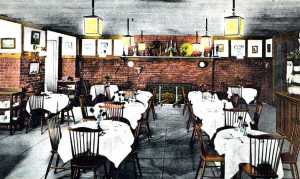 Clearly they valued a good location. The Vanity Fair at 4 West Fortieth Street began in 1911, bearing a notice on its postcard (pictured) that it was across the street from the “new” public library which also opened in 1911. The tea room’s upstairs ballroom was the site of many a party, such as a Shrove Tuesday celebration in February 1914 attended by 150 masked guests.
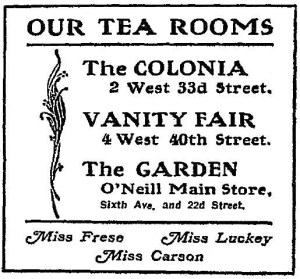 Adding to their financial success were several real estate coups. In 1914 Ida somehow obtained a lease on a coveted Fifth Avenue property. Her feat astonished everyone who followed real estate deals since the owner, a granddaughter of William H. Vanderbilt, had turned down repeated offers from would-be lessees and buyers. The house at #379 was one of the last residences on Fifth Avenue between 34th and 42nd streets which had not been turned into a store or office building. Ida and Ada moved the Colonia, previously on 33rd Street, to this address and rented the remaining space to retail businesses, dubbing the structure the “Women’s Commercial Building.”
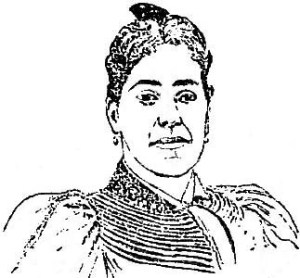
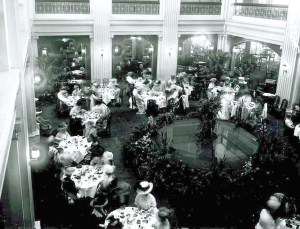 In 1890 Harry Gordon Selfridge, manager of Field’s in Chicago, took the then-unusual step of persuading a middle-class woman to help with a new project at the store. Her name was Sarah Haring (pictured) and she was the wife of a businessman and a mother. In the parlance of the day, she was needed to recruit “gentlewomen” (= middle-class WASPs) who had “experienced reverses” (= were unexpectedly poor), and knew how to cook “dainty dishes” (= middle-class food) which they were willing to prepare and deliver to the store each day.
 And so — despite Marshall Field’s personal dislike of restaurants in dry goods stores — the Selfridge-Haring-gentlewomen team created the first tea room at Marshall Field’s. It began with a limited menu, 15 tables, and 8 waitresses. Sarah Haring’s recruits acquitted themselves well. One, Harriet Tilden Brainard, who initially supplied gingerbread, would go on to build a successful catering business, The Home Delicacies Association. Undoubtedly it was Harriet who introduced one of the tea room’s most popular dishes, Cleveland Creamed Chicken. Meanwhile, Sarah would continue as manager of the store’s tea rooms until 1910, when she opened a restaurant of her own, patenting a restaurant dishwasher in her spare time.
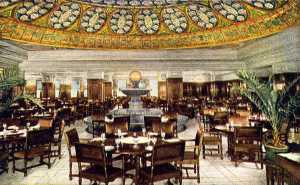 A graduate of Chicago’s School of Domestic Arts and Sciences named Beatrice Hudson opened the all-male sanctum Men’s Grill (pictured) about 1914 and was responsible for developing a famed corned beef hash which stayed on the menu for 50+ years. Later she would own several restaurants in Los Angeles, coming out of retirement at age 76 to manage the Hollywood Brown Derby and again in her 80s to run The Old World Restaurant in Westwood.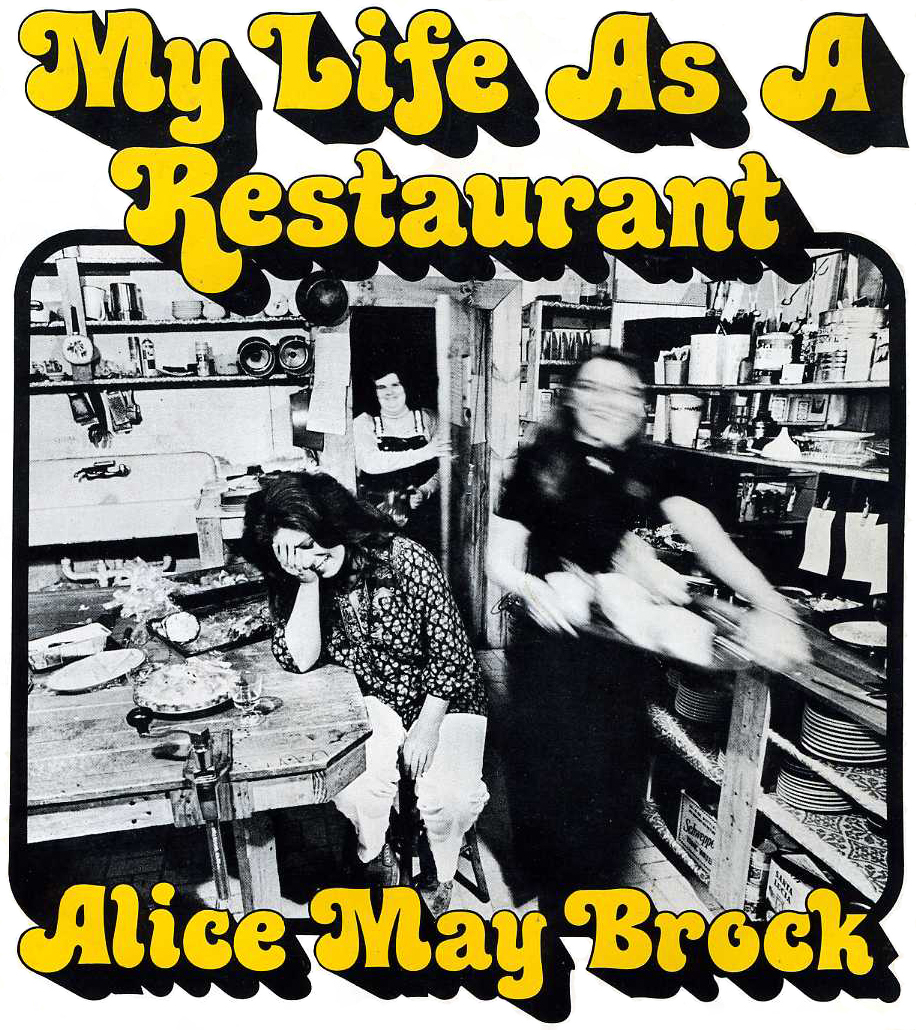

 In interviews and in her two books Alice espoused the value of fresh ingredients, garlic, meals with friends, and an experimental approach to cooking. Her words convey a free-wheeling, irreverent outlook. Some examples:



 It's great to hear from readers and I take time to answer queries. I can't always find what you are looking for, but I do appreciate getting thank yous no matter what the outcome.