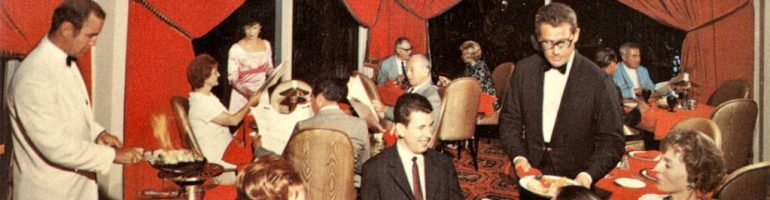
 Hundreds, maybe thousands, of celebrities have gone into the restaurant business when their careers waned. Their level of direct involvement may be high or low but all these ventures bank on the idea that a famous name will attract customers.
When Evelyn Nesbit opened her NYC tea room in May of 1921 she made sure that her name was prominently displayed. Located on West 52nd street just off Broadway, the sign saying “Evelyn Nesbit’s Specialty Shop” was visible from the theater district’s Great White Way.
 She was then in her mid-30s, years away from her peak as a teenage artist’s model [above, age 16], “Gibson Girl,” Floradora showgirl, and millionaire’s wife. Her fame derived not only from her former good looks – from the years her image was displayed everywhere – but also from her involvement in a romantic triangle with prominent architect Stanford White and her insanely jealous husband Harry Thaw. After Thaw shot and killed White in 1906, she became notorious as a witness during the sensational “trial of the century.”
By 1921 she had divorced Thaw, had a son, returned sporadically to the stage, taken up sculpture, published a memoir, and married a second husband from whom she was estranged. Characteristically, she was in debt, owing the equivalent of a year’s income to a dress shop.
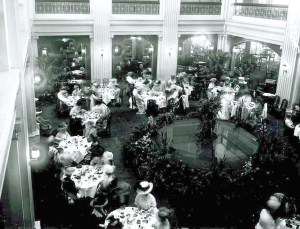
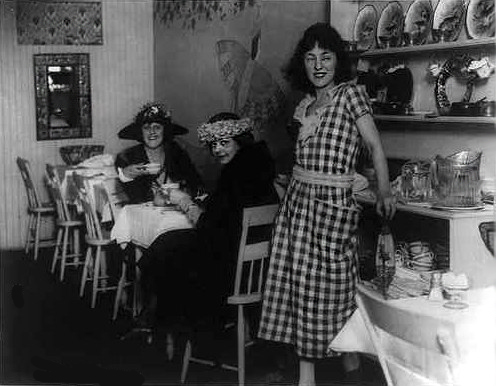 Her tea room enjoyed such a short, unsuccessful run that it is hard to learn much about it. Presumably she raised funds from friends to furnish it and pay the $300 monthly rent. She lived in two rooms upstairs. One account described the 100-seat tea room as “super-beautiful” and furnished with rich carpets, Oriental tapestries, and exotic plants, a description at odds with the homey scene in a 1922 photograph shown here.
In several interviews Evelyn made what sound like preposterous claims that she served food available nowhere else. “I am revolutionizing the restaurant business in New York,” she boasted. Her specialties included deep dish apple pie and ice cream which she said she made herself. “I amazed the chef, let me tell you, with what I know about cooking,” she said.
I found it surprising that she claimed to be a good cook; however I did discover that when she left the US for Paris in 1910, surely pregnant with her son, she told friends that she planned to rent a modest apartment on the outskirts of Paris, study sculpture, and do her own cooking. Although she evidently hired someone else to cook for the tea room she said she furnished the recipes and did all the buying.
Things went wrong fast. During the first six months she (barely) survived three robberies, one kidnap attempt, one suicide attempt, and eviction for nonpayment of rent. On a second try in January of 1922 she was successfully evicted, after which she returned to cabaret dancing. In 1926, while performing at Chicago’s Moulin Rouge, she tried to kill herself again by swallowing Lysol. Her troubled brother took his own life two years later.
But Evelyn achieved happiness in later life and lived on to age 81. She moved to Southern California near her three grandchildren and their father, a pilot for Douglas Aircraft. She returned to her lifelong interest in art, teaching sculpture and ceramics at a community center. Easing her constant need for money, she received a $10,000 bequest when Thaw died in 1947 and was paid more than $50,000 for use of her life story in the 1955 movie “The Girl in the Red Velvet Swing.”
After many years away, she visited New York in 1955, reflecting on the great meals she had eaten during her heyday. Passing the former location of Sherry’s, she recalled “the wonderful terrapin they served.” She expressed surprise that she had managed to stay slim in her youth. “I ate so much in the old days I still wonder why I didn’t get fat,” she said referring to another performer’s, Lillian Russell’s, “upholstered” appearance. Heading off to a restaurant dinner, the ever-unsentimental Evelyn confessed, “You know what I really want to see most in New York? A nice big broiled Maine lobster.”
© Jan Whitaker, 2012


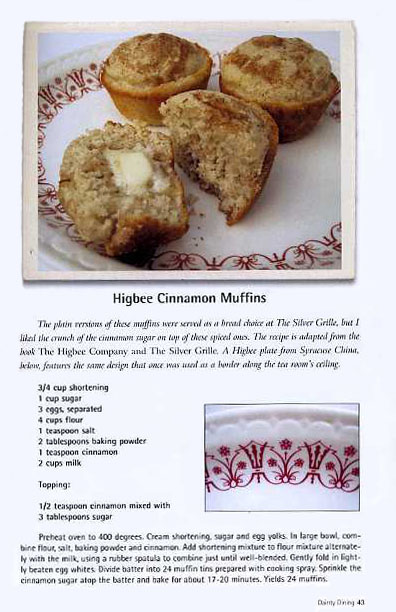

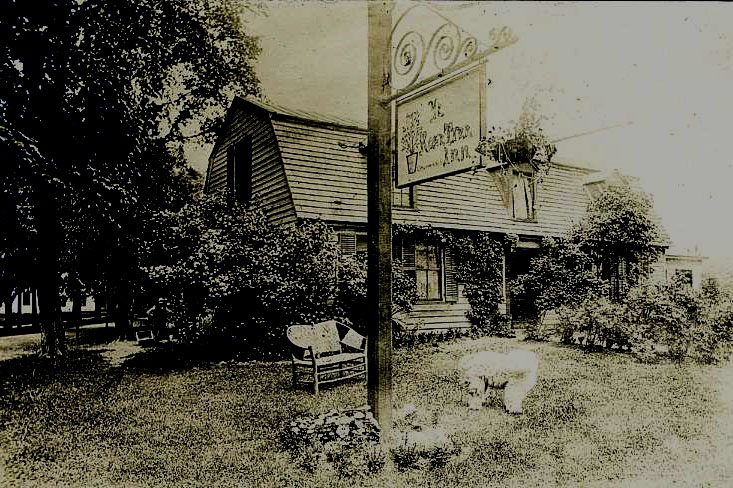
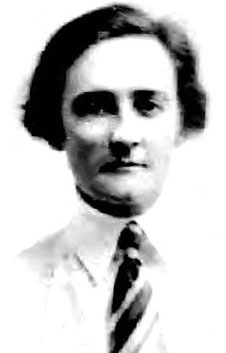
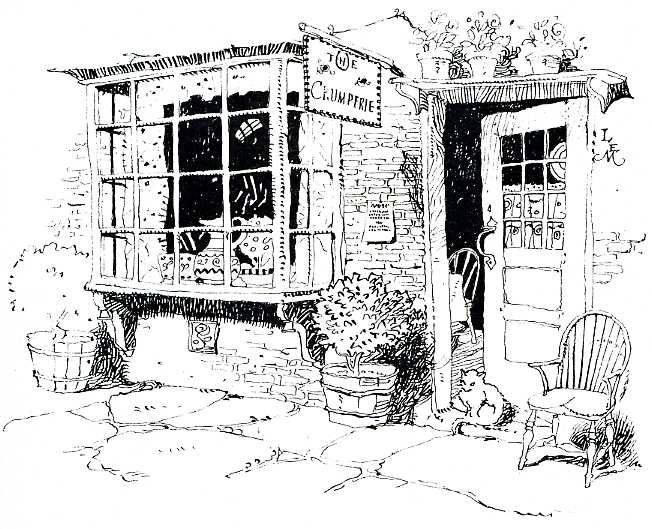
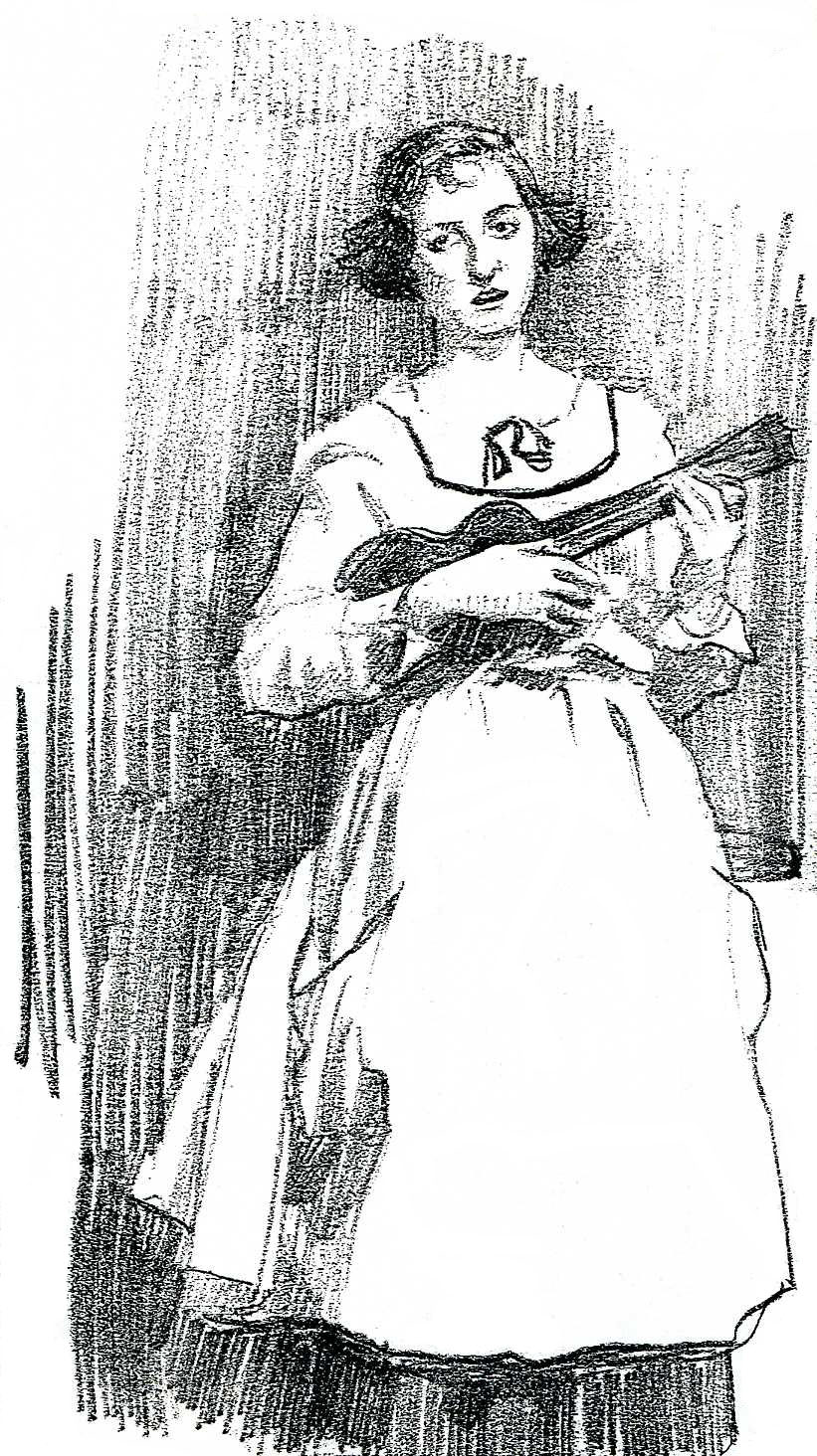
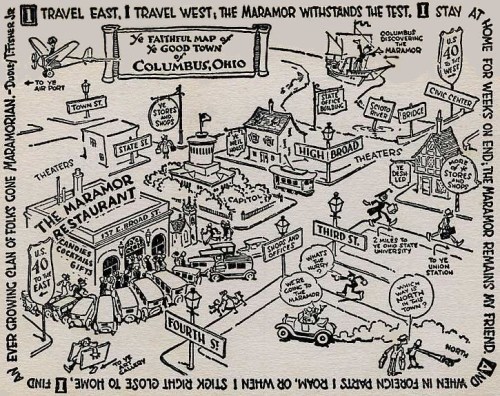 Imagine a restaurant management style diametrically opposed to Gordon Ramsay’s (as he takes command in nightmarish kitchens on TV), and you might well be picturing how Mary Love ran her restaurant, The Maramor in Columbus, Ohio.
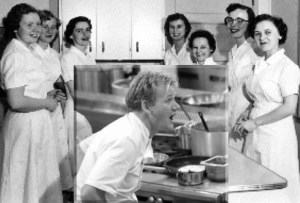 In 1941 Mary described to a home economics conference how she ran her kitchen. She avoided frying and stressed the nutritional properties of food, preparing fresh vegetables to retain flavor and vitamins. Each day her planning department presented the production manager with the day’s menus, while a weighing and measuring specialist prepared trays with complete ingredients for every dish. The trays were given to the cooks, along with detailed instructions for cooking. “This,” Mary said, “helps them to keep their poise and self-respect through the working day, and a cook with poise and self-respect has a better chance of turning out a good product.” (Gordon?)
 Historically, few tea rooms have enjoyed financial success. So, while “empire” may be a bit grandiose, it’s hard not be impressed by the tea rooms enterprise Ida Frese and her cousin, Ada Mae Luckey, built in New York City in the early 20th century. Ida and Ada, both from a small town near Toledo OH, struck it rich by winning the patronage of wealthy society women. Over time they owned six eating places: the Colonia Tea Room (their first), the 5th Avenue Tea Room, the Garden Tea Room in the O’Neill-Adams dry goods store, the Woman’s Lunch Club, and two Vanity Fair Tea Rooms.
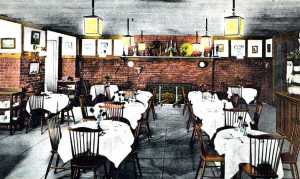 Clearly they valued a good location. The Vanity Fair at 4 West Fortieth Street began in 1911, bearing a notice on its postcard (pictured) that it was across the street from the “new” public library which also opened in 1911. The tea room’s upstairs ballroom was the site of many a party, such as a Shrove Tuesday celebration in February 1914 attended by 150 masked guests.
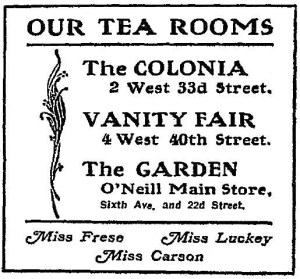 Adding to their financial success were several real estate coups. In 1914 Ida somehow obtained a lease on a coveted Fifth Avenue property. Her feat astonished everyone who followed real estate deals since the owner, a granddaughter of William H. Vanderbilt, had turned down repeated offers from would-be lessees and buyers. The house at #379 was one of the last residences on Fifth Avenue between 34th and 42nd streets which had not been turned into a store or office building. Ida and Ada moved the Colonia, previously on 33rd Street, to this address and rented the remaining space to retail businesses, dubbing the structure the “Women’s Commercial Building.”
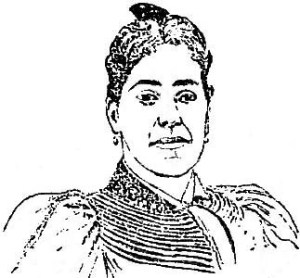
 In 1890 Harry Gordon Selfridge, manager of Field’s in Chicago, took the then-unusual step of persuading a middle-class woman to help with a new project at the store. Her name was Sarah Haring (pictured) and she was the wife of a businessman and a mother. In the parlance of the day, she was needed to recruit “gentlewomen” (= middle-class WASPs) who had “experienced reverses” (= were unexpectedly poor), and knew how to cook “dainty dishes” (= middle-class food) which they were willing to prepare and deliver to the store each day.
 And so — despite Marshall Field’s personal dislike of restaurants in dry goods stores — the Selfridge-Haring-gentlewomen team created the first tea room at Marshall Field’s. It began with a limited menu, 15 tables, and 8 waitresses. Sarah Haring’s recruits acquitted themselves well. One, Harriet Tilden Brainard, who initially supplied gingerbread, would go on to build a successful catering business, The Home Delicacies Association. Undoubtedly it was Harriet who introduced one of the tea room’s most popular dishes, Cleveland Creamed Chicken. Meanwhile, Sarah would continue as manager of the store’s tea rooms until 1910, when she opened a restaurant of her own, patenting a restaurant dishwasher in her spare time.
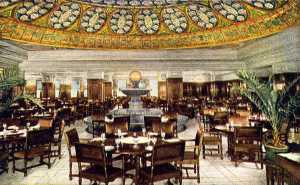 A graduate of Chicago’s School of Domestic Arts and Sciences named Beatrice Hudson opened the all-male sanctum Men’s Grill (pictured) about 1914 and was responsible for developing a famed corned beef hash which stayed on the menu for 50+ years. Later she would own several restaurants in Los Angeles, coming out of retirement at age 76 to manage the Hollywood Brown Derby and again in her 80s to run The Old World Restaurant in Westwood.

 It's great to hear from readers and I take time to answer queries. I can't always find what you are looking for, but I do appreciate getting thank yous no matter what the outcome.

 Restaurant-ing through history