Category Archives: restaurant customs

Toothpicks

Although toothpicks have many uses in the home, their career as a tool for picking teeth is mostly associated with restaurants. And, like so many aspects of restaurant history, their story says a lot about social class. The short version is that when using toothpicks was viewed as a custom of European elites it was approved in the U.S., but when American working class men adopted it, it became taboo. Today the use of toothpicks after a meal is infrequent compared to what it was roughly 100 years ago when it was at its peak.

In the Quick Lunch era of the early 20th century, toothpicks became more than a means to loosen bits of food stuck in tooth crevices. They were assertions of masculinity, essential accessories for the male lunchroom crowd. A dangling toothpick sent a macho signal as speedily as a cigarette between the lips of 1960s filmstar Jean Paul Belmondo.

In the 1890s lunchroom patrons felt entitled to toothpicks just as much as to a paper napkin and a glass of water. When a distinguished Afro-American man was told by a Kansas City restaurateur in 1890 that he would be charged an exorbitant $1 for pie and coffee, he seemed to consent but later walked out saying “Sue me for the rest” as he tossed a dime on the counter. And he grabbed a handful of toothpicks on the way, staking a claim to equality in an unmistakable fashion.

Arbiters of etiquette deplored toothpicks. Starting in the late 19th century when the picks came into fairly common use in the United States, and for the next 100 years at least, a string of advice columnists from Mrs. John Sherwood to Ann Landers railed against them. All declared using toothpicks in public vulgar and disgusting. “Dear Abby” echoed her forebears when she roundly condemned public toothpick use in 1986, calling it “crude, inconsiderate, and a show of bad manners.”

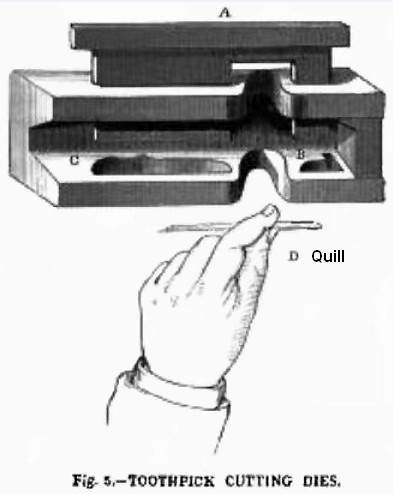
Goose quill toothpicks had been acceptable in the early republic, furnished even at such elite places as Delmonico’s. But as mass-produced wooden picks made of birch and poplar became available in the 1870s, prices fell drastically until even the cheapest eatery could afford to dispense them. Their social status plummeted.

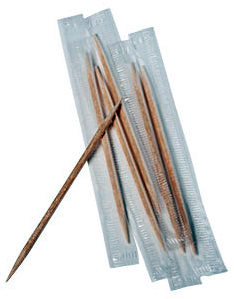
Toothpick haters frequently pointed out that providing toothpicks in restaurants was as ridiculous as handing out toothbrushes. It’s interesting that in the early 20th century another form of tabletop hygiene, the finger bowl, was also about to go under attack. Strangely, since toothpicks and finger bowls were intended for cleanups, they were criticized as germ spreaders. Because toothpicks were provided loose in a bowl or cup, restaurant patrons often grabbed them helter skelter, fingering many they left behind. Trains eliminated them in their dining cars and Minneapolis health authorities banned open containers of toothpicks in 1917.

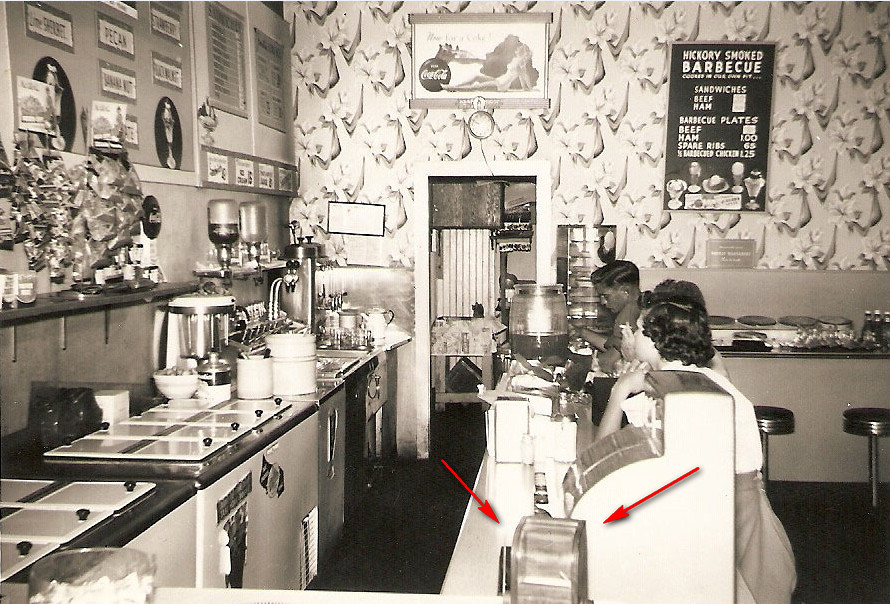
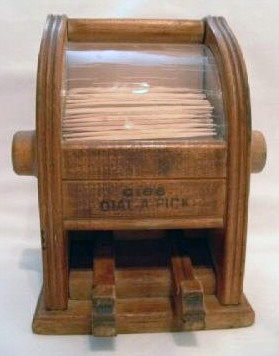
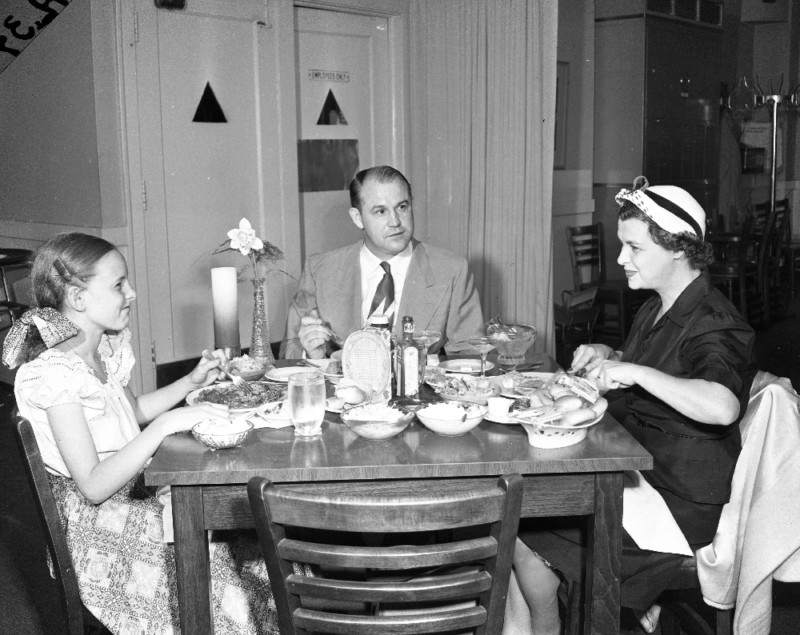
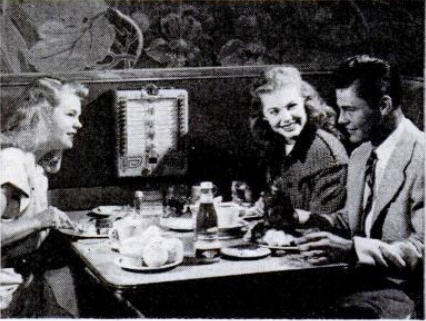
Another solution to the germy toothpick bowl and the habit of grabbing handfuls was bound to occur to America’s legion of gadget inventors. Presto! One-at-a-time toothpick dispensers. [shown here and in restaurant above, the Dial-A-Pic]

Restaurant owners would have been just as happy to see toothpicks disappear altogether. A NYC restaurant owner confessed in 1904 that he disliked the sight of men picking their teeth at his tables as much as that of others sticking knives in their mouths. But he took a pragmatic stance, admitting that “we cannot conduct examinations in table manners before we admit persons to our dining-rooms.”

Today toothpick usage is reportedly unpopular with younger diners and has been dropping off since World War II. So I was surprised to see a little cup of wrapped toothpicks in an upscale restaurant in Kansas City this weekend. Now I’ll be on the lookout everywhere I go.

© Jan Whitaker, 2012
14 Comments

Filed under lunch rooms, patrons, restaurant customs

Restaurant booth controversies

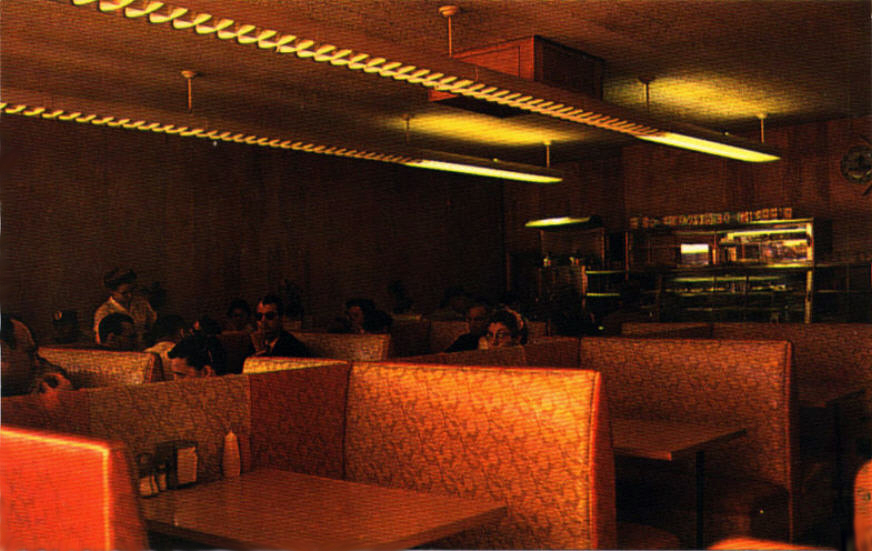
Public eating places have historically presented an array of dining arrangements, from sharing tables with strangers to occupying highly private dining rooms and many gradations in between. In fact, the development of individual tables – as opposed to sharing the host’s own dining table with his family and other customers – marks the emergence of the “restaurant” in late 18th-century France.

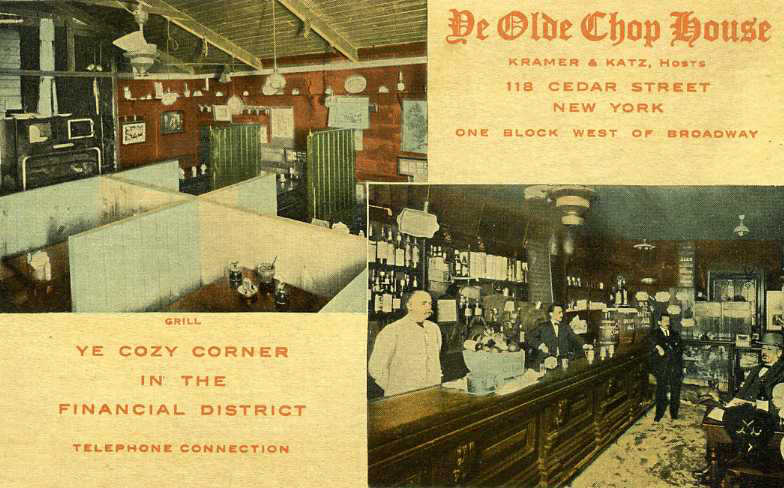
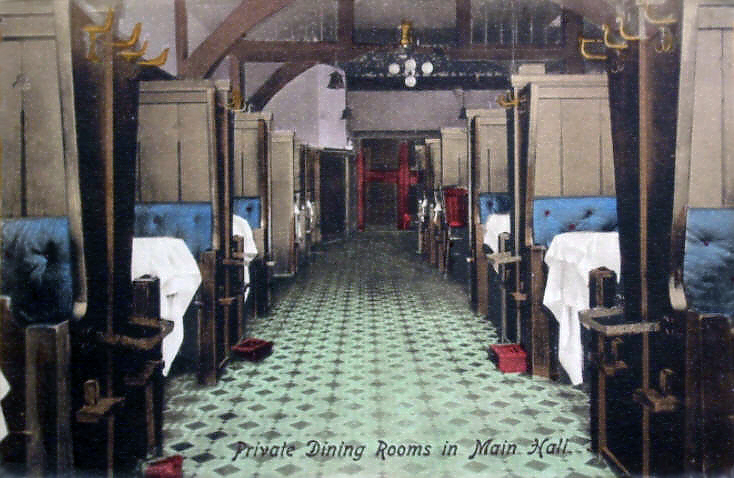
Booths are a dining option that give a measure of privacy within a public room that is often furnished with tables in the open as well. Private dining rooms were found in taverns and coffee houses of the Revolutionary era in America, but there were no booths then. There were, however, boxes. The English, who ran most early eating places in this country, were fond of creating boxes in churches and opera houses that gave their occupants some separateness from others. Boxes, as shown here in a latter-day chop house, were the forerunners of booths.

Boston’s New Porter Cellar advertised in 1796 that it had been renovated and could now accommodate customers with a “range of boxes, of convenient magnitude, into which any party may retire, and detach themselves from the company, as agreeably as in a private apartment.” Sometimes, boxes were ranged around the side of a room, allowing them to be closed off with curtains, as was true at Boston’s Exchange Coffee House in 1809 which was outfitted with “handsome boxes, each containing a mahogany table, seats, and a bell rope; each box … is faced with mahogany, and decorated with scarlet curtains, which screen visitors from observation.”

To critics the curtains went one step too far in providing privacy. What were people doing behind those curtains? Moralists wanted diners, and drinkers, to be in full view of all.

Opposition to curtained booths, booths with high backs, and tables partitioned off with high walls crystallized in the early 20th century when municipal ordinances outlawing them were drafted. In 1904 a judge struck down an ordinance in a Utah town which made it unlawful “to permit, construct or place any screen, door, blind, booth, stall, portiere, curtain or other obstruction to the public view, in any restaurant,” in part because it was aimed prejudicially at Chinese restaurant keepers. But in other cities such as Portland OR and Duluth MN ordinances took effect in the years before WWI.

Boston’s White Slave Commission, dedicated to the eradication of prostitution, recommended an ordinance for that city in 1914 which outlawed any kind of space resembling a private room or area not open to public view anywhere food or liquor was served. Exceptions were made only for spaces holding fewer than two or more than six persons. About the same time Olympia WA restricted the use of curtains in booths, declaring them “unhealthful.” Meanwhile a chief of police in Aberdeen, South Dakota, tried to persuade the city council that booths were the greatest menace to the morals of the town’s youth he knew of.

Other ordinances tried to limit the height of booths, 42 inches being the highest booth tolerable to most reformers. Sometimes restaurants were required to provide lights for each booth and make sure they were turned on when guests were seated.

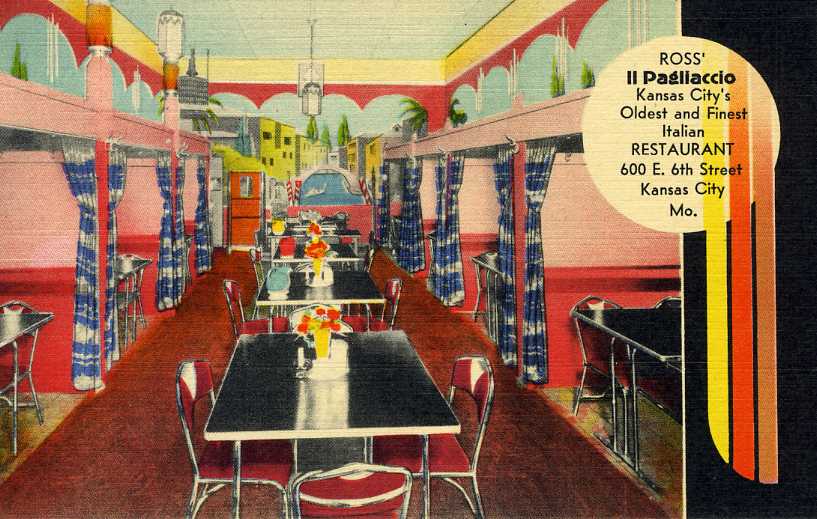
In places where no liquor was served booths seemed to win easy acceptance. Tea rooms often advertised them and New York’s Tally-Ho boasted that it had rehabilitated stalls in the “Famous Astor Stables” as dining alcoves. The whole issue of booth height seemed to die down while national prohibition was in effect, but with repeal it surfaced once again. In 1933 Lewiston, Maine, decreed (rather generously, actually) that booths could not exceed 54 inches in height.

But the truth was that many restaurant patrons preferred booths over ordinary tables and chairs and they had become so popular during the 1920s that it was impossible to turn back. Michigan had to rescind its 1934 order that booths not exceed 42 inches because restaurant owners claimed it was simply too expensive for them to cut down their existing installations.

Soon restaurants were boldly advertising that they had booths that were “cozy and intimate,” the latter a word that would have once been too daring to proclaim. By the late 1930s restaurant supply catalogs were full of modern-styled booths of chrome and colorful leatherette.

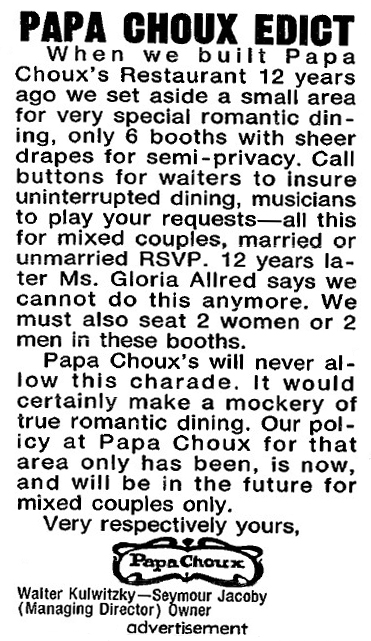
Although there was a 1950s case in which a court upheld an ordinance making booths over 42 inches illegal, the issue disappeared for the most part. But history always has a joker up its sleeve. In 1983 a lesbian couple sued the Papa Choux restaurant in Los Angeles for refusing to seat them in its special curtained booths designed for “romantic evenings.” Although the couple lost their suit initially [see below] they eventually prevailed in the California Supreme Court.

© Jan Whitaker, 2012
7 Comments

Filed under lunch rooms, restaurant customs

Restaurant-ing on Sunday

The Chick-fil-A controversy has arrived at my blog. A few days ago I heard from a reporter looking for restaurant history background on the subject of religion and restaurants.

Was there, she asked, ever a commercial restaurant chain similar to Chick-fil-A that took a strong religious stand evidenced by decisions such as closing on Sundays?

Why, yes, there was. It was the Dennett’s chain of the late 19th century. Founded in New York City by the crusading moralist Alfred W. Dennett, it sported religious slogans on the walls, held a mandatory daily prayer session for employees – and was closed on Sundays. Dennett failed in the Northeast in the 1890s but his successors followed his policies. Later, he made another attempt to run a chain of lunchrooms on the West Coast.

Chick-fil-A boasts of its personnel practices, but Dennett’s was scarcely a model employer as a waitress at a San Francisco Dennett’s discovered. Employees were fined so frequently for missing prayers or other minor infractions that most never took home a full pay envelope. She reported that she saw a placard on the wall that quoted Jeremiah: “Thus saith the Lord, Let not the wise man glory in his wisdom, neither let the mighty man glory in his riches; but let him that glorieth glory in this, that he understandeth and knoweth me, that I am the Lord which exercises loving kindness, judgment, and righteousness, in the earth.” As she read, another waitress came up behind her and remarked wittily, “So now you know that four dollars a week is right, and kind, and just.”

From the patrons’ point of view Sunday closures were generally not pleasing. Sunday was a popular day to eat in a restaurant beginning in the late 19th century and continuing into the 1960s. Not only did thousands and thousands of people living in rented rooms absolutely need access to restaurants all week long, for decades Sunday was the only day off for most working people.

Back when drinking was the social issue of the day, some temperance reformers thought it was advisable to keep restaurants open on Sundays since eating a meal in a decent place was preferable to getting drunk in a saloon. Critics found it outrageous that in the 1870s New Hampshire law ordered all restaurants closed on Sundays unless they also rented rooms.

By the 20th century it was fashionable to eat Sunday dinner out and many patrons filled their Sunday afternoons with dining and dancing to a live orchestra. In the 1920s, when car ownership spread, it became a Sunday treat for families to drive to the “country” (i.e., the city outskirts) to go to a tea room for chicken dinner. Service often was “family style,” with all the food on platters or in bowls to pass around.

I recall as a child going to such a place outside St. Louis, in Valley Park, called Madame DeFoe’s. It was a cottage with many screened windows, in a wooded setting. I thought it was terribly quaint and that Madame was foreign and exotic. Only recently did I discover that her first name was Cora and that she was a farmer.

The reporter also asked me if I knew of any restaurants in the past that, after coming under criticism for a controversial stance such as rejecting homosexuality, had politicians rally the public to show support for it through mass patronage (as is intended to happen August 1 at Chick-fil-A locations).

That one had me stumped.

© Jan Whitaker 2012

5 Comments

Filed under chain restaurants, miscellaneous, restaurant customs

Music in restaurants

Because they traveled quite a bit musicians must have made up a notable percentage of early patrons of public eating places. It’s easy to imagine them playing a few tunes in return for their dinner, but if this happened I’ve found no trace of it. The first mention of music I’ve discovered was in 1866, in a description of a small French restaurant in New York with an oyster-shell framed alcove where “sometimes a boy with a violin will seem to afford music to the feast.”

Note the negatively tinged words “seem to afford.” Throughout history there have been plenty of critics of musical “din” in restaurants.

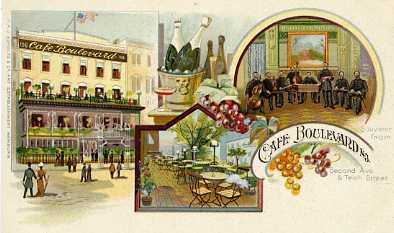
Music in restaurants was apparently a continental custom that migrated to these shores. At first it was highly associated with German restaurants such as Lauber’s at the 1876 Centennial Exhibition in Philadelphia. But by the late 1890s musical accompaniment with dinner became quite popular and all kinds could be found. “Wild” gypsy music as was played at NYC’s Café Boulevard was a favorite at Hungarian restaurants. Such places were known for their bohemian atmosphere — Why, people even talked to strangers! Later in the evening, the combined effect of food, wine, beer, and strolling musicians would have everyone singing choruses.

Orchestras of young women were also popular. In Boston, D. S. McDonald’s on Tremont  Street served dainty chafing dish specials such as Lobster a l’Americaine and Oyster a la Poulette en Blazer to the tunes of such a group. “This is a touch of Bohemia right in the heart of Boston,” proclaimed a 1903 advertisement.

American restaurant-goers of the turn of the century were evidently longing for the music of exotic others to invigorate and entertain them. On the West coast that often meant Hawaiian hulas. Everywhere else it meant the music of African Americans, especially ragtime.

The naysayers pleaded for quiet with their dinners. Articles in 1904 and 1905 issues of Town and Country, noting that potted palms and Hungarian bands expressed “the spirt of the age,” nonetheless complained that even the Third Avenue Delmonico’s had become “a hall of artificial palms, red paper, gilding and ragtime.”

Some hoped the early, pre-WWI tea room would provide a haven from the “garishness of strong lights, deafening music,” and restless thrill seekers found at the average restaurant. Instead music spread everywhere. Chinese restaurants installed Chinese orchestras which played all the latest rags. Even cafeterias joined the bandwagon.

It wouldn’t be long before clever minds figured out how to automate music in cafes and restaurants. At NYC’s Kalil’s in 1909 recorded voice of Caruso and other famous singers could be played on the Victor Auxetophone loudly enough to be accompanied by a live orchestra. The jukebox would not be far behind. In 1927 an advertisement advised cafeteria owners that the colorful Electramuse stimulated people “to have a good time – to spend MORE money!”

But jukeboxes ran afoul of polite society in short order. They were popular in teen hangouts – and that was part of the problem. Adults shunned these cafes, and neighbors complained about loudness. Fights broke out over musical selections. The jukebox took on associations of low life, not helped one bit by stories like the one that appeared in 1954 about a feuding North Carolina drive-in restaurant operator blasting super-amplified “Shake, Rattle and Roll” at an evangelical meeting across the street. The final straw for the jukebox was its takeover by racketeers.

Muzak fared much better in the restaurant industry than did jukeboxes. It started operation in NYC in 1936 with 40 restaurants as clients. Among its early customers were the dining room in the Algonquin Hotel and the Kungsholm Swedish restaurant on E. 55th Street. At first limited to large cities, technical advances in 1954 permitted Muzak franchises to spread to smaller towns throughout the country.

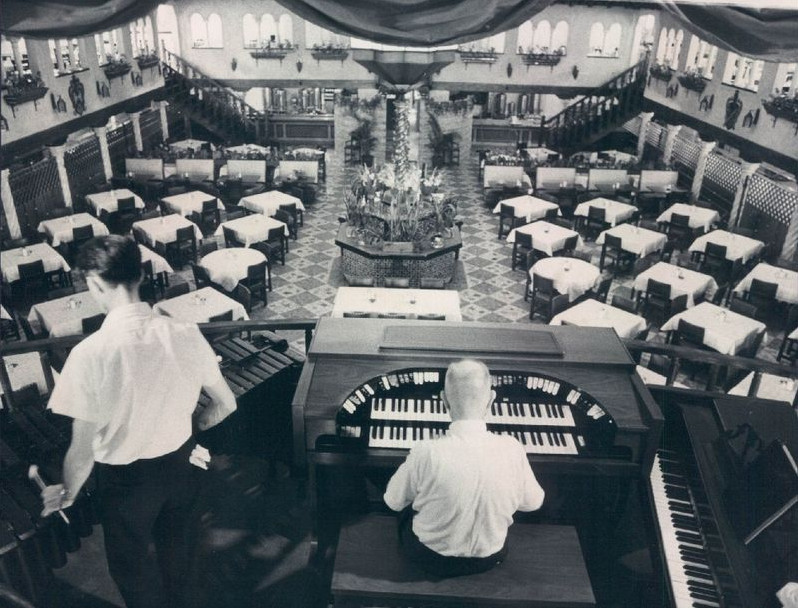
Today we have the full panoply of music. Rarely do we hear orchestras, but string quartets, harpists, strolling musicians, and canned music are plentiful. Even jukeboxes have been scrubbed clean of their dark past to the delight of patrons of retro diners.

© Jan Whitaker, 2012
4 Comments

Filed under restaurant customs, technology

Dipping into the finger bowl

Once upon a time finger bowls were routinely presented with the check in expensive restaurants. To the average American, who probably never went to this type of restaurant, they were a great source of humor. Jokes typically involved an unsophisticated restaurant patron drinking water from the bowl or eating the lemon slices floating in it. The funny stories demonstrated the joy Americans take in spearing pretentiousness, a quality which finger bowls epitomized to many.

Like salad forks and menus in French, using finger bowls was an esoteric social custom that was certain to befuddle the average person. How many fingers do you put into the bowl at once? What do you do after you get your fingers wet? Must you use it at all?*

These questions would soon fade from American culture because the finger bowl was about to run afoul of history in the World War I era.

Yet in the decade before finger bowls met their downfall, the number of restaurants providing them actually increased. Live music and finger bowls were two amenities put forward as competitive attractions over places that didn’t have them. Some observers believed that because so many restaurants adopted finger bowls, it deprived them of the eliteness they once enjoyed and that this was a factor in their downfall.

Further warning signs of the finger bowl’s decline in status surfaced as early as 1908 when a veteran waiter confessed to a reporter that wise patrons should demand to witness their waiter filling the bowl. Otherwise, he warned, it was likely they’d get one with wastewater from a previous user fermenting in it.

For reasons that are still mysterious to me, 1913 was a turning point in the fortunes of the finger bowl. The Buffalo NY health department launched an attack on brass bowls, which they claimed were in use in over half of the city’s restaurants. Glass bowls could be sanitized with boiling water but brass, said the health commissioner, could not. Omaha hotelier Rome Miller declared that modern guests were more germ conscious than ever before and wanted everything – tea, coffee cream, breakfast cereal – individually packaged. For guests desiring to wash their fingertips after dining, he recommended silver holders with disposable paper inserts.

Whether due to the influence of Rome Miller or not, the city of Omaha totally outlawed reusable finger bowls in 1915. The ordinance did make one exception – for finger bowls “made from paper or other substance which shall be delivered after being once used and not used or offered for use a second time.” The crusading Mr. Miller was further vindicated a couple of years later when he learned that a New Jersey paper company was supplying 263 leading hotels with sanitary paper finger bowls. “And so the finger bowl marches on,” he wrote, revealing a surprising dedication to its future.

But, for the most part, it was not to be. Glass, brass, or paper, all would be swept aside. World War I delivered the coup de grace when the Food Administration implored restaurants to do away with excess china, silver, and glassware, whether service plates, side dishes, salad forks, or finger bowls. The few straggler bowls that survived that era were wiped out by another such war order in 1943. Since then, high-end restaurants that serve food requiring a clean-up afterwards provide scented towels while lower-price establishments go with packaged towelettes.

© Jan Whitaker, 2011

*Dip one hand at a time and then dry your fingers on the napkin in your lap. Ignoring a finger bowl is a safe course.

16 Comments

Filed under restaurant customs, restaurant etiquette

Product placement in restaurants

Product placement usually refers to the display of branded products in movies and TV shows, such as when the main character sips a certain cola or goes into a coffee shop and opens up his laptop with an image of a glowing piece of fruit clearly visible.

But manufacturers of national brand foods have long been eager to have their products on display in restaurants and that, too, is a form of product placement. In both the media and in restaurants the product is supposed to gain exposure and status by association.

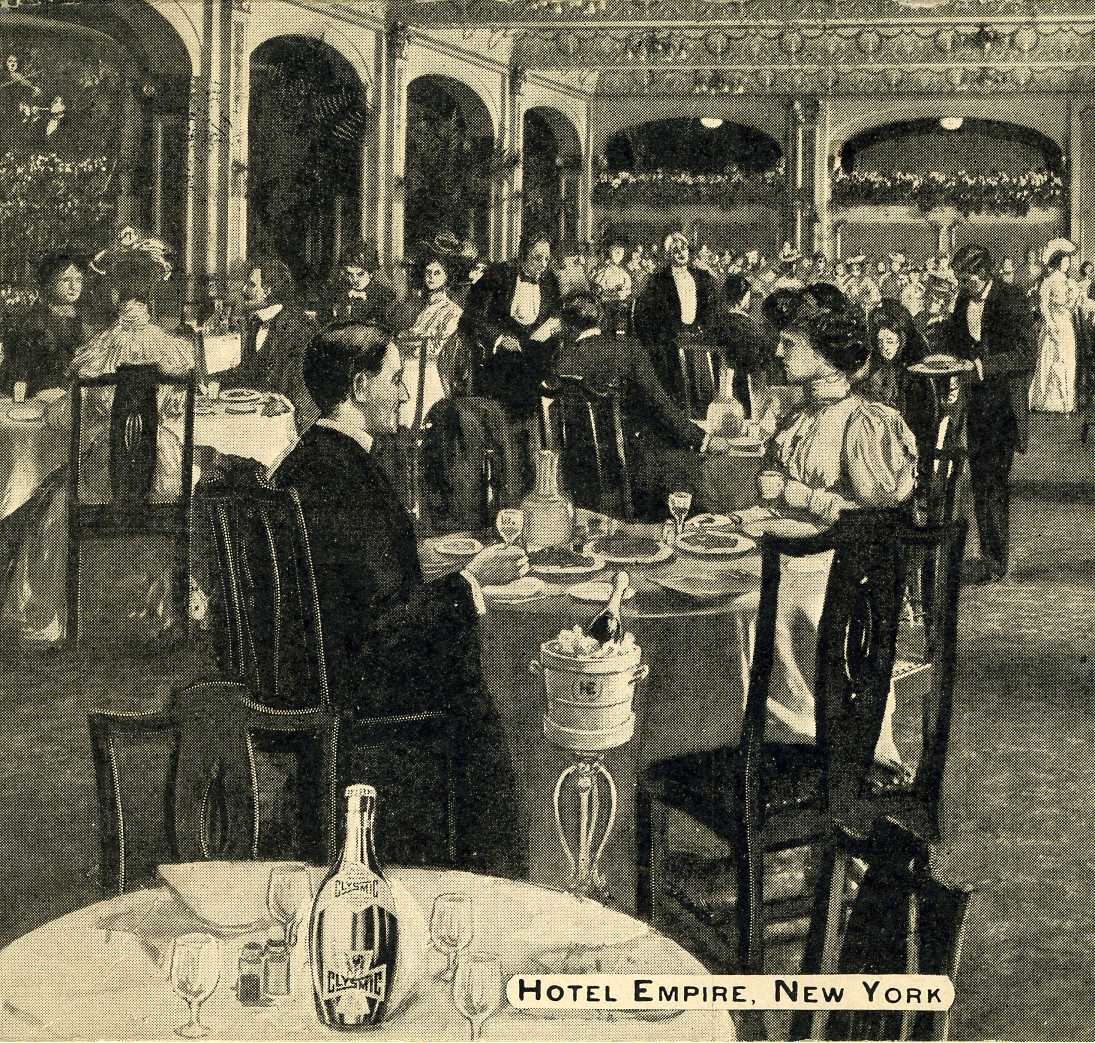
Beverages were among the very first branded “food” products in the United States, and perhaps the first to place their bottles on restaurant tables and in restaurant advertising such as the 1908 Hotel Empire postcard above which features Clysmic bubbling spring water. First advertised in the 1880s as a homeopathic drink that cured cystitis and other maladies, by the early 20th century the water in the unusually shaped green bottle with the red label had become a cocktail mixer. The company put out a complimentary Booze Book which told how to mix drinks.

The Faust restaurant at New York’s Columbus Circle had similar postcards with slightly enlarged bottles of Coronet Sloe Gin and Old Quaker Rye Whiskey shown on tables in the foreground.

With restaurants it was a two-way street where food products were concerned: both the restaurants and the products sought to gain status. In the early 20th century people were distrustful of the cleanliness of restaurants as well as much of the food in the marketplace because of decades of widespread adulteration. This attitude became especially prominent following publication of Upton Sinclair’s sensational book The Jungle which exposed disgusting practices in slaughterhouses. To counter distrust branded food products began to advertise extensively and were quite successful in convincing the public they were pure.

The ever-clever “Fra” Elbert Hubbard, head of the Roycroft craft studios, developed sophisticated advertising copy in his publication The Philistine in 1901 in which he stressed that Heinz products were regularly used in the Roycroft inn’s dining room. Around 1902 the National Biscuit Company introduced industrially extruded (“shredded”) wheat to the public through restaurants, dining cars, and steamships.

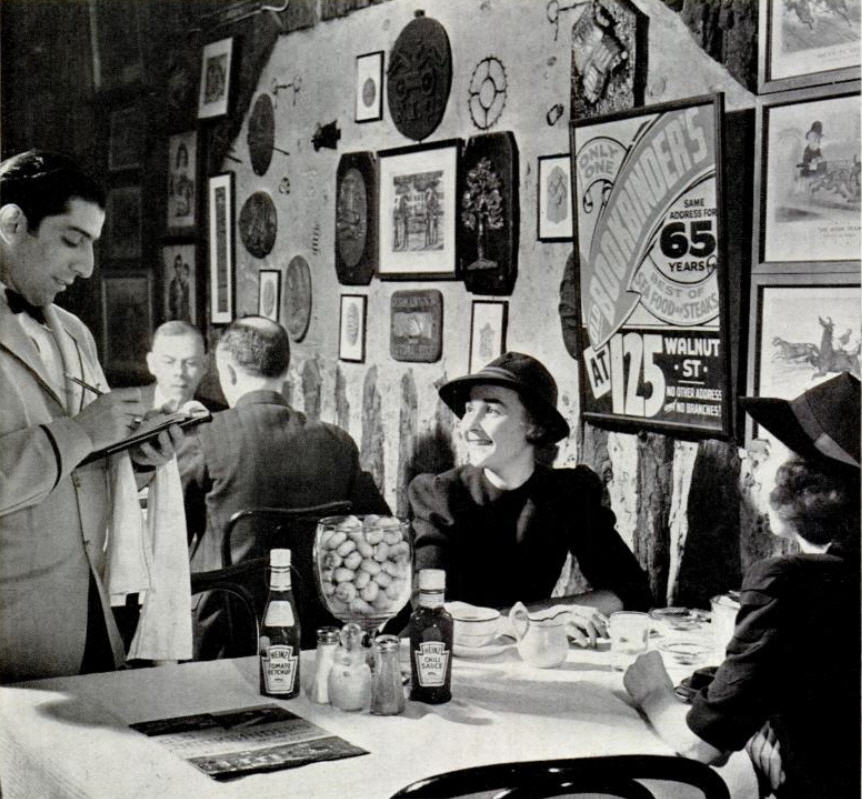
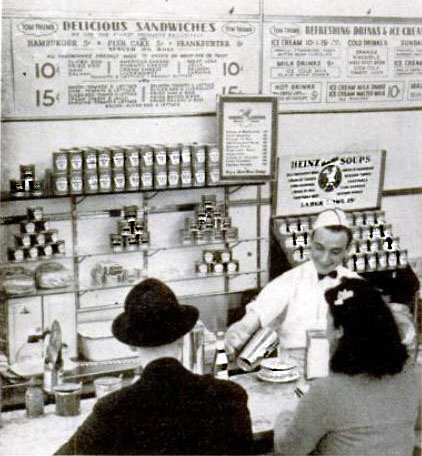
Even into the 1940s and beyond, restaurants were eager to let patrons know that they used brand-name food products. “Brag About Brands” because it gives the customer confidence, suggested the New York Restaurant Association in 1946. Manufacturers — and their advertising agencies – continued to rely upon nationally known restaurants to give products name recognition and cachet. Heinz advertised extensively in the mid-20th century, with photographs showing patrons at restaurants such as Bookbinder’s in Philadelphia and the Brown Derby in Los Angeles using their catsup.

© Jan Whitaker, 2011

3 Comments

Filed under restaurant customs

Lunch and a beer

It won’t come as a surprise to learn that the free lunch wasn’t really free. As everyone knows the patron of a saloon had to buy a beer or some other sort of drink in order to partake of whatever edibles the proprietor had to offer. What might be news, though, is that it wasn’t exactly what we would call lunch nowadays. It was more of a snack eaten between meals, sometimes around noontime, sometimes not.

Although the standard free-lunch time began at 11:00 a.m. through much of the 19th century, some saloon keepers put out a spread as early as 9:00 in the morning, hours after most working people had their breakfasts. Or it might be at night – a kind of happy hour. At some saloons lunch on the house was provided every day, but at others it was more of a special occasion celebrating a grand opening, holiday, or proprietor’s birthday.

The dishes did not conform to our modern idea of a snack. In early June of 1872 the owner of a Sioux City IA saloon promised a Saturday morning spread where patrons could accompany their juleps and Roman punches with oyster soup, fish with egg sauce, deviled ham, lobster salad, pickled oysters, salmon, tongue, pickles, lettuce, and radishes – a very different kind of morning break than today’s coffee and doughnuts. Which proves that our snacks have become lighter, while lunch has gained the stature of a regular meal. It also shows that profit on the sale of whiskey and beer could be more than enough to underwrite a veritable feast.

It’s likely that the free lunch is a very old custom. Certainly there were plenty of free lunches to be had in New York City in the 1840s and 1850s. But in their advertisements saloons rarely described a spread equal to what the drinking man (respectable women did not enter saloons) could find in New Orleans, considered the country’s finest free lunch locale. In Northeastern cities often only plates of crackers and cheese made it onto the counter, possibly accompanied by a crock of soup. The New Orleans free lunch was more elaborate, with beef, mock turtle soup, “delicate slices of highly flavored buffalo tongue,” and “well dressed salads.”

The rule of thumb was that where there was intense competition, there would be high-quality saloon fare. San Francisco qualified, as did St. Louis and Chicago. Chicago’s spreads were rarely elegant, but they were hearty. Beer drinkers there favored sandwiches of dark rye bread piled with liver sausage or herrings, strong mustard, and sauerkraut.

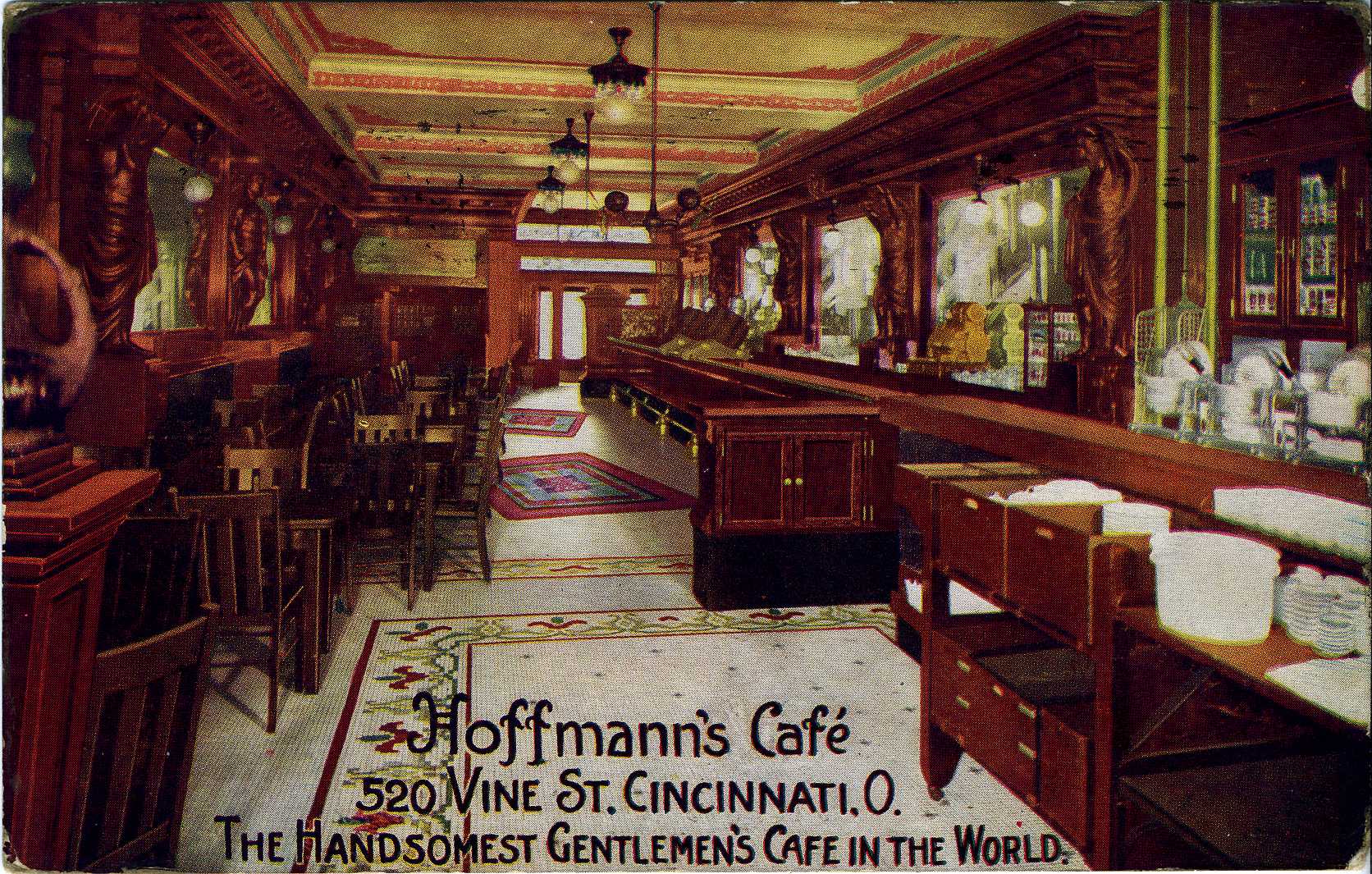
In the 1860s, upscale saloons patronized by better-off customers started calling themselves buffets or cafés. Later some would charge a small charge for a “merchant’s lunch.” Business men liked these lunches because they were quick. The food was ready, no tipping was necessary, and little ceremony was involved. You could eat standing if it suited you, in fact there were few tables and chairs.

Feeling the loss of customers, restaurateurs repeatedly tried to abolish the free lunch habit, as did temperance advocates who wished there could be cheap but respectable restaurants that competed successfully with saloons for the workingman’s business. The average saloon normally charged only 5c for food and drink, an amount for which most restaurants could not furnish a decent meal.

The anti-saloon movement grew stronger with the approach of World War I. Alcohol-free quick lunch chains such as Thompson’s and Child’s — the McDonald’s of their day — learned that by doing a high-volume business they could serve lunches almost as cheaply as saloons. With national prohibition in 1920 the restaurant industry, freed from saloon competition, blossomed and took its modern shape.

Reformers from the 19th century would be thrilled to learn that cheap lunches today are no longer normally washed down with a beer.

© Jan Whitaker, 2011

12 Comments

Filed under lunch rooms, restaurant customs

Waiters’ games

Since this post is about server dishonesty I’ll start off with a couple of disclaimers. First, I don’t mean to imply that all, or even most, servers – or kitchen staff – are dishonest. Also, the stories I’ve found are mostly about men but I don’t take that to mean that men are more dishonest than women or that women are less skilled in larceny and chicanery then men.

The history of servers and kitchen staff cheating and stealing reveals an extraordinary degree of laxity in restaurant management, which did not begin to change significantly until the Prohibition era when the idea of system and efficiency took hold in some eating places, especially chains.

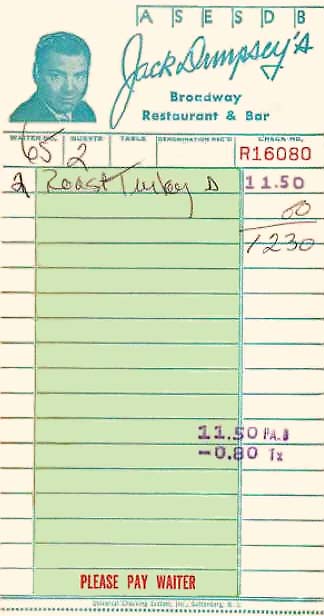
For most of the 19th century and well into the 20th many restaurants operated on a cash basis and kept no records whatsoever. Servers didn’t even use written customer checks. Under a (non)system such as this, exemplified in restaurants such as Gonfarone’s in Greenwich Village as described in the book Papa’s Table d’Hôte, waiters needed little larcenous intent to end up with money that should have gone to the house. As author Maria Sermolino recounts, “even a waiter who tried to be honest might find his pockets unaccountably bulging with dinner money which, somehow, got confused with his tip money. There was so much of it pouring in, that everybody shared.”

Waiters at Gonfarone also regularly made off with bottles of wine, roasts, and chickens, according to Sermolino, daughter of one of the restaurant’s owners. Her father refused to crack down on the practice, claiming that there was plenty to go around and if the waiters felt distrusted they would steal even more. A similar winking attitude evidently prevailed at the New York hotel described by Gay Talese in A Writer’s Life. There, in the 1950s, the waiters routinely did their daily grocery shopping from the kitchen provisions, taking home whatever was on their list. The practice was referred to as “valising” and was so strongly identified with the waiting occupation that the staff referred to each other as valises, as in “Who’s that new valise the chef just hired?”

Probably pilfering has gone on as long as there have been restaurants, yet complaints about it seem to begin with the influx of immigrant waiters in the later 19th century. Written checks and checkers who wrote down and totaled up whatever food orders waiters carried out of the kitchen came into use in some restaurants around the 1880s. Waiters were required to pay cash for their checks when they came on duty; at the end of the shift their used checks would be totaled and they would receive change and/or a commission if that was due to them.

The check-checker system was supposed to put an end to the days when waiters palmed off sirloin steaks as porterhouses, pocketing the difference, or colluded with patrons to charge 25 cents on the dollar for a meal and receiving a very generous tip in return.

But, of course, it didn’t.

At first checks weren’t always written in ink, numbered, or marked paid, permitting them to be altered, discarded and replaced, or reused – with the end result of unaccounted for cash going into the waiter’s pocket. But even when these gaps were remedied, the games continued. Food was held under the tray and smuggled out of kitchens right under the eye of the checker. Worse yet, for the patrons, their meals might be assembled, completely outside the system, from uneaten scraps left behind on the plates of departed diners. A penciled check would be presented, then erased after payment was taken.

As more safeguards were put in place, collusion became necessary. Waiters conspired with checkers who would leave certain items off the tally. At the Chicago’s World Fair, where waiters were required to buy a set amount of tickets each day with which to pay for food orders from the kitchen, the workers who collected the tickets resold them at a steep discount off face value to restaurant managers who then resold them to waiters at a discount. The syndicate of ticket takers, managers, and waiters all made money at the expense of the Fair’s restaurant concessionaires.

Bartenders, too, have enjoyed lucrative schemes, such as pouring drinks from their own bottles of liquor and keeping the payments. Proof that larceny behind the bar hasn’t ended is found in a 2009 book The Hungry Cowboy. Its author Karla Erickson reveals how a bartender in collusion with a server and an assistant manager diverted a significant amount of cash by ringing up a large number of sales as voids. The manager noticed liquor costs rising in relation to receipts but didn’t investigate further until his usual sales bonus was withheld.

The beat goes on. Computerized orders and credit cards have created new barriers but have not, I have no doubt, foiled cheating completely.

© Jan Whitaker, 2011

2 Comments

Filed under restaurant customs

Image gallery: tally ho

A persistent theme in 20th-century restaurants, found mainly in names and signs – and thankfully now over – was the coach and four theme. Obviously it is only one of a host of old-time symbols that restaurants have borrowed over the past 100 years. Others include spinning wheels, grist mills, and, oddly enough, brothels, all suggestive of simpler times when things were made by hand and gender roles were clear cut. The names and signs also acted as practical signifiers indicating to prospective patrons that they could expect standard American food to dominate the menu.

Both World War I and World War II stimulated this theme, possibly because Americans were looking for comfort and reassurance. Tea rooms of the First World War era were among the first and the worst offenders when it came to invoking a stable and secure pseudo-past. (When they were in New England, you think, Well, they have a right.  Yeah, maybe.) An even stronger wave of nostalgia washed through the nation’s restaurants after the Second World War, replacing the brash modernism of the 1930s with colonial motifs for coffee shops and cafeterias. Never mind that the actual mode of transportation was bringing smog and sprawl to cities nor that convenience food had overtaken restaurant kitchens whose cooks could no more have cooked from scratch at a fireplace than their patrons could have hitched a buggy.

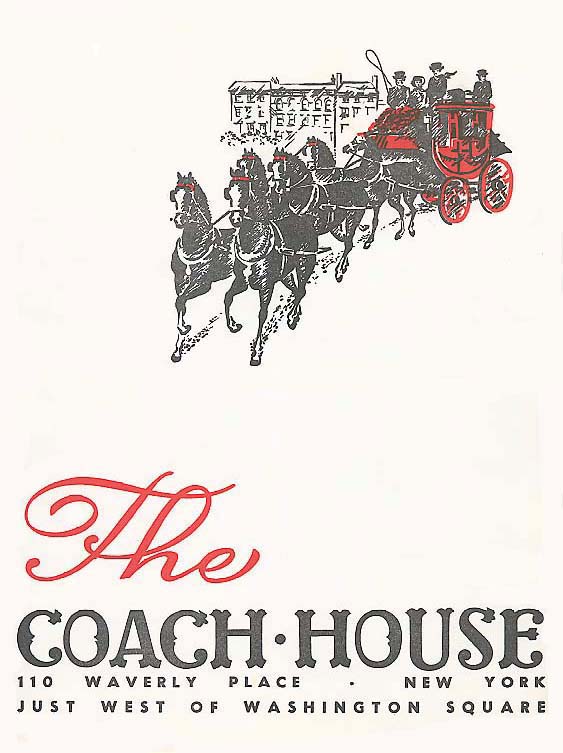
[Left] One of James Beard‘s favorite restaurants was Greenwich Village’s Coach House. It differed from most of its namesakes in having innovative cuisine. [Right] Another Coach House, in Atlanta.

Another Coast House, in Atlanta.

3 Comments

Filed under restaurant customs