Category Archives: popular restaurants

Building a myth: Bookbinder’s

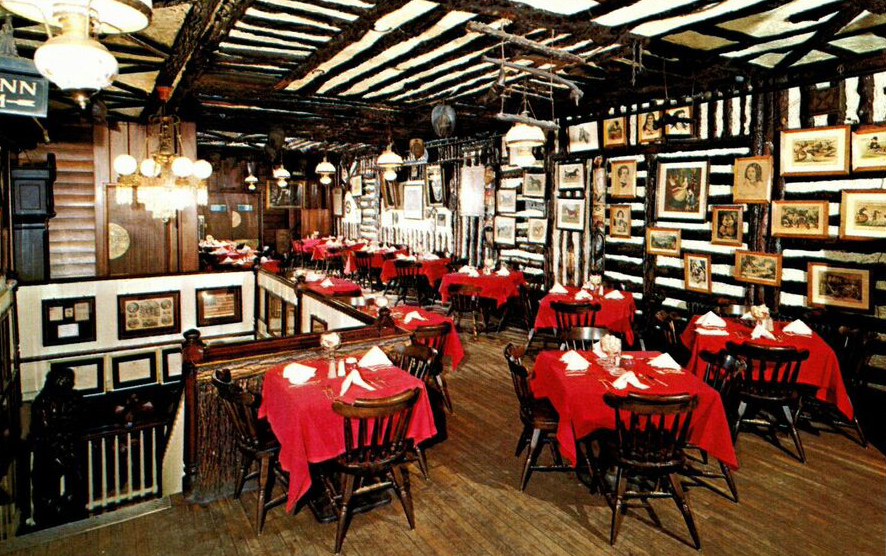
As a Philadelphia Inquirer story observed when the legendary Bookbinder’s on Walnut Street closed for the first time, in 2002, its popular appeal had been based not only on seafood and steaks but also on the restaurant’s ability to play on its history.

Eventually, in the 1940s, the myth led to a claim that it was founded in 1865. Not everyone took the claim seriously, but that still leaves the question of why the restaurant invented it. The motivation was somewhat mysterious considering that Bookbinder’s was in fact very long-lived compared to most restaurants in the U.S., which do well to last five years. It’s curious to me that the actual founding date in the 1890s wasn’t good enough, but it may have been that its actual beginnings didn’t seem like much compared to the long patriotic history of Philadelphia.

An 1895 newspaper story reported that Cecilia Bookbinder, wife of Samuel, had bought the building on 125 Walnut Street for $5,000. Since 1884, it had been operated as an oyster and chop house by a man named Attila Beyer. It appears, however, that the devious Beyer may not have actually owned the building when he sold it to Cecilia, having already used it as collateral for a loan on which he was about to default as he left for California.

Perhaps due to monetary claims by Beyer’s creditors, the Bookbinders evidently lost ownership of the building and didn’t regain it until 1906, nevertheless operating the restaurant all the while, possibly at first under the simple name Merchant Restaurant. The restaurant was in Philadelphia’s long-established insurance district where business people flooded the local eating places at noon.

Somewhat before the myth of an 1865 founding was adopted, 1875 was advertised as the restaurant’s start date. For instance that was the date given in a 1940 Life Magazine advertisement for Hines ketchup shown here; it is also indicated by the poster on the wall.

A family rift may partially explain the adoption of an exaggerated founding date. Bookbinder’s on Walnut street adopted the name “Old Original Bookbinder’s” about 1935 or 1936 after Samuel C. Bookbinder, son of the founders, opened a rival Bookbinder’s on South 15th Street [shown above, 1935]. He had been in line to inherit the Walnut Street restaurant but was disinherited upon his conversion from Judaism to Catholicism in order to marry a Catholic woman. The false founding date and the name “Old Original” were likely ways to distance the Walnut Street restaurant from its new competitor. [Note that the 1936 advertisement below had not yet revised the fictitious founding date.]

As a result of the family split, Harriet Bookbinder took over the Old Original, operating it with her husband Harmon Blackburn. He was a successful corporate lawyer, and a collector of Americana, including the Lincoln memorabilia, old theater playbills, and Carrier & Ives prints that adorned the restaurant’s walls.
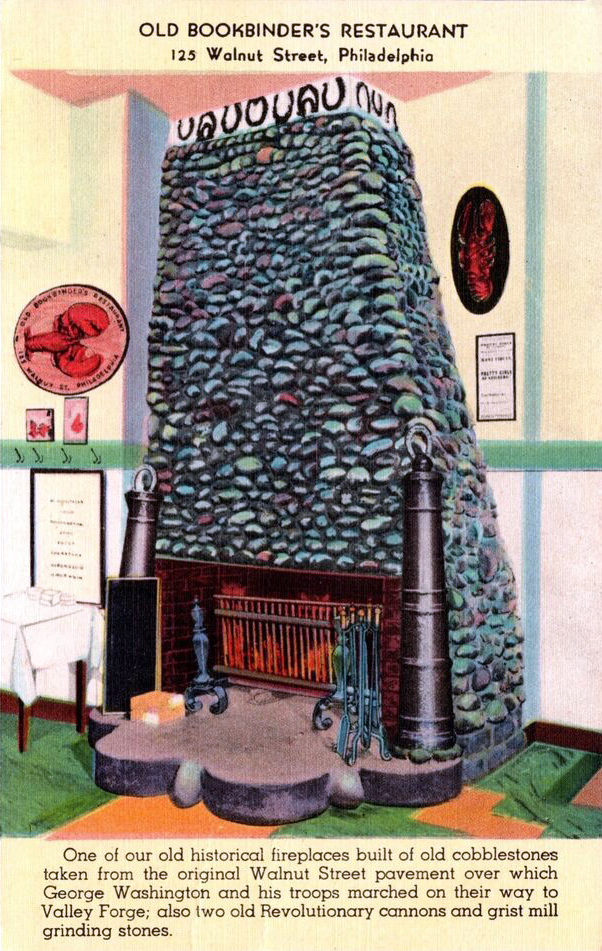
Obviously the building occupied by Old Original Bookbinder’s itself looked aged, and the memorabilia contributed to a sense of age. Other historical attractions were the fireplaces made of old cobblestones taken from Walnut Street. The fireplaces probably dated back to 1915 or 1916 when the city was removing cobblestones from streets. A 1916 advertisement promised “A Beefsteak Dinner in the ‘Maine Woods’” cooked at that room’s fireplace, with steaks and chops grilled in the fireplace and served with oysters, radishes, celery, and hot biscuits baked on the hearth.

When Harriet died in 1944, her husband ran the restaurant for a year and then donated the business to the Federation of Jewish Charities. Along with the building, the furnishings and equipment, the donation included “all food and liquors on hand, the good will and everything in the till.” John and Charles Taxin bought it, with John running it until its final bankruptcy and closure.

In the 1940s and 1950s Old Original Bookbinder’s was regularly recommended in books featuring the country’s favorite restaurants, such as Duncan Hines Adventures in Good Eating. In 1947 “The Dartnell Directory for America’s Most Popular Restaurants named it the country’s most popular eating place of the 2,300 restaurants it recommended.

In 1965 the restaurant celebrated its 100th anniversary as Bookbinder’s — a mere 30 years prematurely.

By the 1970s, the cobblestone fireplaces remained, but some rooms had been redecorated and modernized. Time was catching up with Bookbinder’s then, as new kinds of restaurants with inventive cuisine such as Le Bec-Fin came on the scene. Citing an estimated 300 new restaurants opening in Philadelphia in the early 1970s, a 1978 issue of trade magazine Restaurant Hospitality observed that traditionally conservative Philadelphia was now “vying with New York and San Francisco as the Eating Capital of the United States.”

Nevertheless, in 1986 Restaurant Hospitality rated Old Bookbinders the nation’s 7th highest-grossing restaurant, with annual sales totaling $10.6M and an average dinner check of $33. It was well-known nationwide and particularly popular with tourists, all the more so since it was near historical points of interest.

But nothing lasts forever. Both Bookbinder’s closed in the first decade of the 21st century.

© Jan Whitaker, 2024
12 Comments

Filed under popular restaurants, proprietors & careers, restaurant advertising, restaurant decor

Chicken in the Rough

Frequently when I write about the demise of a restaurant chain I can almost be certain to hear from at least one person who lets me know there is a survivor of that long-gone chain.

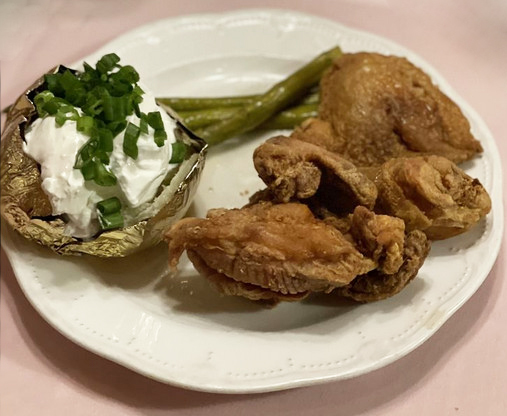
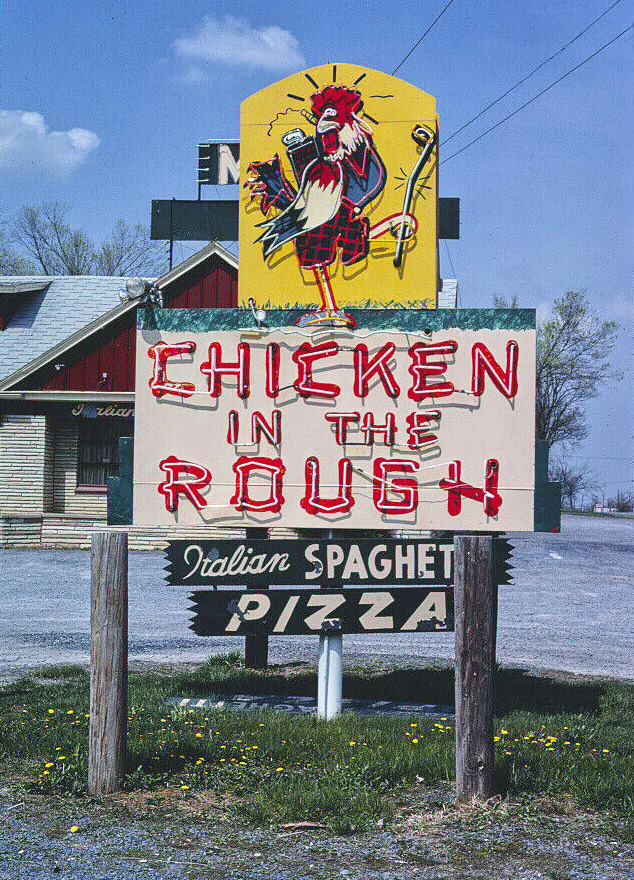
And, yes, that is also true of Chicken in the Rough, a franchised process for preparing fried chicken. As recently as now, Palms Krystal Bar & Restaurant in Port Huron MI offers “The World’s Most Famous Chicken Dish,” as it has for decades. In 2000 a Palms order consisted of an unjointed half fried chicken, with shoestring potatoes, hot bun, and jug of honey. Two orders cost $9.99 and they even threw in free coleslaw. In the 1930s an order usually was priced at 50 cents. [above, 1940s menu from an Arkansas restaurant]

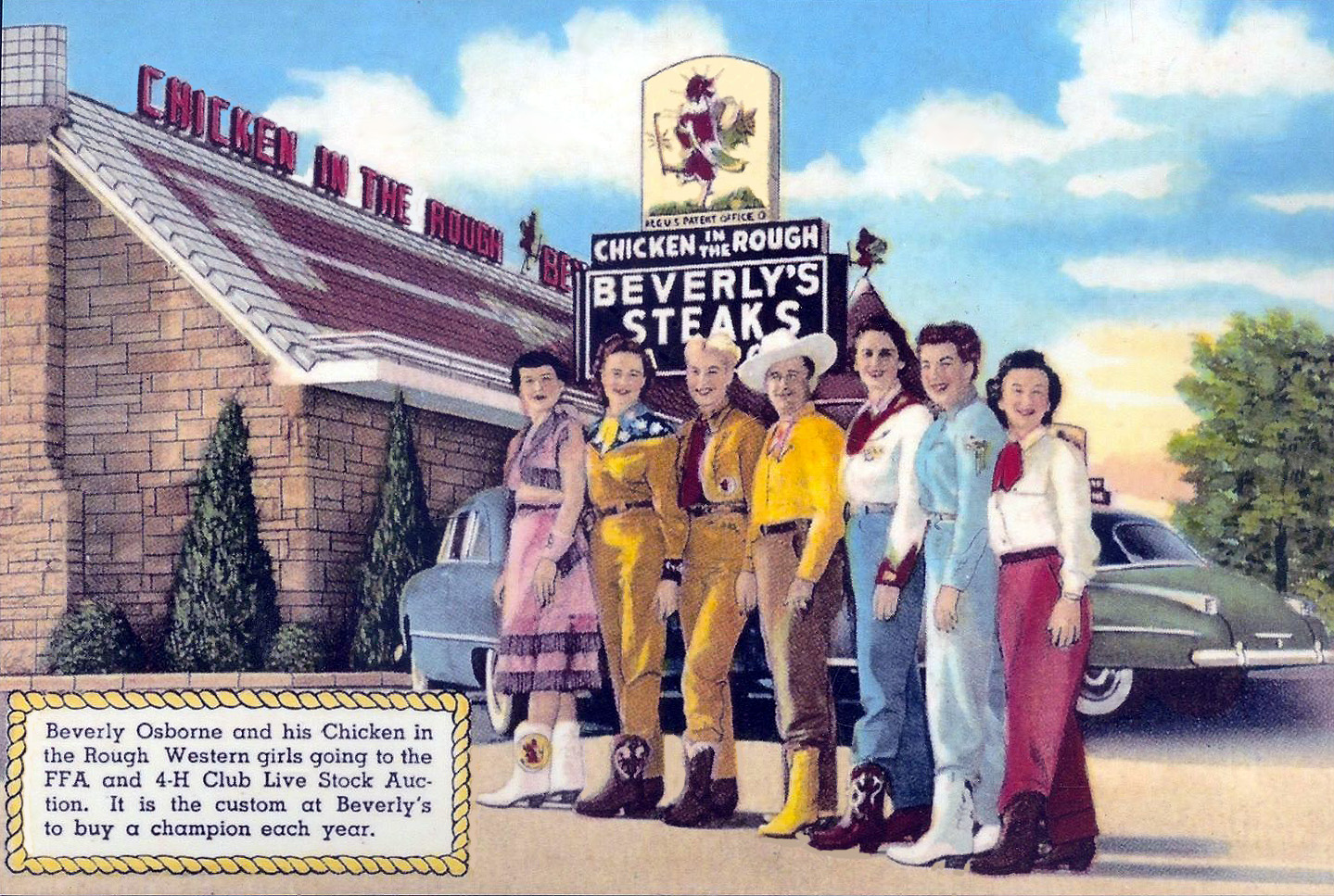
The developers of the Chicken in the Rough formula were a husband and wife team, Beverly and Ruby Osborne. They ran roughly nine cafes and waffle shops in Oklahoma City and even the 1930s Depression could not halt their enterprising spirit. [above: Beverly Osborne pictured in yellow boots]

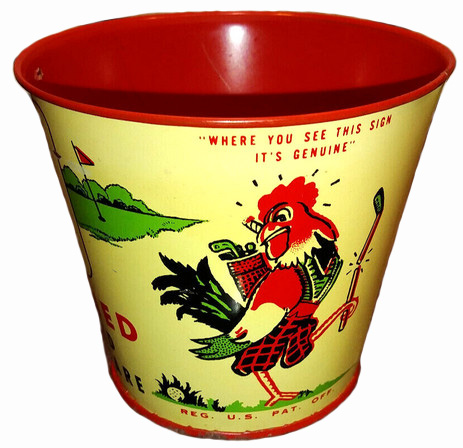
Their operations employed the magic word in modern management of that time – “system” – to streamline their operations and reduce costs. In 1936 they opened a drive-in in Oklahoma City which introduced customers to their method of preparing chicken. They soon began franchising the process and the trademark. In 1942, they patented their imprinted dishware and glasses, and the image of a chicken with a broken golf club, all of which had been in use for several years.

“In the Rough” was a perplexing phrase that often needed an explanation. It meant no silverware was provided despite the half chicken being unjointed. Evidently customers proved willing to adapt to “roughness,” although I’ve run across some evidence that over time some franchisees served the chicken in pieces. Another alternative was to serve the meal with a small metal pail filled with water for cleaning hands.

When the Osbornes opened the Ranch Room at their Oklahoma City drive-in in 1937 a large advertisement appeared in The Daily Oklahoman. Just in case anyone reading it didn’t realize the name Chicken in the Rough had been copyrighted, they were informed of this six times in the text: Yes Sir, “Chicken in the Rough.” (Copyrighted) – In one year we are known from coast to coast for “Chicken in the Rough.” (Copyrighted) – Served without silverware. In one year we have sold over 50,000 chickens or 100,000 orders of “Chicken in the Rough.” (Copyrighted) – We are now able to offer for sale franchises on “Chicken in the Rough.” (Copyrighted) . . . We took the town by storm – “Chicken in the Rough.” (Copyrighted) 50c. [Above: Madison WI franchisee]

The Osbornes were very particular about the meal’s composition, preparation, and presentation. Franchisees were required to use a freshly killed chicken, weighing 2 pounds and graded A, meaning it had been raised in an incubator and had sustained no injuries. No batter could be added to falsely make it look bigger and it had to be cooked in vegetable oil that had not been used for any other purpose. Inspectors came by regularly to make sure franchisees were following the rules.

World champion runner Jesse Owens, winner of four gold medals in the 1936 Olympics, was slated to open a restaurant featuring Chicken in the Rough in Chicago in 1953, for which he planned to use delivery wagons decorated with large images of himself racing. I could not determine the fate of that plan, but I don’t think it ever materialized.

The Osbornes sold the rights to their franchised process in 1969 and ten years later ownership changed hands once again. At the time of the first sale of the business there were only 68 franchises in 20 states left, compared to possibly 379 in 38 states at the peak, which I am guessing was in the late 1940s. Judging from a 1946 postcard that claimed to list all the U.S. restaurants with franchises then, most of the populous states without franchisees were in the Northeast. By contrast, Michigan had the most, followed by Indiana and California.

Unlike that of Harlan Sanders, who also began by selling a chicken recipe across the U.S. some years after the Osbornes, their venture remained a franchised cooking process and did not develop into a chain of restaurants.

© Jan Whitaker, 2023

18 Comments

Filed under popular restaurants, proprietors & careers, signs

Taste of a decade: the 1990s

The decade began in an economic slump, putting a damper on the expensive dining trends of the 1980s. Informal dining venues met the situation by crafting new “casual cuisine” menus featuring less expensive, quickly prepared pasta dishes and grilled meat, all tailored for the Baby Boomers who formed the prime market for dining out.

Although surveys showed that Americans want healthful food choices in restaurants, beef remained extremely popular, and sales at casual steakhouses rose.

In the early 1990s restaurant chain operations emphasized efficiency and speed with microwave ovens, automatic dishwashers, and computerized systems that integrated taking orders with food preparation, as well as managing accounts and inventory. Coordination of operations enabled customers at drive-up windows to order, pay, and pick up their food rapidly.

Unable to compete with fast-food chains’ quick service and low prices, old-style casual eateries such as Horn & Hardart automats, Woolworth lunch counters, and cafeterias were disappearing. New York’s last remaining Automat, at E. 42nd St. and Third Ave., closed in 1991.

As the economy improved it became clear that luxury restaurants hadn’t vanished. The December 1990 announcement that the James Beard Foundation was forming an awards program was a sign that top chefs were not to be forgotten. Yet, despite the boost to fine dining given by the awards, fine-dining establishments continued to struggle.

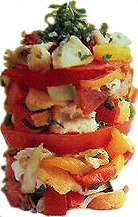
New, artsy trends in plating meals emerged, among them the brief but dramatic art of stacking food into towers that wowed the eye but proved difficult to eat gracefully.

Even as elite food fads came and went, one trend appeared unstoppable: the gathering up of thousands of chain restaurants by regional owners and giant food corporations. While the media focused on top chefs and their novel dishes created in landmark restaurants, huge corporations such as Tricon Global grew even larger with many venturing into worldwide operations.

Mexican immigration doubled, reaching a new high of 8.8 million by the end of the decade and furnishing a large number of restaurant kitchen workers. Small Mexican restaurants opened to supply traditional food to the new immigrants, but by 1999 Taco Bell’s 7,000 U.S. outlets had captured 90% of the thoroughly Americanized Mexican restaurant market, serving 55M customers a week, with sales of $5.1 billion annually.

Black restaurant workers and customers had their day in court in 1993 with successful discrimination suits against Shoney’s and Denny’s. Shoney’s was found liable of charges it had set a limit to the number of Black workers it would hire in some of its restaurants, as well as hiring all-Black staffs in Black communities and all-white staffs elsewhere. Denny’s faced multiple law suits.

Highlights

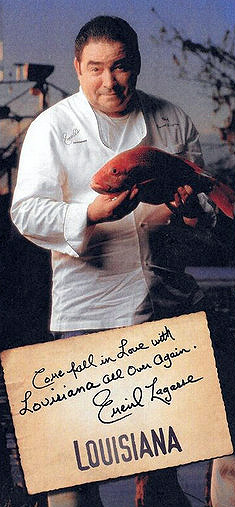
1991 Six men and one woman are the first regional chefs to be honored by the newly formed James Beard Awards: Jasper White (Boston), Jean-Louis Palladin (D.C.), Emeril Lagasse (New Orleans), Rick Bayless (Chicago), Stephan Pyles (Dallas), Joachim Splichal (Los Angeles), and Caprial Pence (Seattle).

1992 A U.S. Department of Labor report on technology announces that due to increases in productivity, chain-owned restaurants “for the first time . . . exceeded the number of independently owned restaurants.”

1993 Shoney’s, at the time the third-largest chain, is fined an unprecedented $105M for racial discrimination in hiring, while Denny’s pays $54M for refusing service to Black customers, insulting them, and overcharging them.

1993 The new Food Network spotlights restaurant chefs and methods of preparation. Viewers become interested in new restaurant dishes, while rising use of garlic at home is attributed to viewers watching Emeril. Despite the interest in inventive cuisine, 1991 James Beard winner Stephan Pyles feels forced to close his Routh Street Café in Dallas.

1994 Sensing that Black patrons may have been offended by revelations regarding Denny’s discriminatory behavior, the corporate owner hires a Black Chicago advertising firm to create an image of the restaurants’ friendliness to Black customers and workers.

1995 Stacked food – aka vertical or tall food – is reportedly now passé in New York’s trendy restaurants, replaced by layering food on the plate. However, a short time later vertical food is said to be “sweeping the country.”

1996 Taco Bell is the country’s leading Mexican restaurant, with 6,867 stores.

1997 PepsiCo.’s spinoff Tricon Global, based in Louisville KY, racks up more than $7 billion in sales with its major chains Pizza Hut, Taco Bell, and KFC.

1998 In a survey, Applebee’s and Cracker Barrel tie for 8th place as family favorites among the country’s 30 largest chain restaurants.

1999 The U.S. Department of Commerce declares this “The Year of the Restaurant” and the Beard award for Outstanding Restaurant goes to NYC’s Four Seasons.

© Jan Whitaker, 2023

10 Comments

Filed under chain restaurants, chefs, elite restaurants, family restaurants, food, popular restaurants, racism, restaurant fads, technology

Restaurant brawls

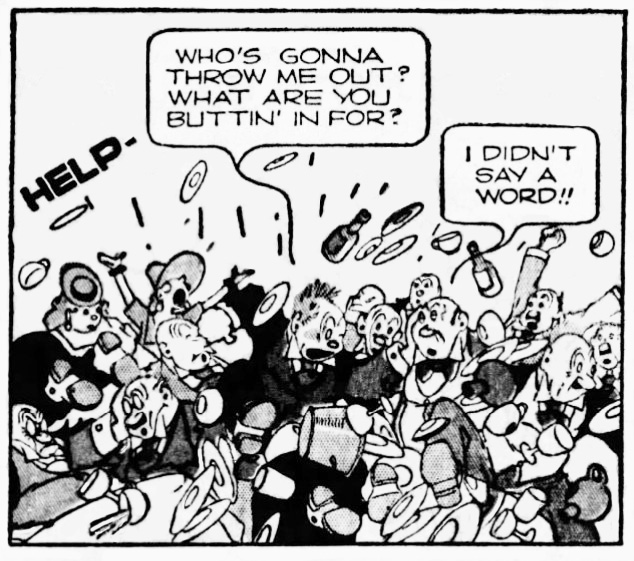
All the discussion about guns in public places these days has me thinking about restaurant security, a subject that, as a patron, I never actually consider. Specifically, I began to wonder for the first time whether ordinary eating places all the way up to elite restaurants have armed employees or a gun stashed away somewhere. Or, might patrons be armed? [shown above is a 1946 Jiggs comic strip scene]

Given that the answer has been “yes” back into the 19th century, and that more Americans are armed now, it’s likely to still be true.

But a more common type of violent incident that occurs in restaurants is a brawl which, thankfully, hasn’t usually involved guns.

Of course restaurants have always had a certain number of problem patrons to deal with. According to one 19th-century account, even Delmonico’s had a man employed to handle difficult guests, such as those who arrived inebriated. He headed off trouble by not admitting them or by whispering a “word of advice” to patrons who drank too much while in the restaurant. Mainly, he said, his job was to recognize by sight the city’s “bunko steerers and confidence men”: “I just meet them at the door and tell them it won’t do, and they know it won’t, so they go away quietly. There is no bouncing or knocking out required.”

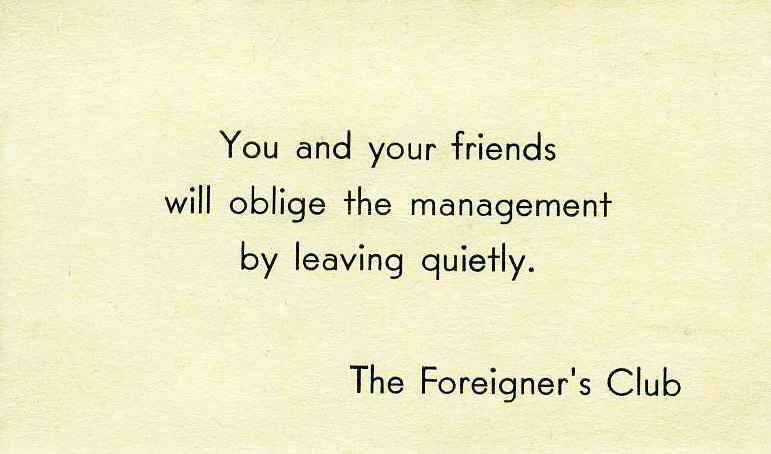
His genteel method was similar in tone to that of “The Foreigner’s Club” of Sorrento, Italy, where this card was used.

Alas, such methods were only available in certain restaurants. At others, there were no door keepers, subtle ushers, or “convertible waiter bouncers.” It seemed from time to time that nothing could stop patrons from fighting other patrons or a server or even instigating a mass brawl.

I started thinking about restaurant brawls when I read a story in this year’s January 29 issue of the NYTimes Magazine. It described the scene of a Waffle House in Texas where a melee erupted and was captured on video. It involved patrons standing on the counter, throwing dishes and chairs, and attacking workers who fought back in like manner. Other popular videos show similar scenes in Popeyes and sub shops.

The author, Niela Orr, expressed a degree of longing for the days of Edward Hopper’s famous 1942 painting Nighthawks, where patrons sit glumly in isolation from other sad sacks at the counter. Like the Waffle House patrons, they are alienated but unlike them they aren’t throwing crockery.

They could have been though. Restaurant customers were documented hurling dishes as early as the 1860s.

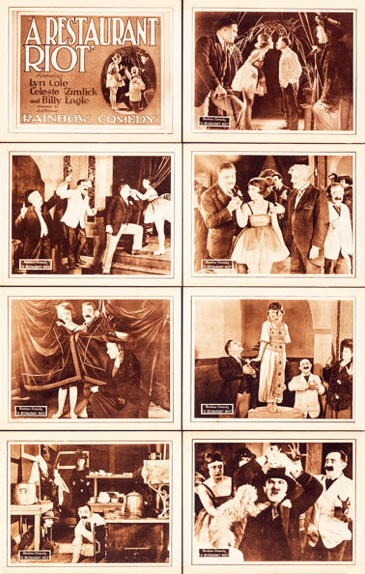
In 1920 movie patrons laughed at the subject of riots in restaurants.

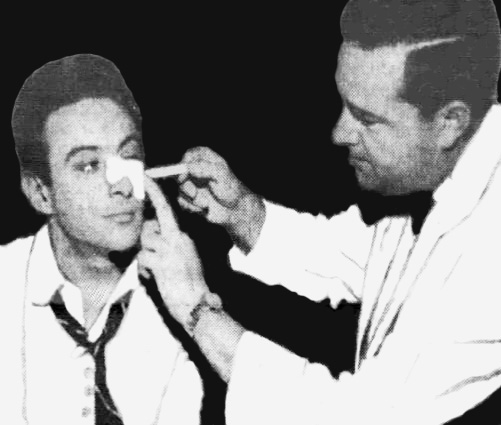
Restaurant brawls are diverse. Undoubtedly many of the sites where they occurred were lowly eateries but others were mainstream chains, such as the International House of Pancakes, Child’s, and White Castle. And Googie’s – where comedian Lenny Bruce went through a plate glass window. [1957 photo]

Not even Grandma’s Family Restaurant and Pancake House in Rockford IL was safe from disruption. In a 1992 melee there, an estimated 30 patrons “went wild,” breaking out four plate glass windows, jumping over booths, and throwing whatever they could get their hands on.

Incidents sometimes involved brawlers you might not expect, such as students at elite colleges (Harvard vs. Dartmouth in one case), or men in tuxedos upset that a server refused to give them more sugar during WWII rationing. Generally participants have tended to be young, white, male, and intoxicated.

Few incidents could outdo the brawl in New York City’s Bryant Park Grill said to be a repeat of a similar event in DC three years earlier. To quote a 1998 story in the Jersey (City) Journal, 40 of NYC’s firemen celebrating Medal Day in their finest uniforms “annoyed patrons, exposed themselves, urinated in public and invaded a women’s restroom.” They also threw a policeman over a row of planters when he tried to break them up. And, as so often happens, no one was arrested.

Personally, I will try to push all this to the back of my mind when I’m visiting restaurants.

© Jan Whitaker, 2023

12 Comments

Filed under patrons, popular restaurants, restaurant issues

Kibbitz & Nosh, the book

Today is launch day for Kibbitz & Nosh: When We All Met at Dubrow’s Cafeteria, a book of black and white photography by Marcia Halperin. In the 1970s she began dropping by Dubrow’s on King’s Highway in Brooklyn and in Manhattan’s garment district. The cafeterias from what may seem like a long-gone past were as unpretentious as their customers.

The images she captured are reminiscent of street photography at its best, showing aspects of everyday life in the city. The book also includes essays by playwright Donald Margulies and Deborah Dash Moore, historian of Jewish-American life, including Jewish New York: The Remarkable Story of a City and a People (2017).

There is an interview podcast with Halperin by Street Photography Magazine, and a selection of her photographs from the book can be viewed at the Edward Hopper House Museum in Nyack, NY, until June 25.

Kibbitz & Nosh is available from independent booksellers, Amazon, and Barnes & Noble, as well as its publisher, Cornell University Press.

UPDATE of coming events

Signup for June 8 at Launch Photobooks – In Person

Signup for June 11 at Nyack Library — In Person

Sign up for June 29 at Yiddish Book Center – Virtual

4 Comments

Filed under cafeterias, patrons, popular restaurants

The art of menu covers

Ask someone to name a designer of menu covers and it’s likely you will get a blank look. Although many stylish and eye-catching menus have been produced over time, their designers and illustrators mostly worked in anonymity.

In the early 20th century many of the menu cover artists were probably women. In 1900 the Kalo Shop in Chicago, for instance, employed six women graduates of the Art Institute who were trained in the esthetics of the arts-and-crafts movement. They created menu and magazine covers and other items. It’s likely that most of their menu work was for private banquets, while their biggest clients would have been steamships and railroads.

Individually produced menus such those from the Kalo Shop were rapidly being made obsolete by chromo-lithographers who could achieve quality effects at a lower cost. Unsurprisingly, the next chapter of menu production was taken over by printing companies with designers on their staffs. Some of the printing companies, such as Denver’s Standard Menu Co., were specialists in menu production as early as 1920. Like the women artists of earlier times, the names of designers in printers’ art departments are unknown. In more recent years, menu covers for well-capitalized restaurants have been designed by independent design firms. They created striking logos to be used on signs and menus and in advertising, giving individual restaurants and chains a thoroughly integrated visual signature.

In his book on menu design, “May I take Your Order?,” Jim Heimann says that well known illustrators such as Maxfield Parrish and Norman Rockwell rarely, or never, designed menus or created art specifically for menu covers. That is mostly true, with a few exceptions, such as Al Hirschfeld, who contributed caricatures to New York’s Stage Deli menu and Charles Bragg, who painted a crowd of Hollywood celebrities for Chasen’s in Los Angeles [shown at top].

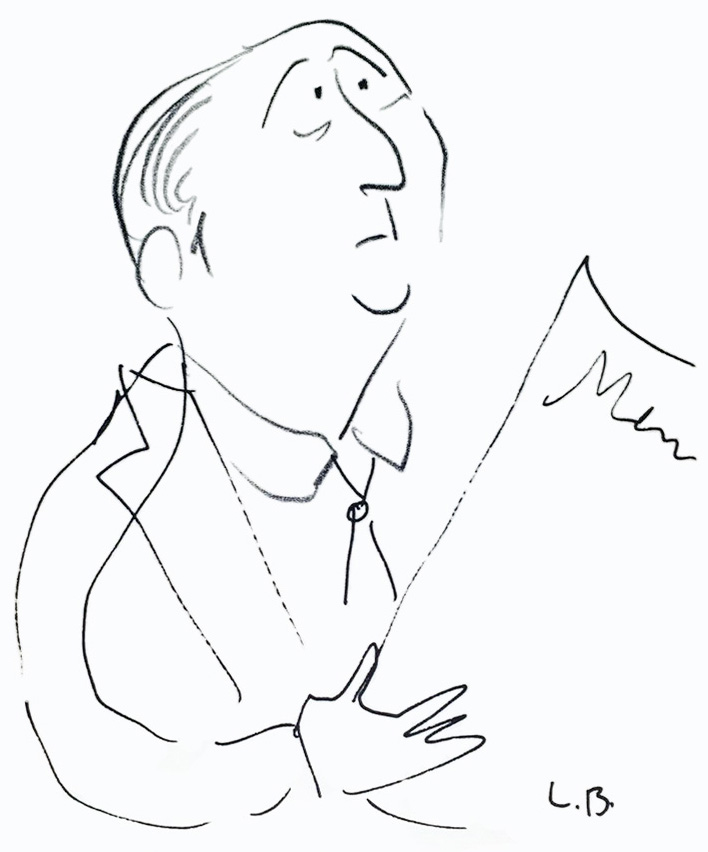
Chicago’s Blackhawk Restaurant used 8 drawings by Ludwig Bemelmans in the 1960s. They were not originally created for the restaurant, though owner Don Roth bought the originals, obtained Bemelmans’ permission to use them on menus, and gave them to customers as souvenirs.

Here are a few menus with designs that I particularly like.

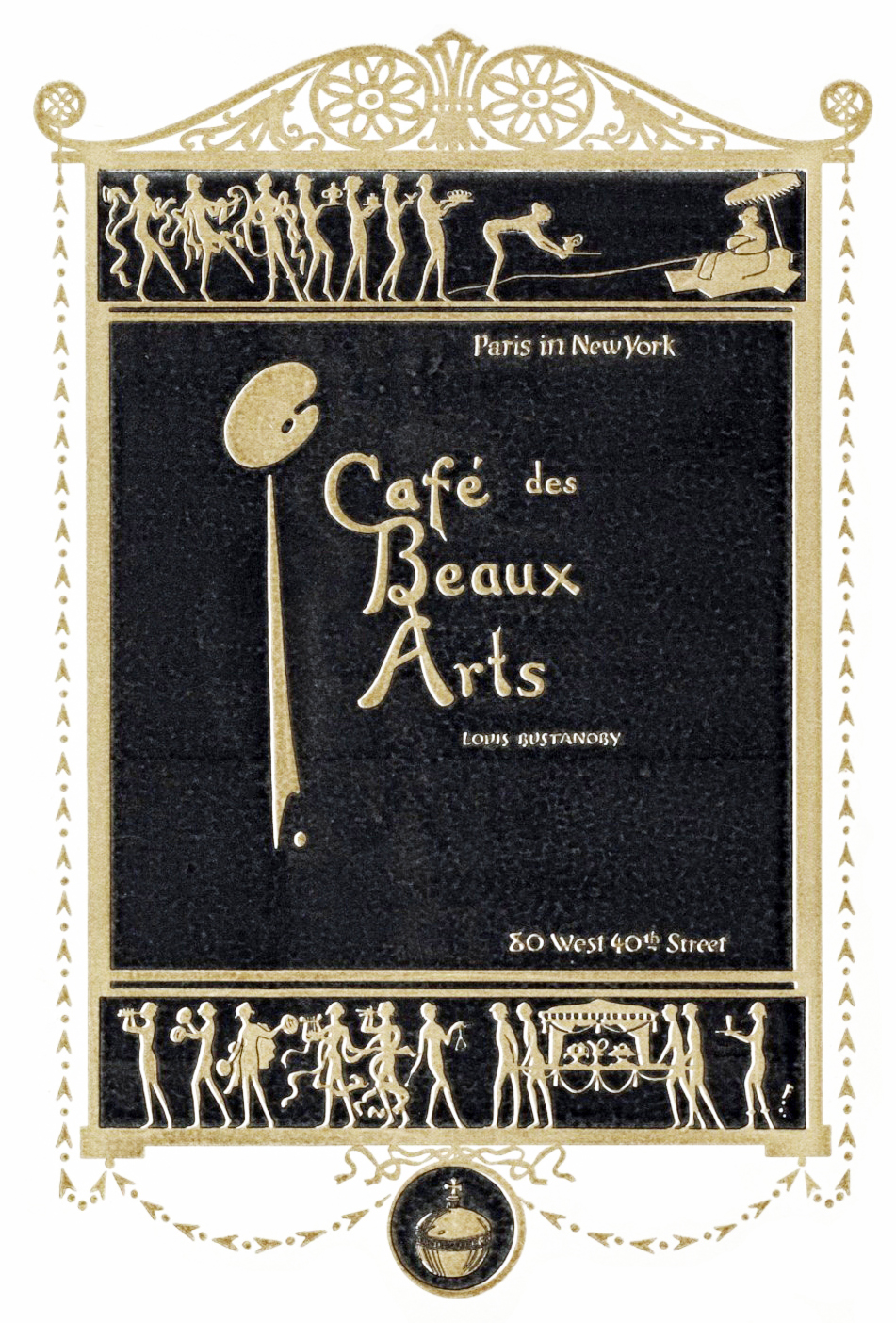
Café des Beaux Arts, New York City, ca. 1910
A fashionable café of the early 20th century created by brothers Louis Andre and Jacques Bustanoby. Said to be a hangout of the artistic crowd, on Sunday nights it was so crowded no one could enter. Unlike other so-called “lobster palaces,” it reputedly served good food. It closed in 1920, a victim of Prohibition.

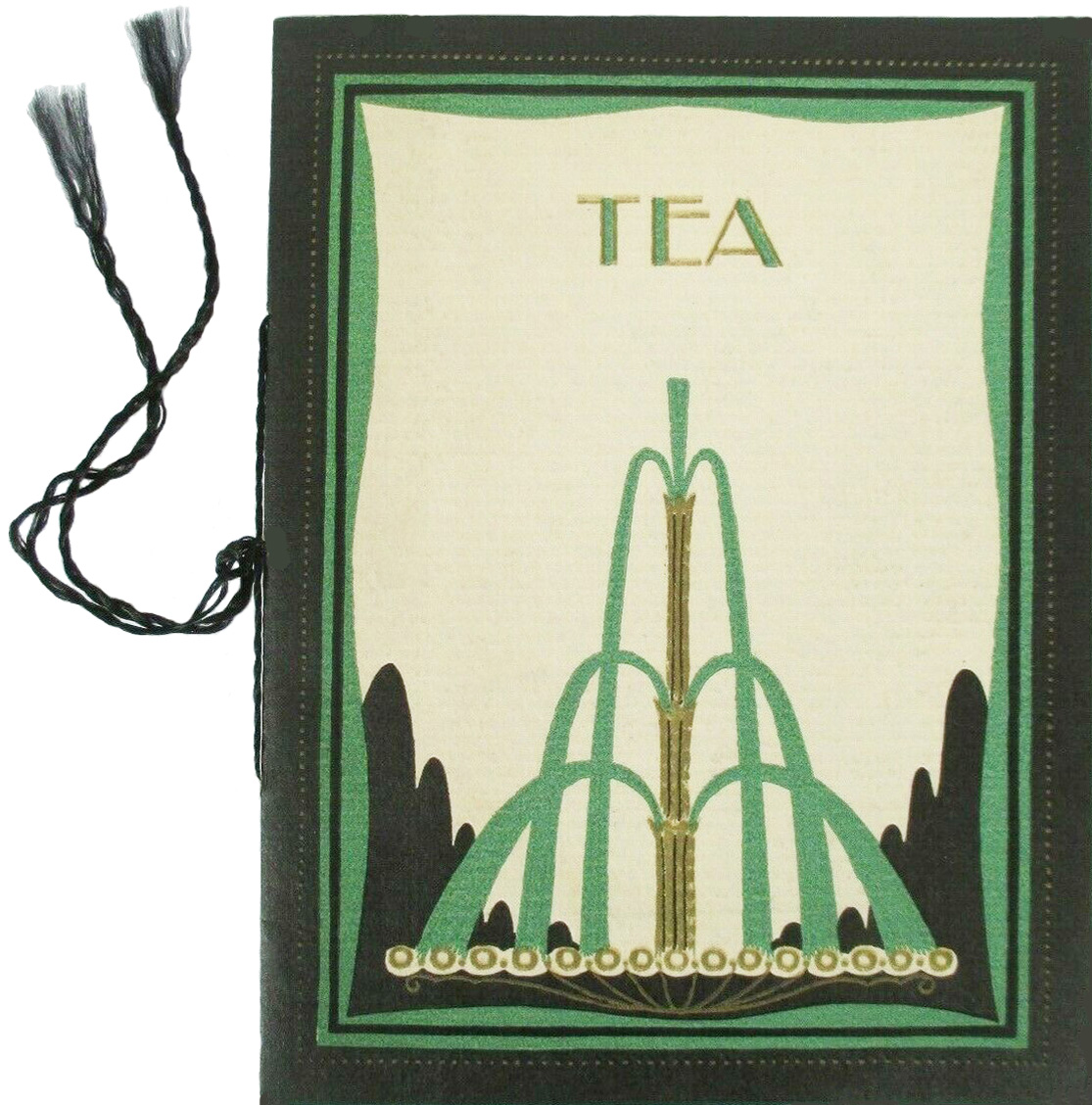
Carson Pirie Scott Tea Room, Chicago, early 20th century
In 1904 the old dry goods store named Carson Pirie Scott bought a building on Chicago’s State Street built by famed architect Louis Sullivan. The 8th-floor tea room soon became a city-wide attraction. This menu of uncertain date has the subdued but assured look of a pedigreed eating place meant to appeal to “ladies” who seek to be correct as well as stylish.

Café Society, New York City, 1938, 1940
In this case a known artist, Anton Refregier, not only contributed his artwork but did so in a full cover design when Barney Josephson, owner of New York’s Café Society music club restaurants, hired him to create menu covers for his two locations, first downtown at Sheridan Square in 1938, and then uptown at East 58th street in 1940. [Both covers are probably on beige-ish, not white, paper]

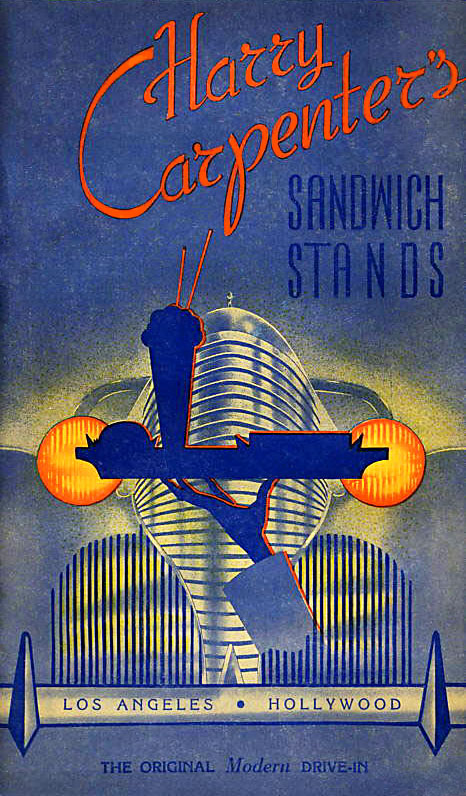
Harry Carpenter’s drive-in, Los Angeles, early 1940s
Harry Carpenter opened his first drive-in, an octagonal building, on the corner of Wilshire Blvd. and Western Ave. It was so popular he soon opened two more. In addition to hamburgers and hot dogs, Carpenter’s served corned beef on rye and chicken a la king on toast. This menu, though somehow foreboding, is dramatic.

The Hungry I, San Francisco, ca. 1955
The Hungry I, a comedy and music club, was founded around 1950, then sold and relocated to 599 Jackson street in 1954 where this menu was in use. Among those appearing there were Mort Sahl and The Kingston Trio. This menu offers entrees such as steak, lamb chops, chicken, and shish kabob. In ways that are hard to pinpoint, the cover design captures the spirit of the 1950s beatnik counterculture.

Huddle Restaurants, Southern California, 1956
The Huddle’s menu borrows the lettering of the chain’s exterior signage as well as the style of its architecture by Louis Armét and Eldon Davis. Probably their firm also handled the design of this menu, either in-house or by commission. Not all the restaurants in the chain featured futuristic “googie” design, but you can view images of many of those that did.

According to Heimann, the golden age of menu cover design in America ran from the 1920s through the 1950s. The 1960s in his judgement was mostly “a monotonous era” for menu design. Sadly, to me, in recent years printed menus with covers have almost completely vanished, along with postcards, matchbooks, and business cards. Digital photographs, if preserved, may become the sole visual record of most restaurants.

© Jan Whitaker, 2023

Note: Fans of menu cover art would enjoy Menu Design in America (2011) and May I Take Your Order (1998). Reproductions of menus suitable for framing are available from Cool Culinaria, which also provides links to samples from the collections of Lou Greenstein, Henry Voigt, and the Culinary Institute of America. Also, beginning April 25, over 200 menus from the 19th and 20th centuries selected from Henry Voigt’s collection will be on display at New York’s Grolier Club. More about that later.

14 Comments

Filed under menus, popular restaurants

An early restaurateur’s rise & fall

Life in the 19th century was chaotic and unpredictable in so many respects, but the weird and eventful life and restaurant career of the highly enterprising Mark Langdon Winn, with its succession of ups, downs, and strange twists, would stand out in any century.

As far as his many business schemes went, he never stuck with any of them for long, restaurants included. He bounced around Maine, Boston, New York City, Albany NY, San Francisco, Virginia City NV, and finally back to New York City where he died in 1881. His San Francisco restaurants were the most successful of his enterprises, but despite their promise he held onto them only for about six years.

Before going to California he owned two grocery stores in Boston. Next he went to New York City where in 1843 and 1844 he manufactured and sold a cure-all product called Winn’s Irish Vegetable Relief Candy, good for “weakness of the chest and lungs, liver complaint(s), asthmatic affection, impurities of the blood, dyspepsia and all bowel complaints.”

Maybe restless, disappointed by candy sales, or lured by gold, he took off for San Francisco in 1849, age 34, after leaving Albany where his wife and children remained for another couple of years. Borrowing money from a shipmate upon arrival, he began making candy and peddling it in the streets. After a short time he had enough money to open a confectionery with a partner. Before long he was running the business solo and had added bakery goods and simple meals to his offerings.

Fires were frequent occurrences in San Francisco and he was burned out at both of his initial locations in less than a year. In 1851 he opened his principal restaurant on Long Wharf, calling it Winn’s Fountain Head. Despite the abundance of eating places in the city, it rose to prominence rapidly due to its respectability, cleanliness, and relatively low prices. It was unique in heavy-drinking San Francisco for providing no alcoholic beverages. Winn was a dedicated temperance advocate, always emphasizing the cause in his frequent, wordy newspaper advertisements that often contained sermons on the evils of drink.

The Fountain Head was not fancy. Long Wharf (aka Commercial Street) was hardly a fine location. It was a busy street without sidewalks, filled with liquor saloons, gambling dens, and all-night stores. It vibrated with “a heterogeneous crowd” of carriages, horses, carts, and pedestrians. A writer in the March 1854 issue of The Pioneer wondered “Why there are not a dozen or two broken necks there daily.”

The Fountain Head was open seven days a week from 6 a.m. to midnight, with a menu that included a wide range of meats and vegetables, along with puddings bearing such homely names as Aunt Sally’s and Cousin Jane’s. According to a ca. 1853 menu, an order of roast beef, veal, or corned beef and cabbage cost 25c, while most vegetables were 12c.

According to the city’s Commercial Advertiser in April, 1854, the Winn enterprises — by then comprising the main Fountain Head restaurant and a more elegant “Branch” welcoming women with fancy desserts – had attained the pinnacle of success. Together, the story reported, the two places served 3,000 patrons daily, taking in $57,000 a month, and paying out monthly as much as $1,600 for advertising, $8,000 for meat, $4,000 for milk, $3,000 for potatoes, and $2,000 for ice.

But this account was misleading because only a few months later Winn went into bankruptcy.

Following bankruptcy he started up at a new address, combining the Fountain Head and its Branch into one. But things soon turned sour again. In Spring 1856, he and his new business partner dissolved their partnership with the partner taking over the business. Almost immediately after that, Winn’s wife Eliza took advantage of a California law that allowed women to run businesses independently, declaring that she would carry on the “Fountainhead Confectionery and Steam Candy Manufactory” in her name. It appears she continued to run the business of making and selling baked goods and confectionery until 1859. He may have briefly tried to make a comeback at his original address, but in 1859 the Fountain Head on Commercial Street and a confectionery run by Eliza Winn were put up for sale.

Years later, in a Poughkeepsie NY newspaper story of 1878, Mark Winn would blame the failure of his San Francisco restaurants on employees who robbed him. “Every man I employed was a thief,” he said, singling out his secretary, cashier, and cook. With honest help, he claimed, “I would have been worth a half a million of dollars.”

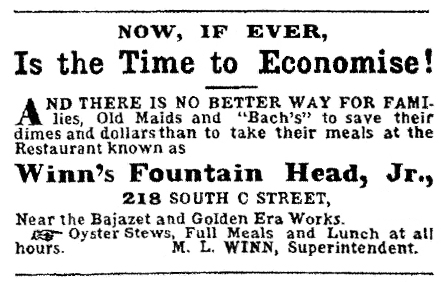
But the Winns’ western odyssey wasn’t over after leaving San Francisco. In 1860 they moved to the boomtown Virginia City, Nevada, where silver had just been discovered. There, Mark Winn struck silver, opened a restaurant and confectionery called Winn’s Fountain Head, Jr., and invested in a hotel. The hotel soon relocated to another city in Nevada and he lost his investment. The fate of the restaurant is unknown but it did not achieve fame as he had done in San Francisco [1864 advertisement]. He tried to sell shares in his silver mine, advertising that “there is no doubt that within the next six months a fair dividend will be made to the stockholders.”

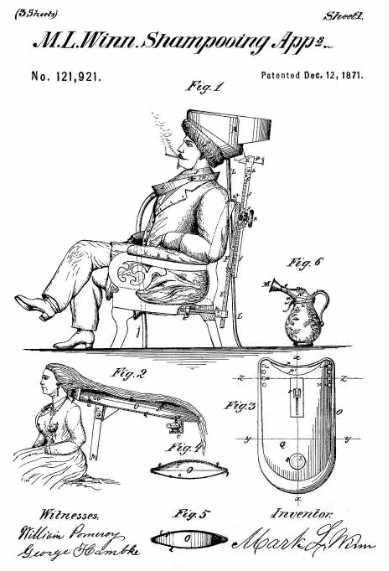
Apparently he didn’t strike it rich, though, because after five years in Virginia City he filed for insolvency and the Winns returned to San Francisco where he began work on the invention of a shampooing device that was patented in 1871 [shown above].

Next, the couple moved to New York City where he deteriorated rapidly, living in destitution and displaying signs of paranoia that had been in evidence as far back as 1854 when he referred to his “enemies” in an advertisement for the Fountain Head. On one occasion he was arrested as a public nuisance, wandering the streets of New York wearing “armor” and a tin helmet (possibly the shampooing device?) while distributing religious tracts. He spent his final days in the Alms House on Blackwell Island where he was described as suffering from “religious mania.” It also came out that his father had been an alcoholic.

Despite the uneven contours of his career as a restaurateur, Winn’s Fountain Head has become a subject of interest, often mentioned positively in a number of books and articles that tell of San Francisco’s early history. It’s presented as a triumphal success, when really it’s a boom and bust story sadly common in the restaurant business.

© Jan Whitaker, 2022

2 Comments

Filed under confectionery restaurants, food, popular restaurants, proprietors & careers, restaurant prices

Digesting the Madonna Inn

The Madonna Inn complex in San Luis Obispo CA, including a fantasyland motel, wedding venue, shops, and restaurants, represents the genius and determination of a rugged male individual – assisted by his wife — conquering all obstacles to build a dream.

Alex Madonna had been planning his project from 1953 if not earlier. The motel opened in the full sense of the word in early 1959, but it was not until a couple of years later that the complex was furnished with eating facilities.

Although all along it has had plenty of overnighters, honeymooners, lunch and dinner patrons, banqueters, and gawkers who love it, the place has also had detractors. Among their assessments: “a fantasy run amok,” “the epitome of lousy taste,” and “a crazy, outrageous Hansel-and-Gretel complex.”

Madonna Inn lore credits its unorthodox design to Alex and Phyllis Madonna’s untutored creativity. Alex, according to legend, speedily dismissed the architects he initially consulted. Yet, up until the end of 1958 Madonna worked with plans developed by Beverly Hills architect Louis Gould, a former Hollywood film set designer. And as late as 1966 an advertisement for an apartment complex Gould designed credited him with other “outstanding landmarks . . . including the famed Madonna Inn.” To the extent that the Inn’s exterior achieved any coherence, it may be due to his early influence.

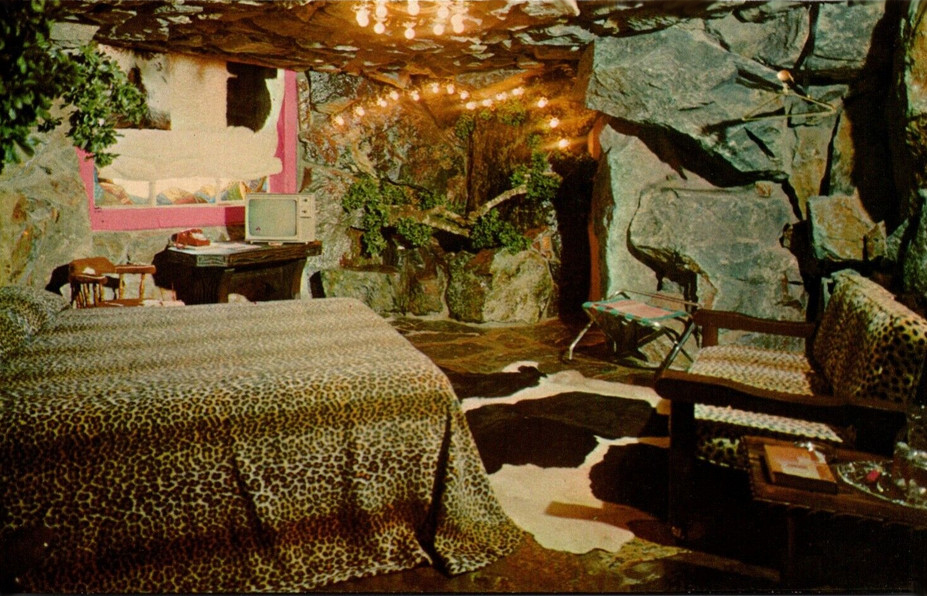
Yet there was a point where no professionals guided the design, as revealed especially in the striking – to me jarring – use of large stones and boulders. The two most celebrated rooms – a men’s public bathroom with a urinal flushed by a waterfall and the Caveman Room [shown above] – prominently feature these materials.

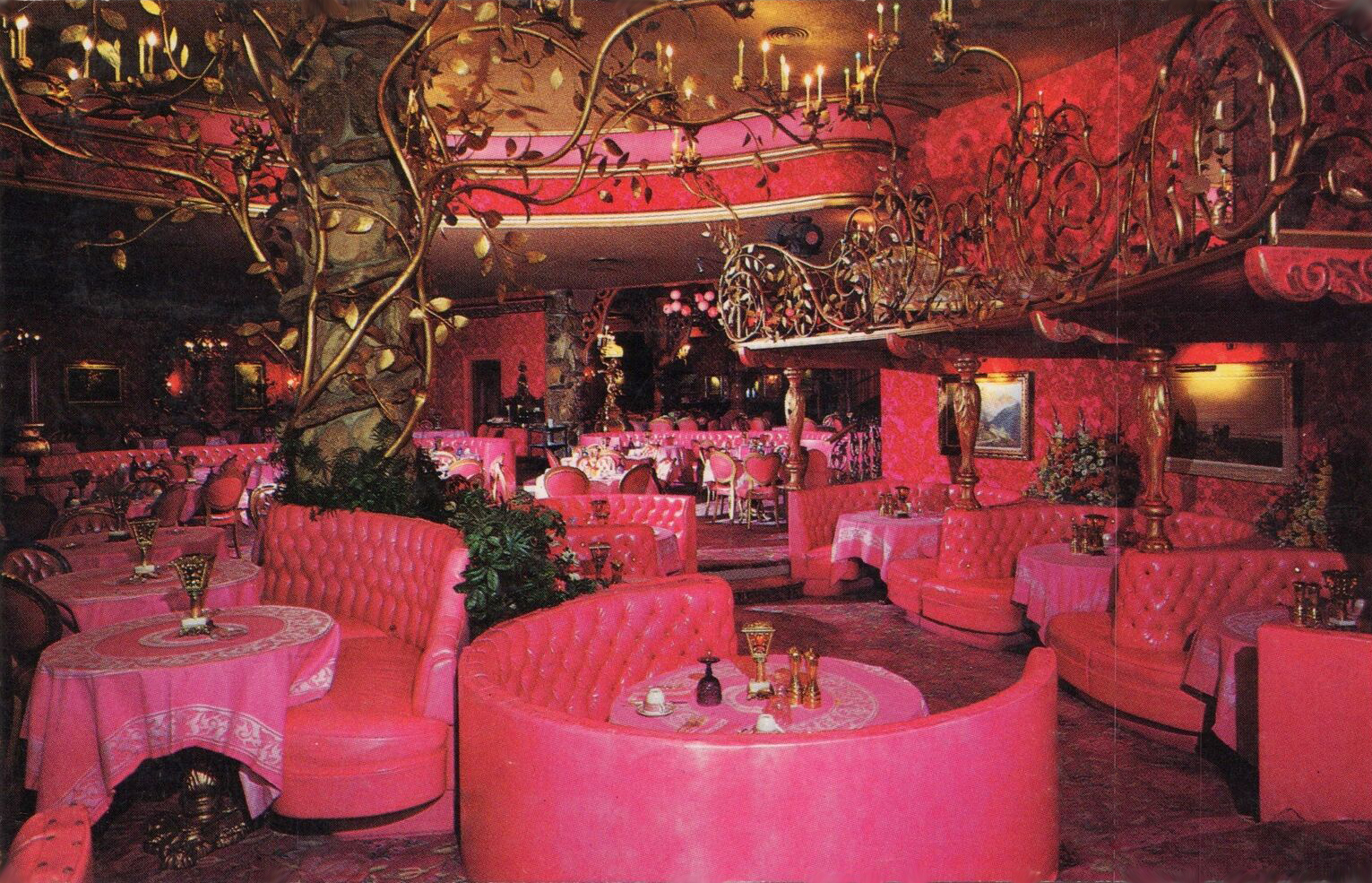
Throughout the interior, the combination of stones and boulders with bright primary colors, artificial flowers and vines, gilded cupids, figured textiles, and plush carpeting is disturbing. The Inn’s eating places exemplify the common observation that many American restaurants are more about decor than food. This was especially true of the primary dining room, the Gold Rush Room [shown below]. Its jangling decor, superficially suggesting luxury but not allowing the eye to rest, is out of keeping with fine dining where food is the star.

A Los Angeles Times reviewer said he lost his appetite in the Gold Rush Room after viewing the giant tree with “fat, glossy, grinning cherubs, spray-painted gold and swimming in Pepto-Bismol.” Alex Madonna responded with a letter defending the room’s centerpiece. The 25-foot tall tree, he pointed out, had been “hand-crafted” on the spot out of “electrical conduit and copper remnants left over from building projects.” The pink, he wrote, was inspired by a visit to Hawaii where it was used lavishly in hotels and restaurants. At one point, even the Inn’s bread and sugar were pink.

The images of the Madonna Inn shown here are difficult to date, but most are probably from the 1960s and 1970s. Everything was subject to change and frequently overhauled. As a 1973 story in the Los Angeles Times observed, Alex Madonna perpetually thought up new ideas, one being an indoor lake featuring a floating cocktail bar that patrons would reach by canoe. The room would have been furnished with a snowflake machine and a three-story fireplace that burned entire trees. That dream did not materialize, nor did the plan to build another motel complex atop the San Luis Mountain behind the Inn that he bought from the city of San Luis Obispo in1972.

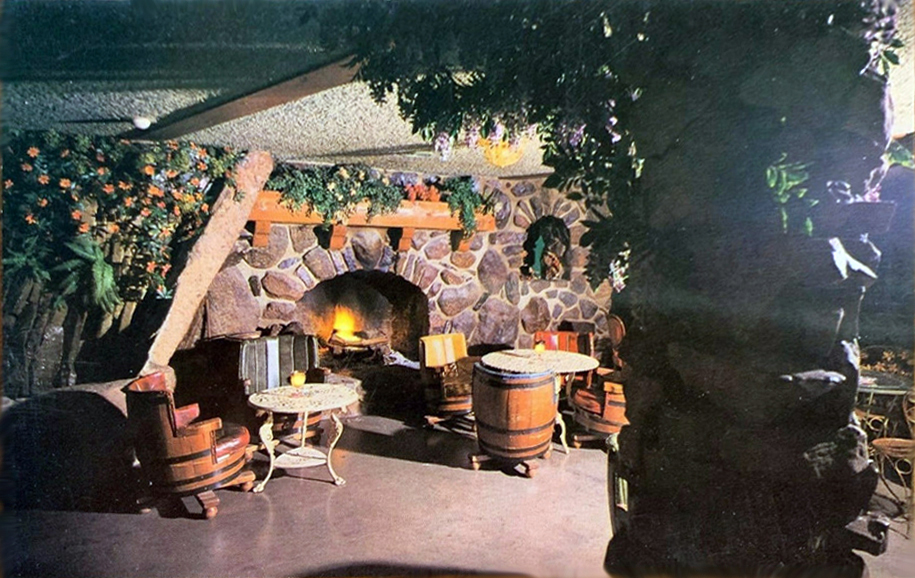
The Inn’s basement Wine Bar below the Gold Rush Room featured boulders incongruously festooned with vines and blooming flowers, a beamed ceiling, and chairs fashioned from barrels. If the wine list was anything like the coffee shop’s, it too would have specialized in Lancers and Paul Masson selections such as Rosé and Sparkling Burgundy, along with Port and Sherry aperitifs.

Lunch and supper specials on a ca. 1960s coffee shop menu were also uninspired. They included low-calorie choices such as Ground Beef Patty with Cottage Cheese, and entrees like Top Sirloin Steak with Cottage Cheese and Peaches. “Chilled” Tomato Juice as an appetizer.

The 1960s and 1970s were not distinguished decades gastronomically, and in that sense the Inn was typical. Patrons might be thrilled with the oversized pastries available in the coffee shop, but otherwise the fare did not receive many comments. A few observed that it was nothing special and overpriced. Recent photos taken by guests are not flattering, though it’s only fair to admit that they may reflect Covid-era staffing issues.

The Inn was hailed in the 1970s by fans of vernacular roadside architecture, such as John Margolies, as well as some influential writers and scholars. Not only did Margolies declare the Inn’s meals “delicious,” he considered the complex “a labor of love” designed to make people happy” and “a place where things that don’t go together go together.”

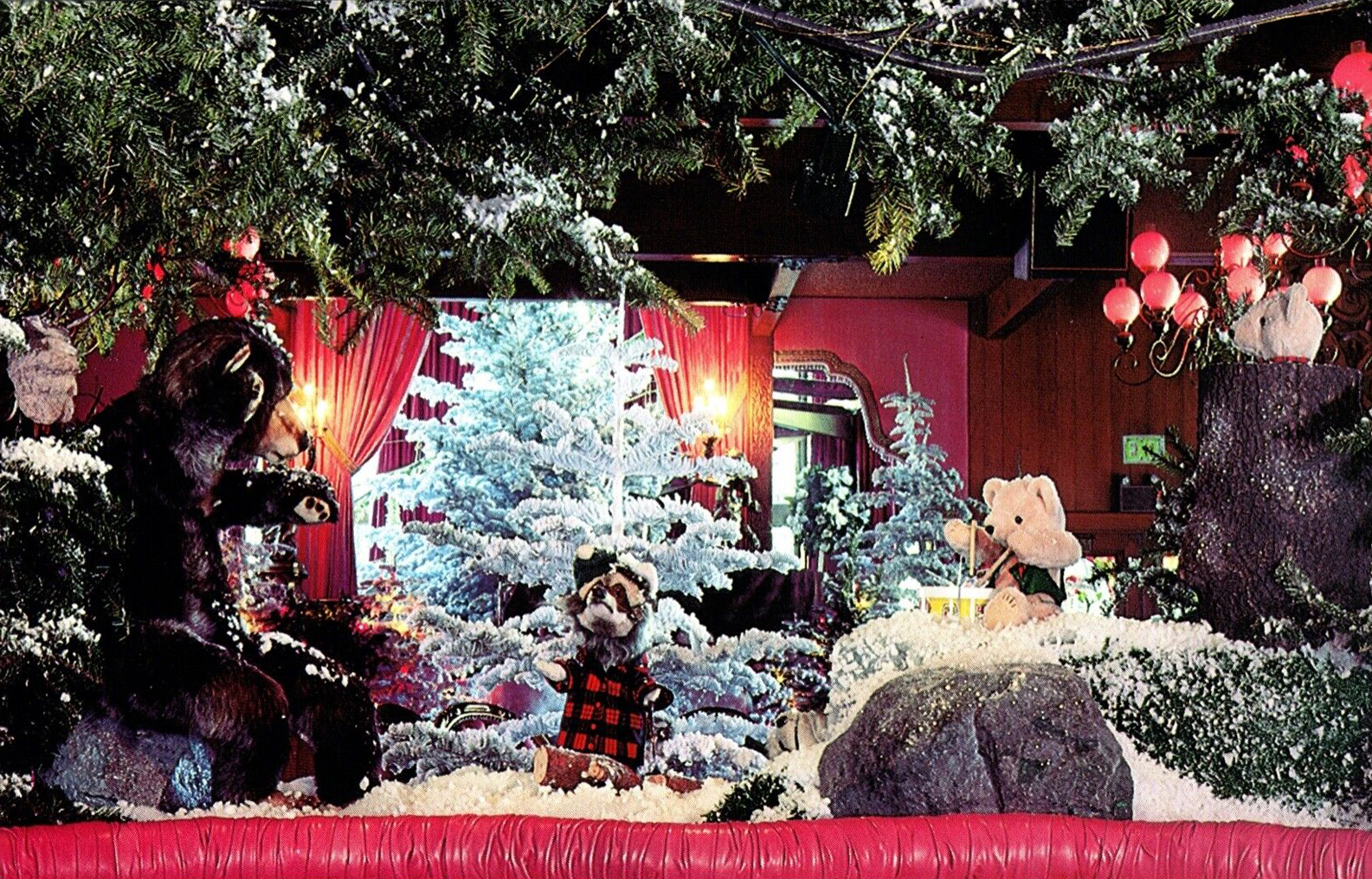
Hmm. I’d say that in the Gold Rush Room’s Christmas scene, among others, things could never go together.

© Jan Whitaker, 2022

13 Comments

Filed under decor, food, odd buildings, Offbeat places, popular restaurants, proprietors & careers

Halloween soup

Although the food-page story in a New Orleans newspaper said that this photo showed a jack-o-lantern just carved by Chef Gunter Preuss for his children, I can’t help feeling a little bit spooked by it. Is it how he’s holding that knife, or his serious gaze?

Never mind, because the story was about the Harvest Cream Soup he makes out of the pumpkin’s insides. (See recipe below.)

At the time of this story, 1976, Gunter Preuss and his wife Evelyn were owner-operators of the Versailles Restaurant in New Orleans. Eight years later they acquired a part interest in Broussard’s, which they took over from 1993 to 2013.

The Versailles received a glowing review in Richard Collin’s “Underground Gourmet” column in 1978 — although it was definitely not a restaurant for the price-conscious diner. Collin declared it “spectacular,”and “about as fine a restaurant as one can imagine.” He singled out many dishes as “platonic,” meaning they could not be more perfect. Among them were Bouilabaisse Marseillaise, Rack of Lamb Persillades, Ris de Veau Grenobloise, and Pears Cardinal. Chef Preuss was also featured on the show Great Chefs of New Orleans.

The recipe for pumpkin soup does not give amounts for every ingredient. It calls for a pumpkin’s interior, seeds removed, to be cubed and washed. Then sauté the cubes with onions and celery until glazed. Add flour and a half quart of chicken stock. Simmer the mixture over medium heat for 45 to 60 minutes, seasoning with salt, white pepper, powdered ginger, and white wine. Then strain the soup and add three eggs yolks and a cup of light cream. Simmer on low flame for five minutes, then pour into cups and serve with a whipped cream topping and a touch of ginger. Serves six.

Enjoy Halloween!

1 Comment

Filed under chefs, food, popular restaurants, proprietors & careers

Restaurant as community center

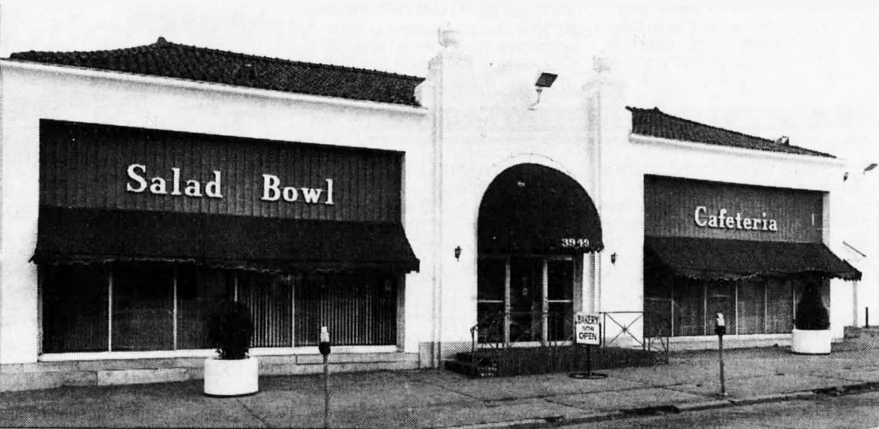
The first Salad Bowl restaurant, at 4100 Lindell in St. Louis, was established in 1948 by two former employees of Miss Hulling’s Cafeteria downtown. The husband and wife owners were mainly concerned with making a living for their family and had little idea that, like Miss Hulling’s, their venture was destined to become a celebrated local institution and landmark. [above: final and primary location, 1989]

The Salad Bowl’s founders were Elmer and Anna Sewing, whose three sons would one day take over the cafeteria, having gained plenty of hands-on experience working there in their younger years. At its final location at 3949 Lindell Blvd. the sons, David and his twin brothers Norman and Norbert, took full charge after their father’s death in 1976. Knowing they had to expand the business, they encouraged greater use of the banquet rooms. To draw customers during the day the sons made the rooms available for free to clubs and organizations for meetings and talks if their members and attendees went through the cafeteria line. [Norbert and Norman Sewing at the bakery counter, 1989]

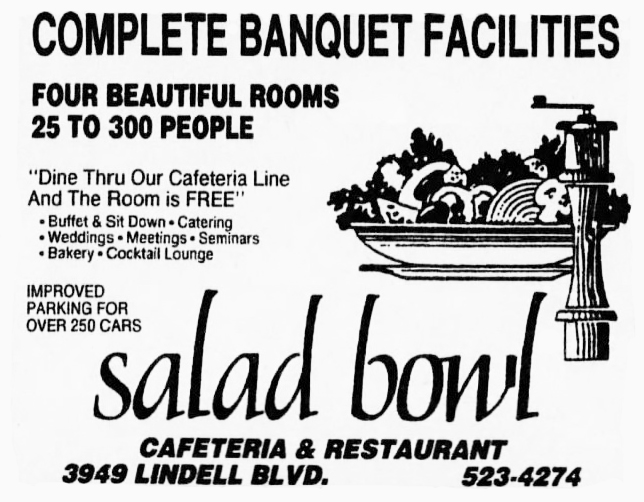
The cafeteria was located about halfway between two universities, making it possible for the cafeteria’s banquet rooms to become popular sites for talks and lecture series by professors. The Salad Bowl had the unique distinction of being the only eating place that I know of that advertised “seminars” among its attractions. [1988 advertisement] A few of the topics covered over time were homelessness, children’s mental health, the working poor, the global economy, and the Jewish sanctuary movement.

News conferences took place regularly at the Salad Bowl. In 1986 a speaker from Ralph Nader’s Public Citizen group discussed the rapidly rising rates of liability insurance, blaming it on greed in the insurance industry. The event was sponsored by the Missouri Public Interest Research Group and the Missouri Citizen-Labor Coalition.

Although, like many restaurant owners, Elmer Sewing had turned away Black diners at a time when he judged that white customers would not accept them, he often said that he was opposed to segregation. According to his grandson Stephen, who privately published a memoir-style history of the Salad Bowl* after its closure in December of 2005 [title page above], his grandfather was personally opposed to segregated eating facilities. He was said to be eager to welcome Black customers once the Civil Rights Act had passed, making it illegal to refuse service to patrons based on race. Stephen wrote that the cafeteria was one of the first in St. Louis to integrate.

Black organizations, clubs, and events by Black activists were included in the Salad Bowl mix, as were prayer breakfasts in honor of Martin Luther King. Another example was a news conference held by well known activist Ivory Perry who denounced President Ronald Reagan’s introduction of housing vouchers in 1982, calling it a step in federal abandonment of public housing and urging people to join a protest rally in Washington. A St. Louis section of the National Council of Negro Women held its 5th annual awards dinner there in 1986.

Both Black and white politicians gave talks at the cafeteria, and Jessie Jackson visited there. According to Stephen Sewing’s book, “Every state senator, state representative and governor has known the Salad Bowl because of all the political parties, press conferences, meetings and rallies held at the Salad Bowl over the years.” Organizations holding regular meetings included the Book Lovers Club, the League of Women Voters, the Press Club, Retail Druggists, Weight Watchers, the Worker’s Rights Board, the Women’s Coalition for the Democratic Party, and locals of the St. Louis Teachers Union and the Service Employees Union.

Scrolling through the notices of talks and public events held at the cafeteria made me realize how impossible it is to give more than a partial idea of how many and varied they were.

In the 1990s the cafeteria was also used as a site for flu shots, blood pressure tests, and school children’s immunizations.

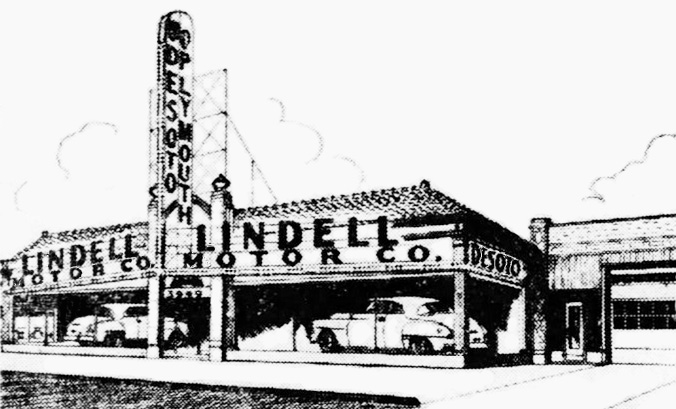
The Salad Bowl menu focused on standard cafeteria comfort food such as Kidney Bean Salad, Whiting, Beef Brisket, Banana Cream Pie, and the St. Louis specialties, German Potato Salad and Toasted Ravioli. Customers could also stop at the bakery counter to buy baked goods to take home. A tavern room called Bits and Saddles operated for ten years as part of the complex and there was an underground parking garage, a remnant of the car dealership that had occupied the site before the Salad Bowl took it over. [shown below, 1952]

The restaurant also served as a special gathering spot for the extended Sewing family who used banquet rooms for their own wedding dinners and receptions as well as major holiday feasts. With the three fathers working long days, sometimes six days a week, often the only way to see them was for their families to come to dinner at the cafeteria. Their wives and children also put in time as spare hands for serving banquets, helping with bookkeeping, and other chores.

Now, when restaurants tend to be ranked and rated mainly for the quality and novelty of their cuisine and interior appointments, I find it refreshing to review a restaurant from the past that was so deeply a part of city life, and valued for that by thousands of St. Louisans.

© Jan Whitaker, 2022

  • Two copies of the 90-page booklet are available at the main St. Louis Public Library.

4 Comments

Filed under alternative restaurants, cafeterias, popular restaurants, proprietors & careers