Category Archives: miscellaneous

Taste of a decade: restaurants, 1810-1820

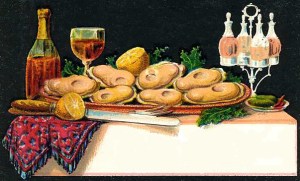
oysters090The nation has begun to grow westward though settlement is still mostly along the coast. Seven cities exceed 10,000 in population in 1810, rising to eight over the decade. In the largest city, NY (152,056 in 1820), commerce is on the rise, yet by mid-decade there are only eight hotels and five banks. Pigs run free in the streets. The defeat of Britain in the War of 1812-1815 does not cause an immediate end to British influence on public eateries, though there are a few French restorators. Beefsteaks are popular and oysters are served almost everywhere. Alcohol flows freely. Most eating places are also drinking places and boarding houses as well. Board can include lodging or not — some people pay a weekly or monthly fee simply for meals.

Highlights

1810 With close to 34,000 inhabitants Boston, the nation’s fourth largest city, has almost 50 victuallers who run either cook shops where householders take food to be cooked or places where cooked food is served on the premises. There are also five confectioners, one restorator (Jean Gilbert Julien), three taverns, three coffee houses, and seven wine shops, some of which serve cooked food.

1811 Robert Wrightson, owner of the Union Coffee House in Boston, advertises for “a young Woman to do Kitchen Work.” He has recently opened a hotel near Cambridge where, he promises, he will stock the finest Champagne, Madeira, Sherry, Port, and London Brown Stout. Also on tap: bowling alleys and “Dinners and other Refreshments provided at the shortest notice.”

1814 In Newport RI, N. Pelichan announces he has opened a Victualling House and is ready to serve “good Beef-Steaks, Oysters, Turtle-Soups, etc. with Pastries, Wines and all kinds of Spiritous Liquors, of the very best quality.” He looks forward to hosting dinners and suppers for men’s clubs and societies which make up a good part of the dining public.
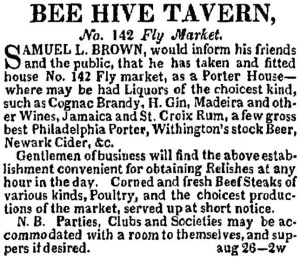
beehiveny18181815 On July 17 Hannah Julien, who has run Julien’s Restorator since the death of her husband Jean ten years earlier, informs the public that she will be serving a “fine green turtle” that day. – In Salem MA, John Remond, who is black and from the West Indies, also runs a restorator where he prepares soups, green turtles, cakes, wafers, French rolls, and other delicacies.

1817 Boasting that he has cooked for wealthy men as well as President James Madison, Henry F.Doyhar promises to furnish breakfasts, dinners and suppers at his Washington, D.C. fruit and pastry shop “on the shortest notice.” Evidently he also has a billiard table on the premises because a few months later he receives a pardon from President James Monroe for keeping it without a license. – Meanwhile, over in Georgetown William Collins lures epicures with “the richest gravies, finest jellies,” York, Cove, and Nantiquoke oysters, canvassback ducks, and “every article that will serve to embellish a supper, and give gaiety and animation to the repast.”

1818 For a day of recreation, Philadelphia families head to Greenwich Point Tavern on the Delaware River. They order a meal or simply graze on turtle soup and ice cream which are prepared every Sunday. If they become bored they take a boat ride across the river to Gloucester Point on the New Jersey side.

1819 A New York oyster cellar on Chatham Street fills up around 9 pm with patrons who drop by for fried, stewed, or raw oysters washed down with their favorite alcoholic beverages. A visitor describes the interior: “There were several tables in little boxes, covered with cloths not very clean, and having broken castors, filled with thick vinegar and dirty mustard, together with knives and forks not very tempting in their appearance.” He is also critical of the age of the patrons (too young), their appetites (too big), and the times (too extravagant).

© Jan Whitaker, 2009

Read about other decades: 1800 to 1810; 1860 to 1870; 1890 to 1900; 1900 to 1910; 1920 to 1930; 1930 to 1940; 1940 to 1950; 1950 to 1960; 1960 to 1970; 1970 to 1980
3 Comments

Filed under miscellaneous

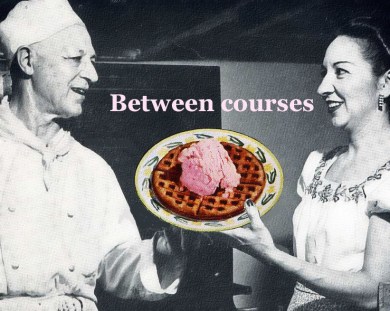
Between courses: nutburgers & orangeade

9betweencourses1

Had S. J. Perelman not gone to Los Angeles to write for the movies — including the Marx brothers’ Horse Feathers — we might never have known his reaction to LA’s larger-than-life animals and shoes, etc., housing restaurants that served food he found hilariously weird. In a 1934 series of absurdist essays called “Strictly From Hunger” he portrays his introduction to the “Plushnick Studio” and his efforts to obtain a meal along Hollywood Boulevard.

In a Pig ‘n Whistle café he orders an avocado salad, which the server covers with walnuts and chocolate sauce. He decides to order something else. She suggests the special nutburger. “‘Hamburger with chopped nuts,’ she offered helpfully. ‘Double ball of vanilla on the side.’ ‘What would a man drink with that’ I muttered averting my eyes. ‘Well, how’s about a Mammoth Malted Milk?’” He faints.

Next he goes to “a pink-and-blue shack whose neon lights told me that it was Burp Hollow, Home of the Realistic Ten Cent Hot Dog. My head began to swim again and I hurried on.”

mothergoose1928 After passing up Bamboo Isle (“Strictly Kosher Turkey Sandwiches, Fifteen Cents”), he heads to what was probably Mother Goose. “Finally, in an eatery built in the shape of an old boot I was able to procure a satisfying meal of barbecued pork fritters and orangeade for seventy-five cents. Charming platinum-haired hostesses in red pajamas and peaked caps added a note of color to the scene, and a gypsy orchestra played Victor Herbert on musical saws.”
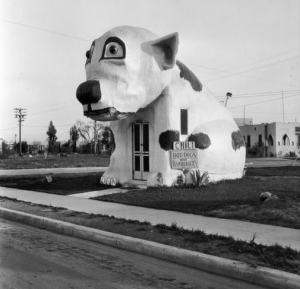
thepup1930 In a 1936 photo series called “Chamber of American Horrors” for which he wrote captions he describes Mother Goose as a place where “Inside, kiddies from six to sixty, most of whom are indistinguishable from each other, gnaw sizzling steaks and discuss their movie favorites.” Other eating places included in the Chamber were the Toed Inn (“tasty combinations of avocado and bacon, pimento and peanut butter”), the Laughing Pig Barbecue Pit (“Etched in red and blue neon lights against the velvety southern California night, it can be seen and avoided for miles.”), and the Pup (“The most ravenous appetite fades before this elaborate cheese dream.”).

© Jan Whitaker, 2009

2 Comments

Filed under miscellaneous, Offbeat places

Between courses: keep out of restaurants

betweencoursestext1A “faux” want-ad for a young clerk, allegedly placed by “Iscariot Grasp, 1 Brokers’ Alley,” was published in New York in 1849. It represents a humorous take on Puritanical notions of morality of that time. Evidently an upstanding young man then was supposed to confine his dining to home. If he wanted the clerk job he had to promise to reside with his parents and not to frequent “oyster-cellars, porter-houses, theatres, balls, ten-pin alleys, billiard rooms, sweat-boards [a dice game], raffles for poultry or game, restaurants, confectioners, steam-boats, Coney-Island, Rockaway or Saratoga.”
2 Comments

Filed under miscellaneous

Taste of a decade: 1950s restaurants

forumdishBy the end of the decade almost 40% of Americans live in suburbs and 75% have televisions. Church-going enjoys a revival. “Under God” is added to the Pledge of Allegiance and “In God we trust” is stamped on coins. Even as social pressures push women toward homemaking, 40% work outside the home. Congress passes the Internal Security Act requiring communists to register with the Attorney General. In Brown vs. Board of Education the Supreme Court rules that “separate but equal” education must end. Casual dining prevails, both at home and in public, yet interest in new dining experiences, luxury, and exotic cuisines is apparent. The restaurant industry looks forward to a bright future.

Highlights

1950 Trade magazine Restaurant Management warns restaurateurs to have nothing to do with subversive organizations on the Attorney General’s list, including the Abraham Lincoln Brigade, the Hawaii Civil Liberties Committee, and the Michigan School of Social Science. – The National Restaurant Association adopts the slogan “It’s fun to eat out” to boost the family trade which has fallen off because, the organization believes, people are home watching TV.

picks2991952 A Chicago restaurant advertises its “atomic menu,” with items such as “Guided Mussels.” – Teens get behind the wheel and drive-ins flourish. In Stockton CA patrons can choose among Billy’s Drive-In, Dick’s Drive In, Don’s Drive-In, Travo-Burger Drive Inn, or the Snow White Drive Inn. – A prominent black Denver physician wins a suit against a drive-in restaurant in Fort Morgan CO after he and his wife are refused service.
1953 Dazzled and bewildered, vacationing Eleanor writes to Clare in Haverhill MA about the smorgasbord she enjoyed at Old Scandia in Miami: “Had dinner here today. Couldn’t tell you half of what I ate as the food is so different. What a life.”

1954 A wine expert advises restaurateurs that California wines, though inexpensive, are hard to merchandise because of their “strange un-American names” such as Cabernet Sauvignon, Pinot Noir, and Chardonnay. – Restaurant surveys in Chicago reveal that “some establishments use 25 per cent fewer man hours in the kitchen now than five years ago because of pre-fabricated meats, frozen foods, pre-pared potatoes, and commercial pies and cakes.”

1955 A pancake boom begins after the Aunt Jemima Pancake House opens in the new Disneyland in Anaheim CA. – Duncan Hines says that some of the best restaurant dishes he’s ever eaten are almond souffle at Voisin in NYC, cheesecake at Lindy’s, and apple pie at the Forum Cafeterias in Chicago.

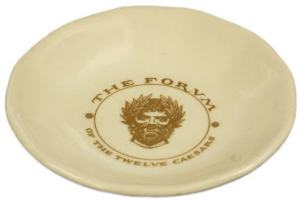
hotshoppes29711957 The Hot Shoppes company operates restaurants and cafeterias in 11 states and D.C. as well as serving meals on airlines, the NY Thruway, and in government dining facilities. It keeps a 3,000-acre sheep and cattle ranch in Virginia, as well as a commissary, butcher shop, bakery, and ice cream plant in D.C. – In NYC the Forum of the Twelve Caesars opens. Unfazed by its campy decor and toga-clad waiters, NYT reviewer Craig Claiborne hails its “lusty elegance,” “opulent” food, and “superb” service.
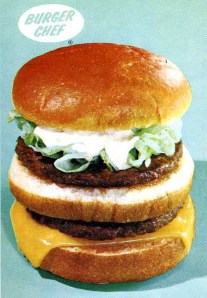
burgerchef2981958 When the IRS cracks down on expense accounts by requiring detailed proof of expenses, membership in The Diners’ Club rises sharply. In NYC, advertising executives make up the largest category of members, followed by people in the TV industry. – The Burger Chef chain gets its start.
1959 Along suburban roadways national hamburger chains offer stiff competition to drive-ins and downtown hamburger shops such as Little Tavern and White Tower. With more than 100 units across the US, Ray Kroc attributes McDonalds’ success to cheap mass-produced food and the elimination of carhops. – Citizens protest that the new coffeehouse phenomenon will attract beatniks. In D.C., Coffee ‘n’ Confusion, offering Irish stew, coffee, and chess, promises to price coffee high enough to keep out undesirables.

© Jan Whitaker, 2009

Read about other decades: 1800 to 1810; 1810 to 1820; 1820 to 1830; 1860 to 1870; 1890 to 1900; 1900 to 1910; 1920 to 1930; 1930 to 1940; 1940 to 1950; 1960 to 1970; 1970 to 1980

52 Comments

Filed under miscellaneous

Happy holidays, eat well

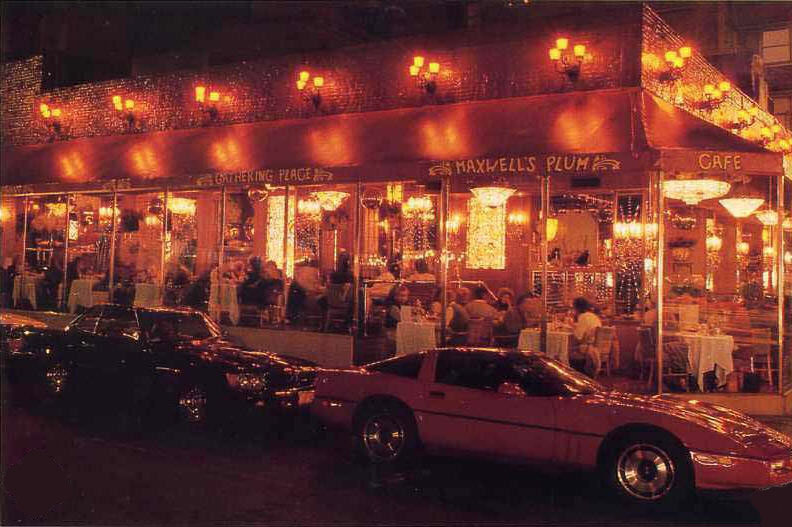
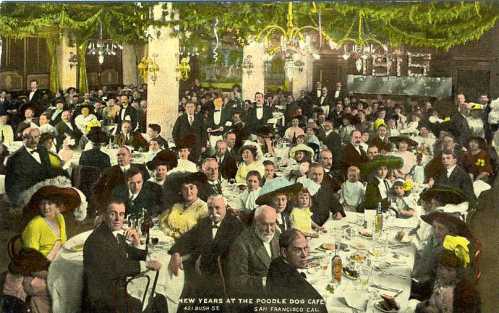
poodledog237No matter whether you prefer Roast Goose, Chicken Tiki Masala, or Chinese, don’t forget to visit your favorite restaurants over the holidays. I’ll be back in a couple of weeks. Upcoming posts in the works include James Beard (launching a “good eaters” theme), the 19th-century Downing family of black restaurateurs, the spectacular Maxwell’s Plum, famous restaurants in Paris, World’s Fair cafés and restaurants, linen supply and “the mob,” early cafeterias, and more “tastes of the decades.”
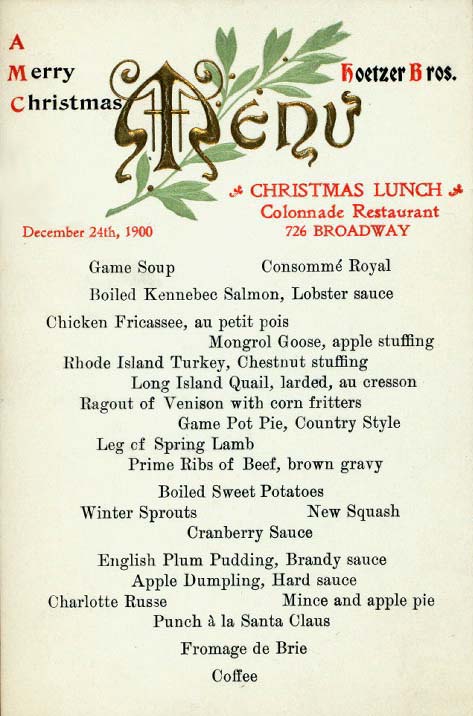
Cheers!christmasrestaurant1

1 Comment

Filed under miscellaneous

Taste of a decade: 1860s restaurants

egerton1866REVHalf the population of the largest cities is foreign born. San Francisco continues to attract adventurers and French chefs. The Civil War brings wealth to Northern industrialists and speculators, encouraging high living. With German immigration going strong, beer gains in popularity as do “free” lunches. Saloons prosper and the anti-alcohol movement loses ground as the states where liquor is prohibited shrink from thirteen to six, then to one. Cities grow as young single men pour into urban areas. Restaurants spring up to feed them and cheap lunch rooms proliferate, offsetting the high prices prevalent during and after the war. By the end of the decade, one estimate puts the number of eating places in NYC at an astonishing 5,000 or 6,000.
Highlights

1861 In what may be the first published use of the term lunch counter, the new proprietor of the Front-Street Coffee House in New York advertises his “Dining Saloon, Lunch Counter, Bar and Oyster Department.” – Boston, population about 178,000, lists 135 restaurants in its city directory.

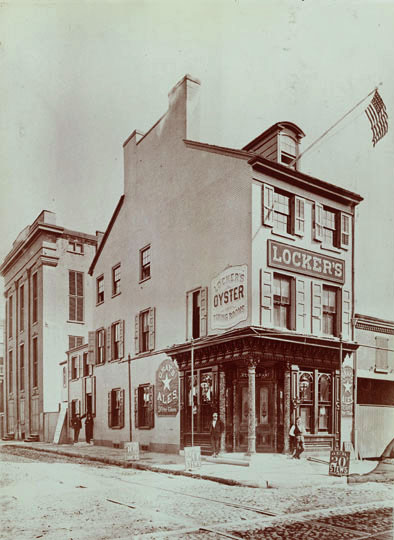
1862 Madame Favier assures patrons of her Charleston SC restaurant that she will not substitute rye for genuine Rio coffee “in spite of the hard times and the blockade.” – War wealth in New York stimulates business at the new 14th Street Delmonico’s at Fifth Avenue, boosting the restaurant’s distinction.lockersphil1868

1863 War stirs up restaurants in Virginia. A Richmond newspaper observes, “Norfolk, like Richmond, is swarming with restaurants.” Among Richmond’s eating places are the Hygeia, the Friendship Restaurant, and the Café de Paris.

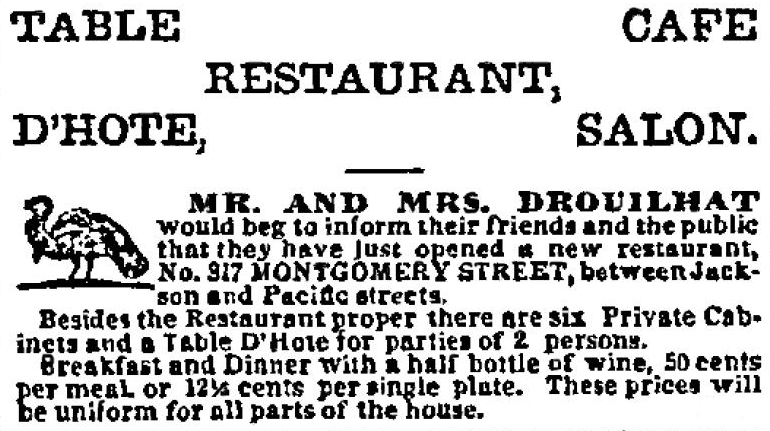
1864 To raise funds for Union soldiers, volunteers organize a fair in Brooklyn featuring a New England Kitchen. Crowds pack the 1770s “theme” restaurant where women in “quaint attire” serve pork & beans, pumpkin pie, and doughnuts to guests who eat with two-tined steel forks from the olden days. — In San Francisco, a French couple open a new restaurant and salon (see below — Is it merely linguistic confusion or are they offering wine with breakfast?).

1865 A journalist describes the comical, unfamiliar sight of men wolfing down grub at a NYC lunch counter while perched on high stools with their heads bent down “and their elbows in rapid motion.” “Viewed from the rear,” he writes, “one might suppose them to be weaving or fiddling.”

1867 Wealthy black Philadelphia restaurateur John W. Price, born a slave, throws a bash for Frederick Douglass. His restaurant at 4th and Chestnut is one of the city’s largest. – In Memphis, Monsieur John Gaston opens a “Ladies’ Restaurant” where, he promises, “the most delicate and sensitive will find nothing to offend their ear or observation.”

sftabledhote18641868 Louis P. Ober establishes a Restaurant Parisienne on Winter Place in Boston. Like some other French restaurateurs, he is also a wine importer. – In Leavenworth KS, the Italian Giacomini brothers open the New Delmonico Restaurant. – In San Francisco, diners in French restaurants push back the dinner hour from the middle of the day to around 6:00 p.m.

1869 On the spur of the moment, President Ulysses S. Grant enters a fashionable Washington restaurant for breakfast wearing a stove-pipe hat. A cashier, failing to recognize him, refuses him a private dining room and explains later that Grant looked like “an old shoemaker with his Sunday clothes on.”

Read about other decades: 1800 to 1810; 1810 to 1820; 1820 to 1830; 1890 to 1900; 1900 to 1910; 1920 to 1930; 1930 to 1940; 1940 to 1950; 1950 to 1960; 1960 to 1970; 1970 to 1980

© Jan Whitaker, 2008

1 Comment

Filed under miscellaneous

Taste of a decade: 1930s restaurants

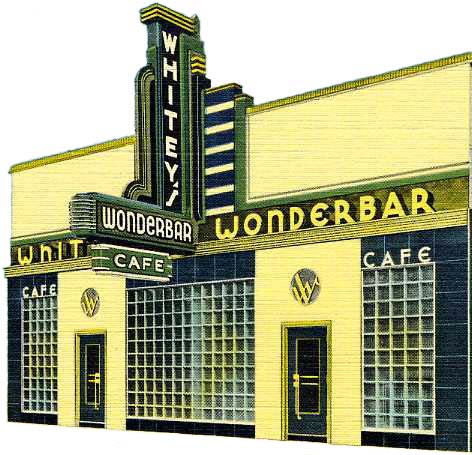
wonderbar1941Even as the Depression deepens, the number of full-fledged restaurants continues to increase, from 134,293 in 1929 to 169,792 in 1939. Immigration slows in response to restrictive legislation of the late 1920s, reducing the supply of professional waiters and cooks. Female servers make up more than half of waitstaffs. The economical fixed-price meal, which had virtually been replaced by a la carte service, returns to popularity. Promotions such as “all you can eat” and “free coffee refills” are featured. After the repeal of Prohibition nightlife revives. Many diners, accustomed to speakeasies, show a preference for small, intimate restaurants. All-white interiors give way to imaginative decor which mimics ships or European courtyards. Federal financing facilitates modernization, encouraging restaurants to add streamlined fronts and air-conditioning. Deprived of bootlegging revenues, racketeers infiltrate unions and extort restaurants, dispatching picketers and stench bombs to those that don’t play along.

Highlights

veneto351981931 Restaurants drop prices and see patronage rise. In Chicago prices go down by 10% to 12%.

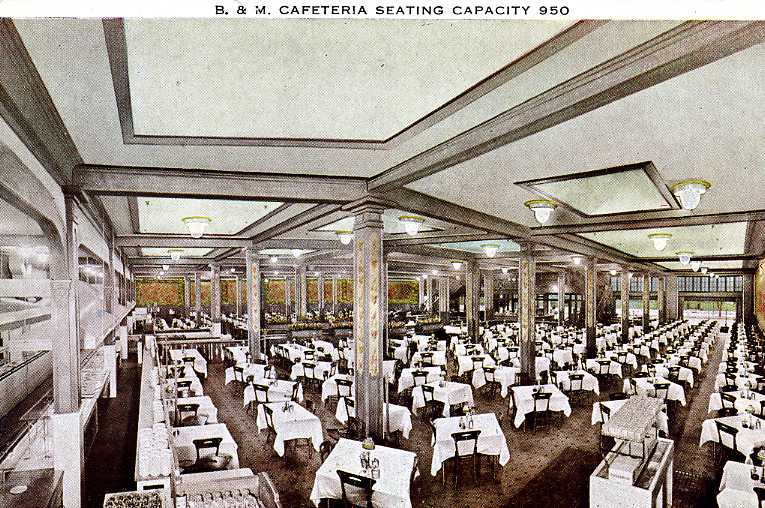
1932 Stores install lunch counters to lure shoppers and capture a piece of the flourishing lunch trade. Architect Ely Jacques Kahn designs a sleek tea room with vermilion-topped tables and green and black terrazzo floors for the Broadmoor Pharmacy on NYC’s Madison Ave. – Chains such as Schrafft’s, Childs, Horn & Hardart, Lofts’, and Bickford’s expand as they take advantage of reduced rents and absorb failed competitors.

1933 Expecting all alcoholic beverages to be legal by the end of the year, liquor suppliers court restaurateurs. In Amherst MA a small lunchroom operator receives complimentary wine and champagne from the S. S. Pierce Company. – The Afro-American proprietor of the Launch Tea Room in Sheepshead Bay decides to cancel plans for wintering in Palm Beach and turn her Long Island tea room into a free dining room for the poor.

1934 In post-Repeal California Ernest Raymond Baumont-Gantt opens Don the Beachcomber, while Victor Bergeron starts Hinky Dinks, forerunner to Trader Vics. In accordance with state law both must include food service with their bar operations. – In NYC, the president of the Downtown Restaurants association acknowledges, “We know now that repeal of prohibition has saved the restaurant business from utter annihilation and saved it just in time.”

1935 The pro-America mood of the 1920s continues, exemplified by a column in a restaurant trade magazine which asserts preposterously that Delmonico’s got its recipes from Southern plantations while in the 1880s French chefs “flocked to this country” to learn American cooking. — Many restaurants remodel their fronts (see above illustration) as towns across the country launch “Modernize Main Street” campaigns backed with federal money.

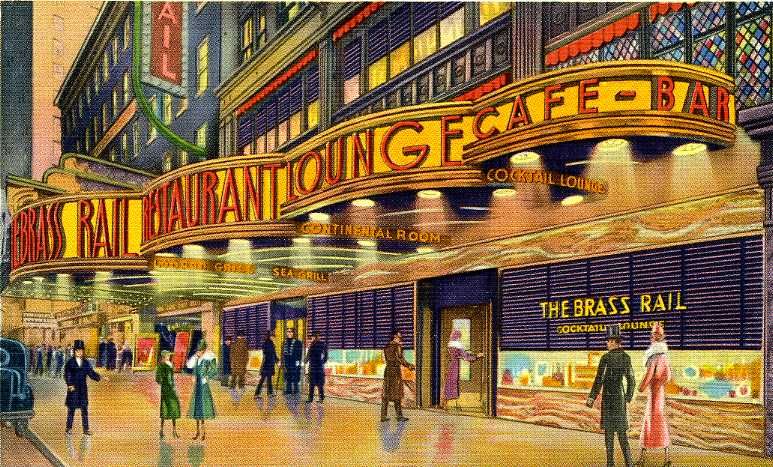
brassrail371971936 An investigation reveals that Jack Dempsey’s, Lindy’s, The Brass Rail, and numerous cafeterias are among the NYC eating places that have capitulated to shake-downs by mobsters.

1937 The nationwide Childs chain reports that 47% of all alcoholic drinks served in their dining rooms are cocktails, 22% are highballs, 8% are wines (mostly sherry and port), and oldfashioned195the remainder are cordials. Beer is the most popular drink in summer.

1938 The president of the National Restaurant Association warns members that the number of places serving meals has quadrupled in the past 15 years and only the ingenious will survive.

1939 A book on how to run a tea room notes that 30,000 restaurants are managed by women and advises prospective proprietors to make inquiries such as, “Do the racketeers expect you to pay for protection?”

Read about other decades: 1800 to 1810; 1810 to 1820; 1820 to 1830; 1860 to 1870; 1890 to 1900; 1900 to 1910; 1920 to 1930; 1940 to 1950; 1950 to 1960; 1960 to 1970; 1970 to 1980

© Jan Whitaker, 2008

34 Comments

Filed under miscellaneous

Taste of a decade: 1920s restaurants

The 1920s is an important decade because it marked the birth of the modern restaurant industry. The advent of national prohibition stripped away liquor profits, shifting emphasis to low-price, high-volume food service. More people ate out than ever before. Restaurant owners formed professional associations to raise industry standards, counter organized labor, and lobby for their interests. Famous pre-war restaurants closed, while cafeterias, luncheonettes, and tea rooms thrived. Female servers began to replace men. Restaurant chains incorporated and were listed on the stock exchange. While critics bemoaned the demise of fine dining, the newborn industry and its patrons celebrated simple, home-style, “American” fare.

Highlights

1920 After a strike of 1,100 cooks and waiters in Chicago, the Congress Hotel hires a crew of waitresses. – Milwaukee restaurateurs report that Sunday has become their biggest day because of families eating out.

1921 A character in Alexander Black’s novel The Seventh Angel observes, “Life is just one damned restaurant after another,” then asks plaintively, “Is there any home-eating any more?” – A restaurant trade magazine reports that half of all restaurant meals in Los Angeles are sold in cafeterias and other self-service eateries. – In New York City, a former “lobster palace,” Murray’s Roman Gardens, advertises sodas and candy in its Ice Cream Salon.

1922 The International Association of Hotel Stewards endorses the elimination of French terms on menus.

1924 A brochure from the B/G Sandwich Shop chain boasts of “Food selected and prepared as in your American home; served by the sort of people you find at home, – high class ambitious young Americans who do not desire to submit to the European custom of depending upon the master’s gratuities.” – Cafeteria chain manager Harry Boos, president of the National Restaurant Association, declares: “Men and women want their goods quick and clean. The restaurant business is a greater industry than ever before in history.” – “Quick and Clean” is also the slogan of the White Cafeteria in Indianapolis.

1925 After the closure of his once-celebrated NYC nightspot restaurant “Jack’s,” owner John Dunstan complains “The town’s full of cafeterias.” – Henri Mouquin’s famed French restaurant is demolished to make room for a Princeton Cafeteria.

1926 The Cordleyware Co. advertises that its champagne buckets for restaurants can be used as carriers for soiled silverware.

1927 The journal Restaurant Management reports that from 25% to 30% of all meals in cities are eaten in restaurants and that close to 60% of restaurant patrons are women. – A restaurant of the Happiness Candy Stores chain opens on the Fifth Avenue site once occupied by Delmonico’s.

1928 In recognition of the growing number of women in the restaurant business, the American Restaurant journal begins a special section called “The Restaurant Woman.” – Chicago’s corned beef sandwich mogul, John P. Harding, known for catering exclusively to men, opens a restaurant especially for women.

1929 A restaurant trade magazine editorial asserts that the industry has finally won respectability. There is, it notes, “tremendous change in popular feeling toward a business once thought precarious – as well as beneath consideration, socially.”

Read about other decades: 1800 to 1810; 1810 to 1820; 1820 to 1830; 1860 to 1870; 1890 to 1900; 1900 to 1910; 1930 to 1940; 1940 to 1950; 1950 to 1960; 1960 to 1970; 1970 to 1980

© Jan Whitaker, 2008

21 Comments

Filed under miscellaneous

Taste of a decade: restaurants, 1800-1810

The American population is settled mainly along the Eastern seaboard. The largest city, New York, with almost 80,000 people, is one of only about 15 cities with more than 1,000 inhabitants. Meals are available in taverns, oyster houses, coffee houses, and French restorators. Most diners are male travelers, businessmen, or boarders, though religious societies and clubs of firefighters, politicians, or old soldiers gather for banquets from time to time. The dinner hour falls between noon and 3:00 p.m.

Highlights

1800 Meat, fish, and fowl are the principal offerings of eating places, and an establishment’s quality is measured by the amount and assortment of animal protein set out on the table. At the Portland Restorator in Portland, Maine, the proprietor proudly announces he has “potted lobster, potted eel, chicks fricaseed, and fine ragouts, beef alamode, and barbicues, sausage Bologna, Hamburgh, Naples, choice venison pastry, pork pie Cheshire, good beef steak, and bacon rasher” as well as “round of beef, fat Sirloin, turkey roast, or calf’s head boil’d with tongue & brains.” Beyond these main dishes, he supplies only soup and a few pies. Strangely, he does not mention one of the most popular edibles of the 19th century, oysters.

1801 Well-off Americans who read fashionable magazines are fascinated by the popularity of restaurants in Paris. There, it is said, “everybody” (who is anybody) dines frequently outside the home. The awkward term “restorator,” an Americanized version of restaurateur which refers either to a place to dine or to its proprietor, becomes a trendy metaphor for a publication, an essay, or an editor.

1802 Napoleon offers amnesty to his opponents and many French citizens who escaped to America during the revolution return to France, shrinking the number of skilled restaurateurs. Not all leave, however. Julien continues in Boston.

1802 The inimitable black caterer Othello Pollard, of Cambridge MA, beckons “select” clients from nearby Harvard with beefsteak, soup, cheese, ham, tongue, ice cream, custard, strawberries and cream, whip-syllabub, pies, jellies, olives, and fruit, along with a well-stocked liquor cabinet. In an unusual advertisement, he observes: “It is a wise saying … that the Body is as much a subject of education as the Mind. Both require tuition and discipline. The UNIVERSITY takes the Mind for its pupil; OTHELLO takes the Body. He, therefore, who has not been at both schools is half a Scholar.”

1803 In Charleston, South Carolina, a new hotel opens with a banquet room accommodating 300.

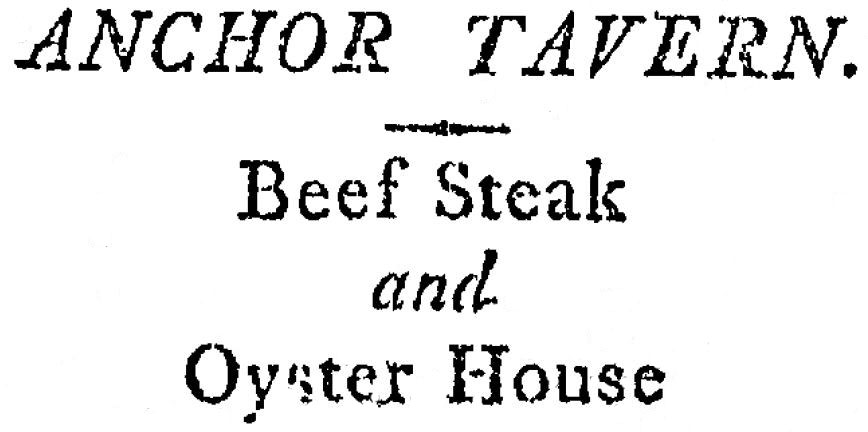
1807 The beefsteak and oyster house remains a popular sort of eating place. Turtle soup is a delicacy and restaurants place notices in papers when they are about to prepare it. On June 8 Wm. Fryatt, who has recently opened a Porter, Beef Steak and Oyster House on the corner of Pine and Nassau in New York, advertises he will prepare the last turtle of the season.

1808 Henry Doyhar of New York City announces that he will list his dinner specials in writing each day: “To accommodate those who wish to procure their Dinner …, the bill of fare, containing the dishes regularly numbered, will be exhibited every day from nine till eleven o’clock, A.M. for the purpose of engaging beforehand such dishes as may be wanted.” Since so many people are illiterate at this time, this suggests his clients are educated and probably wealthy.

1809 In Boston the elegant and expensively built Boston Exchange Coffee-House opens with a coffee room on the ground floor, furnished with a bar and 14 private and “handsome boxes, each containing a mahogany table, seats, and a bell rope.” On the second floor is a banquet hall and a dining room whose “walls are painted a beautiful green, and the windows decorated with curtains of scarlet moreen.”

Read about other decades: 1810 to 1820; 1820 to 1830; 1860 to 1870; 1890 to 1900; 1900 to 1910; 1920 to 1930; 1930 to 1940; 1940 to 1950; 1950 to 1960; 1960 to 1970; 1970 to 1980

© Jan Whitaker, 2008

6 Comments

Filed under miscellaneous

Taste of a decade: 1960s restaurants

Americans grew wealthier, traveled more, and demanded more exotic cuisine. Yet there were few trained restaurant cooks. Convenience food – in the guise of continental dishes (as in pineapple = Hawaiian) – offered the solution for many restaurants as the decade wore on. In other developments, old restaurant formats such as automats, diners, cafeterias, and drive-ins disappeared or shrank drastically in numbers. Fast food and dinner house chains, relatively scarce at the beginning of the decade, flourished by its end. Black Americans began to make headway in gaining civil rights in restaurants. By the middle of the decade signs of the counterculture could be seen here and there.

Highlights

1960 New Armour & Co. boiling bags filled with beef burgundy, lobster Newburg, and coq au vin mean that “Every drive-in can now be a Twenty-One Club, every restaurant a Maxim’s de Paris,” according to a trade mag. – In Columbus Ohio the opening of the Kahiki adds to the Polynesian restaurant boom, while in NYC La Fonda del Sol opens, offering exotica such as Empanadas, Grilled Peruvian Tidbits on Skewers, and Papaya Filled with Fresh Fruits.

1961 In Sherman Oaks the Wild Goose adds four dishes to its menu: Boned Pheasant Chicken Kahlua, Veal Cutlet Oskar, Fresh Gulf Shrimp Stroganoff, and Breast of Chicken Kiev. – Four-star Lutèce opens in New York, one year after La Caravelle.

1962 A café in Sioux Falls announces “microwave cooking,” while in New York’s Time Square a restaurant opens featuring frozen entrees which the customer is to pop into a tabletop microwave. – A new product for restaurants comes on the market: instant mouthwash in a sealed paper cup to be presented to customers after they eat heavily spiced dishes.

1964 Continental and Polynesian restaurants find they must add steak to their offerings. – Kelly’s steak house in Sherman Oaks announces it sold approximately 400,000 pounds of steak in the past year.

1965 Maxwell’s Plum opens in NYC with an eclectic menu that ranges from Pâté and Escargots Bourguignonne to a Foot-long Hot Dog with Chili. Rumors spread of a naked woman seen walking casually through the dining room. — Extra-thick Frymaster Jet Griddles are marketed to keep cooking temperatures stable even when “completely loaded with frozen food.” – Aggressively cheerful California-style coffee shops, which combine the features of drive-ins, coffee shops, dinner houses, and cocktail bars, spread across the country.

1966 After touring the US, a wine expert says that he believes 99% of licensed restaurants have no interest in promoting wine. He reports that not once did a server ask if he’d like wine with his dinner. Instead they asked if he wanted a cocktail, followed by “Coffee now or later?” – Alice Brock opens The Back Room in Stockbridge MA which will be made famous by Arlo Guthrie as “Alice’s Restaurant.”

1967 Students at the University of Washington, Seattle, boycott Aggie’s Restaurant because they believe it discriminates against students, especially if they are dressed in “funny clothes,” following an incident involving a long-haired “fringie.” – The adoption of frozen convenience foods increases in restaurants after passage of the Minimum Wage Act which raises kitchen workers’ pay.

1968 Countering the fast food trend, the menu at the Trident in Sausalito advises its patrons to be patient: “Welcome to Our Space. Positive energy projection is the trip. … Care in the preparation of food requires time especially if we’re busy! So please take a deep breath, relax and dig on the love & artistry about you. May all our offerings please you. Peace within you.” – In Fayetteville, Arkansas, a diner declares he is tired of an “unrelieved diet of chili dogs and waffle fries” and bemoans the lack of any “quality dining establishments.”

1969 The Scarlet Monk in Oakland advertises a “Topless Luncheon” Monday through Friday. – In Chicago, menu language has become more sophisticated, according to linguistic researchers. They report: “Du jour is an accepted form on menus and appears more often than of the day. Anything – pie, potatoes, sherbet, cake, pudding – can be du jour (or de jour, du jor, dujour, and du-jour), and the Florentine Room even has … potato del giorno.”

Read about other decades: 1800 to 1810; 1810 to 1820; 1820 to 1830; 1860 to 1870; 1890 to 1900; 1900 to 1910; 1920 to 1930; 1930 to 1940; 1940 to 1950; 1950 to 1960; 1970 to 1980

© Jan Whitaker, 2008

50 Comments

Filed under miscellaneous