Category Archives: food

Ice cream parlors

Ice cream is an affordable, intergenerational family-friendly treat with a mild sedative effect. Historically it’s been associated with the temperance movement, innocent youthful courtship, and after-theater refreshment.

For ages ice cream has been primarily a commercial product. As was largely true of soda and beer, it was usually consumed outside the home until after World War II. Only then did supermarkets and homes acquire extensive freezer capacity. In 1925, according to Jakle and Sculle’s Fast Food, 19% of all ice cream was sold in grocery stores, the bulk of it being marketed through confectioners, drug store soda fountains, wayside stands, restaurants, and lunch counters.

Those who could afford it in the late 18th century often obtained ice cream from confectioners and caterers of European origin who made it each day in summer and served it in outdoor gardens or delivered it to homes for immediate consumption.

Late 18th- and early 19th-century residents of Philadelphia and New York City enjoyed eating ice cream in private parks such as NYC’s Vauxhall, Washington, and Columbian gardens which opened yearly on June 1. An elderly writer recalled in the 1860s that in the 1790s at Contoit’s on Broadway in NYC, “Little alcoves, well shaded, on each side of the gravelled walk, had each its table, where friends or lovers, in undisturbed quiet, could enjoy their cream and cake.”
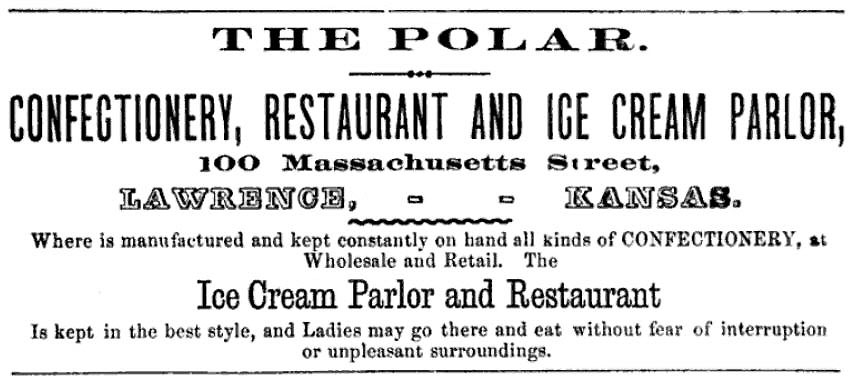
Ice cream saloons (the term merely indicating a spacious room) and parlors, as they were called later in the 19th century, were described as gaudy mirrored palaces, lit brightly by gaslight. In 1869 M. F. Brigham & Son opened a Ladies’ and Gentlemen’s Coffee, Lunch and Ice Cream Saloon on Washington Street in Boston, in connection with a confectionery at which they sold candy, pastry, ice cream, frozen puddings, sherbets, jelly whips, charlotte Russe, Roman punch, and other confections.
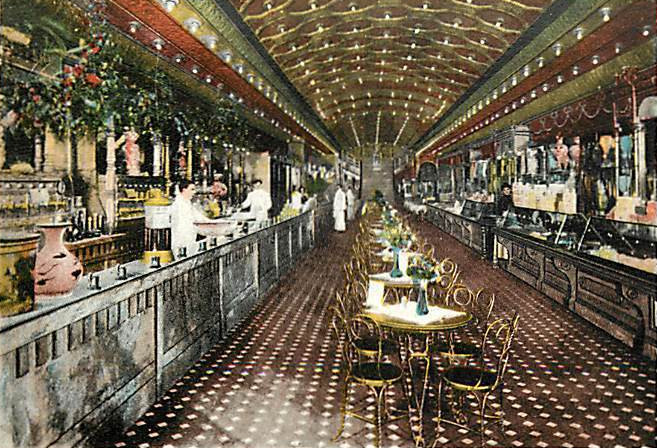
In Chicago, a number of these “ladies’ cafes,” as they were usually known, sprang up on State Street at the time of the 1893 World’s Fair, among them Gunther’s [pictured] and Plow’s. They featured special attractions – positively non-temperance drinks such as Yum Yum and a special version of Roman punch, the former 13% and the latter 20% alcohol!

It is strange, and a little jarring, to see so many advertisements of 19th-century eating places  specializing in ice cream AND oysters – until you realize the two were not usually consumed together. Featuring both as specialties makes perfect sense, though, since for decades oysters were not eaten during the summer months and ice cream was eaten only then.

Frequently, places that started out with just ice cream and simple refreshments eventually branched into restaurants selling lunches and other meals. When Schrafft’s established its first NYC store at Broadway and 36th Street in 1898, for instance, it served nothing beyond candy and ice cream.

With the increase in automobile ownership in the 1920s, and into the 1930s and 1940s, chains of roadside ice cream stands and eateries featuring ice cream began to form, among them Dutchland Farms, Howard Johnson’s, Prince Castle, Henry’s, and Friendly’s. “Soft serve” – a product whose name reflects that it does not meet the official definition of ice cream – caught on in the 1940s, a decade which commenced with the first Dairy Queen, located in Joliet IL.
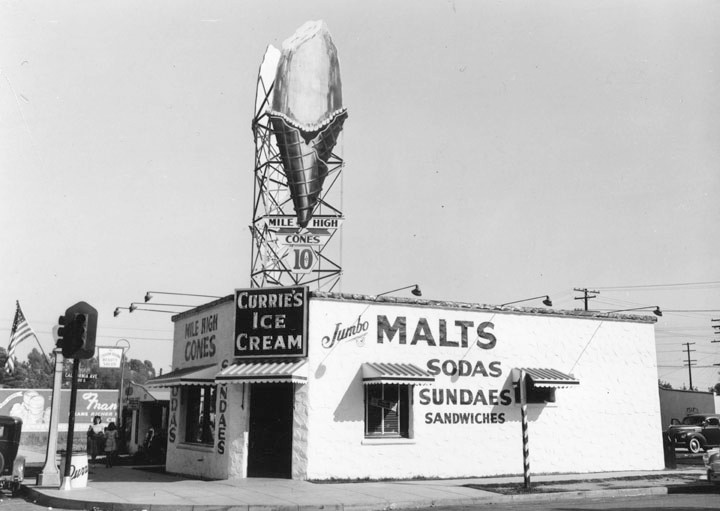
In Southern California, people still fondly remember the Currie’s chain and its “mile-high cone” whose replica was often displayed billboard-style on roofs. The chain was started in 1927 by three brothers named Kuhns. After WWII they sold it to the Good Humor company who later sold it to Lipton in the 1960s. In 1964 the chain opened its 87th store, in North Hollywood. Although Currie’s anticipated launching units in every community in Southern California, only three outlets were listed in the 1967 Los Angeles phone book and the chain had disappeared by the 1980s.

© Jan Whitaker, 2012

59 Comments

Filed under food

Odd restaurant food

Over the weekend I went to an antiques show in Fitzwilliam NH and bought some vintage menus. The seller had a cache of them from a printer in Manchester NH, all from 1956.

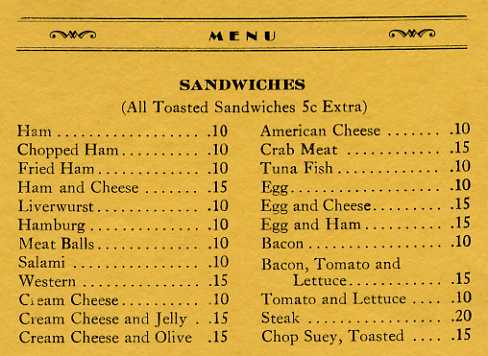
An unusual selection on one of the menus caught my eye, a Toasted Chop Suey sandwich. Odder still, the sandwich appeared on a menu from Angelo’s Spaghetti House.

It would seem slightly less strange to me if it had been a Chinese restaurant, such as the Chinese and American Red Rose Restaurant in New London CT, where around 1960 diners could order a Chow Mein sandwich.

But, upon reflection I have to ask myself why either of these sandwiches should seem odd. I used to enjoy a specialty of St. Louis Chinese restaurants called the St. Paul sandwich which consisted of something resembling Egg Foo Young served between two slices of spongy white sandwich bread slathered with mayonnaise. It was delicious.

I don’t mean to single out New England as the home of strange restaurant dishes, but it so happens that I’ve personally encountered two of the weirdest food combinations of my dining-out life in this part of the world.

Both involved potatoes.

One was in a New England inn with a quaint name and an old coach on the front lawn. It is against my better judgment to go to such places but a visitor from afar expressed interest in it. I have no idea what I ordered but let’s assume it was chicken or beef. Along with it, in a small saucer, came two whole boiled potatoes smothered in tomato sauce straight out of the can. I have to think that the cook was suddenly taken ill and the dishwasher, the only other person in the kitchen, had to take over.

At a restaurant in Springfield MA I experienced another culinary shock. I had taken my visiting parents there on the way to the train station because they liked Italian restaurants and it was handy. I have forgotten what we ate, but at tables all around us people joyfully celebrated carbo-loading with side dishes heaped with spaghetti AND french fries — in addition to their main dishes. I like spaghetti. I like french fries. But together?

Changing the focus from New England to California, “Chili Size” might at first seem like an odd dish but upon closer inspection it is not so much the components that are peculiar – a hamburger patty covered with chili with beans, sometimes with cheese melted on top of it all – as it is the name.

On the other hand there may be people who don’t think any of these things are odd.

© Jan Whitaker, 2012

29 Comments

Filed under food

Peas on the menu

I read a story on dining-out trends a few days ago that said, “We’re ordering fewer peas …” Of course! I can’t remember when I last ordered peas in a restaurant. Never, I suspect. Plates often come adorned with little piles of grilled asparagus, or maybe julienned carrots and zucchini, but peas? No.

Admittedly, even at this moment, someone could be serving up peas in the pod in a trendy farm-to-table restaurant somewhere in Westchester County or in California wine country, but other than these outlier examples, I ask, how many peas have been served in restaurants in the last several decades? Very few, I’d bet.

Yet, strangely enough, once upon a time they were the darling vegetable of elite restaurants and hotel dining rooms. At Boston’s luxury hotel, Tremont House, an 1843 menu listed “Les Petits Pois à la Parisienne.” Small, tender, bright green peas imported from France were considered a delicacy, and were expensive. American canned green peas came on the market in the 1850s, but it took so many hands to pick and shell them that they too were expensive, yet not considered good enough to displace the popularity of the French imports.

French peas continued to reign even in lesser eating places, often appearing on holiday menus at hotel dining rooms across the land. For example the Rankin House in Columbus GA featured French Peas for Christmas dinner in 1887, along with choice dishes such as Oysters on the Half Shell, Green Turtle Soup, and Tenderloin of Beef with Mushrooms.

In that same year, though, an alarm was raised about the wisdom of eating imported French peas. Their bright green color was produced by adding copper sulfate, warned critics who said this was toxic, fatal if taken in big enough doses. Evidently the warnings did not impress many people because French peas continued to be served in fine restaurants. Loud cries to ban their importation were not heard until after the American invention of a machine that would both pick and shell peas in 1893, thus bringing down their cost to consumers.

In 1906 many states passed pure food laws that made it illegal to sell French peas colored with copper salts. In Idaho the state’s Pure Food Commissioner confiscated 72 cans of imported French peas found in a hotel and destroyed them by punching holes in the cans and pouring kerosene over the contents.

French peas appeared on menus after that, but it’s likely they were grown and canned in the US. “Petit pois” was the name adopted in this country for the smallest size pea, 9/32-inch in diameter. In the 1940s, 1950s, and 1960s, French Peas on a menu continued to suggest luxury or a special occasion such as Mother’s Day or Thanksgiving. Green Peas, Garden Peas, and June Peas, on the other hand, suggested freshness and nutrition, but not luxury or style. They were exactly what a diner expected to see filling in the blank spaces on a dinner plate at Howard Johnson’s.

In the last several decades I believe peas have vanished from menus. When was the last time you had peas in a restaurant?

© Jan Whitaker, 2012
11 Comments

Filed under food

Reuben’s: celebrities and sandwiches

Once upon a time there was a famous NYC restaurant called Reuben’s. Today there is a famous grilled sandwich of corned beef, Swiss cheese, sauerkraut, and Russian dressing on pumpernickel called a Reuben. Wouldn’t it make a nice story if the sandwich came from the restaurant?

The connection has been well researched yet it remains unresolved. For anyone who wants to examine the matter in detail, I recommend Jim Rader’s excellent account. He has the last word, inasmuch as there is one.

Two important points. 1) No one has come up with an early menu from Reuben’s that lists the Reuben sandwich as it is known today. It does appear under the name “Reuben’s Pioneer” on a 1971 menu but by then the sandwich could be found everywhere. 2) Despite being a publicity hound – and despite an Omaha woman winning a national contest for creating the sandwich in 1959 — founder Arnold Reuben never laid claim to it as his restaurant’s creation.

What is certain is that the fame of Reuben’s restaurant and delicatessen was built upon sandwiches — and the celebrity patrons who ate them.

I have seen a menu from Reuben’s said to be from 1922. Under the top heading “Reuben’s Famous Sandwiches” are listed 42 sandwiches. Nine are named after celebrities of stage and screen of that time. What is striking about the named sandwiches is that they cost more than the others. At the low end are ordinary sandwiches priced at 35 cents such as Salami, Corned Beef, and Liver Wurst. The special celebrity sandwiches range from 75 cents to a dollar, amounts that would then buy a whole dinner in many restaurants. The specially named sandwiches probably had more ingredients and may have been larger, but the aura of celebrity around them must have added a few cents too.

Naming sandwiches for celebrities was a publicity gimmick probably thought up by a press agent. The columnist Westbook Pegler claimed that Reuben’s initially acquired fame because of publicity generated by the audacious Harry Reichenbach who encouraged Arnold to sue a well-known New Yorker over the price of a ham in 1920. Thereafter, like Lindy’s and the Stork Club, Reuben’s was constantly in the nationally syndicated gossip columns of the 1920s, 30s, and 40s.

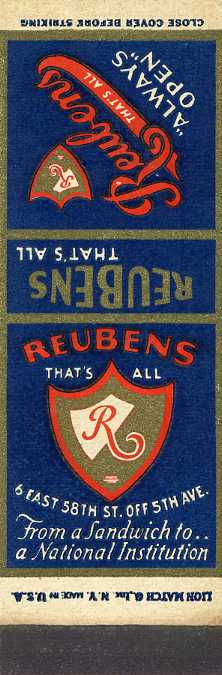
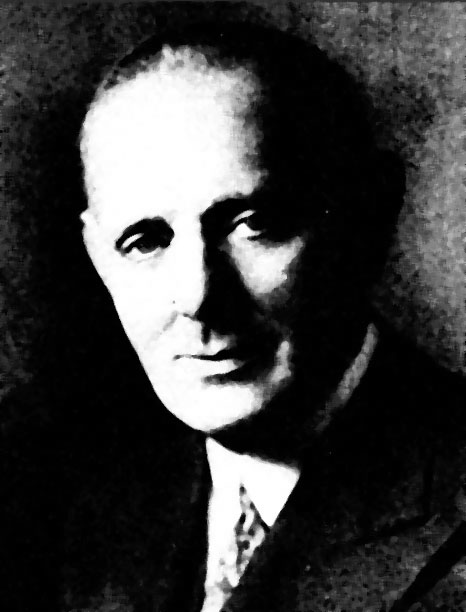
Arnold Reuben was a German Jew who, with his family, immigrated to the US as a young child around 1886. He helped out by peddling produce, then worked at a delicatessen. In 1908 he opened his own deli, which he later referred to as a “shtoonky little store.” By the end of the teens, he was thriving; he had incorporated his Pure Food Shop at 2102 Broadway and opened an eating place at 622 Madison Avenue which was popular with Broadway performers and stars from Hollywood. (Transitions from food store to restaurant are not uncommon and, as was also the case with Texas butcher shops-to-barbecues, often begins with sandwiches.) In 1928 he had a third restaurant in Philadelphia and was said to be “enormously rich.” Adopting the slogan “From a Sandwich to a National Institution,” he often told a story about the first celebrity sandwich he created – ham, cheese, turkey, cole slaw, and dressing — for a struggling young actress.

He experienced some financial difficulties in 1933 and filed for bankruptcy but only two years later was back on course with a bigger and better restaurant [pictured] to replace the one on Madison Avenue. Of critical importance to his comeback was the end of Prohibition. His opening announcement in the New York Times attested to this with a prominent display of the names of Reuben’s “friends,” seven liquor manufacturers and distributors.

In 1946 he opened a restaurant on West 57th near Carnegie Hall, with a front nearly identical to East 58th Street. Like his others it was open 24 hours. No doubt it, too, had a doorman who greeted patrons with the bywords “Reuben’s, that’s all.” Larger than the East 58th place, it was billed “A City in Itself,” and contained shops for delicatessen, flowers, chocolates, cigars, and theater tickets, as well as a perfume bar and a barber shop. Despite all, it silently disappeared a couple years later.

Arnold retired to Florida in the mid-1960s and sold the business, which he had turned over to his son to manage years earlier. Reuben’s in NYC continued under new ownership at various locations until 2001. A Reuben’s was also opened in Miami in the 1940s but I have not been able to determine its subsequent fate.

© Jan Whitaker, 2012
4 Comments

Filed under food, popular restaurants, proprietors & careers

It was a dilly

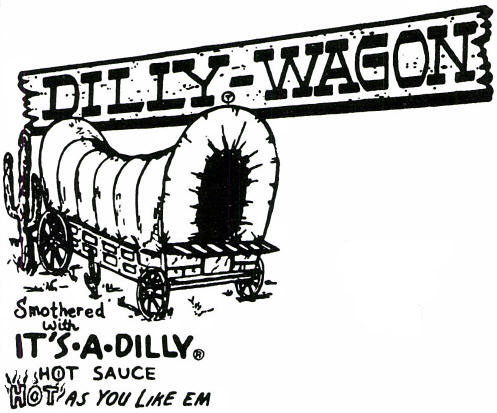
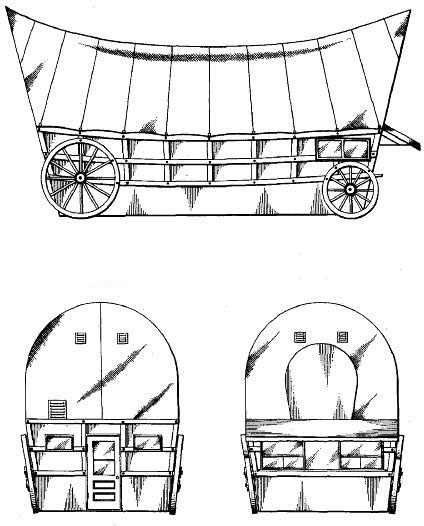
Dilly-Wagon drive-ins, which looked like oversize prairie schooners, were certainly eye-catching enough in the 1960s but their main attraction was the “It’s a Dilly” sauce served on burgers and hot dogs. People still remember it longingly. I wish somebody would describe it. Was it a mayonnaise-based sauce with dill in it like that used with fish? What made it hot?

The sauce was created by Charles Weinstein who experimented with it in his Potsdam NY kitchen after an illness prevented him from continuing with his former business, selling apparel. The sauce, which was guaranteed to “perk up … just about any meat or meat dish,” was also sold in food stores, with three degrees of hotness, Pleasing, Extra, and Triple “for those who like a sauce that sizzles.”

In February of 1961 Charles applied for a patent for the design of his drive-in structure [see illustrations]. In the early 1960s local and regional drive-ins were still popular, not yet squeezed out by national fast-food franchises. Why he chose a Conestoga wagon style is unknown, but as was true of all roadside businesses, being able to catch the eye of passing motorists was critical.

Later in 1961 an advertisement appeared in the South Burlington High School yearbook for a Dilly-Wagon drive-in at 1907 Williston Road. That same year Charles ran an ad in the Oneonta NY paper saying that the drive-ins cost only $12,750, could be opened in three short weeks, and were ideal for a college town. By August there were Dilly Wagons not only in Burlington but in Rutland VT and in Potsdam NY, and he was hoping to place more in the Lake George area.

Strangely, by summer 1962 the price of a Dilly Wagon had inexplicably jumped up to $20,000, according to a franchise advertisement that appeared in a Pennsylvania newspaper.

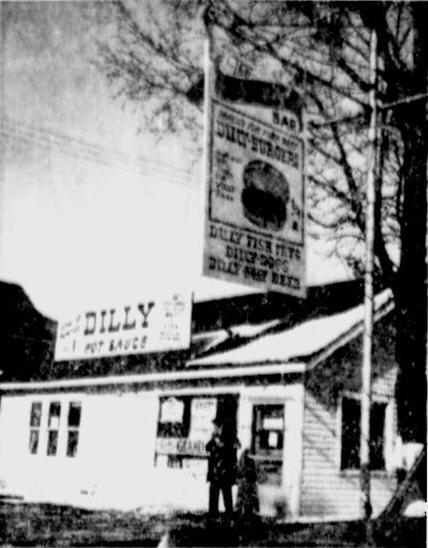
Exactly how many Dilly-Wagons were franchised, and where, is unknown. I’ve been able to locate one in New Hartford NY and one as far away as Sheboygan WI. The Wisconsin Dilly-Wagon, purchased in 1963, was run in conjunction with a Dairy Queen stand. There was also a Dilly Bar operated by Charles Weinstein and a partner on Curry Road in Schenectady NY (pictured, 1966). Curiously, this operation, which was not in the form of a covered wagon, specialized not just in burgers and hot dogs but also Chinese egg rolls, Southern fried chicken, and “dilly root beer,” whatever that might be.

© Jan Whitaker, 2011

117 Comments

Filed under drive-ins, food

Basic fare: salad

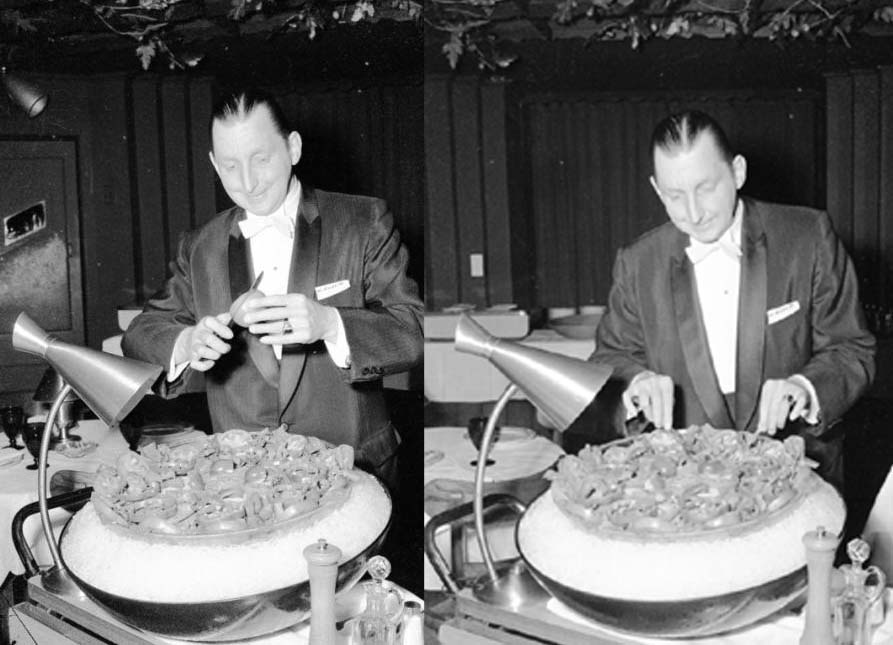
To paint a complete portrait of the restaurant’s history, the iconic image of Man Carving a Roast should be accompanied by Man Mixing a Salad. For in haute restaurant-ology it is Man, not Woman, who rules the salad bowl.

In the 19th century wealthy men who styled themselves epicures often impressed their dining companions by rising from the table and mixing the salad. In the 20th century the custom passed into the hands of headwaiters at chi chi venues.

The tradition can be traced to peripatetic Frenchmen who wandered around Europe solemnly ministering to urban dinner parties with the contents of their small yet sacred chests of salad ingredients which included flavored vinegars, soy, caviar, truffles, anchovies, and other delectables.

In the 18th century sallad (spelled in the British manner) referred to a mixture of greens and herbs, possibly radishes, dressed with vinegar and oil and perhaps a raw egg. It could also mean chopped cabbage, known in the early 19th century as “cold” slaw. How many taverns, coffee houses, and other early eating places served salads is unknown but the number was probably very small and their salad days limited to springtime.

Although some green salads appeared on 19th century menus, the word salad more often referred to cold chopped meat or fish dressed with mayonnaise. Lobster and chicken were favorites. Combination salads and fruit salads did not come into popularity until the 20th century, largely due no doubt to the lower price of greens, vegetables, and imported bananas and pineapples.

The type of restaurant that did most to advance the green salad as a basic component of the American diet was the table d’hôte, a small French or Italian restaurant serving a fixed-price meal of about five courses. In 1844, patrons at the Café Tortoni in NYC enjoyed dinners of soup, stew-like entrees, roast meat, salads “mixed a la des Jardins,” and desserts. Head lettuce was rare, so typical salads featured romaine, chicory, dandelions, or field greens. Salad lovers particularly lauded Italian restaurants for their salads, both in the 19th and 20th centuries (despite the common appellation “Wop salad” ca. 1940-1970). In 1909 a patron wrote that Italian restaurant salads “are almost always good, and the dressing, made from red wine vinegar, is usually delicious. The mixed salad, in spring includes tomatoes, peppers, lettuce, celery, sometimes spinach and usually chives. Beet tops are also served as salad.”

In the New England countryside, on the other hand, salads were rare – and unsatisfactory. As a patron in a hotel dining room noted in 1881, “If by any chance there is lettuce on the table – for this happens rarely – and you manifest a desire to eat of it, the waiter puts before you the vinegar cruet and the sugar bowl. If you want to make a fool of yourself, call for salad oil. It will take some time to explain your meaning, and when you have done so the attendant will sneeringly inform her companions that ‘That feller eats grease on his lettis.’”

Although some thought salads were gaining popularity in the 1890s as sedentary city dwellers woke up to the wisdom of lighter fare, hotel cook Jessup Whitehead remarked in 1901 that “salads are not among the common popular dishes, and the average public seldom seems to think of them.” Many cooks had no idea how to prepare them, he added.

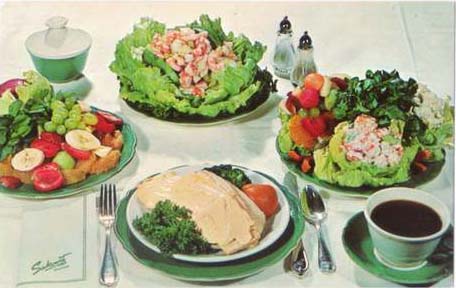
Salads became feminized in the 1920s. Perhaps it was the popularity of fruit salads in tea rooms, or the increasing use of flavored gelatin salads, but some male gourmets denounced women for preferring “comic salads” chosen for eye appeal rather than taste. Indeed there were some bizarre ones such as the Candlestick (illustrated), and others with names such as Clara Barton, Bon Ton, Butterfly, and Martini. Even a female tea room proprietor had to admit that “Atrocities have been committed in the name of salad.”

In the mid-20th century the tossed salad smothered under a layer of thick dressing became the standard start of a regulation meat and potatoes restaurant dinner. The high incidence of mediocre salads led syndicated columnist Inez Robb to launch a one-woman campaign in the 1960s against the two-pronged “red menace” to restaurant salads: chopped red cabbage and sludgy red-orange “French” dressing. Relief was on the way, for in the 1970s field greens returned, and ingredients rarely (but sometimes) found in salads of previous decades, such as olive oil, radicchio, and arugula came into wider use.

© Jan Whitaker, 2011

See also: salad bars, caesar salad

5 Comments

Filed under food

Frenchees, oui, oui

It’s remarkable how people still pine for Frenchees of days gone by. Recipes for the most cherished of these, the Cheese Frenchee, a battered, deep fried cheese sandwich with a crunchy exterior, are all over the internet. It may have been modeled on the somewhat similar Croque Monsieur sandwich of France, possibly explaining the name Frenchee.

Frenchees, sometimes spelled Frenchies, were the creation of King’s Food Host, a fast food chain catering to families and college students in the 1960s and 1970s. Most of the chain’s units were located in the middle of the country, with headquarters in Lincoln, Nebraska, where there were once nine units. The first – King’s Drive-In – was started by James King and Larry Price in 1955, on North Cotner in Lincoln. I wonder if the first one had telephones at each table that patrons used to send their orders to the kitchen?

King soon dropped out of the partnership but Price stayed with it until 1972 when he gave up control of the company for around $3 million. It had reached its peak size then, with about 100 company-owned stores and 35 franchised units. Reportedly it had units in Winnipeg, Canada, and 20 states, but I’ve only been able to identify 18: Arizona, Colorado, Florida, Idaho, Illinois, Indiana, Iowa, Kansas, Minnesota, Missouri, Montana, Nebraska, New Mexico, North Dakota, Oklahoma, South Dakota, Wisconsin, and Wyoming.

kingsfoodhostbrookingsSD1972785In King’s younger days around 1966 when it had only 35 locations in 10 states, it focused on building near universities. King’s were handy for students at state universities in Nebraska (Lincoln), Iowa (Ames), Wisconsin (Madison), and Colorado (Boulder), with new units under construction in Norman, Oklahoma, and Lawrence, Kansas. [pictured: King’s near South Dakota State University]

Larry Price, who graduated from Nebraska Wesleyan University, had been a football assistant there and served on the university’s board of trustees. His first food service foray was as a teenager in 1934 when he ran a hamburger stand at the 1934 Nebraska State Fair. He was very likely the motive force behind the chain’s advertised principles. The company would not sell cigarettes nor allow patrons to tip lest servers “compete with each other for the tip to the extent that they appear greedy.” Price was disgusted when King’s new corporate managers installed cigarette machines because he believed it would encourage minors to smoke.

The Frenchees may have disappeared from the chain at some point or maybe simply dropped out of favor. They were heavily promoted as part of a nostalgia campaign shortly after King’s went into Chapter 11 bankruptcy protection in 1974. Apart from Cheese Frenchees, King’s offered Tuna Frenchees [pictured], Hot Dog Frenchees, and Pizza Frenchees. Never having seen an actual Frenchee myself, I can’t picture what the last two varieties looked like. Apparently the Pizza Frenchee, which “joined the Frenchee family” in the dark days of 1974, was not a big hit. Nor were the 30% soymeal burgers which Larry Price, coming out of retirement to offer advice, persuaded the new owners to scuttle shortly after they were introduced to manage high beef costs.

None of these moves, nor others — the adoption of chicken in a box, frequent discounts, or red, white & blue decorating schemes — could save the company. The chain’s troubles started just after it went public in 1969 and began a rapid expansion drive. In debt for millions, it could not work out a satisfactory deal with creditors and never emerged from bankruptcy. Stock shares which sold for $14 each in 1969 dropped to a low of 50 cents after bankruptcy was declared. In 1978 a couple of business men from Minnesota and Wisconsin bought the remaining King’s outlets, which by then numbered only 17.

© Jan Whitaker, 2011

37 Comments

Filed under chain restaurants, food

The all-American hamburger

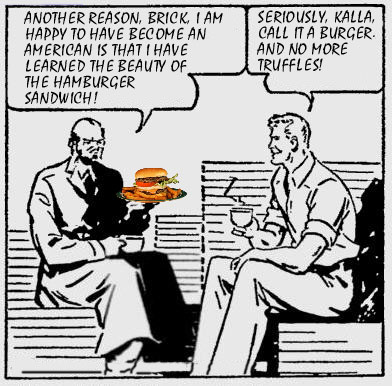
Brick counsels the elitist alien Kalla about his Americanization issues around food. Increase your own cultural capital by reading about the hamburger’s restaurant career.

1 Comment

Filed under food

Basic fare: French fries

I suspect that in the 19th century more Americans ate French fried potatoes at home than in restaurants. Boiled, baked, and mashed potatoes were more common on restaurant menus than fried potatoes of any sort.

However there were probably a few restaurants that served French fries. Maria Parloa, whose New Cook Book of 1880 included a recipe for preparing French fried potatoes in a frying basket lowered into boiling fat, traveled around giving cooking lessons, and I know of at least one restaurant manager who attended them. The course of lessons she delivered in Trenton NJ in 1884 included how to make French fries, perhaps extending to the sweet potato fries that appeared in her cookbook. I have discovered at least one 19th-century restaurant menu with French fries, in Grand Forks, North Dakota, in 1894.

The reason why few restaurants served fries then was not that they weren’t popular but that they used too much cooking fat. According to Jessup Whitehead, a culinary advisor to restaurant cooks in the 1880s and 1890s, raw potatoes cooked in hot lard were the most expensive potato dish for an eating place to prepare, while baked potatoes were the most economical.

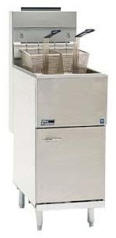
Perhaps things were starting to change in the 20th century. I’ve found a 1902 advertisement for a potato slicer for hotels and restaurants that cut “perfect French fries.” In 1911 another company produced a heavy duty model (pictured). Around this time there was a movement afoot among restaurants to charge separately for French fries rather than provide them “free” with meat or fish orders. This change could have made it possible to make a profit despite the high cost of cooking oil.

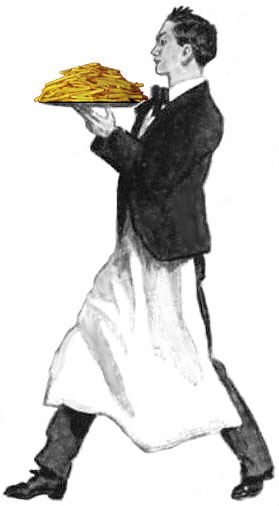
In France at this time – and probably much earlier – street vendors outfitted pushcarts with coke-fired kettles and prepared fries (“pomme frites”) on the spot for customers who ate them from paper cones. Many American soldiers in France during World War I developed the French fry habit, probably increasing demand for them in this country upon their return. In the 1920s and 1930s they began to appear on more and more menus. During World War II potatoes were scarce but after the war returning GIs, sick of mashed potatoes because of the dehydrated ones they had eaten in mess halls, hungered for French fries. Through much of the 20th century restaurant operators believed that men loved fries more than women did.

French fries were prominent on menus of postwar drive-ins. By then they were available frozen or formed from moistened dried potatoes forced through an extruder (little did the vets know they were eating dehydrated potatoes in a new guise). By 1968 the restaurant industry considered it “archaic” to make French fries from fresh raw potatoes. It was so much easier to shake frozen fries out of a bag straight into the fryer, no muss, no waste. According to Jakle & Sculle in their book Fast Food, the consumption of frozen potatoes went from 6.6 pounds a year per person in 1960 to 36.8 pounds in 1976. In this same period French fries made the short hop from drive-ins to their successors, hamburger chains such as McDonald’s.

Perhaps because of their mid-century popularity as side dish to sandwiches, French fries were shoved aside in the white tablecloth restaurants of the 1960s and 1970s by the old-fashioned baked potato which returned to favor as the prestigious accompaniment to steak and prime rib, especially when served with sour cream and fresh, er, frozen, chives.

© Jan Whitaker, 2010

4 Comments

Filed under food

He-man menus

I question whether there are huge gender differences in food preferences but I’ve seen plenty of evidence that many restaurants have marketed menus on this basis, especially by playing to the idea that men have manly tastes. This idea seems to have grown stronger in the 20th century when more women patronized restaurants on an equal basis with men.

Many people believe that men like heartier food than women do. In the 19th century, of course, men dominated restaurants and women were often viewed as special guests. Since eating places were accustomed to catering to men then, menu staples such as oysters, beef, and pie came to be seen as men’s favorite dishes. Perhaps they were, but then again they may have been regarded as “masculine” simply because men were the ones who usually ate them out in public.

In the early 1900s articles began to appear in newspapers that offered ideas of what food men liked best. Restaurants designed menus to appeal largely to male diners. Pollution of oyster beds brought growing distrust and beef came to top the list. “Quick lunch” spots noticed that men ordered more meat dishes than women. Louis Sherry said that women guests in his deluxe Fifth Avenue restaurant did not like to draw blood so they avoided red meat and game.

In the many places that served “business men’s lunch,” the favorite meal was meat and potatoes, pie, and coffee. If the lunch was served in a tavern setting, the pie and coffee might be replaced by a glass of beer. But men had other favorites as well, such as griddle cakes, corned beef and cabbage, beef stew, chili con carne, bean soup, fried potatoes, and ham and eggs.

With the advent of national Prohibition in the 1920s, observers noticed that men were eating lighter meals, more sandwiches, and even the occasional salad. While nutritionists hailed the change as healthier, some restaurant owners longed for the return of the heavy eater. When beer became legal again in 1933 the executive chef of Chicago’s Palmer House said, “With the stein on the table, masculine foodstuffs are bound to come into their own.” In 1934 a New York guide book tipped off men about where they could enjoy “man-sized” food “served without fancy gegaws.”

After Prohibition men who preferred no women in the dining room could go to bar & grill restaurants in hotels such as the Esquire Restaurant in the Penn-Harris Hotel in Harrisburg PA or the men’s bar at the Waldorf Astoria where they could enjoy their Martinis and Mutton Chops minus female company. In the men’s bar at the Mayflower Hotel in Washington, D.C.,  the dining room captain personally prepared Cannibal Sandwiches of raw beef, onion, egg yolk, and Worcestershire sauce at guests’ tables.

Known as the Rib Room, the men-only Mayflower bar was also host to FBI chief J. Edgar Hoover, who lunched there daily in the 1960s, always at the same table facing the door. His favorite meal, consumed with only the slightest variation, was cream of chicken soup, coffee, and Jello. While he was President, in 1970, Richard Nixon and four of his staff dropped in at the Rib Room for breakfast after Nixon’s early morning visit to Vietnam War protesters at the Washington Monument. Nixon ordered corned beef hash with an egg on top which, according to his press secretary, marked the first time he had eaten this dish in five years.

© Jan Whitaker, 2010

Leave a comment

Filed under food, patrons