Monthly Archives: January 2012

A famous fake

. . . but not quite famous enough because many people still mistake the image shown here, dubbed “America’s first restaurant,” as a reproduction of a genuine Delmonico’s menu from 1834.

It makes me realize how little sense of restaurant history most people have because this “menu” (probably not a menu at all but a newspaper advertisement or handbill) is definitely not from the genuine Delmonico’s, one of the country’s most elegant establishments. In 1831 Delmonico’s expanded from its original status as a confectioner’s shop into a Parisian-styled “Restaurant Francais.” In stark contrast, the “menu” shown above (this particular example was used to promote a modern-day restaurant) originates with one of the lowliest dives in New York City. Plus it’s nearly 50 years later than alleged.

The prices shown are a fraction of what a Delmonico’s meal would have cost. The dishes shown are scarcely French fare. “Hamburger steak” was unknown by that name in the 1830s, first appearing in the 1880s. Although, like all fine restaurants, Delmonico’s could provide a guest with just about anything on demand, items like Pie, Crullers, Mutton Stew, and Pork and Beans would most certainly not have appeared in print. But then restaurants did not use printed menus in 1834.

The true status of the advertisement above was unraveled by Ellen F. Steinberg and Jack H. Prost in an article called “A Menu and a Mystery” appearing in the Spring 2008 issue of Gastronomica. Recently, after consulting a book in which the fictitiously identified facsimile is treated as a valid Delmonico’s menu, I was inspired to dig up a few additional details.

After exhaustive research, Steinberg and Prost discovered that the likely origin of this advertisement was an establishment at 494 Pearl Street in lower Manhattan run by “R. Barnabo.” His was a place where the poor and down-and-out found cheap offerings, possibly acquired by the proprietor as leftovers from other restaurants and hotels.

The duo also discovered that the typeface on this document was not in use until the 1880s. They determined that this image made its modern debut as a facsimile of a genuine Delmonico’s menu in the 1930s, and was used in advertising campaigns for restaurants in the 1940s. Distributed by wire services, stories about the “legendary” low prices found on “America’s first menu” have cropped up as filler items in countless newspapers from the 1930s until the present. Syndicated columnist Hal Boyle made use of it repeatedly.

And yet nobody, nobody!, ever asked, “Can it be true that America’s finest restaurant served cheap doughnuts and whopping great halves of pies?” And hamburger, a despised food for the poor until mid-20th century? Pigs’ heads?

Here is what I can add to the story of R. Barnabo’s eating place known, perhaps humorously, as “Small Delmonico’s”: First, his name was actually Francisco Bernabo, born in Italy and naturalized as a U.S. citizen in 1882. He operated an eating place at 46 Franklin until 1879 when the property was sold and the restaurant was taken over by William S. Pontin. He then moved to 494 Pearl Street where he stayed until 1887 at which time he took a three-year lease at 6 Chatham-Square. He is listed at that address in 1888 but after that I cannot find a trace of him.

Strangely enough, the prices shown on this 1880s “menu” are actually lower than would have been found in a cheap restaurant of the 1830s. They are typical of the “5-cent restaurants” of New York City in the 1880s which were located in Chatham Square where Bernabo moved in 1887. He may have bought food secondhand, but it’s also noteworthy that in the 1880s the bottom ranks of butchers were selling the cheapest cuts of Chicago beef to lowly restaurants for 1 and 2 cents per pound. According to MeasuringWorth.com a 10-cent hamburger steak in 1884 would be about the equivalent of one costing $2.29 today.

© Jan Whitaker, 2012
11 Comments

Filed under menus

Music in restaurants

Because they traveled quite a bit musicians must have made up a notable percentage of early patrons of public eating places. It’s easy to imagine them playing a few tunes in return for their dinner, but if this happened I’ve found no trace of it. The first mention of music I’ve discovered was in 1866, in a description of a small French restaurant in New York with an oyster-shell framed alcove where “sometimes a boy with a violin will seem to afford music to the feast.”

Note the negatively tinged words “seem to afford.” Throughout history there have been plenty of critics of musical “din” in restaurants.

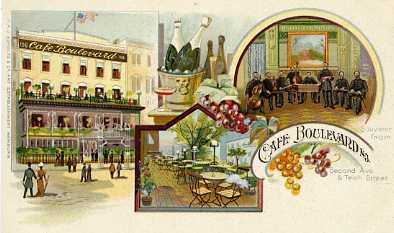
Music in restaurants was apparently a continental custom that migrated to these shores. At first it was highly associated with German restaurants such as Lauber’s at the 1876 Centennial Exhibition in Philadelphia. But by the late 1890s musical accompaniment with dinner became quite popular and all kinds could be found. “Wild” gypsy music as was played at NYC’s Café Boulevard was a favorite at Hungarian restaurants. Such places were known for their bohemian atmosphere — Why, people even talked to strangers! Later in the evening, the combined effect of food, wine, beer, and strolling musicians would have everyone singing choruses.

Orchestras of young women were also popular. In Boston, D. S. McDonald’s on Tremont  Street served dainty chafing dish specials such as Lobster a l’Americaine and Oyster a la Poulette en Blazer to the tunes of such a group. “This is a touch of Bohemia right in the heart of Boston,” proclaimed a 1903 advertisement.

American restaurant-goers of the turn of the century were evidently longing for the music of exotic others to invigorate and entertain them. On the West coast that often meant Hawaiian hulas. Everywhere else it meant the music of African Americans, especially ragtime.

The naysayers pleaded for quiet with their dinners. Articles in 1904 and 1905 issues of Town and Country, noting that potted palms and Hungarian bands expressed “the spirt of the age,” nonetheless complained that even the Third Avenue Delmonico’s had become “a hall of artificial palms, red paper, gilding and ragtime.”

Some hoped the early, pre-WWI tea room would provide a haven from the “garishness of strong lights, deafening music,” and restless thrill seekers found at the average restaurant. Instead music spread everywhere. Chinese restaurants installed Chinese orchestras which played all the latest rags. Even cafeterias joined the bandwagon.

It wouldn’t be long before clever minds figured out how to automate music in cafes and restaurants. At NYC’s Kalil’s in 1909 recorded voice of Caruso and other famous singers could be played on the Victor Auxetophone loudly enough to be accompanied by a live orchestra. The jukebox would not be far behind. In 1927 an advertisement advised cafeteria owners that the colorful Electramuse stimulated people “to have a good time – to spend MORE money!”

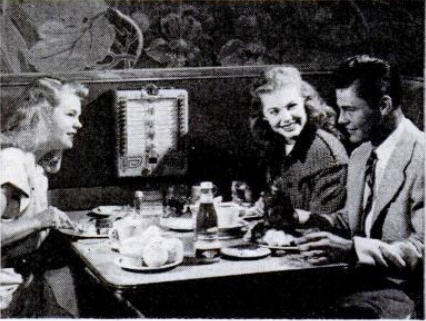
But jukeboxes ran afoul of polite society in short order. They were popular in teen hangouts – and that was part of the problem. Adults shunned these cafes, and neighbors complained about loudness. Fights broke out over musical selections. The jukebox took on associations of low life, not helped one bit by stories like the one that appeared in 1954 about a feuding North Carolina drive-in restaurant operator blasting super-amplified “Shake, Rattle and Roll” at an evangelical meeting across the street. The final straw for the jukebox was its takeover by racketeers.

Muzak fared much better in the restaurant industry than did jukeboxes. It started operation in NYC in 1936 with 40 restaurants as clients. Among its early customers were the dining room in the Algonquin Hotel and the Kungsholm Swedish restaurant on E. 55th Street. At first limited to large cities, technical advances in 1954 permitted Muzak franchises to spread to smaller towns throughout the country.

Today we have the full panoply of music. Rarely do we hear orchestras, but string quartets, harpists, strolling musicians, and canned music are plentiful. Even jukeboxes have been scrubbed clean of their dark past to the delight of patrons of retro diners.

© Jan Whitaker, 2012

4 Comments

Filed under restaurant customs, technology

Co-operative restaurant-ing

Although it is a footnote to restaurant history, the notion that restaurants could provide a solution to social and domestic problems is one that has cropped up quite a few times in American history, beginning in the 1840s, continuing into the 1970s, and not totally extinct even today.

The idea of community dining began with Frenchman Charles Fourier’s plan for a society organized into communes (phalanxes) where people both lived and worked. Several were established in the United States in the 1840s and 1850s, in Ohio, Texas, Wisconsin, New York, and New Jersey. The North American Phalanx in Red Bank NJ, which continued for 12 years, may have been the longest lasting. Its phalanstery, a kind of hotel or apartment building, had 85 rooms and a “refectory” where members gathered at long tables and chose their meals from a bill of fare with prices.

The Fourier-inspired communes did not survive, but the idea of collective dining did. From the 1870s until World War I feminists saw commercial restaurants as the next, virtually inevitable, step in evolutionary progress that would liberate women from kitchens. Suffragist Tennessee Claflin observed in 1871 that women’s chores such as teaching children and making clothes were leaving the home and becoming special trades. Noting that men were becoming accustomed to eating their midday meal in restaurants, she expected food preparation to be next.

Others observed the same thing, especially with the growing popularity of kitchenless apartments. An 1876 article in The American Socialist viewed NYC apartment buildings where meals were served in ground floor dining rooms as an outgrowth of Fourier’s ideals. Although limited to fairly affluent families then, apartment living was regarded as a step toward universal cooperative housekeeping.

A goal of some futurists and feminists, such as Edward Bellamy and Helen Starrett, was to have complete meals delivered to the home ready to eat. Starrett wrote in 1889 that the solution need not be a non-profit enterprise. Rather, just as butter and soap making had been commercialized, she expected that the business world would find a way to do this profitably. Indeed, in Knoxville, Tennessee, a woman started a meal delivery service as early as 1896, sending out “steaming hot” food to families. The idea got a boost during World War I when a surging war economy drew hired cooks out of affluent households (e.g., Florence Hulling).

Author and social thinker Charlotte Perkins Gilman knew of three cooked food companies in operation, in New Haven, Pittsburgh, and Boston. She fully expected efficient restaurants and food services to replace the home as a site of production, which, she wrote in 1903, “lingers on inert and blind, like a clam in a horse-race.” In her 1909 novel What Diantha Did, the enterprising heroine not only runs a hotel for working women, she also operates a lunchroom for business men, a cooked food delivery service, and a mini-maid service.

Other than supporting utopian societies and liberating women from household chores, the goals of “public service” style restaurants in the 19th and 20th centuries also variously encompassed providing inexpensive lunches for young working women, luring alcoholics away from saloons, resolving labor strife, reducing the cost of living, and promoting healthy diets.

Social motives often lay behind the start of commercial restaurants also, such as the Dennett’s chain whose funding came in part from missionary societies. And some eating places that had their starts as community co-operatives developed into commercial ventures, such as the Hollister Cooperative Coffee Club or the Mission Cafeteria in Long Beach [shown], both in California.

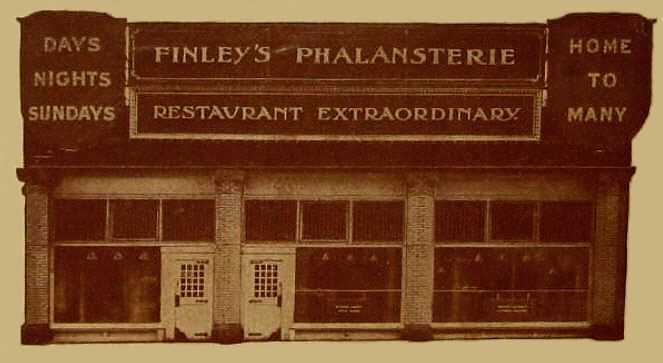
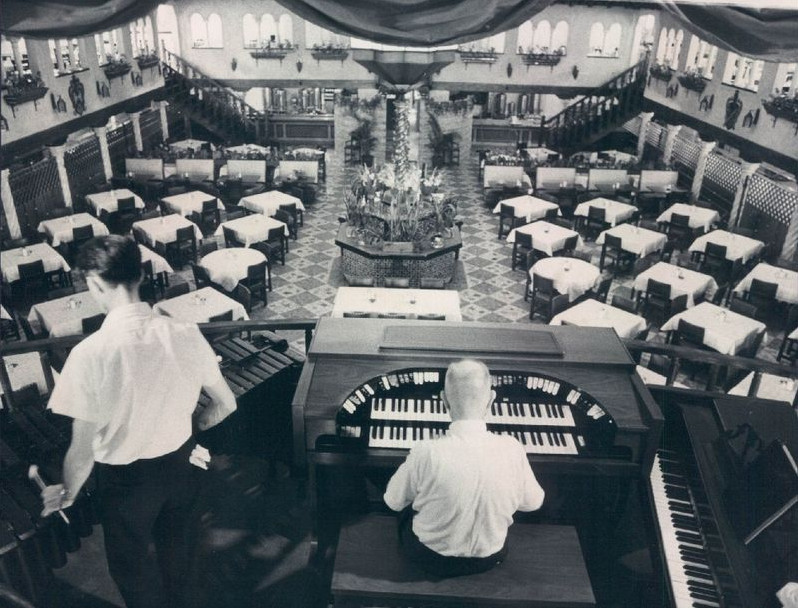
A curious outgrowth of the interest in communal dining occurred in Cleveland OH, where Richard Finley established Finley’s Phalansterie shortly after the turn of the century [pictured above]. Eventually he presided over six eating places in Cleveland and grew rich. Although he chose the generally unfamiliar name to pique interest in his restaurant, it turned out that he did in fact have communitarian motives in mind. His plan, reminiscent of Elbert Hubbard’s Roycroft in East Aurora NY, was to establish a colony in California where workers would live and produce arts and crafts furniture and objects. I was unable to discover how far he succeeded beyond building a hotel and cottages in La Canyada and publishing a magazine called Everyman.

The story of restaurants and eating places with social motives is not complete without mentioning the hippie and communal restaurants of the 1960s and 1970s – but that will be another chapter.

© Jan Whitaker, 2012

17 Comments

Filed under alternative restaurants, Offbeat places

Dainty Dining, the book

From my vantage point I can tell you that at any time of day or night hundreds of thousands of souls are searching for recipes from their favorite restaurants of old. Perhaps they are hoping to relive their pasts or to recall happy moments spent with departed loved ones. Or maybe they simply remember THAT Steak Diane or Chicken Salad as being the most delicious they ever tasted. And who can say it wasn’t?

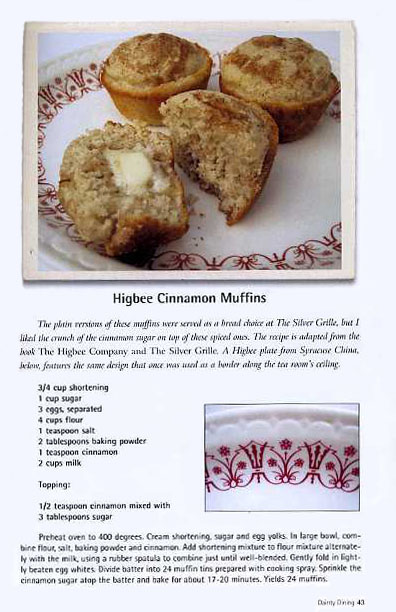
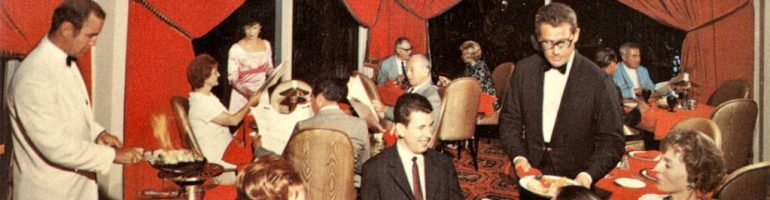
Among the searchers, the most dedicated may well be those pining for dishes from long-gone department stores. For them, I have a fix, a new book by Angela Webster McRae called Dainty Dining: Vintage Recipes, Memories and Memorabilia from America’s Department Store Tea Rooms. In it are recipes, tested personally by Angela, from 20 of the country’s historic department stores, all gone except for two, Macy’s and Younkers (although the Des Moines flagship closed in 2005). Among others, readers will find favorites such as Cream of Cauliflower and Cheese Soup from Lazarus (Columbus OH), “Mr. Bingles” desserts from Maison Blanche (New Orleans), Mrs. Herring’s Chicken Pot Pie from Marshall Field in Chicago, and Rich’s Magnolia Room Frozen Fruit Salad (Atlanta).

In addition to providing brief histories and vintage images of each department store, Angela has photographed her culinary productions quite attractively.  Dainty Dining is not yet available on Amazon but it can be purchased from Scott’s Bookstore in Newnan, Georgia (770-253-2960) or via Angela’s blog Tea with Friends.

5 Comments

Filed under miscellaneous, tea shops

Famous in its day: Miss Hulling’s Cafeteria

In 1978 two of the nation’s top grossing independent restaurants were New York’s Tavern on the Green and Mama Leone’s, according to Restaurant Hospitality magazine. At the first, guest checks averaged $14.50, while at Mama Leone’s the average was $13. A big aspect of both restaurants’ business was alcohol, accounting for 30% of revenues in the case of Warner LeRoy’s Tavern on the Green.

Meanwhile, a sturdy favorite in downtown St. Louis, the venerable Miss Hulling’s, home of chicken livers, creamed spinach, and carrot marshmallow salad — with a negligible drinks business – had a check average of $2. Yet it still managed to rank #58 out of the 500 restaurants in the survey.

Miss Hulling’s was the creation of Florence Hulling, who came to St. Louis around 1907 as a teenager from rural Illinois to work as a private cook. After a few years in domestic service she went to work for the Childs restaurant chain. Eventually she was promoted to manager, a rare status for a woman at that time. Childs closed in 1928 and she and her sister Katherine took over management of the cafeteria in the Missouri Hotel. When it closed in 1930 Florence bought the failed restaurant on the opposite corner and named it the Missouri Cafeteria.  It would stay in business there for the next 62 years [shown just before razing].

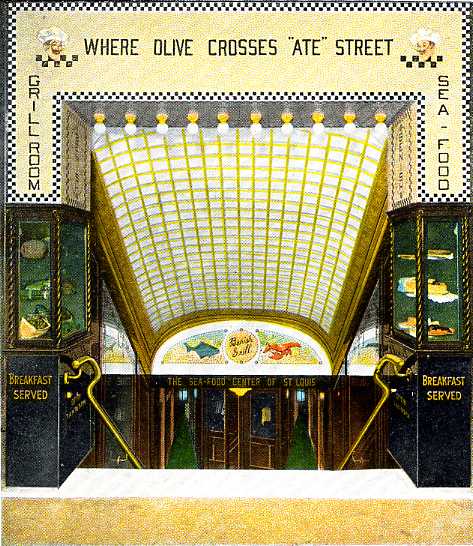
Florence married Stephen Apted in 1931 and in 1934 the Apteds opened a second cafeteria at 8th and Olive, calling it Miss Hulling’s, a name that would eventually apply to the Missouri Cafeteria as well. The Olive Street restaurant occupied a basement site that had previously held the Benish cafeteria [entrance shown] and before that – I think — Lippe’s, a restaurant operated by Detlef van der Lippe.

How well I remember a job I once held chauffeuring an alcoholic boss to Miss Hulling’s, his regular eating place and virtually his true home when he wasn’t bunking in the office of his advertising agency. I suspect he was not the only St. Louisan who relied on Miss Hulling’s for more than just food.

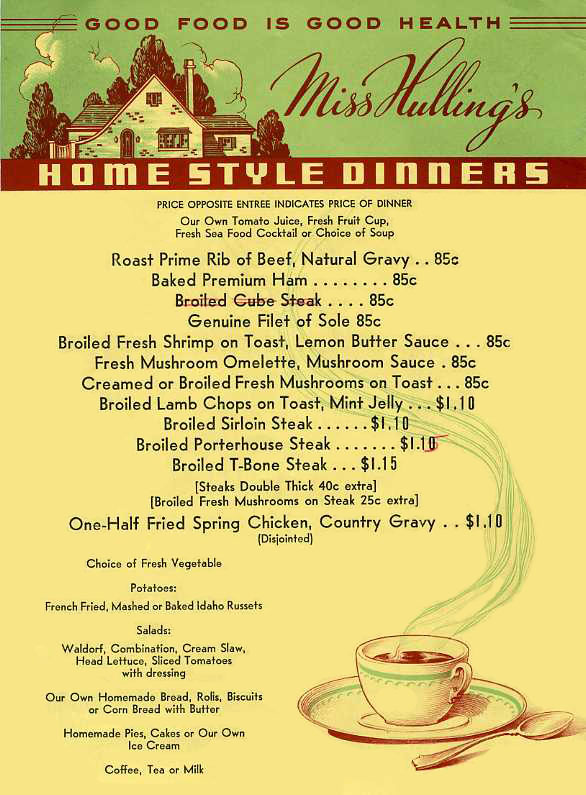
A 1939 Miss Hulling’s menu reveals the kinds of homelike dishes featured there. In addition to those shown, a mimeographed attachment lists a number of dishes not found much in restaurants now. Among the choices are Stuffed Baked Veal Hearts and Braised Ox Joints. If a complete dinner was ordered, for about 50 cents, the diner also got soup or salad, bread and butter, a vegetable such as Creamed Kohlrabi or Fried Egg Plant, a beverage, and a dessert such as Peach Rice Pudding. (See Miss Hulling’s Sour Cream Noodle Bake and her German Chocolate Cake on my Recipes page.)

In the 1940s and 1950s Miss Hulling’s was just the kind of place that earned high ratings from Duncan Hines and Gourmet’s Guide to Good Eating, the latter reporting, “Everybody in St. Louis swears by Miss Hulling’s. Food is exceptionally delicious, clean, and of high standard.” The cafeterias served their own ice cream and baked goods, used fresh fruit for pies, and prepared food in small batches.

Through succeeding decades the Miss Hulling’s enterprise, headed by the couple’s son Stephen J. Apted, grew large. It acquired Medart’s (turning it into the Cheshire Inn), and opened numerous restaurants in the metro area, among them The Cupboard and the Open Hearth, as well as running food services at two hospitals. Headquarters, including a bakery, were at 11th and Locust above the two-floor cafeteria. At the same location were the more formal dining spot Catfish and Crystal, His Lordship’s Pub, and a bakery and ice cream shop. In 1993 the entire operation at this site was closed down, the same fate having befallen the Olive Street cafeteria some years before.

© Jan Whitaker, 2012

107 Comments

Filed under cafeterias, popular restaurants, proprietors & careers, women