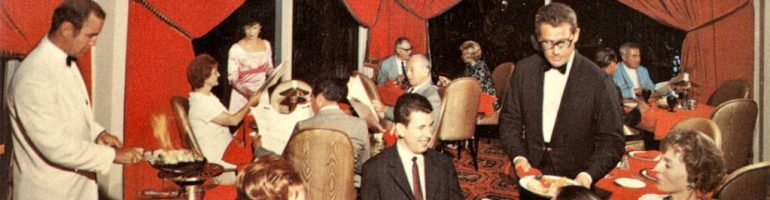
During the growth of Harlem as an entertainment district, known mainly for its jazz and night clubs of the 1920s and early 1930s, the Black-occupied part of New York City, with a population nearing 200,000, was also home to a number of tea rooms.
Unlike the night clubs, many of which had White owners, the tea rooms were owned and run almost exclusively by Black residents of Harlem. Also differing from the White-owned clubs — which did not admit Blacks — tea room patrons were in all likelihood predominantly Black. Of the tea rooms for which I could determine the proprietor, several were male.
A number of tea rooms were located near what was known as “strivers’ row” where well designed row houses on tree-lined streets housed wealthier, often more educated, Black residents.
Tea rooms were also part of the Harlem renaissance of the 1920s in which Black men and women joined the ranks of accomplished American artists and writers.
The tearoom named Odds and Ends was the earliest I found. It was in business in Harlem at least by November, 1920. It would appear that its owner and cook, Mrs. Benjamin Price, aka Susie Price, hosted debutantes and distinguished visitors from other states. One year after its opening it announced it would host Wednesday afternoon Teas and Dinner Dances, with music by Prof. Harding’s Orchestra. Among the patrons the following year was White author Gertrude Sanborn, a lunch guest of the editors of the newspaper Negro World. She was in Harlem to gather research for a book she was writing about racial passing called “Veiled Aristocrats,” published in 1924.
Harlem tea rooms differed from tea rooms around the U.S. in keeping long hours. In 1921 Odds and Ends advertised that it served lunch, afternoon tea, dinner, and after-theater supper, closing at midnight. Many Harlem tea rooms served breakfast, which was unusual. This may have been a way of attracting White patrons ending their night of revelry.
Another early tea room was the White Peacock, planned as a friendly haven for Harlem’s writers and artists by proprietor Douglas O. Howe. Howe was said to be a member of Harlem’s “smart set.” With an orange and black color scheme, the tea room’s walls were painted by local artists in summer 1922, with one mural depicting a white peacock. There was a library with writing materials, books, and periodicals. Hours were to be from 11 a.m. until 2 a.m., serving tea, coffee, and light lunches. In the spirit of equality, women were to be allowed to smoke.
Was the White Peacock a success? I wish I knew. As is true of many of the tea rooms – and Harlem jazz clubs too — how long it stayed in business is unknown. I could find no further trace of it.
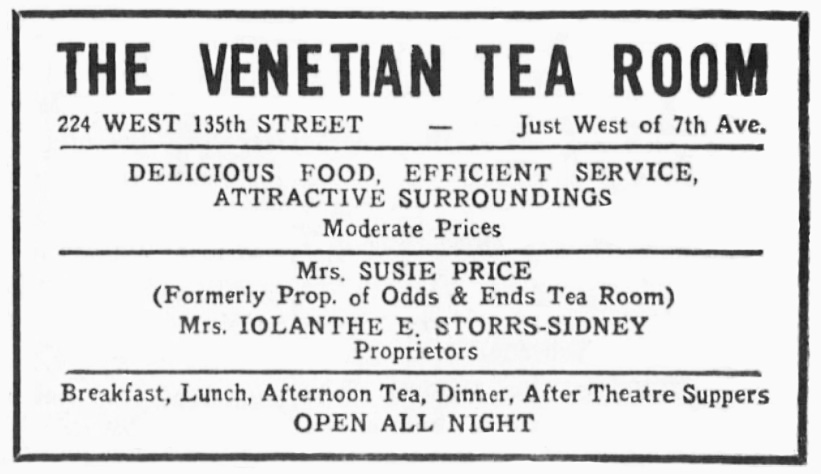
Odds and End’s Susie Price moved on in 1927, running the Venetian Tea Room with Iolanthe Sidney (full name: Iolanthe E. Storrs-Sidney). Iolanthe, a graduate of Talladega College who was socially active and well known in Harlem, took the role of hostess while Susie did the cooking. The tea room, known for its green and black decor, offered breakfast, lunch, and dinner, staying open all night with a la carte service. It became immensely popular very quickly. It was closed by October 1930 when a classified ad appeared offering “Complete Tea Room or Restaurant Equipment.”
A 1927 story about Flo’s tea room seemed to suggest that it wasn’t necessarily tea that patrons were sipping out of cups. But, at the same time Flo’s was also a gathering place for “society,” for Democratic party events, and for members of service organizations such as the Urban League and the American Legion.
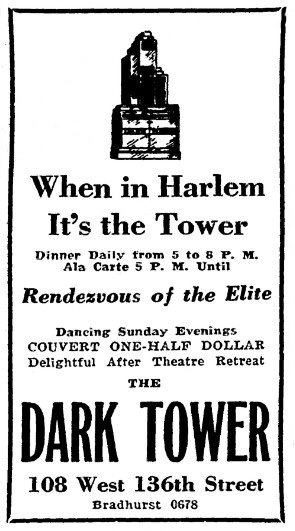
Another development in 1927 was the creation of the Dark Tower Tea Club, as part of the Walker Studio created in a town house by the daughter of Mme. C. J. Walker who became rich with her Black cosmetics business. Her daughter and business successor, A’Lelia Walker, carved out a tea room as part of the Studio. In line with the Studio’s emphasis on the arts, the tea room was highly decorative, with a red, green, and black color scheme and ebony furniture decorated with red. After beginning as a free service to Studio members, it began charging for tea. Still in business in November 1929 and in February 1930, it advertised on the earlier date that it was “serving dinner daily” and had music and dancing.
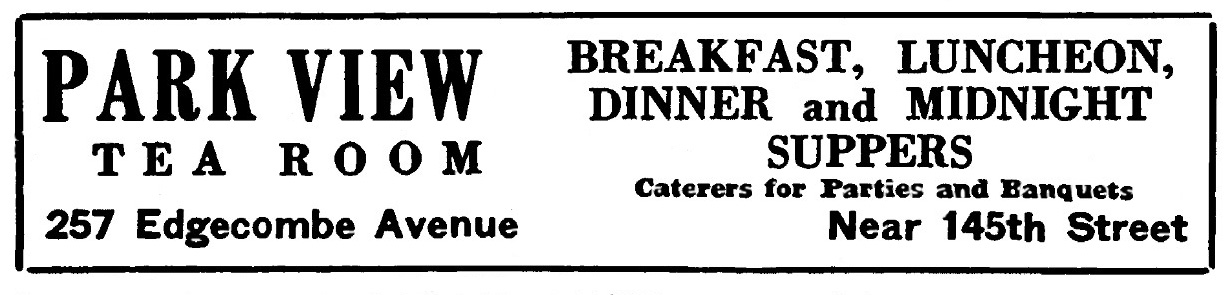
It is somewhat difficult to know what to make of the elite Park View tea room that overlooked Bradhurst Park in northern Harlem. This is because of the coy wording of “Lady Nicotine” who wrote a column called “Between Puffs” for the Tattler. In a 1927 column she described the area as “most fashionable” and seemed to gush over the Park View’s “ample room for dancing.” She then said it was “poetic enough, if you get what I mean, to offer to its clientele caviar, anchovies, and stuffed truffles,” adding that “when you have followed one of its dinners . . . you have consumed well over your one quart.” Not sure I get what she means, but it could be interpreted as saying that alcoholic beverages were plentiful there.
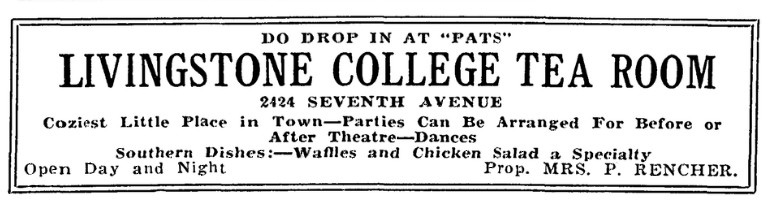
The Livingstone College Tea Room was probably designed to attract alumnae of the college of that time located in the South. The advertisement is from 1929.
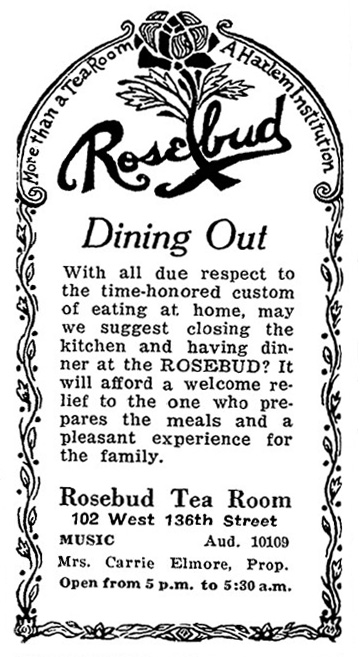
It seems there were two tea rooms named “Rosebud.” One [advertisement shown above] was run by Carrie Elmore, stayed open all night, and offered “Hot Steaming Dinners in Roasted Meats and Fowls” and “Delicious Coffee served with pure Cream.” The other, at 413 Lenox Avenue, was operated by Mrs. Lucille Pitts. A 1932 blurb said its decor was “a marvel of the decorators’ art . . . skillfully disguised to resemble a bower of roses” and serving chicken a la Maryland, corn fritters and “every known variety of sea food. It was open all night, serving “predawn breakfast.”
In addition to the White Peacock, tea rooms owned or at least managed by men included The Marguerite, The Flamingo, and Ellerbe’s. When the Marguerite opened in 1927 it drew lines of people waiting to enter, perhaps to enjoy its chicken and waffles, a menu item that was ubiquitous in Harlem. The Marguerite was run by Edward Ellerbe and G. Truesdale. Later Ellerbe opened a tea room under his own name, but by 1932 that tea room seemed to have a new male proprietor.
The Flamingo Tea Room, described as “swanky’ and ‘beautiful’ opened on 7th Avenue in summer of 1931 under the direction of Pete Johnson, said to be an experienced restaurateur. It was an unpromising time, not long after the stock market crash that resulted in the closure of many clubs in Harlem.
Other 1930s openings included the Caswell Tea Room and the Theresa Tea Room, both of which opened in 1932 with women proprietors promising home-cooked food.
But the 1930s were a turbulent time in Harlem as elsewhere. Rioting in 1935 caused the closure of many clubs and probably the tea rooms too. In retrospect they seem highly ephemeral businesses that nonetheless helped build New York City’s Black community for a time.
© Jan Whitaker, 2026


 It's great to hear from readers and I take time to answer queries. I can't always find what you are looking for, but I do appreciate getting thank yous no matter what the outcome.
 Restaurant-ing through history