Tag Archives: Chicago restaurants

That night at Maxim’s

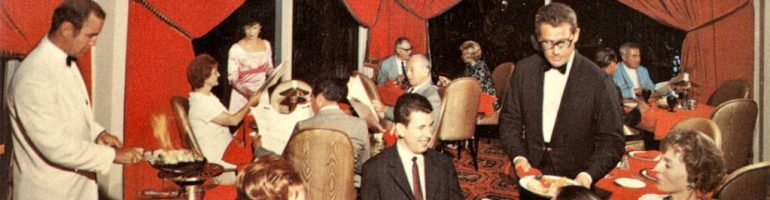
A restaurant is an expression of its time and place. Except for fast food franchises which are based on an industrial mode of mass production detached from local particularity. So when a replica of an art nouveau turn-of-the-century culinary haunt of demimonde Paris shows up in the basement of a hotel on Lake Michigan’s gold coast in the mid-20th century – well, it’s a little strange.

In short, was the Paris-based Maxim’s franchise that arrived in Chicago in 1963, with its undulating woodwork, fleur-de-lis lights, red velvet banquettes, Soles Albert, and Poires Helene, the real thing?

I’ve been pondering this question as I’ve pored over the fascinating photograph above, which was taken by prize-winning photographer Gary Settle, probably for The Chicago Daily News.

What was the occasion? It’s not a casual shot. At least two floodlights are in evidence and there is something stagey about the scene. I suspect the couples were asked to leave their coffee and smokes and get up and dance. Unfortunately, in the process two napkins were flung aside in an unsightly manner. Elegance is so hard to achieve.

The Brylcreemed man leaning over the table must be Chef Pierre Orsi who had very recently arrived from Paris to take command of the kitchen. The man seated to the right of him looks as though he could be French, but the other men in the picture, apart from the musicians, appear to be of German ancestry. I wonder if they might be two sets of twins.

Which of the women owns the sable coat and elbow-length black gloves? I believe it is the blissful dancer on the left. She will carry home leftovers in a foil purse-shaped doggie bag — perhaps she is dieting or didn’t love her Calves Liver with Raisin and Grape Sauce so much.

The table has a center lamp with pink silk shades and coffee cups bearing Maxim’s curlicue M logo. A cigarillo rests in one of the souvenir ashtrays, while others have been used by the table’s two Winston smokers who prefer a fliptop box to a soft pack. Did these eight people really polish off four bottles of champagne? Did anyone use the replica antique telephone to check in with their babysitter?

I invite readers to create a scenario. Who are these people and what were they thinking at this moment in September, 1967?

© Jan Whitaker, 2012
19 Comments

Filed under elite restaurants, miscellaneous, patrons

Restaurants and artists: Normandy House

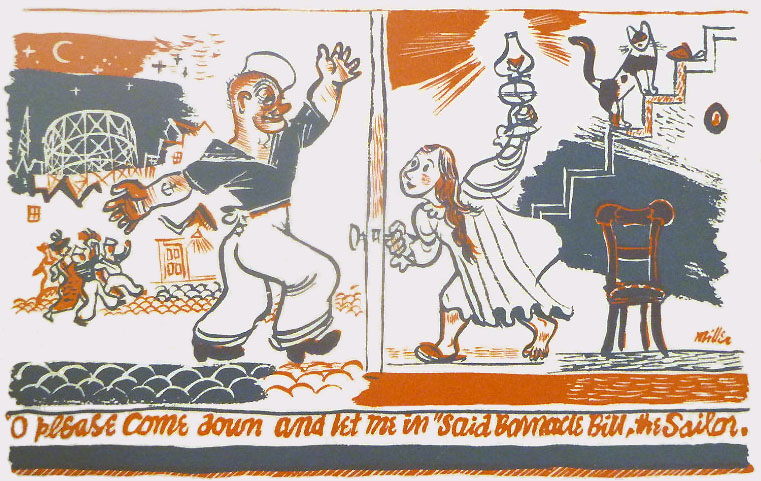
With the recent publication of the book Edgar Miller and the Handmade Home has come renewed appreciation of Miller’s talents and of the central role he played in the birth of Chicago’s Old Town arts colony in the 1920s and 1930s. Often seen as “Chicago’s forgotten Renaissance man,” Miller is mainly admired for his imaginative renovation of apartments and studios, with Sol Kogen, employing materials from demolished buildings.

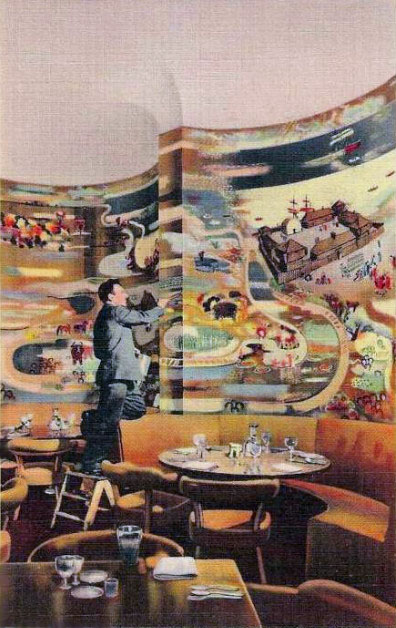
His work encompassed mural paintings [portion of Black Sheep mural below], stained glass windows, wood and stone carvings, ceramics, wallpaper, and fabrics. In addition to dwellings, his playful virtuosity in the decorative arts was bestowed upon a number of Chicago’s eating and drinking places, including Harry’s New York Bar and the several outdoor cafes at the Streets of Paris complex in the 1933-34 Century of Progress Exposition. Following Repeal, when money poured into updating bars and restaurants, he worked with architects such as Andrew Rebori, painting murals for bars in the Northern Lights hotel, the 885 Club, and a Fred Harvey restaurant in Dearborn Station [pictured below]. At the Tavern Club, where Miller was a member and his precocious young son Skippy would later hold “one-man” shows, he created a renowned mural called Love Through the Ages.

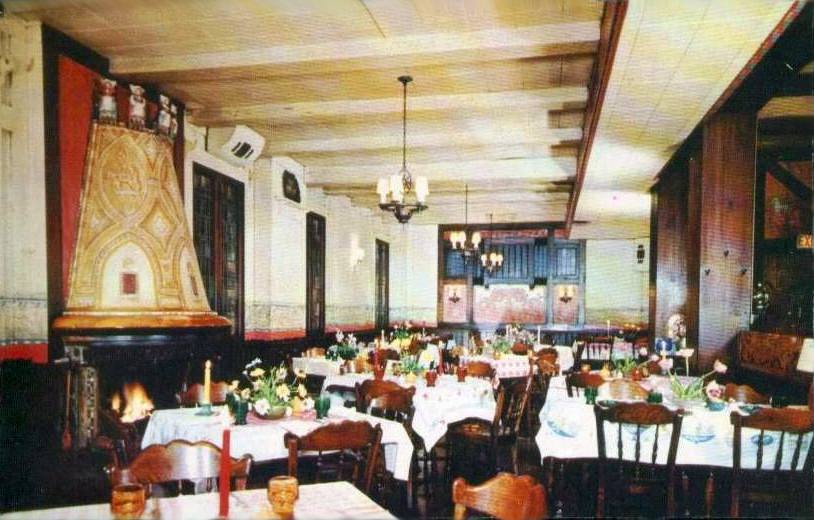
Normandy House on Chicago’s near north side became his ongoing project in the late 1930s and through the 1940s. The restaurant occupied the corner structure in a row of five apartment buildings, each four stories in height, at the southern end of Tower Court (aka Tower Place and North Michigan Ave.) opposite the historic water tower. Once the home of the city’s blue-bloods, by the 1920s the entire row had become a commercial property. A restaurant called the Charm House occupied the corner site until about 1937 when Grace Holverscheid bought the business, renaming it Normandy House.

Grace, a widow, operated it with her friend Helen Wing, also widowed. Grace would soon marry a third partner, Richard Tallman. All three were involved with music, Richard as a composer, Grace as a concert vocalist, and Helen as her arranger and accompanist. While running Normandy House, Helen also wrote books and composed operettas for children.

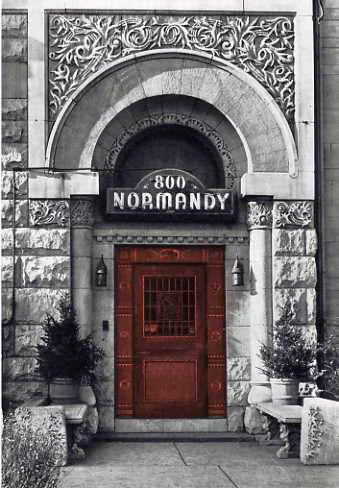
Edgar Miller lived upstairs over the restaurant, perhaps trading his artistic work in exchange for rent. During its incarnation as Charm House, the restaurant had been renovated in quaint style with beamed ceilings, etc., to resemble a sister restaurant in Cleveland OH. An Old English taproom and grill installed in the basement in 1934 – named the Black Sheep Bar by its new proprietors — became the focus of Miller’s decorative elaborations. Over the years when he, and later his family, lived on the third floor, he carved a front door, painted murals, and made stained glass windows, wood sculptures, ceramic plaques, and wall paper for the restaurant. He was assisted by his brother Frank who became the Black Sheep’s bartender.

The Millers’ quarters, up the stairs past the restaurant’s cashier, also served as studio space for Edgar and his wife, the former Dale Holcomb, who translated many of Edgar’s designs into fabrics. At any given moment the whole family, including the two young sons, might be painting portraits, squeegeeing silk screens, or engaging in any number of artistic endeavors. Other artists, musicians, and classes of art students from the Art Institute frequently paid visits.

The Normandy House, like Chicago’s Le Petit Gourmet, attracted a clientele that included club women and professional groups of architects and academics. Its menu featured favorites such as the Pink Squirrel (broiled beef tenderloin with Roquefort sauce) and Eggnog Pie, as well as 1950s innovations such as salad in wooden bowls and individual loaves of bread served on cutting boards.

Helen Wing and the Tallmans closed Normandy House and retired in the summer of 1956. Then, under the management of a long-time employee and with backing from a Florida hotel mogul, it was reopened. In 1960 it moved to Rush Street, reinstalling at least some of Miller’s pieces.

The Tower Court building housing Normandy House along with the other four buildings in the row were razed to make room for a multi-story hotel. In the 1960s Miller and his wife moved to Florida where they ran a motel until her death. Edgar lived in Taos NM, Australia, and San Francisco, then returning to Chicago where he died in 1993 at age 94.

© Jan Whitaker, 2012

Read more about Edgar Miller’s life and work.

1 Comment

Filed under restaurant decor

Regulars

The modern idea of eating out revolves around choice. Where shall we go? What shall we order? We are looking for change, novelty. We want to vary our routine.

It hasn’t always been this way.

Choice in dining out did not become the norm to any great extent until the second half of the 19th century, and then slowly and incompletely. Before that patrons were divided into “regulars” and “transients,” with the first category making up the backbone of the fledgling restaurant business.

In early American taverns the regulars were male groups such as firemen, clubs, or religious societies who turned up on a scheduled basis and were served group meals for a prearranged price. To put it in other words, much of the business of a tavern or eating house was conducted on a catering basis. Male college students, in the decades before dormitories and dining halls, grouped together in dining clubs that operated similarly.

By the 1870s restaurants filled with the same old people eating the same old food day after day came to be regarded as somewhat archaic. A visitor to a chop house in lower Manhattan that served steaks and baked potatoes observed patrons who, curiously, “did not give any order.” He reasoned that they were habitues and learned that one, a dry goods merchant, “has dined there every day for the last seventeen years.”

The system of regular diners and regular meals worked effectively during an era when there was not a large dining public like today. But even by the time things had changed significantly, in the early 20th century, many small cafes tried to take the guesswork and risk out of their business by cultivating regular customers. They sold meal tickets for which patrons paid in advance for a number of meals in order to receive a discount.

Even today there are probably still some individuals who would rather eat at the same place on a frequent, even daily basis. There are those who order the same thing every time or are automatically served the day’s special without even glancing at the menu. Is there an invisible straight line in NYC connecting the 1859 eatery where “regular patrons at the sandwich counter merely sit down and their sandwich is placed before them” and The Colony, where in the 1950s a woman was enjoying her 28th year lunching on lamb chops, salad, and grapefruit? Likewise in that same decade regulars at a Mississippi City restaurant were fond of sitting down and telling the proprietor, “Joe, fix us up.”

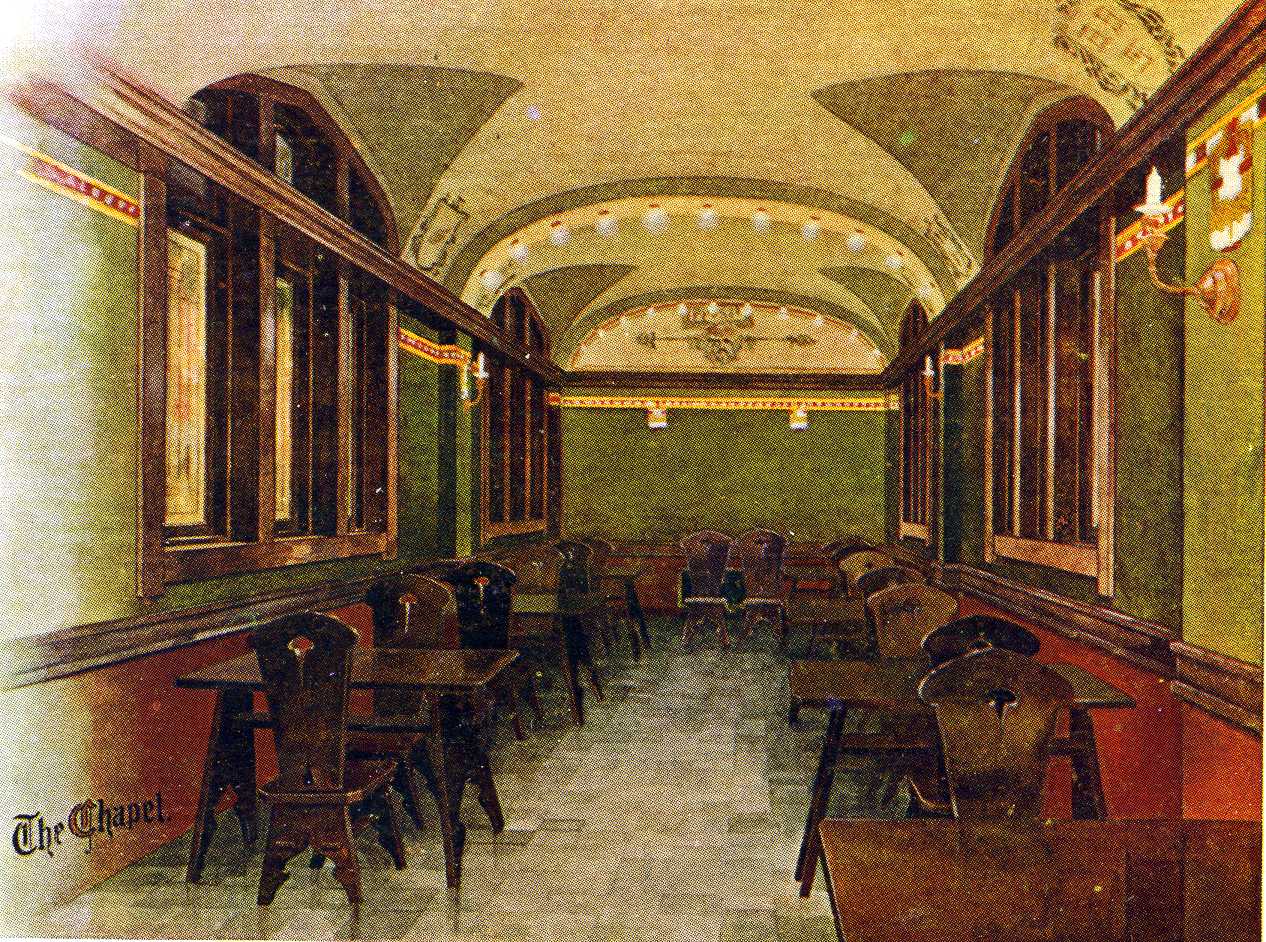
Another vestige of the old system that lingered on for decades was that of men’s professional groups who ate together regularly at the same restaurant – and the same table – for years on end.  Around the turn of the century insurance adjustors — members of the Firebug Club (whose name commemorated the olden days when adjusters colluded with policyholders to commit arson for profit) – used to meet at Mike Lyons’ in NYC’s Bowery. About the same time St. Louis’s Lippe’s was set up with alcoves for trade groups. There was a “Hoo-Hoo” decorated with a painting of a black cat that was designated for lumbermen, and another called “The Roost” decorated with a goose and other birds, meant for tailors. Might “The Chapel” have been intended for ministers? The tradition continued into the 1940s at the century-old Speck’s in that city where there was a bankers’ table, a doctors’ table, etc.

Journalists were well-known for socializing together in restaurants. In Chicago, Ric Riccardo hosted correspondents for the major national magazines and newspapers in his restaurant’s imitation jail called the Padded Cell in the early 1950s. By the 1970s the room had become dedicated to the weekly luncheons of the St. Louis Browns fan club.

Restaurants highly esteemed their regular patrons, none more so than Maylie’s in New Orleans, which closed its doors in 1920. The all-male restaurant admitted patrons each day at 11:00 a.m. and 6:00 p.m., seating them at long communal tables. When a regular died, his chair was left empty for several days.

© Jan Whitaker, 2012

6 Comments

Filed under patrons