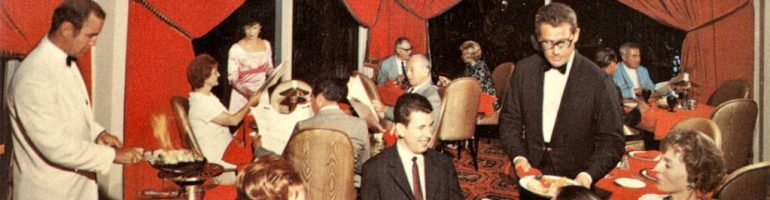
 The 1920s is an important decade because it marked the birth of the modern restaurant industry. The advent of national prohibition stripped away liquor profits, shifting emphasis to low-price, high-volume food service. More people ate out than ever before. Restaurant owners formed professional associations to raise industry standards, counter organized labor, and lobby for their interests. Famous pre-war restaurants closed, while cafeterias, luncheonettes, and tea rooms thrived. Female servers began to replace men. Restaurant chains incorporated and were listed on the stock exchange. While critics bemoaned the demise of fine dining, the newborn industry and its patrons celebrated simple, home-style, “American” fare.
Highlights
 1920 After a strike of 1,100 cooks and waiters in Chicago, the Congress Hotel hires a crew of waitresses. – Milwaukee restaurateurs report that Sunday has become their biggest day because of families eating out.
1921 A character in Alexander Black’s novel The Seventh Angel observes, “Life is just one damned restaurant after another,” then asks plaintively, “Is there any home-eating any more?” – A restaurant trade magazine reports that half of all restaurant meals in Los Angeles are sold in cafeterias and other self-service eateries. – In New York City, a former “lobster palace,” Murray’s Roman Gardens, advertises sodas and candy in its Ice Cream Salon.
1922 The International Association of Hotel Stewards endorses the elimination of French terms on menus.
1924 A brochure from the B/G Sandwich Shop chain boasts of “Food selected and prepared as in your American home; served by the sort of people you find at home, – high class ambitious young Americans who do not desire to submit to the European custom of depending upon the master’s gratuities.” – Cafeteria chain manager Harry Boos, president of the National Restaurant Association, declares: “Men and women want their goods quick and clean. The restaurant business is a greater industry than ever before in history.” – “Quick and Clean” is also the slogan of the White Cafeteria in Indianapolis.
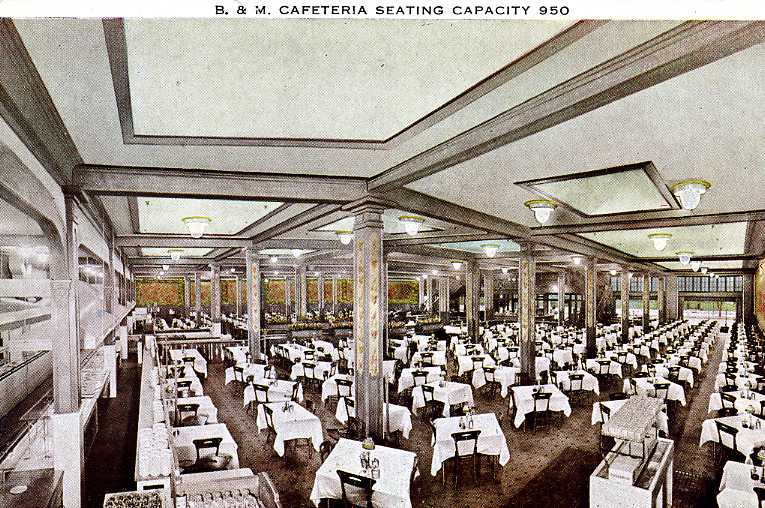 1925 After the closure of his once-celebrated NYC nightspot restaurant “Jack’s,” owner John Dunstan complains “The town’s full of cafeterias.” – Henri Mouquin’s famed French restaurant is demolished to make room for a Princeton Cafeteria.
1926 The Cordleyware Co. advertises that its champagne buckets for restaurants can be used as carriers for soiled silverware.
1927 The journal Restaurant Management reports that from 25% to 30% of all meals in cities are eaten in restaurants and that close to 60% of restaurant patrons are women. – A restaurant of the Happiness Candy Stores chain opens on the Fifth Avenue site once occupied by Delmonico’s.
 1928 In recognition of the growing number of women in the restaurant business, the American Restaurant journal begins a special section called “The Restaurant Woman.” – Chicago’s corned beef sandwich mogul, John P. Harding, known for catering exclusively to men, opens a restaurant especially for women.
1929 A restaurant trade magazine editorial asserts that the industry has finally won respectability. There is, it notes, “tremendous change in popular feeling toward a business once thought precarious – as well as beneath consideration, socially.”
Read about other decades: 1800 to 1810; 1810 to 1820; 1820 to 1830; 1860 to 1870; 1890 to 1900; 1900 to 1910; 1930 to 1940; 1940 to 1950; 1950 to 1960; 1960 to 1970; 1970 to 1980
© Jan Whitaker, 2008







 It's great to hear from readers and I take time to answer queries. I can't always find what you are looking for, but I do appreciate getting thank yous no matter what the outcome.
 Restaurant-ing through history