Early chains: Vienna Model Bakery & Café

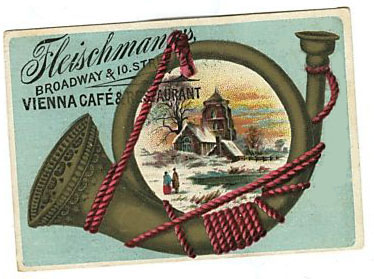
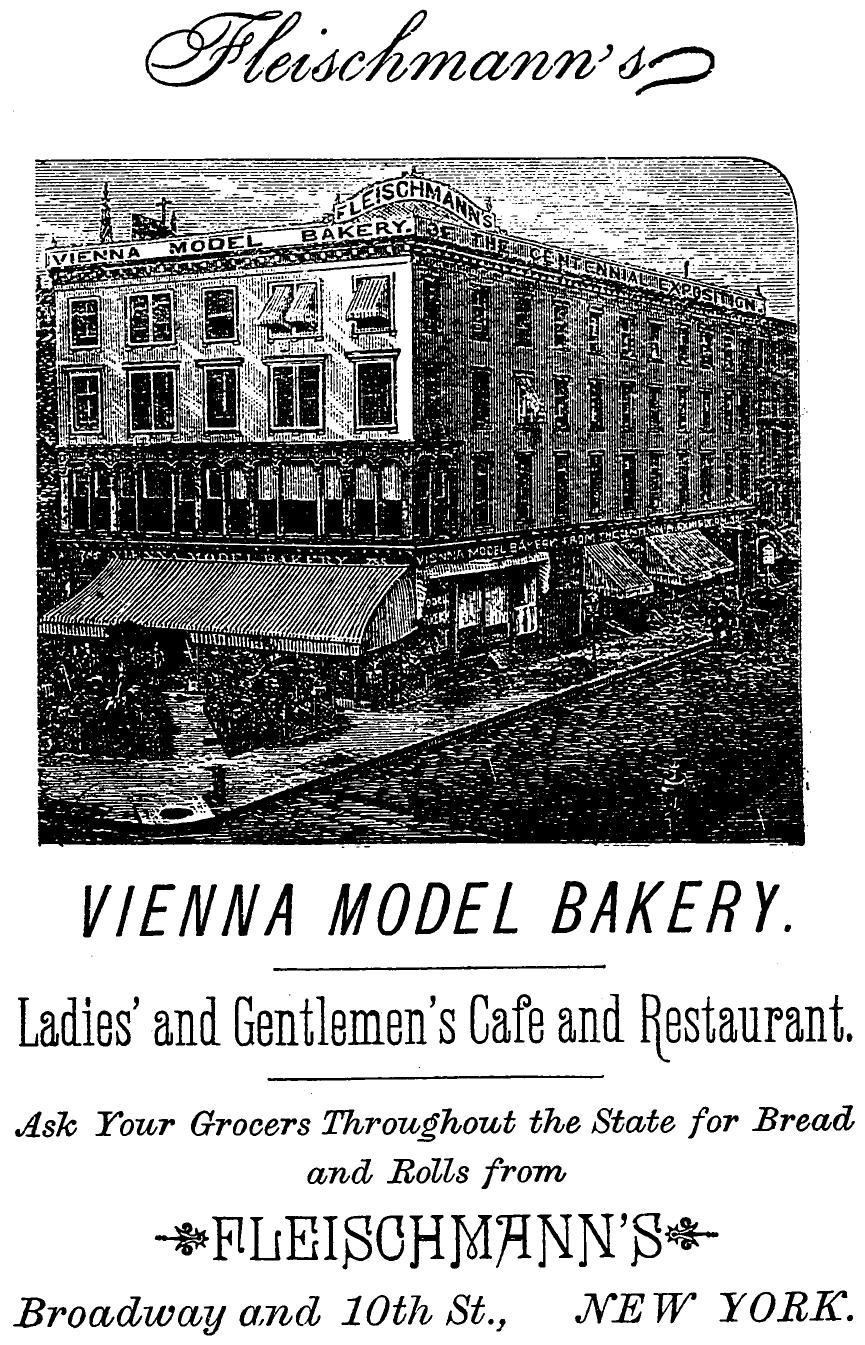
Contemporary bakery restaurant chains such as Au Bon Pain and Panera Bread may have more units but they are scarcely the sensations that Vienna bread cafés were in the 1870s. America was a country that many considered plagued with inferior bread, whether commercial or home baked. The Fleischmann brothers, Charles, Maximillian, and Louis, were determined to improve American bread with their compressed yeast. Although they manufactured it as early as 1872 – as a byproduct of distilled spirits (another Fleischmann enterprise) – its fame was established at the 1876 Centennial Exposition in Philadelphia. There the crusty Vienna-style bread produced with Fleischmann’s yeast won a prize for excellence and attained international renown. Although the fair’s Vienna Model Bakery café which served this bread was intended mainly to showcase the baked goods that could be made with the company’s yeast, it became a runaway hit in its own right. Some said the bakery café’s fame was as great as the fair itself.

A short time after the Centennial ended, Vienna Model Bakeries and cafés were opened in Philadelphia, New York City, San Francisco, St. Louis, and Chicago, very likely making this the country’s first restaurant chain. The cafés, whose coffee was as prized as their baked goods, were modeled on European coffee houses and furnished guests with comfortable seating and newspapers from all over the world. The St. Louis branch was so popular it had to move to larger quarters within months of opening. In Chicago, as in New York City, the cafes were located close to the cities’ major dry goods firms, Field & Leiter and A. T. Stewart, respectively, thereby attracting women customers as well as men. In the 1880s New Yorkers could enjoy their refreshments outdoors amidst planters of flowers under a large awning stretching in front of the 10th and Broadway café, which also had a full-scale restaurant on the second floor.

Another distinction of the Manhattan Fleischmann’s was its practice of giving away bread to anyone who would wait in line at midnight. Dubbed “the bread line,” it continued until around 1918 when the bakery café closed.

© Jan Whitaker, 2008
4 Comments

Filed under chain restaurants

When ladies lunched: Schrafft’s

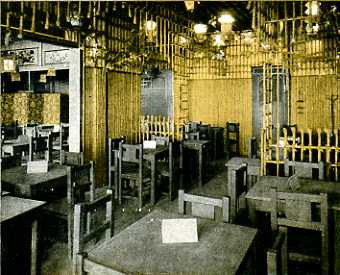
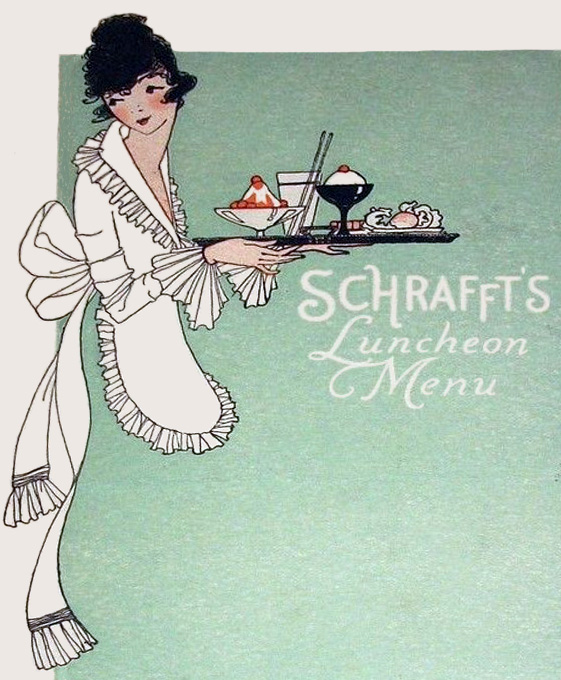
Schrafft’s began as a candy manufacturer in Boston but over time morphed into a well-known restaurant chain. In 1898 Frank G. Shattuck, a salesman for the Schrafft company from upstate New York, opened a candy store at Broadway and 36th in New York. His sister, Jane Shattuck, was largely responsible for the introduction of light lunches into the stores. The first to serve food was the Syracuse store in 1906 where a “Japanese Tea Room” (shown here) was boldly advertised as “the daintiest luncheon spot in all the State.” By 1909 Jane also introduced meals to the second NYC Schrafft’s, at 54 West 23rd Street in the heart of a thriving shopping district. By 1927, when there were 25 units, most located in NYC, the Wall Street Journal estimated that around 75% of Shattuck’s business was in the restaurant trade, with the rest candy-related.

schrafft's1920Schrafft’s was known for reproducing an air of gentility typical of the upper middle-class WASP home. Cooks, supervisors, and even some executives were women. Menus of the 1920s and 1930s included many salads, more desserts than entrees, and non-restaurant-y vegetable selections such as creamed cauliflower and fried eggplant. Frank claimed Schrafft’s cuisine was inspired by his mother’s cooking. Repeated efforts to overcome connotations of a “women’s restaurant” and attract men met with disappointing results despite customers such as James Beard. Women dominated even after some units began to serve cocktails in 1934.

Rent cuts in the depression encouraged chain expansion and by 1937, when Frank died, there were 43 Schrafft’s, most in metro NYC but a few in Boston and Philadelphia. At its peak there were about 50 units in greater NYC. In 1961 the chain played briefly with the idea of selling frozen dinners on the roadside. In the late 1960s the Schrafft’s candy company was sold to Helme Products while Pet, Inc. took over the restaurants. Pet made a renewed effort to renovate Schrafft’s image and attract men. At the Fifth Ave location (between 45th & 46th) the soda fountain was removed and a bar installed. The second floor, men-only dining room was given dark wood paneling, zebra-stripe carpeting, and named “The Male Animal.” The 1970s saw confusion as a Schrafft’s opened in Los Angeles (sporting a Chinese room and an Elizabethan room), new ownership took control, and numerous NYC locations were shut down. In 1981 the candy company ceased while the few restaurants remaining were in various hands.

© Jan Whitaker, 2008

147 Comments

Filed under chain restaurants, tea shops, women

Taste of a decade: 1960s restaurants

Americans grew wealthier, traveled more, and demanded more exotic cuisine. Yet there were few trained restaurant cooks. Convenience food – in the guise of continental dishes (as in pineapple = Hawaiian) – offered the solution for many restaurants as the decade wore on. In other developments, old restaurant formats such as automats, diners, cafeterias, and drive-ins disappeared or shrank drastically in numbers. Fast food and dinner house chains, relatively scarce at the beginning of the decade, flourished by its end. Black Americans began to make headway in gaining civil rights in restaurants. By the middle of the decade signs of the counterculture could be seen here and there.

Highlights

1960 New Armour & Co. boiling bags filled with beef burgundy, lobster Newburg, and coq au vin mean that “Every drive-in can now be a Twenty-One Club, every restaurant a Maxim’s de Paris,” according to a trade mag. – In Columbus Ohio the opening of the Kahiki adds to the Polynesian restaurant boom, while in NYC La Fonda del Sol opens, offering exotica such as Empanadas, Grilled Peruvian Tidbits on Skewers, and Papaya Filled with Fresh Fruits.

1961 In Sherman Oaks the Wild Goose adds four dishes to its menu: Boned Pheasant Chicken Kahlua, Veal Cutlet Oskar, Fresh Gulf Shrimp Stroganoff, and Breast of Chicken Kiev. – Four-star Lutèce opens in New York, one year after La Caravelle.

1962 A café in Sioux Falls announces “microwave cooking,” while in New York’s Time Square a restaurant opens featuring frozen entrees which the customer is to pop into a tabletop microwave. – A new product for restaurants comes on the market: instant mouthwash in a sealed paper cup to be presented to customers after they eat heavily spiced dishes.

1964 Continental and Polynesian restaurants find they must add steak to their offerings. – Kelly’s steak house in Sherman Oaks announces it sold approximately 400,000 pounds of steak in the past year.

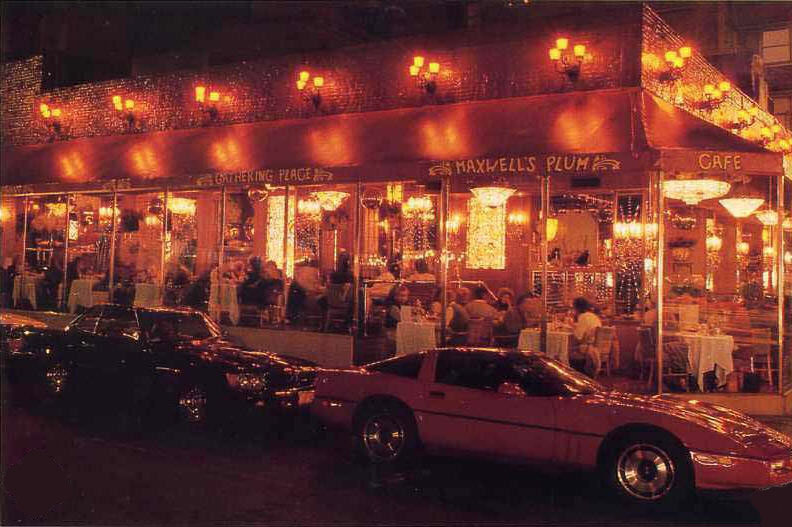
1965 Maxwell’s Plum opens in NYC with an eclectic menu that ranges from Pâté and Escargots Bourguignonne to a Foot-long Hot Dog with Chili. Rumors spread of a naked woman seen walking casually through the dining room. — Extra-thick Frymaster Jet Griddles are marketed to keep cooking temperatures stable even when “completely loaded with frozen food.” – Aggressively cheerful California-style coffee shops, which combine the features of drive-ins, coffee shops, dinner houses, and cocktail bars, spread across the country.

1966 After touring the US, a wine expert says that he believes 99% of licensed restaurants have no interest in promoting wine. He reports that not once did a server ask if he’d like wine with his dinner. Instead they asked if he wanted a cocktail, followed by “Coffee now or later?” – Alice Brock opens The Back Room in Stockbridge MA which will be made famous by Arlo Guthrie as “Alice’s Restaurant.”

1967 Students at the University of Washington, Seattle, boycott Aggie’s Restaurant because they believe it discriminates against students, especially if they are dressed in “funny clothes,” following an incident involving a long-haired “fringie.” – The adoption of frozen convenience foods increases in restaurants after passage of the Minimum Wage Act which raises kitchen workers’ pay.

1968 Countering the fast food trend, the menu at the Trident in Sausalito advises its patrons to be patient: “Welcome to Our Space. Positive energy projection is the trip. … Care in the preparation of food requires time especially if we’re busy! So please take a deep breath, relax and dig on the love & artistry about you. May all our offerings please you. Peace within you.” – In Fayetteville, Arkansas, a diner declares he is tired of an “unrelieved diet of chili dogs and waffle fries” and bemoans the lack of any “quality dining establishments.”

1969 The Scarlet Monk in Oakland advertises a “Topless Luncheon” Monday through Friday. – In Chicago, menu language has become more sophisticated, according to linguistic researchers. They report: “Du jour is an accepted form on menus and appears more often than of the day. Anything – pie, potatoes, sherbet, cake, pudding – can be du jour (or de jour, du jor, dujour, and du-jour), and the Florentine Room even has … potato del giorno.”

Read about other decades: 1800 to 1810; 1810 to 1820; 1820 to 1830; 1860 to 1870; 1890 to 1900; 1900 to 1910; 1920 to 1930; 1930 to 1940; 1940 to 1950; 1950 to 1960; 1970 to 1980

© Jan Whitaker, 2008

50 Comments

Filed under miscellaneous

Department store restaurants: Wanamaker’s


Until very recently I thought John Wanamaker’s in Philadelphia had the first in-store restaurant in the U.S. Several scholars have insisted this is true, with the exception of a Macy’s historian who claimed R. H. Macy was first, in May 1878. Wanamaker’s, I’ve discovered, did not install eating facilities until September of 1879 when it enticed a local caterer, Alice Weldon, to run her restaurant inside The Grand Depot, as the store was known then. Weldon, a confectioner born in Ireland, operated a popular oyster-plus-ice-cream café near the store (it sounds like an odd combination but such places were once common). Every day all the shoppers would vacate the store to go eat at Alice’s, so Wanamaker reasoned he had to have her on his side. For about six years she ran the forerunner of The Dairy, an eatery the store created in 1883, one year after installing a soda fountain (another department store first claimed by Wanamaker’s).

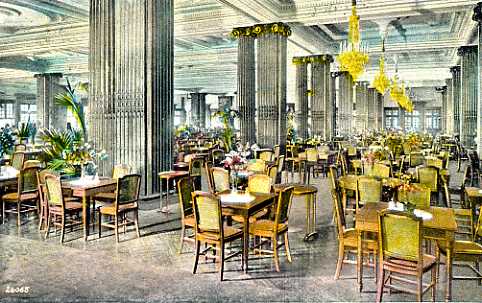
The better known restaurant in the Philadelphia store was the Grand Crystal Tea Room which opened on the 8th floor of the new Wanamaker’s completed in 1911. Immense and filled with chandeliers, it was modeled on the tea room in the Philadelphia mansion of Robert Morris, a financier of the American Revolution. Also on the 8th floor, speedily reached by 24 direct-service elevators, were a number of private dining rooms, a men-only tea room, and the store’s ultra-modern kitchens. The Grand Crystal Tea Room survived the demise of Wanamaker’s and the tenure of its successor but finally closed in 1995 and is now a private banquet hall.

The New York City Wanamaker’s, opened in 1896 in the old A. T. Stewart store and closed in 1954, was also well supplied with esteemed eating places. A 1900 menu shows a full complement of delectable lunch choices, including blue points, cream of new asparagus soup, and lamb with mint sauce. The store’s tea room advertised ca. 1908 that its tea was “specially imported,” and prided itself on its “quaint service.” In 1940 the store operated three eating places on the 9th floor: the main restaurant, Green Shutters; a more casual Side Walk Café; and a Men’s Grill decorated with antique French tapestries.

© Jan Whitaker, 2008
25 Comments

Filed under department stores, tea shops

Women as culinary professionals

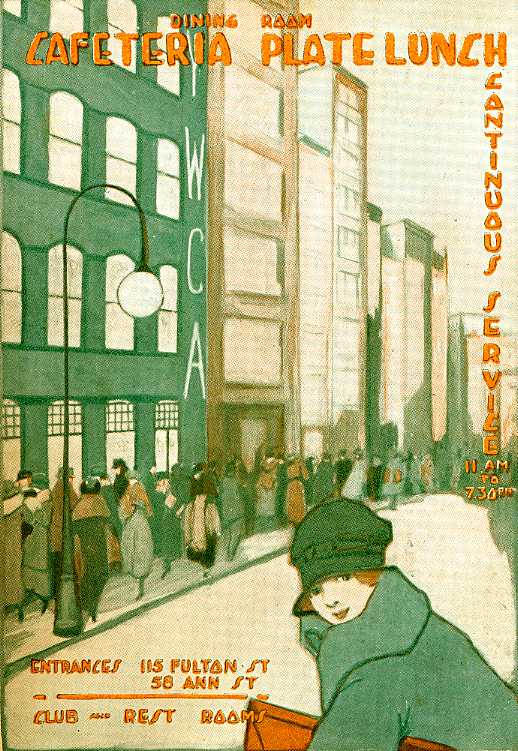
Women were the first to obtain professional training in the culinary trades from American institutions. However, because their training took place in college “domestic science” (home economics) programs it tends to be omitted in discussions of the development of culinary schools (most of which originated after World War II). Another important source of women’s formal training was the Y.W.C.A. So well respected was the “Y” for food service training that a large restaurant chain sent its managers to a New York branch in 1914 to study efficiency methods.

Throughout the last two centuries, most of the professionally trained people who owned, managed, cooked, and served in restaurants were born in Europe and learned their trades there. Native-born restaurant managers and workers, by contrast, tended to have no culinary backgrounds whatsoever unless they had cooked in their own homes or those of others. Exceptions included some women who had gained experience as housekeepers and many ex-slaves who had learned the culinary arts in the “employ” of rich Southern planters.

By the end of the 19th century, and especially in the early 20th, domestic science programs in colleges and universities began to train women in quantity cooking, nutrition, and the management of large-scale dining facilities, both commercial and institutional. Women were the first college-educated personnel to enter the restaurant and hospitality field, with degrees from Pratt Institute, the University of Chicago, Simmons College, Michigan State, the University of Wisconsin, and others.

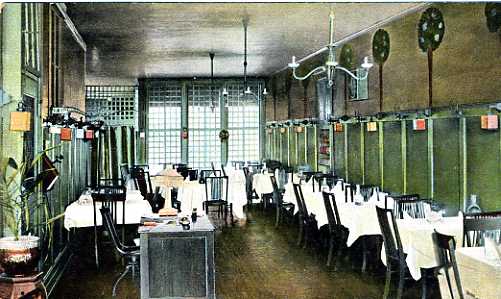
Although many graduates went on to head hospital and school food service operations, quite a number took over department store restaurants or opened their own places. An early, ca. 1896, graduate of a program at the Armour Institute in Chicago (later the Illinois Institute of Technology) was Ida Foster Cronk, catering director and manager of the Coffee House at Jane Addams’s Hull House. In 1900 Cronk left the settlement house to open her own Ristorante Roma in Chicago’s Loop, shown here ca. 1906.

© Jan Whitaker, 2008

2 Comments

Filed under women

Basic fare: fried chicken

Actually chicken, however it was prepared, was not so basic until well into the 20th century. Only then were poultry raising and marketing streamlined to produce the tender, year-round, low-cost product which made chain restaurants such as Kentucky Fried Chicken and Chicken Delight feasible. Until after World War II chicken was not terribly popular in most restaurants, often being rather expensive yet tough and stringy.

The chicken found on the menus of most American eating places of the 18th and 19th centuries was not fried, but roasted, boiled, or broiled. Fried chicken seemed to be limited to the South for many decades. The first instance of fried chicken in a restaurant that I have found occurred at the 1876 Centennial fair in Philadelphia where one of the concessions specialized in Southern dishes such as fried chicken and hominy. Despite this, fried chicken did not catch on in restaurants for some time. It could be found mainly in small, down-home style cafés run and patronized by Afro-Americans. An example in the 1890s was a small cabin called the Café Du Chat Noir in Washington, D.C., run by a former slave who went by the name Madame Early. A bit later, in San Francisco, a black restaurant provided possum and yams in season, corn pone, watermelon and chicken, fried, boiled, or roasted. Another type of early 20th-century fried chicken venue was the Chinese restaurant.

The third kind of eating place that made a specialty of fried chicken was the country tea room. In fact chicken of all kinds – fried, in salads, or creamed on waffles – dominated tea room menus. It’s likely that the substantial increase of women restaurant patrons in the 20th century, tea rooms’ main clientele, was behind the rise in chicken’s popularity. Restaurateurs often noted that while men preferred steak, women favored chicken. Taking the family for a Sunday automobile ride into the countryside for a fried chicken dinner at a tea room or family-style inn was a major form of entertainment for millions of Americans well into the 1950s.

The reason that fried chicken became popular primarily in out-of-the-way places, whether Afro-American, Chinese, or tea rooms, may have been due to these places having access to freshly killed chickens at a time when so much poultry served in restaurants had been ruined by long stays in cold storage. Cold storage chicken –- i.e., frozen — so dominated the market that in 1909 California law required restaurants to inform patrons if their chicken came from that source. On the other hand, restaurants run by blacks and Chinese often kept live chickens in cages, while rural tea rooms had local suppliers.

© Jan Whitaker, 2008

Leave a comment

Filed under food

Chain restaurants: beans and bible verses

Although the restaurants run by Alfred W. Dennett in the 1880s and 1890s were popular and earned him a cool million in just a few years, some people took a strong dislike to them because of the framed bible quotations which covered the walls. Newspapers regularly ridiculed them, noting for instance that burglars who cracked the safe at the Park Avenue Dennett’s in New York City did so right under a sign that read, “Be ye strong, therefore, and let not your hands be weak, for your work shall be rewarded.” But no one took such a negative position against the Northeastern coffee/dairy/beans & fishcakes-based chain as did Terrence Powderly, head of the Knights of Labor. In a talk in Brooklyn he offended some audience members when he declared, “I, temperance man as I am, would go into the lowest rumhole in the city, and get blind, rolling drunk, rather than go into that restaurant where they have such signs as ‘Love Thy Neighbor as Thyself,’ to get a cup of coffee.”

Founder Dennett, born in 1840 the son of a storekeeper in Topsham, Maine, was a zealous religious believer and temperance advocate who required his waitresses to attend daily prayer services and took a leading role in citizen vice squads. In New York City he disguised himself — as streetcar conductor, laborer, or man about town — to conduct surveillance and collect evidence against suspected sites of immorality. He gave away his fortune to charity, was forced out of his company by stockholders, and had numerous mental breakdowns, culminating in a declaration of insanity after being found wandering the streets of San Francisco with a pillowcase over his head. When the Childs brothers took over the chain in 1900 evidently they retained the Dennett’s name and left the bible verses on the walls. The chain of about 16 outlets continued until at least 1912.

At various times Dennett and his son George tried for a comeback on the West Coast, operating several places in San Francisco and Los Angeles in the early 20th century (and possibly earlier) but they did not succeed and some of the San Francisco locations were taken over by the Puritan restaurant chain, which continued in a religious vein under the management of the appropriately named Mr. Goodbody.

© Jan Whitaker, 2008

2 Comments

Filed under chain restaurants, Offbeat places

Eating kosher

It is impossible to say when the first kosher restaurant appeared in the United States. Jews were among the earliest settlers and it’s likely they established restaurants at the same rate as other ethnic groups, so there may have been inns and taverns following Jewish dietary laws as early as the 17th century. (Of course not all Jewish-run restaurants kept kosher.) By the 1860s, nearly a million Jews lived in Brooklyn and New York City. At least 50 restaurants catered to them particularly, though patronage included non-Jews as well. Among the restaurants chartered to operate at the Centennial in Philadelphia in 1876 was The Hebrew Restaurant run by a Charles Collman of Philadelphia.

Although New York’s lower East Side Jewish population included Austrians, Russians, Poles and Lithuanians in the 1880s, Rumanians kept many of the restaurants there. By 1901, the American Jewish Year Book estimated that there were at least “one hundred and fifty restaurants, two hundred wine-cellars, with lunch rooms attached, and about thirty coffee-houses kept by Rumanian Jews.” Late into the night their patrons would engage in passionate discussions of politics and the arts and the names Marx, Tolstoy, and Ibsen were sure to be heard.

New York was the largest center of Jewish life, but not the only one. All cities had their Jewish enclaves and cafés. In 1901 in Pittsburgh, the Hotel Sablodowsky ran a kosher delicatessen where they served “Everything Fresh, Imported and Clean. Smoked Tongue, Cured Beef, Summer Sausage, Servelot, Imported Cheeses of all kinds. Holland Herrings, Pickles, Olives, Etc.” In McKeesport, Pennsylvania, Max Schwartz’s Café Liberty provided “Strictly Kosher Meals.” Restaurants in Chicago’s Jewish neighborhoods around 1908 reportedly served a dish known as “Jewish chop suey” containing various vegetables, spices, and sour cream.

Notable and well-known historic Jewish restaurants are too numerous to list, but a few striking examples include the NY kosher restaurant on West 35th kept by Hyman Trotzky, brother of Leon*; Reuben’s, grown into a celebrity haunt from, in Arnold Reuben’s own words, a “shtoonky delicatessen store;” Chicago’s Gold’s; and Al Levy’s in Los Angeles.

* Was Hyman really Leon’s brother? My source said yes, but a reader’s research casts this in doubt.

© Jan Whitaker, 2008

Leave a comment

Filed under kosher

Restaurateurs: Alice Foote MacDougall

Alice, shown in this 1929 book frontispiece at least 20 years younger than her true age at the time, was one of the most carefully crafted restaurant personas of her day. Due to numerous magazine stories spun by her publicity agent, she was widely known as the poor widow with three children who built a coffee wholesaling and restaurant empire on $38. Even she had to admit (or was this PR also?) that the story was overplayed. “How tired I did get of that woman and those interminable three!” she confessed. Quite honestly, I’ve always felt her much-vaunted opposition to suffrage for women was a publicity stunt too.

She was from a distinguished New York City family. Her great grandfather, Stephen Allen, was mayor of New York City in the 1820s, while her wealthy father Emerson Foote was a charter member of the Union League. Alice, her daughter, and her two sons were listed in the city’s Social Register in 1918. Her career in the coffee wholesaling business began in 1909 with the death of her husband Allan MacDougall. In the 1920s she was said to be the only woman expert in coffee grading and blending in the U.S.

She opened her first eating place, The Little Coffee Shop, in Grand Central Station in New York in December 1919. Waffles were the specialty in her homey café which was decorated with a plate rail and shelves holding decorative china. (Evidently tips were good, because MacDougall had the nerve to charge her waitresses $10 a day to work there.) By 1927 she had signed a $1 million lease for her fifth coffee house, Sevillia, at West Fifty-seventh Street. Her places became known for their Italian-Spanish scene setting. The reason, she said, was that it provided a way to disguise long, narrow spaces, as was clearly the case with the Cortile (shown here).

At Firenze, reputedly used as a movie set, she dressed her black servers like Italian peasants in bright uniforms and head scarves and had them go about filling copper jugs with water from a stone well. Tables were set with imported pottery which she sold as well, along with her Bowling Green Coffee. The Mediterranean village style mimicking courtyard interiors became wildly popular throughout the U.S. in the 1920s and countless women were inspired by MacDougall to open tea and coffee shops of their own. The chain went bankrupt in the depression and new management took over for a time, lowering prices and adding cocktails to the menu.

© Jan Whitaker, 2008

9 Comments

Filed under tea shops, women

Drinking rum, eating Cantonese

Will the real Don the Beachcomber please stand up and mix me a Zombie? As is true with so many business histories it’s difficult to lock down the true story. Confusion in the case of Don the Beachcomber mainly arises from a divorce between the principals, Don (or Donn) Beach (born Ernest Beaumont-Gantt) and his one-time wife Cora Irene Sund. Both were involved in the development of the original Don the Beachcomber, begun in 1934 as a bar serving exotic drinks in Hollywood, California. Cora, a Minnesota schoolteacher turned model, arrived on the scene shortly after Don launched his business. She invested in it and became president, while Don acted as general manager. She focused on the food side of things, hiring a Cantonese chef and expanding the bar into a restaurant with “South Seas” cuisine. They married in 1937 and divorced in 1940, the year Cora opened a branch in Chicago. When Don came back from the Air Force after WWII they split up as business partners, she keeping the mainland operations while he concentrated on Hawaii.

According to Vic Bergeron, creator of Trader Vic’s, Don the Beachcomber provided his inspiration for transforming his Oakland CA bar and sandwich spot Hinky Dink’s into a Polynesian restaurant in 1938.

beachcombertrunkDon ran into trouble with the postwar longshoremen’s strike and decided to limit his Honolulu Beachcomber to a drinking spot. By the early 1960s he was also in the restaurant business, operating a South Seas Cabaret Restaurant, a Colonel’s Plantation Steak House, a Colonel’s Coffee House, and at least one restaurant boat. Cora’s popular Chicago Don the Beachcomber was named one of the top 50 US restaurants in 1947. She soon opened another location in Palm Springs and by 1972, when it was acquired by Getty Financial, the chain had 6 or 7 units.

The greatest growth occurred under Getty management, eventually building the chain to a total of 16. An architect gave the Beachcombers a new look. The interior of the new 1973 Dallas Beachcomber, like others to follow, featured a full array of tropical effects such as a bridge over a reflecting pool, a waterfall, rain forest, thatched roofs, palm trees, and outrigger canoes suspended from a firefly-studded ceiling. But the public’s love affair with Polynesian restaurants began to fade and by 1989 only three Don the Beachcombers remained.

© Jan Whitaker, 2008

3 Comments

Filed under Polynesian restaurants