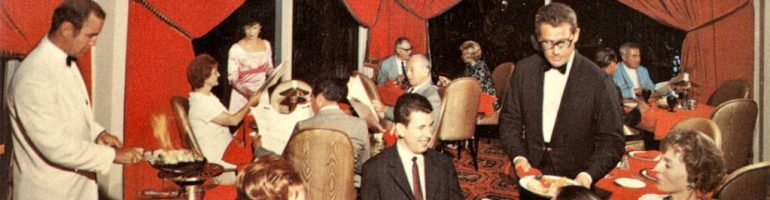
 What could be more starkly different from the somber coffee shops of today with their earnest and wired denizens than the beatnik coffeehouses of the 1950s? Could Starbucks be anything but square to the beat generation?
The classic coffeehouses of the beatnik era were sites for conversation, poetry readings, folk music, improvisational jazz, stand-up comedy à la Mort Sahl, and experimental theater. In an era driven by the conformist quest for success and button-down normalcy they sheltered misfits, art, and European culture in settings decorated in moody “opium-den style” or stained-glass/marble/wrought iron “junkyard posh” assembled from the detritus of American cities then being dismantled.
Along with beats, coffeehouses were attractive to teens as well as curiosity seekers and wannabees. (See Dupo IL high school coffeehouse photo.) Authorities had an almost obsessive dislike of coffeehouses and their patrons. Even church basement coffeehouses came under attack. A John Birch Society member lectured youths at a YMCA coffeehouse in a Chicago suburb about how dissolute their gathering place was (“You can’t tell the difference between boys and girls”).
 Although the word beatnik came into usage around 1958 (inspired partly by Sputnik), the phenomenon of dropping out of the “rat race” to lead an existentialist, non-consumerist life was part of the aftermath of World War II akin to the “Lost Generation” after World War I. The first coffeehouses sprang up in Greenwich Village in the late 1940s, but the beats weren’t averse to hanging out in cafeterias either — their “Paris sidewalk restaurant thing of the time.” When coffeehouses began levying cover charges for performances, beatniks tended to drop out of them too.
 The heyday of the coffeehouse was the late 1950s into the early 1960s. Few did much cooking so they weren’t restaurants in the true sense, but many of them offered light food such as salami sandwiches (on exotic Italian bread) and cheesecake, along with “Espresso Romano,” the most expensive coffee ever seen in the U.S. up til then. Of course the charge for coffee was more a rent payment than anything else since patrons sat around for hours while consuming very little. Other then-unfamiliar food offerings included cannolis at La Gabbia (The Birdcage) in Queens, Swiss cuisine at Alberto’s in Westwood CA, Irish stew at Coffee ’n’ Confusion in D.C., les fromages at Café Oblique in Chicago, “Suffering Bastard Sundaes” at The Bizarre in Greenwich Village, and snacks such as chocolate-covered ants and caterpillars at the Green Spider in Denver.
 Coffeehouses went in for oddball names such as above and also the Hungry i in San Francisco, Cosmo Alley in Hollywood, Fickle Pickle and College of Complexes in Chicago, The Cup of Socrates in Detroit, Café Wha in Greenwich Village, House of Fencing Masters in New Orleans, Laughing Buddha in St. Louis’s Gaslight Square, and Café Mediterraneum in Berkeley.
© Jan Whitaker, 2009
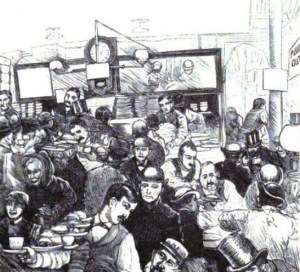 As the decade starts there are over 19,000 restaurant keepers, a number overshadowed by more than 71,000 saloon keepers, many of whom also serve food for free or at nominal cost. The institution of the “free lunch” has become so well entrenched that an industry develops to supply saloons with prepared food. As big cities grow, the number of restaurants swells, with most located in New York, Pennsylvania, Illinois, Massachusetts, and the Midwest where young single workers live in rooming houses that do not provide meals. Southern states and the thinly populated West, apart from California, have few restaurants.
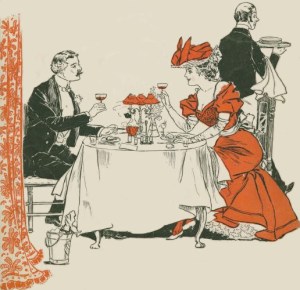 Near the decade’s end, the “Gay 90s” commence and those who are able and so inclined pursue the good life, which increasingly includes going to restaurants for the evening. It is still considered somewhat disreputable to do this, so some people go out to dinner only when visiting another city.
 1893 A drunken man fires five shots into
 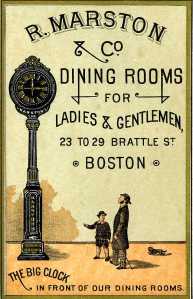 1895 Competition from cafés and restaurants in Massachusetts has just about wiped out the old boarding houses where renters had all their meals supplied. One reason is that people prefer restaurants because they get to choose what and when they eat. – Boston’s Marston restaurant, established by sea captain Russell Marston in the 1840s, opens a women’s lunch room on Hanover Street.
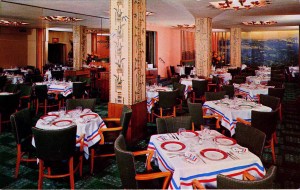 Where could you — once upon a time – enjoy European pastries, cinnamon toast, and ice cream soda while you hugged a teddy bear? Rumpelmayer’s, of course. A very popular rendezvous for pampered New York children after a visit to the zoo or the ballet. I suppose adults could hug the bears too, but Rumpelmayer’s sweetness – its confections, pink walls, and shelves of stuffed toys — might close in on you if you didn’t hold fast to some grown-up habits such as cigarettes and highballs.
 Rumpelmayer’s tea and pastry café began its Manhattan life in 1930 in the new Hotel St. Moritz on the corner of Central Park South and Sixth Avenue. The hotel almost immediately went into foreclosure though it continued in business. Oh, happy day when Repeal commenced in December of 1933 and the St. Moritz announced, “In Rumpelmayer’s, as in the Grill, we will feature a number of bartenders with Perambulating Bars, for serving mixed drinks.” Bars might be everywhere, but Rumpelmayer’s other attractions were not. For decades it provided a jolly spot for children’s birthday parties, lunches, late Sunday breakfasts, and afternoon teas and hot chocolates. It closed around 1998.
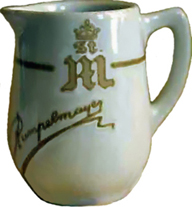 Always proud of its continental delicacies, New York’s Rumpelmayer’s was related (exactly how I’m not sure) to sister tea shops in London, Paris, and on the Riviera. The original Rumpelmayer’s was begun by an Austrian pastry cook in the German resort town of Baden-Baden in the last quarter of the nineteenth century. It then followed its Russian clientele to Cannes and Nice, then later to Mentone and Monte Carlo. In 1903 a shop was opened on Paris’s Rue de Rivoli (pictured, somewhat later) and in 1907 on St. James Street in London. Parisians, infected by Anglomania in the early 20th century, eagerly adopted the afternoon tea custom, in this case reputedly known as having a feeve o’clock-air at “Rumpie’s.” Though it was rated slightly less chic than the Ritz, it attracted mobs of fashionably dressed women who paraded their outfits up to the counter where, according to custom, they speared their chosen pastries with a fork.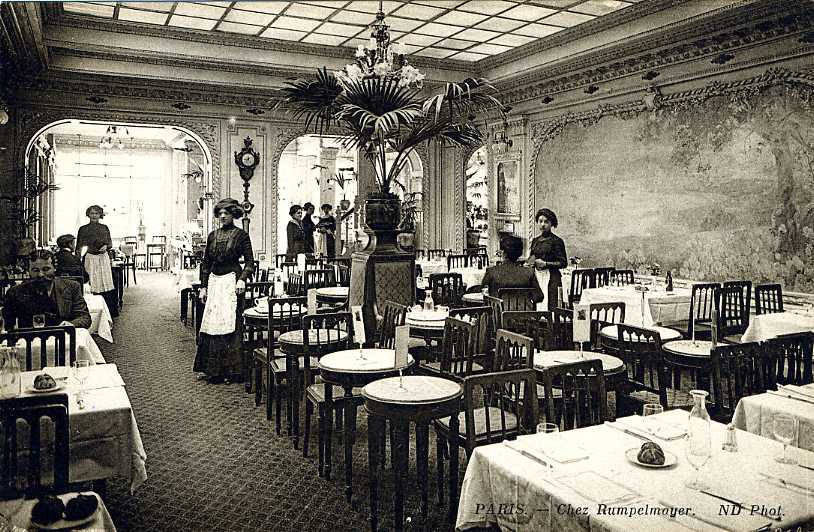
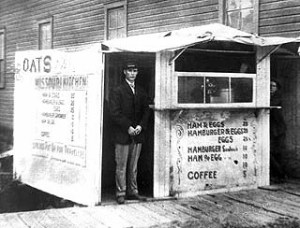 The restaurant business didn’t get much respect until it was sharply disconnected from drinking and put on a business-like footing in the Prohibition era of the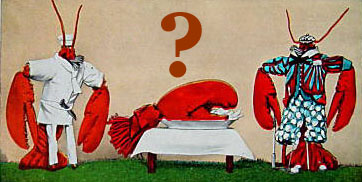
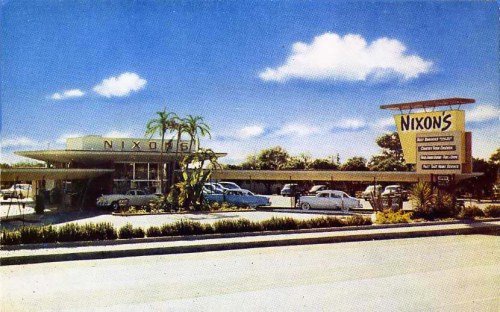 Since the 35th anniversary of Richard M. Nixon’s 1974 resignation from the presidency was commemorated this past weekend, it’s as good a time as any to focus on his brother Donald’s brief career as a restaurateur in Southern California. In the short span of five years in the 1950s, Don managed to go out of business while doing some serious damage to brother Richard’s political fortunes.
 The chain of five Nixon’s restaurants began modestly in 1943 when the Nixon family’s grocery store, established in 1922 by father Francis Nixon in Whittier, added a coffee shop. Although Don was involved in running the coffee shop, his first real business venture took place in 1952 when he opened a drive-in on East Whittier Blvd. (shown above). Two years later he opened Nixon’s Family Restaurant, also on East Whittier, home of the “Nixon Burger” whose unfortunate, opportunistic name would be used to taunt Richard Nixon during his two terms as President. Next Don opened a drive-in near Disneyland, in Anaheim, and a restaurant and bakery in Fullerton. In 1957, despite the Hughes loan and proceeds from the sale of Nixon’s Market to a supermarket chain, Don Nixon put all five restaurants up for sale to settle the chain’s debts.
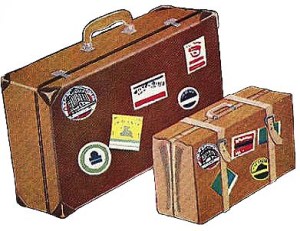 “Become a chef and see the world!” might have been the motto of many of the chefs who came to the United States from Europe in the 19th century. Take Joseph L. Legein, born in Belgium in 1852. He compressed a lot of traveling into his young working life. His biography could be used as a recipe for a colorful culinary career. Did he ever imagine he would end up as an ice cream maker in Springfield, Massachusetts?
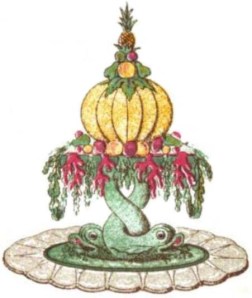 Every chance you get, travel throughout Europe visiting international exhibitions where pièces-montées made by chefs of spun sugar, gum and almond paste are displayed. You will need to make these for centerpieces at formal dinners.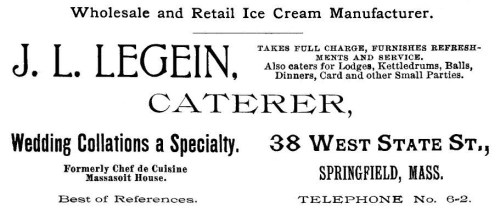
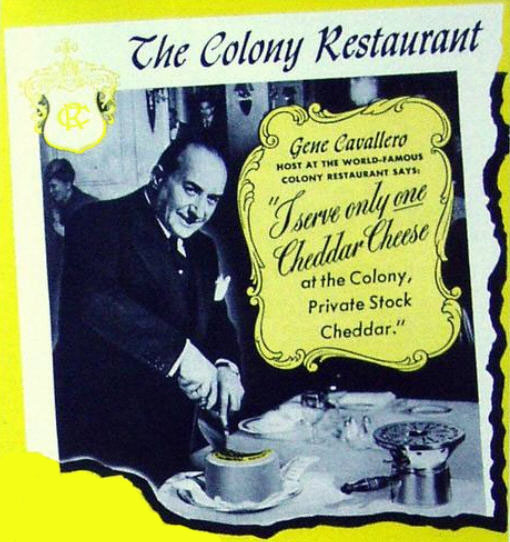
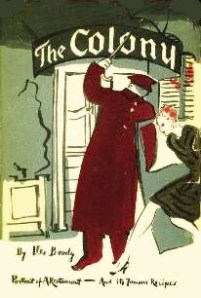 What a pain the rich can be. That’s the message you’ll take away if perchance you pick up The Colony Cookbook by Gene Cavallero Jr. and Ted James, published in 1972. The dedication page is plaintively inscribed by Gene, “To my father and all suffering restaurateurs.” Chapter 3 details what caused the suffering, namely the privileged customers who imposed upon him and his father in so many ways. They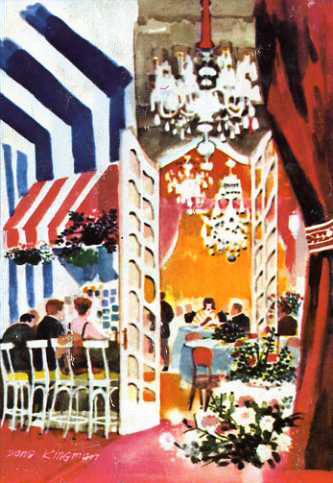
 The London Chop House, Detroit’s 21 Club, enjoyed a ranking as one of the country’s top restaurants in the 1950s, 1960s, and 1970s. James Beard named it as one of the ten best restaurants nationwide in 1961, the same year it won a Darnell Survey award as one of America’s Favorites. It won Holiday magazine awards repeatedly. Honors continued throughout the 1970s, and in 1980 it made Playboy’s top 25 list.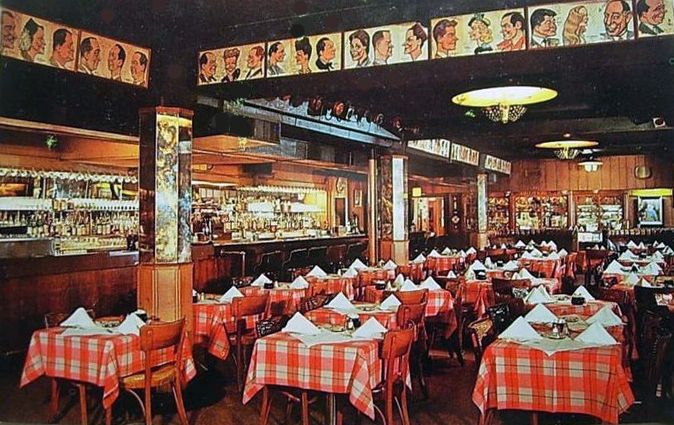
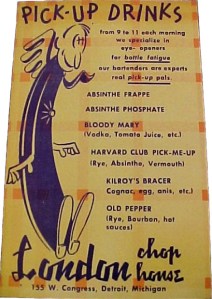 The Grubers were adept at flattering the male ego. When a guest made a reservation, he would arrive to find his table with books of matches and a reserved sign all imprinted with his name, as well as a card with a coin in a slot reimbursing him for his phone call. Alpha types jostled for table #1, while regulars glowed with the knowledge that their suavely jacketed waiter had remembered how many ice cubes they liked in their highballs. To keep up with escalating demand, in 1952 the Grubers opened a second place across the street, the Caucus Club. The 1980s turned out to be a tough decade for the Chop House. Les Gruber sold it in 1982, chef Schmidt left, and the new owner passed away. Despite efforts to keep it afloat, it closed in 1991.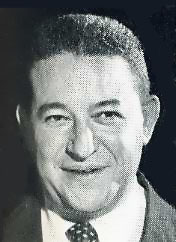
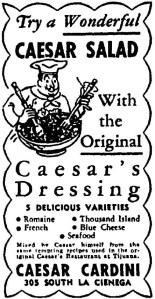 When we get into questions of the origins of certain dishes we have left history behind and entered into the murky depths of lore and legend.
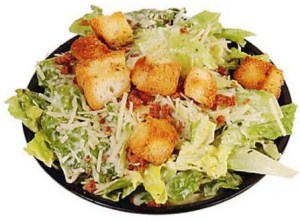 A strong inventorship claim was presented by Caesar’s brother, Alexander, in the 1960s. Caesar died in 1956, while running a grocery store in Los Angeles where he produced and bottled Caesar salad dressing. According to Alexander’s son, who ran Cardini’s in Mexico City, the two brothers had developed the salad together in a Tijuana restaurant in their younger days, improvising on a recipe their mother used when they were boys in Italy. In this “Mother’s recipe” account, the salad was initially called “Aviator’s salad” in honor of their customers who were soldiers, sailors, and airmen.
 It's great to hear from readers and I take time to answer queries. I can't always find what you are looking for, but I do appreciate getting thank yous no matter what the outcome.
 Restaurant-ing through history