Dining in shadows

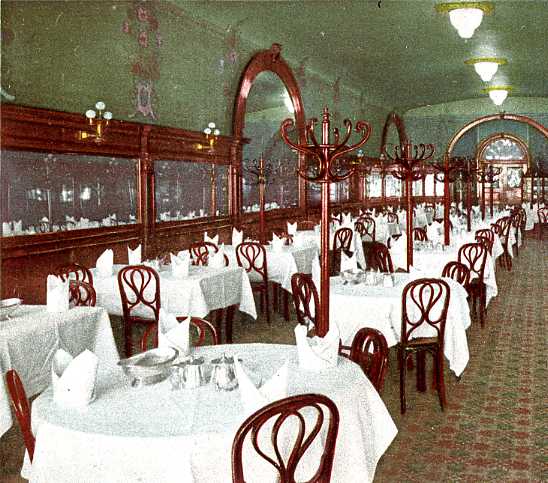
Until electricity became common no one thought dining by candlelight was the least bit romantic. In the later 19th century any restaurant that acquired electricity made a big bragging deal of it. A Chicago restaurant called The New York Kitchen boasted in 1888 that its dining room was “brilliantly lighted by the Mather Incandescent Electric System.” In the early 20th century going places with bright light was fashionable, especially because it turned restaurants into stages on which to be seen and to covertly stare at others.

But there were some ultra-refined people who considered the glare of bright light vulgar. Etiquette expert Emily Holt recommended in1902 that candles be used instead of gas or electric chandeliers for home dinner parties lest the dinner resemble a “blazing feast … in some hotel restaurant.” At that time restaurant patrons who wanted mellow light could choose a place such as Sherry’s in New York where wall sconces gave off gentle illumination and candles topped by artistic shades reposed on each table. So private! So French!

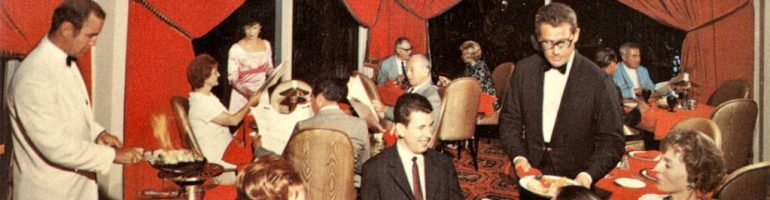
Candlelight promised the gentility of an elite dinner party, far removed from loud music, noise, and guests who drank too much. Candles suited the tea room perfectly. Not only did they shed flattering light, they discouraged the rowdy, fun-seeking masses from entering the door. Tea room owners, overwhelmingly WASPs, also liked how candles, as well as lanterns and fireplaces, created a quaint atmosphere that they imagined resembled how their Colonial ancestors lived.

In Greenwich Village some tea rooms of the 1910s used candles exclusively. The homey Candlestick Tea Room was described as “a little eating place chiefly remarkable for its vegetables and poetesses.” Like other tea rooms lit solely by candles it was undoubtedly atmospheric, but its owners Mrs. Pendington and Mrs. Kunze probably had a more basic reason for using candles. Many of the substandard Village buildings had no electricity. Nonetheless candles did not guarantee respectability. In Chicago, police declared the candle-lit Wind Blew Inn disreputable. A dilapidated, Bohemian student hangout, it had only three candles lighting its two floors.

Outside of Bohemian haunts, though, candles in tea rooms continued to suggest quiet good taste. Alice Foote MacDougall pronounced in her 1929 book The Secret of Successful Restaurants that “Tea time is relaxation time and lights are softened, candles lighted, music plays softly, accompanied by the rippling measure of water falling from our fountains.” She spent the considerable sum of $10,000 a year on candles in her tea rooms. In the 1930s genteel shoppers at Joseph Horne’s in Pittsburgh enjoyed tea and cake by candlelight while listening to organ music in the department store’s tea room.

Today candles are so common in restaurants that they are scarcely noticed, yet as recently as 50 years ago they were considered feminine tools of romantic entrapment. A kind of low-level warfare simmered through the 1950s and early 1960s in which women such as Patricia Murphy of the Candlelight Restaurant in Yonkers announced that wives could save their marriages with candle-lit dinners, while men countered they “liked to see what they were eating.” In 1962 a fire official in Beverly MA said that his ban against candles in restaurants was not motivated by a dislike of dining by candlelight but a need to protect the public from “open flames.” But change was on its way. In the 1970s millions of Americans, male and female, would flock to restaurants where they sipped wine while candles flickered against exposed brick walls.

© Jan Whitaker, 2010
2 Comments

Filed under restaurant customs, restaurant decor

Spotlight on NYC restaurants

This month, at noon on October 27, I will moderate a panel of authors who have written about the history of New York restaurants. The event takes place at the 92nd Street Y in Tribeca (92YTribeca) which is downtown at 200 Hudson Street.

The title of the panel, “Appetite City: The History of New York’s Restaurants,” clearly refers to panelist William Grimes’ book APPETITE CITY: A CULINARY HISTORY OF NEW YORK. Grimes, of the New York Times, was the paper’s restaurant critic from 1999 to 2003. He also curated the New York Public Library’s exhibit of historic menus in the 2002-2003 show “New York Eats Out,” which I was lucky enough to see.

Mark Kurlansky, best-selling author of COD, SALT, and many other books, will also be on the panel. His THE BIG OYSTER discusses oyster cellars and other historic restaurants in New York, while his FOOD OF A YOUNGER LAND also contains essays on restaurants. He will be signing the latter book as well as EDIBLE STORIES, his new novel which should debut in time for the October 27 panel.

David Sax will talk about Jewish delicatessens past and present that he researched and visited when writing his book SAVE THE DELI. His blog of the same name is a lively and humorous spot dedicated to, as he states, “the preservation of the Jewish delicatessen, a hallowed temple of salted and cured meats.”

I’m expecting an enjoyable hour with lots of good discussion, followed by me eating lunch at Café 92YTribeca. Care to join me?

4 Comments

Filed under miscellaneous

L’addition: on tipping

In an interview for the story “What do we tip waiters for?” in the online magazine Salon, Steve Dublanica, author of the blog (and book) Waiter Rant, says that in his experience restaurant patrons, no matter what they may say in surveys, do not actually tip servers based on the quality of service. Rather, there are numerous other factors that influence why and how much they tip, such as social convention, mood, guilt, shame, or who knows what.

The subject of tipping is, in my opinion, a fascinating one with endless dimensions. There are so many wrinkles in this aspect of the server-patron relationship that I’ve tumbled upon in researching restaurant history that I find it hard to put it all together into a coherent post. So, for now, I’ll skip that and simply comment on one of Steve’s suggestions for how servers can influence the size of their tip. He recommends concentrating on cultivating regular customers: “You remember their favorite wine, their anniversary, their favorite table. You make them feel special so they’ll feel loyal …”

Good advice. But it reminds me of one of cruder methods (“dodges”) servers used to employ in the 19th century to curry favor with regular customers — one that the restaurant industry has done its best to stamp out but that undoubtedly still goes on in places that have lax checking systems. It is to give selected patrons more or better food than they ordered – a porterhouse rather than a sirloin – while charging them for the cheaper item. The customer still comes out ahead even after rewarding the server with an extra-large tip.

As early as the 1880s management tried to head off the game by installing a spy box (sometimes occupied by the restaurateur’s wife) in the pickup area of the kitchen, or by stationing a checker at the door to the dining room to see and record exactly what the server was delivering to the customer. Of course these tactics didn’t really work.

© Jan Whitaker, 2010
Leave a comment

Filed under restaurant customs

Taste of a decade: 1870s restaurants

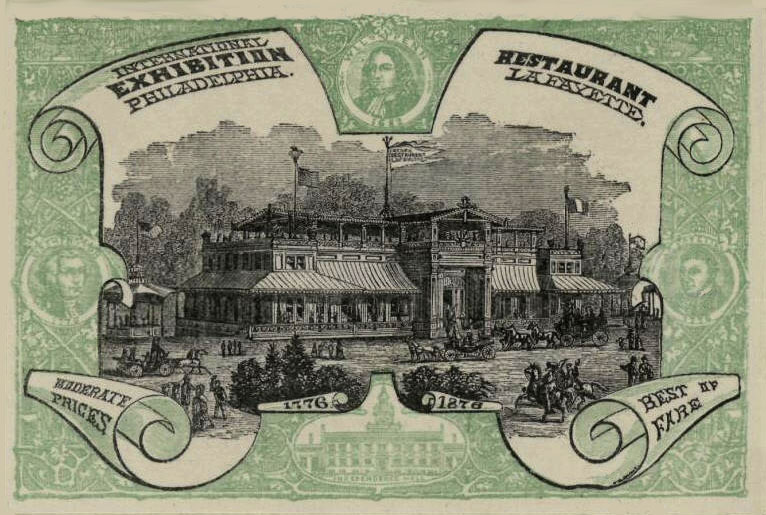
Marked by a deep Depression with high rates of unemployment and business failure, the destruction of Chicago by fire, and the world’s most popular international fair to date, the 1870s are a tumultuous time for the burgeoning restaurant trade. On the one hand many restaurants fail, yet the field widens as new types and markets emerge. Despite a 14% unemployment rate, the appeal of dining out grows as many of the nearly 10 million visitors to Philadelphia’s Centennial Exposition experience restaurants for the first time. Some of the fair’s restaurants set up permanent businesses when it ends.

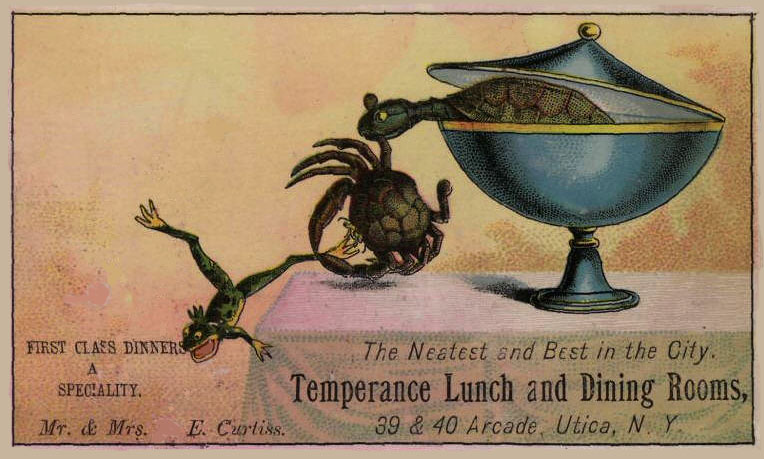
The temperance movement introduces innovation with cheap coffee houses that demonstrate how to serve the masses on a strict budget without profits from alcoholic drinks. Under financial pressure American-plan hotels, which formerly provided limitless amounts of food with the price of a room, shut down their dining rooms, expanding the number of customers for outside restaurants. Better restaurants open special rooms and sections for unescorted women in response to growing demand. A Civil Rights Act is passed in 1875 that outlaws discrimination in public accommodations but it is disregarded and has little impact.

Experiencing reduced incomes, middle-class people wish for inexpensive eating places that are clean and have decent food. The NY Times comments, “Gentlemen who a few months ago would spend a dollar or so for a lunch and bottle of ale, now would be satisfied with a piece of roast beef and a glass of lager or cup of coffee…”

The country is primarily rural. As the decade begins only two cities have more than 500,000 population. The big wave of immigration has not yet begun, and many restaurants are run by Irish, English, and German immigrants from earlier decades. Refrigerated railway cars make it easier than ever before to ship dressed meat, oysters, seafood, fruits, and vegetables to all parts of the country, bringing luxuries to the tables of restaurants in out of the way spots.

Highlights

1870 After dealing in spices, coffee, wholesale liquors, and real estate, and running a beer hall, ball room, distillery, dry goods store, and country hotel, Hanoverian baron Christian Wolfgang von Dwingelo, a refugee of the failed German revolution of 1848, opens a restaurant on William Street in NYC.

1871 Amidst the smoldering ruins of the Great Fire, inventive Chicagoans put their culinary operations on wheels and tour about the city supplying long lines of hungry patrons with fried fish, sausages, coffee, and pie. In a sense these are the first American “diners.”

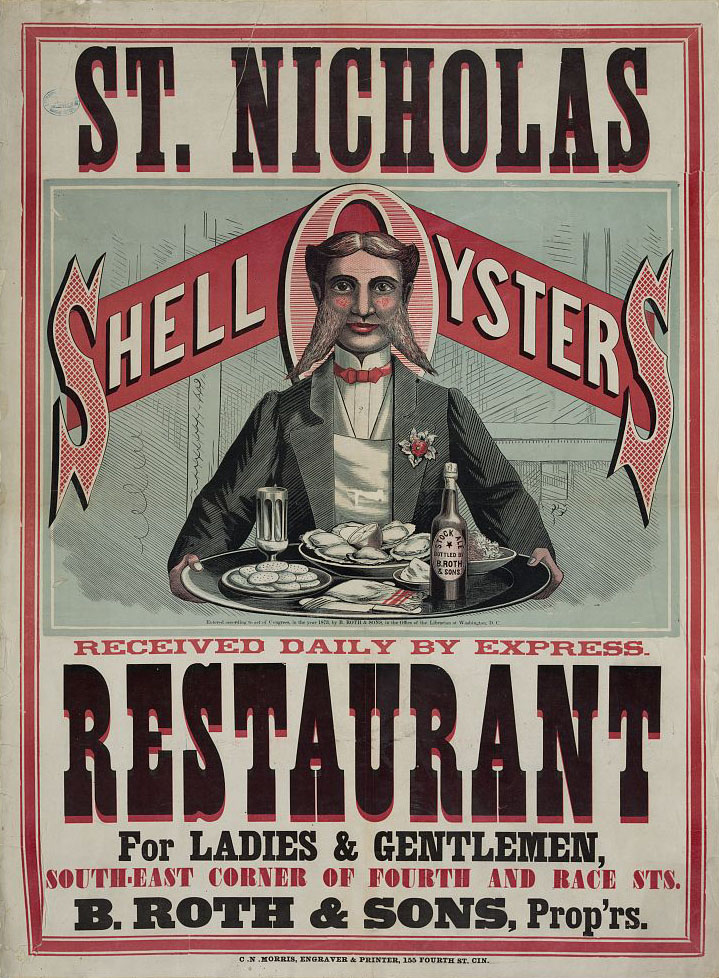
1873 Harvey & Holden in Washington D.C., which claims to be the largest oyster house in the nation, serves premium oysters from Maryland and Virginia every day from 6 a.m. until midnight. The restaurant is moderately priced, except for black patrons who allege they are charged extortionate prices.

1874 The enterprising Frederick Kurtz, operator of four “Old-Established and First-Class Restaurants” in lower Manhattan advises his customers that he has “reduced the Prices of his Bill of Fare to the most reasonable rates, To Suit the Times.”

1875 At Thompson’s in Chicago, about one third of the patrons are women. Unlike most restaurants, no liquor is served here.

1876 The Centennial Exposition in Philadelphia is well supplied with restaurants, among them a re-creation of the world-famous Trois Frères Provençeaux [Three Brothers from the Provinces] which closed in Paris four years earlier. One commentator prays it will influence America’s tough-steak-and-weak-coffee cookery.

1876 Edmund Hill of Hill’s Dining Rooms in Trenton NJ visits the Exposition for the seventh time and has dinner at Lauber’s German Restaurant with a refrigerator salesman. He writes in his diary, “There must have been a thousand persons there at the time I was eating.”

1877 After an editorial appears in the Boston Globe stating a need for decent, inexpensive restaurants, a reader writes in to complain about how “Dirt and democracy seem somehow inseparable” and the only clean restaurants are unaffordable ones such as Delmonico’s.

1878 At the Oyster Bay Restaurant on Alpine Street in Georgetown, Colorado, oysters are served “in all styles and at all hours.”

1879 Journalist and author Lafcadio Hearn starts a cheap restaurant in New Orleans called The Hard Times where all dishes cost 5 cents. He writes to a friend that he is “going to succeed sooner or later, even if he has to start an eating-house in Hell,” but rapidly goes out of business all the same.

© Jan Whitaker, 2010
Read about other decades: 1800 to 1810; 1810 to 1820; 1820 to 1830; 1860 to 1870; 1890 to 1900; 1900 to 1910; 1920 to 1930; 1930 to 1940; 1940 to 1950; 1950 to 1960; 1960 to 1970; a href=”https://restaurant-ingthroughhistory.com/2013/09/24/taste-of-a-decade-1970s-restaurants/”>1970 to 1980

6 Comments

Filed under miscellaneous

He-man menus

I question whether there are huge gender differences in food preferences but I’ve seen plenty of evidence that many restaurants have marketed menus on this basis, especially by playing to the idea that men have manly tastes. This idea seems to have grown stronger in the 20th century when more women patronized restaurants on an equal basis with men.

Many people believe that men like heartier food than women do. In the 19th century, of course, men dominated restaurants and women were often viewed as special guests. Since eating places were accustomed to catering to men then, menu staples such as oysters, beef, and pie came to be seen as men’s favorite dishes. Perhaps they were, but then again they may have been regarded as “masculine” simply because men were the ones who usually ate them out in public.

In the early 1900s articles began to appear in newspapers that offered ideas of what food men liked best. Restaurants designed menus to appeal largely to male diners. Pollution of oyster beds brought growing distrust and beef came to top the list. “Quick lunch” spots noticed that men ordered more meat dishes than women. Louis Sherry said that women guests in his deluxe Fifth Avenue restaurant did not like to draw blood so they avoided red meat and game.

In the many places that served “business men’s lunch,” the favorite meal was meat and potatoes, pie, and coffee. If the lunch was served in a tavern setting, the pie and coffee might be replaced by a glass of beer. But men had other favorites as well, such as griddle cakes, corned beef and cabbage, beef stew, chili con carne, bean soup, fried potatoes, and ham and eggs.

With the advent of national Prohibition in the 1920s, observers noticed that men were eating lighter meals, more sandwiches, and even the occasional salad. While nutritionists hailed the change as healthier, some restaurant owners longed for the return of the heavy eater. When beer became legal again in 1933 the executive chef of Chicago’s Palmer House said, “With the stein on the table, masculine foodstuffs are bound to come into their own.” In 1934 a New York guide book tipped off men about where they could enjoy “man-sized” food “served without fancy gegaws.”

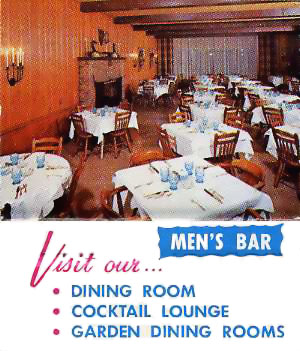
After Prohibition men who preferred no women in the dining room could go to bar & grill restaurants in hotels such as the Esquire Restaurant in the Penn-Harris Hotel in Harrisburg PA or the men’s bar at the Waldorf Astoria where they could enjoy their Martinis and Mutton Chops minus female company. In the men’s bar at the Mayflower Hotel in Washington, D.C.,  the dining room captain personally prepared Cannibal Sandwiches of raw beef, onion, egg yolk, and Worcestershire sauce at guests’ tables.

Known as the Rib Room, the men-only Mayflower bar was also host to FBI chief J. Edgar Hoover, who lunched there daily in the 1960s, always at the same table facing the door. His favorite meal, consumed with only the slightest variation, was cream of chicken soup, coffee, and Jello. While he was President, in 1970, Richard Nixon and four of his staff dropped in at the Rib Room for breakfast after Nixon’s early morning visit to Vietnam War protesters at the Washington Monument. Nixon ordered corned beef hash with an egg on top which, according to his press secretary, marked the first time he had eaten this dish in five years.

© Jan Whitaker, 2010
Leave a comment

Filed under food, patrons

That glass of water

I don’t know how many times I’ve gone to a restaurant with someone who answers “Just water” when the server asks what they would like to drink. For some inexplicable reason I am always strangely disappointed when I hear this reply. Is it my Irish-German ancestry haunted by ghosts of the temperance movement? I honestly don’t know but I am fascinated with the question of why that glass of water is plunked down first thing in American restaurants.

Why are Americans so crazy for water when diners in other parts of the world are not? European visitors from the 1860s to yesterday never failed to notice the American habit. In 1883, a Londoner reported that in hotel dining rooms, “Immediately the guest is seated, the attendant at the table brings a napkin, a bill of fare, and a glass of iced water.” Another crossly noted, “You cannot escape from this glass of water from the day you set foot on American soil to the day you leave it…”

Carbonated soda water and mineral water were available in early 19th century American cafes, as was ice for beverages. But the first mention I’ve found of water served free with a meal occurs in the 1840s, which happens to be the decade that NYC’s and Boston’s public water supplies began. In the late 1840s a newspaper reporter reflected on cheap restaurants where patrons could enjoy “pumpkin pie at four cents the quarter-section, with a cup of Croton, fresh from the hydrant, gratis,” referring to the Croton Reservoir from which water flowed into NYC beginning in 1842.

It is also a decade when the temperance movement geared up, praising cold water as the most moral beverage and the only one drunk in Heaven. The teetotaling followers of food reformer Sylvester Graham found cold water the sole drink consistent with “nature’s bill of fare.” The mission of temperance advocates was to make pure water widely available in hopes they could lure drinkers away from the hard stuff. The battle continued at the Centennial Exposition of 1876. After failing to prevent the sale of beer and wine at the fair’s European-style restaurants, temperance groups installed a free ice-water fountain.

Restaurants run by new Americans did not immediately fall into line. Italians, for instance, preferred wine as their basic beverage. A Boston diner in 1906 was impressed with how totally different it was to eat in an Italian restaurant as compared to a typical wineless Yankee lunch room where the staples were baked beans, pie, doughnuts, cookies, cake, gingerbread, toast, and boiled dinners — all washed down with ice water.

Although the custom of providing water was likely firmly established during Prohibition, even before that water service gradually lost its temperance overtones and became standard operating procedure in restaurants. A waitress in 1907 learned the first day of work that as soon as she took an order she was to give the patron water as a signal to the head waitress that the order had been taken. A 1908 manual instructed waiters to “serve water first” and the bread and butter set-up later.

Americans don’t always drink the water provided in restaurants, but they expect it to be there. In 1930 patrons of luncheonettes coast to coast were dismayed by burnt toast, dirty menus, and failure to serve water unless requested. A National Restaurant Association survey in 1978 found that customers did not like to ask for water and almost 75% of them were annoyed if there was no water on their table.

© Jan Whitaker, 2010

16 Comments

Filed under restaurant customs

Famous in its day: Tony Faust’s

By the 1880s Anthony E. Faust had established quite a culinary empire in St. Louis. He ran a Café and Oyster House downtown on Broadway which had a nationwide reputation. Since 1878 it had featured rooftop dining, uncommon in the U.S. then. From his adjoining “Fulton Market” he also retailed and wholesaled “Faust’s Own” oysters and other delicacies such as truffles, soy sauce, and curry powder which he shipped to Southwestern and Western states. His Faust label beer, made for him by the Anheuser brewery, was also sold in the West.

He didn’t start out in the food business but as an ornamental plasterer who immigrated from the Prussian province of Westphalia at age 17. After being accidentally shot while watching a parade, he gave up his trade and decided to open a café in 1865.

Obviously he had a knack for the new business. And it helped that St. Louis was a booming hub of shipping and commerce positioning itself to dominate commerce with the West. His closeness to the Adolphus Busch family of beer fame was undoubtedly another asset. In 1886 Tony opened a second restaurant in a huge new Exposition Building on Olive Street between 13th and 14th which hosted conventions of architects, music teachers, fraternal organizations, and the Democratic National Convention of 1888.

In the late 1880s he razed his restaurant and replaced it with a finer building. With an interior of carved mahogany woodwork, a tapestried ceiling, and an elaborate mosaic tile floor, the restaurant catered to the fashionable after-theater crowd. At some point, perhaps in 1889, a second story was added, eliminating the rooftop garden (above image, ca. 1906).

Success seemed to mean Tony could do as he wished. Caught serving prairie chickens out of season (under the frankly fraudulent name “Virginia owls”), he freely confessed and flippantly said he’d pay the fine or “break rock” if need be. When the Republican National Convention was held in St. Louis in 1896 he claimed his staff would not prepare or serve meals for Afro-American delegates. Even after the convention’s managers offered to hire a space, furnish stoves, and buy provisions to feed the black delegates if Faust would oversee the work, he absolutely refused to do it. Period.

In preparation for the 1904 St. Louis World’s Fair (the Louisiana Purchase Exposition), Faust joined half a dozen of St. Louis’s top restaurateurs in a trust, the St. Louis Catering Company, probably designed to buy in large quantities and possibly to set prices too. Faust went into partnership with New York’s Lüchow’s to create a Tyrolean Alps Restaurant at the Fair which seated 5,000 diners and featured costumed singers (pictured). It represented brewers’ interests as well, leading one observer to joke that the enormous beer hall should have been named “Budweiser Alps.” According to the Fair’s Official Program there was also a Faust restaurant in the Fair’s west pavilion on Art Hill.

At the time Tony Sr. died in 1906 the Faust empire included a second Fulton Market location, and another Faust restaurant in the Delmar Gardens amusement park in University City managed by his son Tony R. Faust. Like many a successful businessman in the Midwest, Tony R. went to NYC to see about opening a branch there. There was a Faust restaurant in NYC’s Columbus Circle in 1908 (pictured), but I am not certain whether this belonged to the St. Louis Fausts. In 1911 Tony Jr. was declared insane. After that his older brother Edward, an executive of Anheuser-Busch who was married to a daughter of Adolphus Busch, took over the restaurants and markets. The downtown restaurants in St. Louis and NYC, and probably the others as well, closed in 1915 and 1916, casualties of looming Prohibition.

© Jan Whitaker, 2010
13 Comments

Filed under outdoor restaurants, proprietors & careers

Theme restaurants: prisons

I’ll admit that I’m not fond of theme restaurants. So often they seem designed for tourists who will never return and, therefore, don’t get very good treatment. Food is often a secondary consideration, mediocre at best, while the entertainment is hokey.

Yet obviously many people enjoy places that allow them to escape their everyday lives for a few hours. What kind of escape does a prison concept provide? Appreciation of freedom? The opportunity to tell friends “I was in jail last night”?

Whatever it may be, it’s never been a common restaurant motif, yet it endures today. The theme can be traced back to 19th-century Montmartre’s Café of the Penitentiary (Café du Bagne). The beat was picked up in the US by “beefsteak dungeons” that sprang up around 1900. In another variant, Don Dickerman led patrons down into a dark cellar, the brig, in his Pirates’ Den in the Greenwich Village of the 1920s, which he recreated in Miami, Washington, and Hollywood CA (shown) in the 1930s and 1940s.

Los Angeles was host to several jail theme eating/entertainment venues, the first in the early 1920s when LA entrepreneurs were eager to cash in on the popularity of Greenwich Village by creating outlandish eating places that resembled the Village’s. One LA attraction was a coffee shop largely patronized by sailors where the walls were painted to resemble the stone walls of a prison on which patrons scrawled their names. Then, in 1925, The Jail opened on Sunset Boulevard. Each table occupied its own barred cell. Just like in Montmartre of the late 1800s, waiters dressed as convicts — the bitterly ironic yet unconscious American twist being that they were black men.

Within a year the proprietors of The Jail opened a second place. This location, or perhaps the first, became the set for two movies which have subsequently fallen into obscurity: Sweet Daddies (silent, 1926) and Ragtime (1927).

The Jails featured chicken dinners. Diners were furnished with no knives or forks, thus carrying on the beefsteak dungeon’s “caveman” tradition of eating with the hands. In 1930 a newspaper columnist named The Jail as one of the “seven wonders of Hollywood,” along with the Hollywood Bowl and the residence of Harold Lloyd. That honor may have marked its swan song as it seemed to disappear around then.

There were also jail-themed restaurants in other parts of the country. Depression-era Indianapolis had Fox’s Jail House Restaurant (shown above) where the “inmates” ate behind bars, while Fairfield, Iowa, enjoyed Turner’s Jail Café where, in 1939, Mr. and Mrs. Turner invited guests to Eat (plate lunches) at the Jail!

Believe it or not, the macabre subject of execution has also served as a theme for some eating places, such as The Noose Coffee Shop located across from Chicago’s Criminal Courts building in the 1920s. It supplied condemned prisoners with their last meals and they reciprocated with autographed photos. In the 50s, 60s, and 70s, Tarzana CA had a jokey place called The Hangman’s Tree Café, whose menu cover featured a noose dangling from a tree and the slogan “Jail Fare.” Although it was presumably meant to invoke the Wild West I feel reasonably certain not many black guests chose to accept the invitation to “hang out” there. I almost hate to mention the Taipei, Taiwan, restaurant called The Jail which in 2000 was grotesquely (but briefly, following public outcry) decorated with photo murals of emaciated prisoners of German concentration camps and a sign for the rest rooms that read “gas chamber.”

© Jan Whitaker, 2010

7 Comments

Filed under theme restaurants

L’addition: French on the menu, drat it

In his 1904 Culinary Handbook, Charles Fellows pledged: One of my first thoughts in writing this handbook was to abstain from French terms. I said to myself, I WILL WRITE AN AMERICAN CULINARY HANDBOOK FOR AMERICANS. I have heard it frequently stated that the terms for the bill of fare could not be properly represented in the American language. I SAY IT CAN, and as proof positive you have it here. There are no French terms used for the receipts [recipes] of this book, and the headings as given are what should in my opinion be placed on the bill of fare, as perfectly adequate in describing the dish.

He was unable to keep his pledge. There are French terms throughout the handbook. On one typical page appear not only the fairly commonplace French words purée and sauté, but also béchamel, epigramme, haricot, matelote, saûtoir, and vélouté. He duly translates Chicken Chasseur as “Broiled chicken, Hunter’s Style,” but then instructs the cook to serve it with “sauce chasseur.”

Fellows felt that many dishes on restaurant menus went unordered simply because diners didn’t know what they were. This may have been true, especially since the dining public was broadening in the early 20th century, bringing unsophisticated but monied newcomers into  high-class restaurants.

French terms began to appear on American menus in the 1850s. By the 1890s their use was considered essential for luxury restaurants. But the tide began to turn around the 1920s when people started eating lighter, faster meals and menus were greatly scaled down, simplified, and rendered in English. The 1918 menu of the Tuxedo Rotisserie and Grill actually listed “Frog Legs in Paper Bags” rather than the dreaded en papillote. But, there are terms that remain today and still puzzle diners. Many of the menu terms below were not well known by most Americans in the 1890s, nor even 40 years later.

compote – a dish of fruit stewed in sweetened liquid, sometimes a dessert as was the case with Compote of Apricots and Rice which appeared on an 1893 menu at San Francisco’s Delmonico’s Restaurant. But I have also seen “Pigeons en compote” on an 1841 menu.

fricandeau – sliced meat or fish fried or braised and sauced, similar to a fricasée. In 1839 Fricandeau of Veal appeared in the French section of a menu of the Astor House, a first-class NYC hotel. This term is antiquated today.

glacé – according to Restaurant Menu Planning (1954), this word is an excellent one for menus, right up there with oven-baked and crisp. It properly refers to reduced meat stock that can be used to give flavor and sheen to dishes. Sweet Breads Glace was on the menu for a special dinner at the Rankin House, Columbus GA, in 1887.

jardiniere – Le Jardinier de Macaroni à la Italienne appeared on an 1843 Tremont House menu under Hors D’Oeuvres. In 1915 the Budweiser Café in Indianapolis IN offered “Fricandeaux (perhaps indicating by the “x” that there is more than one slice) of Veal, Jardiniere” for a mere 30c. Jardiniere indicates a dish served with a garnish of cut up mixed vegetables, perhaps in gravy. In 1965 the Armour Company advertised a new product which provided restaurants with flexible film pouches containing eight servings of braised oxtails jardiniere.

la financiere – Sweetbread patties a la Financiere as served at Fleischmann’s in NYC in 1906 undoubtedly were patties made from the thymus glands of veal or young lambs with a garnish or sauce of button mushrooms, bits of truffle, and possibly some cockscombs (yes, the red things atop roosters’ heads) with Sherry or Madeira wine.

maitre d’hotel – The Broiled Halibut, maitre d’hotel on the menu of New York’s Café des Ambassadeurs in 1905 was fish with a melted butter sauce to which was added lemon juice, chopped parsley, and a little grated nutmeg. The popular and expensive Jack’s in San Francisco dared in 1947 to offer Broiled Spring Salmon Steak à la Maitre d’Hôtel, giving the words their full accented treatment. (The menu also featured Tripe à la Mode de Caen.)

ragout – this word, now antique, was almost synonymous with French cooking in the early 19th century and critics always referred to it when criticizing French food for its overseasoned character which was believed to be unhealthy and induce drinking. In short it means spicy stewed meat and vegetables. When given a French name, western restaurants could sell stew at high prices to miners who felt they were living large. Ragout of Mutton appeared on a 1903 menu of the Occidental Hotel, Breckenridge CO.

rissole – According to Delmonico’s long-time chef Charles Ranhofer, in the 1890s rissoles were one of many items that could be served for the hors d’oeuvres course which followed soup. They were made of chopped meat, or possibly fish, vegetables, or even fruit, which was held together with egg, formed into a rounded shape, encased in crumbs or pastry, and fried.

quenelles – meat or fish forced through a small mesh and formed into balls, such as the marrow balls in the Green Turtle Soup aux Quennells a la Moelle served at the Central Hotel in Charlotte NC in 1896 or Quenelle of Calves Liver, German Style, served at Kentucky’s Louisville Hotel in 1857. Not long ago I attended a forum in NYC which declared quenelles, and the fancy cuisine they represent, totally decrepit.

vol au vent – a pastry basket from which a “lid” is cut and replaced after inserting a filling of delicately sauced meat, fish, vegetables, or fruit. The case is then baked. Sometimes found grossly misspelled on menus as in “voloven garnie de clams a la poulette,” which presumably is pastry with a chicken filling garnished with clams.

© Jan Whitaker, 2010
6 Comments

Filed under food, menus

Anatomy of a restaurateur: Romany Marie

Marie Marchand, whose business name was Romany Marie, was taken aback in the 1950s when a Greenwich Village restaurateur declined to host a dinner for Marie’s artist friends on the grounds they would occupy the tables too long. In a 1960 interview recorded in Romany Marie, Queen of Greenwich Village by Robert Schulman, Marie reflected, “It was a little shock to me. Poor dear, she felt she had to have turnover, she was in the restaurant business, not in the venture of maintaining a center for lingering tempo.”

For someone such as Marie who had herself been in the restaurant business for over 30 years, this would seem to be an odd reaction. But hers were odd restaurants – she preferred to call them centers – where patrons were encouraged to linger. If they lacked money for a meal, and they fit her criteria as creative spirits, she let them eat for free. Luckily, she had a brother who helped her out financially because hers was not a lucrative business. On the other hand, she encouraged and helped sustain dozens of artists and creators such as Buckminster Fuller, Burl Ives, Stuart Davis, Edna St. Vincent Millay, and John Sloan (one of the many artists who painted her portrait – pictured above).

Marie, who as a teenager came to the US from Romania in 1901, said she patterned her taverns (so-called though she served no alcoholic drinks) after the inn her mother ran for gypsies in the old country. To honor her mother, Marie dressed as a gypsy and usually decorated in rococo style with peasant scarves, batiks, pottery, and her patrons’ paintings. Several of the 11 locations she occupied over the years featured fireplaces, which to the horror of health inspectors she used for broiling steaks.

After working initially in the garment industry Marie brought her mother and sisters to New York. The family lived on the lower East Side near the Ferrer School which offered workers free adult education. She became involved with the school where she met artists and thinkers who later became her patrons and, sometimes, volunteer waiters. In 1914 she opened her first place in the Village’s Sheridan Square. Amenities were sorely lacking, with both stairway and toilet facilities located outdoors. For years she had no electricity, candles furnishing the only lighting.

AtmosphereRomanyMarieSummer1921In 1915 she moved to 20 Christopher Street and it was at this location, the one she occupied the longest, that her name became well known. Another location of renown was 15 Minetta Street, with an interior designed by Buckminster Fuller in the late 1920s. In the 1960 interview Marie quoted Fuller as saying, “I’m going to fix up this place in a Dymaxion way.” He outfitted the restaurant with canvas sling chairs, “aeroplane tables,” and aluminum cone lights. Instead of the darkness her patrons were accustomed to, Fuller lit the place up by painting the walls silver. Sculptor Isamu Noguchi assisted (“Bucky got me to help him with painting the place up solar.”). Everyone disliked the brightness, the tables wobbled when food was placed on them, and the chairs collapsed when sat on. The experiment failed but Marie promised Fuller one free meal a day for the rest of his life, a benefit that carried him through the Depression.

In addition to Romanian dishes such as meat pies and cabbage rolls, Marie specialized in strong coffee which she advertised as Café Noir à la Turque. Her signature dish was ciorbă, a soup of vegetables, meatballs, eggs, lemon juice, and sour cream. Marie’s husband Arnold, a difficult man who was known to deliberately break dishes and otherwise sabotage her efforts, rendered this dish on his phonetic menu as “Tchorbah, peasant soop.” A menu by him also listed “Boylt Beeph wit been’s & hors radish,” and “Lone Guy Land Greens.”

Marie continued in the restaurant business until 1946 when she retired to care for Arnold. Each time Marie moved her restaurant she announced it with a sign which said “The caravan has moved.” Its last move was to 49 Grove Street.

© Jan Whitaker, 2010

2 Comments

Filed under Offbeat places, proprietors & careers, women