Washing up

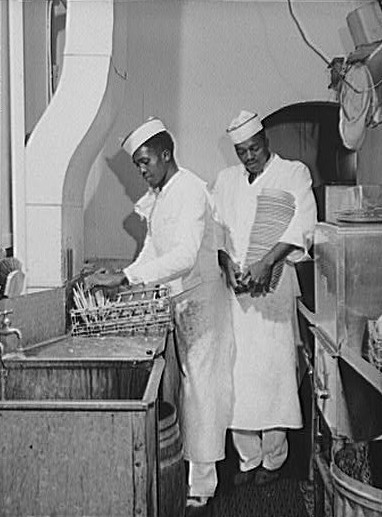
“Please don’t make me a pearl diver,” begged ruined Chicago restaurateur John Raklios as he entered debtors’ prison in 1939. As someone who had worked his way up in the restaurant world, he knew there was no job lower than washing other people’s dirty dishes.

In restaurant kitchens dishwashers were long considered “life’s wreckage,” people so reduced by circumstances, drugs, and drinking that they could find no other work. In the 19th and early 20th century dishwashers worked up to 12 hours a day for a free meal and very little money. In addition, they were often tormented by cooks and others in the kitchen.

A stark portrait of the life of a dishwasher, based on the author’s firsthand experiences, is painted by George Orwell in his autobiographical book Down and Out in Paris and London. Luckily, at its best dishwashing could produce a zen-like state in which the mind is untethered  from mundane matters.

The origins of the slang term “pearl diver” are as murky as dishwater itself. According to one historic account washers would clean dishes by feeling rather than sight. They would reach down into deep sinks “sorting the dishes into rows, washing them with a wave-like motion through the water” and then scooping huge piles onto a drain board. During busy periods when dirty dishes flowed into the kitchen “like lava from a volcano,” pearl divers quickly learned to “manipulate thousands of dishes at lightening speed.”

In literary and journalistic portraits, dishwashers were typically males unused to the better things in life and therefore relatively unbothered by floating scum, filth underfoot, rats, taunts, or low pay. Despite Orwell’s claim that the dishwasher “has no escape from this life, save into prison,” there were numerous stories of men who worked their way into careers as successful restaurateurs, such as Vincent Sardi, Morris Schwartzer of the NYC Biltmore Cafeteria chain, and Philippe Mathieu, purveyor of acclaimed French dip beef sandwiches in Los Angeles.

Afro-Americans or new immigrants who didn’t speak English often became dishwashers mostly because of their reduced job prospects generally, and were thus less likely to be from the ranks of the truly down and out. The same may have been true of women who washed dishes. Until 1911, when labor laws reduced the number of hours women could work, many dishwashers were women. Evidently they continued to work as dishwashers after reforms too, because state inspections of Michigan restaurants in 1918 revealed that for every two male dishwashers there were three women doing that work. Their pay, $1.20 a day, was rock bottom for restaurant workers then.

Mechanical dishwashers were invented in the 19th century, but were not electrified or widely used until well into the 20th. Though not the first female dishwasher inventor, Josephine Cochran is credited with devising the first truly practicable dishwasher, which she patented in 1886 [illustrated, 1912]. From a comfortable home with servants who performed kitchen labor, she was driven by a wish to prevent breakage. But her invention, which led her to form a company called Garis-Cochrane, ended up in hotels and restaurants rather than private households.

Before being electrified, generally during the teens and 1920s, mechanical dishwashers were manually operated, some requiring two people to turn handles that swished baskets of dishes through suds. The heavy baskets were lifted out of the water by pulleys which required considerable strength, sometimes resulting in the replacement of women dishwashers by men.

Despite strides in kitchen mechanization in the 1920s, it is notable that a survey of Rockford IL in 1929 found that only 16 of the city’s 179 restaurants had mechanical dishwashers. Even as late as the 1940s many restaurants still washed dishes by hand, often inadequately. Health department crackdowns following World War II found that scalding hot water and/or chlorine rinses still were not employed in many of the smaller restaurants across the country.

Though it’s unclear how many worked in restaurants, according to the Bureau of Labor Statistics there were 522,900 dishwashers making an average of $8.19 an hour in 2008.

© Jan Whitaker, 2011

9 Comments

Filed under proprietors & careers, sanitation, technology

Taste of a decade: 1910s restaurants

Like the decade following World War I, this was an eventful period in the development of the restaurant. Social and economic changes favored the growth of eating out. Even before the U.S. entered the war in April of 1917 restaurant patronage was on the rise and by the following year the Food Administration, under the direction of future president Herbert Hoover, estimated that more food was consumed in restaurants than in homes.

It was a schizophrenic decade. It opened with an accent on the high life but ended in austerity mode. Luxurious cabarets and “lobster palaces” of the early decade would sink into oblivion near its close. But at the same time urbanized speed-up and intense modern work regimes inclined people to seek more outlets for pleasure. Increasing numbers of single male and female white-collar workers in cities abandoned the old home-based courtship tradition; the new custom of middle-class dating brought a search for entertainment and swelled restaurant going. With better public transportation and the feminization of downtowns, more and more women patronized tea rooms and restaurants in and around department stores.

Due to growing sentiment against drinking, the saloon free lunch was on the skids by mid-decade. State-wide prohibition spread and the majority of the nation’s population soon lived in areas where the sale of alcohol was illegal. Saloon keepers remaining in the larger cities saw that their days were numbered and began to take out restaurant licenses. Authorities suspected that many of the restaurants did not actually serve meals but just wanted to evade laws which forced saloons to close on Sundays. Nevertheless, the trend would increasingly become genuine and bars would be turned into lunch counters and soda fountains.

In a tight labor market accompanied by Food Administration conservation measures that discouraged frills, most of the new restaurants were lunch rooms of the self-service type. In them customers avoided tipping and enjoyed lower prices for simple ready-to-eat meals.

American involvement in the war encouraged anti-ethnic sentiment, particularly toward Germans. Many restaurants took steps to appear more American, such as changing their names. Patrons expressed a wish to see menus with no French or other foreign terms. With the sudden end to European immigration, culinary labor unions took the opportunity to strike for shorter hours and higher wages. Frequently restaurant owners responded by replacing striking male waiters with women, who were believed to be more docile.

Highlights

1910 Measured as a ratio of restaurant keepers to total population, the nation’s top five restaurant cities are: 1) Seattle (1:434); 2) San Francisco (1:449); 3) Los Angeles (1:560); 4) Kansas City (1:580); and Manhattan (1:583)*. Los Angeles claims the reason for so many restaurants is its wealth of tourists and single men.

1911 Until legal counsel advises this would be a discriminatory misuse of police powers, the Massachusetts Legislature bandies about the notion of making it illegal for women under 21 to enter Chinese restaurants.

1912 New York City’s first Horn & Hardart Automat opens. – Speedy service is prized even at Casebeer’s Lazy J Cafeteria in Waterloo, Iowa, where the slogan is “One minute service – We don’t waste your time.”

1913 The diary of an executive secretary in NYC shows her eating in restaurants over 100 times during the year, including her first-ever restaurant breakfast. Among her favorites are Childs, Schrafft’s, The Goody Shop, and The Vanity Fair and The Rip Van Winkle tea rooms.

1913 NYC’s cabarets and “lobster palaces” such as Murray’s, Martin’s, and Shanley’s, formerly open all night, take a hit as the mayor orders 1:00 a.m. closings.

1914 Despite earning only $5.85 a week, a woman working in an Ohio playing card factory spends 30% of her food budget on restaurant meals, most costing 25 cents.

1915 An exact replica of a white-tiled Childs lunchroom is featured in a scene of a Broadway play directed by David Belasco.

1916 On one short block near Boston’s Newspaper Row, twelve restaurants serve 40,000 meals daily. – In the novel The Thirteenth Commandment a young couple gets engaged after a “a typical New York courtship [in which] they visited restaurants of all degrees.”

1917 Although the managers of Chicago’s Bismarck Hotel station an American flag at the entrance to the dining room (the Berlin Room), it is damaged by dynamite just a few months after the U.S. enters war with Germany. — The Kaiserhof Cafe in NYC changes its name to Cafe New York.

1918 Restaurants place glass on tabletops to save linens and laundry for the duration of the war. They remove sugar bowls, take cheese dishes such as Welsh rarebit off their menus, and feature more hors d’oeuvres, fresh vegetables, salads, fruits, seafoods, and organ meats.

1919 In response to labor agitation, restaurant men organize and hold the first National Restaurant Association convention in Kansas City MO. – Louis Sherry announces he will close his deluxe Fifth Avenue restaurant due to hardships imposed by Prohibition and “Bolsheviki waiters.”

* By comparison a recent NYT story reported that the U.S. city with the highest number of restaurants per capita is San Francisco, where the ratio is 1:227. NYC is 1:347.

© Jan Whitaker, 2011

Read about other decades: 1800 to 1810; 1810 to 1820; 1850 to 1860; 1860 to 1870; 1870 to 1880; 1890 to 1900; 1900 to 1910; 1920 to 1930; 1930 to 1940; 1940 to 1950; 1950 to 1960; 1960 to 1970

4 Comments

Filed under miscellaneous

Dipping into the finger bowl

Once upon a time finger bowls were routinely presented with the check in expensive restaurants. To the average American, who probably never went to this type of restaurant, they were a great source of humor. Jokes typically involved an unsophisticated restaurant patron drinking water from the bowl or eating the lemon slices floating in it. The funny stories demonstrated the joy Americans take in spearing pretentiousness, a quality which finger bowls epitomized to many.

Like salad forks and menus in French, using finger bowls was an esoteric social custom that was certain to befuddle the average person. How many fingers do you put into the bowl at once? What do you do after you get your fingers wet? Must you use it at all?*

These questions would soon fade from American culture because the finger bowl was about to run afoul of history in the World War I era.

Yet in the decade before finger bowls met their downfall, the number of restaurants providing them actually increased. Live music and finger bowls were two amenities put forward as competitive attractions over places that didn’t have them. Some observers believed that because so many restaurants adopted finger bowls, it deprived them of the eliteness they once enjoyed and that this was a factor in their downfall.

Further warning signs of the finger bowl’s decline in status surfaced as early as 1908 when a veteran waiter confessed to a reporter that wise patrons should demand to witness their waiter filling the bowl. Otherwise, he warned, it was likely they’d get one with wastewater from a previous user fermenting in it.

For reasons that are still mysterious to me, 1913 was a turning point in the fortunes of the finger bowl. The Buffalo NY health department launched an attack on brass bowls, which they claimed were in use in over half of the city’s restaurants. Glass bowls could be sanitized with boiling water but brass, said the health commissioner, could not. Omaha hotelier Rome Miller declared that modern guests were more germ conscious than ever before and wanted everything – tea, coffee cream, breakfast cereal – individually packaged. For guests desiring to wash their fingertips after dining, he recommended silver holders with disposable paper inserts.

Whether due to the influence of Rome Miller or not, the city of Omaha totally outlawed reusable finger bowls in 1915. The ordinance did make one exception – for finger bowls “made from paper or other substance which shall be delivered after being once used and not used or offered for use a second time.” The crusading Mr. Miller was further vindicated a couple of years later when he learned that a New Jersey paper company was supplying 263 leading hotels with sanitary paper finger bowls. “And so the finger bowl marches on,” he wrote, revealing a surprising dedication to its future.

But, for the most part, it was not to be. Glass, brass, or paper, all would be swept aside. World War I delivered the coup de grace when the Food Administration implored restaurants to do away with excess china, silver, and glassware, whether service plates, side dishes, salad forks, or finger bowls. The few straggler bowls that survived that era were wiped out by another such war order in 1943. Since then, high-end restaurants that serve food requiring a clean-up afterwards provide scented towels while lower-price establishments go with packaged towelettes.

© Jan Whitaker, 2011

*Dip one hand at a time and then dry your fingers on the napkin in your lap. Ignoring a finger bowl is a safe course.

16 Comments

Filed under restaurant customs, restaurant etiquette

The Craftsman, a model restaurant

The restaurant operated by Gustav Stickley on the 12th floor of his retail house furnishings store on 39th street in NYC was a brave but brief experiment in pure food, sanitation, and “progressive living.” It opened in May of 1913 and was out of business a few months short of three years later when the entire retail business failed.

The restaurant’s ability to attract patronage was undoubtedly limited since it was intended to appeal to the same people who admired Arts & Crafts furniture and house fixtures. This did not include most Americans, particularly new immigrants who populated big cities such as New York. Additionally, restaurants located in stores, even big department stores which can attract hordes of shoppers each day, typically lose money.

The restaurant followed the same aesthetic, both in its decor and its approach to food preparation, that defined the Craftsman Workshop’s project generally. The Workshop’s ambitions were captured in the motto which appeared on furniture labels and the restaurant’s china: “Als ik kan.” In its quaint Dutch formulation, it was a pledge to do one’s very best work.

When applied to food this meant pure and fresh ingredients straight from the source, simply prepared by cooks using modern appliances in a pleasant work environment, and consumed slowly in a restful setting. “Style,”whether in house furnishings or a meal, was supposed to emerge organically from an honest approach to materials and workmanship. A 1910 article in the influential Stickley publication The Craftsman identified a type of ideal restaurant, the down-to-earth “marketman’s” café (such as New York’s Smith & McNell or Boston’s Durgin-Park) which used fresh fruit, vegetables, fish, and fowl that had never seen the inside of a factory or cold-storage warehouse.

Provisions such as eggs, dairy products, vegetables, and spring water served for lunch[eon], teatime, and dinner at the Craftsman Restaurant were trucked in daily from Stickley’s 600-acre Craftsman Farms in Morris Plains NJ. As food reformer and “real food” proponent Alfred W. McCann argued, the restaurant was a model for the entire industry. “The legalized chemical preservatives, chemical bleachers, chemical glazes, chemical flavors, inert fillers and extenders, coal tar dyes and grossly impoverished foods, however popular, can find no place on the Craftsman bill-of-fare,” he wrote in 1915.

The Craftsman Restaurant was a haven for people of “good taste” wishing to avoid the show-off culture of champagne and loud music exemplified by lobster palaces and cabarets. It was the polar opposite of the garish Café de l’Opera, though ironically each in its own way was a spectacular failure. The Craftsman appealed to patrons such as well-to-do club women and college alumni groups. Shortly before it closed, the restaurant hosted Columbia University’s class of 1902. They enjoyed their dinner but were sorely disappointed to find out that the restaurant served no alcoholic beverages.

The dining room was decorated in earth tones: browns, deep reds, oatmeals, and creams. Plates, bowls, and cups were rimmed with a pinecone design. Bread was served in handmade willow baskets. The wood floor was mostly left bare while the tables were covered with criss-crossing Irish linen runners. A focal point of the room was a Germanic-looking hearth covered in Grueby tiles, with a hammered copper hood.

In keeping with the subdued decor, quiet and low-key service was accomplished by what one visitor described as “soft-treading little men of Nippon,” while stringed instruments softly played “something familiar from Grieg or [Edward] MacDowell.” This was most definitely not a restaurant for rowdies.

The store and restaurant closed early in 1916. In August the entire stock of the Craftsman Workshops store was sold at Gimbels Department Store at reductions of 35% to 50%.

© Jan Whitaker, 2011

7 Comments

Filed under alternative restaurants

Anatomy of a restaurateur: Chin Foin

In the early 20th century Chin Foin was considered Chicago’s foremost Chinese restaurateur, being affiliated with four of the city’s leading Chinese restaurants: the King Yen [above] and King Joy restaurants and the Mandarin Inn and New Mandarin Inn. His exact degree of ownership and management of the four over time is difficult to determine but it’s clear that his participation was significant. He also ran an import business in Chicago called Wing Chong Hai & Co.

His first restaurant King Yen Lo began inauspiciously in 1902 upstairs from a saloon, the notorious establishment of alderman Michael “Hinky Dink” Kenna on the corner of Clark and Van Buren. Operating above or behind a saloon was not uncommon for Chinese restaurants and may reflect difficulties the Chinese encountered in renting property. Additionally, having a restaurant nearby or physically connected may have served the interests of saloon keepers who wanted to evade early closing laws by funneling drinks through an eating place.

Whatever the case, the King Yen restaurant was better than it had to be. Like the other restaurants Chin Foin would run, it appealed to the non-Chinese after-theater crowd and featured orchestral music and steaks and chops alongside chop suey and “Mandarin” dishes. The kitchen was open for inspection and a special section was reserved for women unaccompanied by men, important since women shoppers were known to be fond of Chinese food. It’s not clear how long he was actively involved with King Yen but he was still an owner in 1907 when a Chinese envoy attended a formal dinner held there for the christening of Chin Foin’s infant son Theodore.

The King Joy restaurant on W. Randolph [pictured, ca. 1910] was a much bigger venture. It was a component of an international Chinese organization meant to raise funds for political and economic modernization in China. Investors included Chinese living in China and America as well as non-Chinese Chicagoans who supplied $125,000 [more than $3M today] to build the thoroughly modern restaurant. It opened in December of 1906 with Chin Foin as manager.

The investors in China must have heard that running restaurants in America was very profitable because little more than a year after the restaurant’s opening they began to complain about not receiving any dividends. I don’t know how all that was sorted out but clearly Chin Foin’s personal wealth was growing, enabling his family to move to a posh neighborhood in 1912. The newspaper reported he was a wealthy Yale graduate, which brought a grudging acceptance from a non-Chinese woman who said she could hardly object to a Chinese neighbor since, she observed, “We have Negroes out here now, and a few Goths and Visigoths.”

The very Americanized Chin Foin had ambitions of running a type of restaurant that was scarcely Chinese at all. After opening the Mandarin Inn in 1911 and the New Mandarin Inn in 1919 [pictured], both on South Wabash, he announced he had taken a 25-year lease on a Wilson Avenue property formerly occupied by a car dealer. To be called the Mandarin Gardens, the restaurant was supposed to open in 1921 but never did as far as I can tell. Reflecting on the upward arc of his restaurant career, he said in 1920, “Now we’ve cut out the far east features and operate a strictly American restaurant, and that’s what the Mandarin Gardens will be.”

The New Mandarin Inn had also shed some of its Chinese-ness. Since its opening in 1911 it had broken with Chinese restaurant tradition by using linens on the tables and serving European wines. Although it served Chinese dishes, it also offered Sunday chicken dinners and, in 1921, served a high-priced Easter dinner with choices such as Blue Points on the Half Shell, New Orleans Gumbo, Lamb with Mint Jelly, Whipped Potatoes, and Strawberry Shortcake.

Sadly, Chin Foin’s plans were abruptly terminated in 1924 when he stepped into an empty elevator shaft at the New Mandarin Inn. The subsequent owner of that restaurant, Don Joy, added “Chinese” features such as dragons on the front and a simulated temple roof. Don Joy’s Mandarin Inn closed in 1928, later to become a nightclub (Club Royale) and, eventually in 1959, Jimmy Wong’s Cantonese restaurant. The building occupied by King Yen was razed in the teens for a new location of the John R. Thompson’s lunchroom chain, while King Joy became the Rialto Gardens (Chinese), and then one of Dario Toffenetti’s cafeterias.

© Jan Whitaker, 2011

12 Comments

Filed under proprietors & careers

“Hot Cha” and the Kapok Tree

What kind of career might the son of a junk dealer father and a mother who owned a restaurant end up with?

If he was Richard Baumgardner he would run restaurants raucously decorated with gilded and spray-painted objets d’art — wonderfully kitschy palatial junque bought by the ton in Europe (70 tons of statues in 1966). When his warehouse ran low on statues and urns, he would make plastic replicas with rubber molds.

His customers would find it all enchantingly “different.”

But first, he’d take a detour into the entertainment world as a jazz-era musician and bandleader known as Dick “Hot Cha” Gardner. As an introduction to his restaurant career in 1936, Dick inaugurated the Hot Cha Supper Club in conjunction with his mother Grace’s tea room, the Peter Pan Inn in rural Urbana MD. After she died in the 1940s, Dick took over the Peter Pan and transformed it into a let’s-drive-to-the-country mega-attraction for Washington DC families. In 1958, retired from bandleading, Dick opened his first Kapok Tree Inn in Clearwater FL, on the site of a tree planted in the 1880s.

It’s hard to know how to classify his restaurants. They fall into two of my classifications: 1) the high-volume restaurant, and 2) the curiosity-shop restaurant filled with quaint stuff.

The decor at the Clearwater Kapok Tree was a mix of light fixtures from Paris, chandeliers gathered from the DC Italian Embassy and old theaters in Baltimore and New York City, paneling from a De Medici compound replicated in plastic, and on and on.

Yet for all their madcap faux elegance, Dick’s restaurants followed a rigid formula designed for maximizing profits and minimizing costs. Magically, it worked. Despite ticket windows where customers were required to prepay their dinner tab, a teen-age staff, long waits for tables (in the bar), sticky sweet rum drinks, and limited menus with pedestrian cuisine, customers absolutely adored these zany buses-welcome eateries.

For years diners had just four dinner choices: fried chicken, ham, deep fried shrimp, and steak. When customers sat down at their tables, servers collected their receipts, knowing immediately by the prices what they had ordered. A complete meal included a typical 1950s melange of appetizers which never varied year in and year out, whether in Maryland or Florida — cottage cheese, (sweet) pickled vegetables, muffins, and apple butter. Sides were roast potatoes, peas in mushroom sauce, beets, and hush puppies. Ice cream for dessert and seconds on everything but the entrees. Boxes were provided for leftovers and the complimentary tall cocktail glasses. Few left empty-handed.

The Kapok Tree Inns prospered with the Pinellas County boom of the early 1970s. By 1978, two years after Dick died, there were three Kapok Tree Inns, in Clearwater, Madeira Beach, and Daytona Beach. The first remained the largest, seating at least 1,700. On really busy days upwards of 5,000 meals were served there.

Controlling interest in the Kapok Tree corporation, which also included the Peter Pan Inn and a couple of Baumgardner’s Restaurants in Florida, passed to Dick’s widow, a former waitress at the original Clearwater restaurant, who had largely been running the operation since he had a stroke in 1970. A year after his death, she told a reporter that hers was the most profitable publicly-held restaurant chain in the nation. The Daytona Beach Kapok Tree closed  in 1981, and the Clearwater restaurant closed ten years later.

I wonder what happened to all the wacky furnishings?

© Jan Whitaker, 2011

23 Comments

Filed under popular restaurants, restaurant decor

Find of the day: Demos Café

It’s pretty cool when you can stroll over to an antiquarian book and ephemera show only a few blocks from your house and, barely 10 feet into the room, come upon a trove of restaurant memorabilia. That’s what happened a few days ago when I found a collection of photographs and water glasses from one of Muskegon’s premier cafés.

Judging from the hubbub in some of the photos of the bar area, the moderne-style Demos Café was a real Michigan hotspot in 1939 and 1940 when these were taken. Some of the patrons seem to be hiding from the camera and one man’s face was deliberately blacked out in the darkroom. Hmmm…

Located at 415-419 W. Western Avenue, the café was owned and run by the Greek-American Demos brothers, Spyros, Theodore (Ted), and John. Ted is shown behind the bar in two of these photos while John stands in the back of a crowded room in one and in another lights a cigarette for visiting Hollywood celebrity Buddy Rogers, husband of Mary Pickford. The café’s cocktail lounge often hosted touring jazz bands. And, as can be seen, it kept customers up to date on baseball scores.

The café’s wood veneer backbar was almost certainly a product of local industry. The Brunswick-Balke-Collender company’s main plant, which manufactured bar fixtures, was located in Muskegon. As soon as beer was legalized in 1933 the factory geared up with 1,500 new workers in anticipation of renewed business.

In addition to serving zombies (“only 2 to a person”) and frozen daiquiris, and apparently pouring quantities of Four Roses bourbon, the Demos Café specialized in steaks, chops, and sea foods. Signs placed in the front windows advertise a blue plate special for 50 cents, “genuine Italian spaghetti with Roman cheese” for 35 cents a plate, and “sizzling steaks,” a Depression-era culinary gimmick across the U.S. As was true of most Greek-American restaurants, the menu would have been thoroughly Americanized, without any dishes common to the owners’ native land.

During its heyday in the 1940s the Demos Café, along with the Causeway Café and the Lakos Café – all Greek-American owned – was one of the big three restaurants in Muskegon. But by 1951 or 1952 the café apparently went out of business after a tax investigation and lawsuit.

© Jan Whitaker, 2011

14 Comments

Filed under proprietors & careers

Footnote on roadhouses

Is Casablanca one of the unluckiest names a restaurant could have? Granted, there is a fair amount of mayhem surrounding restaurants and cafes generally, at least judging from newspaper stories, but places with this name seem to have attracted more than their share of violent crime.

There is a fascination with the dark side of restaurants, witnessed by interest in revelations of filth, chaos, and bad tempers in the kitchens, not to mention the popularity of such topics as  gangster affiliations. This post is inspired by a reader living near Palatine IL outside Chicago, the location of the old Casablanca referred to in an earlier post on roadhouses. He wrote that he would “love to hear about the old-school ‘joints’ that used to pepper the ‘quiet’ suburbs.”

He is not alone. When I recently posted a photo of an old no-tell motel, the Coral Courts, on my hometown’s Facebook page, interest was notable. Likewise someone’s FB post recalling a horrid massacre at a roadhouse called Cousin Hugo’s just outside the borders of that formerly dry and ultra-proper suburb attracted comments like a magnet.

The Casablanca on Rand and Dundee Roads in Palatine was begun by Loretta Cooper, daughter of Polish immigrants in Chicago. She may have opened it in the early 1940s, but under another, unknown name. She would have been about 25 years old and already 7 years into her restaurant career. She started her first cafe, the Star Tavern in Chicago, around 1935 when she was only 18. Being underage she needed her older brother to act as the nominal manager.

Loretta proved to be a “survivor” in the restaurant business, owning a number of establishments over at least a 30-year period. She didn’t run the Casablanca for long, though, because by 1943 she had taken over the old Eddie’s Castle Café on Evergreen in Arlington Heights IL and renamed it Loretta’s Castle Café. It stayed in business until the late 1960s when the building was demolished. She and her husband Edward also ran a place in Arlington Heights called Cooper’s.

Loretta sold the roadhouse to Michael Buny around 1944 and he renamed it Casablanca after the Humphrey Bogart film that had come out two years earlier (thanks to his family member for this piece of the story). In May of 1949 he was killed in a holdup. When two hooded men entered the roadhouse one night with shotguns, he attempted to foil them by sneaking outside through the kitchen and getting a gun, evidently planning to ambush them when they left. He was shot by lookouts watching from the getaway car. Although the police rounded up suspects who went on trial in the early 1950s no convictions were secured. Years later one of the suspects was apprehended for home repair fraud.

Michael Buny’s wife and daughter ran the Casablanca after his death. In 1951, about two years after her father’s slaying, daughter Darlene was shot in the shoulder as she struggled with a tall scar-faced robber who broke into the café one night. It’s uncertain how long she kept the Casablanca going after that.

Quite by coincidence, I assume, a nightclub restaurant opened on Dundee Road in Palatine in the 1980s called Bogie’s, with decor inspired by the film Casablanca. Local history would have made for a riskier theme.

© Jan Whitaker, 2011

3 Comments

Filed under roadside restaurants

Spectacular failures: Café de l’Opera

In 1910 the media was abuzz with the new Café de l’Opera on Broadway between 41st and 42nd streets in NYC. Its enormous cost and the stunning, over-the-top lavishness of its interior set a new standard for opulence on the glittering White Way. Could anyone have guessed that in a mere four months this splendid “lobster palace” would fail?

Given its fate, how perfect was it that the crowning jewel of the interior decor was a billboard-sized painting of the fall of Babylon installed prominently on a landing of the 22-ft wide staircase?

The after-theater eatery was designed to be the showplace of Times Square. It was financed by a consortium of investors that included architect/decorator Henry Erkins and John Murray, impressario of the almost-as-splendiferous Murray’s Roman Gardens, also designed by Erkins. The team sunk millions into gutting the old Saranac Hotel and turning it into a fantasy Babylonian stage set worthy of the Hippodrome. The bill for interior renovations and decor, under Erkins’ direction with Stern Brothers department store acting as general contractor, came to $1,250,000, a sum that borders on $30 million in today’s dollars.

The silver service alone cost a quarter of a million 1910 dollars, while a huge painting by Georges Rochegrosse cost something like $50,000. Er, or so it was gushingly reported. However another source claimed the painting was a copy, which is probably true. As for many of the imported ancient treasures, they were replicas cast from Middle Eastern artifacts housed in British and French museums. The gleaming black marble covering interior surfaces and pillars on the ground floor and balconies was artificial.

The interior was a startling demonstration of the transformative power of life-size statuary, concealed lighting, mirrored walls, and a million or so sheets of gold leaf. The electrical industry was thrilled with the restaurant’s flair for showcasing what miracles modern lighting could perform. But the architectural community was rather scandalized. They hid their distaste in a haze of apparent flattery, producing choked praise in which adjectives like magnificent served as insults. The “lurid and gorgeous” restaurant was so overwhelming it could “overcome at once the more sober judgment of the critic,” claimed The Architects’ and Builders’ Magazine.

The restaurant’s dining rooms occupied four floors with its main kitchen located above them. Manager Henri Pruger, hired from the Hotel Savoy in London at the princely salary of $50,000 a year, oversaw a staff of 750. Six months after arriving in NYC he headed back home, and one can only wonder how much of his salary he managed to collect. Stern Brothers wasted no time seizing all the furnishings for auction but a goodly number of them apparently were acquired by the new owner, Louis Martin. A restaurant pro, he had formerly presided over the famed Café Martin at Broadway and 26th with his brother J. B.

Martin quickly made changes, moving the kitchen to the basement to solve the problem of food arriving cold at the tables as had happened under the previous management. He installed a bar on the first floor and eliminated the previous regime’s terrifically unpopular formal dress requirement, said to be an English notion. But the jinx was on. If ever a location reeked with bad omens, it was this. On opening night in December 1910 an employee of the Café de l’Opera started an accidental fire in a storeroom causing firemen to parade through the dining room with axes. Well, there was that foreboding fall of Babylon depicting invaders in the banquet hall. But what possessed Louis Martin to create a dining room lighted by a dozen perched owls with electrified eyes the size of silver dollars?

Martin, who ran the restaurant as Café Louis Martin, withdrew from the business in 1913. The new management renamed it the Café de Paris. On the color postcard shown here it is clear that the golden statues on the balcony are gone, replaced by flowers during this incarnation. In 1914 the Café de Paris went bankrupt and in February the restaurant’s “furniture, pictures, ornaments, rugs, carpets, curtains, linen, tableware, kitchenware, and other equipment and furnishings” were auctioned. The building was razed in 1915.

© Jan Whitaker, 2011

13 Comments

Filed under elite restaurants, night clubs, restaurant decor

Product placement in restaurants

Product placement usually refers to the display of branded products in movies and TV shows, such as when the main character sips a certain cola or goes into a coffee shop and opens up his laptop with an image of a glowing piece of fruit clearly visible.

But manufacturers of national brand foods have long been eager to have their products on display in restaurants and that, too, is a form of product placement. In both the media and in restaurants the product is supposed to gain exposure and status by association.

Beverages were among the very first branded “food” products in the United States, and perhaps the first to place their bottles on restaurant tables and in restaurant advertising such as the 1908 Hotel Empire postcard above which features Clysmic bubbling spring water. First advertised in the 1880s as a homeopathic drink that cured cystitis and other maladies, by the early 20th century the water in the unusually shaped green bottle with the red label had become a cocktail mixer. The company put out a complimentary Booze Book which told how to mix drinks.

The Faust restaurant at New York’s Columbus Circle had similar postcards with slightly enlarged bottles of Coronet Sloe Gin and Old Quaker Rye Whiskey shown on tables in the foreground.

With restaurants it was a two-way street where food products were concerned: both the restaurants and the products sought to gain status. In the early 20th century people were distrustful of the cleanliness of restaurants as well as much of the food in the marketplace because of decades of widespread adulteration. This attitude became especially prominent following publication of Upton Sinclair’s sensational book The Jungle which exposed disgusting practices in slaughterhouses. To counter distrust branded food products began to advertise extensively and were quite successful in convincing the public they were pure.

The ever-clever “Fra” Elbert Hubbard, head of the Roycroft craft studios, developed sophisticated advertising copy in his publication The Philistine in 1901 in which he stressed that Heinz products were regularly used in the Roycroft inn’s dining room. Around 1902 the National Biscuit Company introduced industrially extruded (“shredded”) wheat to the public through restaurants, dining cars, and steamships.

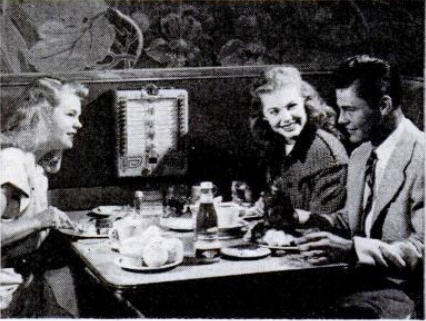
Even into the 1940s and beyond, restaurants were eager to let patrons know that they used brand-name food products. “Brag About Brands” because it gives the customer confidence, suggested the New York Restaurant Association in 1946. Manufacturers — and their advertising agencies – continued to rely upon nationally known restaurants to give products name recognition and cachet. Heinz advertised extensively in the mid-20th century, with photographs showing patrons at restaurants such as Bookbinder’s in Philadelphia and the Brown Derby in Los Angeles using their catsup.

© Jan Whitaker, 2011

3 Comments

Filed under restaurant customs