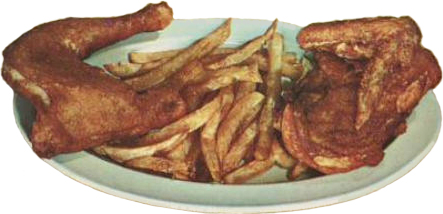
Why the parsley garnish?

parsleyNchicken

Nothing decorated more restaurant plates in the 20th century than parsley, most of it by all accounts uneaten.

Why use so much of what nobody wanted? The best answer I can come up with is that parsley sprigs were there to fill empty spaces on the plate and to add color to dull looking food.

Parsley was not the only garnish around, but it has probably been the most heavily used over time. It has shared the role of plate greenery with lettuce, especially after WWII when lettuce become readily available, and to a lesser extent with watercress.

Parsley has long been a favorite in butcher shops where it is tucked around steaks and roasts. As early as 1886 restaurants were advised to emulate butchers and decorate food in their show windows with “a big, red porterhouse steak, with an edge of snow-white fat, laid in the center of a wreath of green parsley.” By the early 20th century, almost the entire U.S. parsley crop, more than half of which was grown in Louisiana and New York, went to restaurants and butchers. By 1915 parsley sprigs were a ubiquitous restaurant garnish that many regarded as a nuisance. Diners sometimes suspected that the parsley on their plate had been recycled from a previous customer.

While European chefs use garnishes as edible complements to the main dish, Americans have focused primarily on their visual properties.

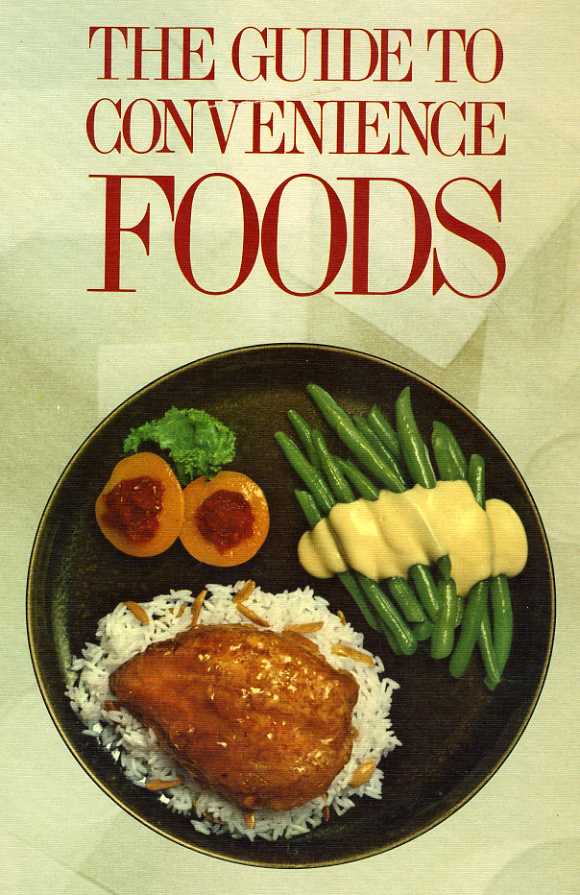
parsleyGuidetoConvenienceFoodscvrAround 1970 when convenience foods invaded restaurant kitchens, garnishes took on heightened significance in jazzing up lackluster, monochromatic frozen entrees. In the words of Convenience and Fast Food Handbook (1973),“The emergence of pre-prepared frozen entrees on a broad scale has revived the importance of garnishing and in addition, has led to innovative methods of food handling, preparation and plating. If an organization is to achieve sustained success in this field, emphasis must be placed on garnishing and plating. These are the two essentials that provide the customer with excitement and satisfaction.” [partial book cover shown above, 1969]

Excitement?

parsleyNOThe head of the Southern California Restaurant Association admitted in 1978 that he hated to see all the food used as garnishes go to waste in his restaurant, including “tons” of lettuce. But this was necessary for merchandising, he said: “We have to make food attractive. It’s part of the cost of putting an item on the table.” It was – and is – probably true that an ungarnished plate such as shown here looked unattractive to most Americans.

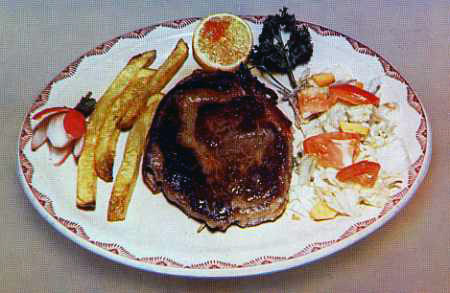
parsleyNfiletmignon

So many garnishes decorated food in American restaurants in the 1970s that food maestro James Beard got very grumpy about it, calling it stupid and gauche. He could allow watercress with lamb chops or raw onion rings on a salad, but put a strawberry in the center of his grapefruit half and he was outraged. Next to orange slices and twists, his most detested “tricky” garnishes were tomato roses and flowers. Funny that he didn’t mention radish roses such as the one shown above.

© Jan Whitaker, 2008, revised 2015

17 Comments

Filed under food, restaurant customs

Early vegetarian restaurants

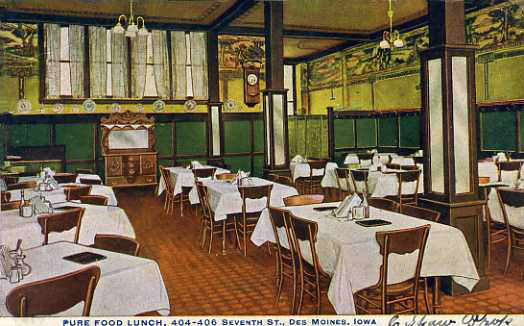
vegetarianpurefood880

As early as the 1830s in the U.S., the Graham Journal of Health and Longevity espoused a regimen called “Nature’s Bill of Fare.” It advocated meatless meals that contained no more than three different articles of food, and no desserts, condiments, or beverages except water. Diners were to eat at precisely the same time each day and chew very thoroughly. Needless to say, the “Grahamites” were very much at odds with the majority of Americans who expected to eat meat three times a day.

Some of the followers of Sylvester Graham lived in special boarding houses where no meat was served, but it wasn’t until the 1890s that the first public vegetarian restaurants appeared in this country.

The first was the well-named “Vegetarian Restaurant No. 1” opened on West 23rd Street in New York City in 1895. It was sponsored by the New-York Vegetarian Society, which did not tolerate either taking life for food or drinking alcohol.

One of the co-founders of No. 1 was its manager Louise Volkmann, a remarkable 50-year old German-born woman who was active in the women’s suffrage movement, the labor movement, and the peace movement, as well as being a music teacher and a volunteer in prisons and hospitals. However, not even such a force of nature as Louise could make the restaurant succeed. It closed due to insufficient patronage in less than a year.

vegetarianrestOutWest1902

VegetarianCafeteriaLA

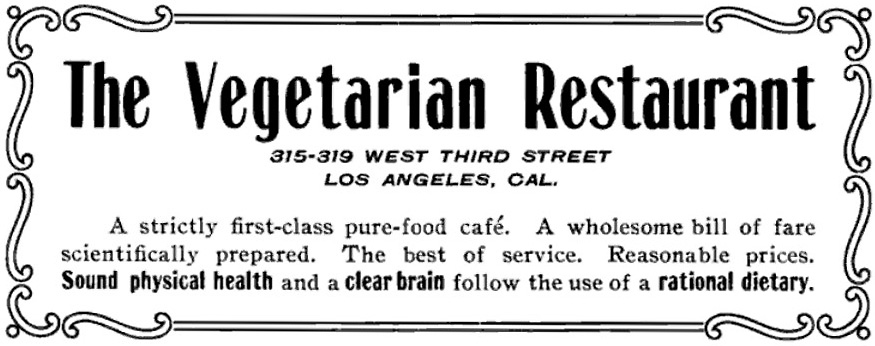
By 1899 a few more vegetarian restaurants had opened around the country. In Minneapolis a restaurant operated by two partners, Peterson and Mataumura, made the concession of supplementing the menu of Vegetable Turkey and a roast made of crushed nuts with a few meat dishes for non-vegetarians. Detroit and Boston also had restaurants catering to vegetarians, while San Jose actually had two, one of which also accommodated meat eaters. Detroit’s vegetarian café evidently was vegan; its macaroni was served with nut paste rather than cheese and its eggs were made of cereal or nuts and served boiled, curdled, or scrambled with lemon or, presumably fictitious, “cream.” [illustration of Los Angeles’ Vegetarian Cafeteria, ca. 1910]

Many of the early vegetarian restaurants served nut and grain-based food products – Granose, Nuttose, Wheatose, and others made by the Battle Creek Sanitarium Health Food Company in Michigan. Well-off people, not necessarily all vegetarians, would sign up for a stint at the Sanitarium to improve their health. A vegetarian dinner there in 1900 featured items with remarkably unattractive names such as Gruel, Dry Gluten, and Protose Salad.

vegetarian1912Cleveland

The vegetarian movement and its restaurants got a boost from rising meat prices and stockyard scandals shortly after the 20th century began. A 1904 directory listed 57 vegetarian restaurants nationwide, and the passage of the Pure Food and Drug Act in 1906 encouraged more to open. New customers mobbed vegetarian restaurants while eating places of all kinds added meatless dishes such as spaghetti and omelets to their fare, an exercise they would repeat under the austerity measures of World War I. Up to and during the war, vegetarian cafes flourished and chains began to form, such as the Physical Culture Restaurants in New York, with branches in Boston, Philadelphia, Pittsburgh, Buffalo, and Chicago. In addition to the Battle Creek connection, a number of pre-WWI vegetarian restaurants were connected to the Seventh-Day Adventist religion.

Often going under names such the Hygienic Restaurant or the Pure Food Restaurant, a typical vegetarian restaurant menu of 1902 or 1903 might have included selections such as these from Chicago’s Mortimer Pure Food restaurant:

Asparagus on toast, 15
Roosevelt [vegetable] cutlet, with mushroom sauce, bread and butter, 20
Poached eggs, with rice and currie sauce, bread and butter, 25
Spinach, with poached eggs on toast, 25
Broiled new potatoes on toast, 20
Spaghetti a la Mortimer, 10
Broiled fresh mushrooms on toast, 25
Baked beans, 10

Burl's1950sLA2How well vegetarian restaurants fared in the 1920s is unclear. The Childs restaurant chain, by then a public corporation, embraced vegetarianism briefly but changed its policy after its stock prices dropped in response. On the other hand, restaurant industry leader Myron Green, a Kansas City cafeteria proprietor, claimed in 1928, somewhat unbelievably, that meat eaters constituted less than 25% of food service patrons. In the early 1920s Los Angeles added two raw food restaurants and a Sephardic Kosher café to its list of meatless eating places. Also in this decade, a chain of vegetarian cafeterias appeared in the South, including one in Knoxville TN. In New York City Herman and Sadie Schildkraut operated a vegetarian hotel in the 1920s and by 1933 were directors of Schildkraut’s Vegetarian Food Emporiums, headquartered at 225 W. 36th.

Although meat rationing during World War II would bring back menus featuring vegetable plates, the vegetarian movement would not experience another boom until the counter-culture-inspired food revolution of the 1970s.

© Jan Whitaker, 2008, revised 2015

29 Comments

Filed under alternative restaurants, food

Famous in its day: Blanco’s

blanco'scafePC

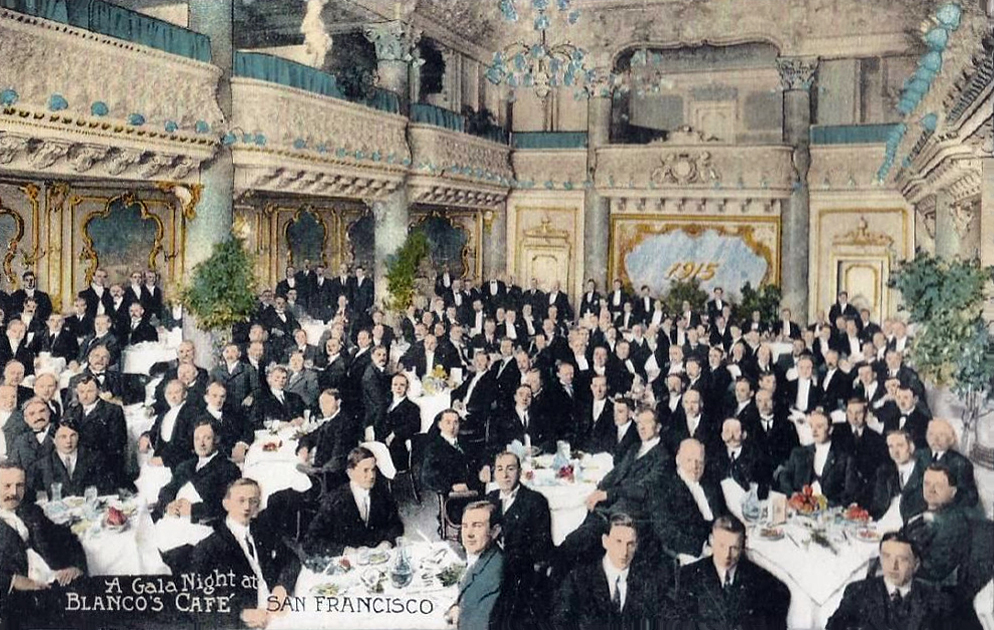
Blanco’s Café was one of San Francisco’s luxury restaurants of the early 20th century. Among the very first restaurants to open after the catastrophic earthquake and fire of 1906, it made its debut on November 7, 1907 at 859 O’Farrell Street.

It soon became a popular place for banquets, one of which is depicted in the 1915 postcard shown above. Typically such banquets were all male, often being made up of members of professional and cultural societies. Blanco’s was also a favorite after-theater spot for men and women who enjoyed a “cold bot and hot bird” as a light supper of champagne and quail was referred to in those days.

Its owners and managers were mostly old hands in the restaurant business, Italians and Germans led by a Spaniard, Antonio Blanco, who had been born in Malaga. Blanco’s reputation was built upon his pre-fire restaurant, The Poodle Dog, which he re-established a short time after opening Blanco’s. Two of Blanco’s managers had previously been at Delmonico’s restaurant in San Francisco, another victim of the fire.

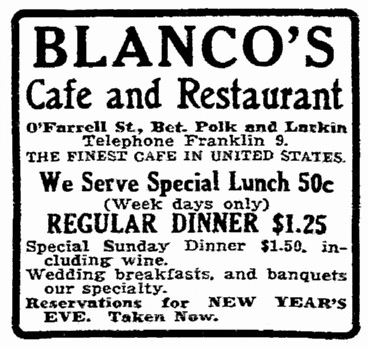
blanco'sDec1914The city’s newspapers were effusive about Blanco’s when it opened, gushing over its Louis XIV entrance hall, marble pillars, murals, and chandeliers. The café’s first chef came from The Poodle Dog, while the dining room manager had earned his exalted reputation at Tait’s and the St. Francis Hotel. All in all, Blanco’s was “a temple of art and beauty” destined to become the envy of caterers around the world. In 1914 Blanco’s boldly advertised that it was “the finest café in the United States.”

Naturally it classed itself as a French restaurant, French cuisine being synonymous with the good life – and the only kind that could command a high price then.

Blanco’s continued in business until 1933 but not without problems. In 1917 a plan to add two stories to the restaurant was abandoned, perhaps because of the looming nationwide ban on the sale of alcohol. Prohibition in 1919 was indeed a blow to fine dining establishments such as Blanco’s. The restaurant blithely advertised in 1919, “Good-bye to good old wines. Good-bye to good old times. But good eats will remain.” But it was becoming increasingly difficult to operate a high-living restaurant in the style Blanco’s was accustomed to. In 1921 its manager was arrested for not keeping a register of transient guests at Blanco’s Annex, the hotel next door which the restaurant had constructed in 1908 and opened the next year.

Few San Franciscans would have failed to realize the significance of this infraction, even if they did not recall Blanco’s “scandal” of 1912. In July of that year a Sausalito woman hired detectives to shadow her husband who was enjoying a romantic dinner at Blanco’s in the company of another woman. Spotting the detectives but not knowing who was under surveillance, Blanco’s manager went from table to table notifying all the guests of the detectives at work. Numbers of couples made a quick exit from the back door. Needless to say, the privacy curtains on the mezzanine booths shown in the ca. 1915 postcard were more than merely decorative.

Yet, despite all, Blanco’s carried on and was recommended in San Francisco guide books of the 1920s. It is ironic that it made it through Prohibition yet failed just as alcohol was becoming legal once again in 1933.

In 1934 the contents of both the restaurant and hotel were sold off, including fine china, silver-plated cutlery, tapestry panels and hangings, 40 copper stock pots, French furniture, bronze statuary, and 140 Viennese arm chairs.

blanco'smusicboxpostcard

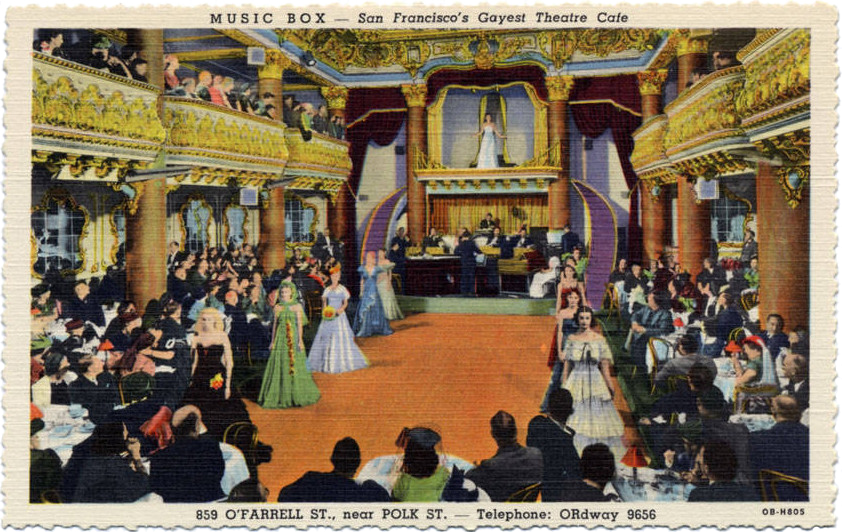
In October 1935 the restaurant reopened as The Music Box, a supper club under the direction of stripper and “fan dancer” Sally Rand. It had been partially modernized. Murals were replaced with mirrors and many other decorations by artist Attilio Moretti had been removed. Ruth Thomas, co-author of Eating Around San Francisco (1937), reported that she was given a tour of the Music Box and saw Venetian glass chandeliers and life-sized plaster statues of women in a basement storeroom.

blanco'sGreatAmericanMusicHall

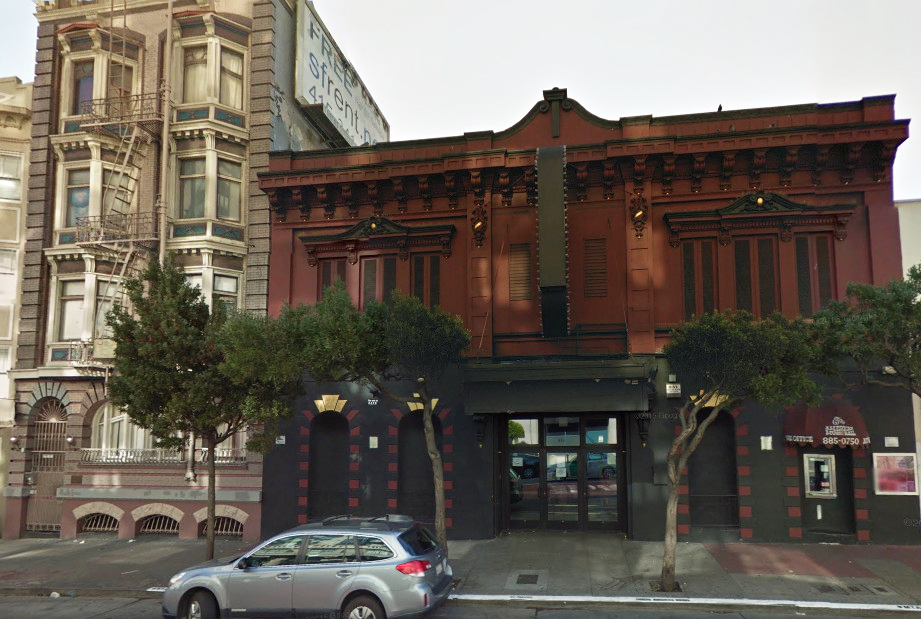
The chandeliers and some of the murals were restored, possibly during the late sixties when the building was occupied by the Charles Restaurant. Today the building still stands and is in use as the Great American Music Hall. [Photo shows the altered restaurant building front, much of it bricked in including the large center window above the door which now supports a sign; the building to the left was Blanco’s Annex hotel.]

© Jan Whitaker, 2015

4 Comments

Filed under elite restaurants

Blue plate specials

blueplateDuring the 1920s and 1930s the blue plate lunch and dinner thrived. The first blue plate special reference I have found is in 1915. A railway running between Bradenton FL and Washington D.C., the Seaboard Air Line Railway, announced that year that they would begin offering a daily special of either meat or fish served on one plate with two vegetables.

The simplicity of the meal, with fewer food items on fewer pieces of china, turned out to be  highly congruent with suggested government cutbacks that arrived with World War I urging restaurants to conserve on all aspects of their operations.

After the war the blue plate special continued to be popular because it was a workable compromise between the needs of a fast-paced urban society and the legions of consumers accustomed to eating a meat-and-potatoes “dinner” at noon. Though resembling a home-style dinner, the blue plate meal was lighter and faster to serve up than its predecessors. Consisting of less food, it required less time for digestion and kept office workers from getting that “siesta” feeling in the afternoon.

blueplatespecialSpfld1930

Its billing as “home cooking” communicated that it was not ethnic cuisine as were meals in table d’hote restaurants run by immigrant Americans. Beef and gravy, pork chops, ham, mashed or fried potatoes, carrots, and green beans were typical on blue plates. [June 1, 1930, special at the Merry Eating Luncheonette, Springfield MA]

In previous eras a “regular dinner” or table d’hote restaurant meal would have arrived parceled out on many plates, saucers, and side dishes. Cutting down both on china and dishwashing as well as server time, the blue plate dinner or lunch was usually offered as an economy meal typically costing about 35 to 50 cents, a moderate price in the post-WWI inflationary economy. Blue plate specials were attractive to restaurants because they permitted them to make use of a good buy or get rid of food stocks on the verge of going bad. The tradeoff was that often the diner had little choice regarding the meal’s composition.

blueplatespecialBoston1940Since the meals’ components were cooked prior to lunch and dinner rushes and kept warm on steam tables, they could be served quickly, saving time for patrons and increasing turnover for the establishment. Of course steam tables took their toll. That one-plate specials were not always the finest is suggested by a 1930 guidebook which commends The Alps restaurant in NYC by noting that their blue plate dinners “are more than mere collections of edibles, served en masse.”

One-plate meals continued into the 1940s and after WWII  but the term “blue plate” was beginning to sound old-fashioned and was used mainly in smaller towns. Stodgy one-plate meals became material for humorists. In 1952 columnist Hal Boyle lampooned the blue plate luncheon “engulfed in gravy,” characterizing it as an “all-America culinary nightmare.” “I take it to the hotel I am staying at and use it instead of soap for a shower,” he wrote. “I rub it on my head as a shampoo.”

© Jan Whitaker, 2008, revised 2015

7 Comments

Filed under restaurant customs

Basic fare: club sandwiches

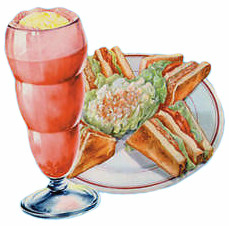
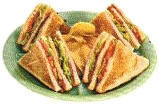
clubsandwichCOLORAmong sandwiches, the club sandwich stands out by having a strong association with restaurants for more than a century. It was not often eaten at home and probably still isn’t. It is unusual, too, in that it was considered both delicate and hearty, making it a favorite with men and women alike when it became popular in the 1890s.

Its versatility included being appropriate for almost any time of day. It was considered an excellent late-night supper, good with beer, healthful, refreshing in hot weather, and perfect for ladies’ luncheons. The sandwiches appeared widely on menus – in hotel and department store dining rooms, after-theater restaurants, men’s grills, railroad dining cars, and tea rooms.

clubsandwichADVSpfld1913

The origin of the word club, which still gives it a certain cachet, is a mystery. One account attributes the creation of the sandwich to an engineer who introduced it to his “lunch club” cronies on a day when they were suffering from hangovers, but the occasion seems to have taken place years after the sandwich had achieved recognition.

For instance, at least five year earlier, shortly after the Palm Tea Room opened in New Haven’s Edward Malley store in 1898, an advertisement notified customers that in addition to ham sandwiches and chocolate eclairs, several items “New to New Haven” were available, among them Club Sandwiches at 15 cents each.

clubsandwichADVBatonRouge1914By 1900 the sandwich’s form and composition were largely standardized. It was made with three slices of toasted white bread, spread with mayonnaise, layered with thinly sliced chicken, bacon, tomato, and lettuce, and cut twice diagonally into wedges. Fresh tomatoes were not always available inexpensively year round, so the full-scale club sandwich may have been a seasonal specialty until after WWII. Other variations included ham instead of bacon and turkey instead of chicken; crusts could be trimmed off for a daintier appearance.

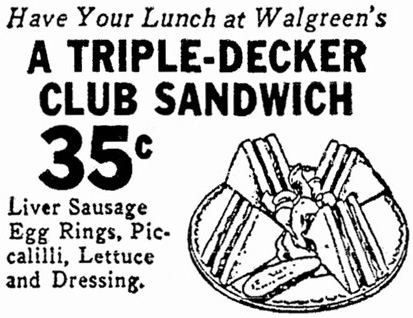
clubsandwichADV1934Over time almost anything could be used to fill a club sandwich, but few variations on the classic combination endured. In 1935 Walgreen’s offered one made of liverwurst, perhaps reflecting that it was the Depression.

Club sandwiches recommended themselves to lunch rooms by their good profit margin. The Childs’ restaurants, the largest chain of the early 20th century, found in 1910 that it could prepare a double-decker club for 4.6 cents and sell it for 20 cents. It went for the same price at drug stores which began adding it to their soda fountain menus. Its popularity at soda fountains was also reflected in the creation of an ice cream club sandwich made in a special mold. The trade journal National Druggist reported in 1911 that in terms of sales the novelty was “a wonder.”

The club sandwich was given a reprieve during the government’s food prohibitions of World War I. Initially targeted along with meat pies and liver & bacon because it contained more than one kind of meat, the ban was quickly lifted.

Another obstacle club sandwiches faced seems truly quaint today. Judging from the number of times women sought advice from newspaper etiquette columns on how to eat them in the 1920s and 1930s, many of them found the club sandwich embarrassing to eat in public. Should they pick it up or eat it with a knife and fork? Strangely – and unimaginably – the latter method was advised.

ClubSandwichwoolworth67But it overcame these minor problems. In the 1920s commercial bakers produced a bread specially made for club sandwiches in restaurants. It was a square “cream bread” with a thin crust, meant for toasting, and sized a bit larger than the smallest sandwich loaves.

Though scarcely considered exciting today, the club sandwich has become a menu classic that can be ordered almost anywhere.

© Jan Whitaker, 2015
9 Comments

Filed under food

Gossip feeds restaurants

gossip1927gossipHeddaHopper3

O. O. McIntyre, a popular columnist who authored “New York Day by Day,” advised his readers in 1925 that anyone wishing to open a “swank” New York restaurant and establish a smart reputation from the start should get prominent people and theater stars to patronize it. “The rest,” he wrote, “is up to the cafe’s press agent.” He might have added, “and gossip columnists.”

By revealing glimpses into the lives of the rich and famous, gossip columnists like McIntyre, working with restaurants’ press agents, played a crucial role in the publicity system that made New York’s restaurants and nightclubs household names across the nation. The same was true of Hollywood’s night spots, particularly in the 1930s and 1940s. Columnist Leonard Hall wrote in 1937, “As restaurants, Hollywood’s famed eating houses are little more than golden shambles, which exist that stars may see and be seen.”

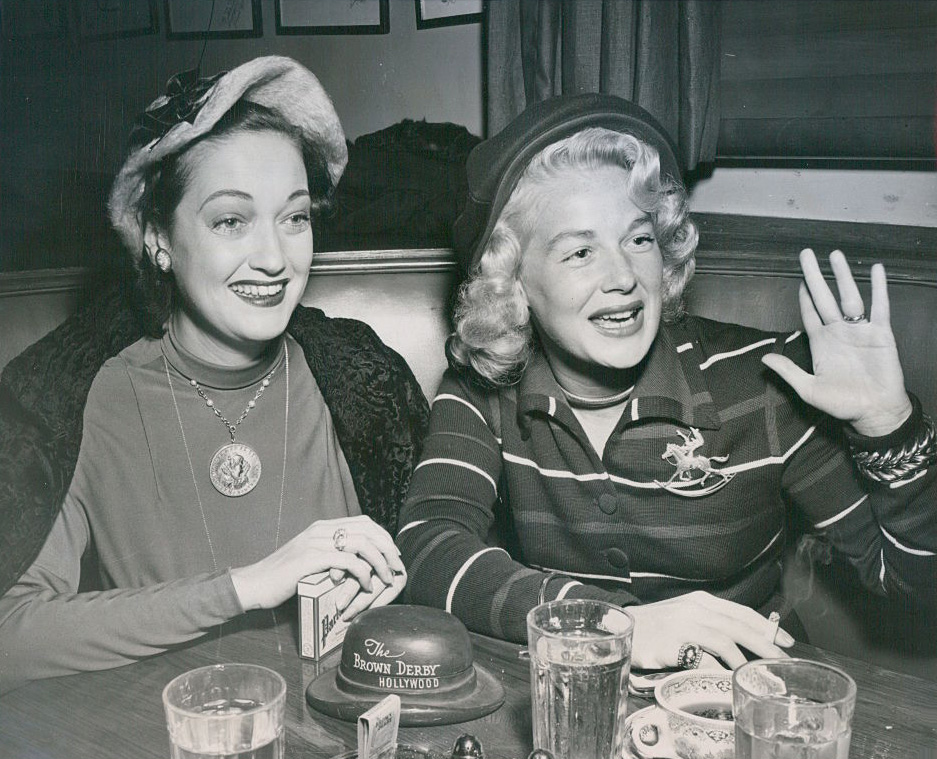
gossipBrownDerbybettyHuttonDorothyLamour1949

Columnists might sometimes focus on a restaurant’s food, decor, or proprietor, but their main subjects were clearly its celebrity customers. Who was s/he with? What was she wearing? Romances brewing? Was anyone getting the cold shoulder, a divorce? Were their stars rising or falling? [Above Dorothy Lamour and Betty Hutton smile wanly for the camera at the Brown Derby]

The main thing, though, was just to get the names before the readers’ eyes. Typically the columns delivered short bursts of mundane info, each bit separated from the next by an ellipsis (. . .). A sample from Lucius Beebe’s “Faces Around Town,” 1938: “Burgess Meredith having early dinner with Frank Shields at Jack and Charlie’s before going to the theater . . . Henry Luce and Claire Luce, ditto, but indicating marital individualism by commanding different entrees – she pompano meuniere, he chateaubriand and German fried potatoes . . .”

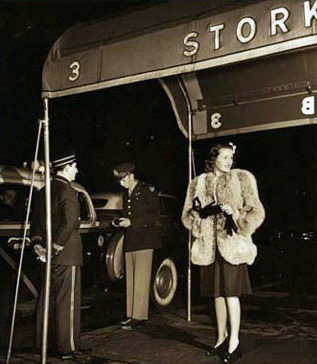
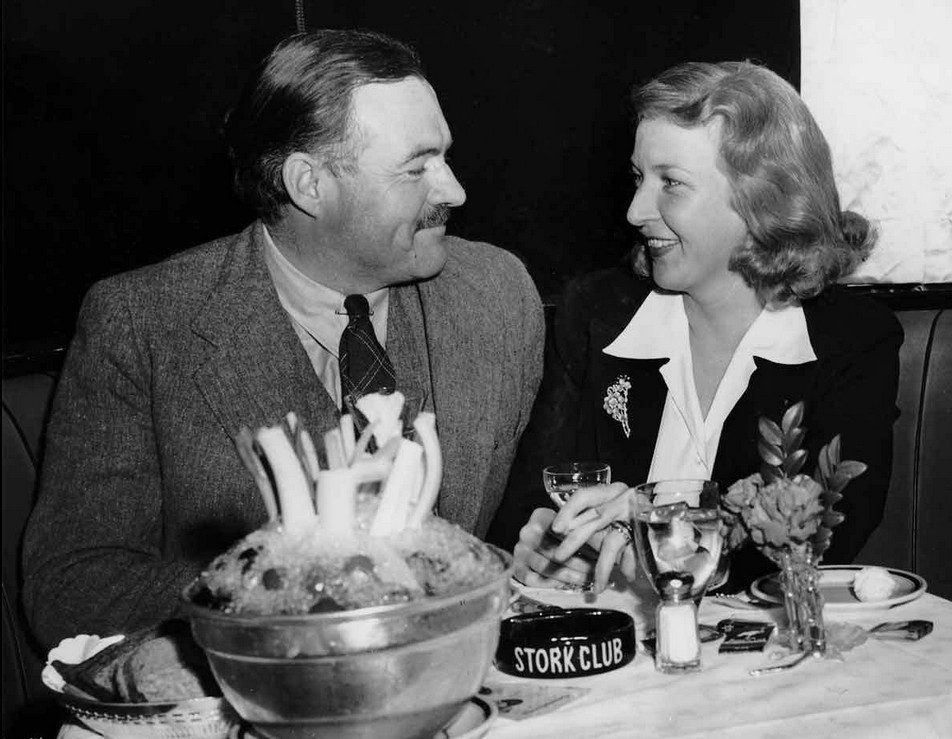
Mid-century spots such as the Stork Club, El Morocco, the Colony, and Jack and Charlie’s ‘21′ in NYC; Hollywood’s Brown Derby, Trocadero, and Ciro’s; and Chicago’s Pump Room were a few of the top restaurants and clubs that played the gossip game. Parlaying gossip was standard practice at the glamour palaces, so much so that the elegant and expensive Voisin on Park Avenue, which also refused to advertise, was noted for having NO gossip columnists holding court at its tables.

gossipStorkClubColumnists were influential. Sherman Billingsley, proprietor of the Stork Club, credited Walter Winchell with making his club successful. Winchell, who operated out of the Stork from his own table, enjoyed a privileged position in the gossip business and at the club whose upstairs barber shop was at his disposal. In the 1960s a short blurb by Dorothy Kilgallen put Elaine’s on the map, according to its proprietor, the late Elaine Kaufman.

Restaurants, celebrities, and columnists profited mutually from gossip. In New York the featured subjects were people with power, café society, theater actors, and literary figures; in Hollywood they were film stars needing to propel their careers. Restaurants living up to the boast, “A gossip columnist guaranteed under every table,” were appreciated by show biz figures. Newspapers and fan magazines regularly ran photographs of stars arriving at a posh restaurant or of couples smiling from their tables. When a new restaurant or nightclub opened the owner hired a press agent to round them up. They dropped by, posed with the owner, and circulated, in a constant routine that kept their faces and names before the public and added glitz to the restaurant. El Morocco found the publicity generated by an opening night so valuable that they held one every year.

gossipErnestMarthaHemingway

Sometimes restaurant owners would even subsidize patrons from film and stage. At Sardi’s, where as late as the 1960s “one well-timed exposure . . . [was] worth more to a burgeoning career than a whole picture series in a fan magazine,” actor Jose Ferrer dined for months on account before attaining success in his role as Cyrano de Bergerac. “Prince” Mike Romanoff, whose own restaurant would one day become a den of celebrity gossip, had enjoyed free meals at Chasen’s in his early days in Hollywood. [Above Ernest Hemingway and his wife Martha]

All the roles were fluid. Hedda Hopper acted before she took up the pen. But perhaps the best role optimization occurred when columnists became celebrities and used their own activities as subject matter. Journalist Christopher Morley wrote about the doings of his lunch clubs while putting the spotlight on NYC restaurants such as Christ Cella’s.

Gossip columnists still operate but their work became less valuable to restaurants and celebrities with the arrival decades ago of newspaper restaurant reviews and television talk shows and, more recently, social media.

© Jan Whitaker, 2015
1 Comment

Filed under guides & reviews

Image gallery: business cards

businesscardRestaurants began using business cards back as far as the 1840s, but most of the early ones in the antiques and collectibles market date from the 1870s and 1880s. Although they are referred to as Victorian trade cards that people saved in scrapbooks, they are essentially business cards that give the restaurant’s name and address, sometimes with a short menu on the back side. I present here some of my favorites, from the late nineteenth century up to today. [above, a ca. 1950s die-cut card] These are some good ones “we think” (see Tom’s Drive-In below).

businesscards870

businesscard2The Senate Cafe, ca. 1915, was almost certainly a drinking spot first and foremost but the dour Mr. Smith probably provided the boys with light refreshments too.  — From around the same time or a little later, Boldt’s, Seattle. The “Cosy Boxes” were for baked goods to take home.

businesscards875

businesscards871

 businesscards869

BusinessCardNEWHouseCarLunch

businesscards872

BusinessCardTom'sDrive-in

Below: cards I’ve picked up in recent years. Clockwise from top left: Northampton MA; Webster Groves MO; City Cafe, Rochester MN; Girl & the Goat, Chicago [turned on end to fit]; Greenfield MA; NYC.

businesscards874© Jan Whitaker, 2015
2 Comments

Filed under restaurant customs

Restaurant row

restaurantrow864

Search for the words “restaurant row” in old newspapers before WWII and you will become convinced that a restaurant was a prime spot to be stabbed or clobbered by flying crockery. Not as dangerous as a barroom, but close.

The other meaning and pronunciation refer not to a fight but to a happier state of affairs, namely a street lined with restaurants that has become a popular destination for diners.

restaurantrowChicago1909

The earliest use of the term I’ve found is a 1909 reference to Chicago’s Randolph Street where 39 busy restaurants lined up on a six-block stretch [illustrated]. A bit later Chicago’s Wabash Ave. was known as cafeteria row, reportedly aggregating the largest number of self-service restaurants in the world, while Clark Street with all its lunch rooms was nicknamed “toothpick row.”

The reason restaurants group together is not hard to see. As was true for downtown department stores that occupied several corners of a single intersection, groups of the same kind of businesses attracted flocks of customers who knew they were likely to find something they wanted. In the early 20th century, when chain restaurants were becoming common, lesser known restaurants were eager to locate near the winners to catch their overflow.

It’s also a marketing ploy. City officials may declare a street Restaurant Row to help boost the local economy, as NYC mayor John Lindsay did in the depressed 1970s with West 46th Street between 8th and 9th.  Actually New York had — and has — many restaurant rows, as is true of other large cities. Perhaps NYC’s first was Park Row in lower Manhattan where hungry politicians and newspaper workers crowded into Dolan’s, home of “beef an’” [corned beef and beans], which anchored the street’s concentration of lunch rooms.

RestaurantrowRichlor'sLos Angeles’ restaurant row on La Cienega Boulevard [illustrated at top] probably achieved more celebrity than did those of any other cities. Coming into prominence with the end of Prohibition in the 1930s it presented a mix of swanky restaurants and nightclubs alight with neon signs. In 1947 the row, centered at Wilshire and La Cienega, was enough of an attraction to inspire Southwest Airlines to offer a weekend jaunt built around it. One of the earliest restaurants in the row, Lawry’s The Prime Rib, established in 1938, continues today. Its owners also operated other La Cienega hotspots, Richlor’s [illustrated] and Steer’s.

Although the 1960s and 1970s were decades of decline on Los Angeles’ restaurant row, it made a comeback in the 1980s and continues to attract visitors today.

restaurantrowFramingham1965It didn’t take long for other cities, even small towns and suburbs, to realize that promoting a restaurant row was a way to bring people to town with money to spend. Restaurant rows with as few as four or five eating places began to advertise their attractions. [Route 9, Framingham MA illustrated]

With the spread of fast food eateries in the 1960s, people began to refer to fast-food rows where pizza, fried chicken, and burger emporiums clustered together. Competing chains kept a close eye on where McDonald’s opened, figuring the fast-food leader had chosen well after conducting extensive research on demographics and traffic patterns.

© Jan Whitaker, 2015
5 Comments

Filed under restaurant customs

At the sign of the . . .

TavernsignsWalker'sTavernEarleTaverns and inns of the Colonial and Early American eras were ancestors to hotels, providing the all-important trio of beds, food, and alcoholic drinks. But they also supplied inspiration to eating places in later centuries, particularly tea rooms and, to a lesser extent, steak houses.

One of the most prominent features of taverns were their signboards. Borrowed from England and Europe, they depicted images of military heroes, courtly symbols, and local landmarks, with names to match. Animals of various colors were especially popular such as the White Swan, the Golden Horse, the Black Bear, or the Red Lion.

TavernsignsCTOldLion

Taverns actually had dual names, the proprietor’s and that of the image on the sign. Signs were linked to a place. Proprietors might move from tavern to tavern but signs stayed where they were. For example, a Boston tavern keeper of the 1760s named Francis Warden advertised that he kept a “public house of entertainment” at the sign of the Green Dragon. Earlier he had been at the Blue Anchor.

Tavern signs have often been admired for their originality, but even in the 18th century they were stereotyped. Artists who painted them often advertised that they had a stock of signs on hand and ready to go except for the lettering. This undoubtedly accounts for the many taverns called The White Horse, The Beehive [illustrated above], The Three Crowns, or The Bunch of Grapes.

tavernsigns1784NYCBy the start of the 19th century the reign of taverns was slowly coming to an end and being replaced by larger hotels. The decline of the tavern was hastened by the temperance movement in the 1830s and 1840s which saw them as dens of iniquity. A temperance advocate suggested tavern signs should bear truthful names such as “The Widow and Orphans Manufactory” or “The New England Rum Pit.” As towns outlawed the sale of liquor, many old tavern signs were pulled down and replaced with signs saying Temperance Hotel.

As taverns declined, nostalgia began to develop for their Days of Olde when jolly hosts greeted guests and ushered them inside to sip hot toddies at the fireplace. Books and newspaper stories appeared describing quaint tavern signs and names of yesteryear. Historical societies became interested in preserving the increasingly scarce old signs. A Boston lodge of the Masons fraternal organization which had been founded in The Bunch of Grapes acquired two of the four carved wooden bunches in 1883 and locked them away in a steel vault. A collector in Pennsylvania treasured a sign he discovered in the 1890s that had been painted in 1771 by famous English artist Benjamin West.

TavernSignsold100TeaRoomWomen, particularly those New Englanders who could trace their ancestry to Colonial times, became supporters of the preservation of American antiquities. Newly possible car travel encouraged them to explore former taverns in the countryside. Next they began to open tea rooms that celebrated Early America, many with names and signs from tavern days. It was as though taverns had returned, clean, ultra-respectable and without liquor and drunkenness. Tea, after all, was known as “the cup that cheers but does not inebriate.”

tavernsignstabbycatwenhamMAOne feature that did not survive was the political statement tavern signs had made back in the days when their keepers sided either with the British crown or the rebellious patriots. Another oddity was how many tea rooms adopted names that incorporated the words “At the Sign of” – preceding “the Green Kettle,” “the Golden Robin,” etc. Where a tavern of 1800 advertised it could be found “At the Sign of the Seven Stars,” a 20th-century tea room, had it used the same style of advertising, would have had to say it was “At the Sign of At the Sign of the Seven Stars.” The sign of At the sign of The Tea-Kettle and Tabby Cat adorned a tea room in Wenham MA.

tavernsignscornishNH858

The sign for the Tea Tray, a tea room in Cornish NH, was painted by Maxfield Parrish and shows much more detail than old tavern signs would have included.

In the 1960s and 1970s some steak houses also adopted a tavern theme, with names such as Steak & Ale, Bird & Bottle, or Cork & Cleaver, but only as a superficial concept that did not include revival of old-fashioned signboards.

© Jan Whitaker, 2015
3 Comments

Filed under signs

“Atmosphere”

atmosphereschaber1941I put the word in quotation marks to acknowledge that what atmosphere in restaurants means is as elusive as air itself — which the word also refers to. It was often used to describe eating places in the 19th century, but not in a flattering way. A typical usage is that from 1868 where someone remarked that in a certain restaurant “the atmosphere is heavy with cooking vapors.”

The term atmosphere (or ambience, which came into use in the 1970s) became used in a more general way to describe the character of a restaurant – that intangible spirit of a place. The broader meaning could encompass an air that was sophisticated or homey, rowdy or relaxing, masculine or feminine, formal or casual, etc. I discovered a 1950s restaurant that claimed to have “Christian atmosphere” with home cooking by a Mrs. and “No Beer, Liquor or Smoking.”

In the 1890s the more general meaning almost always referred to the kinds of people associated with a restaurant, both owners and patrons. For example sawdust on the floor, pictures of athletes on the wall and the presence of prostitutes signaled a thoroughly masculine atmosphere while the presence of artists and writers in French, German, or Italian table d’hotes shouted “bohemian!”. A jolly host could also impart atmosphere, which might be altogether missing if he weren’t on hand, or if his most colorful patrons failed to show.

AtmosphereRomanyMarieSummer1921It didn’t take long before restaurant owners realized they could appeal to new patrons by bragging about their “atmosphere,” especially if it was bohemian. A San Francisco restaurant announced that it attracted “artists, writers, musicians, poets, painters, singers, draftsmen, balladists, literati and newspaper writers.” In 1903 NYC’s Elite Rathskeller Restaurant ran an advertisement claiming to have “Refined Bohemian atmosphere,” which sounds like a contradiction in terms since bohemians were supposed to be carefree souls who violated everyday norms of propriety.

The next step for restaurateurs was to merchandise atmosphere by generating it themselves. Since it seemed that so many people wanted to gawk at bohemians, why wait for them to show up if you could entice them with free dinners? Allegedly some restaurants did just that.

atmosphereVentureTeaRoomPhila

After World War I, following the reign of bohemian restaurants, came a new type of atmospheric eating place, the tea room of the 1920s. The tea room’s special atmosphere was  quaint and homey with artistic touches. In 1922 the Journal of Home Economics pronounced that “The very name of Tea Room has grown to mean a place with ‘atmosphere’ and with furnishings that are unique.” Ranging from the fashionable to the playful, tea rooms proved that women – their primary patrons – were in love with atmosphere.

atmosphere1918FlintMIBucking the trend toward atmospheric decor were a handful of holdouts. Anything like a “restaurant atmosphere” was anathema to a Y.M.C.A. cafeteria in Flint Michigan (1918). The Old Colony Coffee House in Richmond VA renounced “ordinary restaurant atmosphere” in 1924 and vowed it would have instead “simplicity in decorations” and “plainness in food.” Patrons of traditionally masculine restaurants feared that when Chicago’s J. R. Thompson’s tore out its white tiles for a more feminine look it had destroyed its no-nonsense atmosphere and gone “girly girly.” Likewise, design critic Lewis Mumford shuddered when the Childs’ chain replaced the “antiseptic elegance” of its “hospital ward atmosphere” for “fake fifteenth century English,” betraying the honest utilitarianism of the Machine Age. No doubt Mumford chuckled when Alice Foote MacDougall, queen of scenographic Spanish villas and French chateaux in NYC, went bankrupt in 1932. [see The Cortile below]

atmosphereCortile

In the 1950s there was still a tendency in the restaurant industry to see women as the constituency for atmosphere while men supposedly judged a restaurant first by its food quality. But by the 1960s this was no longer true, as indisputably demonstrated by the success of Polynesian restaurants. An executive of the National Restaurant Association (NRA) said that Americans’ demand for atmosphere had raised the cost of opening a restaurant to $4,000 a seat in 1962.

One of the early chains built around atmospheric theme restaurants was David Tallichet’s Specialty Restaurant Corporation in California. In 1965 the firm opened Gate of Spain, capturing the “atmosphere of old Castile” atop a tall building in Santa Monica. Restaurant industry consultant George Wenzel recommended the following year that restaurateurs “give your guests something to do or something to see, or something to make conversations about.” He suggested creating a Gay Nineties or a river boat atmosphere.

In the 1970s theme restaurants came into their own, classified by the NRA as one of three of the basic types of restaurant in 1976, and the one that drew the most affluent guests.

© Jan Whitaker, 2015

5 Comments

Filed under atmosphere, restaurant decor, theme restaurants, women