Category Archives: restaurant customs

“Waiter, telephone please!”

As one year ends and another begins, it’s a good time to think about what’s old and what’s new. For example, talking on a phone at the table in a restaurant seems a new-ish kind of activity. Of course you realize that I’m going to tell you it isn’t.

Even though the telephone was invented in the 1870s, it took a while for it to become an everyday necessity. So it was still newsworthy when restaurants began to provide telephone service at patrons’ tables in the early 1900s. The customer had only to say to the waiter, “Bring me a telephone,” and it would be placed on the table and plugged into a jack.

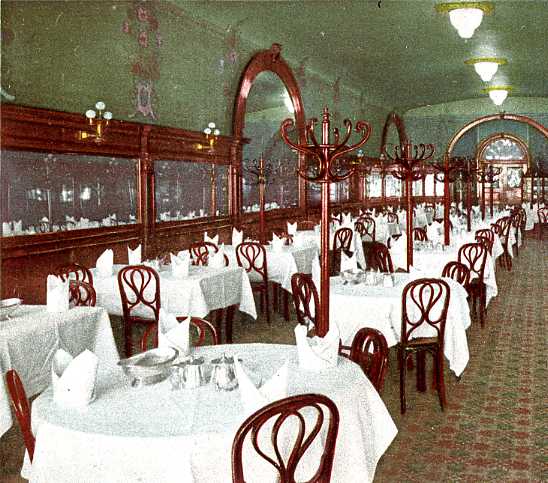
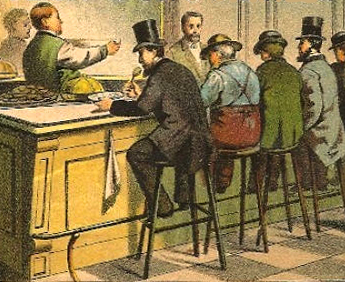
In the first few years of the 20th century tabletop telephone service was available in Chicago, New York, Cleveland, Boston, and probably all big cities. Chicago restaurants such as Kinsley’s, the Bismarck, and Boston Oyster House (pictured), as well as the tea room at Mandel Brothers department store were outfitted with table telephones. Boston’s R. H. White department store also had phone service in its restaurant. In both these stores the telephones were undoubtedly in the men’s, not the women’s, sections.

Fans of old movies might remember scenes where waiters rush telephones to male VIPs enjoying the evening out dressed in tuxedos and accompanied by mink-clad companions. But, actually, early restaurant phoning was apparently more like today’s: business transactions, usually conducted at lunch. Stock brokers in New York City — who paid a monthly telephone rental fee and might take as many as 30 calls while lunching at a restaurant — were at least liberated from their earlier practice of gulping sandwiches at their desks.

Social commentators worried about the effect on health, how working during times meant for rest would cause “brain fag” and indigestion. The invasion of the restaurant by telephones inspired one journalist in 1902 to imagine how one day “some brilliant genius will invent a telephone that can be carried in the vest pocket and then the hustling American can wire messages to his wife, telling how busy he is while he is crossing the street or going up in the elevator.”

© Jan Whitaker, 2010

5 Comments

Filed under restaurant customs, technology

Between courses: a Thanksgiving toast

As I wrote last year – and as everyone knows — Thanksgiving is not a big day for most restaurants and they tend to be closed. This holds true especially for ethnic restaurants which don’t ordinarily serve anything resembling the traditional American-style turkey dinner.

For those who work in Chinese restaurants the day is a grand romantic holiday. Jennifer 8. Lee, author of The Fortune Cookie Chronicles: Adventures in the World of Chinese Food, explains why. Few Americans eat Chinese food on Thanksgiving and for this reason, writes Lee, “it’s the only day that the nation’s Chinese restaurant workers can consistently get off.” And this means they are able to plan weddings for this day. Lee continues, “Each year, tens of thousands of people, almost all Chinese restaurant workers or former workers, flood into Chinatown on Thanksgiving for hundreds of weddings. Banquet halls are booked more than a year in advance, instead of just a month or two, as is standard for the rest of the year. The marital marathon of multiple simultaneous seatings starts before noon and stretches well into the night.”

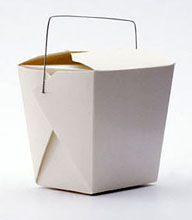
I highly recommend Lee’s book. She explores the history of restaurant staples of Chinese restaurants in America, past and present, such as chop suey, General Tso’s chicken, fortune cookies, and soy sauce — even take-home cartons. What I found of greatest interest, though, were her stories of Chinese Americans and newly arrived Chinese who operate restaurants, and who work long days cooking, serving, and delivering Chinese food.

This Thanksgiving I am going to toast the Chinese restaurant workers who are enjoying their wedding day or their anniversary, or just a rare day off.

© Jan Whitaker, 2010

3 Comments

Filed under miscellaneous, restaurant customs

Linens and things — part II

One trouble with the ideal of snowy white restaurant linens is, of course, laundry that piles up and must be washed. By the late 19th century huge steam laundries in big cities were able to handle up to 100,000 pieces a day. And about the same time a new idea in laundry service came along. Rather than owning linens a restaurant could, in effect, rent them from a service that would bring fresh supplies every time they picked up dirty laundry. Many of the first such businesses called themselves towel services, reflecting that their primary customers were factories using thousands of shop towels. Restaurants and hotels developed as the next customer base.

According to a book called Service Imperative, it was around World War I that the modern linen supply industry developed, with over 900 firms in the US. Most were in New York, followed by Illinois, Ohio, and Pennsylvania. At about the same time a national organization of linen supply companies was formed, the forerunner to the Linen Supply Association of America, renamed the Textile Rental Services Association of America in 1979 to better reflect the full range of member services – and to improve the organization’s public image.

It seems to me that the name change was mostly about public relations. While it may have been true that “linen supply” did not reflect all services, the difference between “textile rental” and “linen supply” is a bit subtle. Why the change? On the face of it the words “linen supply” sound completely innocent. Yet by the mid 20th century they had acquired a negative tinge thanks to mob infiltration in the business coupled with widely publicized congressional hearings, particularly the U.S. Senate’s McClellan committee which investigated organized crime in the late 1950s and early 1960s.

Linen supply was one of a number of services to restaurants, along with garbage hauling, that attracted the mob in the 1920s and even more so in the 1930s when Prohibition ended and bootlegging profits dwindled. It offered itself as a legitimate business in which it was possible to gain dominance rapidly as well as a way for mobsters who had migrated into narcotics to launder money. In Kansas City, a mob magnet in the 1930s, gangs made handsome profits in linen supply. Running the industry as a monopoly, they reportedly divided up the city, agreed not to compete, and set prices high.

Certainly not all linen supply companies were, or are, mob affiliated or engaged in illegal activities, yet in some places – notably NYC, Chicago, and Detroit — many have been. In 1958 New Jersey linen supply corporations charged with violation of anti-trust laws were said to control 85% of business in that state. Linen supply racketeering continues today. In 2003 the NY Times reported that the president of White Plains Coat & Apron Co., doing business with restaurants in NYC, Westchester, and parts of Connecticut and New Jersey, pled guilty to conspiring to restrain trade over a ten-year period in which sales had totaled better than $500M.

The cost of monopoly linen services does not affect consumers enough that they notice it. Restaurant owners, on the other hand, experience higher operating costs. And, as Patricia Murphy found out long ago, they are likely to be paid a visit by a “plug-ugly” if they try to switch suppliers. “I chased him out the door with a broom,” she said, adding, “I suppose I was too insignificant a client for him to carry out threats of reprisals.”

© Jan Whitaker, 2010

1 Comment

Filed under restaurant customs

Linens and things — part I

I hadn’t thought about this until I started to write this post but now I realize that I’m picky about restaurant napkins. I abhor polyester and am sort of iffy about colors. My favorite fold is a compact, squarish one called “the book.” Last night I went to a very nice place in Western Massachusetts. The food was delicious and everything was perfect – almost. Approaching the table, I felt the tiniest inadvertent ripple of irritation at seeing napkins folded to resemble a tuxedo. (Thought that flashed through my mind: Do they think their guests are that “easy”?) Please, no trickiness. No bishop’s hats [pictured below], and especially no fans with either side hanging limply from a goblet.

Do restaurateurs imagine that guests will critique their napkin folds? I hope they have better things to focus on. Actually though, it’s not really a new area of complaint. Twentieth-century consultants advised that men disliked small, ladylike napkins or ones that left lint on dark suits. But it was the lack of cleanliness in table linens that drew the most disapproval from guests, especially in the 19th century. How endless were the complaints about filthy tablecloths, themselves sometimes used as napkins for hands and mouths when none were provided – which was often.

After the hungry hordes finished breakfast in American hotels, one London visitor remarked in the 1840s, they left behind tablecloths littered with food fragments and overturned crockery and “defiled with stains of eggs, coffee, gravy.” In cheap restaurants the stains could accumulate for days before the cloth would be replaced.

Increasingly a first-class restaurant was distinguished by its immaculate linens. Some said Delmonico’s taught discriminating diners to expect this. However, in the 1890s, and no doubt later, some lunch counters furnished nothing more than a common towel hanging from a hook. Other restaurants, clearly not first-class, folded napkins nicely and placed them in a glass but, trouble was, they had already been used by other people.

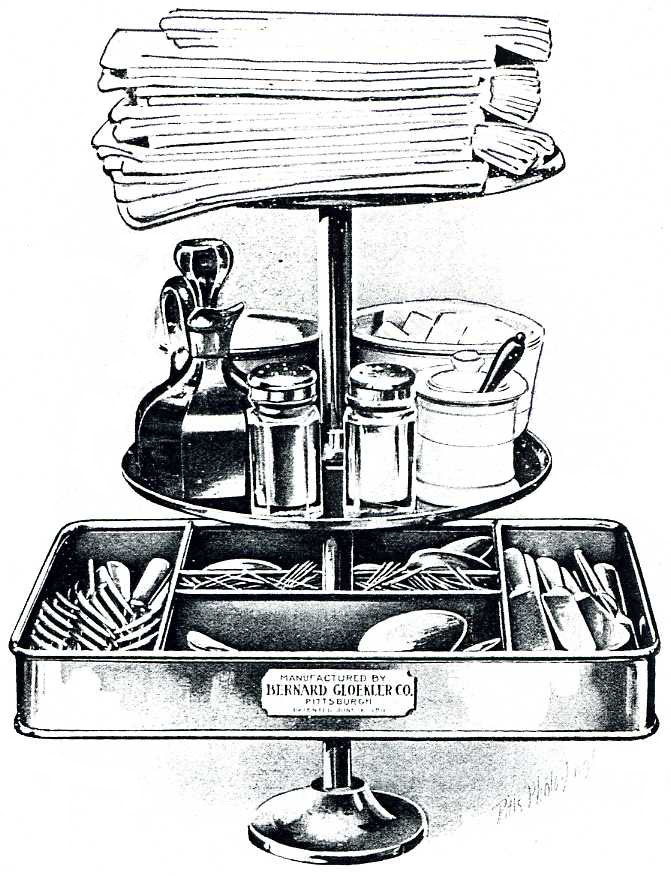
As early as 1885 some eating places began to substitute paper napkins for cloth, a move that was hailed by the hygiene-minded. A Philadelphia restaurant run by the Women’s Christian Temperance Union adopted them in the 1890s, as did modern self-service chain lunch rooms which placed table casters on tabletops which held napkins, condiments, and silverware [though in this image the napkins look like cloth].

In the early 20th century almost all tea rooms used paper napkins, often dainty ones imported from Japan or China. They also did away with tablecloths, leaving tabletops bare or using doilies or placemats. Tea room proprietors were motivated not only by a wish to cut laundry expense but also because they were of a time and social class that believed it was more sanitary to rid interiors of the excessive furbelows of the Victorian age. Reflecting this mentality, Alice Foote MacDougall remarked in a 1928 article titled “Eating Aesthetically,” “There is nothing particularly alluring about long rows of tables, standing like shrouded sepulchers in winding sheets of more or less unsanitary tablecloths.”

As the 20th century wore on most restaurants got rid of tablecloths making them something of a rarity, resulting in the term “white-tablecloth restaurant” for more luxurious establishments.

© Jan Whitaker, 2010

4 Comments

Filed under restaurant customs

Dining in shadows

Until electricity became common no one thought dining by candlelight was the least bit romantic. In the later 19th century any restaurant that acquired electricity made a big bragging deal of it. A Chicago restaurant called The New York Kitchen boasted in 1888 that its dining room was “brilliantly lighted by the Mather Incandescent Electric System.” In the early 20th century going places with bright light was fashionable, especially because it turned restaurants into stages on which to be seen and to covertly stare at others.

But there were some ultra-refined people who considered the glare of bright light vulgar. Etiquette expert Emily Holt recommended in1902 that candles be used instead of gas or electric chandeliers for home dinner parties lest the dinner resemble a “blazing feast … in some hotel restaurant.” At that time restaurant patrons who wanted mellow light could choose a place such as Sherry’s in New York where wall sconces gave off gentle illumination and candles topped by artistic shades reposed on each table. So private! So French!

Candlelight promised the gentility of an elite dinner party, far removed from loud music, noise, and guests who drank too much. Candles suited the tea room perfectly. Not only did they shed flattering light, they discouraged the rowdy, fun-seeking masses from entering the door. Tea room owners, overwhelmingly WASPs, also liked how candles, as well as lanterns and fireplaces, created a quaint atmosphere that they imagined resembled how their Colonial ancestors lived.

In Greenwich Village some tea rooms of the 1910s used candles exclusively. The homey Candlestick Tea Room was described as “a little eating place chiefly remarkable for its vegetables and poetesses.” Like other tea rooms lit solely by candles it was undoubtedly atmospheric, but its owners Mrs. Pendington and Mrs. Kunze probably had a more basic reason for using candles. Many of the substandard Village buildings had no electricity. Nonetheless candles did not guarantee respectability. In Chicago, police declared the candle-lit Wind Blew Inn disreputable. A dilapidated, Bohemian student hangout, it had only three candles lighting its two floors.

Outside of Bohemian haunts, though, candles in tea rooms continued to suggest quiet good taste. Alice Foote MacDougall pronounced in her 1929 book The Secret of Successful Restaurants that “Tea time is relaxation time and lights are softened, candles lighted, music plays softly, accompanied by the rippling measure of water falling from our fountains.” She spent the considerable sum of $10,000 a year on candles in her tea rooms. In the 1930s genteel shoppers at Joseph Horne’s in Pittsburgh enjoyed tea and cake by candlelight while listening to organ music in the department store’s tea room.

Today candles are so common in restaurants that they are scarcely noticed, yet as recently as 50 years ago they were considered feminine tools of romantic entrapment. A kind of low-level warfare simmered through the 1950s and early 1960s in which women such as Patricia Murphy of the Candlelight Restaurant in Yonkers announced that wives could save their marriages with candle-lit dinners, while men countered they “liked to see what they were eating.” In 1962 a fire official in Beverly MA said that his ban against candles in restaurants was not motivated by a dislike of dining by candlelight but a need to protect the public from “open flames.” But change was on its way. In the 1970s millions of Americans, male and female, would flock to restaurants where they sipped wine while candles flickered against exposed brick walls.

© Jan Whitaker, 2010

2 Comments

Filed under restaurant customs, restaurant decor

L’addition: on tipping

In an interview for the story “What do we tip waiters for?” in the online magazine Salon, Steve Dublanica, author of the blog (and book) Waiter Rant, says that in his experience restaurant patrons, no matter what they may say in surveys, do not actually tip servers based on the quality of service. Rather, there are numerous other factors that influence why and how much they tip, such as social convention, mood, guilt, shame, or who knows what.

The subject of tipping is, in my opinion, a fascinating one with endless dimensions. There are so many wrinkles in this aspect of the server-patron relationship that I’ve tumbled upon in researching restaurant history that I find it hard to put it all together into a coherent post. So, for now, I’ll skip that and simply comment on one of Steve’s suggestions for how servers can influence the size of their tip. He recommends concentrating on cultivating regular customers: “You remember their favorite wine, their anniversary, their favorite table. You make them feel special so they’ll feel loyal …”

Good advice. But it reminds me of one of cruder methods (“dodges”) servers used to employ in the 19th century to curry favor with regular customers — one that the restaurant industry has done its best to stamp out but that undoubtedly still goes on in places that have lax checking systems. It is to give selected patrons more or better food than they ordered – a porterhouse rather than a sirloin – while charging them for the cheaper item. The customer still comes out ahead even after rewarding the server with an extra-large tip.

As early as the 1880s management tried to head off the game by installing a spy box (sometimes occupied by the restaurateur’s wife) in the pickup area of the kitchen, or by stationing a checker at the door to the dining room to see and record exactly what the server was delivering to the customer. Of course these tactics didn’t really work.

© Jan Whitaker, 2010

Leave a comment

Filed under restaurant customs

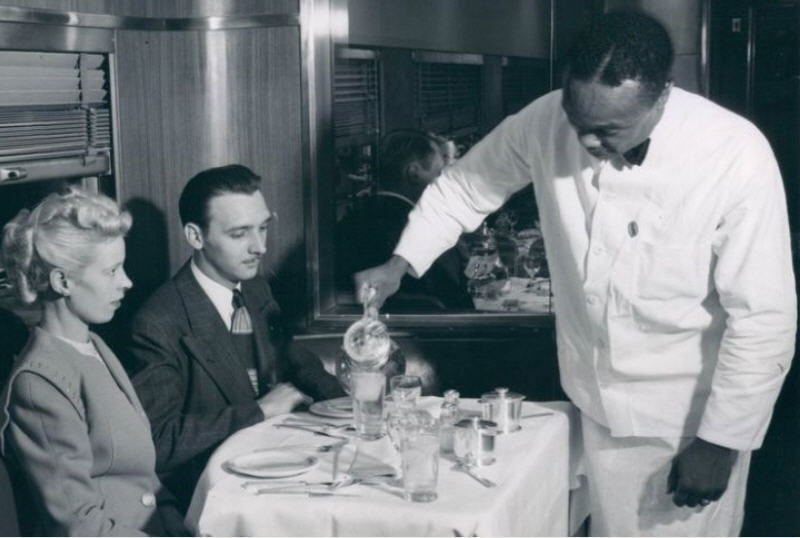
That glass of water

I don’t know how many times I’ve gone to a restaurant with someone who answers “Just water” when the server asks what they would like to drink. For some inexplicable reason I am always strangely disappointed when I hear this reply. Is it my Irish-German ancestry haunted by ghosts of the temperance movement? I honestly don’t know but I am fascinated with the question of why that glass of water is plunked down first thing in American restaurants.

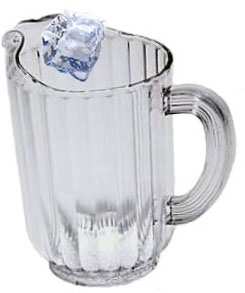
Why are Americans so crazy for water when diners in other parts of the world are not? European visitors from the 1860s to yesterday never failed to notice the American habit. In 1883, a Londoner reported that in hotel dining rooms, “Immediately the guest is seated, the attendant at the table brings a napkin, a bill of fare, and a glass of iced water.” Another crossly noted, “You cannot escape from this glass of water from the day you set foot on American soil to the day you leave it…”

Carbonated soda water and mineral water were available in early 19th century American cafes, as was ice for beverages. But the first mention I’ve found of water served free with a meal occurs in the 1840s, which happens to be the decade that NYC’s and Boston’s public water supplies began. In the late 1840s a newspaper reporter reflected on cheap restaurants where patrons could enjoy “pumpkin pie at four cents the quarter-section, with a cup of Croton, fresh from the hydrant, gratis,” referring to the Croton Reservoir from which water flowed into NYC beginning in 1842.

It is also a decade when the temperance movement geared up, praising cold water as the most moral beverage and the only one drunk in Heaven. The teetotaling followers of food reformer Sylvester Graham found cold water the sole drink consistent with “nature’s bill of fare.” The mission of temperance advocates was to make pure water widely available in hopes they could lure drinkers away from the hard stuff. The battle continued at the Centennial Exposition of 1876. After failing to prevent the sale of beer and wine at the fair’s European-style restaurants, temperance groups installed a free ice-water fountain.

Restaurants run by new Americans did not immediately fall into line. Italians, for instance, preferred wine as their basic beverage. A Boston diner in 1906 was impressed with how totally different it was to eat in an Italian restaurant as compared to a typical wineless Yankee lunch room where the staples were baked beans, pie, doughnuts, cookies, cake, gingerbread, toast, and boiled dinners — all washed down with ice water.

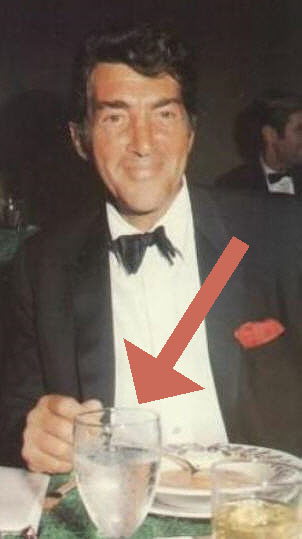
Although the custom of providing water was likely firmly established during Prohibition, even before that water service gradually lost its temperance overtones and became standard operating procedure in restaurants. A waitress in 1907 learned the first day of work that as soon as she took an order she was to give the patron water as a signal to the head waitress that the order had been taken. A 1908 manual instructed waiters to “serve water first” and the bread and butter set-up later.

Americans don’t always drink the water provided in restaurants, but they expect it to be there. In 1930 patrons of luncheonettes coast to coast were dismayed by burnt toast, dirty menus, and failure to serve water unless requested. A National Restaurant Association survey in 1978 found that customers did not like to ask for water and almost 75% of them were annoyed if there was no water on their table.

© Jan Whitaker, 2010

16 Comments

Filed under restaurant customs

The (partial) triumph of the doggie bag

I can’t remember when restaurant servers began automatically asking if you wanted to take home food left on your plate but I know it’s a relatively recent phenomenon. It used to be that food was wrapped up only if patrons asked.

Probably some customers have always smuggled away food from restaurant tables, usually in napkins. Maybe to stop this, the custom of furnishing diners with bags in which to take home leftovers began after the second World War when upward mobility widened the dining public. Doggie bags went into production around the mid 1950s and their use increased tenfold in Chicago in the 1970s, according to a Chicago Tribune story.

But what is interesting is how many people were embarrassed by the practice. Well into the 1970s etiquette columns in newspapers got letters from restaurant patrons asking if it was ok to ask for a doggie bag if they didn’t have a dog. Usually the writer cited a spouse or friend who objected to the custom. A typical query is the one in 1964 from a wife whose husband “looked aghast” when she asked for a bag and told her it was in poor taste to take home table scraps. Nonetheless, with the exception of Elizabeth Post, Emily Post’s granddaughter by marriage, advice columnists invariably approved of doggie bags as sensible if not downright virtuous.

Doggie bags and other containers grew more acceptable in the 1970s – but not in all restaurants. The most expensive and elegant places, such as the Four Seasons and upscale French restaurants, showed a distinct dislike of the custom. Many would only provide a container if asked, and then often fashioned a swan of aluminum foil as if to say, “We don’t make a habit of this – this is just for you.”

There are a number of explanations why taking home leftovers has not always been universally accepted by restaurants or their guests. Some restaurants cite health concerns. French restaurateurs are offended by the idea of someone microwaving their cuisine; they believe food should be eaten just at the moment the chef sends it to the table. Diners who are the least bit intimidated by a restaurant or its servers are unlikely to ask to take food home. I was recently in a restaurant that does not permit guests to place jackets or coats on the back of their chairs. I am certain they would cringe at a request to take away uneaten food (and I’ve never seen it done there). In any event, the small portions served in this and other upscale restaurants do not allow any provision for future meals. Other restaurants handle the matter discreetly. In a power lunch spot in Los Angeles, diners must pick up their leftovers, packed in a tasteful tote bag, at the front desk as they leave. No styrofoam box sitting on tables through the dessert course there!

On a deep socio-psychological level the reasons doggie bags carry a degree of embarrassment and often are not accepted by elite restaurants are the same as why it’s considered poor manners to smack or gobble. Higher status accrues to those who disguise hunger by eating slowly, who appreciate small portions, and whose delicate appetite requires “appetizers” and little dainties with names such as “amuse bouche.” Leaving food on the plate communicates the absence of animal neediness. It is a version of Thorstein Veblen’s concept of “conspicuous consumption” in that it flaunts the diner’s ability to walk away from perfectly good food.

© Jan Whitaker, 2010

9 Comments

Filed under restaurant customs

Christmas feasting

Last year, thanks to a travel screw-up, we found ourselves eating Christmas dinner at a San Francisco hotel. It was new and chic, with a highly rated chef, so we could have fared much worse … and yet we were dissatisfied. There was something pompous about how dramatically the waiters poured soup from pitchers into bowls which had been daubed artistically with creme fraiche. Not to mention all the other absurd ceremony that surrounded the meal yet failed to prevent orders from being mixed up and food from arriving burnt or cold.

Anyway, this got me wondering about eating Christmas dinner in hotels roughly100 years ago, around the turn of the last century when lengthy formal dinners were still in vogue. Even though hotels were the best places other than home to have a holiday dinner then, I’m not sure we would have liked that experience any better.

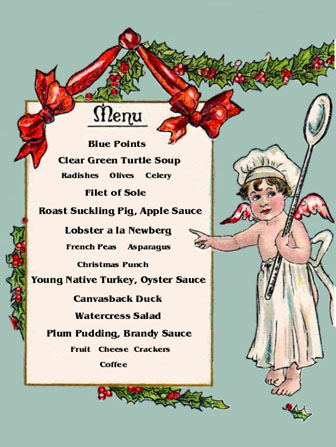
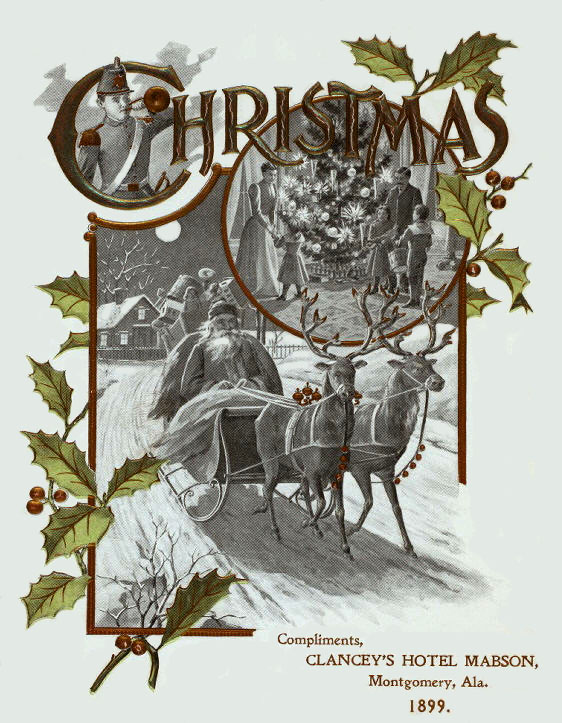
For one thing, who could eat all the food hotels piled on? The menu shown here represents my distillation of the most typical dishes from about 20 Christmas dinner menus of American hotels from 1898 to 1906. I’ve selected only one dish for each course, whereas the actual menus often had three or more and diners could choose as many as they wanted! Though the number and sequence of the courses varied somewhat from hotel to hotel, the most common arrangement was as shown here. The meal began with Oysters (a course all their own in the U.S.), then Soups, Relishes, Fish, Relevé (featuring a roast despite a later Roasts course – I don’t get it), Entrées, Vegetables, Roasts, Game, Salads, Desserts (which could be subdivided, with hot desserts coming first, under Entremets), Cheese, and ending with Coffee. Strictly speaking the Relishes, Vegetables, and Salads are not separate courses as they would be served with other dishes. So I believe the sample shown here would be an 8-course dinner. Each course would have been accompanied with wine and brandy may have been served with the coffee.

There were some interesting regional dishes on the menus I looked at. The Hotel Metropole in Fargo ND offered Saddle of Antelope; the New Century Hotel in Union SC had Pompano and Carolina Quail; while the Tulane Hotel in Nashville had Stuffed Mangoes*, Fried Hominy, and Dew Drop Corn. The Hollenbeck Hotel in Los Angeles mentioned that its Turkey was “Pomona Farm Fed” and featured a salad of Monk’s Beard greens. Two hotels, in Alabama and Michigan, presented Suckling Pig that had been barbecued. Without doubt the most unusual menu was that of Jack H. Clancey’s Hotel Mabson, primarily accommodating traveling salesmen in Montgomery, Alabama. In addition to Pompano and Barbecued Suckling Pig, its Christmas menu – the only one entirely devoid of French – introduced dishes seen nowhere else such as Stuffed Tomatoes, Scrambled Calf’s Brains, and Grandma’s Fruit Cake.

Whatever kind of dinner you eat on Christmas Day, enjoy it!

* Thanks to food historian Gary Allen for decoding stuffed mangoes as stuffed bell peppers.

© Jan Whitaker, 2009

7 Comments

Filed under food, restaurant customs

Restaurant-ing on Thanksgiving

As a meal Thanksgiving dinner is steeped in agrarian values and customs that do not thrive in restaurants, which are primarily urban inventions. It is also incongruous to celebrate what has become a domestic festival in a commercial setting. Neither gourmet restaurants nor fast food eateries present the homeyness considered conducive to celebrating the holiday.

Nor is restaurant cuisine quite right for Thanksgiving. Thanksgiving dinner represents the ne plus ultra of comfort food. According to consumer researchers Melanie Wallendorf and Eric Arnould (“‘We Gather Together’: Consumption Rituals of Thanksgiving Day,” Journal of Consumer Research, June 1991), the typical dishes served are like baby food in that they are “baked, boiled, and mashed” foods which are soft in texture and prepared without much seasoning. The emphasis is on the presentation and consumption of abundance, which for participants implies almost compulsory overeating. Few people are interested in culinary innovation which, for most, threatens the essentially infantile pleasures of the occasion.

Despite restaurants’ apparent inadequacy in meeting the challenge of this American national gustatory ritual, there is some evidence that Thanksgiving restaurant-going has increased over the course of the past century. The tendency, though, is to see this more as symptom than innovation. The sentiment expressed in 1892, that Thanksgiving dinner in a restaurant is a “rather melancholy thing” has not been eradicated.

One would think that the restaurants best positioned to capture the Thanksgiving trade would be those with Early American decor, or venerable restaurants that can reference tradition, such as Brooklyn’s Gage and Tollner, or those that stress home-based values, such as tea rooms. In the Los Angeles area, which seems to have had a fair amount of Thanksgiving restaurant trade in the 1920s, diners could choose from Ye Golden Lantern Tea Room or the Green Tea Pot of Pasadena, among others. Harder to understand, though, was the appeal of restaurants serving chop suey to the strains of Hawaiian music. About the same time Indianapolis was well supplied with dining out choices for the holiday, ranging from traditional Thanksgiving fare at the Friendly Inn to barbecue at Ye Log Cabin to a “Special Turkey Tostwich, 25c” at Ryker’s. The city’s Bamboo Inn offered two styles of Thanksgiving dinner, one with turkey and the usual trimmings and the other a Mandarin Dinner with Shrimp Egg Foo Young and Turkey Chop Suey.

Although the president of the Saga Corporation, a restaurant supplier, insisted in 1978 that eating out on Thanksgiving and Christmas had lost its stigma, events such as turkey dinners given by churches and soup kitchens for the poor and homeless, as well as explanations given by restaurant patrons in surveys, would indicate otherwise. They seem to suggest that dining in a restaurant on Thanksgiving is frequently a compensation for some sort of lack on the homefront rather than a positive attraction in its own right. Wallenberg and Arnould reported that only 1.8% of the people they surveyed said they would prefer to spend Thanksgiving in a restaurant than at home.

© Jan Whitaker, 2009

1 Comment

Filed under miscellaneous, restaurant customs