Category Archives: proprietors & careers

Famous in its day: Miss Hulling’s Cafeteria

In 1978 two of the nation’s top grossing independent restaurants were New York’s Tavern on the Green and Mama Leone’s, according to Restaurant Hospitality magazine. At the first, guest checks averaged $14.50, while at Mama Leone’s the average was $13. A big aspect of both restaurants’ business was alcohol, accounting for 30% of revenues in the case of Warner LeRoy’s Tavern on the Green.

Meanwhile, a sturdy favorite in downtown St. Louis, the venerable Miss Hulling’s, home of chicken livers, creamed spinach, and carrot marshmallow salad — with a negligible drinks business – had a check average of $2. Yet it still managed to rank #58 out of the 500 restaurants in the survey.

Miss Hulling’s was the creation of Florence Hulling, who came to St. Louis around 1907 as a teenager from rural Illinois to work as a private cook. After a few years in domestic service she went to work for the Childs restaurant chain. Eventually she was promoted to manager, a rare status for a woman at that time. Childs closed in 1928 and she and her sister Katherine took over management of the cafeteria in the Missouri Hotel. When it closed in 1930 Florence bought the failed restaurant on the opposite corner and named it the Missouri Cafeteria.  It would stay in business there for the next 62 years [shown just before razing].
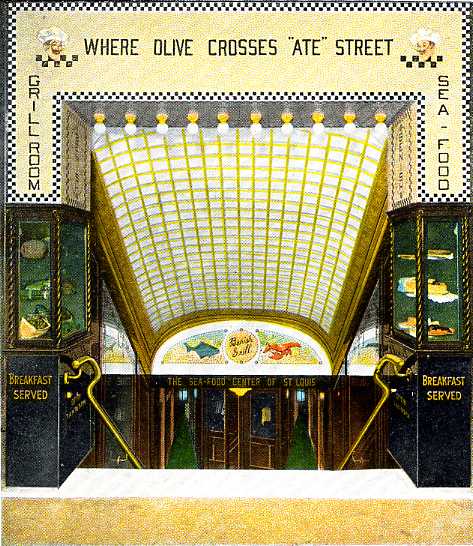
Florence married Stephen Apted in 1931 and in 1934 the Apteds opened a second cafeteria at 8th and Olive, calling it Miss Hulling’s, a name that would eventually apply to the Missouri Cafeteria as well. The Olive Street restaurant occupied a basement site that had previously held the Benish cafeteria [entrance shown] and before that – I think — Lippe’s, a restaurant operated by Detlef van der Lippe.

How well I remember a job I once held chauffeuring an alcoholic boss to Miss Hulling’s, his regular eating place and virtually his true home when he wasn’t bunking in the office of his advertising agency. I suspect he was not the only St. Louisan who relied on Miss Hulling’s for more than just food.

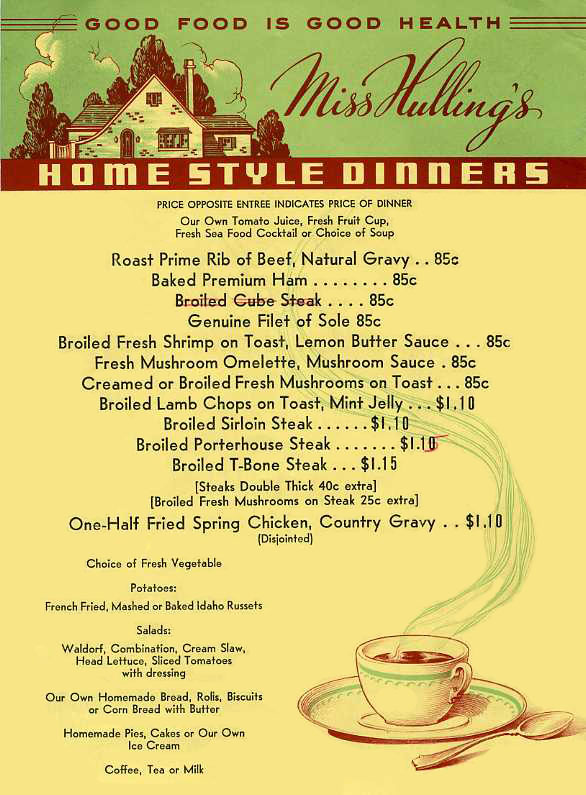
A 1939 Miss Hulling’s menu reveals the kinds of homelike dishes featured there. In addition to those shown, a mimeographed attachment lists a number of dishes not found much in restaurants now. Among the choices are Stuffed Baked Veal Hearts and Braised Ox Joints. If a complete dinner was ordered, for about 50 cents, the diner also got soup or salad, bread and butter, a vegetable such as Creamed Kohlrabi or Fried Egg Plant, a beverage, and a dessert such as Peach Rice Pudding. (See Miss Hulling’s Sour Cream Noodle Bake and her German Chocolate Cake on my Recipes page.)
In the 1940s and 1950s Miss Hulling’s was just the kind of place that earned high ratings from Duncan Hines and Gourmet’s Guide to Good Eating, the latter reporting, “Everybody in St. Louis swears by Miss Hulling’s. Food is exceptionally delicious, clean, and of high standard.” The cafeterias served their own ice cream and baked goods, used fresh fruit for pies, and prepared food in small batches.

Through succeeding decades the Miss Hulling’s enterprise, headed by the couple’s son Stephen J. Apted, grew large. It acquired Medart’s (turning it into the Cheshire Inn), and opened numerous restaurants in the metro area, among them The Cupboard and the Open Hearth, as well as running food services at two hospitals. Headquarters, including a bakery, were at 11th and Locust above the two-floor cafeteria. At the same location were the more formal dining spot Catfish and Crystal, His Lordship’s Pub, and a bakery and ice cream shop. In 1993 the entire operation at this site was closed down, the same fate having befallen the Olive Street cafeteria some years before.

© Jan Whitaker, 2012

107 Comments

Filed under cafeterias, popular restaurants, proprietors & careers, women

Washing up

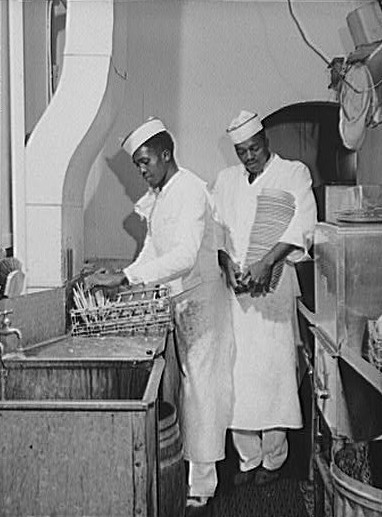
“Please don’t make me a pearl diver,” begged ruined Chicago restaurateur John Raklios as he entered debtors’ prison in 1939. As someone who had worked his way up in the restaurant world, he knew there was no job lower than washing other people’s dirty dishes.

In restaurant kitchens dishwashers were long considered “life’s wreckage,” people so reduced by circumstances, drugs, and drinking that they could find no other work. In the 19th and early 20th century dishwashers worked up to 12 hours a day for a free meal and very little money. In addition, they were often tormented by cooks and others in the kitchen.

A stark portrait of the life of a dishwasher, based on the author’s firsthand experiences, is painted by George Orwell in his autobiographical book Down and Out in Paris and London. Luckily, at its best dishwashing could produce a zen-like state in which the mind is untethered  from mundane matters.

The origins of the slang term “pearl diver” are as murky as dishwater itself. According to one historic account washers would clean dishes by feeling rather than sight. They would reach down into deep sinks “sorting the dishes into rows, washing them with a wave-like motion through the water” and then scooping huge piles onto a drain board. During busy periods when dirty dishes flowed into the kitchen “like lava from a volcano,” pearl divers quickly learned to “manipulate thousands of dishes at lightening speed.”

In literary and journalistic portraits, dishwashers were typically males unused to the better things in life and therefore relatively unbothered by floating scum, filth underfoot, rats, taunts, or low pay. Despite Orwell’s claim that the dishwasher “has no escape from this life, save into prison,” there were numerous stories of men who worked their way into careers as successful restaurateurs, such as Vincent Sardi, Morris Schwartzer of the NYC Biltmore Cafeteria chain, and Philippe Mathieu, purveyor of acclaimed French dip beef sandwiches in Los Angeles.

Afro-Americans or new immigrants who didn’t speak English often became dishwashers mostly because of their reduced job prospects generally, and were thus less likely to be from the ranks of the truly down and out. The same may have been true of women who washed dishes. Until 1911, when labor laws reduced the number of hours women could work, many dishwashers were women. Evidently they continued to work as dishwashers after reforms too, because state inspections of Michigan restaurants in 1918 revealed that for every two male dishwashers there were three women doing that work. Their pay, $1.20 a day, was rock bottom for restaurant workers then.

Mechanical dishwashers were invented in the 19th century, but were not electrified or widely used until well into the 20th. Though not the first female dishwasher inventor, Josephine Cochran is credited with devising the first truly practicable dishwasher, which she patented in 1886 [illustrated, 1912]. From a comfortable home with servants who performed kitchen labor, she was driven by a wish to prevent breakage. But her invention, which led her to form a company called Garis-Cochrane, ended up in hotels and restaurants rather than private households.

Before being electrified, generally during the teens and 1920s, mechanical dishwashers were manually operated, some requiring two people to turn handles that swished baskets of dishes through suds. The heavy baskets were lifted out of the water by pulleys which required considerable strength, sometimes resulting in the replacement of women dishwashers by men.

Despite strides in kitchen mechanization in the 1920s, it is notable that a survey of Rockford IL in 1929 found that only 16 of the city’s 179 restaurants had mechanical dishwashers. Even as late as the 1940s many restaurants still washed dishes by hand, often inadequately. Health department crackdowns following World War II found that scalding hot water and/or chlorine rinses still were not employed in many of the smaller restaurants across the country.

Though it’s unclear how many worked in restaurants, according to the Bureau of Labor Statistics there were 522,900 dishwashers making an average of $8.19 an hour in 2008.

© Jan Whitaker, 2011

9 Comments

Filed under proprietors & careers, sanitation, technology

Anatomy of a restaurateur: Chin Foin

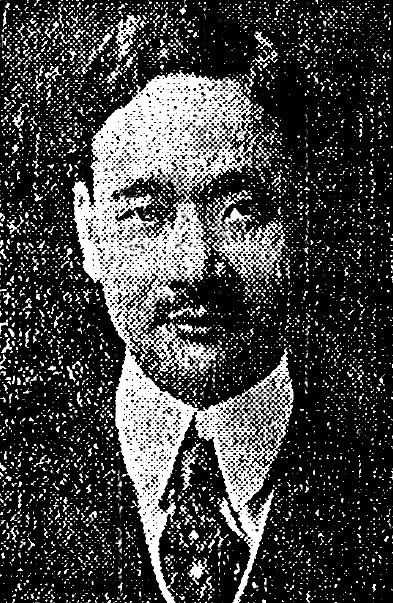
In the early 20th century Chin Foin was considered Chicago’s foremost Chinese restaurateur, being affiliated with four of the city’s leading Chinese restaurants: the King Yen [above] and King Joy restaurants and the Mandarin Inn and New Mandarin Inn. His exact degree of ownership and management of the four over time is difficult to determine but it’s clear that his participation was significant. He also ran an import business in Chicago called Wing Chong Hai & Co.

His first restaurant King Yen Lo began inauspiciously in 1902 upstairs from a saloon, the notorious establishment of alderman Michael “Hinky Dink” Kenna on the corner of Clark and Van Buren. Operating above or behind a saloon was not uncommon for Chinese restaurants and may reflect difficulties the Chinese encountered in renting property. Additionally, having a restaurant nearby or physically connected may have served the interests of saloon keepers who wanted to evade early closing laws by funneling drinks through an eating place.

Whatever the case, the King Yen restaurant was better than it had to be. Like the other restaurants Chin Foin would run, it appealed to the non-Chinese after-theater crowd and featured orchestral music and steaks and chops alongside chop suey and “Mandarin” dishes. The kitchen was open for inspection and a special section was reserved for women unaccompanied by men, important since women shoppers were known to be fond of Chinese food. It’s not clear how long he was actively involved with King Yen but he was still an owner in 1907 when a Chinese envoy attended a formal dinner held there for the christening of Chin Foin’s infant son Theodore.

The King Joy restaurant on W. Randolph [pictured, ca. 1910] was a much bigger venture. It was a component of an international Chinese organization meant to raise funds for political and economic modernization in China. Investors included Chinese living in China and America as well as non-Chinese Chicagoans who supplied $125,000 [more than $3M today] to build the thoroughly modern restaurant. It opened in December of 1906 with Chin Foin as manager.

The investors in China must have heard that running restaurants in America was very profitable because little more than a year after the restaurant’s opening they began to complain about not receiving any dividends. I don’t know how all that was sorted out but clearly Chin Foin’s personal wealth was growing, enabling his family to move to a posh neighborhood in 1912. The newspaper reported he was a wealthy Yale graduate, which brought a grudging acceptance from a non-Chinese woman who said she could hardly object to a Chinese neighbor since, she observed, “We have Negroes out here now, and a few Goths and Visigoths.”

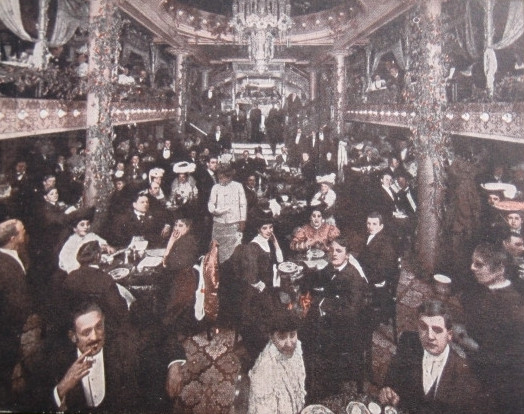
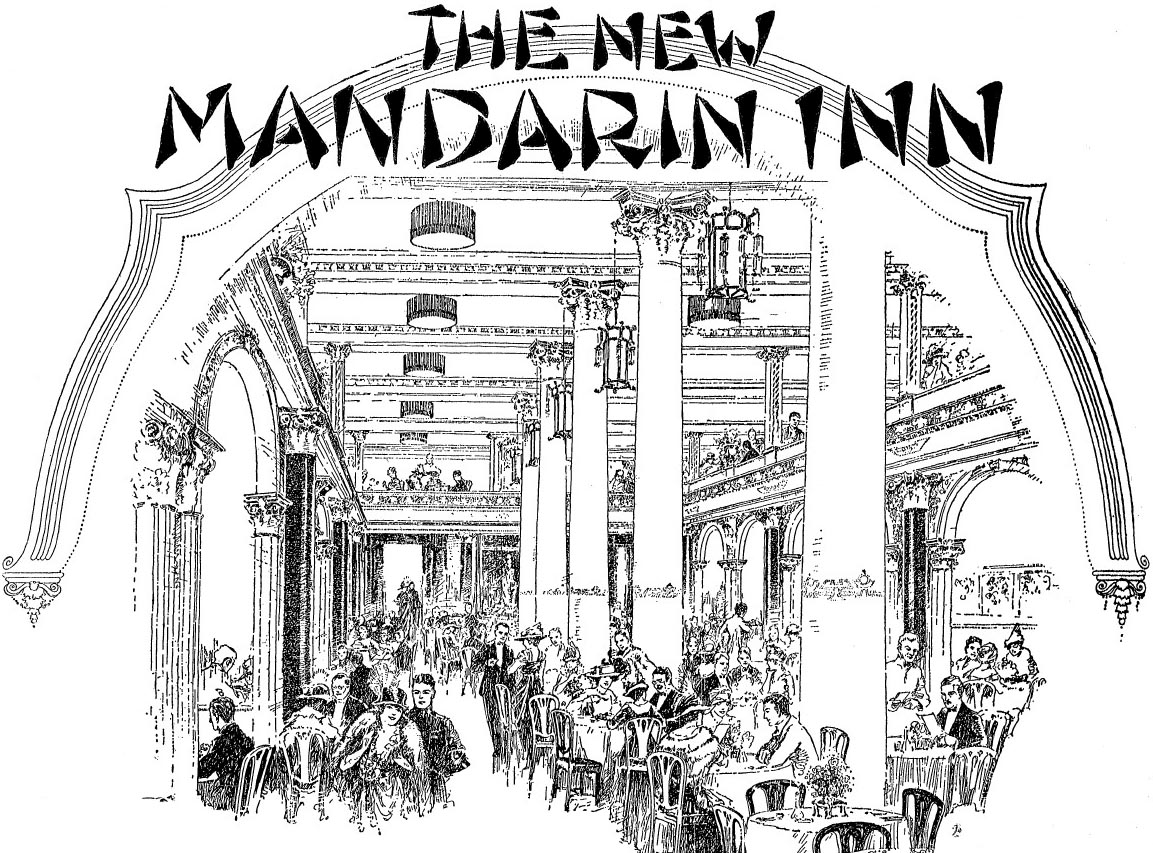
The very Americanized Chin Foin had ambitions of running a type of restaurant that was scarcely Chinese at all. After opening the Mandarin Inn in 1911 and the New Mandarin Inn in 1919 [pictured], both on South Wabash, he announced he had taken a 25-year lease on a Wilson Avenue property formerly occupied by a car dealer. To be called the Mandarin Gardens, the restaurant was supposed to open in 1921 but never did as far as I can tell. Reflecting on the upward arc of his restaurant career, he said in 1920, “Now we’ve cut out the far east features and operate a strictly American restaurant, and that’s what the Mandarin Gardens will be.”

The New Mandarin Inn had also shed some of its Chinese-ness. Since its opening in 1911 it had broken with Chinese restaurant tradition by using linens on the tables and serving European wines. Although it served Chinese dishes, it also offered Sunday chicken dinners and, in 1921, served a high-priced Easter dinner with choices such as Blue Points on the Half Shell, New Orleans Gumbo, Lamb with Mint Jelly, Whipped Potatoes, and Strawberry Shortcake.

Sadly, Chin Foin’s plans were abruptly terminated in 1924 when he stepped into an empty elevator shaft at the New Mandarin Inn. The subsequent owner of that restaurant, Don Joy, added “Chinese” features such as dragons on the front and a simulated temple roof. Don Joy’s Mandarin Inn closed in 1928, later to become a nightclub (Club Royale) and, eventually in 1959, Jimmy Wong’s Cantonese restaurant. The building occupied by King Yen was razed in the teens for a new location of the John R. Thompson’s lunchroom chain, while King Joy became the Rialto Gardens (Chinese), and then one of Dario Toffenetti’s cafeterias.

© Jan Whitaker, 2011

12 Comments

Filed under proprietors & careers

Find of the day: Demos Café

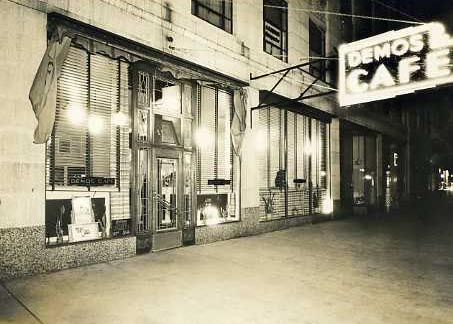
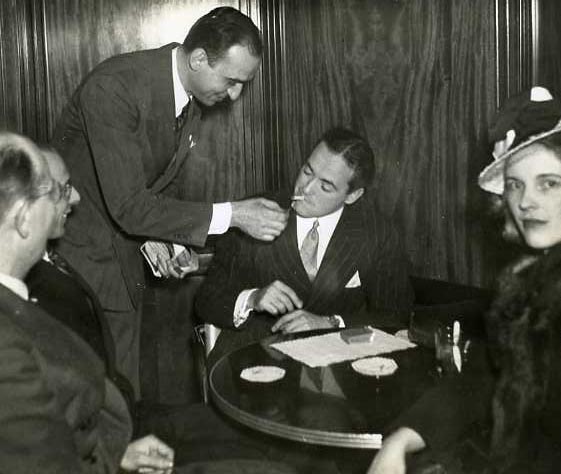
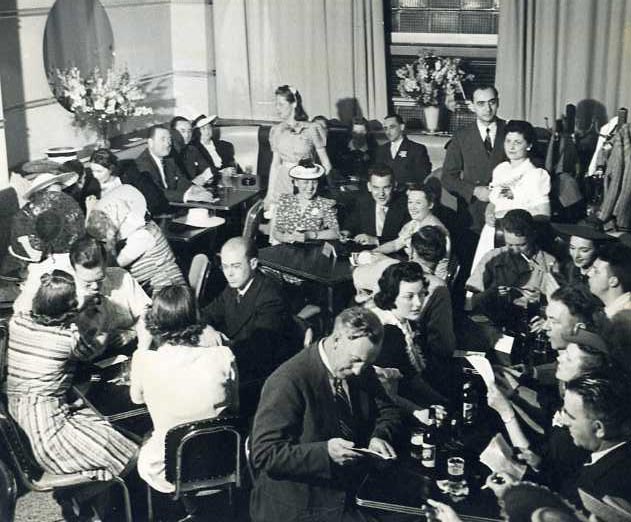
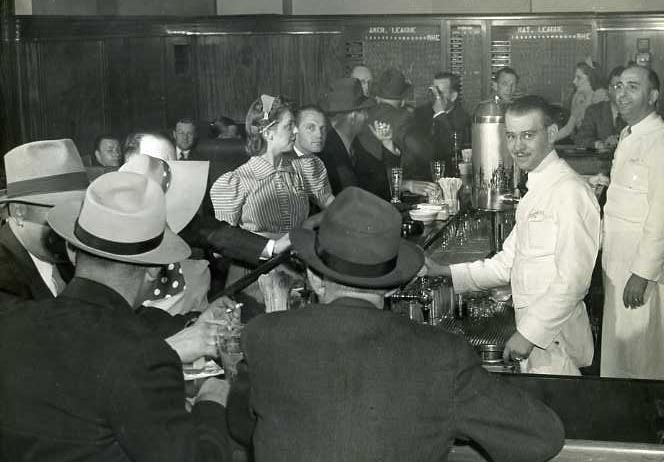
It’s pretty cool when you can stroll over to an antiquarian book and ephemera show only a few blocks from your house and, barely 10 feet into the room, come upon a trove of restaurant memorabilia. That’s what happened a few days ago when I found a collection of photographs and water glasses from one of Muskegon’s premier cafés.

Judging from the hubbub in some of the photos of the bar area, the moderne-style Demos Café was a real Michigan hotspot in 1939 and 1940 when these were taken. Some of the patrons seem to be hiding from the camera and one man’s face was deliberately blacked out in the darkroom. Hmmm…

Located at 415-419 W. Western Avenue, the café was owned and run by the Greek-American Demos brothers, Spyros, Theodore (Ted), and John. Ted is shown behind the bar in two of these photos while John stands in the back of a crowded room in one and in another lights a cigarette for visiting Hollywood celebrity Buddy Rogers, husband of Mary Pickford. The café’s cocktail lounge often hosted touring jazz bands. And, as can be seen, it kept customers up to date on baseball scores.

The café’s wood veneer backbar was almost certainly a product of local industry. The Brunswick-Balke-Collender company’s main plant, which manufactured bar fixtures, was located in Muskegon. As soon as beer was legalized in 1933 the factory geared up with 1,500 new workers in anticipation of renewed business.

In addition to serving zombies (“only 2 to a person”) and frozen daiquiris, and apparently pouring quantities of Four Roses bourbon, the Demos Café specialized in steaks, chops, and sea foods. Signs placed in the front windows advertise a blue plate special for 50 cents, “genuine Italian spaghetti with Roman cheese” for 35 cents a plate, and “sizzling steaks,” a Depression-era culinary gimmick across the U.S. As was true of most Greek-American restaurants, the menu would have been thoroughly Americanized, without any dishes common to the owners’ native land.

During its heyday in the 1940s the Demos Café, along with the Causeway Café and the Lakos Café – all Greek-American owned – was one of the big three restaurants in Muskegon. But by 1951 or 1952 the café apparently went out of business after a tax investigation and lawsuit.

© Jan Whitaker, 2011

14 Comments

Filed under proprietors & careers

Anatomy of a restaurateur: Anna de Naucaze

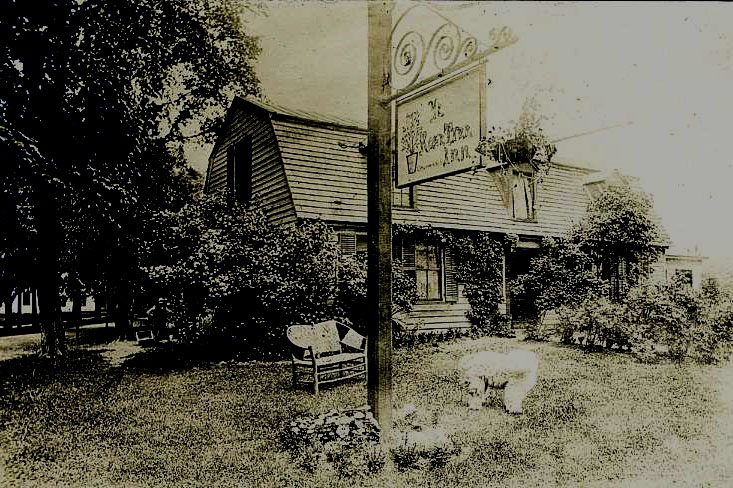
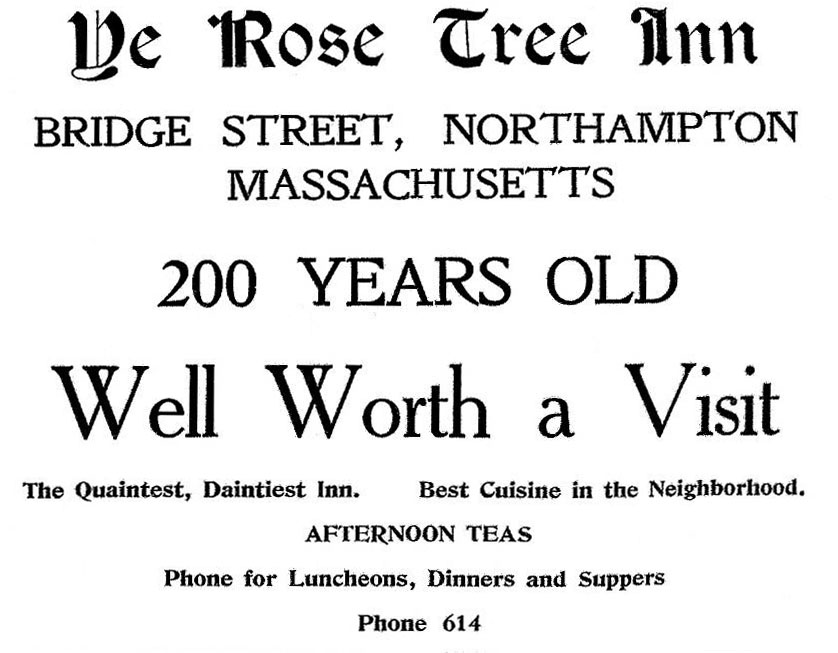
In 1908 two women adventurers opened The Rose Tree Inn, a tea room in a 200-year old house in Northampton, Massachusetts. Both called themselves “Madame” and claimed to be related to European nobility by birth or marriage. They were used to supporting themselves and living by their wits. One, Anna [pictured], a widow, was a former British stage actress, while the other, Marie, who had an 11-year old son, was married to a criminally inclined soldier of fortune who masqueraded as a German baron and was exiled to a British penal colony.

Each had arrived in New York City from London in 1907 to cover the sensational Harry Thaw murder trial for British papers. Almost immediately they became involved in what might be termed attempted “capers.” Madame Anna de Naucaze, 52, claimed she knew the secret to winning at roulette and could prove it if only someone would back her at Monte Carlo, while Madame Marie von Veltheim, about 38, said she had a treasure map showing where $4 million in gold was buried in mountains in South Africa’s Transvaal.

Next they got in trouble with the courts for misappropriating a photo album that was evidence in the Thaw trial. The album contained photographs of Thaw’s wife Evelyn Nesbit who had been having an affair with Thaw’s victim, architect Stanford White. With a possible charge of larceny hanging over them, Anna returned the album to Thaw’s lawyer.

And then they went to Northampton. By comparison with their pasts, the small college town must have seemed dull. It’s not clear what drew them there, though if they were looking for a way to make money, they found it. The RTI, as it was known by its primary patrons, Smith College students, became a very popular place known for its sumptuous desserts and continental, “bohemian” atmosphere. Marie, who claimed to be the inn’s originator, stayed around until about 1913 when, after looking for a location for a new tea room, she evidently left for New York to “save her husband.”

Anna ran the tea room for the next 10 years, catering to students from Smith, Amherst College, and the Massachusetts Agricultural College. She took out advertisements as far away as Yale and also entertained visitors from her stage and literary past. She did well enough to warrant additions to the inn, one a screened-in section known as “the bird cage.” She opened two annexes in town, the Rose Tree Hut and the Rose Tree Den. At some point there was also a summer branch of the RTI in Old Orchard, Maine.

In addition to the attractions of delicious food and the quaint house with its old world charm, everyone was intrigued with the eccentric person of Anna herself, particularly because her gender was ambiguous. She dressed like a man and seemed mysterious. As one student put it, “Some say she is fleeing from justice, that she married a Frenchman and were greatly in debt so left France and came to America.” She was reported at various times to have been born in France, Belgium, and Russia. For several years she published a magazine called “4 All,” and she occasionally appeared in local theater productions. She was also known for writing her own humorous and folksy advertising copy, such as, “If you descend in an aëroplane we will be ready for you, but we much prefer to have you telephone.” According to a 1915 story about her, after business hours she spent evenings “alone with her dog and her revolver.”

In the early 1920s Anna fell afoul of Smith’s good graces over issues such as the inn’s cleanliness and reports that Smith students were smoking, and maybe drinking and meeting boys there. In 1923, when the college still had the power to control which off-campus restaurants students could patronize, the RTI was removed from the approved list. The RTI could not go on and, at age 69, Anna was deprived of her income. She lived in Maryland for a while but died in NYC in 1924. For many years later the building was occupied by the Rose Tree Filling Station.

© Jan Whitaker, 2011

7 Comments

Filed under proprietors & careers, tea shops, women

Famous in its day: the Aware Inn

Whether or not it was the first organic restaurant of the post-WWII era, it is clear that Los Angeles’ Aware Inn significantly predated the late ’60s beginnings of the natural food movement in restaurants. When Jim and Elaine Baker (pictured below in 1955) opened it in 1957 they were dedicated to providing meals using fruits, vegetables, and meats produced without pesticides, artificial fertilizers, and hormones.

Jim Baker, a decorated WWII marine who trained soldiers in jujitsu during the war, came to southern California in 1951 to audition for Tarzan movies. When his film career failed to materialize, he joined the Nature Boys, a small cult of body-building health devotees who ate organic foods. Over the next two decades, he transferred his knowledge of organic food and cooking to a number of Los Angeles restaurants that he and Elaine started, including two Aware Inns, The Old World, and The Source.

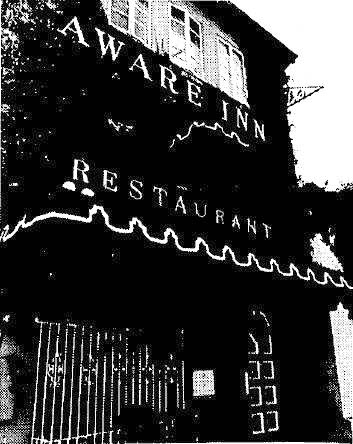
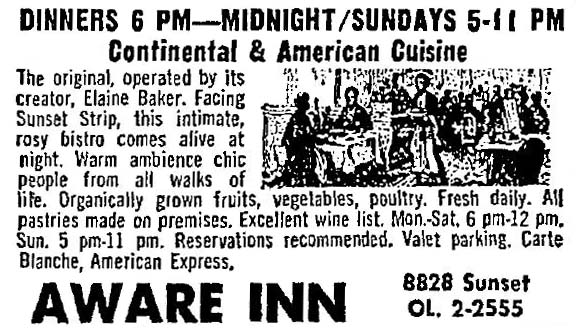
Soon after its opening, the original Aware Inn, at 8828 Sunset Boulevard on the Strip (shown above ca. 1981), became a magnet for Hollywood stars concerned with their health and beauty. Although the menu at the Aware Inn was organic it was pretty standard in other regards. True, it included fresh-squeezed carrot juice and brown rice, but the menu was also filled with organic versions of popular dishes such as burgers, beef stroganoff, and veal Marsala. Baker insisted in 1959 that he was no extremist. He aimed to serve “well rounded meals, but without the fats, carbohydrates and adulterants that you get in most restaurant food.” However in 1969, after his divorce from Elaine, he established The Source, a vegetarian restaurant where raw foods were served almost exclusively.

The Inn’s most famous dish was a hamburger interestingly named “The Swinger” which combined ground beef with cheese and chopped vegetables (see Recipe page). What inspired the name is uncertain but Jim was notably attractive to women. He reciprocated. It was at an apartment above the Aware Inn where in 1963 an irate husband came for revenge. A black belt in judo, Jim disabled his attacker, then used his foe’s gun to kill him (marking the second time he had killed a man in a dispute). His amorous career was just beginning – at the time of his hang-gliding death in 1975 Jim lived in Hawaii with 13 young women.

Following the divorce, Elaine carried on at the Aware Inn on Sunset (the second Aware Inn, in Sherman Oaks, had been sold to Al Kaiser in 1961). She kept the restaurant’s organic foods emphasis but cultivated the flavor of a European café rather than following Jim’s path at The Source which would lead him to develop a cult following and start a commune. A 1969 restaurant review praised the Aware Inn for dishes that were “consistently good and sometimes superb.” In addition to the Swinger, some of the restaurant’s signature items were chicken molé, roast brisket and kasha, and, for dessert, créme de Cassis over blueberry ice cream.

By 1970 the Aware Inn was one of a growing number of health food restaurants thriving in Los Angeles, but at the end of the decade it was getting poor reviews and went up for sale. In 1981 it was rechristened La Petite Maison. Later it became Rama Garden, a Thai restaurant.

© Jan Whitaker, 2011

48 Comments

Filed under alternative restaurants, proprietors & careers

Anatomy of a restaurateur: Harriet Moody

It’s a good bet that there have not been many women, or men, who have opened their first restaurant at age 68 – and, furthermore, made a success of it.

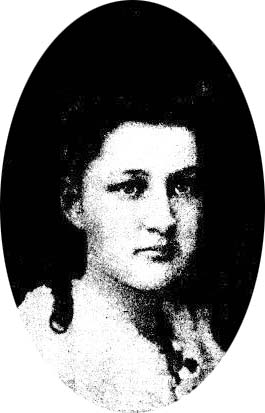
Harriet Tilden (Brainard) Moody [pictured below at about age 20] was exceptional in many ways. She built a culinary reputation long before she opened Le Petit Gourmet in 1920 in Chicago’s Italian Court at 615 North Michigan Boulevard. She had been one of the city’s premier caterers since 1890 when she founded the Home Delicacies Association. Despite her status as a divorcée, she managed to stay afloat in Chicago society, catering teas for charitable affairs and remaining a member in good standing of elite clubs such as the Fortnightly, the Twentieth Century, and the Chicago College Club. Working with her friend Bertha (Mrs. Potter) Palmer, she was one of the “lady managers” of the Chicago World’s Fair.

When her father, a once-wealthy cattle shipper, died in 1886, the recently divorced Harriet was forced to put her Cornell degree to work to support herself and her mother. She took a job teaching high school English but found she needed more income. Although she had never cooked, she deployed her refined tastes to produce dainty salads and baked goods of the sort appreciated by women of the upper classes. She supplied delicate dishes to Marshall Field’s department store tea room, to dining cars in trains departing from Chicago, and to fashionable private clients. Rising at 4:00 a.m. she spent several hours before she left for the classroom each morning supervising the Home Delicacies crew which numbered about 50 by 1899.

She became so successful that she not only supported her mother’s household, but also bought a second house where she lived and ran the catering business on the top floor until transferring it to larger quarters. She also owned a Greenwich Village townhouse on Waverly Place and a summer place, the historic William Cullen Bryant homestead in Cummington MA.

Harriet married poet William Vaughn Moody in 1909 and after his death the following year began to befriend other poets, often putting them up at her places in Chicago, New York, and Cummington, sometimes for months-long stays. At Le Petit Gourmet in the 1920s she organized poetry nights at which Carl Sandburg, Robert Frost, Edna St. Vincent Millay, and many others, read their work.

In 1911 Harriet established a branch of the Home Delicacies Association in London. Harry Gordon Selfridge, who as former manager of Marshall Field’s had jump-started her catering business in Chicago by ordering gingerbread and chicken salad from her, now asked for dishes for Selfridge’s, his department store which opened that year in London.

Seven years after establishing Le Petit Gourmet, Harriet and a woman partner opened another Chicago restaurant, Au Grand Gourmet, in a modern setting on the ground floor of a new building at 180 East Delaware. But her luck changed and in 1929 financial exigency required her to sell out. She attempted to recoup her losses a couple of years later with the publication of Mrs. William Vaughn Moody’s Cookbook.

Le Petit Gourmet, known simply as Le Petit, survived for decades under various owners, most notably Grace Pebbles, who also ran similar restaurants in Oak Park, Miami, Denver, and Hollywood. The Italian Court, constructed from 1919-1926 as a complex of shops and apartments for artists, was razed in 1968 to make way for an office building.

© Jan Whitaker, 2011

1 Comment

Filed under proprietors & careers, women

Theme restaurants: Russian!

Restaurants and coffee houses run by Russian immigrants appeared in the late 19th century. Their proprietors were Jews living on NYC’s lower East Side as well as others in California and Chicago who were pro-revolution enemies of the Czar. But not until after World War I (and the Russian Revolution), when a very different wave of anti-revolution, pro-Czar Russian immigrants arrived, did explicitly and self-consciously Russian-themed restaurants come into being. They flourished in the 1920s and 1930s.

For many readers New York’s Russian Tea Room will immediately spring to mind. It was established on West 57th Street in 1927 by Jakob Zysman, a Polish immigrant who operated a chocolate factory at the little tea room where ballerinas hung out. The business soon moved across the street where it changed hands and was expanded into a full-fledged restaurant. Over its long history it had many owners, notably including Faith Stewart-Gordon who ran it from 1967 until the end of 1995. After extensive renovations by restaurant impresario Warner LeRoy, it reopened in the fall of 1999. LeRoy died in 2001 and the RTR closed the following year.

But it should be noted that, unlike other Russian restaurants of the interwar period, the RTR was not started by a White Russian nor did it have a specifically Russian emigré clientele for most of its tenure. Reportedly, at one point the Russians who haunted the barroom were discouraged from patronizing the place because of their propensity to linger while they eulogized the olden days. The RTR was mainly famous as a flamboyant celebrity restaurant.

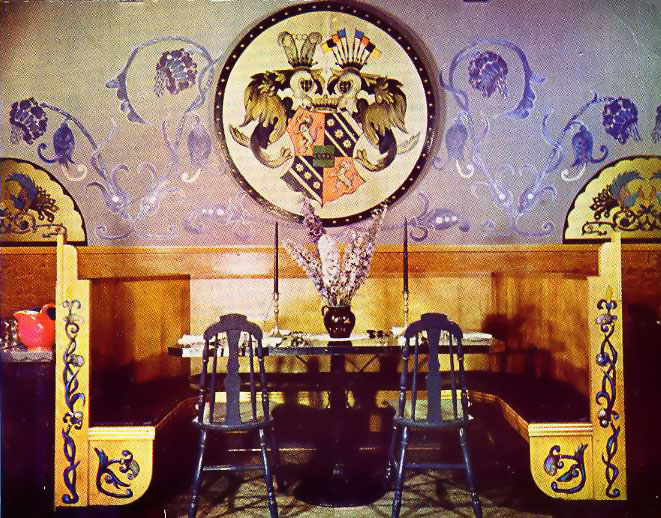
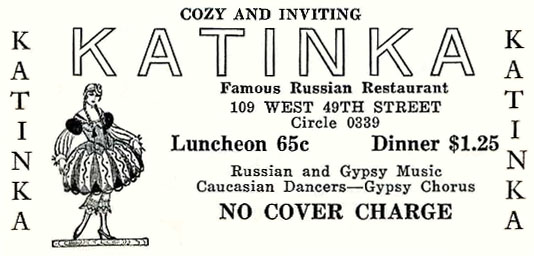
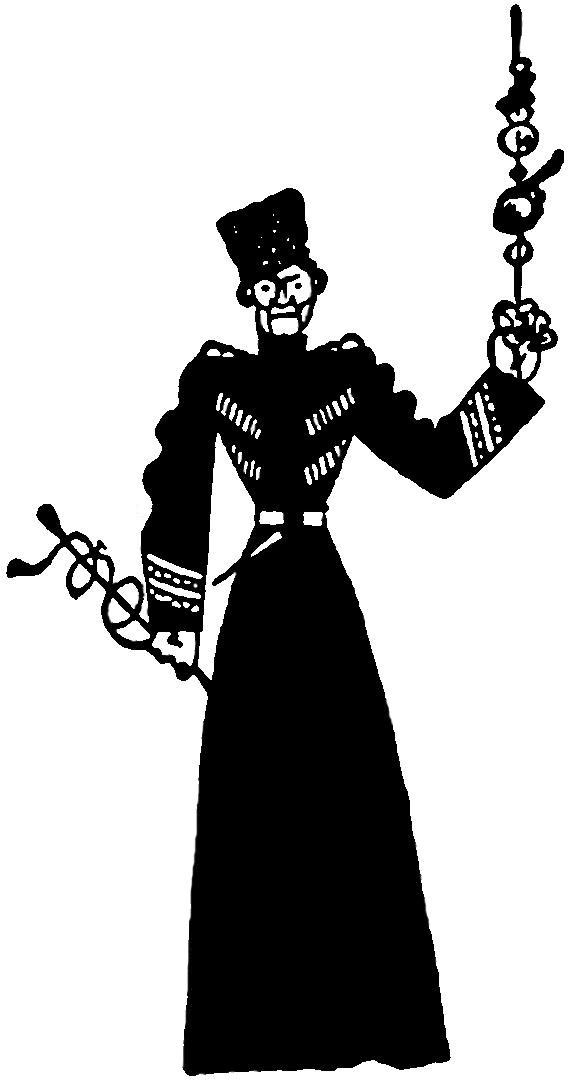
In the 1920s NYC gained a population of White Russians numbering about 6,000, most of them well-educated former members of the intelligentsia or the Imperial Russian Army. Numerous Russian eating places soon cropped up, with names such as The Russian Inn, The Eagle (E 57th), Katinka (W 49th), The Russian Swan, Kavkaz (Bdwy & 53rd), Casino Russe (W 56th), The Russian Sadko (W 57th), The Maisonette Russe (W 52nd), and The Russian Bear (W 57th). On the lower East Side were The Russian Kretchma and the (original) Russian Bear. Striking modernistic wall murals by emigré artists such as Boris Artzybashev, balalaika music, and entertainment by Cossack performers often contributed to the atmosphere of these eating places. As far as I can tell they served both as gathering spots for Russians and as tourist attractions.

Los Angeles also had a White Russian settlement of up to 2,000, with an Orthodox church, art shops, tea rooms, and restaurants. Lured by Hollywood, some Russians from this period acted as extras in movies and a few became studio consultants with expertise on the former glories of the fallen Russian aristocracy. When Theodore Lodijensky, proprietor of NYC’s Russian Eagle, moved westward he consulted on Sternberg’s “Last Command” (1928) — and he opened a West Coast version of The Eagle.

When the RTR began there were also other Russian tea rooms in NYC and around the US, some going by that exact name, some with names such as The Samovar. An importer of artistic wares named Polakoff, a Czarist who used a royal crest in his advertising, ran a Russian Tea Room filled with Russian arts and crafts on Chicago’s South Michigan Blvd. A specialty there was the Petrograd Supreme, a tall sandwich which the eater approached from the appetizer layer on top, working down to the dessert layer at bottom. In the 1930s Valentina Alekseevna Vernon ran a Russian Tea Room in San Francisco. A woman of strong opinions, she found Americans as resistant to some Russian dishes as she was to theirs.“I wouldn’t touch either an ice cream soda or a fruit salad,” she proudly proclaimed. Also in San Francisco was the Moscow Café which opened in 1932 and featured flaming Beef Stroganoff and Cossacks balancing flaming swords. A few Russian restaurants could also be found in Philadelphia, Boston, New Haven CT, and Miami in the 1930s.

The dishes introduced by White Russian restaurants included not only Beef Stroganoff, but also Blini with Caviar and Nesselrode Pudding. Although their menus might list Borscht, Darra Goldstein points out in The Oxford Companion to American Food and Drink that this humble Ukrainian beet soup was brought by Russian Jews who had immigrated earlier.

© Jan Whitaker, 2011

4 Comments

Filed under proprietors & careers, theme restaurants

African-American tea rooms

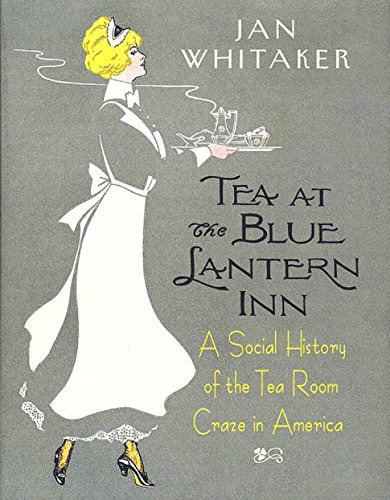
When I wrote my book about the history of tea rooms, Tea at the Blue Lantern Inn, I knew very little about tea rooms run by and for African-Americans. There were few historical sources available on the internet then and even a research trip to Chicago turned up nothing. Since then I’ve discovered that there were many of these tea rooms and that they shared numerous characteristics with tea rooms run by and for whites, yet were also different in significant ways.

It’s easy to see why black women, and men, wanted to create their own tea rooms. For one thing, even in states where Jim Crow policies were not enacted into law it was common for white-run tea rooms and restaurants to engage in racial discrimination. Secondly, starting a business represented the fulfillment of the idea of self-help for blacks as advanced by leaders. Perhaps that was what inspired Mittie Burgess, a Georgia-born caterer in her late 30s, to name her newly opened 1916 place in Lexington KY the Booker T. Washington Tea Room. Although Mittie’s tea room was in the South, quite a few of the proprietors I’ve been able to trace were part of the 20th-century’s Great Migration of Southern blacks to Northern cities.

Like white tea room proprietors, blacks who took up this business tended overall to be of higher social status than the average restaurant owner, white or black. Proprietors I’ve come across included a woman who was a former pharmacist and a man who had been a college professor. Some of the more elite women who operated tea rooms were married to life insurance executives, ministers, doctors, and successful business men. Others were wives of porters, cabbies, and chauffeurs but still seemed to have achieved standing in their communities.

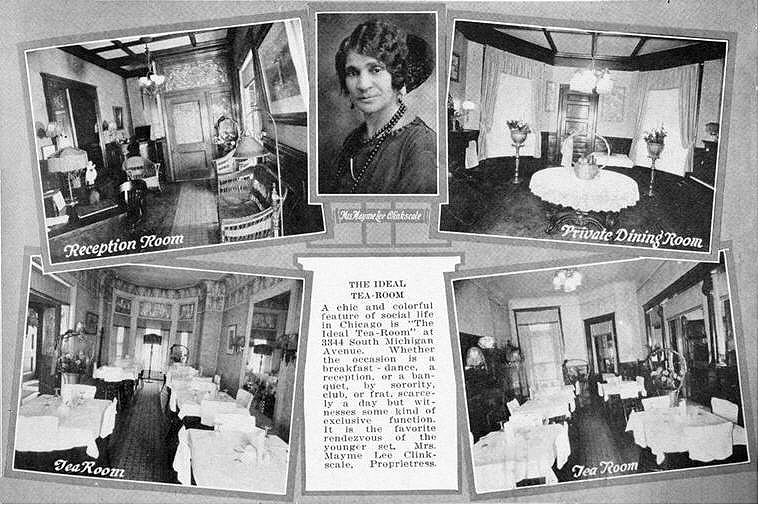
The advertisement for the 1922 opening of Mayme Clinkscale’s Ideal Tea Room [shown above] in Chicago said it was designed for club, society, and lodge banquets, and furnished with “the latest and best in silverware, linen, and glassware.”

A number of tea rooms were clearly meant for the black upper crust. Common phrases in advertisements and news stories include “exclusive,” “the elite of the city are found [here],” or “where the wealthier class of colored people dine.” Mentions of table appointments and decor often include silver bud vases, exotic themes, and carefully coordinated color schemes. Menus offered fried chicken and corn sticks as well as steaks and salads, but were less likely to list rural Southern favorites such as pigs’ feet or greens.

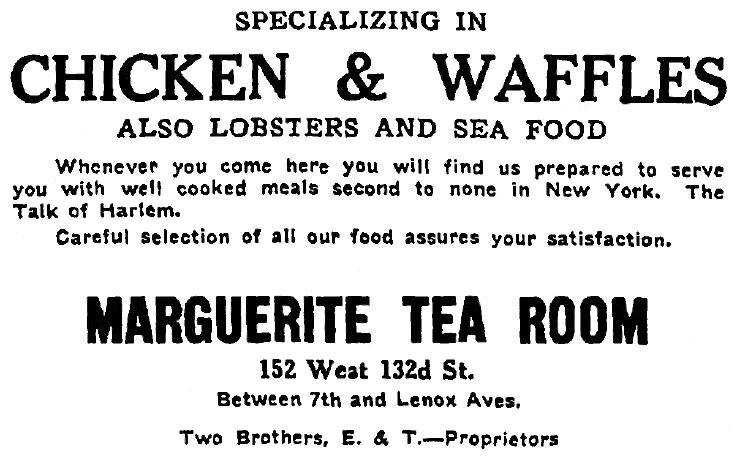
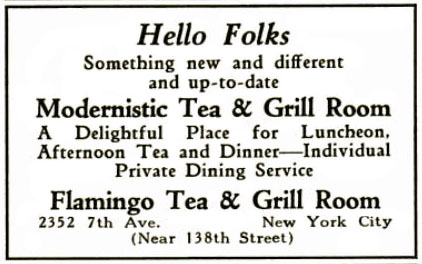
Tea rooms in African-American communities in the teens, 20s, and 30s, frequently hosted important social events. Community leaders hailed them as badly needed establishments. Groups such as the NAACP Women’s Auxiliary, black sports writers, and the Negro Business League held luncheons and dinners at tea rooms. Red Caps from Grand Central and Penn Station hosted their peers at the Gilt Edge Tea Room during a national convention in NYC. Newspaper people from the black newspaper The Amsterdam News celebrated a colleague’s college graduation at Harlem’s Jack and Jill Tea Room in 1928. They certainly received a warmer welcome than had Charlotte Bass, black publisher of the California Eagle, when she and several of her guests were refused service at the white-run Old Adobe in Ventura CA.

Since they were small and did not make money from alcoholic beverages (not legally anyway, during Prohibition) all tea rooms were hard to operate profitably. Yet I sense that owners of Afro-American tea rooms had to work even harder than whites to succeed. They seem to have been open much longer hours, covering meals that ran from breakfast until late into the night. They were also more likely than white tea rooms to offer entertainment such as music and dancing. Many took in table boarders, regular patrons who contracted to eat their meals there for a week or month at a time.

© Jan Whitaker, 2011

55 Comments

Filed under proprietors & careers, racism, tea shops

Famous in its day: Tony Faust’s

By the 1880s Anthony E. Faust had established quite a culinary empire in St. Louis. He ran a Café and Oyster House downtown on Broadway which had a nationwide reputation. Since 1878 it had featured rooftop dining, uncommon in the U.S. then. From his adjoining “Fulton Market” he also retailed and wholesaled “Faust’s Own” oysters and other delicacies such as truffles, soy sauce, and curry powder which he shipped to Southwestern and Western states. His Faust label beer, made for him by the Anheuser brewery, was also sold in the West.

He didn’t start out in the food business but as an ornamental plasterer who immigrated from the Prussian province of Westphalia at age 17. After being accidentally shot while watching a parade, he gave up his trade and decided to open a café in 1865.

Obviously he had a knack for the new business. And it helped that St. Louis was a booming hub of shipping and commerce positioning itself to dominate commerce with the West. His closeness to the Adolphus Busch family of beer fame was undoubtedly another asset. In 1886 Tony opened a second restaurant in a huge new Exposition Building on Olive Street between 13th and 14th which hosted conventions of architects, music teachers, fraternal organizations, and the Democratic National Convention of 1888.

In the late 1880s he razed his restaurant and replaced it with a finer building. With an interior of carved mahogany woodwork, a tapestried ceiling, and an elaborate mosaic tile floor, the restaurant catered to the fashionable after-theater crowd. At some point, perhaps in 1889, a second story was added, eliminating the rooftop garden (above image, ca. 1906).

Success seemed to mean Tony could do as he wished. Caught serving prairie chickens out of season (under the frankly fraudulent name “Virginia owls”), he freely confessed and flippantly said he’d pay the fine or “break rock” if need be. When the Republican National Convention was held in St. Louis in 1896 he claimed his staff would not prepare or serve meals for Afro-American delegates. Even after the convention’s managers offered to hire a space, furnish stoves, and buy provisions to feed the black delegates if Faust would oversee the work, he absolutely refused to do it. Period.

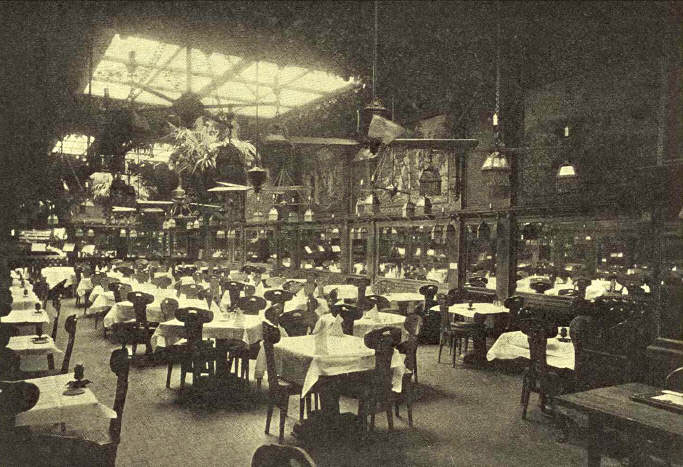
In preparation for the 1904 St. Louis World’s Fair (the Louisiana Purchase Exposition), Faust joined half a dozen of St. Louis’s top restaurateurs in a trust, the St. Louis Catering Company, probably designed to buy in large quantities and possibly to set prices too. Faust went into partnership with New York’s Lüchow’s to create a Tyrolean Alps Restaurant at the Fair which seated 5,000 diners and featured costumed singers (pictured). It represented brewers’ interests as well, leading one observer to joke that the enormous beer hall should have been named “Budweiser Alps.” According to the Fair’s Official Program there was also a Faust restaurant in the Fair’s west pavilion on Art Hill.

At the time Tony Sr. died in 1906 the Faust empire included a second Fulton Market location, and another Faust restaurant in the Delmar Gardens amusement park in University City managed by his son Tony R. Faust. Like many a successful businessman in the Midwest, Tony R. went to NYC to see about opening a branch there. There was a Faust restaurant in NYC’s Columbus Circle in 1908 (pictured), but I am not certain whether this belonged to the St. Louis Fausts. In 1911 Tony Jr. was declared insane. After that his older brother Edward, an executive of Anheuser-Busch who was married to a daughter of Adolphus Busch, took over the restaurants and markets. The downtown restaurants in St. Louis and NYC, and probably the others as well, closed in 1915 and 1916, casualties of looming Prohibition.

© Jan Whitaker, 2010

13 Comments

Filed under outdoor restaurants, proprietors & careers