Category Archives: atmosphere

Dining by gaslight

GSThreeFountainsINTThough it seems fairly obvious when you think about it, the development of entertainment districts post-WWII encouraged the growth of restaurant-ing in many cities across the U.S. On the minus side, the fate of such restaurants was highly dependent upon the fate of the districts.

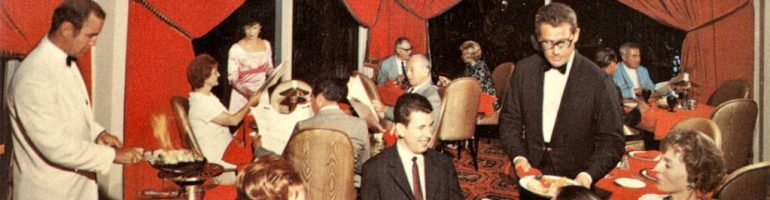
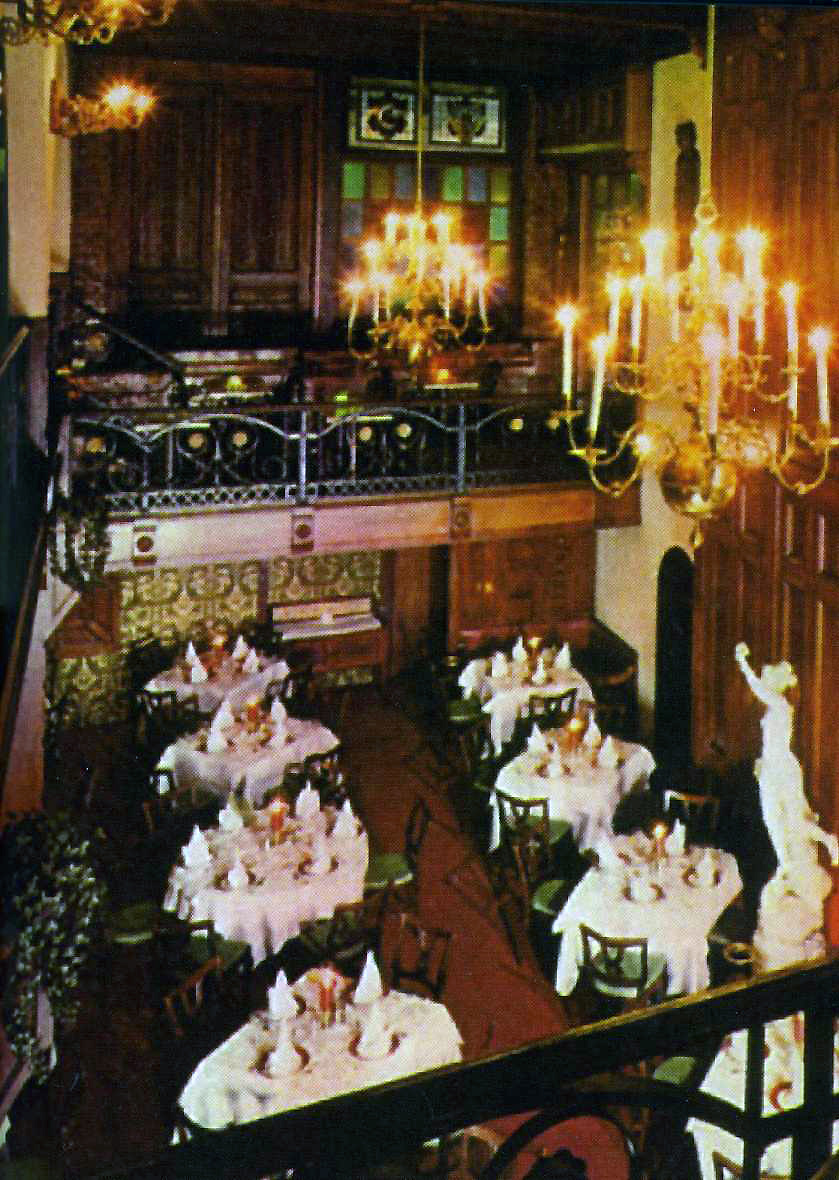
The Three Fountains [pictured] was the star restaurant in the entertainment district of St. Louis which began in the late 1950s and was officially named Gaslight Square in 1961. The one-and-one-half block area attracted affluent suburban St. Louisans and the city’s many conventioneers with restaurants, live theater, and clubs that featured national acts such as the Smothers Brothers, Joni Mitchell, Lenny Bruce, and Miles Davis.

Developing out of a racially borderline, transitional neighborhood populated with apartments, music schools, and antiques stores, its pioneering establishments included the Crystal Palace theater, the Gaslight Bar, Smokey Joe’s Tavern, the Laughing Buddha coffeehouse, and the Dark Side jazz club.
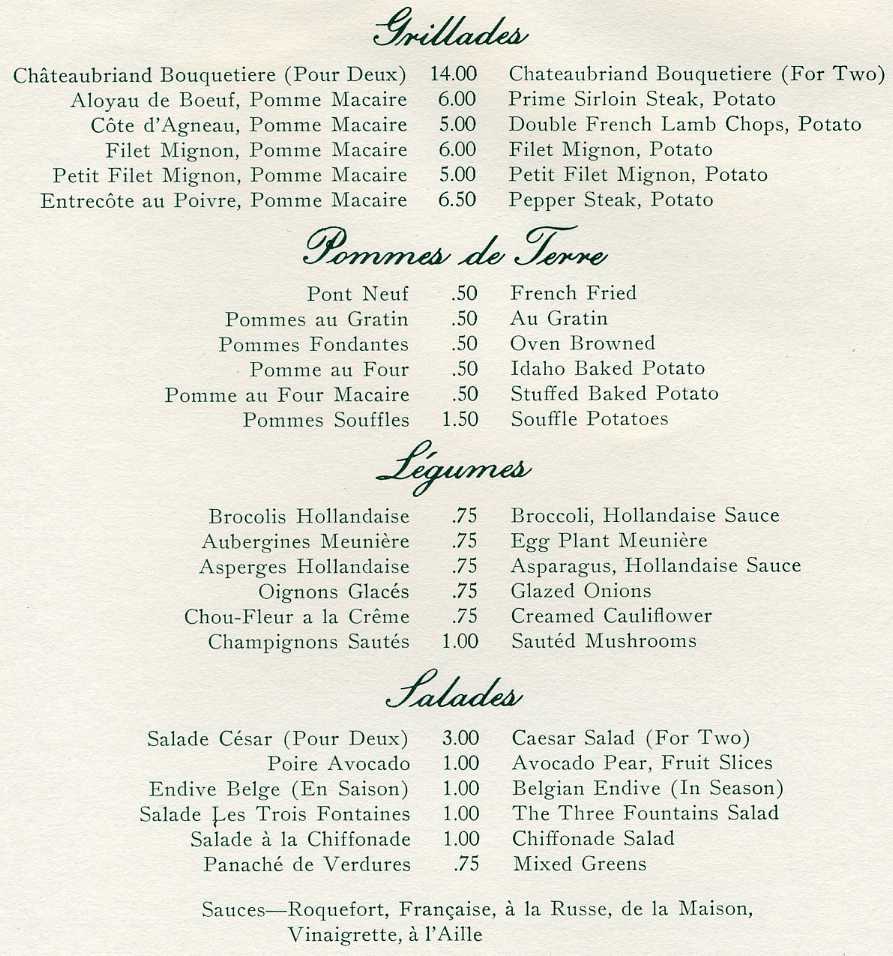
GSThreeFtnmenuThe Three Fountains exuded luxury with a multi-level interior lavishly decorated with  antique fixtures complemented by an oversize menu filled with expensive dishes (the $6.50 pepper steak would cost about $46 today). Its decor, like most of the restaurants and clubs in Gaslight, consisted of an extravagant, crazy melange of salvaged windows, doors, railings, paneling, statues, fountains, and light fixtures from structures mowed down by a city obsessed with urban renewal.

gsMillCreekValleySlum clearance in an area known as Mill Creek Valley brought its bounty. There the destruction of residences formerly housing 20,000 people (95% of them Afro-Americans) freed up tons of antique woodwork and hardware for decorators with a taste for Victorian. The transfer of objects from Mill Creek to the nightclubs and restaurants in Gaslight Square can also be seen as an illustration of a troubled relationship with the city’s black population who lived close by, worked in Gaslight’s restaurants, and performed in its clubs, yet whose patronage was not welcome.

According to Jorge Martinez, owner of a couple of jazz clubs, the block’s business association ruled against his proposal for a dance hall out of fear it would attract Afro-Americans. Terry Kennedy, an Afro-American who grew up in the neighborhood adjacent to the area and became a city alderman in 1989, observed that if you were black “you better not be there too long, or the police would run you off.” (Interviews with Kennedy, Martinez, and others are found in the book Gaslight Square, an Oral History, by Thomas Crone.)

Yet, Gaslight Square offered opportunity to a few Afro-Americans. Sandra J. Parks occupied a rare position in America, that of black female chef. She cooked in several of the area’s better restaurants, including Kotobuki and Port St. Louis and managed Two Cents Plain before moving to Chicago for a career in catering.

Compared to the city as a whole, Gaslight Square was a somewhat integrated area. Nonetheless racial tension would become a major factor in its downfall, most evident in white patrons’ grossly exaggerated fear of black-on-white crime.

From the area’s beginnings as an entertainment zone to its serious decline by 1968, at least 20 restaurants, dozens of nightclubs, and numerous coffeehouses and theaters were in business there [see map]. After-hour parties took place above street level, in apartment buildings and flats.

GScolorpostcard2centsannadels

There were steakhouses (Magnolia House, Marty’s, Jacks or Better, Mr. D’s), two Mexican restaurants (Tortilla Flat and a branch of Chicago’s La Margarita), a Polynesian restaurant (The Islander), a Japanese restaurant where servers dressed as geishas (Kotobuki), a fish restaurant where servers dressed as sailors (Port St. Louis), a Greek restaurant (Smokey Joe’s Grecian Tavern), a deli (Two Cents Plain), an Italian eatery (Bella Rosa), a tavern (O’Connell’s Pub), and several places whose cuisine I could not determine (Red Carpet, The Georgian, Carriage House, Die Lorelei, Left Bank).

Many of the restaurants were in converted town houses. Whenever possible they had patio dining in front, and most featured entertainment such as cabaret, folk music, or Dixieland, ragtime, or cool jazz.
GSLaughingBuhdaSTL60sThe more expensive restaurants were first to suffer from the area’s decline as well-dressed, well-heeled customers stopped coming. Conventioneers were warned off, in many cases, by cabdrivers who refused to drive there. Clubs with go-go dancers in the windows displaced coffeehouses with folksinging and poetry as a younger, more casually dressed crowd took over.

Although Gaslight Square was in ways a model for Chicago’s Old Town and Omaha’s Old Market, many businesses began closing or moving away by the mid 1960s. Port St. Louis and Two Cents Plain moved to more promising locations. In 1965 Craig Claiborne gave the Three Fountains a short – and horrid — review (“It is said to be the only French restaurant in the city and, if this is true, it is unfortunate.”) A few years later a number of gaslights were extinguished for nonpayment of gas bills. By 1972 when O’Connell’s moved to South Kingshighway, the area was largely in ruins.

Aside from a memorial constructed out of the pillars that once stood outside Smokey Joe’s, not a trace of Gaslight Square remains standing today.

© Jan Whitaker, 2013

9 Comments

Filed under atmosphere, Offbeat places

Postscript: beefsteak dinners

healysphotoThis year marks the 100th anniversary of the Armory Show, an art exhibit that introduced Americans to modern art, most notably to Marcel Duchamp’s Nude Descending a Staircase [No. 1]. Last week I received a copy of the Smithsonian’s Archives of American Art Journal which commemorates the show. To my surprise, the journal contains an article (Meat and Beer, by Darcy Tell) about a beefsteak dinner given by the artists who organized the Armory Show in gratitude to the press whose extensive coverage helped make the show a popular success.

The Armory Show was largely organized by American artists Walt Kuhn, Arthur Davies, and Walter Pach. (Kuhn’s and Pach’s papers are preserved in the Archives of American Art, Smithsonian Institution.)

In an earlier post I wrote about beefsteak dens, dungeons, and caves where men put on butchers’ aprons and threw aside the trappings of civilization. Sitting uncomfortably on boxes in dingy cellars, they drank beer and ate steaks without silverware or napkins.

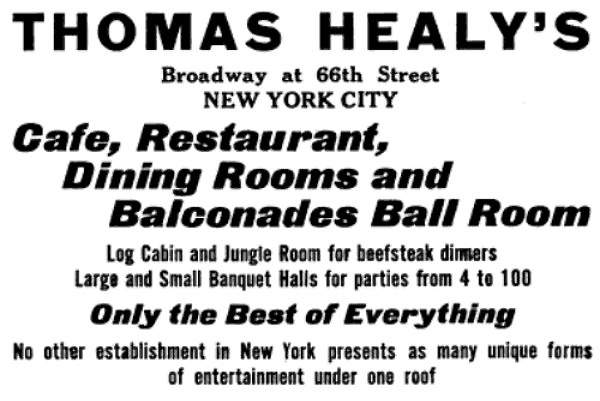
BeefsteakHealy'sADV1916The 1913 Armory Show dinner was held at Healy’s restaurant, on 66th Street in NYC, a popular place for these feasts. It had three rooms dedicated to them: the Dungeon, the Jungle Room, and the Log Cabin Room. The artists and their “friends and enemies from the press,” as they were designated on the menu, gathered in the Log Cabin Room, probably the most civilized space of the three, furnished with long tables and chairs and complete with tablecloths and napkins. While the guests ate, someone read aloud humorous, insiderish (fake) telegrams, even one purporting to be from Gertrude Stein [see link below].

I have to admit I was a tiny bit disappointed to learn that such a (presumably) sophisticated group of men as was represented at this dinner would choose to attend a beefsteak at Healy’s. By 1913, if not long before, beefsteaks were recognized as evenings of orthodox jollity for business men and conventioneers. Yet, the Association of American Painters and Sculptors paid out $234 [at least $5,500 today] for a dinner much like that enjoyed by the Paper Box Makers Association and the League of Associated Hat Men.

And, just like the hat men and box makers, they took away a regulation group photo to show for it.

© Jan Whitaker, 2013

5 Comments

Filed under atmosphere, patrons

Putting patrons at ease

How many readers have thought about how very cleverly table-service chain restaurants engineer their establishments so that patrons feel no unease while eating out? They have relieved patrons of the embarrassment so many have felt historically – and which can still occur in formal restaurants today.

It doesn’t take much for restaurant patrons to become tense or self-conscious. They may feel that other guests are staring at them and judging their appearance or table manners. Or that their server is sizing them up. The menu can be mysterious, especially if it contains foreign or unfamiliar culinary terms. They fear they will mispronounce something and be sneered at for their lack of sophistication. Or order a dish they don’t like the looks of (does that explain why I once encountered a South Dakota menu that described salads as made up of “non-intimidating greens”?). If patrons have brought their children, they may worry they will misbehave and earn the wrath of all the tables around them.

Their fears are not entirely unfounded. I have a vivid memory of extreme discomfort I experienced in a restaurant considered among the top in the 1980s. Although the small dining room was fully occupied, it was almost totally silent. There were expensive arrangements of flowers everywhere. They, along with the preternatural quiet, conspired to create the ambiance of a funeral parlor. The waiter never smiled. I felt as though I was dressed for a barbecue. The melon ball-sized food was hard to identify and oddly assorted. I longed to flee to another room where I heard people laughing and imagined them eating real food.

Intimidation has a long history in restaurants. In 1859 a patron complained about his discomfort in the class of elite restaurants represented by Delmonico’s, admitting “we are made nervous by the sneerful smirk of the waiter, if we order the wrong wine . . .”

Snobbery was assessed as being greater in the East than the West. It’s certainly true that Eastern eateries did not run advertisements like the one in Portland OR in 1873 that greeted potential customers with “Hi You Muck-A-Muck and Here’s Your Bill of Fare. Now’s the time to get the wrinkles taken out of your bellies . . .”

Of course there were always casual eating places, but as some Americans grew wealthier in the late 19th century more foreign terms appeared on menus, leading to great puzzlement by diners. Even Easterners had to admit “a feeling of trepidation when confronted with an elaborate menu composed in the artistic and intricate terms of culinary French.” Jokes circulated about the bumpkin who randomly pointed to things on the menu and was dismayed when the waiter returned with two bowls of soup and some toothpicks.

Women were afraid to eat spaghetti in public lest they look foolish. No such worries at The Old Spaghetti Factory in the historic section of _____  [fill in the blank]!

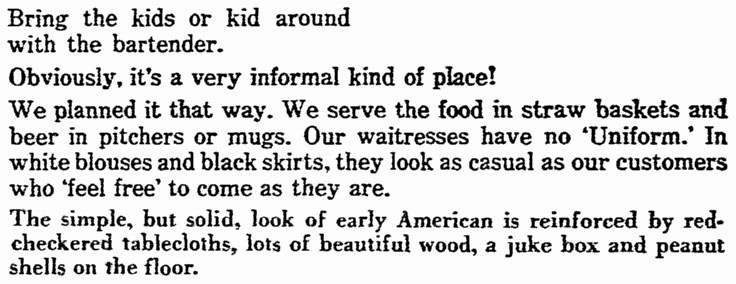
Most sources of intimidation have been eliminated by chain restaurants (See 1973 Jacks Or Better advertisement). A circus-like sense of fun, raucous decor, and auditory buzz distracts everyone from other guests and blanks out children’s tantrums. The ethos is “come as you are.” Service is by relentlessly cheerful teenagers who reply to every request with a “No problem.” There are no pristine white tablecloths or carpets to ruin with spills. No foreign terms appear on menus. In the unlikely event that a menu contains unfamiliar items they will be carefully explained or illustrated. Even today a chain of Mexican theme restaurants in the South supplies a guide letting patrons know how to say the names of dishes, including Nachos (Nah-choz) and Chile Con Carne (Che-lee con Car-nay).

It is interesting to reflect on the deep message conveyed by mass market restaurants. Is it that the American public is juvenile in their tastes and easily manipulated? Or is it the more democratic thesis that Americans will accept being talked down to as the price that must be paid so that no one feels excluded?

© Jan Whitaker, 2012

2 Comments

Filed under atmosphere, patrons

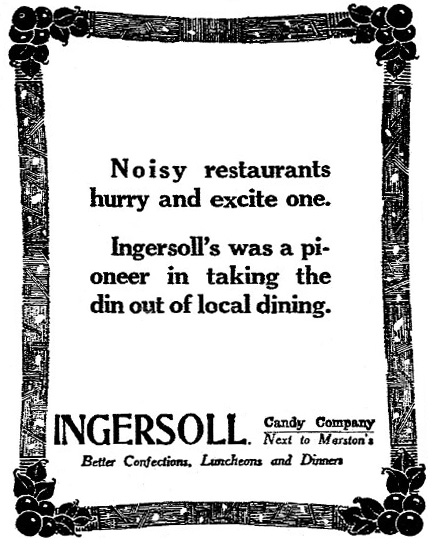
Taking the din out of dining

In the modern world nothing is more expensive than quiet. This certainly holds true for restaurants. The difference between a quiet and a noisy restaurant rests mainly on good padding, both of the room and the patron’s wallet.

But there is also such a thing as too much quiet, such as in a failing restaurant with few patrons. Nobody wants that kind of quiet. Which brings up the point that since the proliferation of theme restaurants in the 1970s, fun has become one of the biggest attractions for restaurant goers. And in most people’s minds fun = noise and crowds.

It seems as though since the 1970s noise has crept up the restaurant ladder, beyond the raucousness of TGI Friday and its kin, so that today even many fairly expensive, white-tablecloth restaurants are so noisy that conversation is difficult. This issue was called to my attention by a friend who asked where she could find a list of restaurants that are free of din. If anyone knows of such a thing, please let me know. With an aging population – older diners, particularly in the 55 to 65 year-old range, make up a sizable market – the noise problem becomes more pressing.

Although the popularity of restaurant-going is comparatively new, complaints about restaurant din are not. In 1848 a satirical essay in that fascinating periodical The Spirit of the Times (“A Chronicle of the Turf, Agriculture, Field Sports, Literature” – and almost everything else) said:

It has been ascertained that a gentleman never enjoys his dinner more than when it is served up in the midst of confusion, excitement, and noise. For this reason, the denizens of New York, observing and sagacious, delight to dine in cellars, and wisely select those which the most boisterous people frequent.

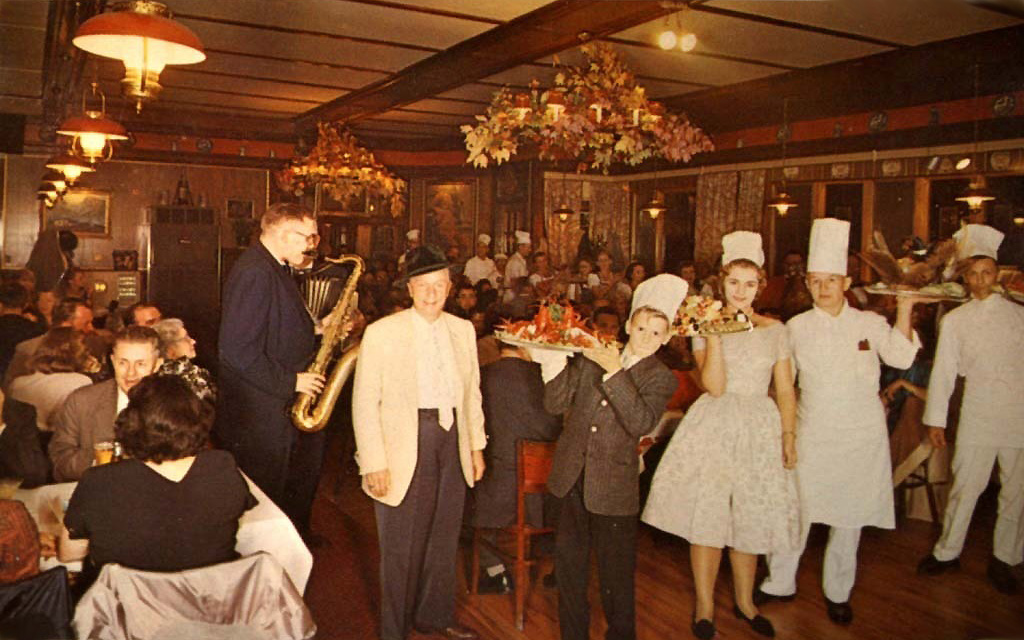
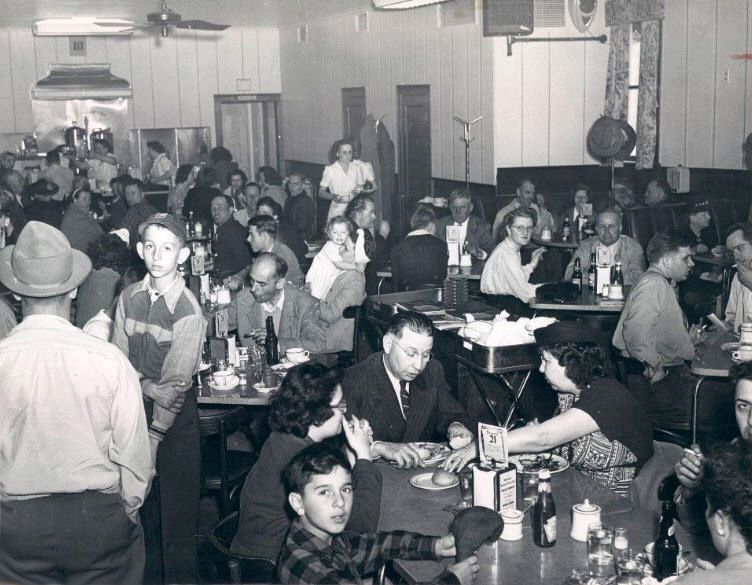
In 1869 another writer observed that at noon in downtown NYC “eating houses are in one continuous roar. The clatter of plates, the slamming of doors, the talking and giving of orders by the customers, the bellowing of waiters, are mingled in a wild chaos.” It would get worse. Restaurants became even noisier when music made its dining room debut, and again during World War II when they were packed to bursting capacity (see image). Cafeterias could be especially deafening.

However, there were some exceptions along the way. The upstanding Craftsman Restaurant in NYC eschewed artificial gaiety. A diner in 1914 wrote (revealing the genteel racism of the period): “About me people were lunching quietly, without haste and without boisterousness. Soft-treading little men of Nippon brought delectable viands on dainty dishes. A stringed orchestra was playing softly . . .”

Tea rooms were also singled out in the teens and 1920s for their peacefulness. Very likely the absence of alcoholic beverages in them played a big role. NYC’s Colonia had “a quiet atmosphere that appeals to the woman of culture,” while in Greenwich Village the women proprietors of The Candlestick provided a luncheon setting “without the annoyance of shrieks, laughter, loud talking and noises that seem to be the necessary accessories of every other similar place in our Village, perhaps in order to create ‘bohemian atmosphere.’” Yet drinking did not inevitably lead to din. Rather surprisingly, the speakeasy restaurant was seen by some as a quiet, relaxing haven where attentive waiters served well-behaved patrons united in a “civilized conspiracy.”

Quiet has also been seen as a necessary condition for a romantic dinner. But let’s note that on such an occasion diners are usually willing to fork out a bit more cash than usual for privacy and a chance to hear the cork pop and the harp being plucked. The question remains: can a restaurant that is thriving be quiet without being expensive?

© Jan Whitaker, 2012

2 Comments

Filed under atmosphere